Sentenced never to leave a hotel again, how does he turn it into an entire world?
Text and illustrations produced by the pipeline
The sentence has one line: house arrest for life, never to leave. The place is Moscow's grandest hotel, the Metropol, standing right across from the Kremlin, gilded ceilings, ivory-handled cutlery, French champagne on tap. Sounds like a vacation? That is where Amor Towles's novel begins — a man who should have faced a firing squad is saved by a poem he wrote as a young man, and locked instead into a garret under the roof, where he spends the next thirty-odd years learning how to live an entire life without ever going anywhere.
A Gentleman in Moscow is Amor Towles's historical novel, published in 2016. Towles is a rare thing in contemporary American letters: a classicist. He tells a twentieth-century Russian story but deliberately borrows the pacing and voice of a nineteenth-century Russian novel. The book became an instant phenomenon and has since been translated into dozens of languages. Readers remember it not for a wild plot but for something much harder to pull off: a man stripped of everything, written as neither tragic nor inspirational, just — dignified.
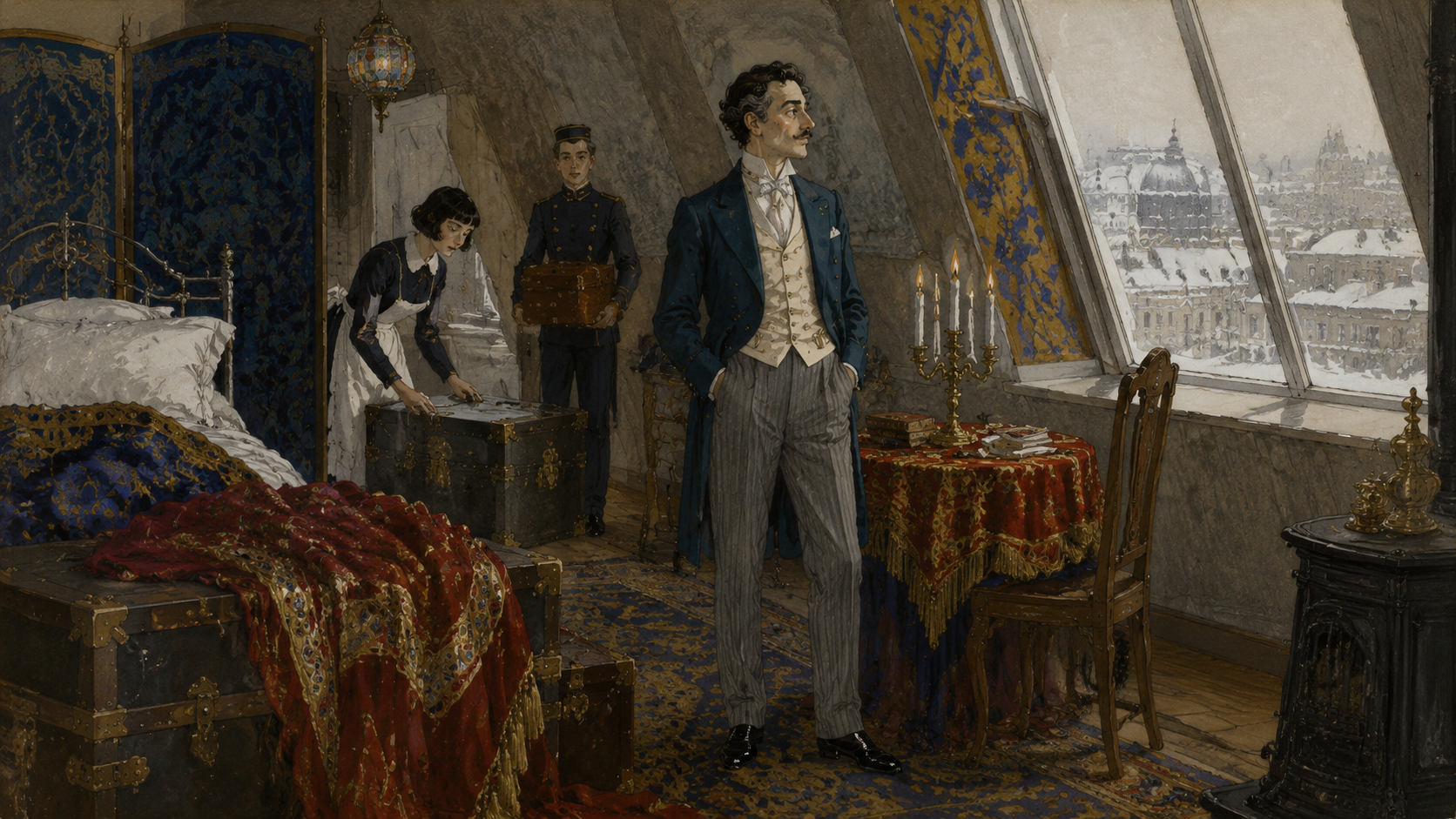
The protagonist, Count Alexander Rostov, a hereditary aristocrat of Tsarist Russia, stands trial before a Bolshevik tribunal in 1922. A poem he wrote in his youth is read as faintly sympathetic to the revolution, and it spares his life — at the cost of never being allowed to leave the Metropol Hotel again. He is evicted from his grand suite and sent up to a cramped attic room under the roof, a fall that becomes the book's single most important physical image.
The plot gives you a map, not the ground itself. What this book actually withholds unless you read it is the physical texture — the creak of wood as a trunk is hauled up the attic stairs, the simmer of beef bone broth in the kitchen at five in the morning, piano music drifting down a corridor and fading out. The best of what Towles writes can't be summarized in any explainer video: how the Count ties his whole view of the world into a waiter's bow tie, how the Triumvirate stops a purge with nothing but a glance, how a father and daughter complete an entire goodbye across twelve years of silence. None of that is available anywhere except inside the book, sentence by sentence, at his pace.
Before the guide was written, this book got a visual foundation — every illustration you just read grew out of it.
The world around him is tiny and dense at once: Nina, the young girl who leads him through the hotel's hidden back passages; Sofia, the daughter Nina eventually leaves in his care and the person closest to him for the rest of his life; the Boyarsky, the hotel restaurant where he rises from waiter to headwaiter; and Emile the chef and Andrey the maître d', who see him through the years of purges — the three of them come to be known, half-jokingly, as the hotel's Triumvirate. There is also Anna Urbanova, a film star and his lover across many years. Beyond the walls: Stalin, war, famine, purges. Inside them: china and glassware, piano music, corridor gossip, a bowl of soup in the kitchen at midnight. What the book pulls off is making you believe, slowly, that the life inside the walls is a complete life too.
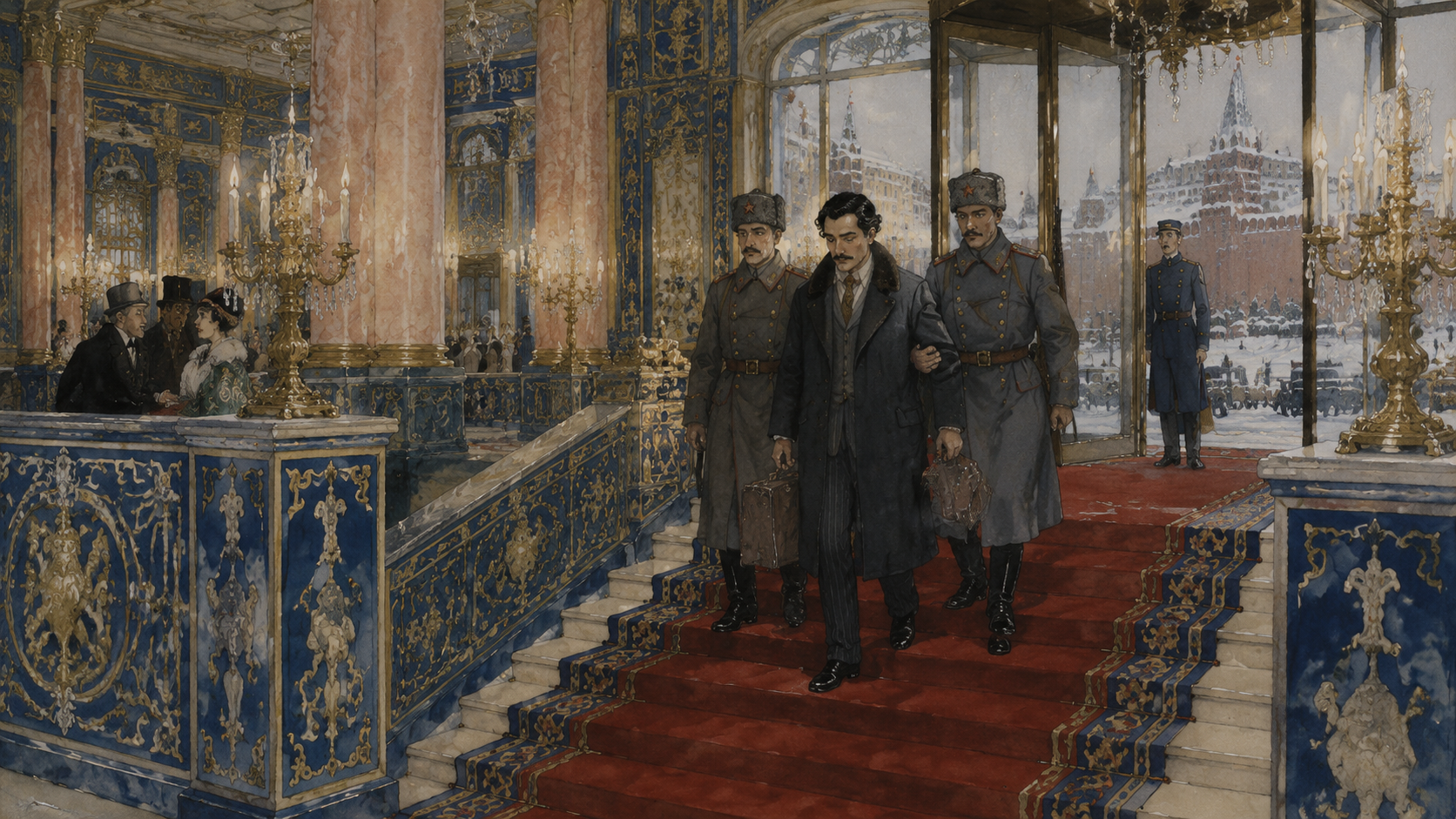
Act One: The Trial and the Fall Into the Attic. In 1922, the Count walks into the courtroom prepared to argue that his generation had been pulled in two directions at once, but the sentence is lighter than he expects: not death, only house arrest. He is marched back to the Metropol and moved from his suite of sitting room and bedroom into a garret under the roof, with nothing but a narrow bed, a single chair, a small wardrobe. This is where the writing does its real work: Towles doesn't let him break down. The next morning the Count combs his hair in the mirror, knots his tie, and calmly accepts that his new lodgings, like the man inside them, will simply have to be put back in order. Dignity here isn't a personality trait. It's a technique.
Act Two: Nina and the Hotel's Underworld. A young girl named Nina becomes his unlikely savior — not out of pity, but to show off that she knows the hotel better than any guest ever could. She leads him through staff corridors, storerooms behind the kitchens, a ventilation shaft where you can hear the whole building breathe. The reader discovers along with him that the Metropol is more than a lobby and a row of suites; it's a ship with its own crew, its own rules, its own dialect. What Nina really teaches him is how to grow rich inside a small world — the most childlike passage in the whole book, and also the setup for a later grief, because one day Nina will simply vanish from the story.
Act Three: The Triumvirate and the Boyarsky. The Count quickly learns that memory alone won't keep a man fed. He starts as the lowliest waiter and, on the strength of a prodigious memory, a sharp read on people, and a real feel for wine, rises within a few years to headwaiter of the Boyarsky — Moscow's most stubbornly surviving French restaurant. He forms an alliance with Emile the chef and Andrey the maître d', and the three of them carry the restaurant through prohibition, through the Great Purge, through years when a colleague present today might be gone tomorrow. Towles shoots their scenes like an old film, the camera always lingering on the moment the three men stand shoulder to shoulder and trade a look without a word. The Triumvirate isn't just a working relationship. It's the family the Count improvises in the middle of a storm.
Act Four: The Years With the Film Star. Across the hotel's long nights, the Count sustains a relationship spanning many years with Anna Urbanova, a film star. It isn't really a romance so much as two separate lives that keep returning to the same table. Towles keeps his distance from melodrama: this isn't betrayal, and it isn't obsession, it's the one door a locked-in man is allowed to keep open onto another kind of life. Every time Anna appears there is wine, there is light, there is the sound of fabric moving — she is the proof, inside his life, that the outside world is still connected to him.
Act Five: Nina's Entrustment. Years later, Sofia, still a child, appears at the attic door — Nina has left her in the Count's care and gone, never to return. The Count has never married, never raised a child, and overnight he becomes a father. Towles gives him no speech about how he will raise her well; instead, the next morning, the Count simply wakes half an hour early and makes her first cup of hot cocoa. The father-daughter line is told from here on entirely through that morning cocoa, late-night piano practice, a dance down a hotel corridor — restrained almost to the point of silence, which is exactly why it carries so much weight.
Act Six: Raising a Pianist. The next decade or so is the quietest stretch in the book. Sofia grows up inside the hotel, from a girl sneaking into the ballroom to listen to the band, to a rising talent bound for the Moscow Conservatory. The Count sees her off and picks her up, chooses her teachers, and deflects a snobbish hotel manager's gossip about this motherless father and daughter. Towles lets time skip forward in leaps — one year she is playing Chopin, another year Scriabin, each chapter reading like a telegram passed between father and daughter. You start to realize that the rarest skill a man stripped of everything can have is keeping careful count even of the days he wasn't there for.
Act Seven: The Escape of 1954. By the story's close, the Stalin years are over, and Sofia has grown into a true adult. The Count arranges two things at once: first, that Sofia leave Russia for good, traveling out as a piano soloist alongside a visiting foreign conductor; second, that he himself slip out through the hotel's fire escape that same day and disappear into the streets of Moscow. Towles writes the escape like a dinner party rehearsed to perfection — every rule, every relationship, every favor banked across thirty-odd years is woven into the plan. The book ends with him walking out into a snowy Moscow night, the building he lived his whole life in behind him, and the entire city he never has to return to ahead of him.
What the book is really asking isn't about escape, or politics, or history — it's how you avoid becoming the thing that's locked you in. The Count's answer: fight time with manners, fight isolation with relationships, fight the absurdity of history with the sheer weight of daily ritual. Towles himself has said he wanted to write about how a trapped man turns his cell into a home. The Triumvirate, the father and daughter, the years-long romance — none of this is plot for its own sake. It's the material the Count uses to rebuild a home.
Craft-wise, Towles does something deliberately old-fashioned: he tells a twentieth-century story with the sense of time that belongs to a nineteenth-century Russian novel. He keeps folding the timeline into elaborate pleats — one evening's dinner can stretch across three chapters, one piece of piano music across ten years. In one chapter he'll spend twenty full pages on the Count orchestrating a single meal at the Boyarsky; in the next, he'll cover five years in three sentences. That contrast is the book's real feeling: he makes you sit inside a single second long enough, then shoves you back under the wheel of history.
The most counterintuitive thing about this book: it's precisely because he can't leave that a locked-in man is forced to learn how to live his small patch of the world all the way through.