READ
Ten-minute illustrated companions to great books, written and drawn by ImaRead. See if one pulls you in.
Cover Feature — A Beautiful Man Who Refused to Age
He Never Aged. The Painting Did It for Him.
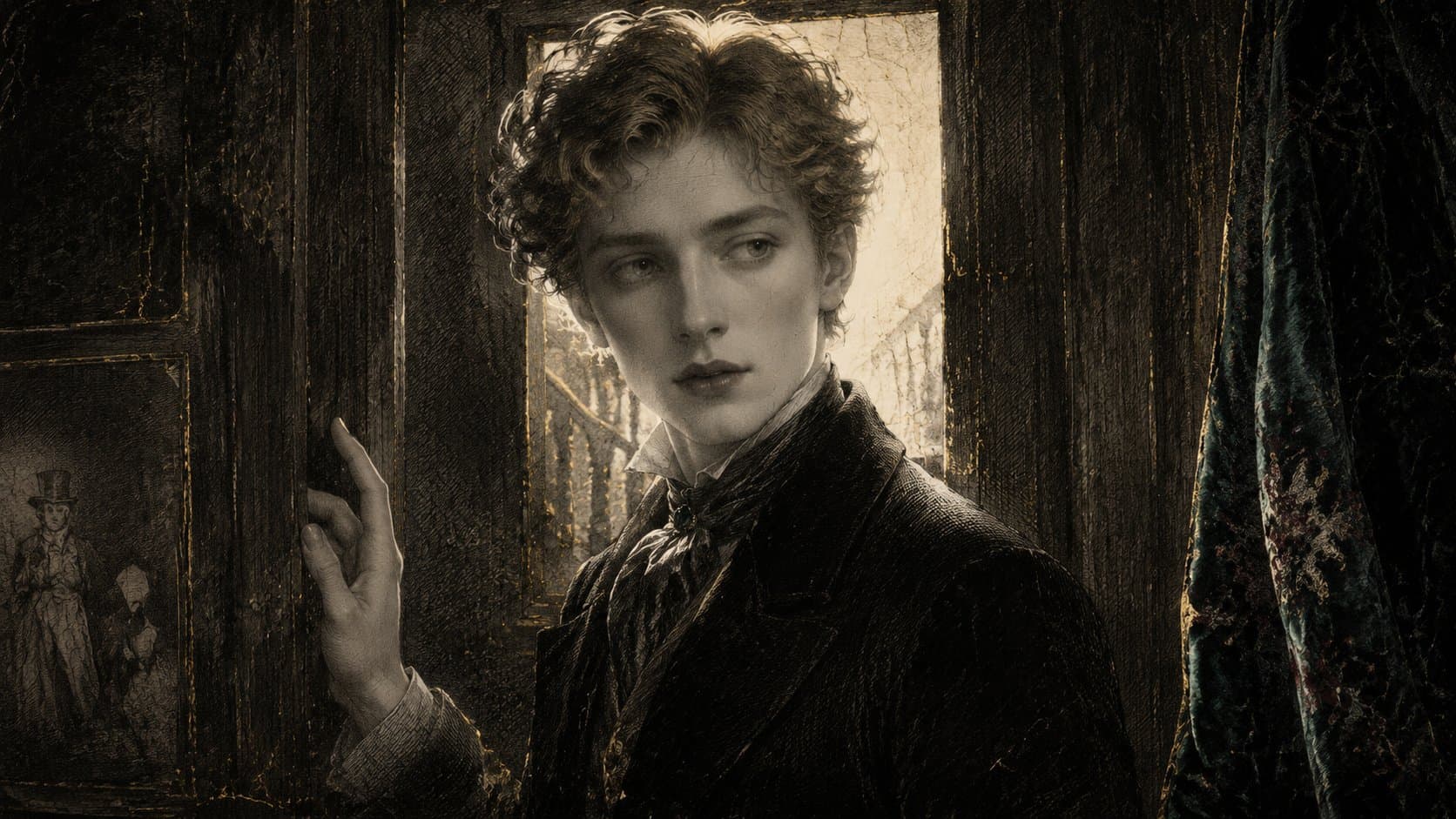
London, 1890: the beautiful young Dorian Gray sits for a portrait by the painter Basil, and, egged on by Lord Henry, makes a reckless wish — that he stay forever young while the painting bears the years instead. From then on he shines in public while the canvas, locked away, grows uglier by the day.
Why read this nineteenth-century London novel today? Because it isn’t a horror story — it’s a parable. The most dangerous wish a young man can make isn’t “let me be bad” — it’s “let me never change, so long as I never pay for it.” The portrait is really a face conscience has grown; each of us keeps one somewhere, behind a locked door.
What lingers isn’t Dorian’s wickedness — it’s how his beauty and his goodness wear away together, at the same rate. He wasn’t born corrupt; he was talked into it, slowly, by a fashionable philosophy of pleasure — “beauty is a form of genius, and needs no explanation.”
The painter Basil is the hardest character to watch: he loves Dorian sincerely, pours his best years into that one face on the canvas — and is killed, in the end, by the very man he painted. The most dangerous thing for an artist is to value his own work above himself.
Dorian’s ending is delivered by no court — only by himself. He stabs the portrait to destroy the evidence; the next morning the servants find an old, hideous body on the floor, while the painting on the wall has become young and beautiful again. Wilde tells it in the calmest sentences, and leaves the reader alone with a question that runs cold.
Note 01 — A Novel With No Name
The Yellow Book
Not long after Sibyl Vane’s death, Lord Henry gives Dorian an unsigned French novel bound in yellow paper. Its story — a young Parisian who tries every sensation life has to offer — becomes something like an instruction manual; Dorian goes on to live the rest of his life as its footnote.
He later has it bound in different colours for different moods and locks it away in the deepest drawer of his study. That a single book could take over a life this completely may be the coldest small detail in the whole novel.
An unsigned book that had already written someone’s life for him.
A man brave enough to hide himself is brave enough to forget himself.
London, 1890
1890s London was the first city to live fully inside an age of image-surplus — photography, newspapers, advertising, salon portraits, all turning appearance into something you could consume. Wilde saw this clearly and folded that whole mood into Dorian’s fate.
The book breathes an almost opiate atmosphere — perfume, cigars, Eastern silk against English drawing-room wood, the smell of a civilisation grown too refined for its own good. It is also the first scent of decay.
Wilde wrote the whole book in deliberate paradox, every epigram landing like a laugh in a drawing room. Only late in the book does the reader realise: every one of those laughs was a blade.
CREATE
How This Edition Was Made
A tarnished photogravure style built for beauty gone wrong: fix a style, draw three boards, keep one face from ever ageing.
Tarnished Gilt Photogravure
A look modelled on late-nineteenth-century photogravure — a touch of grain, a gold-leaning sheen, black-and-white layered under warm gilt. Ornament borrows Wilde-era acanthus scrollwork and gilt borders, but the gold is dulled, never bright.
Character · World · Composition
Process Credits
Back Into the Book
The finished plates return to the chapters, appearing at each moment the portrait changes — an image standing beside the reader every time.
A book about how beauty corrodes should let its own pictures corrode a little too.