Biag ni Lam-ang (The Life of Lam-ang) · Companion Guide
拉芒传
伊洛卡诺口传四百年的英雄长诗:九个月大的孩子独闯高山取回头颅,又在婚宴的河水里被巨鱼吞下再站起来。
A newborn speaks, and names himself
The story opens and Namongan does not give birth to a crying infant. She gives birth to a boy who can already stand, walk, and talk. Worse still, he names himself. I am Lam-ang, he says. This is not the clever child of a folktale; he arrives with a white rooster and a gray dog already at his side, marked from birth as something more than human. The myth sets its terms right here: this poem has no interest in realism. In its world, a newborn can name himself, a rooster's wingbeat can knock a house flat, and a dog's bark can set it upright again.
What kind of book is this
Biag ni Lam-ang is a long epic sung for generations in Ilocano, the language of the Ilocos region in northern Luzon. It carries one label more than any other: the only complete pre-colonial epic to survive in the Philippines, and one of the few oral works from island Southeast Asia to reach a world literary audience. The story most often repeated credits its authorship to Pedro Bucaneg, a blind poet said to have composed it in the early seventeenth century; scholars lean toward a different account: the surviving text was first printed in the late nineteenth century by the folklorist Isabelo de los Reyes, in the periodical El Ilocano. It is required reading in Philippine schools, taught from elementary classrooms straight through to today's stage and film adaptations. In other words, this is a living national record.
Characters and world: the valley, the highlands, and a white rooster
The story's main stage is the Ilocano valley of northern Luzon: rice fields, the shallows of the Amburayan River, the lowland village of Nalbuan, and Calanutian, home to Lam-ang's beloved Ines Kannoyan. Don Juan, the father, rides off to war in the Cordillera highlands, the mountain world of the Kalinga and Igorot peoples, a second and opposing pole to the valley below. The rules that govern this poem are not the laws of physics; they are the laws of divine power, ancestral spirits, and ritual. A rooster can decide the outcome of a battle. A burial cloth can grow flesh back onto bone. The whole worldview belongs to pre-colonial Ilocano tradition. Later transcription added a layer of Spanish-era Christian color, but the story itself still belongs to that stretch of rice paddy and river.
The cast is not complicated. Lam-ang is the undisputed hero, born extraordinary and marked for divine favor. His mother Namongan knows he is no ordinary child; she lets him go into the mountains after his father, and later lets him go again, to court Ines. Motherhood in this epic works less like melodrama and more like a ritual anchor point. Don Juan himself is absent throughout, and that absence is the real engine driving the whole poem. Ines is no passive princess: it is her hands that wrap her husband's bones in cloth, hers that carry out the resurrection. The rival suitor Sumarang survives only as far as the road to the wedding; he stands in for the other kind of man a village produces, jealous and obstructive, cleared off the page by someone stronger. The white rooster and the gray dog are Lam-ang's shamanic guides, present at every major turn of his story.
The switch on the myth is thrown the moment Lam-ang is born. His mother Namongan is still confined to her lying-in month, and already the boy can walk, run, and talk. The white rooster and the gray dog are with him from the start; this is heaven-sent aid, not a pair of companions he happens to pick up later in the mountains. Once a child can name himself in his first sentence, nothing that follows is strange: taking his father's head, crossing a river, courting a girl from another village: these are all the same thing wearing different shapes. This child's fate has been stamped by forces beyond him.
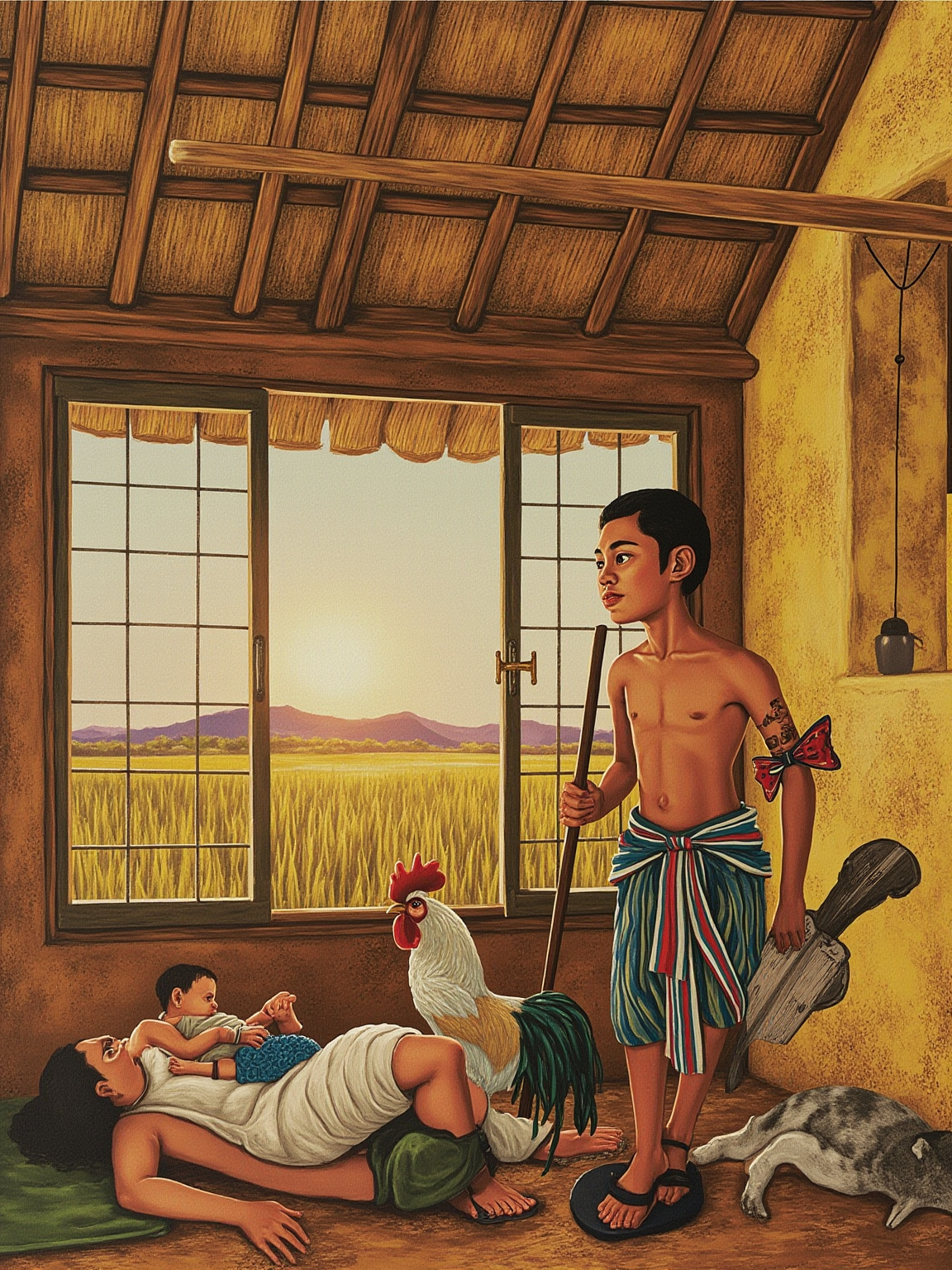
When Lam-ang was born he did not cry; he rose, he walked, he named himself.
拉芒生下来不哭啼,落地便站,便走,便自己唤出自己的名字。
金句 · 开篇 · 神异诞生
Nine months old, alone into the Cordillera: taking back the head
Don Juan marches off to fight in the Kalinga highlands and never comes back. By the time Lam-ang is allowed to leave home, he is not yet a year old, nine months. The epic allows no interval here for growing up first; the narrative jumps straight to this infant setting out alone, walking toward the Cordillera. By the time he arrives, his father's head is already on display, planted on a bamboo stake by the enemy. A crowd of challengers surrounds the spot, and none of them think twice about a lowland toddler who has only just learned to walk. Then Lam-ang takes up a spear, beats back the challengers one by one, and carries his father's head home to the plains alone. The structural job of this scene is plain: a hero's first entrance has to do the largest possible thing at the smallest possible age. Lam-ang cannot yet manage a full sentence of everyday small talk, but he can already carry the entire weight of his family's honor by himself. What struck me most the first time I read this was that the child is never granted a childhood. Myth usually hides its heroes away to grow up in secret; Lam-ang gets no such mercy. He is dropped straight into events.
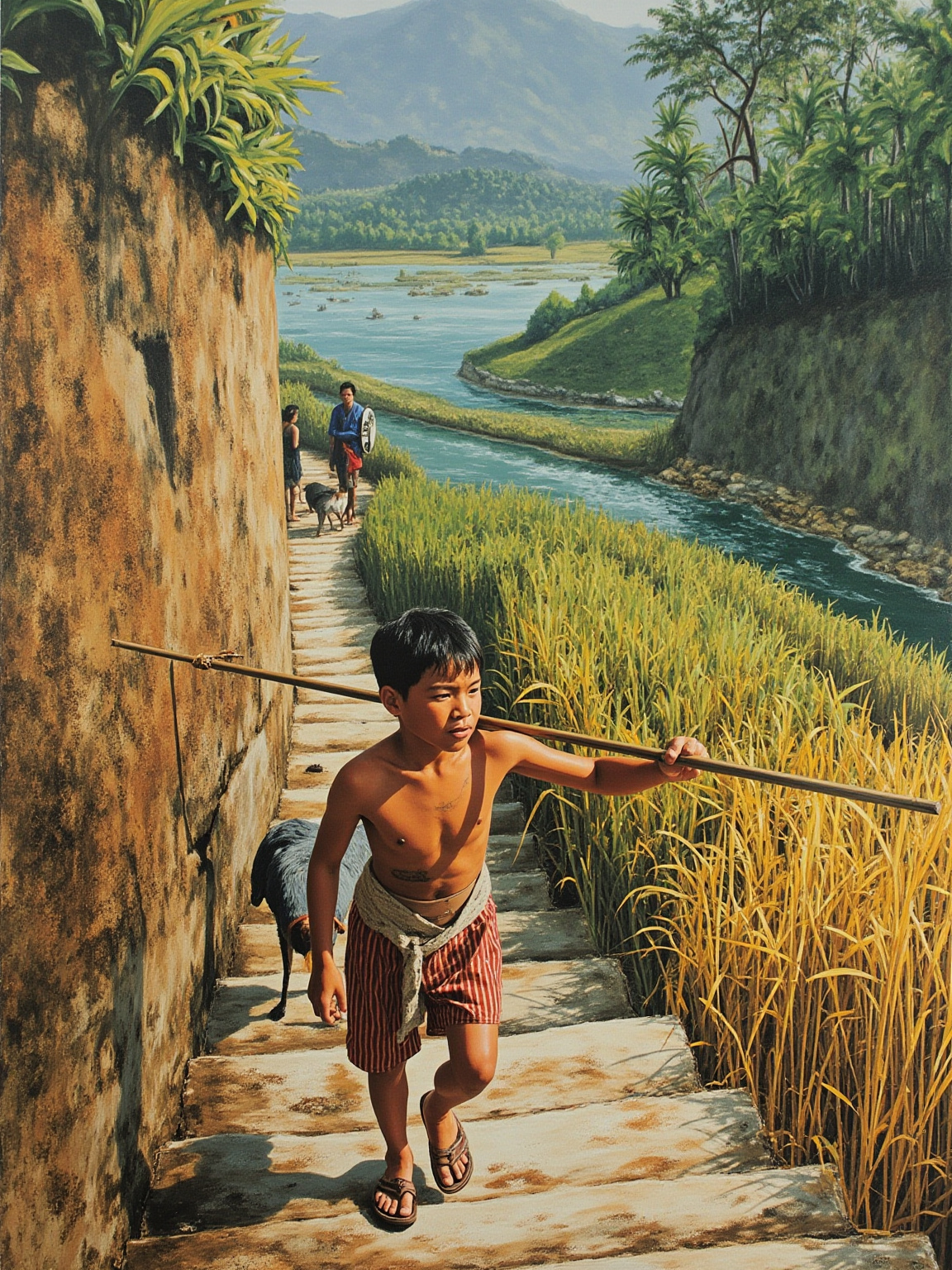
Not yet a year old, he set out alone for the Cordillera, to bring back his father's head.
还未满周岁,他便独自上路,往科迪勒拉去,要替父亲把头颅带回家。
金句 · 九个月独闯科迪勒拉
The Amburayan River: a bath where the miraculous and the absurd collide
On the road back to the plains with his father's head, Lam-ang stops at the Amburayan River. He is caked in dirt and fresh off a fight, so he wades in and washes. The fish and crabs in the water turn belly-up by the hundreds, killed off by his sheer filth. This is not a solemn bathing scene. It plays more like a bit of village comedy bleached pale by tropical sun: the hero has just finished an epic act of vengeance, and the very next thing he does is leave the local fishermen not knowing whether to laugh or cry. The miraculous and the everyday are fused together here: the same man who took his father's head back can also empty a river of fish with one bath. This is where the poem's comic register gets established. It does not go dark. It goes bright, exaggerated, almost too tropical to look at directly.
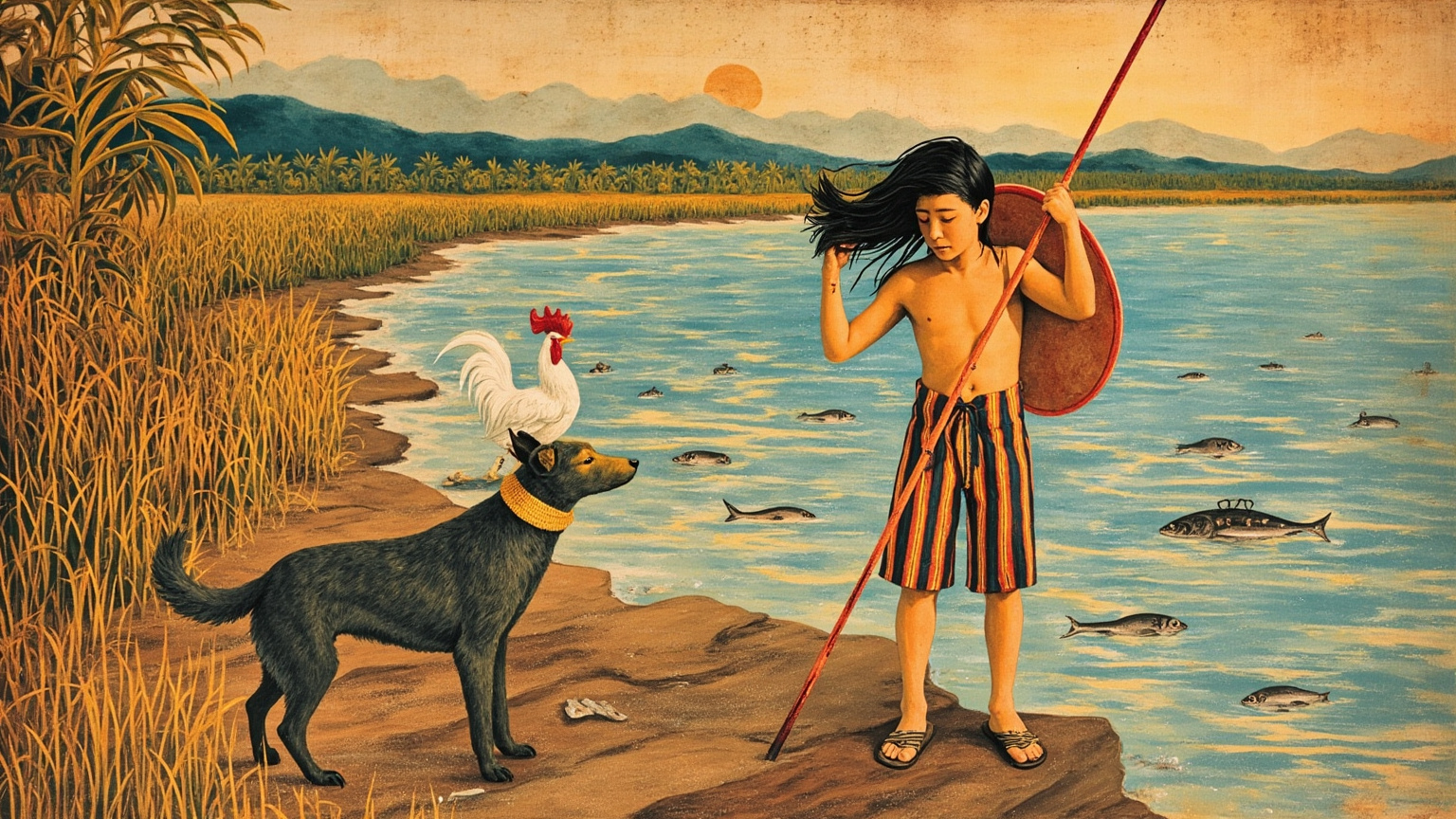
When Lam-ang stepped into the Amburayan, the fish and crabs rose up dead.
拉芒一脚踏入阿姆布拉扬河,水中鱼蟹便翻起白肚,成片死去。
金句 · 阿姆布拉扬河 · 神迹与荒诞
Courtship: two golden ships and a white rooster
Back on the plains, Lam-ang does not rest. The nine-month-old hero has finished his revenge, and the next task is a household of his own. His mother Namongan clearly does not approve of him leaving so soon again, but in this epic a mother's love works by letting go, and in the end, she does. There is one small detour on the road to Calanutian: the rival suitor Sumarang blocks his path and is killed on the spot. Sumarang is not there to deepen anyone's jealousy; he is a functional character, standing in for the ordinary, worldly road the story would have taken without Lam-ang in it. Then Lam-ang reaches Ines's house. The courtship scene is one of the most gorgeous set pieces of village life in the whole poem. The white rooster beats its wings and a house falls down; the gray dog barks and the house rises back up. Back and forth, the entire village is stunned into silence. Ines's parents demand a dowry twice their own wealth: the ordinary social order is still running here, and even a hero has to pay by its rules. Lam-ang's answer is two golden ships loaded with jewels, statues, and fruit. That move, playing by your rules while giving ten times more than anyone dared imagine, is one of the poem's central pleasures: the miraculous and the extravagant, both sitting at the same negotiating table over a village wedding.
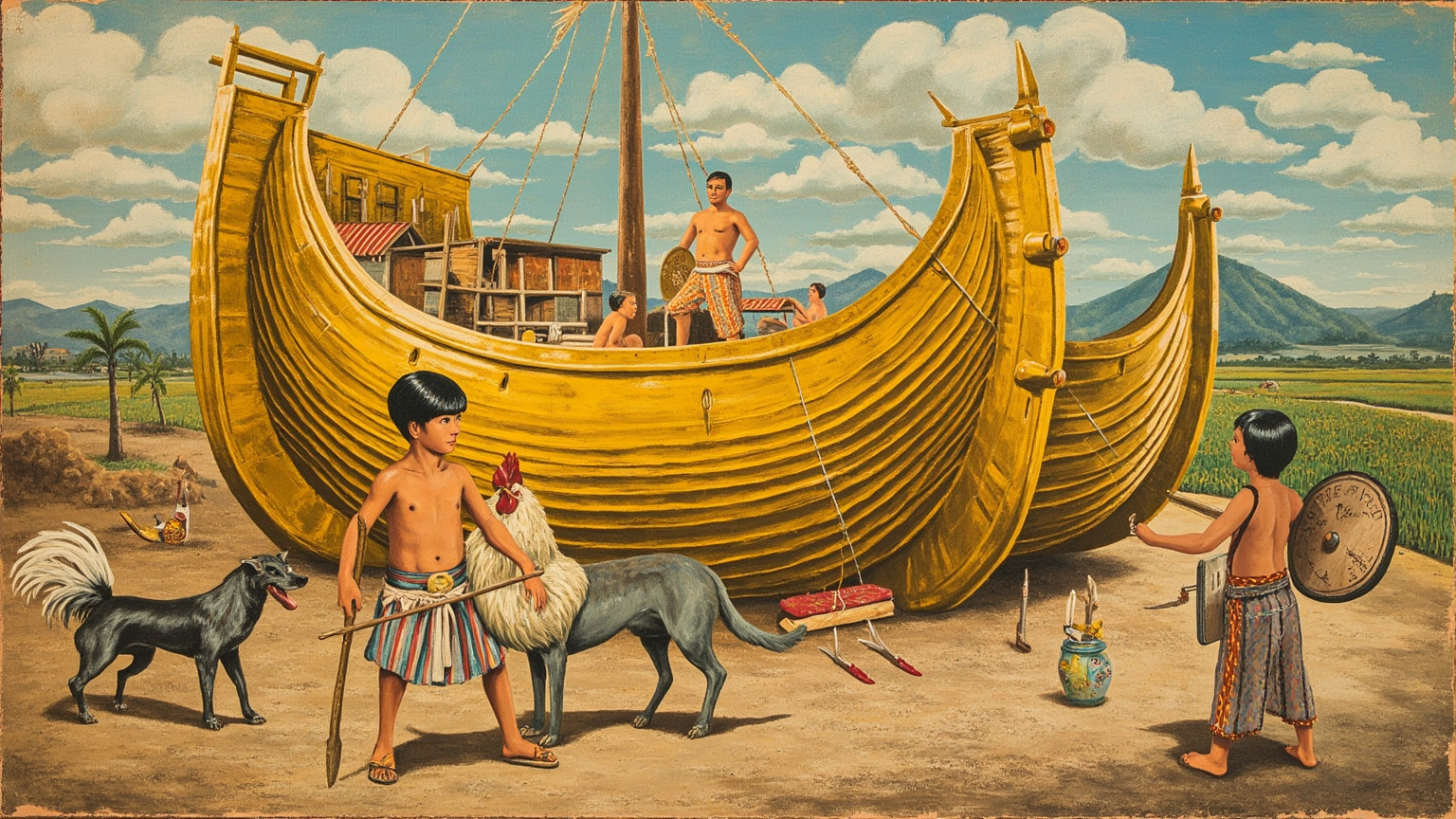
He came with two golden ships laden with gifts, and the white cock struck the house down.
他带着两艘装满聘礼的金船前来,白公鸡一拍翅,屋舍轰然震倒。
金句 · 求婚 · 两艘金船与白公鸡
The wedding, the great fish, the man who stood up from his own bones
The wedding's real drama plays out on the water. Ilocano custom calls for the groom himself to dive for a rarang fish, the ceremonial capstone of the wedding. Lam-ang goes under, the river closes over him, and the great fish Berkakan swallows him whole. The village erupts, but the epic does not treat this as tragedy; it treats death as one more step in a sequence. The old diver Marcos goes down and brings Lam-ang's bones back up. Ines follows the rooster's instructions: the hen beats her wings, the gray dog growls low, the white rooster gives the order, and she wraps the bones in a tapis, the traditional woven cloth. The instant the cloth covers them, flesh grows back over bone, and Lam-ang stands up out of the wrapping to be reunited with his wife. This is the most folk-textured passage in the whole poem: a hero's death handled like a ritual the entire village carries out together, the old diver's skill, the magic worked by hen and rooster, the wife who does the wrapping, the cloth's near-incantatory power. Death here is not an ending. It is just another step in the sequence. I have to say, this kind of death and return is not unusual in the oral epics of island Southeast Asia, but Lam-ang's resurrection has one very concrete physical vehicle: the tapis. This is not an abstract return of the soul. It is a piece of cloth wrapped around bone, unwrapped again as a living man. Reading this passage, it is hard not to picture a family gathered around a heap of white bones, listening to the rooster crow, the tropical evening not yet over, the hearth-fire still burning.
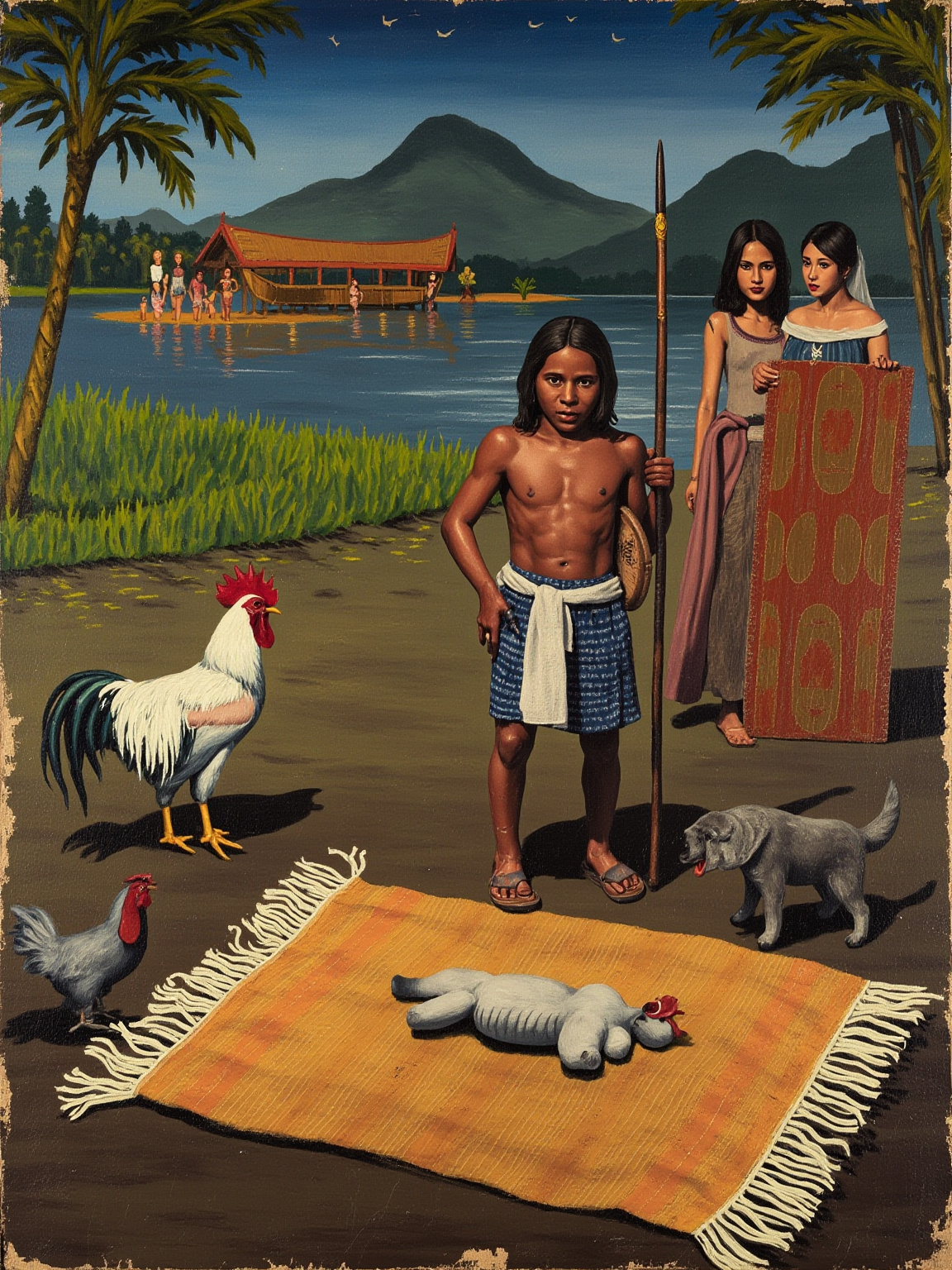
The great fish Berkakan swallowed him whole; yet wrapped in tapis, he rose again from his bones.
巨鱼贝尔卡坎将他整个吞下;裹在 tapis 里的,却是他的骨殖站起来,重又成了新郎。
金句 · 婚礼 · 骨殖之上再站立的人
Themes: filial duty, courage, and rebirth inside a wrapping cloth
This poem is really about three things, and the same worldview welds all three together. The first is filial duty. Don Juan the father never comes home, and his absence is turned into action by a nine-month-old son acting alone. Divine power here is not a special effect; it is a tool for settling a debt across generations. The son retrieves the father's head, which is the same as pulling the family's honor down off the enemy's stake. The second is courage, but Lam-ang's courage is not the grim, iron-blooded kind. It is courage under tropical sun, with a village joke built into it: he can take on a crowd of mountain challengers at nine months old, and he can also empty an entire river of fish and crabs with one bath. The third is a worldview built on rebirth: a hero can be swallowed by a great fish, can be reduced to bones, but as long as the village's ritual holds, the rooster's orders, the wife's hands, the physical cloth, a person can stand back up. These three things echo the rhythm of rice farming: the seed goes into the ground, dies, is harvested, comes back. Lam-ang's death and return are not a magic trick. They are the Ilocano telling of the turning seasons, put into narrative form.
Why it is remembered: oral tradition as a living archive
There are specific reasons Biag ni Lam-ang keeps getting read, performed, and folded back into the national curriculum. It is the only complete pre-colonial epic to survive in the Philippines, and that word alone earns it a place in literary history. It is also one of the very few oral works from island Southeast Asia to reach a world literary audience. Add to that its unusual textual history: the surviving text was actually printed by the folklorist Isabelo de los Reyes in the late nineteenth century, while the widely repeated attribution to a blind poet, Pedro Bucaneg, turns out to be a traditional credit rather than a documented fact. That alone makes the poem a living record of how oral tradition turns into text. What moves readers more directly, though, is its bright, matter-of-fact way of placing miracles next to daily life. A rooster shakes a house down, a dog sets it back up, a bath in the river kills every fish and crab in it: none of this reads as heavy. It reads like the noisy exaggeration you would find at a tropical market, a wedding feast, or out in the rice fields. This is not a book meant for quiet contemplation in a study. It is a book meant to be sung at a festival.
Reasons to read the original: a guide can give you the skeleton, not the warmth
A guide can hand you a map: the birth, the search for the father, the river crossing, the courtship, the swallowing, the return to life. What it cannot hand you is the chant's own heat, the tropical, feverish rhythm that smells of rice paddies. Ilocano epic verse has its own meter, its repetitions, its litany-like refrains, a rhythm held up by the Ilocano language itself; translated, only the shape of it survives. More to the point, the white rooster, the gray dog, the tapis cloth, the fish killed off by filth: these things arrive one after another in the actual text, carrying the smell of everyday life with them. You will laugh out loud at the bathing scene. You will hold your breath at the hen beating her wings over the bones. Those physical reactions only happen when you read the thing yourself. So: knowing the story is not the same as reading it. It is still worth opening the original text.
The deepest trick in this poem: a nine-month-old carries his family's entire honor, and casually kills every fish in the river along the way. It uses the absurd to protect the miracle, and the miracle to complete the absurd.
Art Direction4 plates
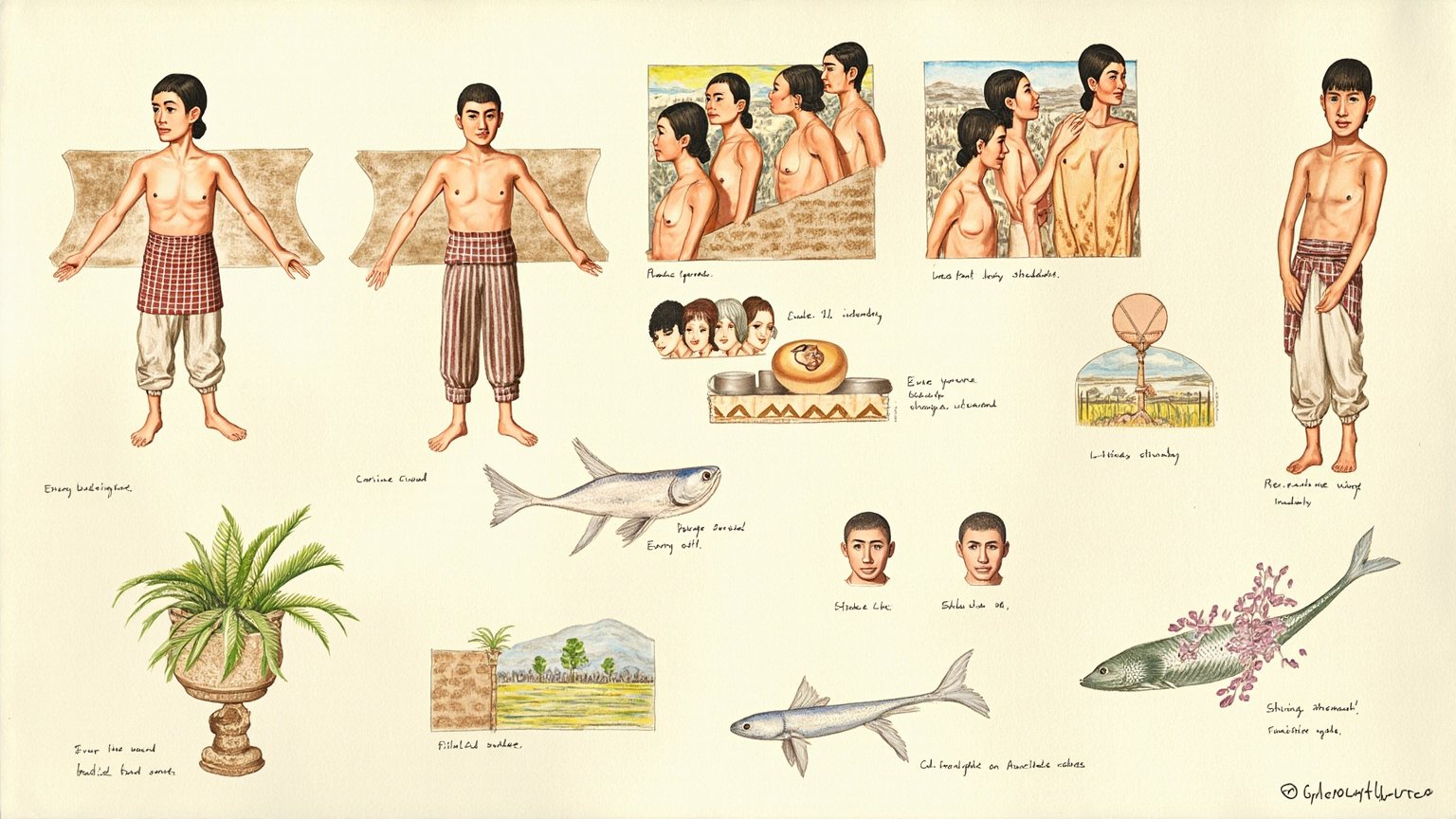
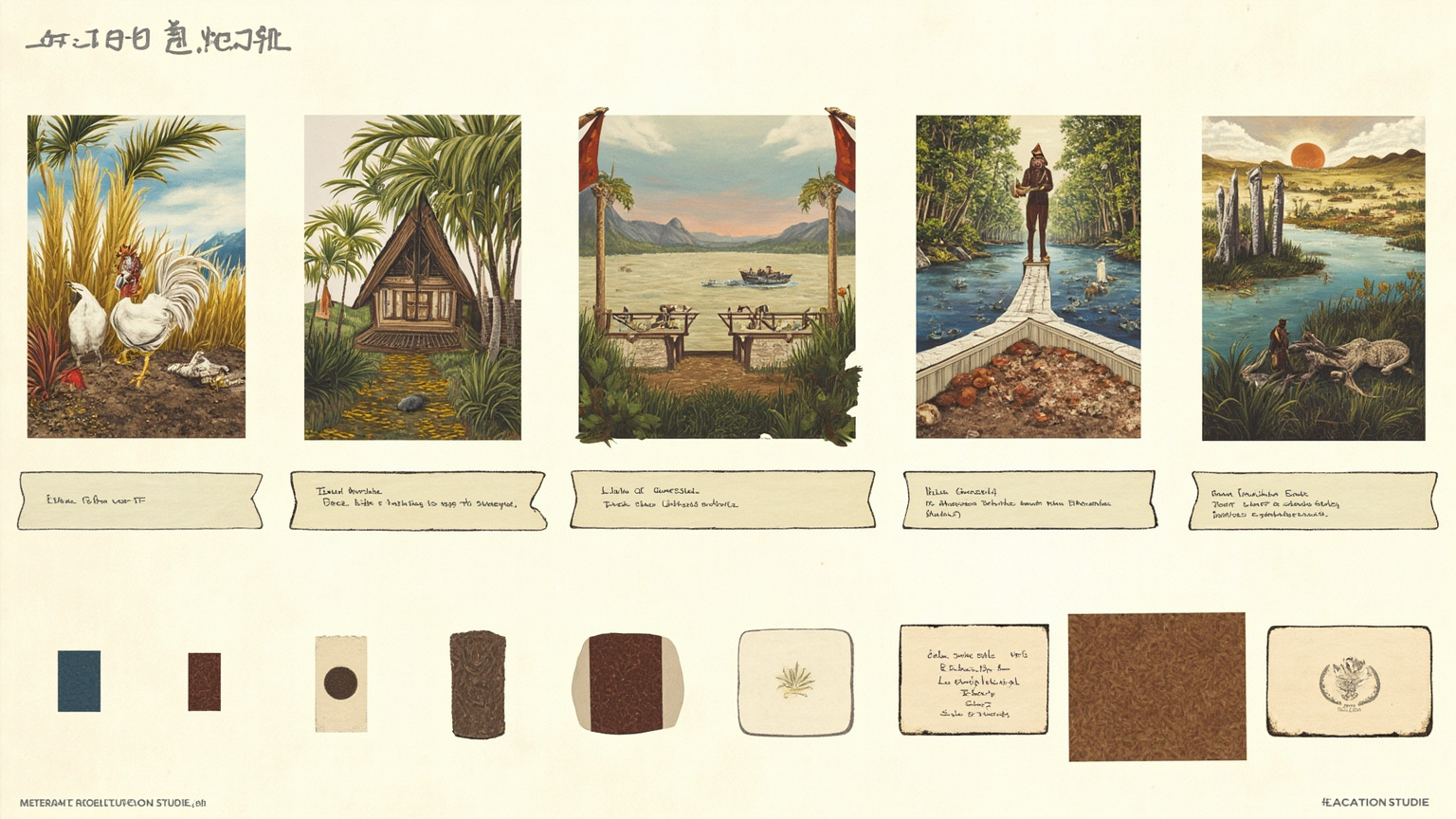
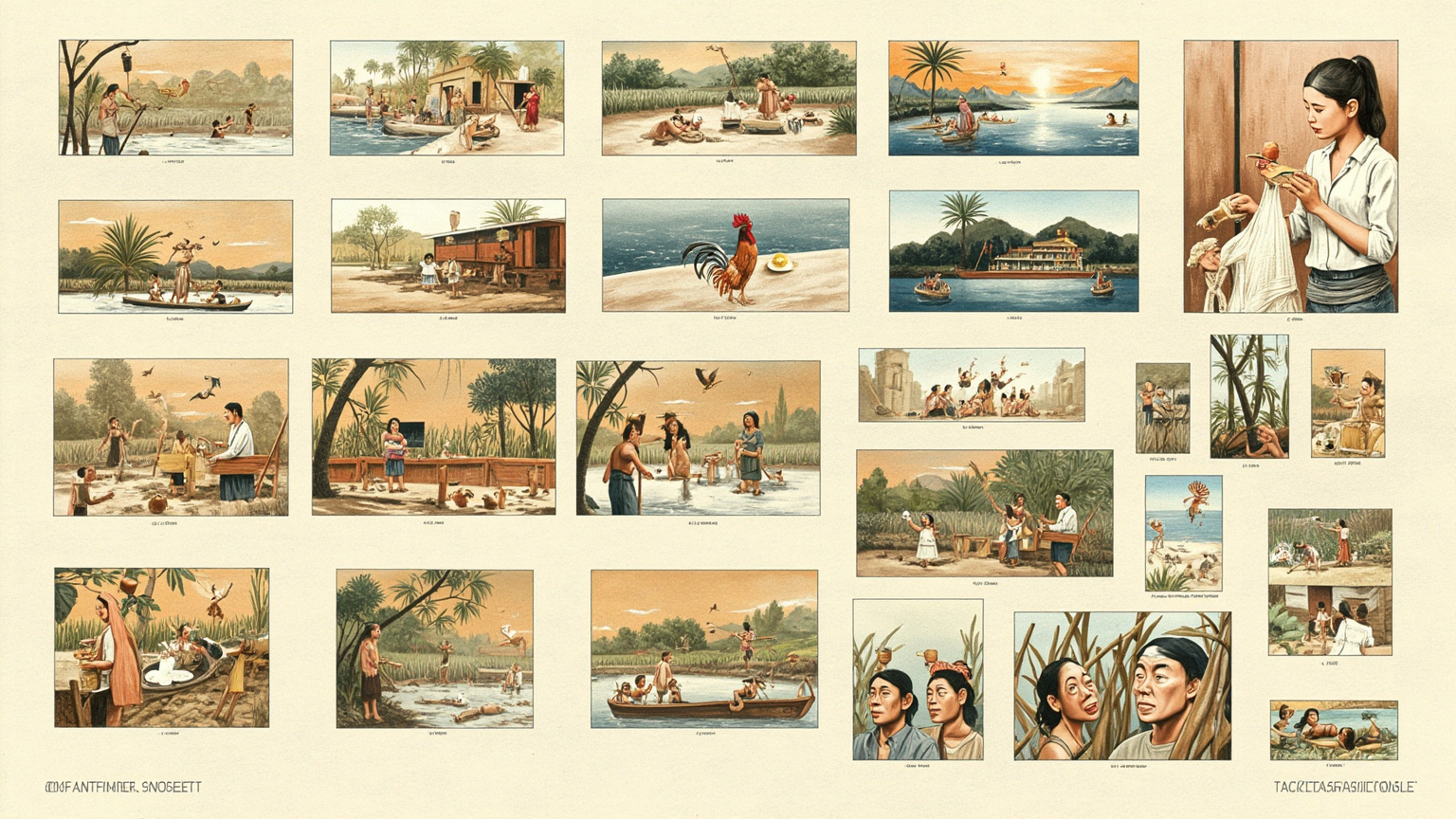
Before the guide was written, this book got a visual foundation — every illustration you just read grew out of it.