The white pagoda Shen Congwen left standing in West Hunan — it falls, and a light still burns on
Text and illustrations produced by the pipeline
A clear stream, an old white pagoda on its bank. Beneath the pagoda is a ferry, and on it a girl of fifteen or sixteen named Cuicui. The Dragon Boat Festival has just passed, the crowds along the riverside street have thinned out, and she has moored the boat and is waiting for someone she cannot even name. This is not the kind of waiting where you stand on the dock craning your neck — it's sitting at the bow with your legs hanging over the water, watching the moon in the current break apart and piece itself back together, over and over. This is the novella called Border Town, and it still burns like the lamp at that ferry crossing, lit somewhere in the memory of countless readers.
Border Town ends on a line everyone remembers: that man may never come back, or he may come back tomorrow. Long before you reach that page, the sentence has already lodged itself in textbooks and in memory. So the real question isn't what Border Town is about — the story is short, and almost nothing resembling drama happens in it — it's whether you can sit with a girl from western Hunan at a ferry crossing that never answers back, and count the days alongside her, one by one.
The author, Shen Congwen, was born in 1902 and died in 1988. In his early twenties he served in the army and spent a long stretch of time drifting through the borderlands where Hunan, Sichuan, and Guizhou provinces meet — and it is in the deepest layer of that memory that Border Town is set, in a small town called Chadong, a real place that today belongs to Huayuan County, Hunan. By the time he wrote the novel he had been away from that stream for years, sitting at a desk in Beiping, hauling that old stretch of time back up and letting it dry in the light. Border Town began serialization in the Guowen Weekly in January 1934, and came out that October as a single volume from the Life Bookstore — the first installment of a planned series of novellas called Ten Cities. It is an anomaly in modern Chinese literature: while the mainstream writers of the era were busy with urban malaise and the collapse of the countryside, Shen Congwen went the other way and wrote a pastoral for an almost utopian little border town. That is exactly why the book has stayed in people's minds — it tells you that the cleanest version of a Chinese person is not found in the big city, but on a ferry.
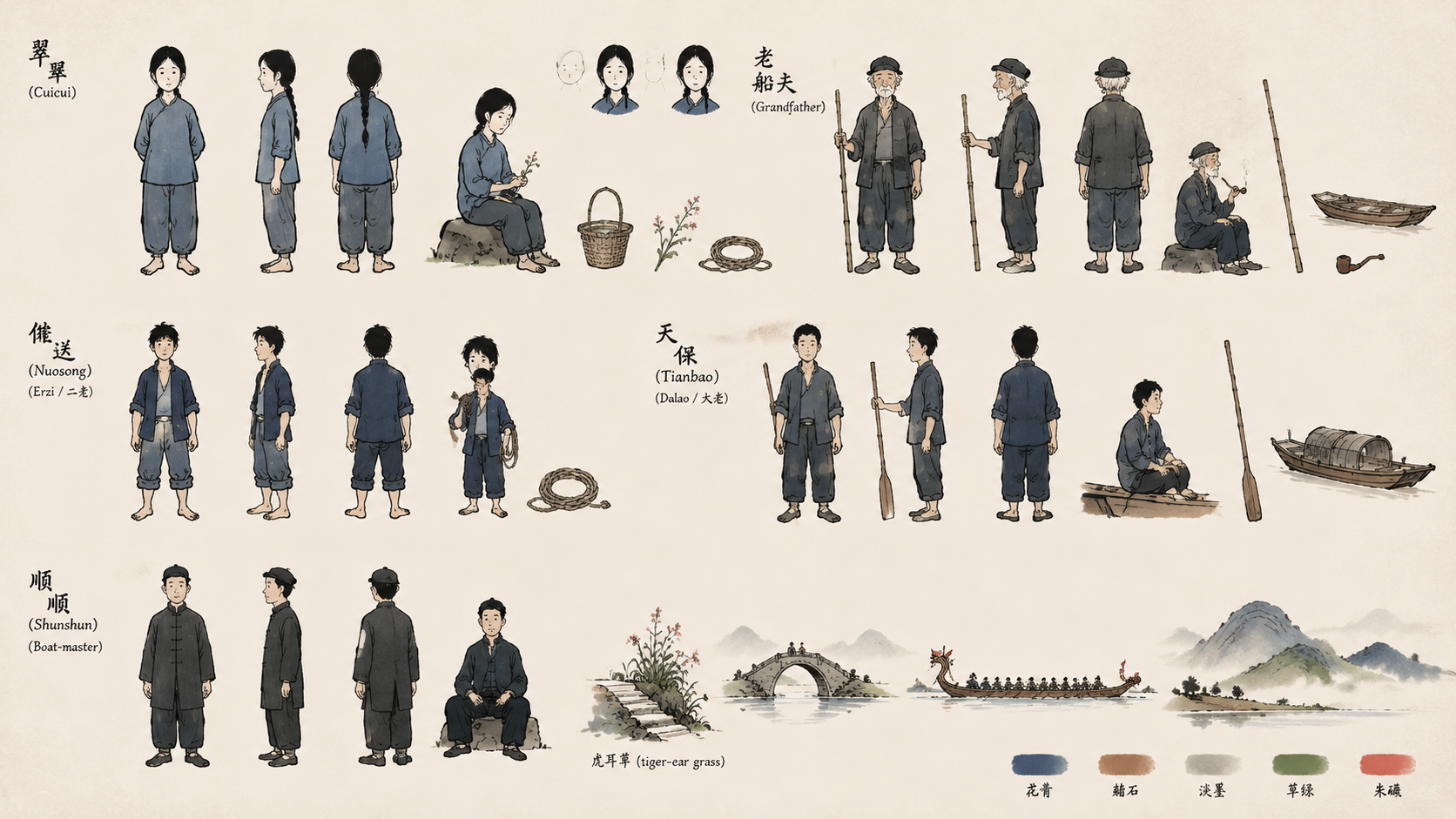
Chadong is a small dock town where ferrying is the main trade, and everyone makes a living off the people and goods moving along the water. The story's core cast is really just four families, and each one can be summed up in a sentence. The old ferryman is Cuicui's grandfather, who has spent most of his life poling this same stretch of stream; fifty years of wind and weather have settled into his hard, creased face. He has exactly one thing on his mind: to see Cuicui placed in the hands of someone trustworthy before he closes his eyes for good. Cuicui is the girl who grew up on that ferry, as artless as the stream itself, secretly fond of Nuosong, the second son of Shunshun the boat master's family — though she can barely get the words out.
Shunshun the boat master is the most respectable man on the docks, a generous man who makes his living off the river. He has two sons. The elder, Tianbao, is open-hearted and outspoken, and he too has fallen for Cuicui; the younger, Nuosong, is known far and wide as the best folk-song singer in the region. Both brothers have lost their hearts, but there is only one Cuicui. This is a world with no court intrigue, no fight over an inheritance — its rules are plain to the point of innocence: if you love someone, you compete for her under the moon according to the local custom of singing folk songs, and whoever wins takes the girl home. That is the entire setup of the novel: one stream, one white pagoda, one family, two brothers, and a girl who won't be the first to speak.
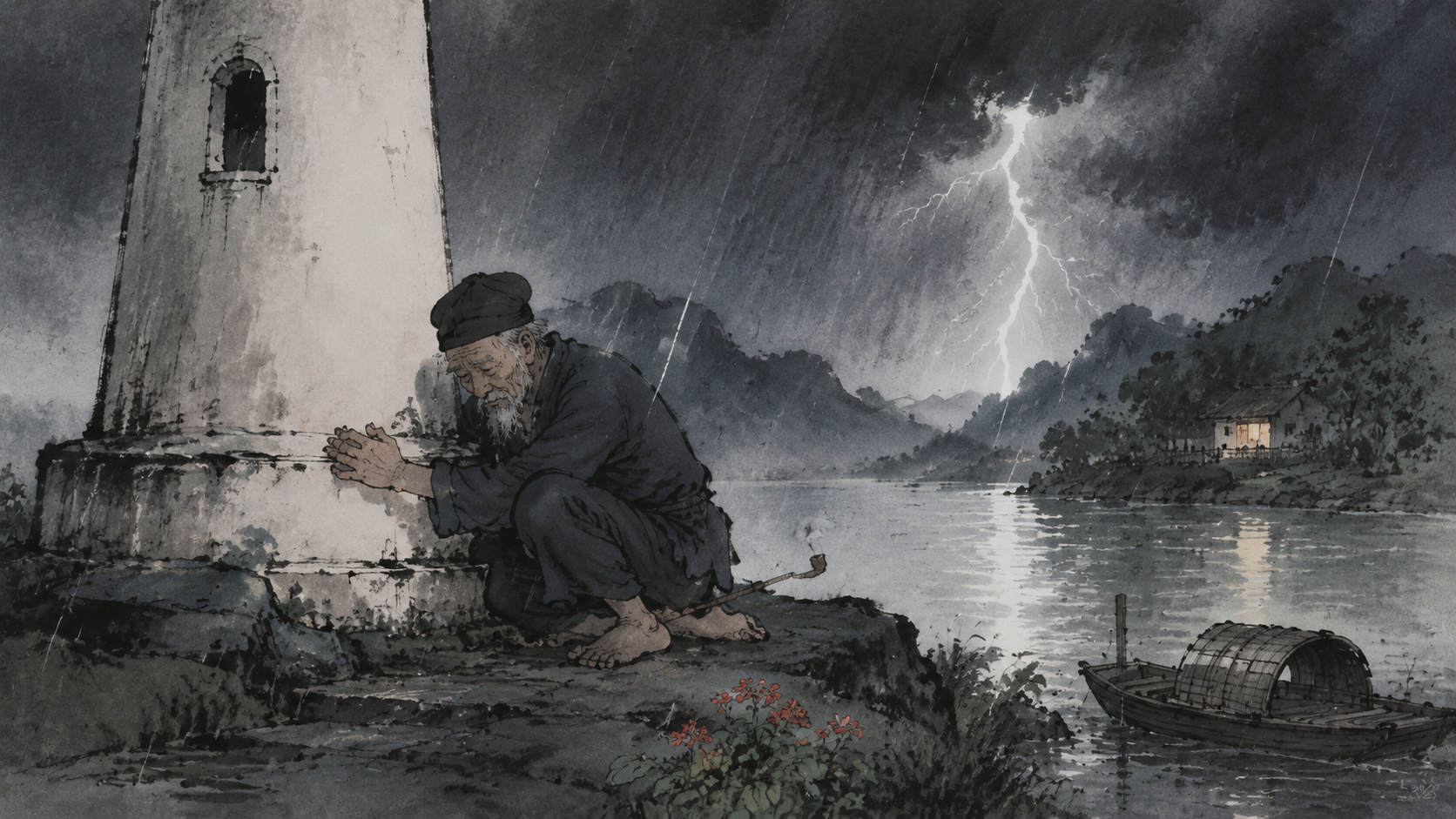
Of everyone in this story, the old ferryman is the one who breaks your heart the most. He has lived a long life, fifty years on this same ferry, watched countless people come and go — and still he cannot read his own granddaughter's heart. He worries for Cuicui, frets over her, runs back and forth between the two brothers and Shunshun trying to smooth things over. But he can't read, he doesn't understand the winding logic of the folk songs, and he can't puzzle out what the young people are really feeling — the harder he tries, the more damage he does. By the time Nuosong turns cold, word of Tianbao's death comes back, and the old pagoda starts leaking, he is alone on a night of thunder and lightning, keeping watch over that crumbling tower, and he simply cannot hold on any longer. He falls. This is a man who gave his whole life to someone else, and the last posture he falls in is a solitary one. Shen Congwen writes his death with no wailing, no accusation — the thunder passes, the rain lets up a little, and he just stops moving.
By now you already know what happens in Chadong. But the real experience of Border Town is not in the plot — it is in the prose itself. Shen Congwen's sentences are like the streams of western Hunan: they look calm on the surface, and you have to put your own hand in the water to find out whether it runs cold or warm underneath. The smell of that early-summer evening at the ferry crossing — cooking smoke, moss, river weeds, the scent of wine drifting from somewhere downstream — is something no summary can hand you. You have to walk through it yourself, line by line, and let the white pagoda, the cool wind, the tiger-ear grass, and the folk song that never quite got sung seep out of the words on their own. More than that, the particular texture of the waiting cannot be translated by any summary. Cuicui waits at the bow for Nuosong; the reader waits before the page for Shen Congwen to give an answer — and he refuses. That experience of reading on, even though you already know the answer, is the gift Border Town gives its careful readers. So go read it. Pick a quiet afternoon, ideally with a little rain outside the window, turn to the first page, and let the stream of Chadong come flowing to you on its own.
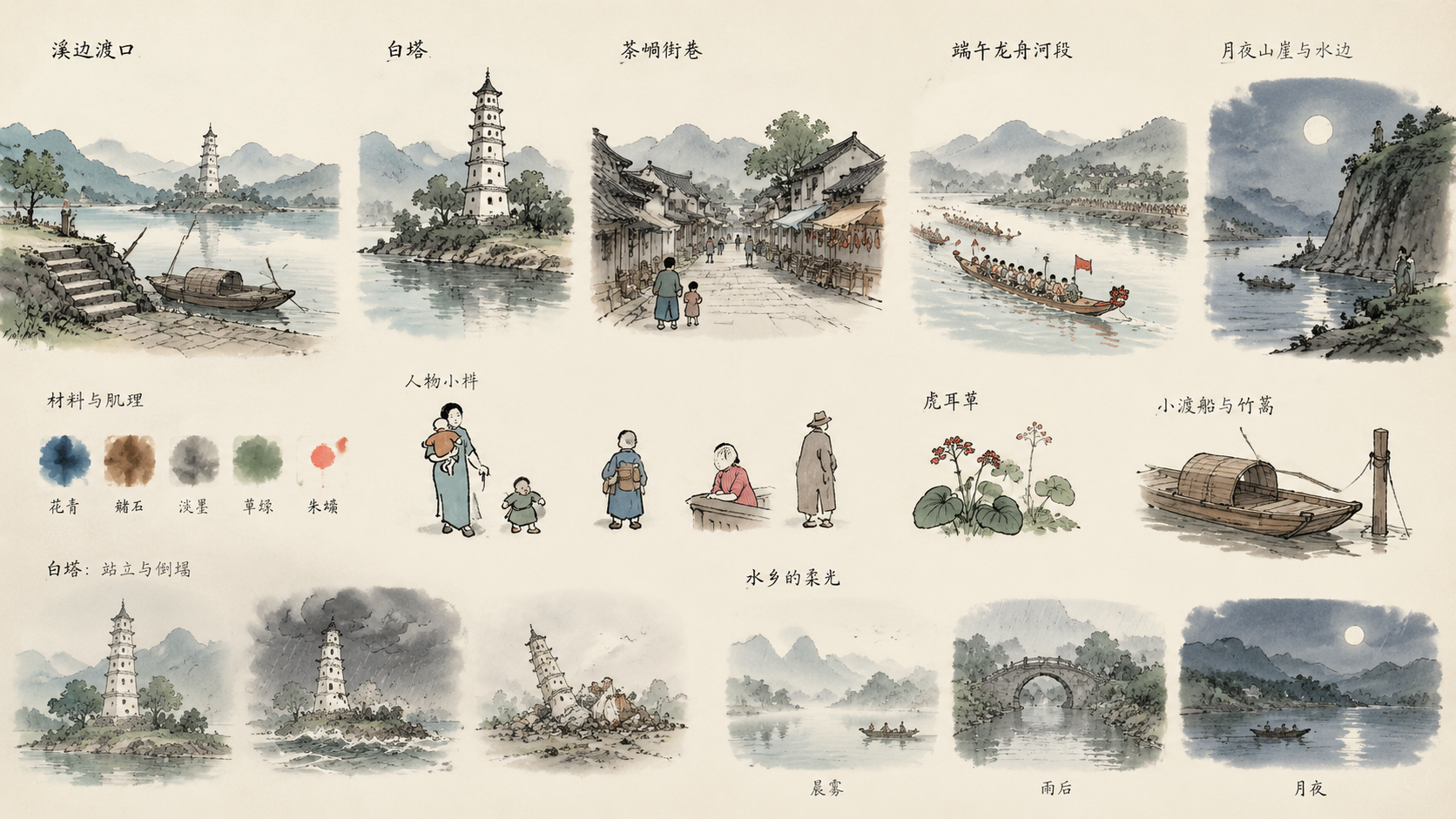
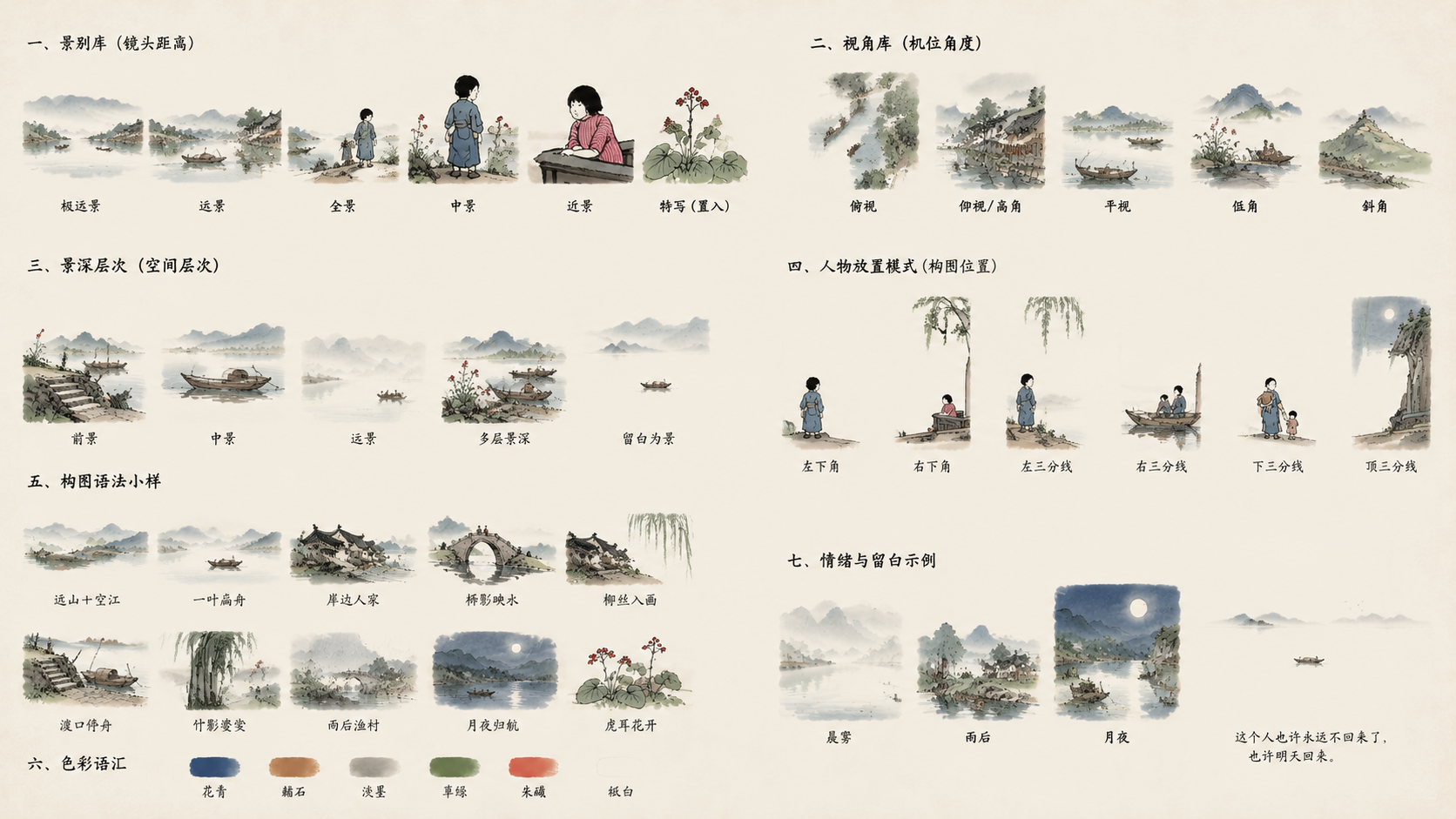
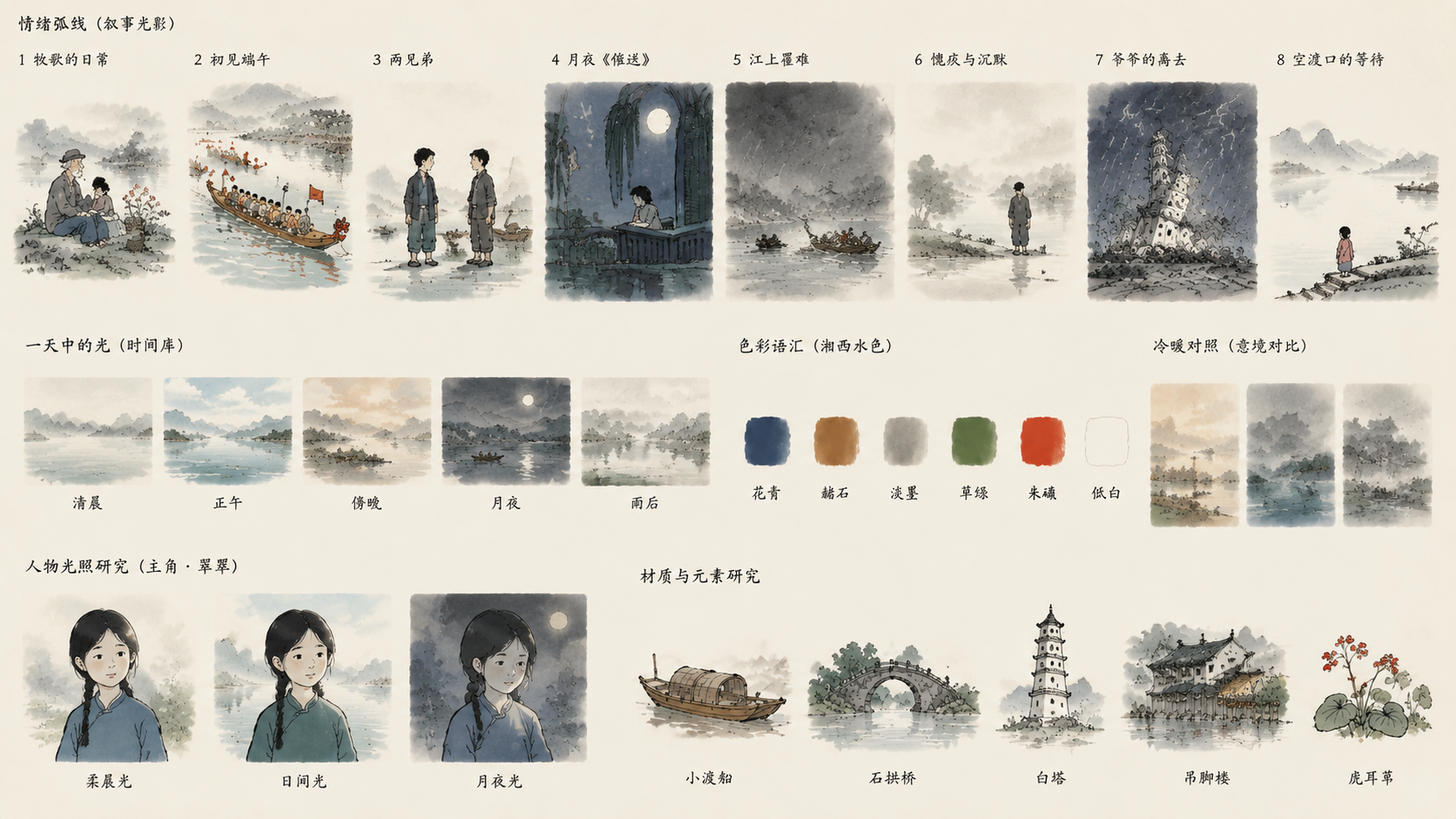
Before the guide was written, this book got a visual foundation — every illustration you just read grew out of it.
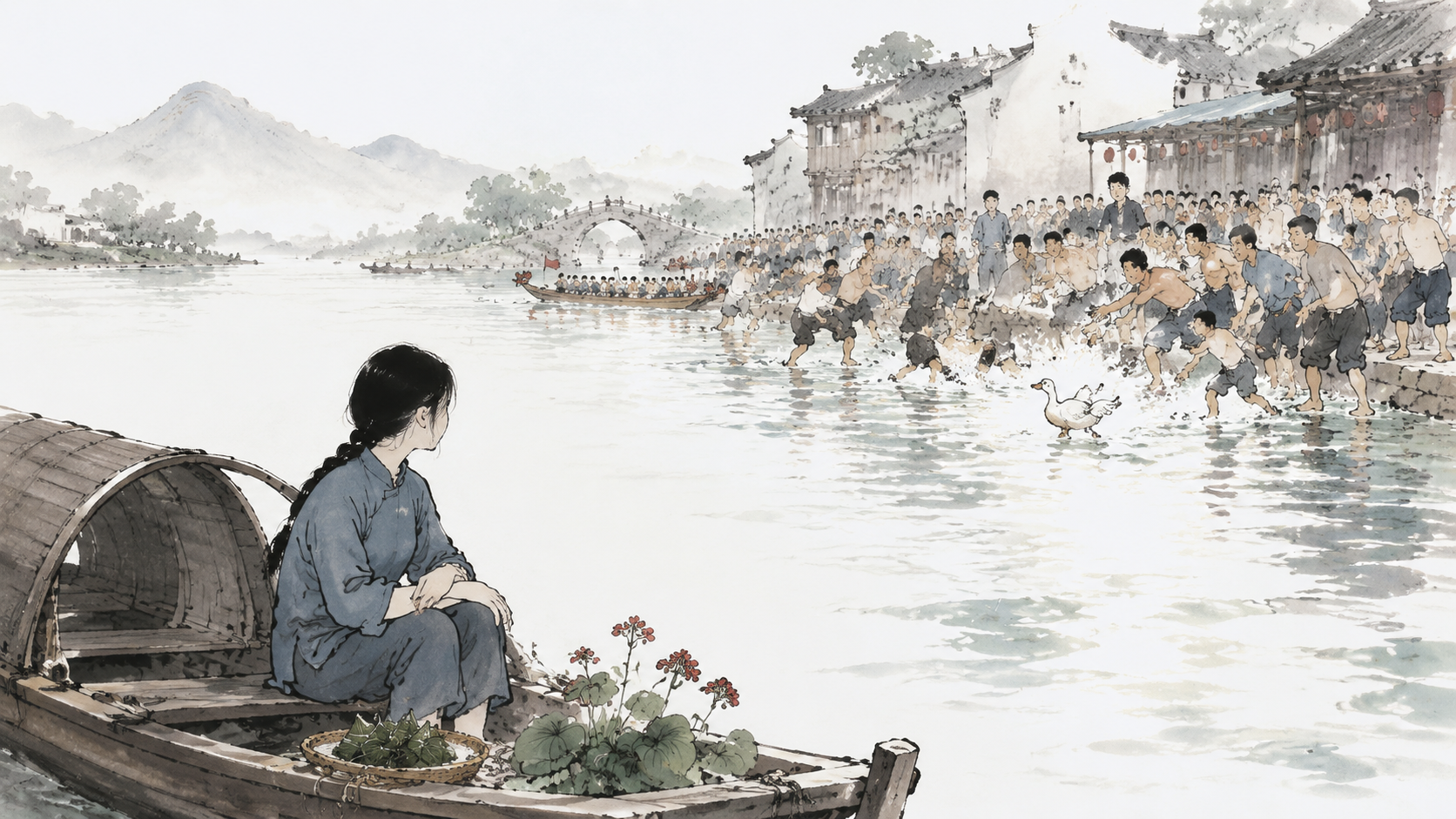
The story opens with the dragon boat races on the Dragon Boat Festival. In Chadong this is the biggest day of the year — the water crowded with boats, the bank crowded with people. Cuicui's grandfather leaves her to mind the ferry, and in the crowd she catches sight of a boy she has never seen before — Nuosong. There's nothing dramatic about that first glance: it's just a knot of bare-chested young men on the riverside street scrambling to catch a duck, and somehow, in the middle of it, a boy notices her. It's the loveliest first encounter in the whole book, and Shen Congwen writes almost none of it — no locked eyes, no dialogue, nothing but the river and the crowd gently holding that one glance up. It's like a seed dropped into the water: before you even see it sink, it has already taken root downstream.
By the following year's Dragon Boat Festival, both brothers' courtship has become official. Chadong custom says that whoever wants to marry Cuicui must climb the hill across the stream on a moonlit night and sing to her — win her heart with the song, and you win. There is something lovely in this way of courting: instead of speaking directly, you hand your feelings to the night wind through song, and let the wind say the words you cannot. This is one of Shen Congwen's finest touches — he lets you see that in a rural world where restraint is a virtue, even a declaration of love has to travel across a mountain to be heard.
Tianbao knows perfectly well he can't outsing his younger brother. He's an open, honest man — no scheming behind anyone's back — so he accepts defeat and turns to leave, taking a boat down into Sichuan to run the rapids for a living. Running rapids was among the most dangerous work on the waterways, something like long-haul freight today, except the road is white water and rock. Tianbao's leaving isn't nonchalance; it's a man swallowing his pride, and it is also the biggest concession an older brother can make — if he can't have her, then he will at least put real distance between them. Shen Congwen writes this with great restraint: no tears, no grand speeches, just a plain sentence, and the older brother is gone. But you can feel that the weight of that departure is far heavier than the words on the page.
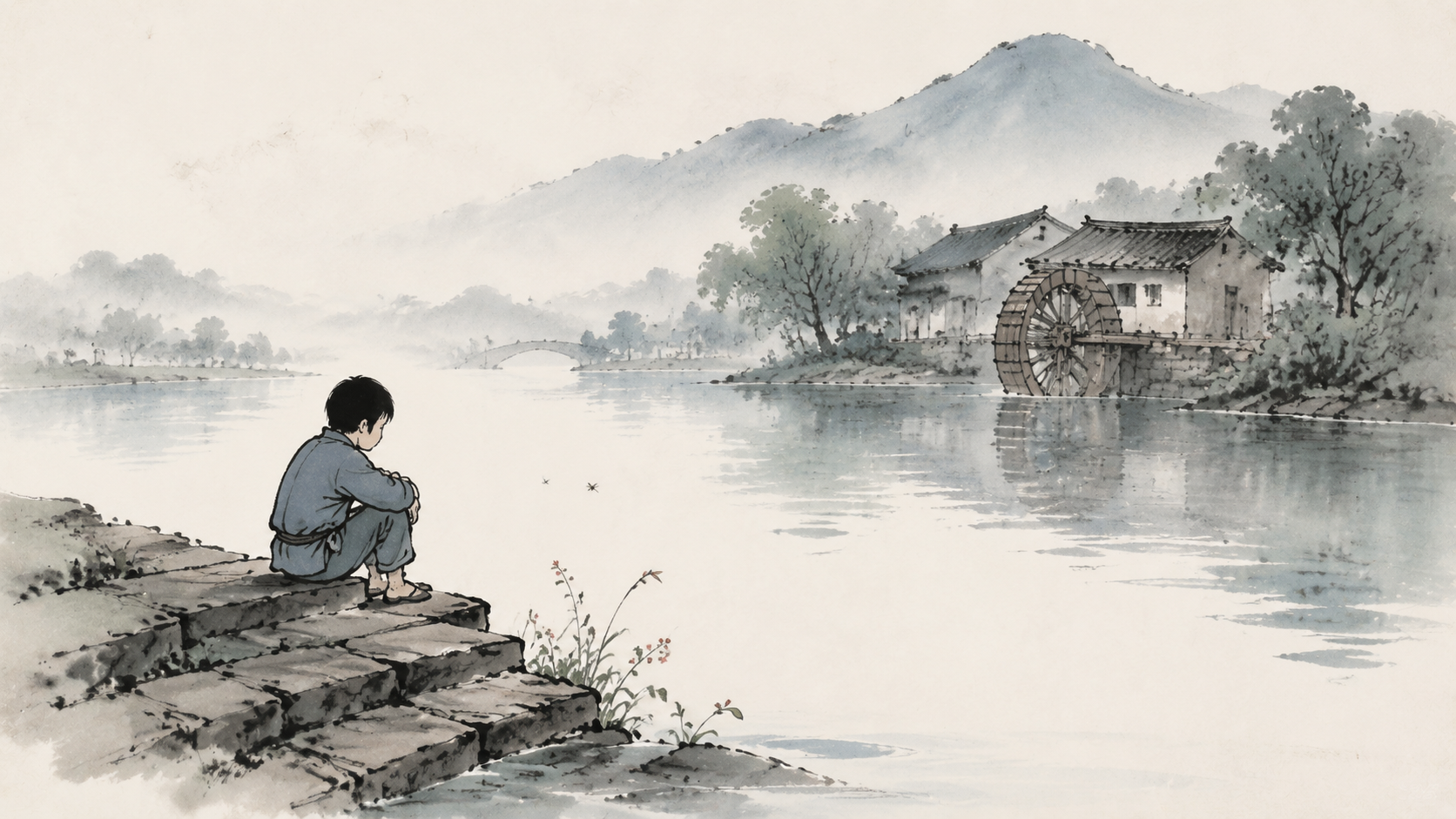
But Tianbao never came back. Partway down into Sichuan, his boat overturned in a fast rapid, and he drowned in a river far from home. The news reaches Chadong and changes everything for everyone. Something snaps in Nuosong — his brother left because of me, and now he's dead; what right do I have to take the girl he wanted? To a reader today that guilt can look almost excessive, but in the world Shen Congwen has built, it is the gravest thing imaginable. Nuosong starts avoiding Cuicui, avoiding the old ferryman, avoiding the stream itself. At the same time, his elders have lined up another match for him — the daughter of the mill owner on the far bank, whose dowry is a working mill, real, solid property worth far more than a ferryman's granddaughter could ever offer. Squeezed between the pressure to marry into the mill and his brother's death, Nuosong is all but forced into accepting the other match.
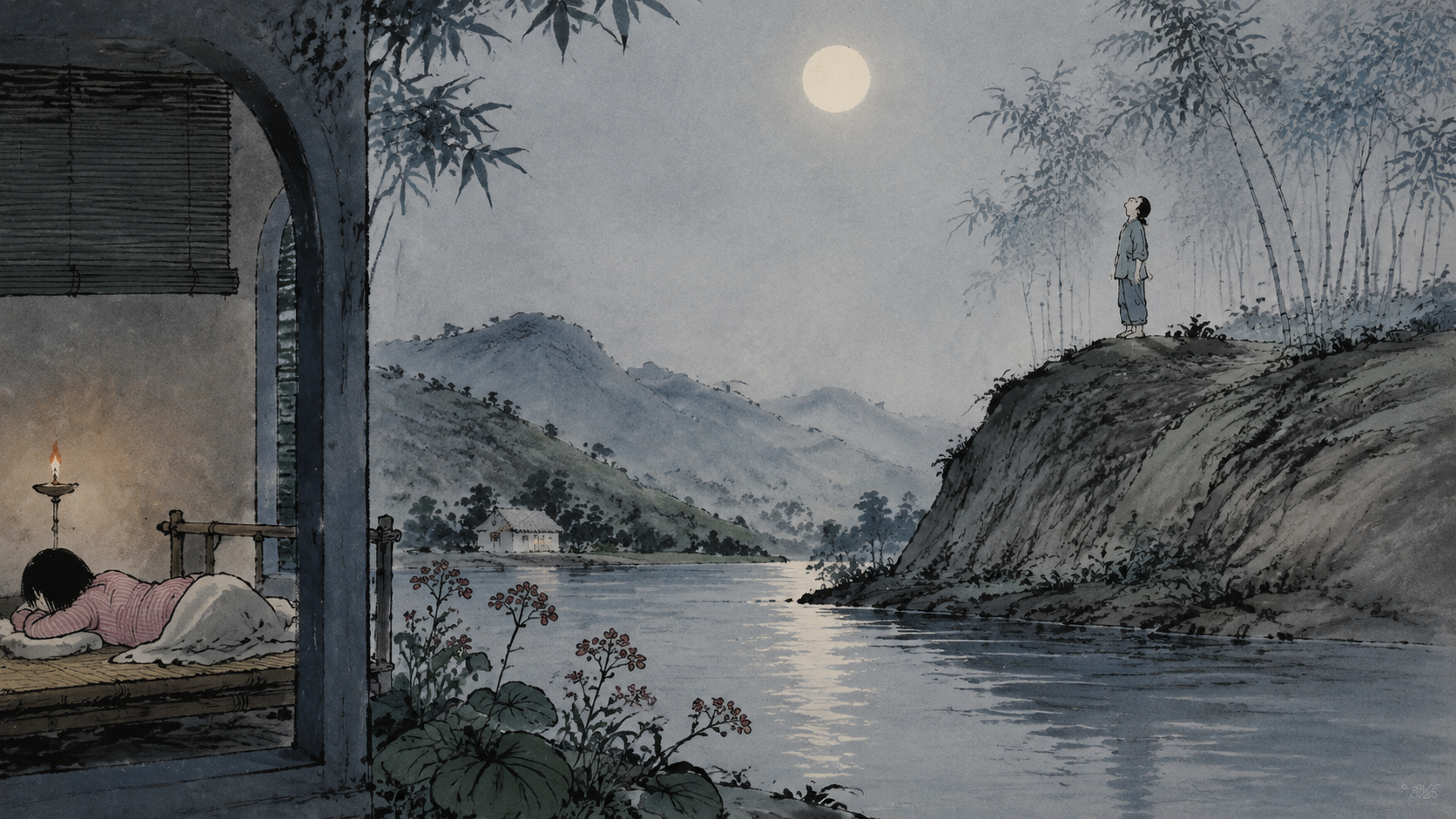
Right when Nuosong is at his most defeated comes the most heartbreaking night in the book. He can't help himself after all: on a moonlit night he quietly poles across the stream and sings folk songs all night long from the cliff above Cuicui's window. It is his last declaration, and the most romantic page in the whole novel — except that on this exact night, Cuicui is asleep. She hears it, but only just; she takes it for a dream, a voice singing somewhere inside the dream, and she never learns whose it was. Shen Congwen does this on purpose. He wants you to see the deepest words of love leave one person's mouth, drift past another person's ear, and sink into the stream, gone without a trace by morning.
The white pagoda collapses that same night. Cuicui wakes to find her grandfather gone and the tower down, and the whole world has changed color overnight. Shen Congwen uses the pagoda's fall to close out the grandfather's fate, and it also pushes Cuicui into a truly unsheltered solitude — the tower is down, and there is no shelter left. After the funeral, she takes up the ferry again alongside her grandfather's old friend Yang Mabing, a weathered old soldier who can keep her company and help her pole the boat — but he is not Nuosong, and he cannot fill that place.
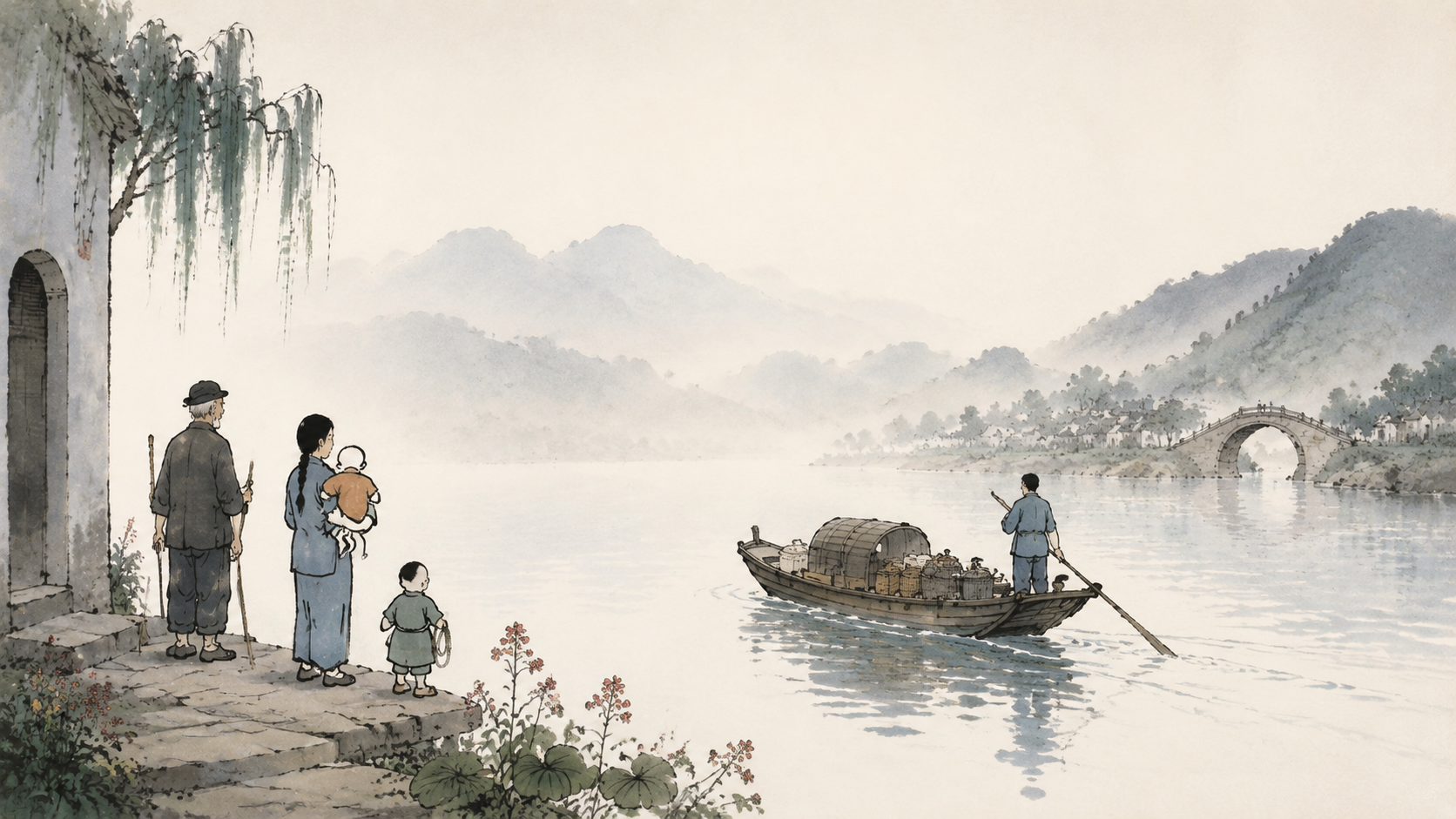
Nuosong leaves. He leaves cleanly — no goodbye, no message, just a boat taking him down into Sichuan, headed nobody knows where. Maybe he will go try his luck out there and come home again; maybe he never will. The novel simply stops here. Shen Congwen closes it with a deliberate blank — that man may never come back, or he may come back tomorrow — and that one word, maybe, is at once the lightest and the heaviest word in modern Chinese literature. Light, because it commits to nothing certain; heavy, because the fate of the entire book hangs from it, suspended in midair, never coming down.
On its surface, Border Town is a love triangle. Underneath, it is about a kind of person who is vanishing. Shen Congwen deliberately writes Chadong as a town outside of time: no soldiers or bandits, no corrupt officials, none of the anxiety that turns people into machines in the modern city. The old ferryman, the boy who sings folk songs, the girl who grew up on a boat — everyone here lives according to their own nature. This is Shen Congwen's utopian experiment: an attempt, somewhere inside twentieth-century Chinese literature, to leave behind a negative of what a human being ought to look like. The trouble is, that negative is fragile. There are a few details you only notice in hindsight: the pagoda has to be rebuilt once it falls, the mill stands for a more calculating kind of modern economic relationship, and in the end Nuosong still chooses to leave and take his chances in the wider world. Every one of these details is telling you the same thing — that the world outside is bound to come flooding in sooner or later. Shen Congwen uses them to quietly let you know that what he is writing is not something eternal, but a stretch of time that is already passing away. That is why Border Town is usually read as an elegy for a traditional, rural China — Shen Congwen is not mourning some particular place, he is mourning a way of dealing with other people that money and calculation had not yet corrupted.
In craft, Shen Congwen went a route exactly opposite the mainstream of his day. That was the era of Lu Xun-style critiques of the national character and left-wing social realism, and writers were busy dissecting society. Shen Congwen was not. He gives you water, wind, moonlight, folk songs, the little glint of gold on top of the white pagoda at dusk. With an extremely clear, extremely spare hand, he takes a story where almost nothing big happens and turns it into a prose poem. For a reader today, this way of writing is a useful reminder: you assume a novel needs conflict? It does not have to. What is genuinely hard to write is a stretch of days where nothing happens, written so well you cannot bear to stop turning the pages.
The cruelest thing about Border Town is not who dies — it is that every word that needed saying got swallowed back down: the song stopped by a mountain, the confession stopped by a dream, the waiting stopped by a stream that never answers back.