Carmina Gadelica, Hymns and Incantations of the Scottish Highlands · Companion Guide
盖尔祝祷谣
一个爱丁堡人坐在泥炭灶旁,听不识字的农妇把世代口传的祷词一句一句念给他——
I. An Old Woman Spinning by the Hearth Says Her Prayers to a Stranger
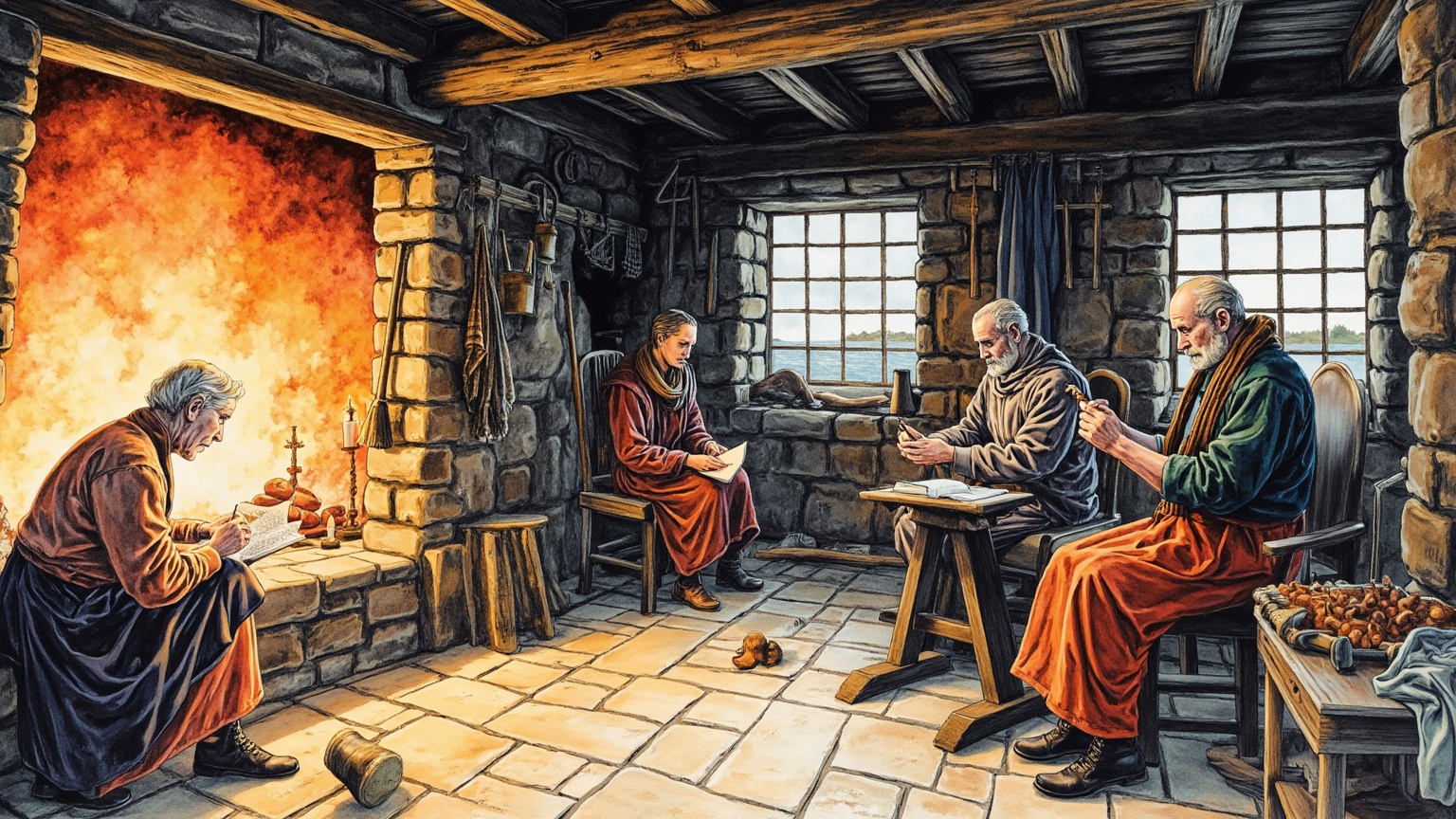
On the Isle of Lewis in the second half of the nineteenth century, peat smoke had blackened the stone walls of the cottage. An old woman in a coarse woolen shawl sat cross-legged by the hearth, spinning thread with one hand and straightening a lock of wool with the other. Across from her sat a man down from Edinburgh, notebook open, his Gaelic coming out slightly off. He could only take down her words in Gaelic letters first, then translate them into English later, working slowly. What she recited was not to be found in any hymnal — it was a handful of lines her grandmother had taught her, passed down from her grandmother's grandmother: what to say when the first fire is lit at dawn, what to say when it is banked for the night, what to say over the first drops of milk, what to say at the threshold when a child will not stop crying in the dark. No one had ever written these words down, and no one had ever thought to. She was one of the last people on the island who still knew them.
The man taking it all down was Alexander Carmichael. Starting in the 1860s, he spent nearly every summer on a steamship out of Glasgow, heading west through the rain and mist of the Hebrides, working his way from island to island. He had a classical education, but the longer he sat by these hearths, the more weight he heard pressing under the words — this was not folklore, it was another theology. Over thirty years he wrote down close to three hundred of them.
II. Not a Book but a Sanctuary Rescued Just in Time
Carmina Gadelica first appeared in Edinburgh in 1900, four volumes with the Gaelic original set against an English rendering, page facing page. There is no protagonist, no plot, no rising and falling action — it is a collection, setting down, one by one and exactly as spoken, the oral prayers scattered across hearths in the Scottish Highlands and the Outer Hebrides. You cannot read it the way you read a novel, following a character. You read it the way you would page through a book of folk prayers: a milking prayer today, a prayer for setting sail tomorrow, a deathbed prayer the day after — each one standing on its own.
It is remembered because it is very nearly the last living record of any of this. Most of the farmwives, fishermen, and midwives Carmichael sat down with died within a few years of his visits; most of their children had already moved on, to Edinburgh Road in Glasgow, or further still, to Canada. Their hearths, their looms, their byres stood empty after that. We can still read these words today because, one summer, somebody opened a notebook.
III. Who Was Speaking, and to Whom
Several voices run through the book, all circling the same hearth. The old woman who prays by the fire — the Gaelic calls her the sean bhean — is the main keeper of these words, most often the grandmother of a Catholic fishing or farming family. The oarsmen out on the fishing boats have their own sea prayers: one for setting out, one for casting the net, one for a storm, one for the storm's passing, one for a safe return to harbor. Highland herdsmen say a working prayer over driving the cattle, shearing, milking. The weaver at her loom has a prayer for starting a piece of cloth, for the first throw of the shuttle, for cutting the finished length free. The midwife by the fire stands guard at both of the fragile crossings — the birth bed and the deathbed. The smith at his anvil says one over the first hammer blow, one over the quenching, and names each piece of iron he makes, as if sending it into the world with a baptism.
Who were they praying to? To Saint Columba, the sixth-century abbot of Iona and patron saint of the Hebrides. To the Virgin Mary. And to older names too, buried under Christianity but not gone: the sea god MacCrummin, Brigid the keeper of the hearth-fire, the Earth Mother. What unsettles a reader is not that these names coexist, but that the people praying never seemed to feel any contradiction in it — Saint Columba and the Earth Mother sat at opposite ends of the same hearth, and you asked whichever one governed the task at hand. This is a hybrid form particular to Celtic folk Christianity, and it looks nothing like the Latin Christianity of southern Europe or the Protestantism of the north.
IV. Lighting the Fire, Drawing the Milk: A Day That Begins in Prayer
Dawn. The old woman by the hearth rakes the ashes apart and pushes in freshly cut peat, and the moment the flame catches, she says a low prayer over it. Not the kind a priest taught her — a few syllables in Gaelic, handed down from her mother, spoken to the fire, to the light, to the new day. This kindling prayer is among the earliest in the book. There is one for banking the fire too, for shutting the door, for closing the window, for before breakfast. The day has not properly begun, and already the house has been prayed into a small sanctuary.
The sun climbs higher and she carries her wooden pail into the byre. The calf nudges her leg, she crouches down, and the first stream of milk goes — not into the pail. She lets it fall on the ground first, an offering poured out to the earth: to the earth itself, to the Virgin, to some older Earth Mother behind her. Only then does she set the pail steady and begin milking in earnest. The gesture itself is a prayer, before a word is said.
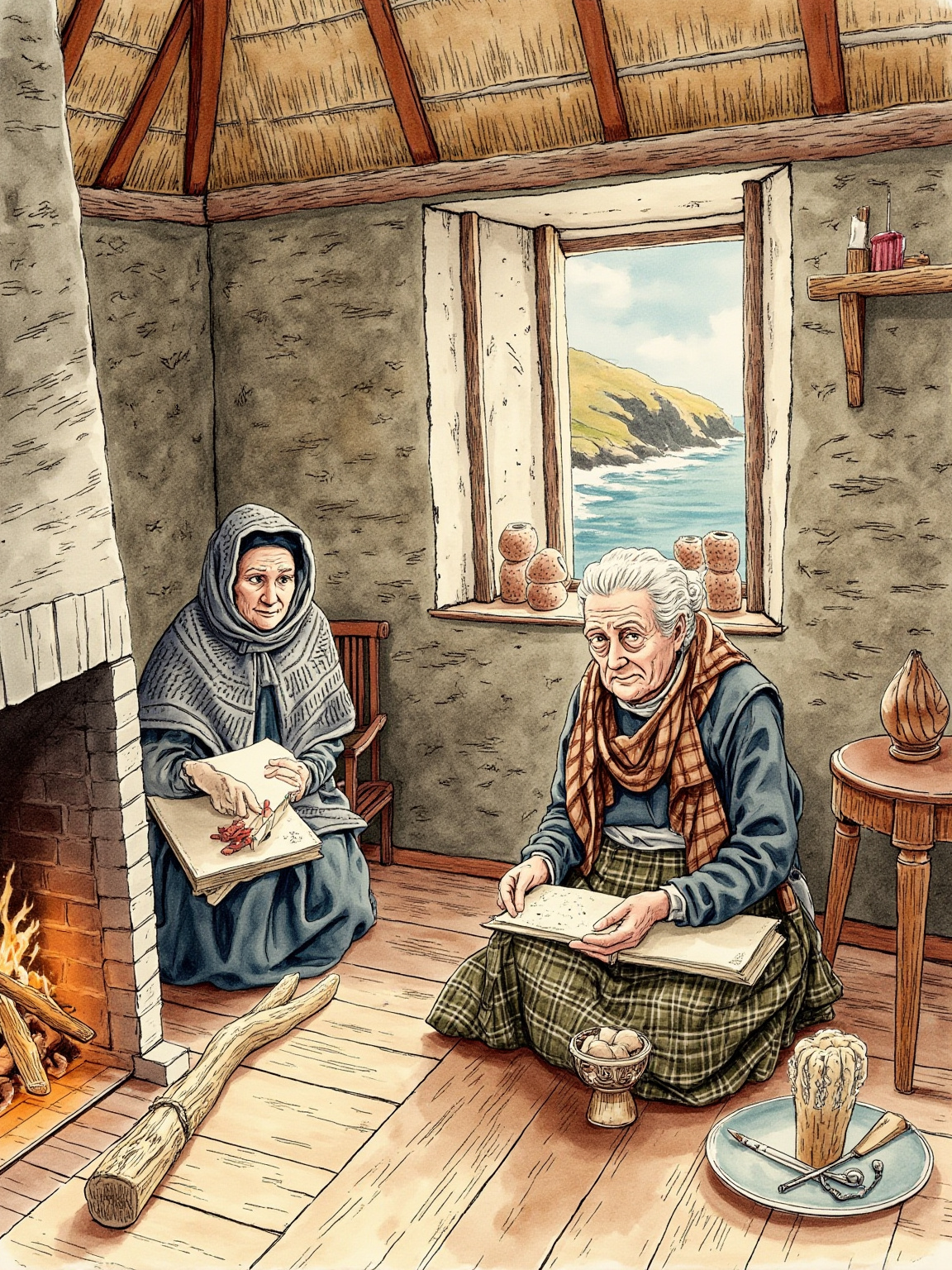
The first milking of the cow is given to the earth before it is given to the bucket.
牛身上挤下的第一缕奶,要先还给大地,才轮到木桶。
金句 · 挤奶祷 · 第一缕奶的祝圣
V. The Herdsman and the Weaver: Every Kind of Hand Has Its Own Prayer
A Highland herdsman drives his black-faced sheep over the ridge while the fog still hangs low. The flock scatters to graze and he stands at the top of the slope and says a blessing over them — three lines of Gaelic, asking that the flock be spared disease and straying. Once they are penned he counts them, finds one missing, and says another charm, this one for bringing a lost sheep home. None of this is performance. It is simply what he mutters before he takes the sheep out, after he brings them in, and whenever one goes missing.
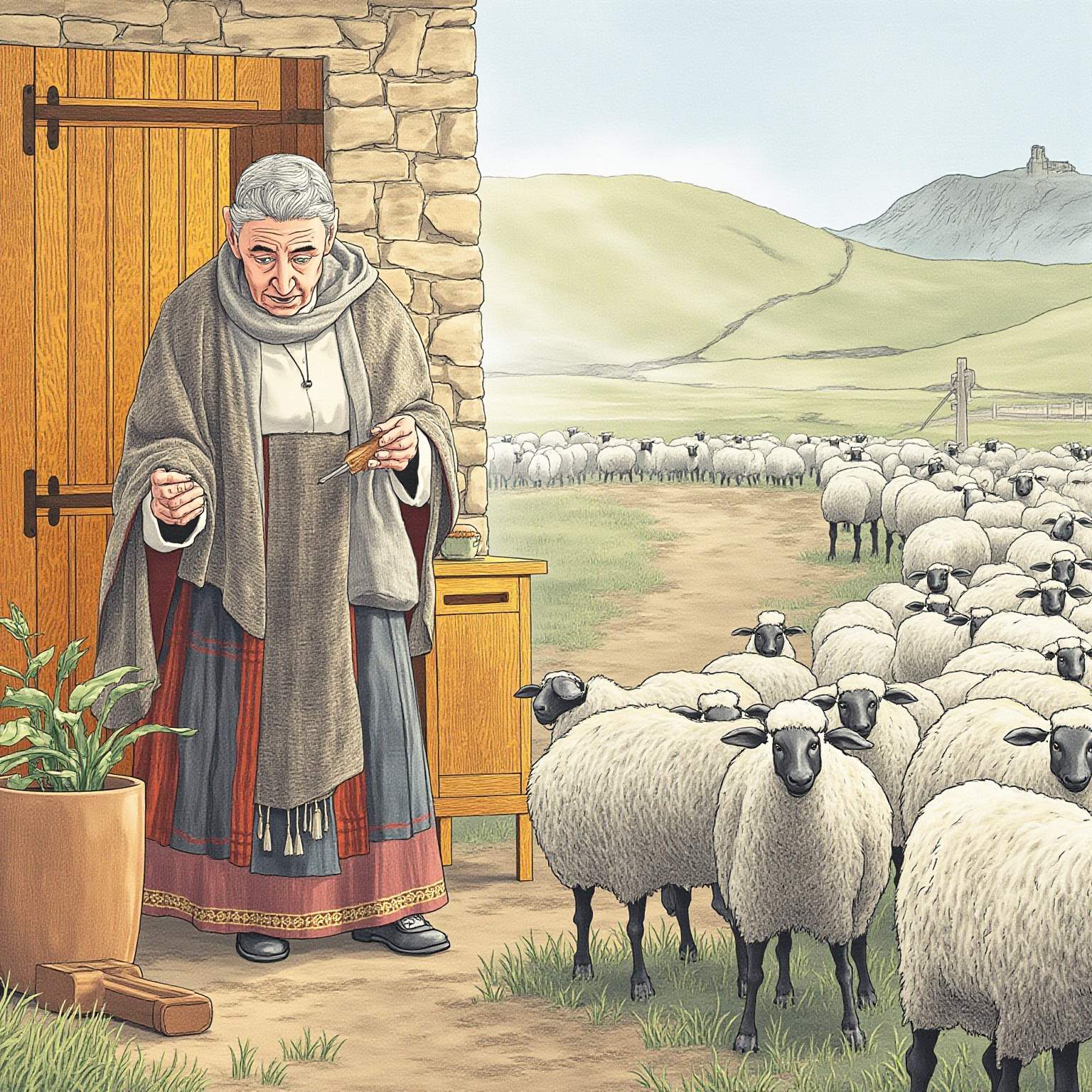
The shepherd counts the flock and finds one missing, and a prayer goes up for the lost sheep.
羊群入了圈,他数一遍,少了一只,便起身为那只迷途的羊念祷。
金句 · 牧羊祷 · 迷途归羊咒
The weaver's scene is more private. Her loom stands by the window, and before she treads the pedal and throws the shuttle across the warp for the first time, she says a prayer over the shuttle. She says one while winding yarn. She says one before lifting the dyed thread out of the indigo vat. Before cutting the finished cloth free, she stops, presses it to her chest, and says a cutting prayer — asking that whoever wears this cloth someday be kept safe from drowning, from fire, from gunshot. By the time a length of cloth leaves her hands, it has already been prayed over more than once.
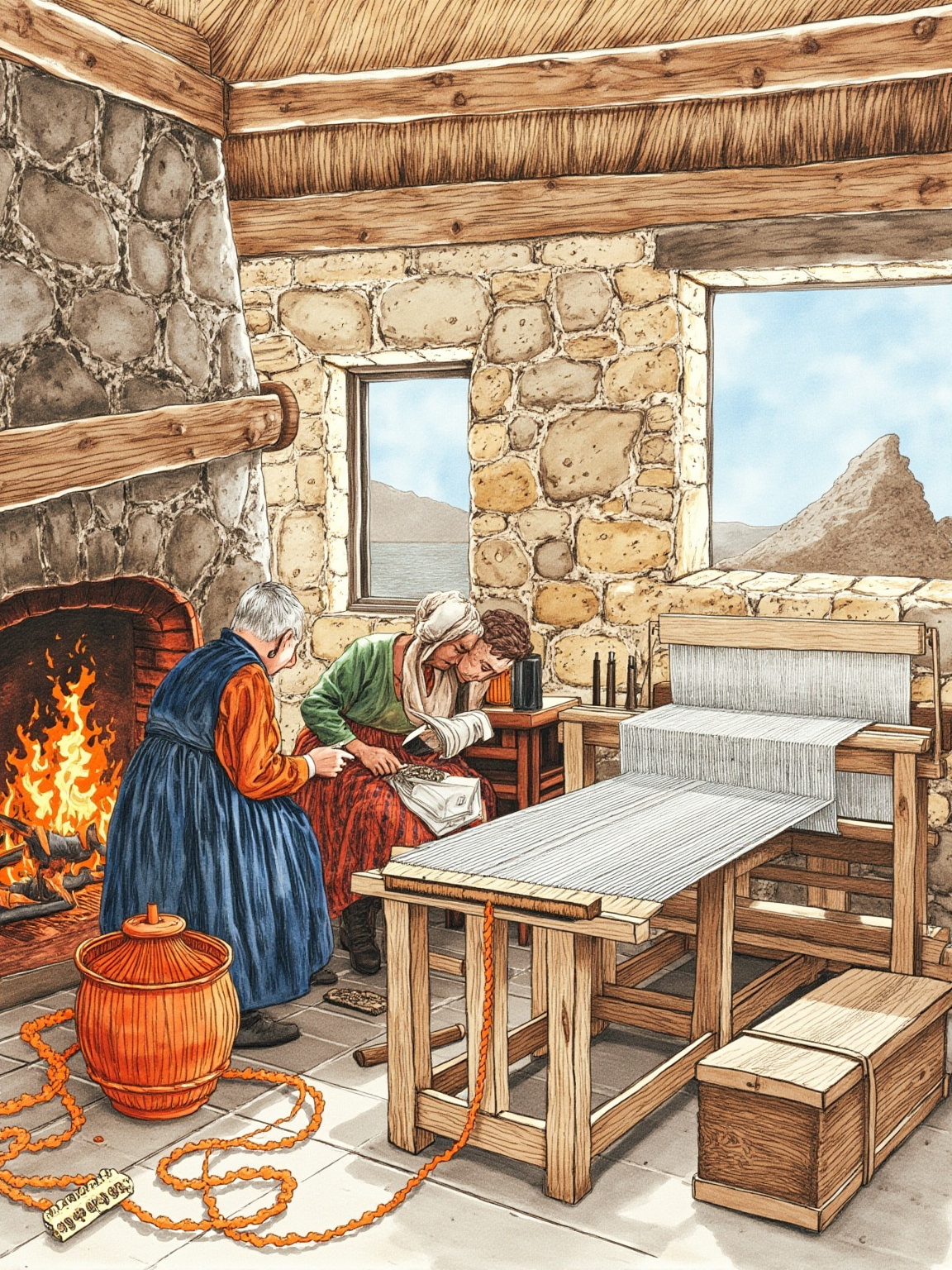
She lays the cloth against her breast before the shears fall, and asks a blessing on the cut.
剪下最后一块布之前,她把布贴在胸口,祈求这一剪被祝福。
金句 · 裁剪祷 · 织机旁的祝圣
VI. Setting Sail and the Storm: A Hybrid Theology at Sea
At the bow. Before a fisherman casts off, he stands straight at the prow and says a few lines of Gaelic: to the Virgin Mary for safety, to Saint Columba for safety, and to the old sea god called MacCrummin, asking him not to raise the waves today. All three names come out of the same mouth with no pause between them, no shift in register — in his mind these are not three different systems of the divine at all.
When a storm hits, no one is stopping to sort out the theology. The waves smash white against the gunwale, the men grip their oars, and they say, low, a storm prayer — its gist is: let death come for me, friend of Columba, and they hand themselves over, hand the boat over, to the saint. When the wind drops and the sea flattens out, they say a different prayer, one to calm MacCrummin, thanking him for not turning them over after all. In a single crossing, the Virgin, the saint, and the sea god all get called on.
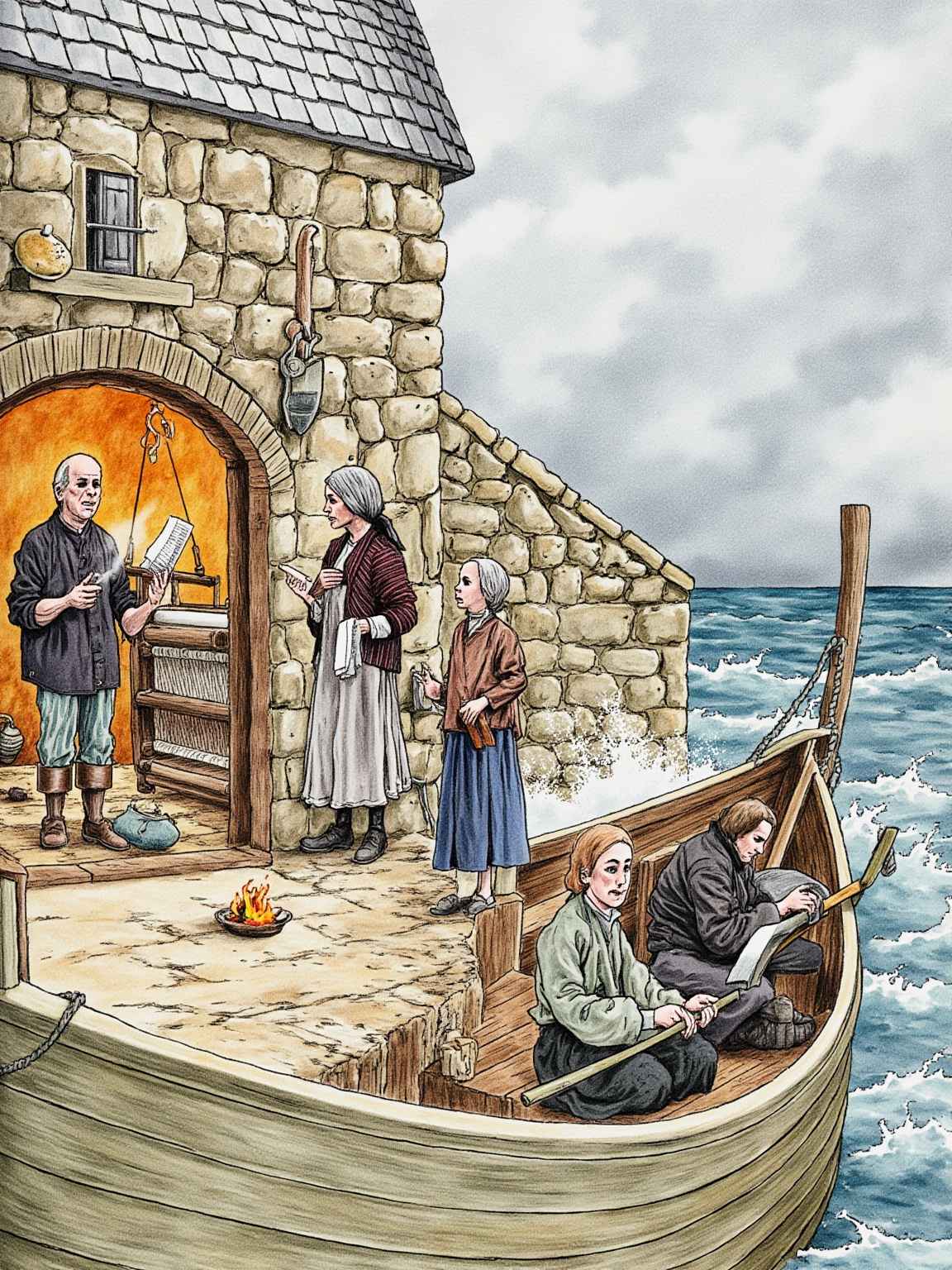
Three names leave the same mouth without a pause — Mary, Columba, and the old sea-god MacCrummin.
圣母、圣科伦巴、还有那更古老的海神,三个名字从同一张嘴出来,中间没有停顿。
金句 · 起航祷 · 船首的混生祝祷
VII. The Birth Bed and the Deathbed: The Watcher at Both Ends of the Threshold
These are the two most solemn voices in the book. The mother lies in bed, and the midwife — Gaelic bean-ghlùine, the one at the knee — sits at the bedside with one hand resting on her belly, saying, low, a charm against the sian, a roving spirit said to drift into the birth room at night and steal a newborn's breath. What the words actually do feels less like an incantation than like shutting a door, keeping some cold out of the room.
The same midwife, years or decades later, might sit at another bedside — this time a deathbed. In the moment before the last breath, she says a soul-leading prayer, a few lines of Gaelic that guide the departing soul out from the bedside and onto its way. Both thresholds — the door life comes in through, the door it goes out through — are kept by the same voice, the same posture. No one else in the book stands closer to this world's entrance and exit.
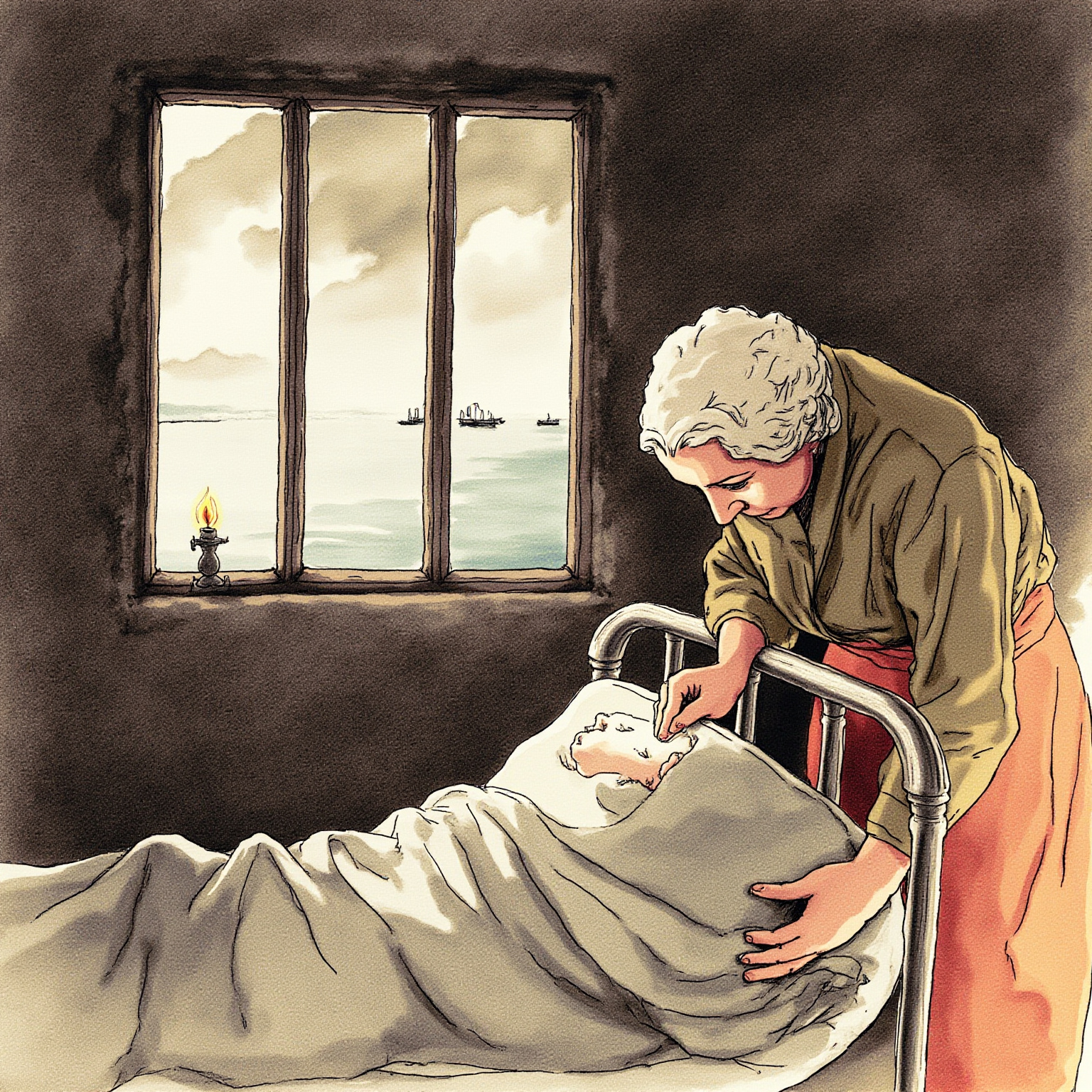
The same woman who brought the child in will, years later, sit at another bed to see the soul go out.
同一位接生婆,几年或几十年后,会坐在另一张床边,送走一个人的灵魂。
金句 · 产褥祷与临终祷 · 门槛两端的守夜人
VIII. The Smith Brands the Name of the Trinity into Iron
The last songs in the book belong to the anvil. Before the first hammer blow, the smith heats the iron in the forge until it glows orange, draws it out, and says a prayer — the name of the Father, the name of the Son, the name of the Holy Spirit, one name for each of three falling strokes. When he quenches it and the iron hisses up white steam, he says a blessing over it; every piece he forges is named, sent out into the world the way a child is sent out through baptism.
Branding the name of the Trinity into iron is the most physical, most bodily scene in Celtic folk Christianity. Faith here is not something that happens in the head — it happens in three strokes of the hand. By the time you reach this passage, you understand why the book's English subtitle uses both Hymns and Incantations: the first half is poetry, the second half is spellwork, and there is no line drawn between them.
Three blows on the iron, and three names — Father, Son, and Holy Spirit — hammered into the steel.
三锤落下,圣父、圣子、圣灵之名,一锤一个,烙进滚烫的铁里。
金句 · 铁匠祷 · 圣三之名烙入铁中
IX. Why It Was Remembered
Folklorists group it with the Isle of Man's Manx Carols and Ireland's Ancient Irish Hymnology as the three great rescue texts of Celtic oral tradition. All three share the same thing: each was gathered from hearths that were about to go silent, each recorded words passed mouth to mouth among farmers at a time when barely half of them could read or write. Twenty years later, none of it would have been there to collect.
For a reader today, it offers a counter-argument: ordinary labor as sacrament — milking is sacrament, weaving is sacrament, setting sail is sacrament, driving the first nail into a door is sacrament, dying is sacrament. Our generation has grown used to cutting faith out of daily life, letting it happen once a week, for one hour on Sunday morning. The Gaels in this book packed faith into the start of every single action instead. It is a different way of living, a different way of dividing up time.
Faith was never an eleven o'clock Sunday morning matter — it was the line of Gaelic you said over the first drop of milk.
X. Even Knowing All This, the Text Itself Still Rewards Reading
A companion guide gives you the map. The text itself is the ground. On the map you can see which prayer belongs to milking and which to a storm; on the ground you can smell the sharp bite of peat smoke, hear the nasal edge the vowels take on when the original Gaelic comes out of an old woman's mouth — translated, those sounds go dead; only the original still has a pulse. And there is one more thing no companion guide can ever give you: the footnote at the end of each prayer, written by Carmichael himself, a few lines noting the year, whose mouth he heard it from, whether the fire was still burning or nearly out. Watching one person set down another person's last words is quieter, and stranger, than the words themselves.
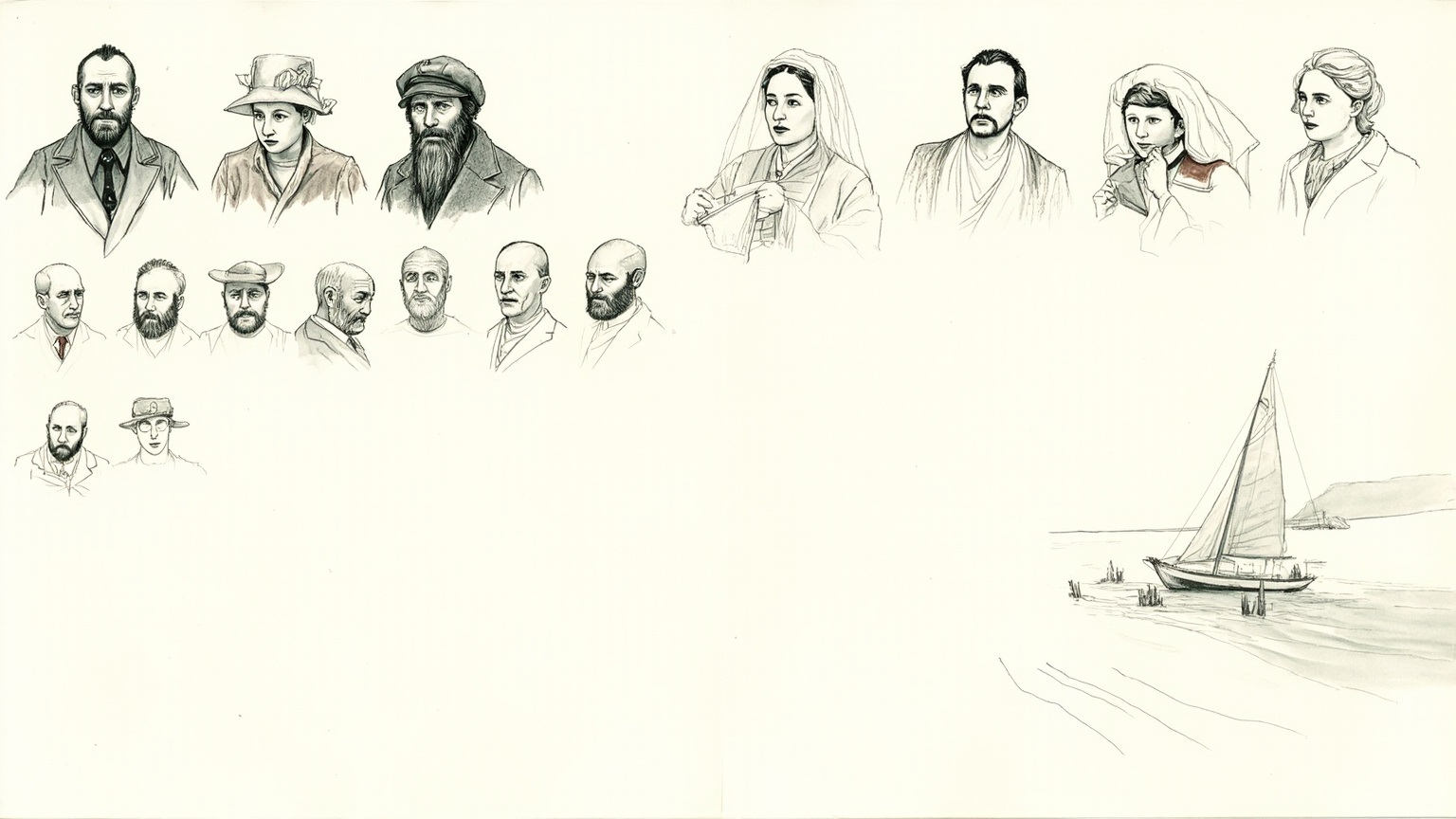
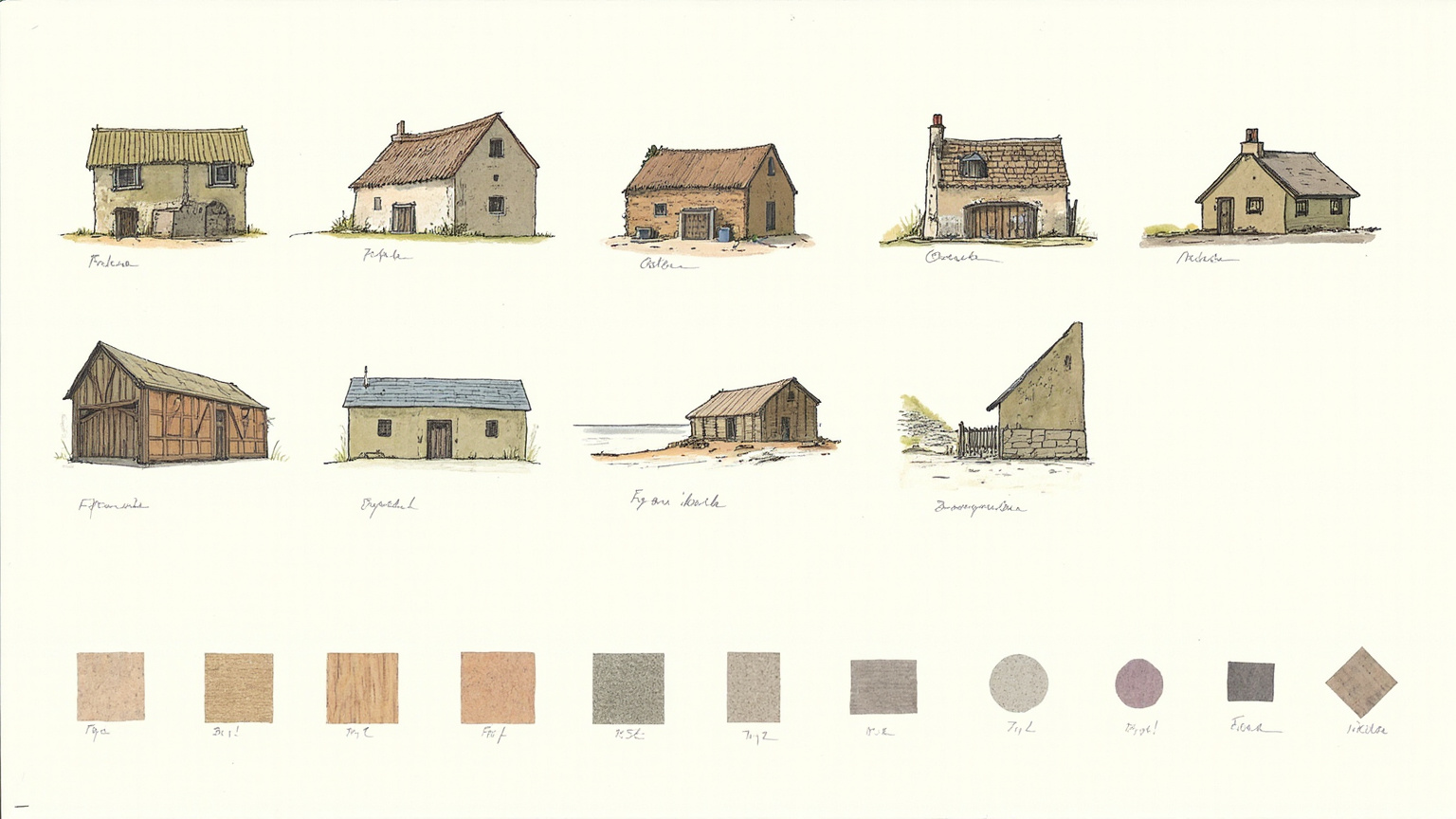
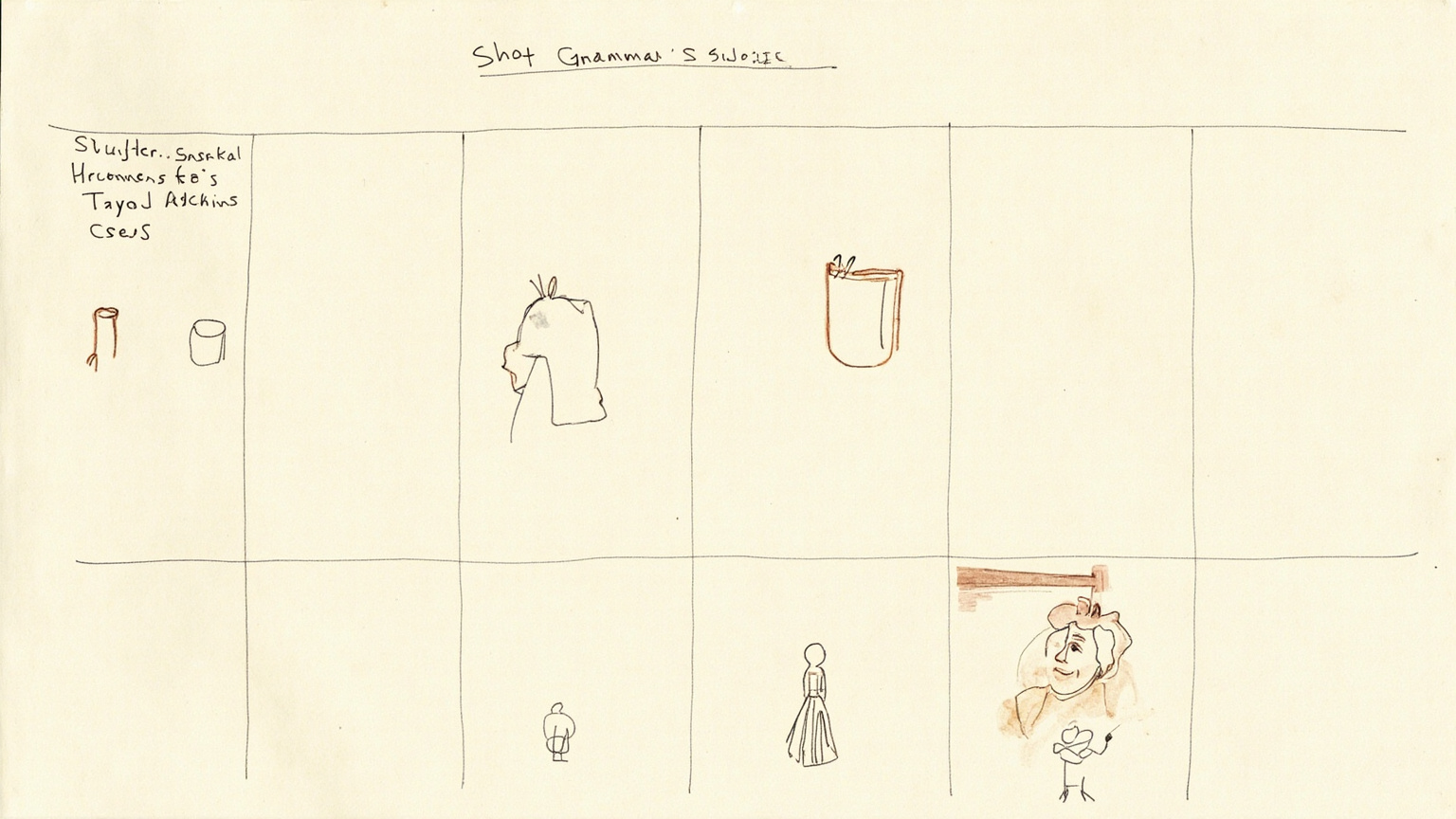
Art Direction4 plates
Before the guide was written, this book got a visual foundation — every illustration you just read grew out of it.