Crime and Punishment · Companion Guide
罪与罚
一个退学大学生为验证“超人有权逾越道德”的理论,在圣彼得堡的炎夏中举起斧头,却从此陷入高烧与谵妄,发现真正的惩罚不是监狱,而是自己内心的审判。
The opening: a stifling attic, and a theory in his head
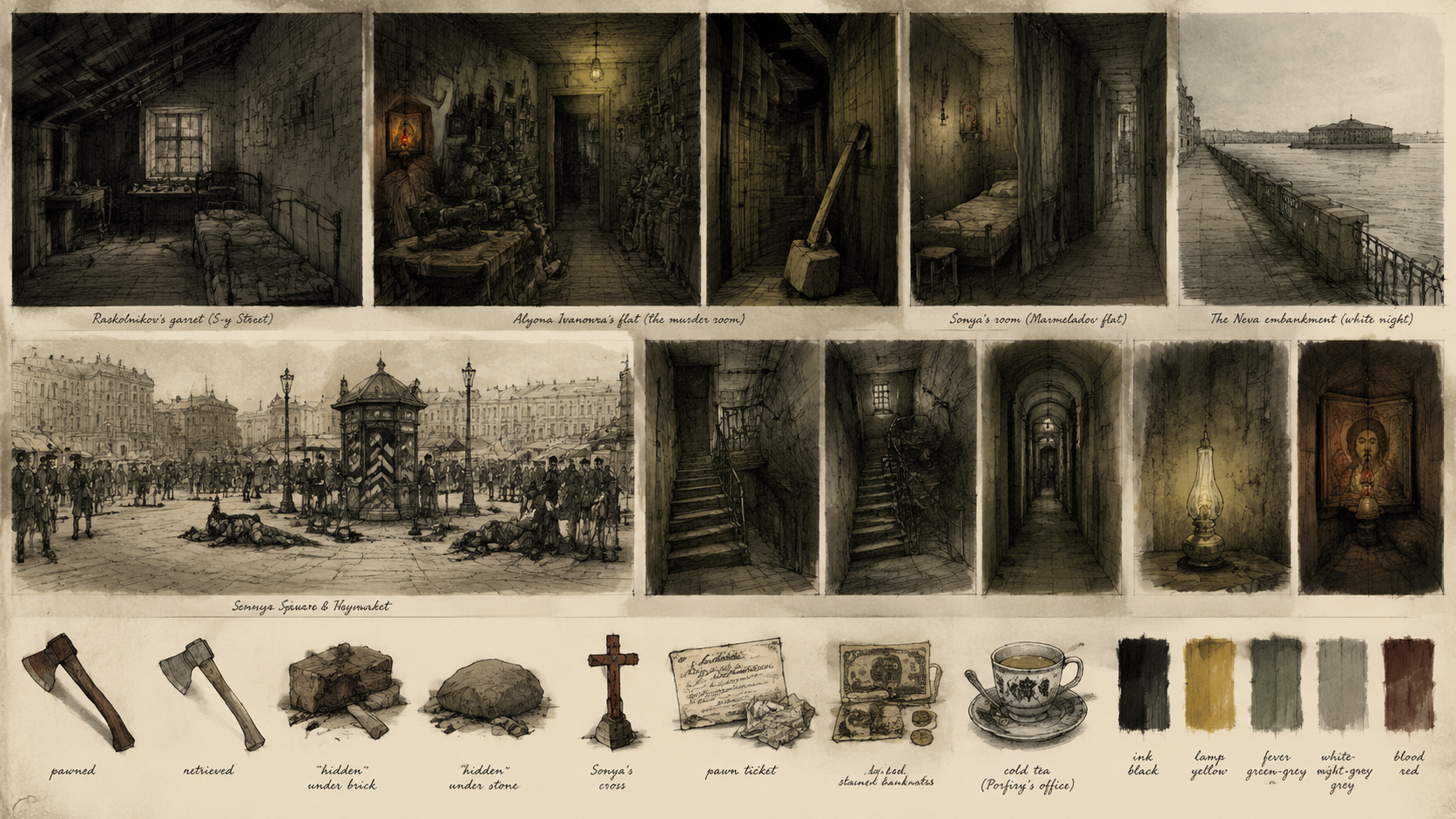
Petersburg in high summer: no air conditioning, an attic that turns into an oven. A poor former law student paces back and forth in a room the size of a closet, one thought looping in his head: there exists a kind of extraordinary man, entitled to step over morality and the law for a great enough purpose. The idea isn't new, but this time he decides to act on it. He sharpens an axe and goes to see the vicious old pawnbroker downstairs. The opening doesn't run on suspense — you already know he's going to do it. What's suffocating is that he's still arguing with himself about whether to, and that argument is worse to sit through than the murder itself.
What kind of book this is
Crime and Punishment is Dostoevsky's novel, serialized in The Russian Messenger in 1866, and it's widely credited with founding the psychological novel as a form. Dostoevsky himself had been sentenced to death as a young man for belonging to a radical political circle, and had his sentence commuted to hard labor in Siberia at the very last moment before execution — that brush with death and the strange resurrection that followed is the deepest undercurrent in this book. It's remembered not because it's a detective story or a moral lecture, but because it's a report on a killer's consciousness written almost against the skin: what actually happens inside a man's head after he has killed someone.
People and place: a few faces from the Petersburg slums
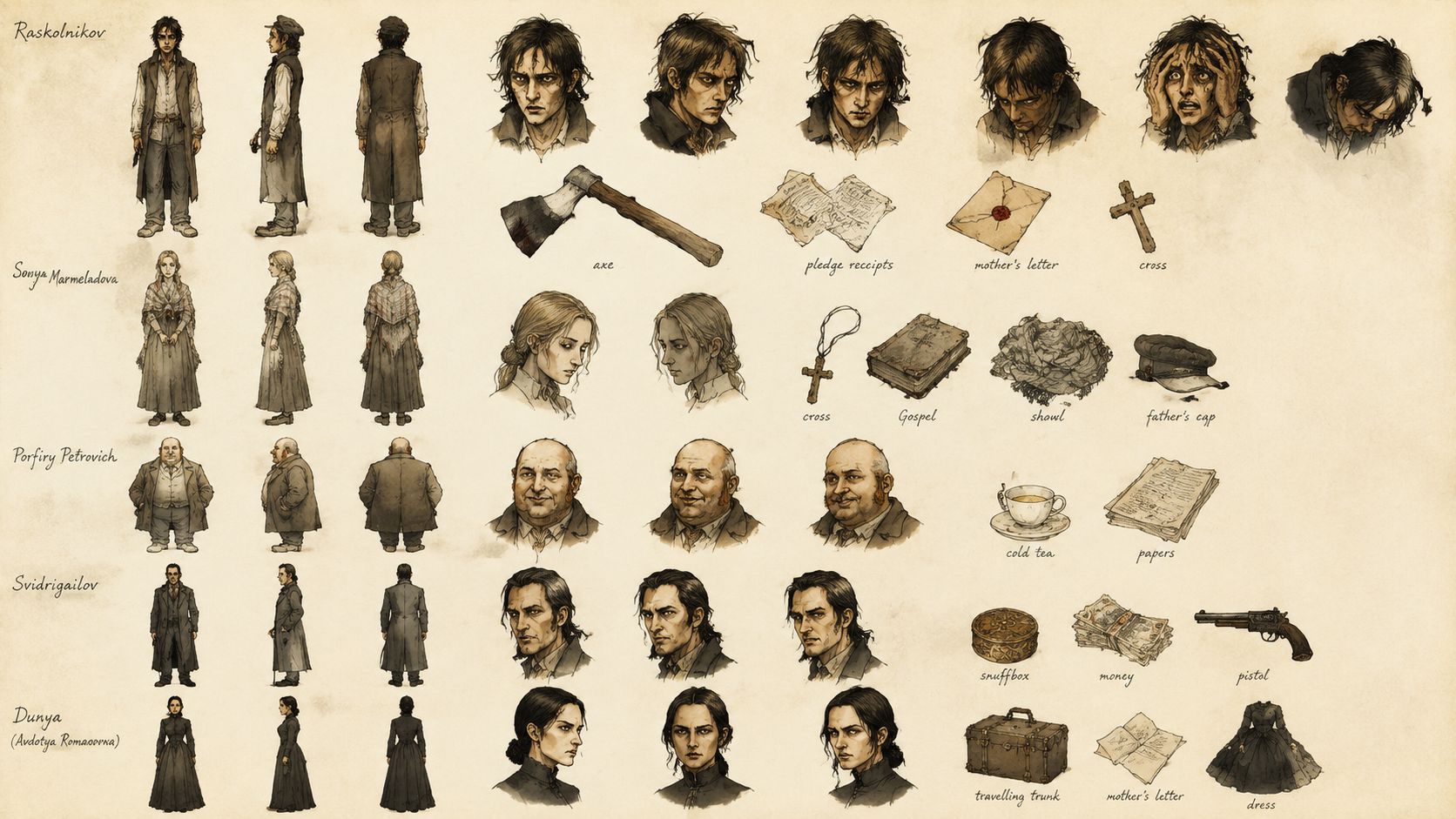
The whole book plays out in a filthy, crowded slum near the Haymarket in St. Petersburg — cramped apartments, stairwells that reek, air that feels like a hand pressing down on your head. Our hero, Raskolnikov, is a poor former law student, and the theory that justifies murder is the lifeline he built for himself — and also the thing that later drags him under.
His real opponent isn't the police — it's Sonya, a young woman forced into prostitution to support her drunkard father's family. Two people who each already consider themselves sinners take their masks off in front of each other. One more figure worth remembering: Porfiry, the examining magistrate, who has no evidence but is a master of talking people into a corner. And Raskolnikov's sister Dunya, who is nearly maneuvered into a mercenary marriage and then harassed by a morally rotten landowner — we'll get to these threads later, but they're all supporting cast for Raskolnikov's private purgatory, not the main line.
Plot thread one: the moment the axe falls
The novel's cruelest move is to strip the murder of any heroism. Raskolnikov creeps up behind the old woman, raises the axe, and brings it down — the author barely mentions his grand motive at all, dwelling instead on his shaking fingers, the axe handle sticking in his grip, the physical nausea of the moment blood gets on his clothes. Then, after the axe falls, the real trouble arrives: the old woman's simple-hearted stepsister Lizaveta walks in on the scene, and in his panic he raises the axe again. That second killing is the debt his conscience can never pay off — for the old woman he can hide behind his theory, but for Lizaveta he has no excuse at all.
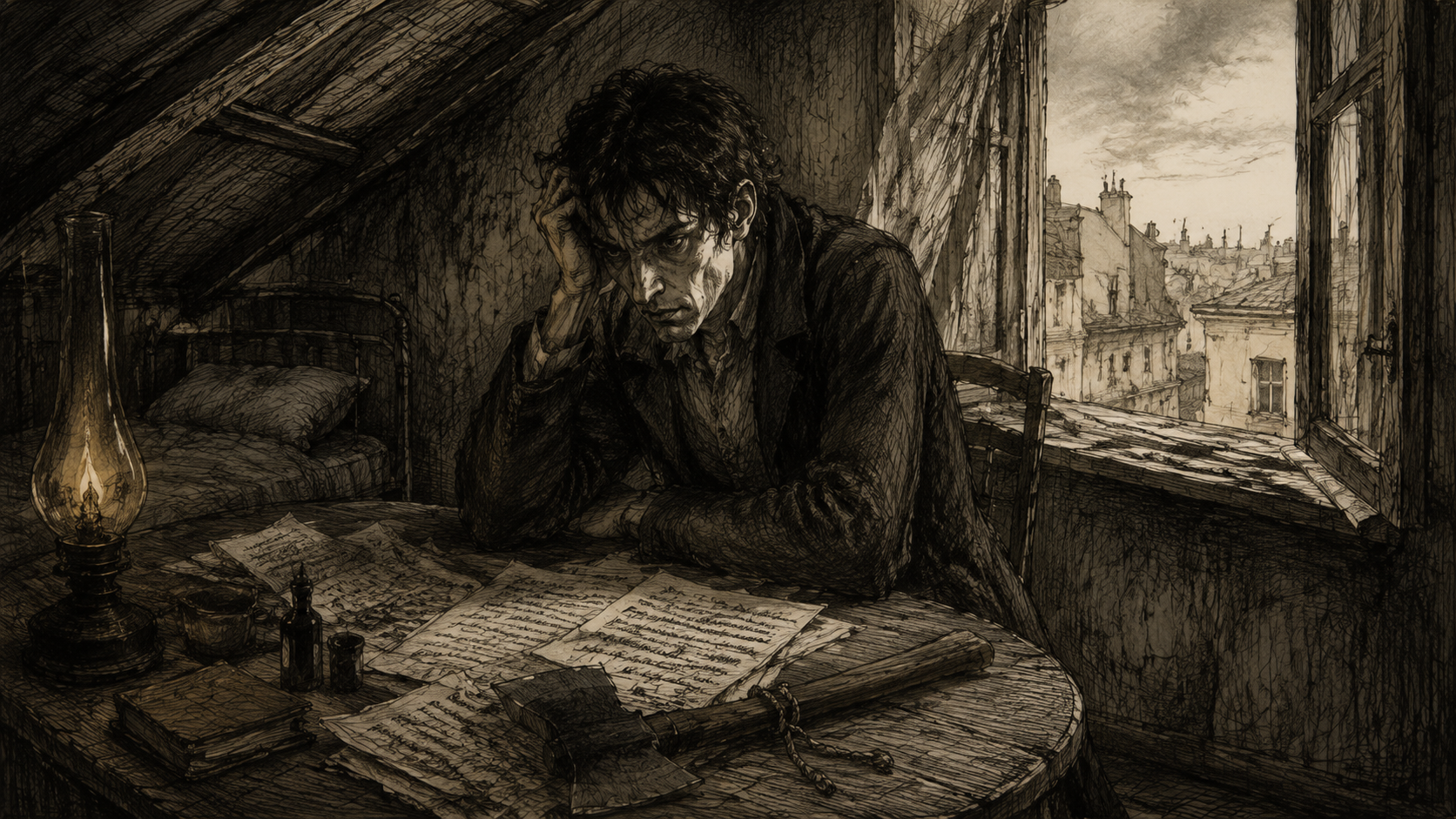
"You are talking and speechifying away, but tell me, would you kill the old woman yourself?"
你夸夸其谈,说个不停——那就告诉我,你会亲手杀了那个老女人吗?
原文金句 · 书程13%
Plot thread two: self-interrogation in a fever
After the murder he doesn't run — he goes home and collapses into bed, and then spends days delirious with fever. Dostoevsky writes the whole fever as a civil war: the body burning, the mind burning worse. One moment he believes he's a Napoleon, one of those extraordinary men; the next, every sound on the staircase sounds like someone coming to arrest him. The author's trick here is exact: he never writes "he felt remorse." He writes "he was about to feel remorse, and then the theory jumped back in to defend him." That's the book's central mechanism — the killer isn't caught by the police, he's strangled, slowly, by his own theory.
Plot thread three: taking the armor off in front of Sonya
He gets to know Sonya, a young woman whose father drinks, whose family is destitute, and who is forced onto the street carrying a yellow ticket. The worse off Sonya is, the more he can relax around her, because they're both people the world has already convicted. Between two sinners a strange understanding grows: he tests her and she doesn't flinch; later, when he lays out the whole truth of the murder, she doesn't step back and she doesn't raise her voice — she hands him a cross with a trembling hand. The writing here is restrained; the author strips out every word of emotion and lets a handful of small gestures from Sonya do the talking, and that does more to corner Raskolnikov than any accusation could, planting the real fuse for the confession that follows.
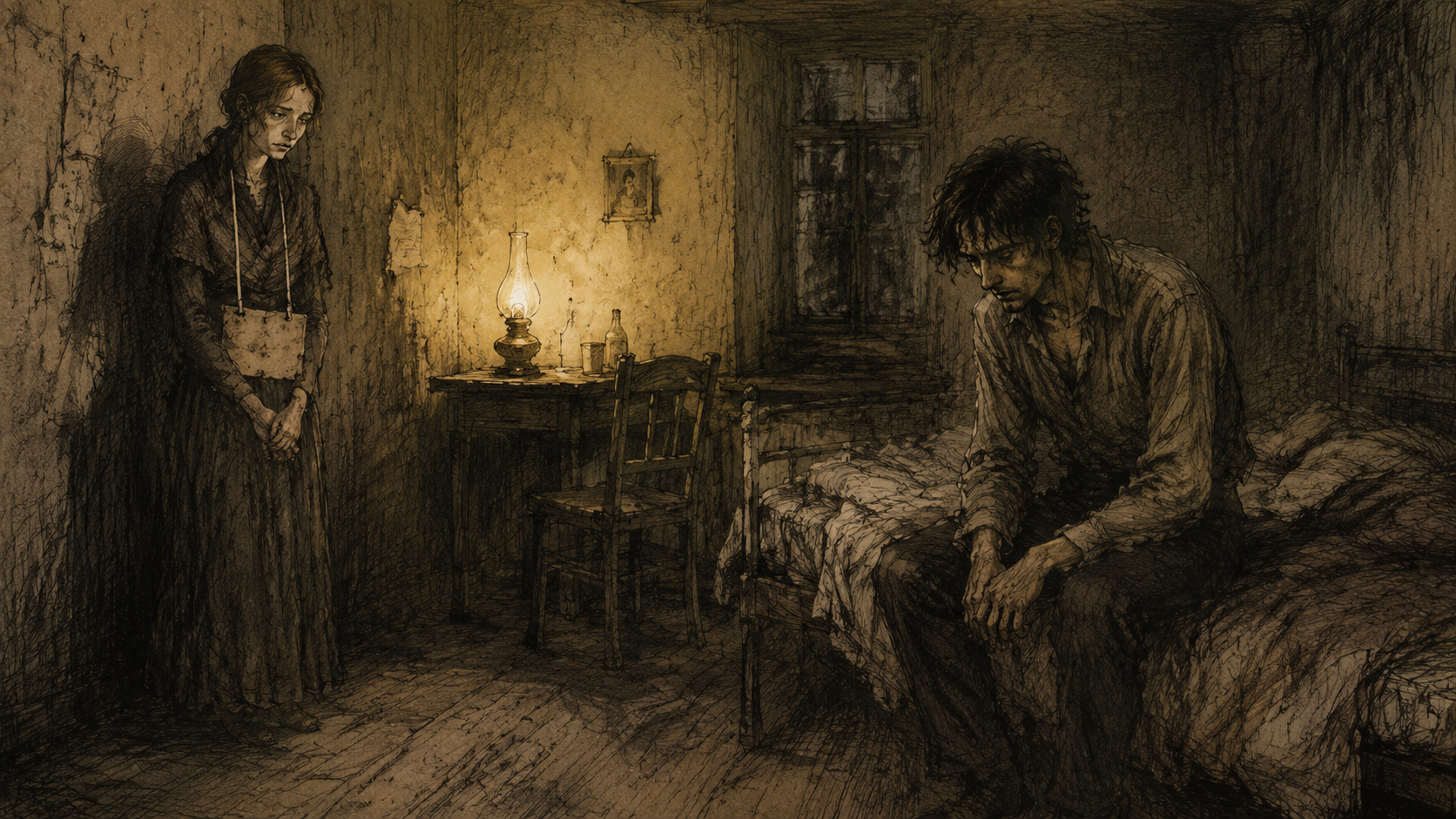
"I asked you to go with me yesterday because you are all I have left."
我昨天要你跟我一起走,因为你是我仅剩的一切。
原文金句 · 书程75%
Plot thread four: Porfiry's psychological siege
This is where Porfiry, the examining magistrate, enters. The man has no hard evidence at all — no fingerprints, no witnesses, no stolen goods. His only weapon is conversation. He calls Raskolnikov into his office again and again, pours tea, chats about philosophy, chats about the theory of the extraordinary man, and every line sounds harmless, almost like idle scratching, while landing precisely on the other man's weakest nerve. At one point Porfiry even says outright, "I know it was you," and then smiles and picks up his teacup. Raskolnikov walks out thinking he's gotten away with it, more than once, and more than once collapses in the street on the way home. This isn't a detective story — there's no flash-of-insight moment where the case breaks. There's only the long process of a killer being backed into a corner by his own conscience.
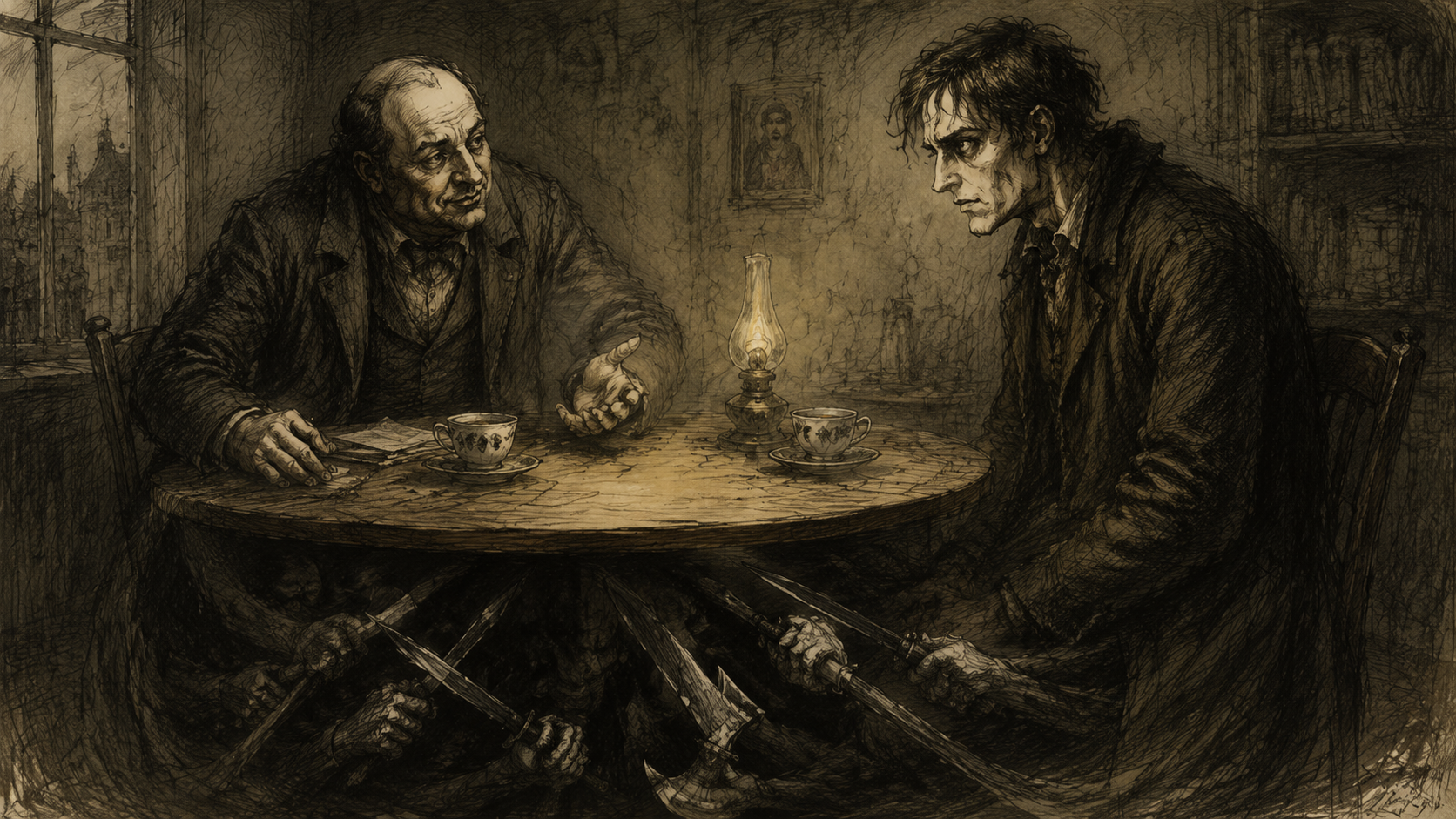
But he had already partly shown his hand, and no one knew better than Raskolnikov how terrible Porfiry's "lead"
但他已经部分摊牌了,没有人比拉斯柯尔尼科夫更清楚波尔菲里那种“引导”有多么可怕。
原文金句 · 书程65%
Plot thread five: Sonya's command — go kneel in the square
Raskolnikov finally says the words to Sonya: "I killed her." Her reaction is the most chilling moment in the whole book — she doesn't cry, doesn't scold, doesn't run. She takes his hand and tells him to go out right now, to the crossroads, kneel down, kiss the earth, and tell the whole world, "I killed her." The demand is cruel past all reason, but it carries a truth in it: a soul can only begin to heal once a person hands himself over of his own will. The scene is written with real skill, too — Sonya's love isn't warmth, it's a blade, a gentle, necessary, non-negotiable blade.
Plot thread six: kneeling in the square, and turning himself in
In the public square, he actually kneels down — dust on his knees, bystanders watching in confusion. Then he gets up, walks into the police station, and says, "It was me." This is the most important moment in the book: he isn't caught, he hands himself over. The author plays the confession as pure anti-drama — no swelling music, just the smell of dust in a summer square and passersby looking at him like he's a madman, and it's exactly that everyday awkwardness that nails the redemption down as something concrete and real rather than staged.
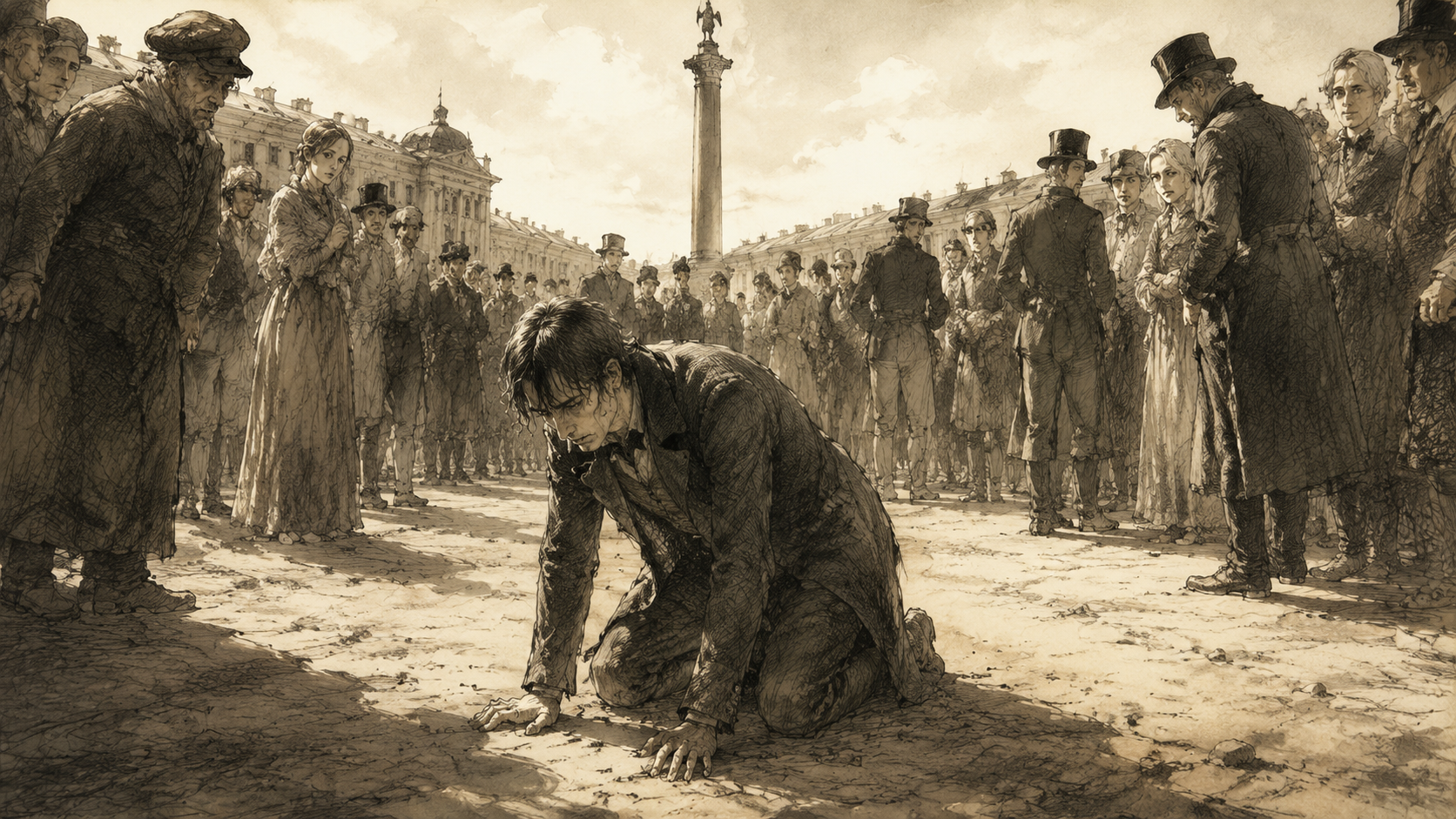
"You always have been a very rational person and you've never been mad, never,"
你一直是个非常理性的人,从来不曾发疯,从来不曾。
原文金句 · 书程80%
Plot thread seven: resurrection in Siberia
He's sentenced to hard labor in Siberia, and Sonya follows him there. The penal settlement is gray, bitterly cold, and short on human warmth — but Sonya is there beside him. At first Raskolnikov is cold to her; he hasn't learned how to accept being loved, and he even resents feeling judged by her love. But near the end of the long sentence, something hard in him finally gives way — and that's where the book ends, leaving the reader a hope that's restrained but genuinely there.
What it's really about
On the surface, this is a story about a poor student whose conscience won't let him rest after a murder. But the question it's really asking is: do you have the right to lift yourself out of morality? Crime and Punishment answers no — and that no doesn't come from the police or the law, it comes from inside you. Once the crime is planted, the punishment is internal: insomnia, fever, the inability to talk to people normally, flinching at every knock on the door. It still cuts today, because Raskolnikov-style self-justification is everywhere around us — I'm doing this for something bigger, I'm not like them, this small sacrifice is worth it — and what Dostoevsky wants you to see is that once a thought like that takes shape, you're the one who pays for it, alone, late at night.
Why it's considered a landmark of craft
This book founded the modern psychological novel — not memory recollected after the fact, but writing that stays pressed against the present flow of consciousness. In the chapters where Raskolnikov is sick with fever, the author all but drops you inside his skull: an unfinished sentence, a thought flickering past, the way one stranger's glance can trigger a collapse. That technique went on to shape an entire century of fiction and film. Its other great feat is stuffing an enormous philosophical question — can the extraordinary man kill? — into a handful of the most run-down streets and apartments in St. Petersburg: filthy stairwells, stinking walls, summer air thick enough to choke on, all of it turned into the mind's own scenery.
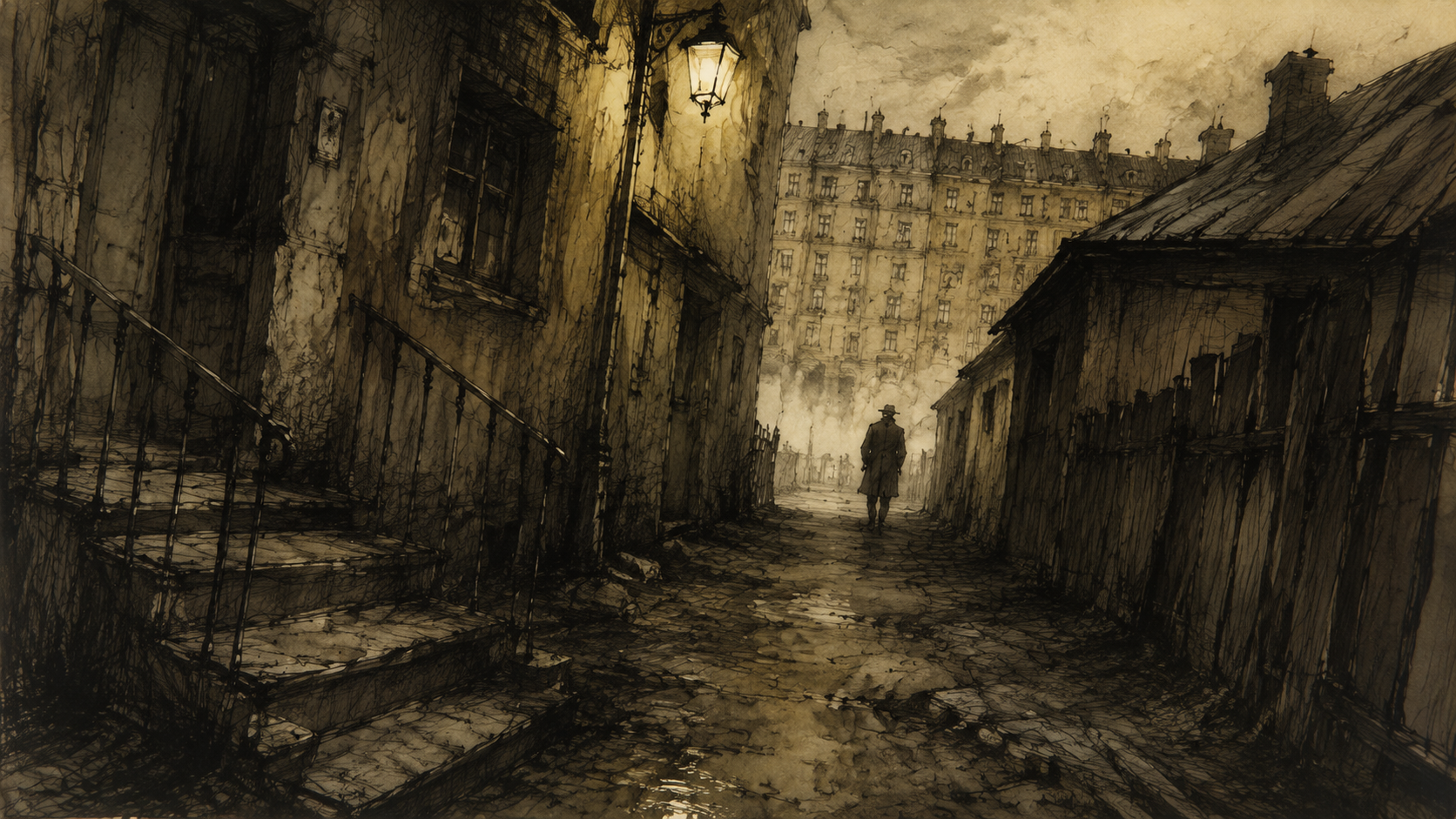
The whole horror of this novel is that the killer doesn't lose to the police — he loses to the theory he built inside his own head.
Why it's worth reading even if you know the plot
I can tell you how the axe falls, how Sonya begs him, how he kneels in the square — but I can't hand you that damp, feverish blur where reality and hallucination stop being distinguishable. What makes Dostoevsky so good is that he doesn't just write "Raskolnikov falls apart" — he keeps you with him in that closet-sized attic, through the delirious nights of fever, through the magistrate's conversations that are polite enough to make your skin crawl, until you start to doubt yourself a little too: would I have believed that theory as well? No summary can give you that experience of stepping into the criminal's own skin. And then there are Porfiry's conversations, which sound like small talk but cut to the bone every time — only the original's slow, layered buildup can make you feel that suffocating, step-by-step tightening. So go read it.
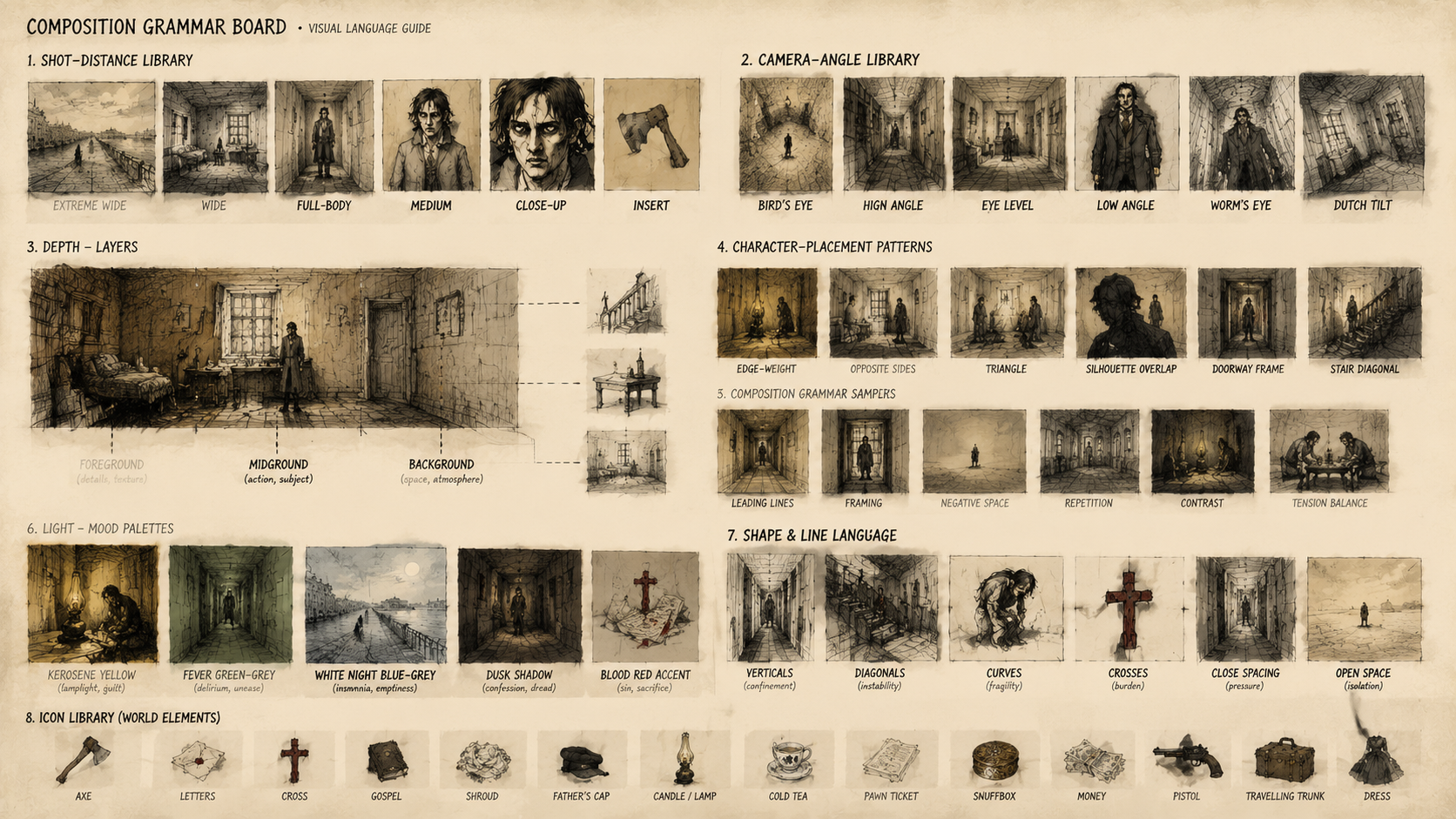
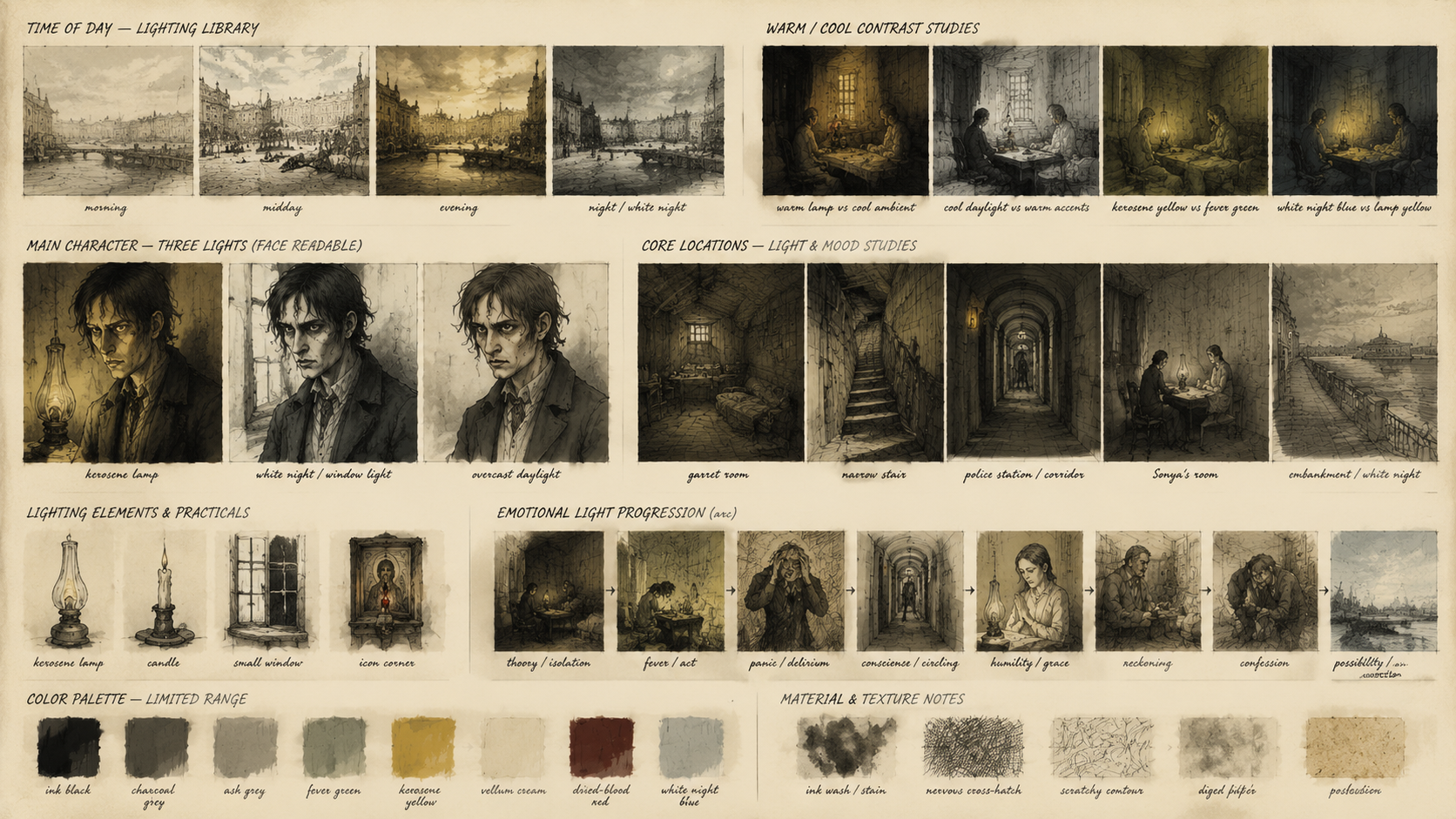
Art Direction4 plates
Before the guide was written, this book got a visual foundation — every illustration you just read grew out of it.