
Dead Souls · Companion Guide
Dead Souls
A respectable swindler rolls into the provinces by troika, going door to door to buy up dead serfs still on the census rolls—he is buying dead men's names, but what it reveals is a whole living landscape of dead souls.
Opening: A Troika Rolls Into a Nameless Provincial Town
A troika rattles into a small town with no name. It's the Russian light carriage, three horses running abreast, bells and wind exploding together, having rattled down a country road to get there. Out of it steps a middle-aged gentleman of middling build, neither fat nor thin, well dressed, with a smile that never slips. His name is Pavel Ivanovich Chichikov, and he looks like anyone you might meet at a dinner party: polite, modest, and always sure of the right thing to say to the right person. But the purpose of his visit would stop any normal listener cold -- he has come to buy "dead souls" from the local landowners. Not ghosts, not corpses: names still sitting on the census rolls, still taxed as if the men behind them were alive. The whole book starts from this one absurd piece of business.
What Kind of Book Is This
Dead Souls is Nikolai Gogol's (1809-1852) only novel, written in the early 1840s and hailed by the critic Belinsky as a landmark of Russian literature the moment it appeared. Gogol called it a "poem" (poema) -- don't let the label throw you; it is a Divine Comedy written in prose, with its hero circling through a provincial hell the way Odysseus circled the underworld, and the five landowners he meets standing in for five circles of vice. It is a founding text of Russian realism and satire: the words "dead souls," "Chichikov," and "Plyushkin" all passed into the Russian language itself, as shorthand for corruption, petty scheming, and hoarding. Two centuries later, it is still a mirror every bureaucratic society can see its own face in.
People and World: The Russian Provinces in the 1830s
The story unfolds in the Russian provinces under Nicholas I -- an era when serfdom was still in full force, the census taxed men by the head, and bureaucrats and landowners together formed the skeleton of the empire. The hero, Pavel Ivanovich Chichikov, is a small-time former civil servant turned traveling schemer: raised from childhood on his father's creed of saving every last kopeck, he has risen and fallen by petty graft and string-pulling ever since. He is no sorcerer -- just a shrewd, small-minded con man.
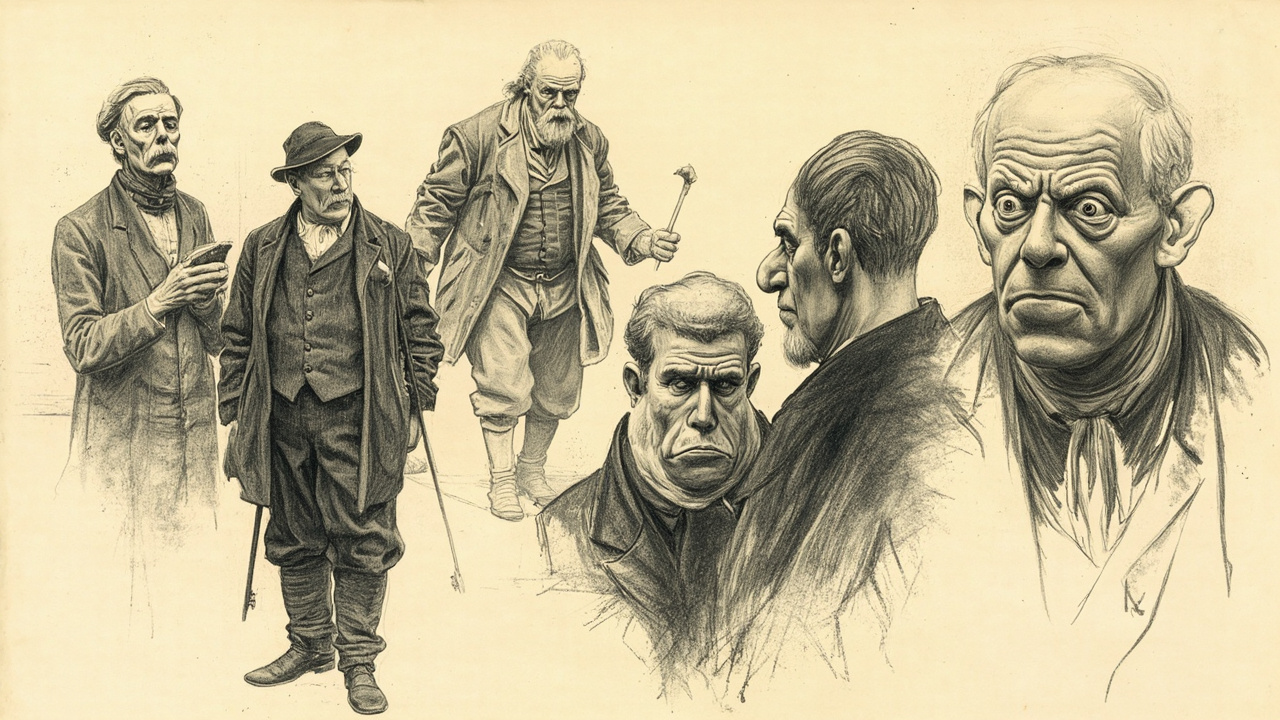
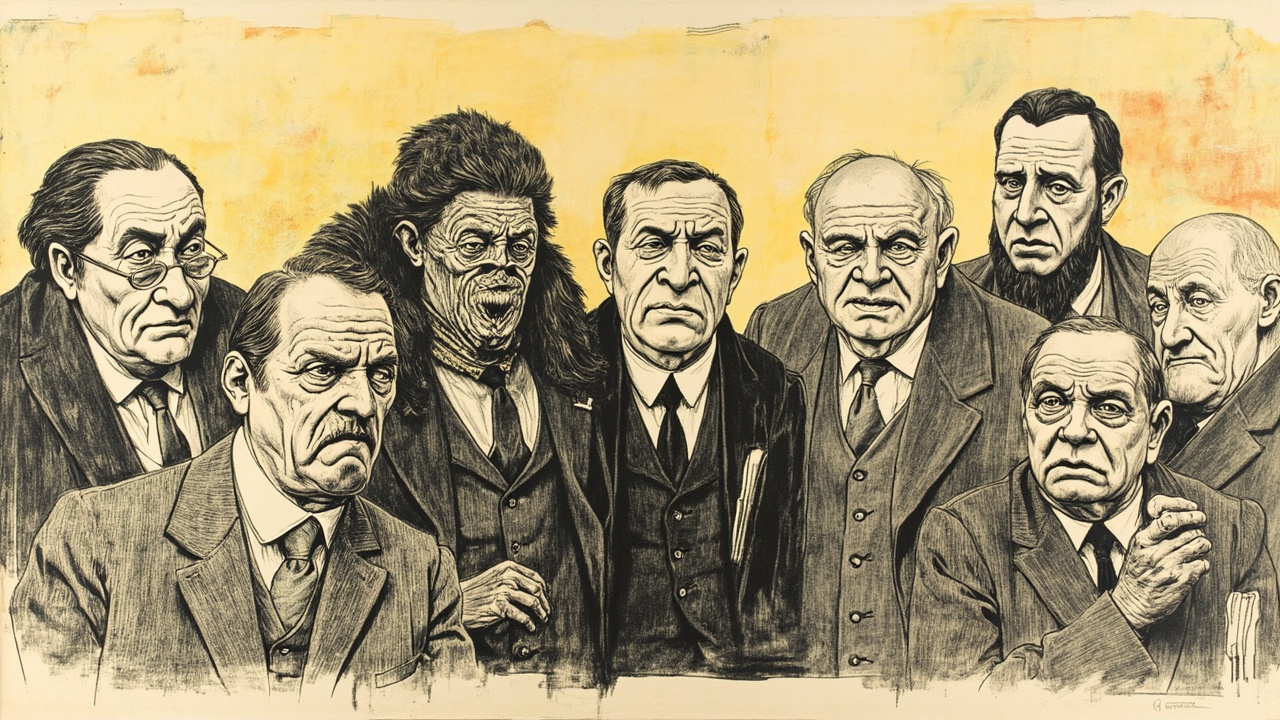
The provincial capital he drives into is left anonymous by the author, called simply the town of N. Its cast of officials -- the governor, the prosecutor, the postmaster, and their wives and daughters -- form the gray backdrop of this gallery of fools: the moment a well-mannered stranger shows up looking prosperous, they crown him a millionaire and the catch of the season for their daughters. But the real protagonists are the five landowners on the five estates outside town: Manilov, Korobochka, Nozdryov, Sobakevich, and Plyushkin -- five faces, five different ways of being broken.
First Stop: Manilov Gives It Away for Free
Manilov, master of the first estate, is a sweet, spineless dreamer gone soft on fantasy: his conversation drips with syrupy pleasantries, he talks endlessly of building a bridge with a covered gallery over his pond, and meanwhile the actual estate falls apart around him. When Chichikov tentatively raises the idea of buying dead souls, Manilov never registers how absurd the deal is -- he is too busy being moved to tears by the word "friendship," and in the end simply hands the souls over for nothing. The joke of the scene is that Gogol never lets Manilov think, because he can't: his mind, like his estate, has gone to ornamental weeds.
Second and Third Stops: The Hoarding Widow and the Drunken Bully
The second stop is Korobochka, an old country widow who hoards every last object like the box her name means -- dull-witted, suspicious, and pinching every kopeck, she interrogates Chichikov over and over about what price dead souls actually fetch, terrified of being cheated. It is she who later comes into town to check the going rate, and in doing so blows the whole scheme open without meaning to. The third stop is Nozdryov -- a manic braggart, a gambler who never pays his debts, a troublemaker looking for a fight. The deal falls through, he nearly beats Chichikov up over it, and worse still, it is Nozdryov who later blurts out the words "dead souls" in front of the whole town.
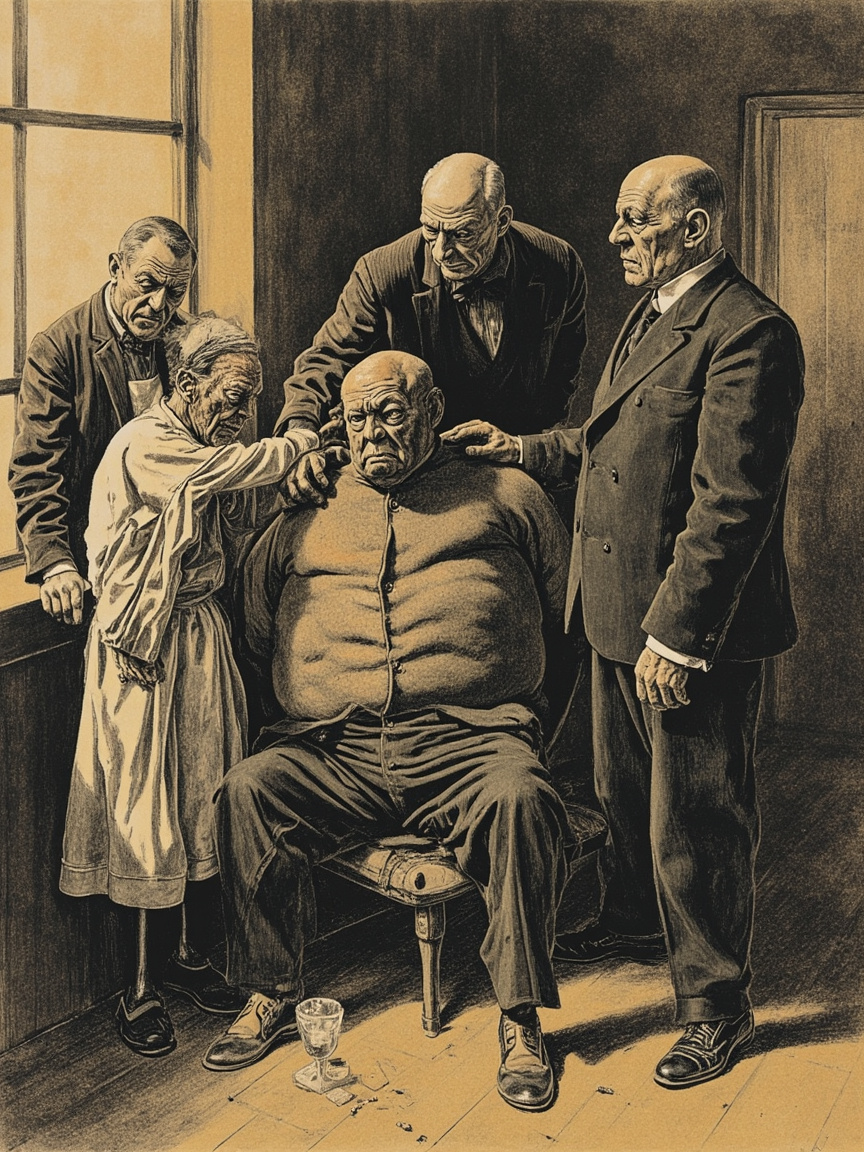
Thrash him, you fellows!
揍他,你们几个!
Original line · Chapter 4 · Nozdryov's take-back move is refused, and he flies into a rage and calls his servants to lay hands on him
Fourth and Fifth Stops: The Bear-Like Sharp Dealer and the Miser Who Lives Like a Skeleton
The fourth stop is Sobakevich -- a lumbering, bear-like man with an enormous appetite, who has built every piece of furniture in his house as sturdy and graceless as himself. But the moment the subject turns to business, he is suddenly razor-sharp, naming a steep price and praising each of his dead serfs, straight-faced, as if they were still his finest workers. The fifth stop is Plyushkin -- what Gogol calls a hole torn in human nature itself: once a prosperous, careful master, he has withered into a hoarding, living skeleton, letting his grain rot in the barns and his serfs starve and scatter while he piles up every scrap of junk he can find and dresses like a beggar. It is Plyushkin who has the most dead souls to sell, and sells them cheapest of all. He is where vulgarity and stinginess finally bottom out.
How the Scheme Works: Alchemy Made of Paper
By this point the reader has to ask: what does he actually want with these dead souls? The answer is pure paper alchemy. Imperial Russia taxed landowners by the census, and a serf who died before the next count still counted as alive and taxable on the books -- an unjust burden the landowners were stuck paying. Chichikov buys up these names cheap, relieving each landowner of that phantom tax; then he plans to use this stack of paper souls as if they were living collateral, taking out a huge loan from the state Board of Trustees while posing as a wealthy landholder commanding a great many serfs -- and then vanishing with the money. Turning something that doesn't exist into hard cash is the novel's central irony: a society that measures a man by a registry and a pedigree.
The Scheme Unravels: Absurd Rumors and a Prosecutor Frightened to Death
But paper can only hide a fire for so long. Back in town with all the deeds signed, Chichikov is toasted by the officials as a millionaire -- until Nozdryov shouts the words "dead souls" in public and Korobochka comes to town asking about prices, and the whole scheme blows open. The town collapses into a cascade of ridiculous theories about who he really is: a forger? A brigand? Napoleon in disguise? The fugitive Captain Kopeikin? The most absurd outcome of all is that the prosecutor is literally frightened to death by the rumors, and Chichikov flees town in a panic. Gogol's technique here is pure caricature: each new theory is more far-fetched than the last, each round of "investigation" more absurd than the one before, and the whole town ends up staring at its own guilty conscience.
The Hero's Backstory: A Portrait Raised on Saving Every Kopeck
Once the scheme collapses, Gogol suddenly slows down and inserts a long flashback, laying out Chichikov's whole history: a poor boy taught by his father to save every last kopeck, who has risen and fallen ever since through petty scheming and small-time fraud. What makes the passage work is how flat it is -- Gogol neither condemns him nor defends him, just lays out, matter-of-factly, the survival tactics of an ordinary man in an ordinary society. What the reader sees underneath is a self-portrait of all of corrupt Russia.
The Troika's Lament: An Unfinished Epic Stops Where It Stops
In the book's final scene, the troika sets out again, racing into the twilight of imperial Russia. Gogol's pen turns here, from biting caricature to lyric incantation: the carriage becomes a metaphor for Russia itself, flying past snowfields, past ringing bells, past towns bristling with chimneys, flying toward some unknowable distance, leaving behind one question for the ages -- Rus, where are you racing to? And no answer comes. This is not a tidy ending. Gogol originally conceived the book as a Dantean trilogy -- Inferno, Purgatorio, Paradiso -- but he burned the finished manuscript of the second part shortly before his death, and never wrote the third at all. The first part simply stops, mid-gallop, in a single flash of lyricism. The unfinished state is deliberate: this "poem" finishes its portrait of the whole ugliness of Russia without ever managing to write its redemption -- or rather, the impossibility of redemption is itself the book's deepest and most tragic note.
Gogol isn't writing a ghost story -- he is writing about the living dead, ranks of them. The soulless ones were never the names on the census rolls.
What It's Really Saying
On the surface, this is an absurd, funny comedy of fraud. Dig one layer down and it is a satire of the hollowness and corruption of the entire empire -- the five landowners are five specimens of human decay (saccharine daydreaming, superstitious hoarding, drunken lying, gluttonous dullness, withered miserliness), an encyclopedia of poshlost, that untranslatable Russian word for smug, small-minded vulgarity. Gogol's great gift is turning the most ordinary greed, vulgarity, and laziness into immortal caricature -- and two centuries later, that gift still works in front of the mirror of any bureaucratic society.
Deeper still, the book has a quality Russian criticism calls laughter through tears: underneath the biting caricature lies a lyric sorrow and a longing for redemption. The troika at the end is the proof of it -- having whipped everything in sight, Gogol turns around and calls up Russia's soul one more time. For readers today, this book is a key to understanding the Russian national character, and a mirror for seeing how any bureaucratic society can hollow a person out.
Why It's Still Worth Reading the Book Once You Know the Plot
A guide gives you the map; the novel is the land itself. The map can tell you how to get to each of the five estates, but it can't draw the syrupy softness in Manilov's voice, the sudden physical menace when Nozdryov flips the table, or the skin-crawling disgust of watching Plyushkin crouch in his junk pile sorting through old socks. Gogol writes with a physical charge -- you can smell the mildew in Korobochka's boxes, hear the chair creak under Sobakevich's weight, feel the dizzying speed of the troika in the book's final pages. And there's the laughter through tears -- it can't be paraphrased, only heard in the rhythm of the original. There's one of the most famous galloping passages in all of Russian literature, and you have to be struck by that lyric lightning bolt yourself. And there's the unfinished ending, which isn't a regret but the deepest gesture this poem makes. Knowing how it ends only makes it more worth going to the text itself to hear how that ending was actually written.
The worst way to understand a book is to only ever hear it secondhand. The best way is to let the troika carry you along for the ride yourself.
Art Direction2 plates
Before the guide was written, this book got a visual foundation — every illustration you just read grew out of it.