The Divan of Hafiz (Divan-e Hafez) · Companion Guide
哈菲兹诗集
一个背得全本《古兰经》的少年,端起酒杯,对路过的教法官扬了扬眉——扬出一部六百年仍在被当作神谕来翻的诗集。
Opening: a rose garden, a cup of wine, a line that makes the mosque scowl
Roses bloom past the wall, the nightingale sings its breast feathers bloody, and the tavern door among the ruins stands half open. A young man who has the entire Quran by heart raises his cup and lifts an eyebrow at the qazi walking by — this is the single most common frame in Hafiz's Shiraz. That raised eyebrow lifted with it a book of poems worn dark at the edges, still a fixture on the coffee table of every Iranian household. He never wrote a story. He folded the air of one city into short poems, over and over. Before you read him, meet the city.
What kind of book this is: the collected lyric poet of Shiraz
Hafiz was born around the start of the fourteenth century and died near its end, having spent almost his entire life in Shiraz. The book was assembled after his death by his friend Muhammad Golandam. Its core is some four hundred and eighty-six ghazals — the classical Persian lyric form — each one self-contained, running anywhere from five or six couplets to more than a dozen. A scattering of odes and quatrains fills out the rest. Each line comes in a couplet, the two halves closing on the same rhyme, and that rhyme, along with a handful of recurring themes, is the only thread holding the whole collection together. Which means you never have to start at the beginning. Any page stands on its own.
The collection went on to become something like the background hum of Persian culture. Persian-speaking households keep it on the shelf next to the Quran, and open it at weddings, funerals, and festivals to read as an oracle. From the eighteenth century on it was translated into one European language after another, and Goethe wrote an entire book, the West-Eastern Divan, in conversation with it. There are two kinds of poetry: the kind that lives, and the kind that only survives in literary history. Hafiz's belongs to the first — it is still being turned over on the low tables of Iranian living rooms.
Cast and world: the tavern's double-faced protagonists
Hafiz's poems rarely explain who anyone is; figures show up under standing labels instead. The pair that appears most often together is the saqi — the wine-pouring youth — and the yar, the beloved or the friend. On the surface these are a boy pouring drinks in a Shiraz tavern and the person the poet longs for. Underneath, in Sufi terms, they are the guide who pours divine love into the human heart. The same line can land in a tavern as a love song and land in a dervish's tent as a statement about the search for God. That double reading, holding both at once, is the trick that makes Hafiz worth applauding.
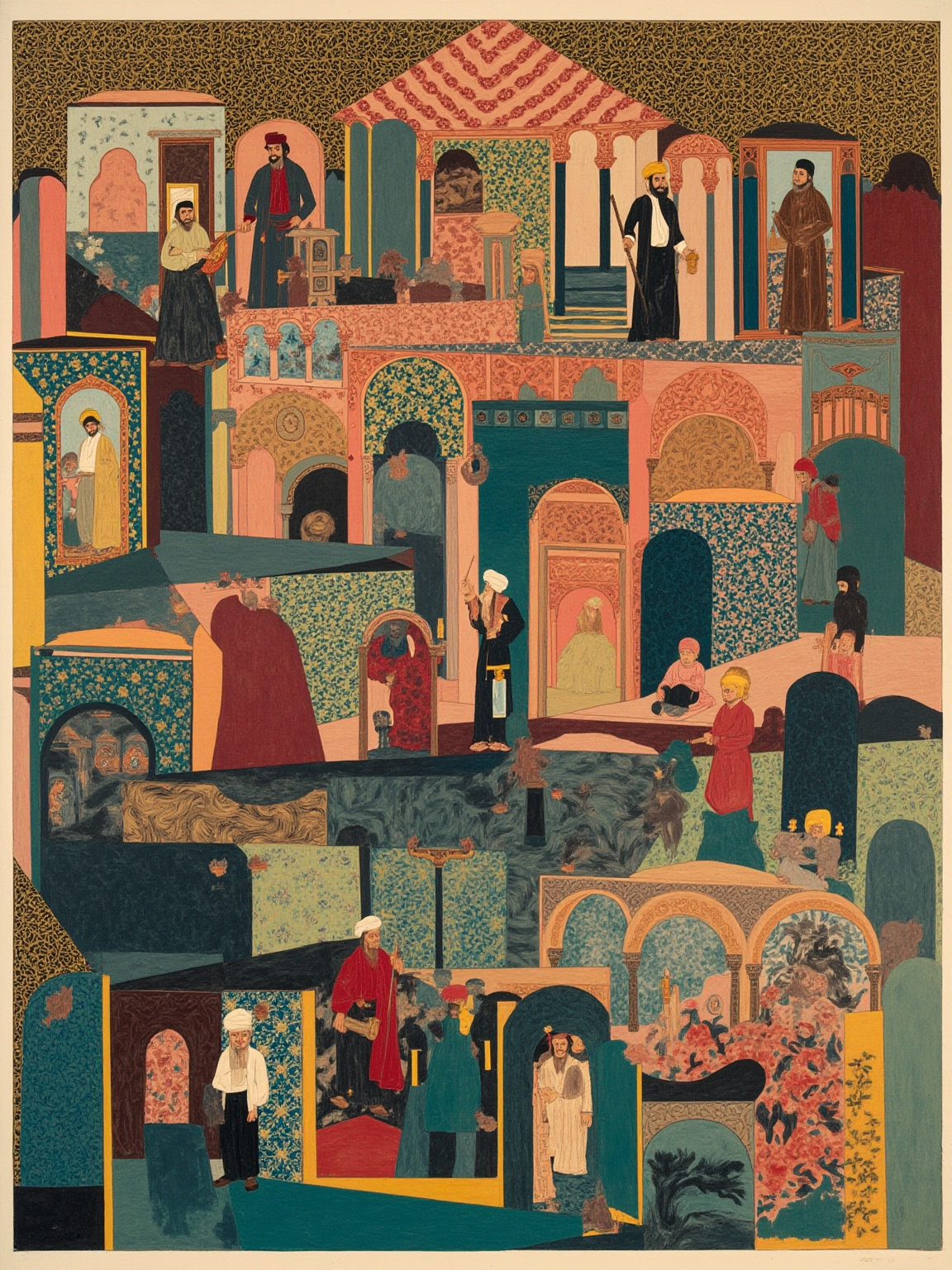
O Sāqī, pass the cup and hand it round; for in the rose garden soon enough there will be neither rose nor friend, nor any song.
斟酒的少年啊,传杯吧,让它流转——因为这座玫瑰园里,玫瑰与故人、歌与欢宴,都留不长久。
金句 · 第1章 · 萨奇与雅尔出场
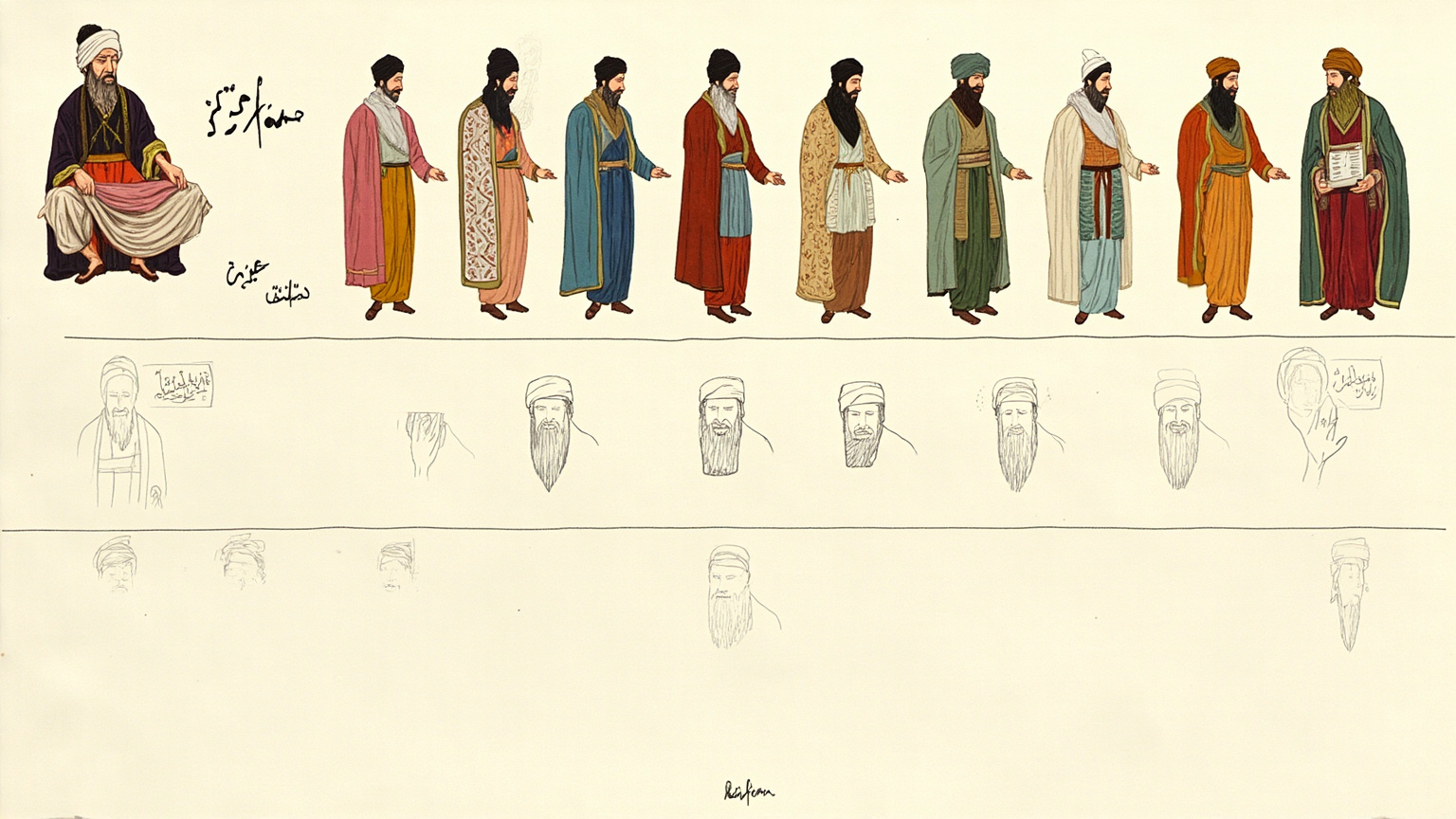
The supporting cast has its own jobs too. The nightingale is the bird that bleeds gladly for love. The rose can mean the beloved's cheek or the ultimate beauty at the end of the path. The dervish — a wandering Sufi, beard shaved, ties to the world cut, who lodges in the ruined tavern — is the drinking companion who mocks the dogmatists. The qazi in the mosque is the target on the other side, a man who holds the law in one hand and takes bribes with the other. One more figure keeps turning up: Shah Shuja, the Muzaffarid ruler of Shiraz, who kept Hafiz on as court poet for most of his life. Their bond broke and mended more than once, and it is the real-world model behind the poet's recurring line about favor received yesterday and exile today.
A childhood on the Quran, a name made by twenty
Hafiz lost his father as a child and memorized the entire Quran through sheer force of memory — the pen name Hafiz means, plainly, one who has the Quran by heart. As a young man he moved into theology, Arabic literature, and the craft of verse, and by his early twenties his lyric and devotional poems had already made a name for him. Shiraz at the time sat under Muzaffarid rule, a city where caravans converged and roses were as famous as its springs. The roses, nightingales, fountains, and morning breeze that run through the Divan are, for the most part, simply what that city looked like at dawn.
A court poet who wrote like a tavern poet
From early adulthood Hafiz lived under Shah Shuja's patronage and served for years as court poet — yet what he wrote about most was not the court but the tavern. He went after the despotism of rulers, the hypocrisy of the pious, and the general rot of society, while in the same breath singing of spring, flowers, wine, and love, calling for freedom and justice, and taking the side of the poor. He drew his salary from Shah Shuja and, in the same poems, complained that the powerful had shut the rose garden and driven the nightingale out of the city. That contradiction — a courtier's position paired with a tavern poet's pen — is the first tension a reader of Hafiz runs into and cannot get around.
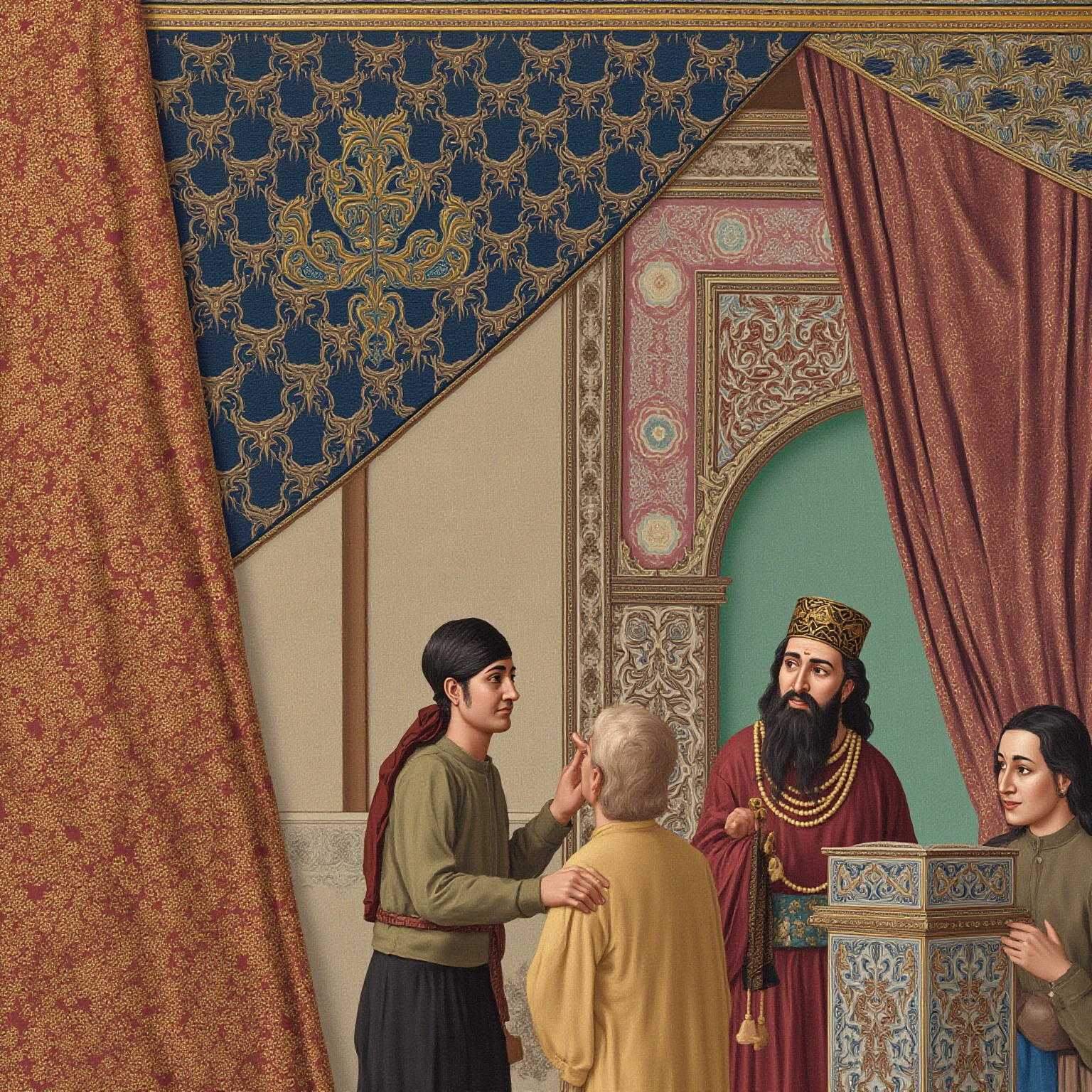
How shall the heart not turn to the rose garden? The plane tree and the rose are companions — and the bulbul of the garden has a fresh tale to tell.
心怎能不转向那座玫瑰园?梧桐与玫瑰并肩而立,而园中的夜莺,恰好有崭新的故事要讲。
金句 · 第2章 · 夜莺与玫瑰
Saqi and yar: two meanings under the same sky
If you remember only one pair of names, make it saqi and yar. Hafiz almost never titles a poem or identifies who is speaking, so these two words float free of any single referent. The wine-pouring youth can be an actual boy working a Shiraz tavern, or the guide who pours the wine of divine love into a heart. The beloved can be a girl on a Shiraz street who has cost the poet sleep, or sacred beauty itself. The last two words of a couplet will often carry both readings at once — a love song read downward, a statement of the search read upward.
The same words, sung as a love song in a tavern and read as an oracle in a dervish's tent — that is Hafiz.
Nightingale, rose, and ruined tavern: the image machine running through every ghazal
The duet between nightingale and rose is the motif that keeps returning through the Divan: the nightingale sings for love among the roses and does not stop even when its breast feathers run with blood, and the rose is both the beloved's cheek and the beauty waiting at the end of the path. The later epithet Nightingale of Shiraz comes straight out of this pairing. Set against it is the kharabat, the ruined tavern — a truer place to search for God, in these poems, than the mosque — and the dervish who lives there. The qazi in the mosque holds the law and pockets the bribe. The dervish in the ruins has shaved his beard and cut his worldly ties, and Hafiz still calls him a companion worth drinking with.
The technique behind that contrast is worth pausing on. Hafiz almost never states feeling outright — he hides the satire inside a pairing of outer and inner, where the outer (the law, the appearance of piety) is false and the inner (lived experience, the state of the heart) is true. That rhythm is the very thing Goethe later tried to imitate in the West-Eastern Divan, and the imitation falls well short of the original — which, if anything, only makes the original's strength easier to see.
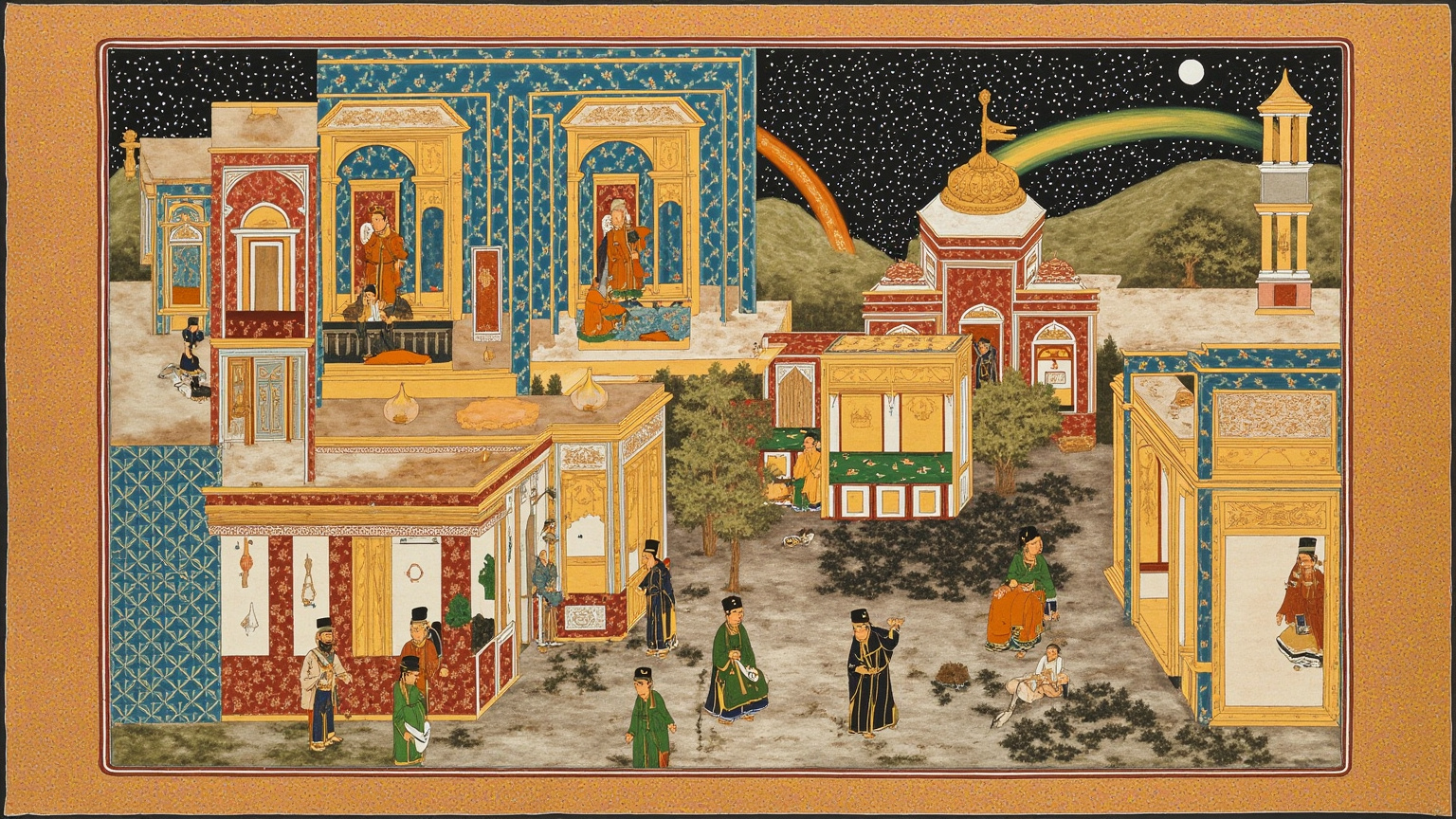
The qalandar's way is hard for the pulpit-man to bear: their great drunkards and ours are two entirely different sorts of drunkard.
苦修僧的路,是清真寺里的教法官所断难容忍的——他们的醉,与我们的醉,原本就是两桩酒、两场昏。
金句 · 第3章 · 废墟酒肆的内与外
The poet who refused to leave: a lifetime in Shiraz
Baghdad, the Jalayirid sultan of Tabriz, and the Bahmani sultans of India all sent envoys with money to bring Hafiz to their courts. He turned down every one. Those rejected sultans must have wondered why a man who could write his own legend into being would choose to stay put in a provincial city. My own answer is that the whole Divan is the answer, addressed to the city itself — the roses, the nightingale, the springs, the morning breeze all point, every time, back to the name Shiraz.
Death, Golandam, and the line that judged its own poet at the funeral
After his patron Shah Shuja died, the successor Zayn al-Abidin kept Hafiz on until the poet's own death around 1389 or 1390. His friend and disciple Muhammad Golandam assembled and edited the Divan we read today. One of the most famous scenes in literary history happened at his funeral: the clerics wanted to rule on whether his wine poems disqualified him from burial rites, and at that moment someone opened his book at random. The page read that even a man drowned in sin still enters paradise. The dervishes present took that as the ruling and buried him.
A book that stayed alive: how one collection became a household dictionary of the soul
The handful of themes that keep recurring — wine, love, freedom, the divide between dogma and lived experience, the craft of double meaning, the air of Shiraz itself — have not turned into museum pieces over six hundred years. If anything they have gotten more ordinary, not less. Iranians call the practice fal-e Hafez, Hafez divination: at Nowruz, on Yalda Night, at weddings, over drinks with friends, or alone, people open the Divan at random and read the page as an oracle. The custom is said to date back to the poet's own lifetime, and it settled his own funeral with one of his lines. In Iranian living rooms today the Divan still sits beside the Quran — it is literature and it is a living book of folk practice at the same time. Of everything in it, wine, love, and freedom are the closest to where we live now.
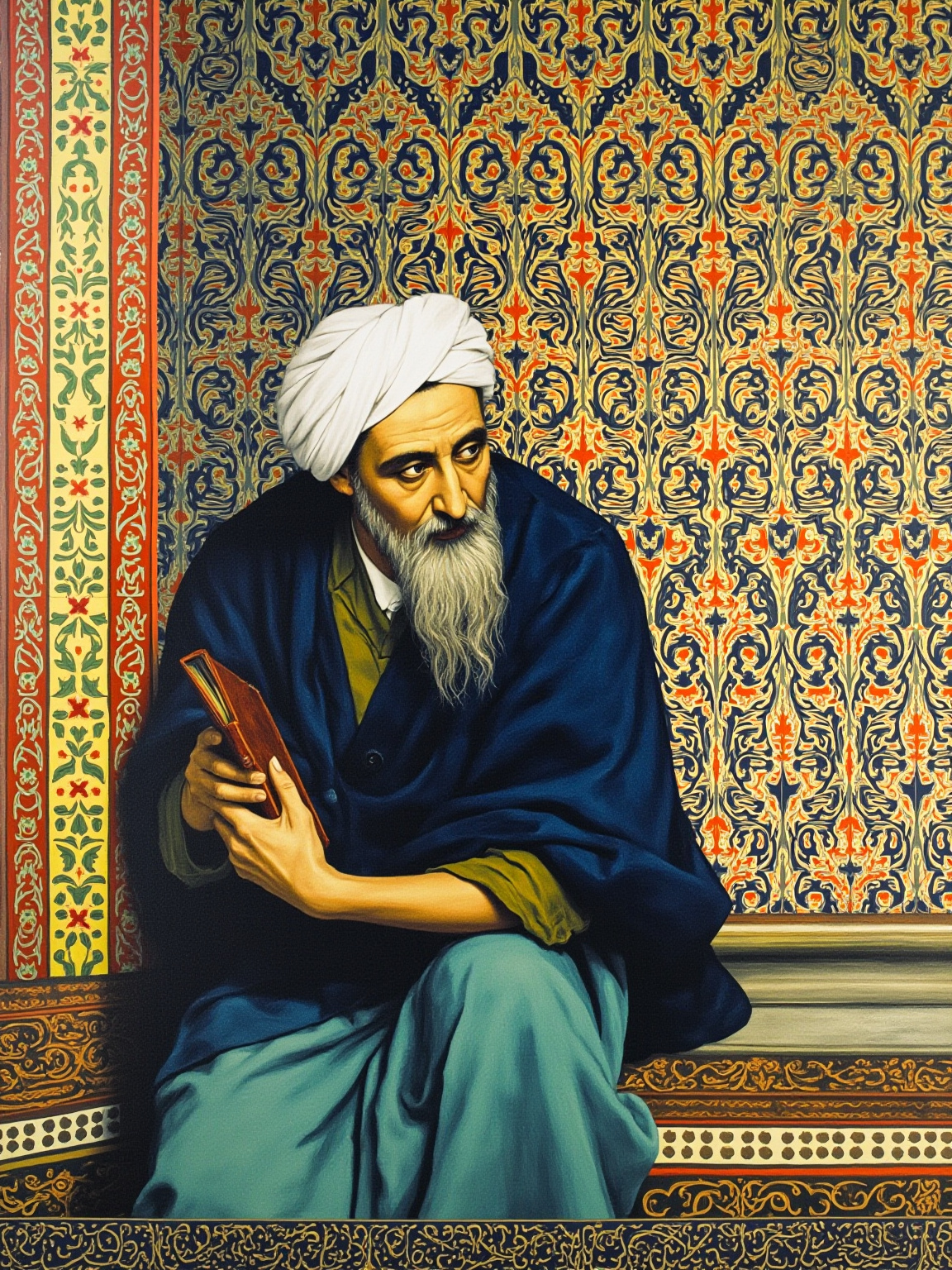
Let the wind of Shiraz carry perfume from the rose-bed of my beloved — for I fear that the life of Shiraz will set the whole world in flames.
让设拉子的风,从我那挚爱之人的花圃携来一缕香吧——我怕是连设拉子的日子,都要把整座天地烧成灰烬。
金句 · 第4章 · 设拉子的气与火光
His tomb, just outside present-day Shiraz, has been rebuilt more than once: restored in the eighteenth century by Karim Khan Zand, then remade in the 1930s by the French archaeologist André Godard into the eight-columned open pavilion that stands there now, still one of the most visited cultural sites in Iran. Visitors read his lines aloud under that pavilion, and his gravestone carries one of his own most famous verses. Honestly, the line already on the cover of this book is enough to make you want to walk in.
Reaching Europe: Goethe's entire book, the West-Eastern Divan
Around the 1770s, the English orientalist Sir William Jones translated Hafiz into English, French, Latin, and Greek, setting off a wave of enthusiasm for him across Europe. But the man who carried that reach into literary history was Goethe. In the early nineteenth century, past seventy, Goethe read a German translation of Hafiz and wrote an entire book in response, the West-Eastern Divan, with a chapter called the Book of Hafiz devoted to him. In it Goethe casts himself as a small boat and Hafiz as the great ship cutting through the waves under full sail — an image that has stood, ever since, as the most durable bridge between German poetry and Persian. Over the two centuries that followed, Pushkin, Lermontov, Yesenin, Emerson, Thoreau, Nietzsche, Hegel, and Engels each took from him what they needed.
What it is still saying: wine, love, and freedom are not indulgence, they are escape
Of all the themes that recur, the one that fits our own moment best is wine, love, and freedom. The wine and the beloved in Hafiz are never indulgence for its own sake — they are how he pushes back against dogma and constraint. One line has him saying that he would be warned off wine a thousand times and still pour the thousand-and-first cup. Lines like that are why the Divan has always functioned, among Persian speakers, as a way of living rather than a text hung on the wall to admire. For a reader today, that move — treating indulgence as resistance — puts on different clothes in every era and still lands.
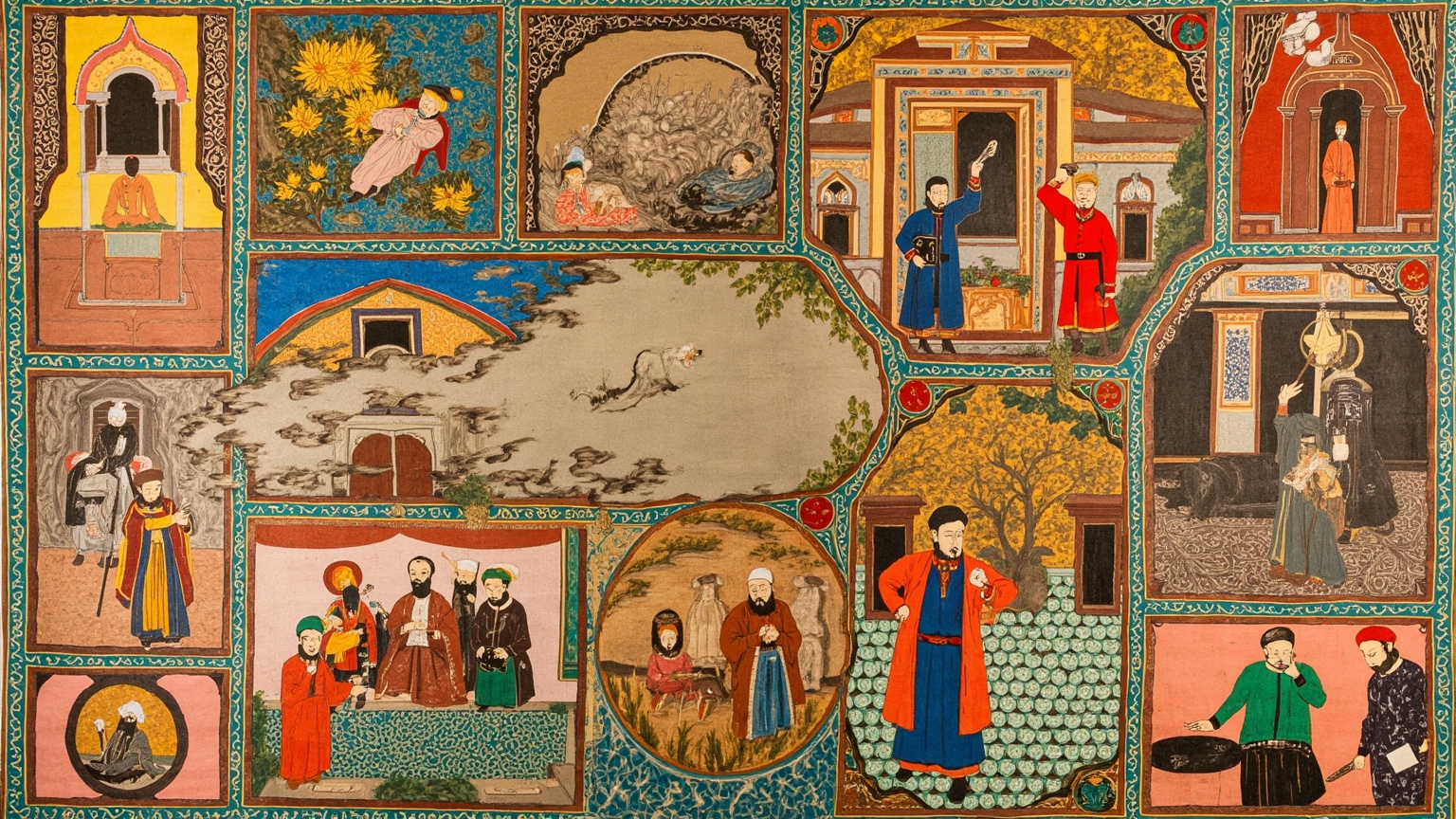
A thousand counsels might they give to wean me from the cup — yet a thousand and one cups, if a thousand rebukes come, I shall drain.
哪怕一千回戒劝,劝我放下这杯——我仍要再加一千零一杯,把那一千句警句全数喝尽。
金句 · 第5章 · 酒、爱与挣脱
To understand Hafiz is to understand a way of writing: hide the satire in the gap between two words, so the same line says opposite things depending on whose mouth it is in.
Why the essay is not a substitute for the poems
An essay can hand you a map. It cannot give you the feel of the ground under your own feet. The ghazal is a necklace form — each poem strings five to a dozen or more couplets, every couplet a bead complete in itself, all of them sharing one rhyme — and across four hundred and eighty-six of them, each poem glints on its own, but only when they are strung on that one thread does the whole necklace catch light. There is no plot in this book, and there was never meant to be one. The plot, if you want to call it that, is the string of brief stares you take as you turn the pages — from rose to nightingale, from the ruined tavern to the mosque, from the tavern in the street to the tavern in the heart. Only the original, or at least a good translation of it, can give you those.
There is another layer too: the live feel of the double meaning. Hafiz's real strength often sits inside a single couplet, where the same words read as a love song going one way and an oracle going the other. That jolt of hearing two sentences at once inside the gap between words is not something an essay, however careful, can hand you — your eyes have to hit that double meaning directly. And there is the fal-e Hafez tradition itself: using the book as a form of divination is not something any introduction can experience on your behalf. You have to open a translation yourself, some night, and let a couplet say something that stops you cold. That is what Hafiz spent his life writing toward.
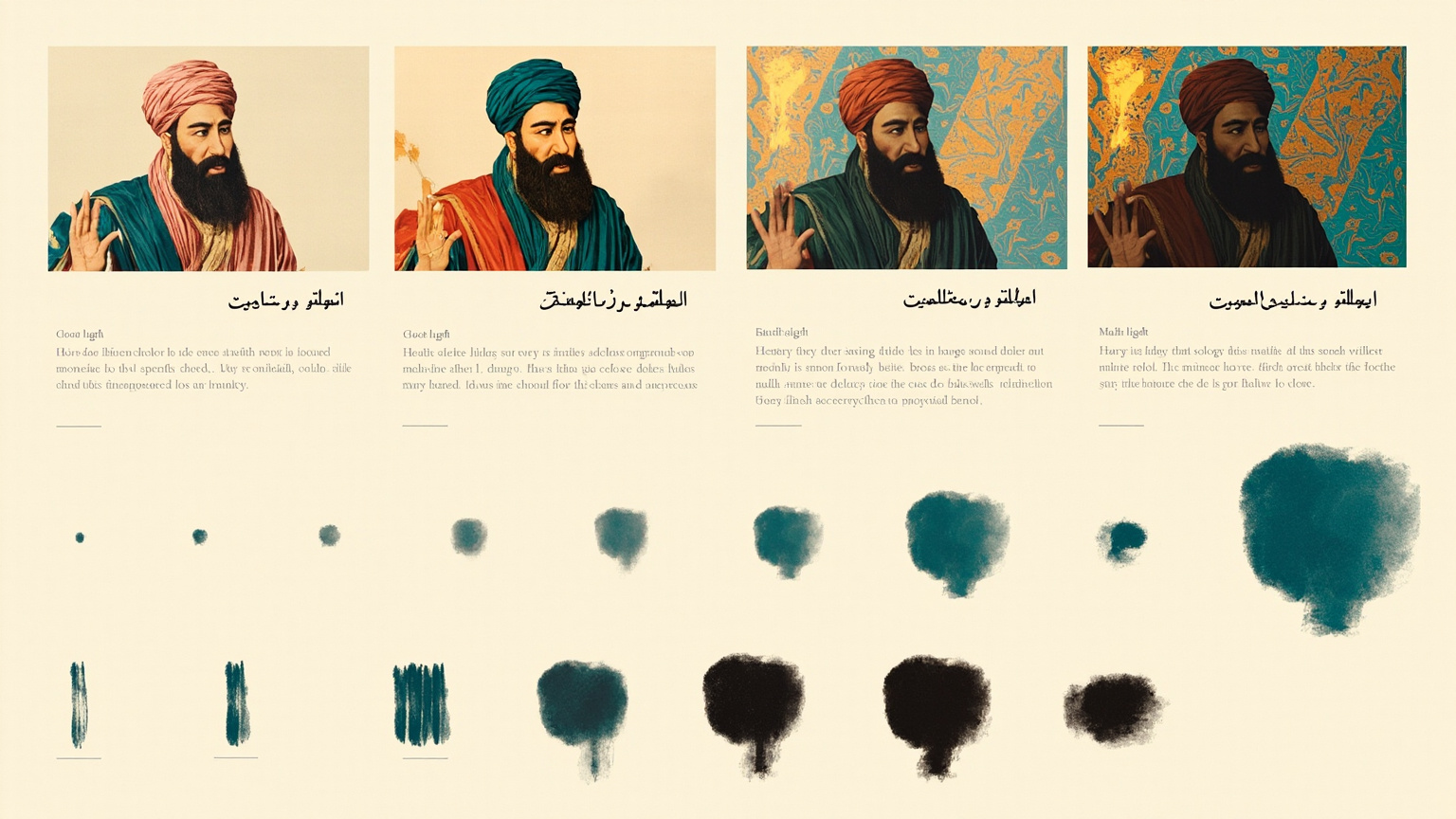
Art Direction4 plates
Before the guide was written, this book got a visual foundation — every illustration you just read grew out of it.