Don Quixote · Companion Guide
堂吉诃德
一个读骑士小说走火入魔的老头,把风车当巨人冲锋,在荒诞世界中寻找骑士梦。
Opening: An Old Man and a Cluster of Windmills
A gaunt old man charges at a row of ten-foot windmills. In rusted armor, lance in hand, he comes howling across the field. A second later the sails fling him into the air like a sack of rags, and he and his horse crash into the mud together, too battered to get up for a long while. This is the image the whole world already knows. But Cervantes did not write this scene for the joke of a fool tilting at nothing — he used a battle against windmills to ask a question that still has not gone stale: when a man's entire understanding of the world has been rewritten by books, and he collides with reality, is it reality that has gone absurd, or is he the only one seeing clearly?
What lands even harder is that this same fool dies at the end peacefully, lucidly, and full of deep regret — admitting that his life's absurd campaigns were not madness at all, but the fault of the books that drove him mad. Cervantes buried a tragedy inside comedy's loudest laugh. That is this book's real feat.
What Kind of Book This Is
Don Quixote is a long novel by the Spaniard Miguel de Cervantes, published in two parts: Part One in 1605 and Part Two ten years later, in 1615. It began as a shot at the chivalric romances that clogged the bookstalls of the day — the stock plots of noble ladies, dragon-slaying heroes, and duels fought over love poems, which Cervantes could no longer stomach, so he wrote a chivalric tale turned inside out, just for the fun of it. What that joke turned into was a work later generations would crown the first modern novel in the Western tradition. It invented the modern novel's grammar: characters with inner lives, characters who change, characters with a fate — and a narrative that can turn around and mock itself, the earliest specimen of what we now call metafiction.
The book is remembered for more than being funny. It is remembered because a century later, and centuries after that, the whole world still reaches for quixotic to describe anyone charging at the impossible. The Mars rover, the idealistic politician, every stubborn decent person who refuses to bow to reality — his shadow falls across all of them. A fictional character becoming an adjective is a rare fate in world literature.
People and World: Two Travelers and One Gaunt Horse
The story is set in La Mancha, Spain, at the turn of the sixteenth and seventeenth centuries — not the Middle Ages. That is the crucial point: Cervantes was not writing an ancient legend but his own contemporary world — worn fields, shabby inns, roads crowded with shepherds, prisoners, traveling actors, and the carriages of touring nobles. Don Quixote sees this world wrong. He sees it as the world of chivalric romance.
The protagonist is a local country gentleman, Alonso Quixano, an aging bachelor of modest means whose mind has been thoroughly scorched by chivalric romances. He renames himself Don Quixote and gives the name Dulcinea del Toboso to a farm girl from a nearby village who has never met him and whom he has never formally courted, imagining her as a peerless lady and swearing to fight in her name. This is the novel's most romantic passage, and also its most bitter: the woman he loves has no idea she exists to him.
His mount is Rocinante, a nag as old and scrawny as he is. The squire who follows him, Sancho Panza, is a stout, plainspoken farmer talked onto the road by Don Quixote's promise of a governorship over an island. This pair is literature's most iconic double act: the master's head is full of chivalry, the squire's belly is full of household arithmetic; one sees giants in the windmills, the other sees windmills; one rides out for honor, the other tags along for bread. And yet, mile by mile, these two utterly different men become the truest friends either of them has ever had.
How the Plot Moves: A Farce, and a Campaign
The premise could not be simpler. Alonso Quixano is a gentleman with time on his hands and money in his pocket, and having nothing better to do, he wears out volume after volume of chivalric romance — hundreds of pages of dragon-slaying and damsel-rescuing, all of which he takes as literal truth, right down to their most worn-out clichés. One day he finally gives himself a title, names his horse, bestows on a farm girl from the next village the invented glory of peerless lady under the name Dulcinea, digs out his family's rusted armor, straps it on, takes up a lance, and rides out to right wrongs and win renown across the land. His first sally is a solo act, full of pratfalls, and it ends with him beaten black and blue and carried home by his neighbors.
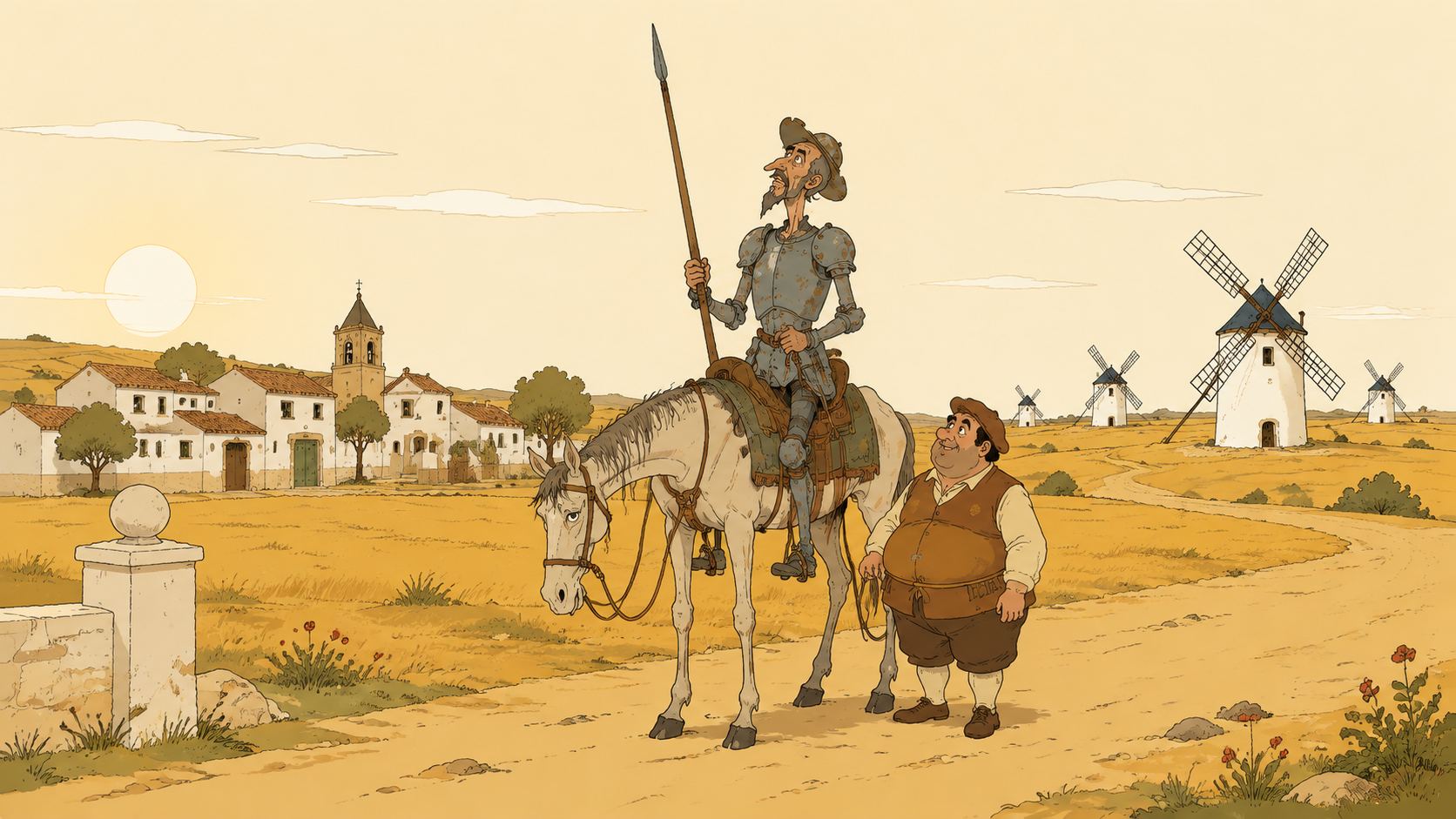
On girding him with the sword the worthy lady said to him, "May God make your worship a very fortunate knight, and grant you success in battle."
可敬的夫人为他挂上佩剑,祝祷道:“愿上帝赐您无上福运,成为最幸运的骑士,战无不胜。”
原文金句 · 第一部第三章 · 授封骑士
On his second sally he recruits a squire, Sancho Panza — a farmer from the next village over, plump, penny-wise, greedy for a bargain, but decent at bottom. Don Quixote promises him an island to govern, a promise absurdly overblown, and Sancho cannot resist the bait. From here on, the novel's most important chemical reaction takes over: Don Quixote's ravings meeting Sancho's common sense and street smarts, one grand and one plain, one mad and one grounded, forming the central tension the whole book runs on. What makes Cervantes's craft here is that Sancho is never just a device for the sane man laughing at the madman — he is written as an equally three-dimensional person, with his own wants, his own judgment, his own feelings. Their exchanges are a meeting of equals.
The road's first classic set piece is the battle with the windmills. Spotting them across the field, Don Quixote instantly declares them monstrous giants and charges alone to rid the world of them. Sancho shouts from behind that they are plainly windmills; Don Quixote does not even turn his head. His lance drives into a sail, the wind catches it, the sail turns, and he and his horse are flung through the air, hitting the ground hard enough to shatter bones. This scene has become one of the defining images in world literature because it compresses the whole novel's theme into a single frame: a man who trusts books over his own eyes is bound to be thrown flat by reality — but he is knocked down by a windmill, not talked out of his belief.
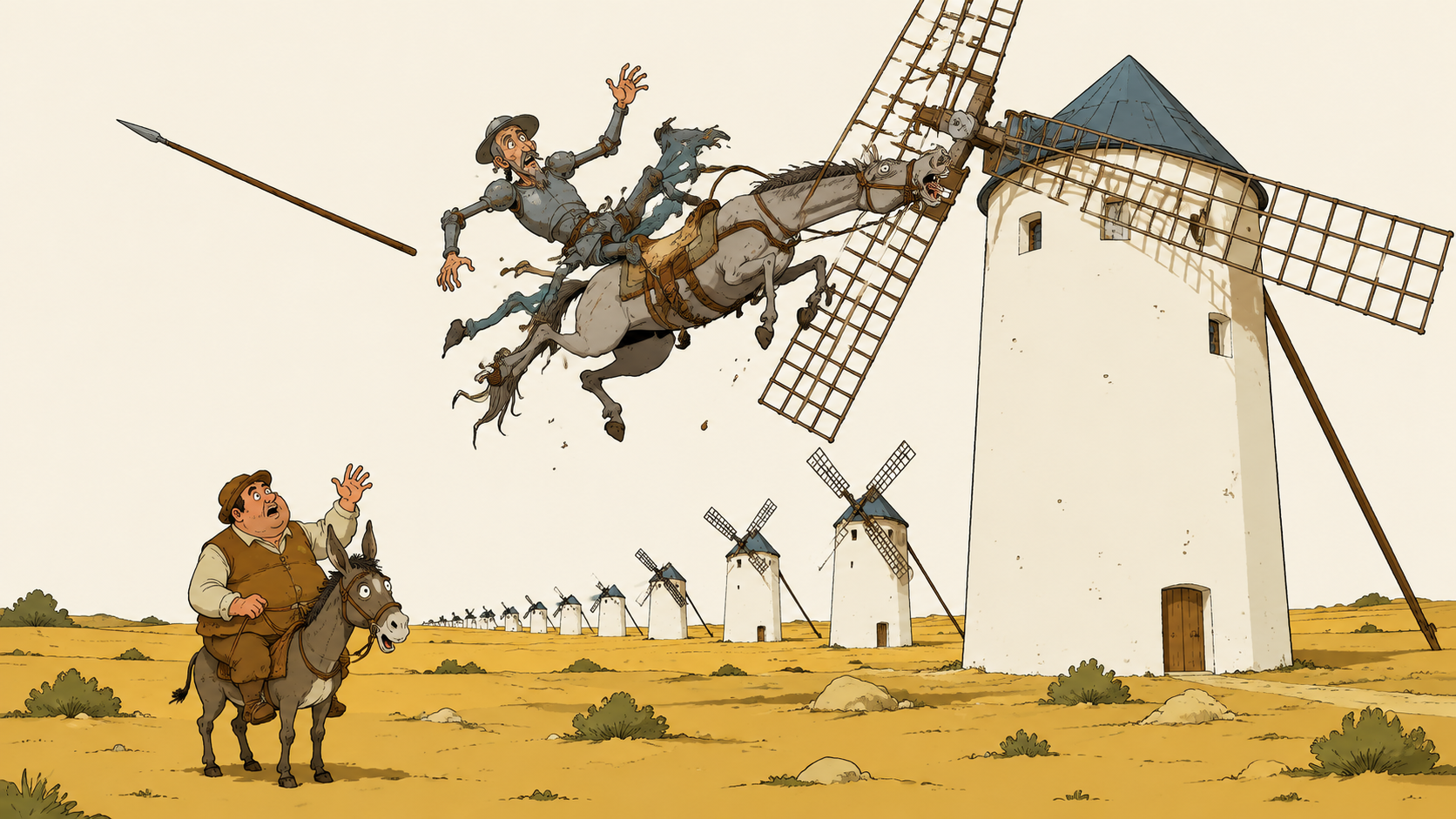
"That's how that thief of a sage, my enemy, can alter and falsify things,"
那个该死的魔法师,我的宿敌,就是这般颠倒黑白、弄虚作假的。
原文金句 · 第一部第八章 · 大战风车
Almost everything that follows on the road can be summed up in the same sentence pattern: Don Quixote sees something, then sees it as something out of a chivalric romance. The finest examples: the country inn where he lodges becomes, in his eyes, a castle, its keeper a lord of the castle, and a barber's brass basin for lathering soap becomes the legendary Helmet of Mambrino, which he seizes and refuses to give up. The real craft here is that Cervantes never simply writes he is mad — he shows exactly how Don Quixote misreads the world, why he misreads it that way, and how sincerely he believes it, in a way that makes you laugh and ache at once. It is this that makes him sympathetic: he is not pretending — he genuinely believes what he sees is the truth.
The first sally ends in humiliation. The village priest and the barber, true friends who mean him well, burn his library of chivalric romances and arrange for the village scholar, Sansón Carrasco, to disguise himself as the Knight of the Mirrors and challenge him, hoping to beat him into submission and bring him home. Don Quixote does not lose that duel — the other man is undone by bad luck instead — but Sansón still manages to trick him back to the village, where he is kept under a kind of house arrest. Part One ends there.
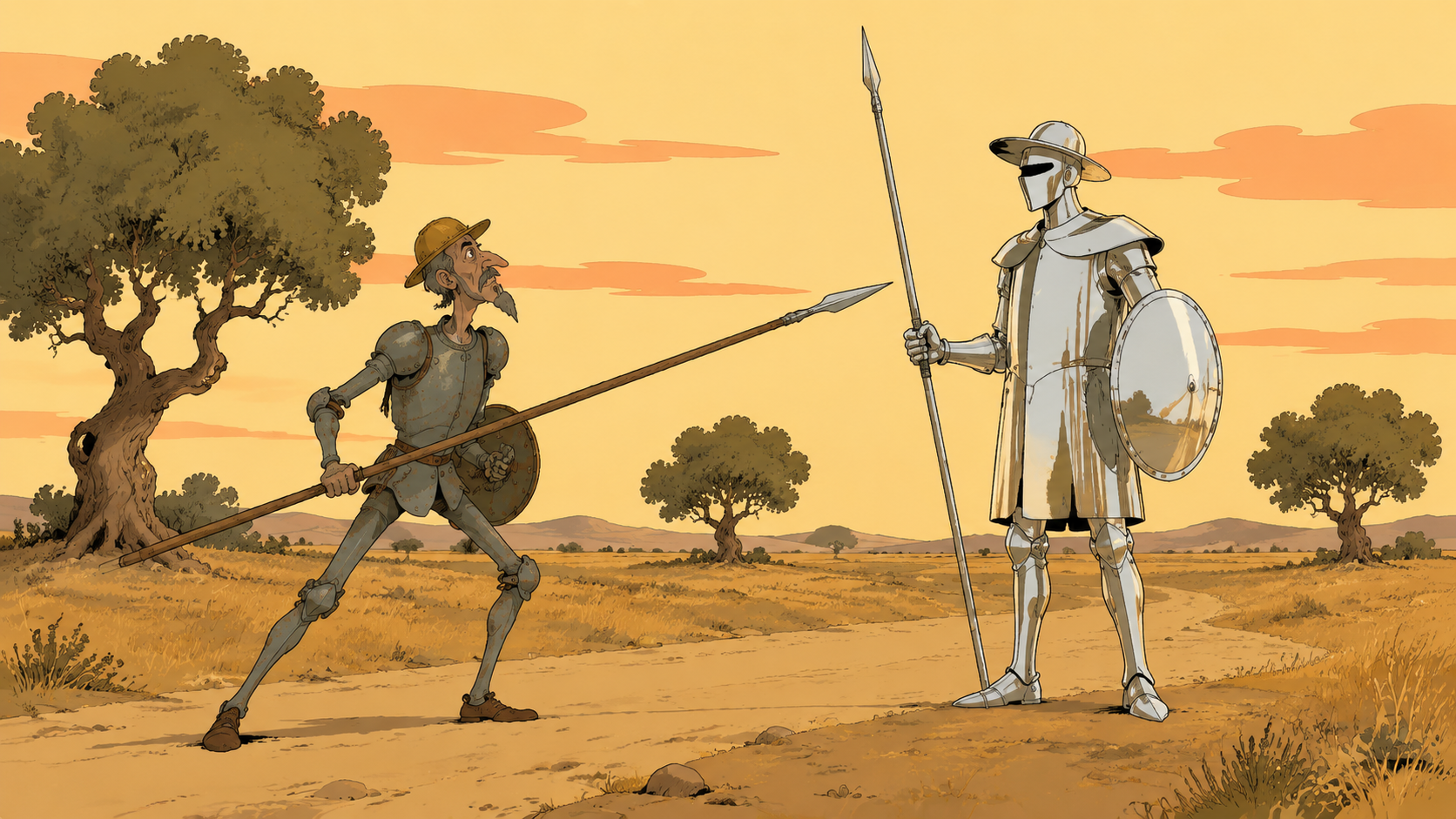
"What blood and fountains are you talking about, enemy of God and his saints?"
你扯什么血啊喷泉的,你这上帝和圣徒的公敌!
原文金句 · 第一部第三十章 · 客栈乱斗
Part Two opens with the finest trick in the whole book: Cervantes took ten years to write the sequel, and inside that sequel, the characters themselves have read the very Part One published ten years earlier. On the road they discover they are already famous throughout the land, and strangers point and whisper when they pass. This is one of the earliest and most complete uses of metafiction in world literature — characters inside a novel reading the story of themselves. Part Two also brings a pair of well-meaning villains: a Duke and Duchess. Bored aristocrats who have heard of Don Quixote's exploits, they invite the pair to stay at their castle and stage an elaborate charade straight out of chivalric romance for their amusement, even letting Sancho actually govern an island for a while. Sancho turns out to be a shockingly wise judge — in one case he spots a fraudulent claim in a loan dispute, in another he tricks two feuding parties into each feeling they have won. It is some of the most enjoyable comic wisdom in the whole book.
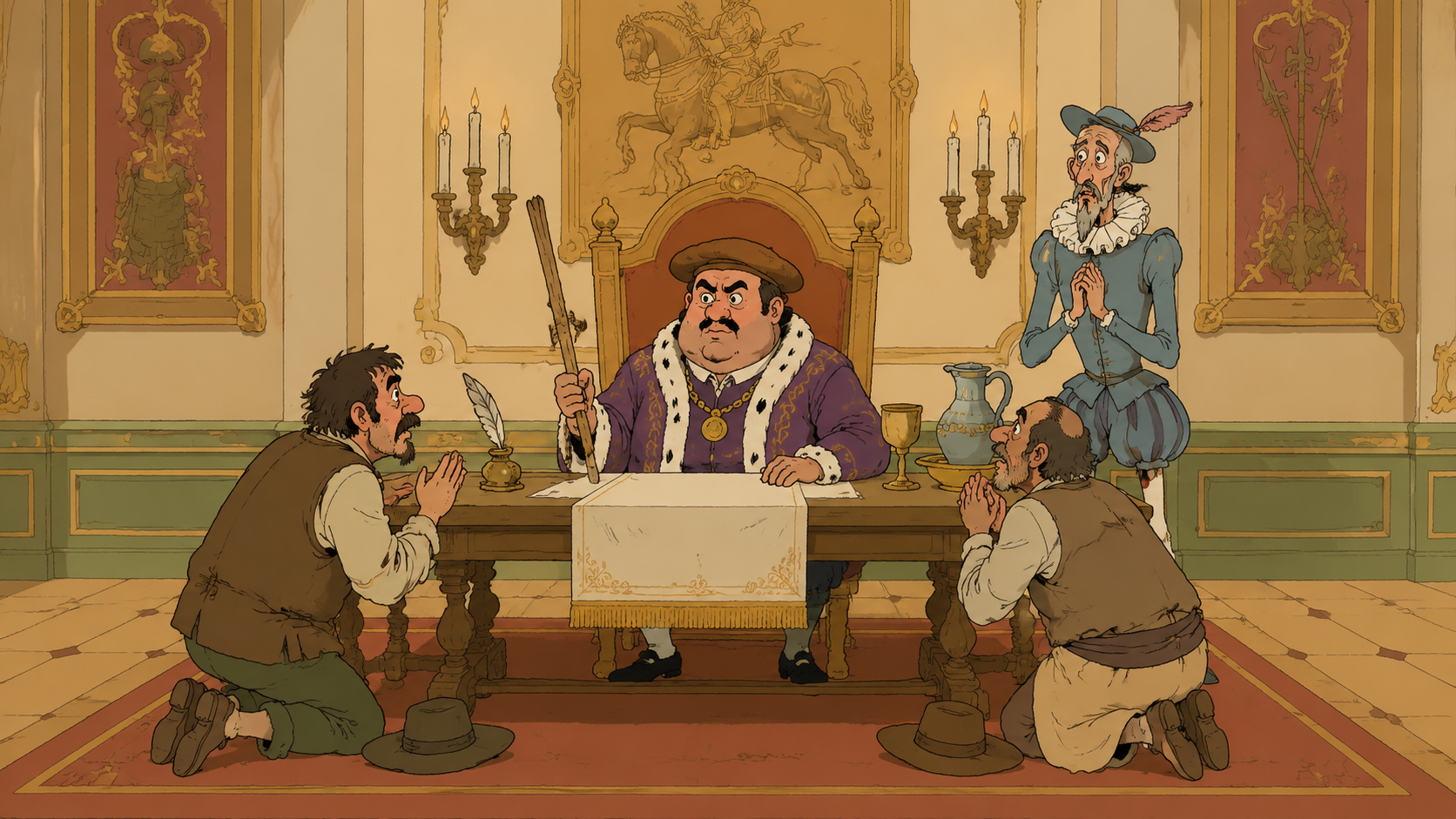
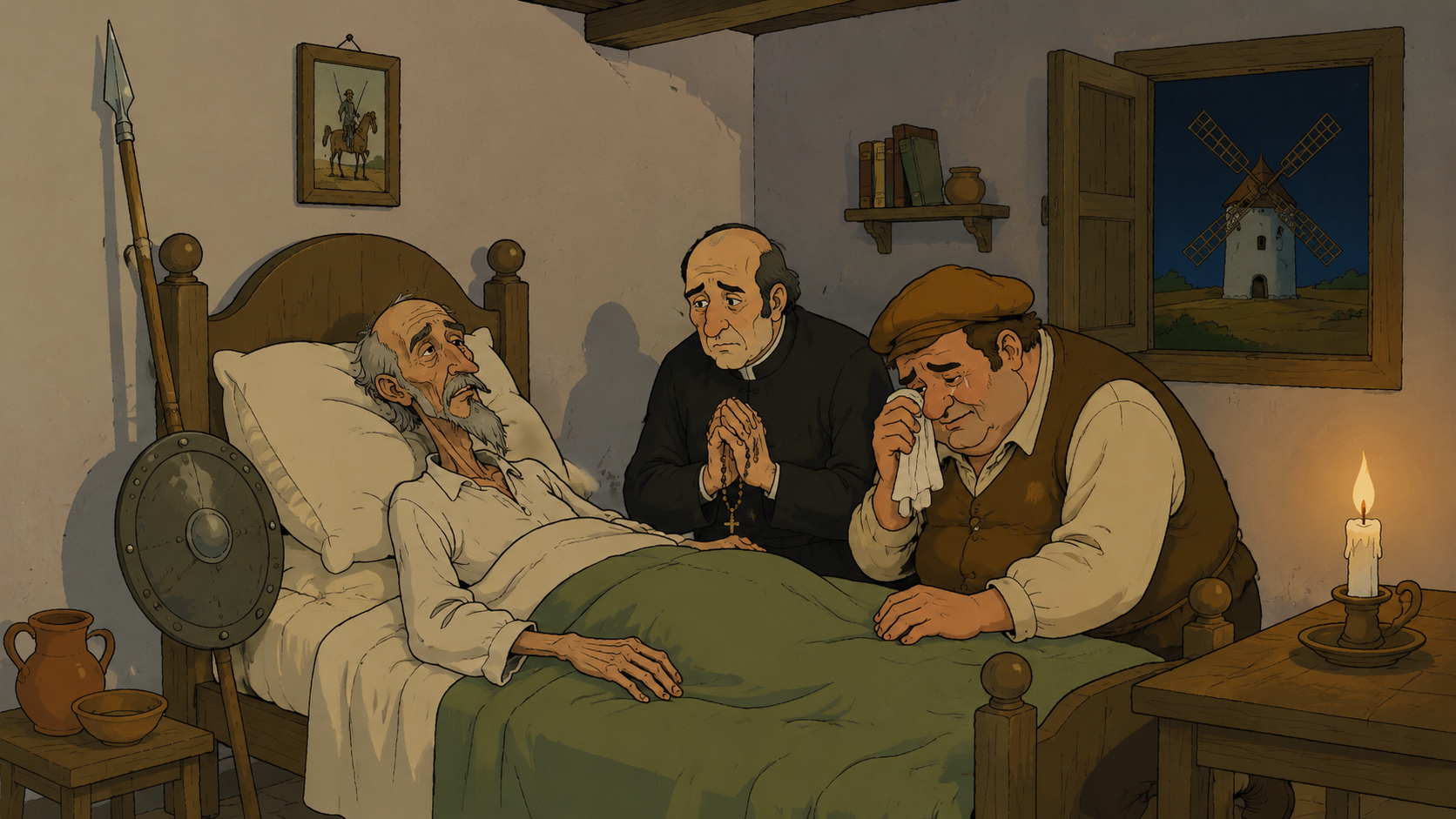
The story's end comes at Sansón Carrasco's second attempt. This time disguised as the Knight of the White Moon, he duels Don Quixote openly on a beach and defeats him, and by the terms of their wager forces Don Quixote to swear to go home and give up knight errantry for a year. Don Quixote returns to the village and falls gravely ill. In his final hour, the author delivers the novel's most stunning stroke: this old man, who spent a lifetime lost in chivalric romances, finally comes to his senses. He stops calling himself Don Quixote, reclaims his true name, Alonso Quixano, and takes the priest's hand to say that the books of chivalry were all lies, and that they, and nothing else, ruined his life. Three days later he dies peacefully. The craft here is exactly the point: Cervantes does not let him die at the height of his delusion, and does not let him die amid laughter — he lets him understand only at the very end, and lets that understanding be what carries him off. That is the real tragedy.
Here Sancho exclaimed, "I don't mount, for neither have I the heart nor am I a knight."
我不上马,既没有那份心,也不是骑士。
原文金句 · 第二部 · 桑丘拒骑
Themes and Craft: The Novel's Ancestor, Laughing Through Tears
On the surface, Don Quixote mocks chivalric romance, but read deeper and it is using the mockery of one madman to interrogate the whole world. The world Don Quixote sees is nobler, more scrupulous, more humane than the one seen by the people around him — he insists on rescuing every beaten shepherd boy, righting every injustice, fighting for beauty and honor. Meanwhile the innkeepers, village women, chained prisoners, and dukes around him — the sane ones — are petty and self-serving. Cervantes never states outright who is right and who is wrong. He simply lets the two worlds walk side by side and lets you watch. That is exactly where its genius lies — it does not lecture; it lets you work it out for yourself, laughing.
This book is also the earliest literary case study of how reading shapes a person. A harmless middle-aged man reads so many books that he lives his life into an entirely different shape — and reading that today carries an eerie sense of foresight. Our own era has people who, because of algorithms, information bubbles, or some story they have come to believe absolutely, have lived themselves loose from reality. Four hundred years on, Cervantes is standing right next to every one of us.
In writing this book, Cervantes also pulled off something almost no one else in literary history has managed: he created the most beloved master-and-servant pair in world literature. The exchanges between Don Quixote and Sancho are comedy at its peak, and also the deepest footnote ever written on friendship. One man lofty yet rooted to the earth, the other shrewd-seeming yet good at heart — they need each other, correct each other, and make each other whole. This pairing would go on to shape countless duos in fiction and film, from Dickens to Tolstoy and on into the present.
Don Quixote is, at bottom, not a book about a madman, but a book of doubt about what is true and what is false — Cervantes shows us a man who lives his way into another world because he believes a book, and who comes to his senses only because he is dying. That is why it still hits readers today.
Why Read the Book Itself, Now That You Know the Story
A guide like this hands you a map, but you still have to walk the ground yourself. What no summary can replace is Cervantes's peculiar gift for carrying enormous weight in the plainest Spanish — he writes the most absurd scenes in the most ordinary, spoken language, and his humor never feels like a joke bolted on; it grows straight out of his characters' bones. Every one of Sancho's quips only lands in his own particular cadence. The best translations have worked hard to keep that earthy, spicy, bitter flavor intact.
And there is more here that no summary can carry, more moving than the plot itself: the nights Don Quixote and Sancho rest under a tree, talking, bickering, confiding in each other; the real sadness that shows through the Duke and Duchess's elaborate charade; the moment at the deathbed when Sancho cries too hard to finish a sentence and Don Quixote comforts him instead. These moments belong only to the pages themselves — you have to read them in, one page at a time, before they can hurt you. And by the time you reach that lucid death at the end, you will have a strange feeling — you will wish he had never come to his senses at all. By then Cervantes is no longer writing a satire of chivalric romance. He is writing the full price of having lived a life. That taste, you can only get by opening the book itself.
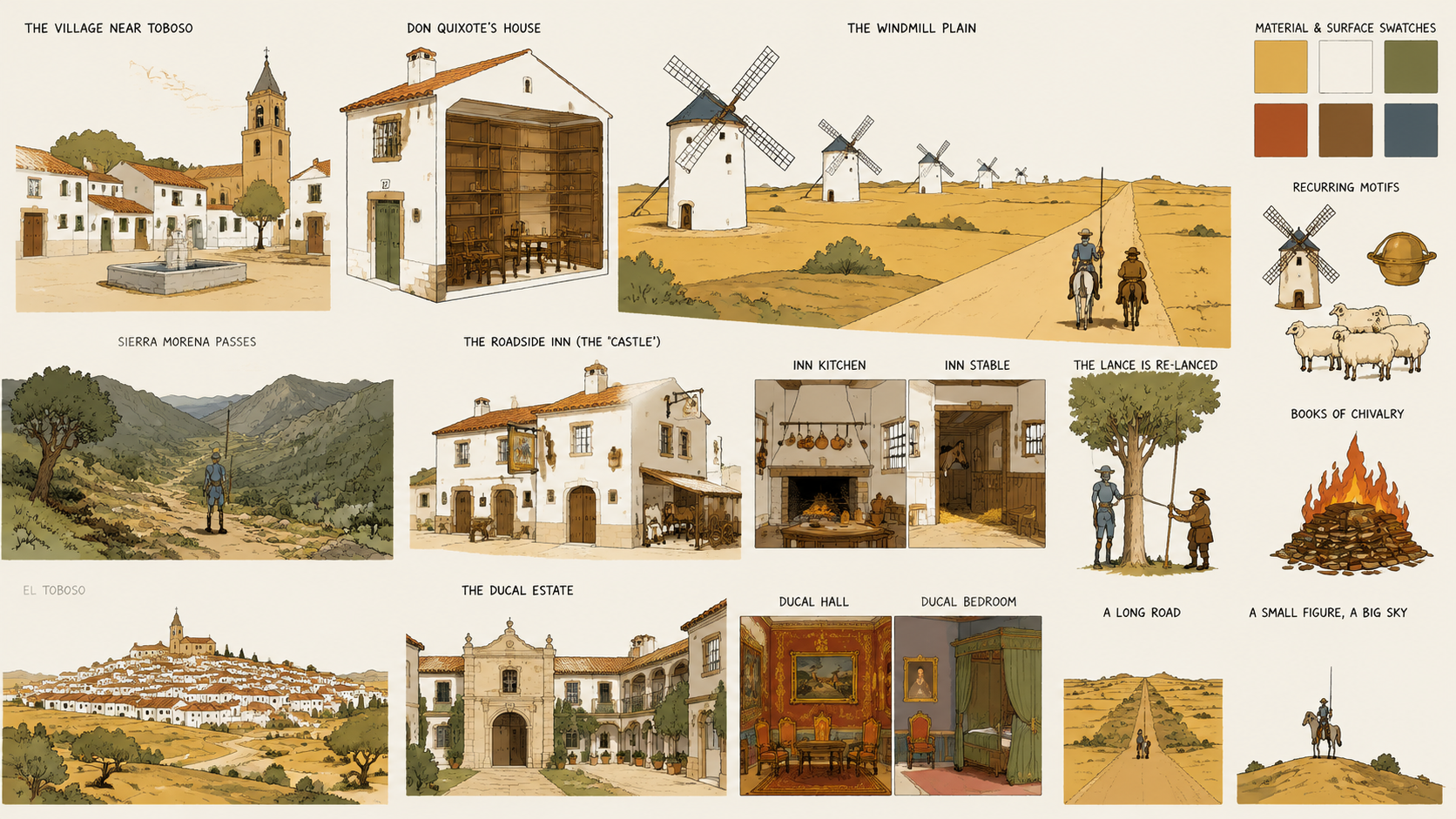
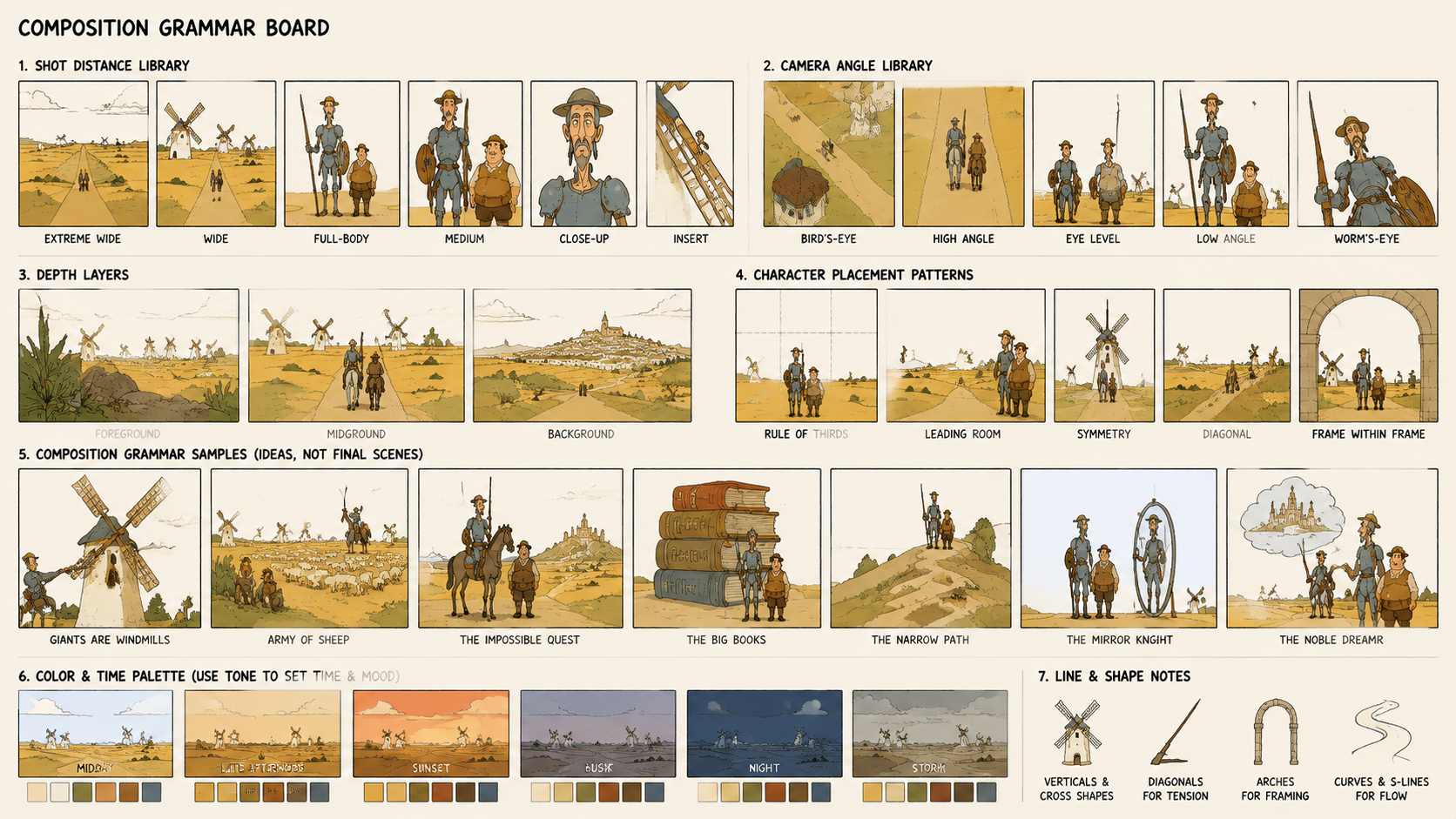
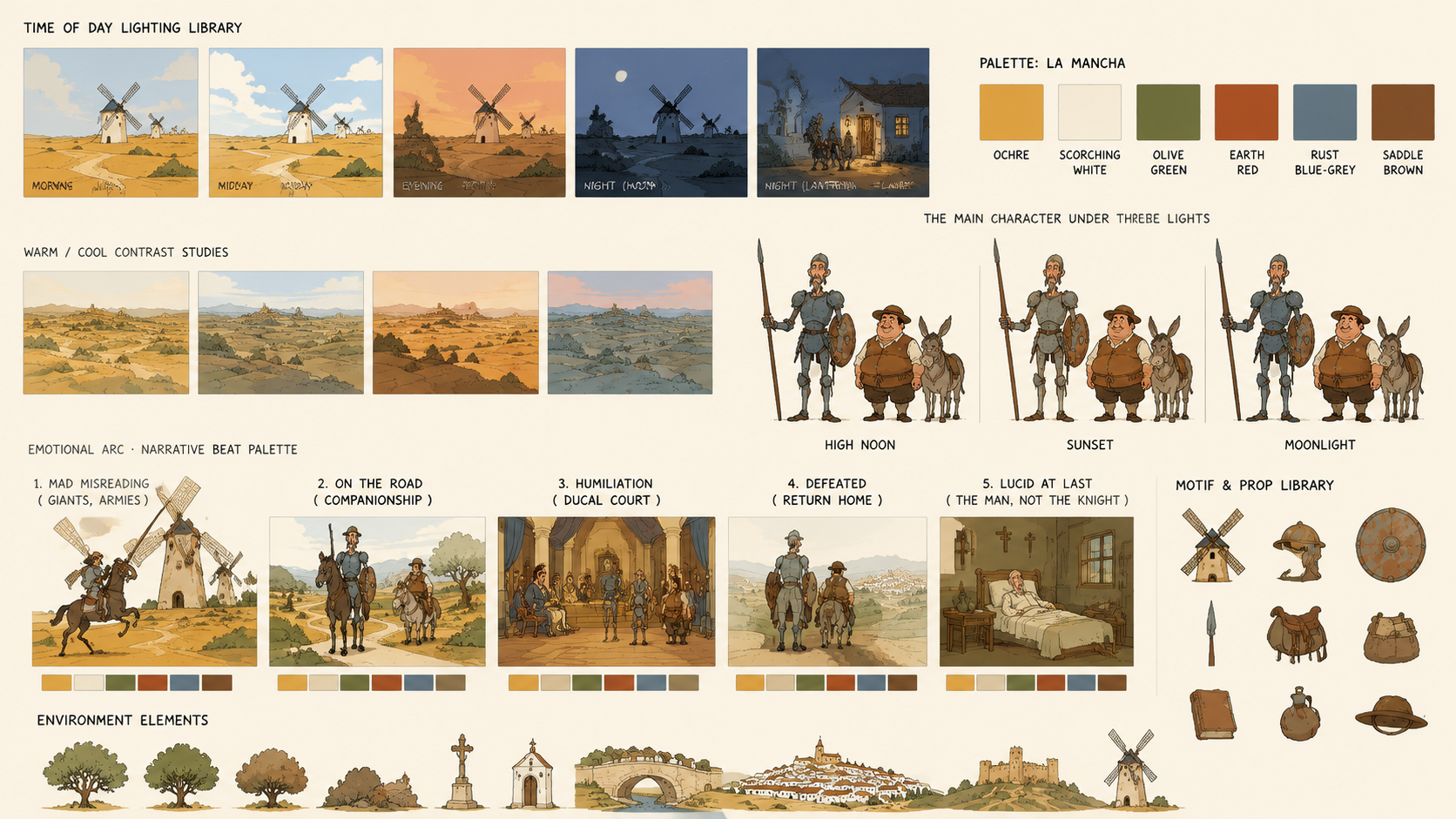
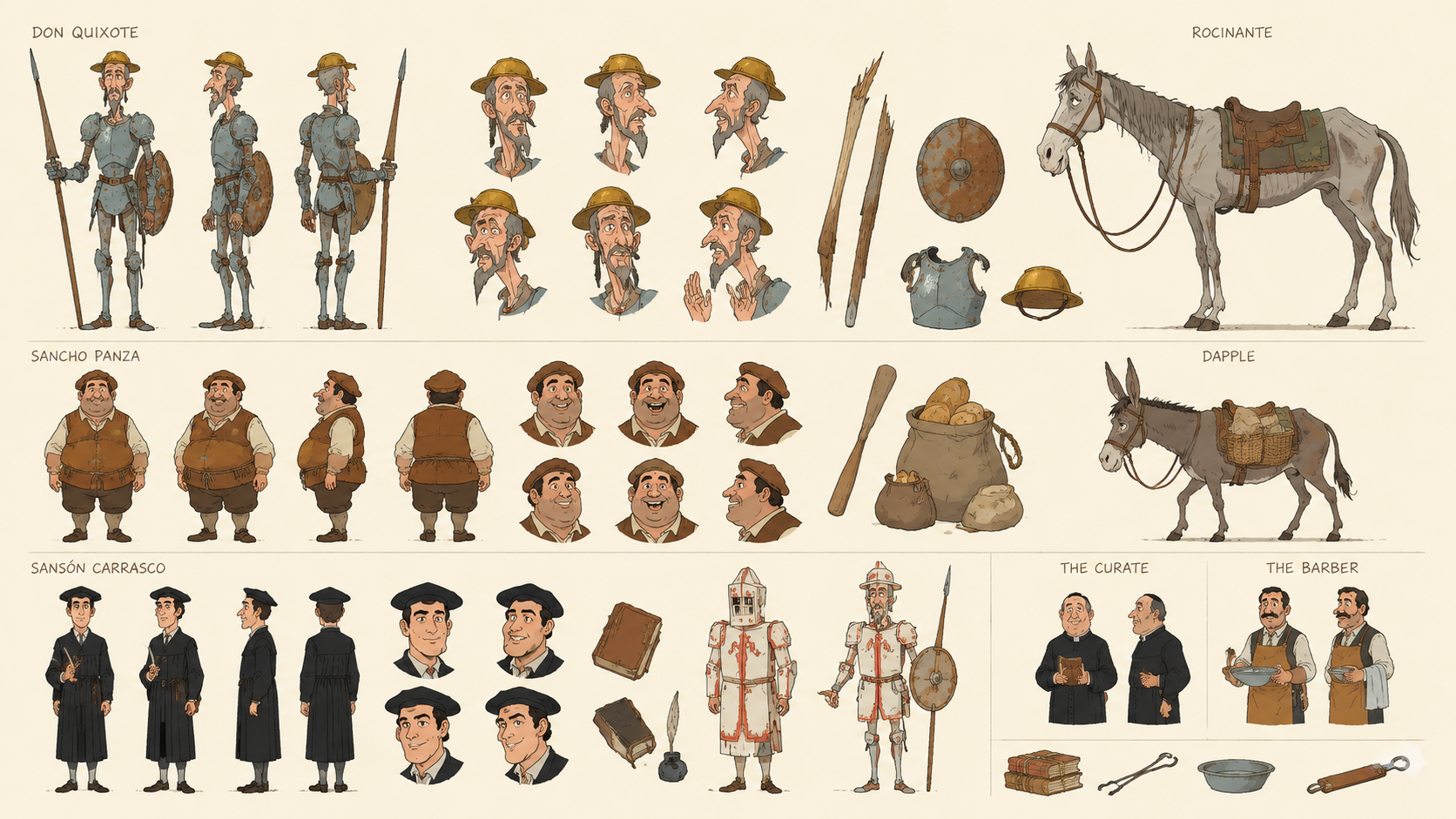
Art Direction4 plates
Before the guide was written, this book got a visual foundation — every illustration you just read grew out of it.