Dracula · Companion Guide
德古拉
一封律师信件拉开特兰西瓦尼亚古堡的黑暗帷幕,当五十箱故乡泥土运抵英国,死亡与梦游蔓延海滨——现代医术束手无策,只有木桩、大蒜和圣水能终结这场越界的入侵。
Opening: Listen to a Phonograph Cylinder First
A stack of diaries. A sheaf of telegrams. A few pages transcribed from wax phonograph cylinders. Nobody steps forward to tell you what happened; you have to piece it together yourself. More than a century ago, an Irish writer used this almost clumsy method of stitching together documents to drag an ancient vampire out of an Eastern European castle and into a modern England of telegrams, typewriters, and railway timetables. That is the coldest thing about Dracula: you think you're reading a horror novel, but really you're leafing through a case file written by hand by seven or eight different people.
What This Book Is, and Why It's Remembered
It is the Gothic epistolary novel Bram Stoker wrote at the end of the nineteenth century, published in 1897 by Archibald Constable and Company in London, and its story unfolds almost entirely between late-Victorian England and Transylvania, then still part of the Austro-Hungarian Empire. For more than a hundred years it has more or less invented everything that now comes to mind when we talk about vampires: castles, coffins, fangs, an aversion to sunlight, garlic, and crucifixes, the ability to turn into a bat or mist, the rule that a vampire must be invited in — every film, every anime, all of popular culture has been in conversation with it ever since. And yet it isn't told from a third-person, god's-eye view at all; it's assembled from the private papers of a handful of ordinary people. That documentary texture, the sense that you're handling a real case file, is the signature that literary history keeps coming back to.
Who's Here, and What They Want
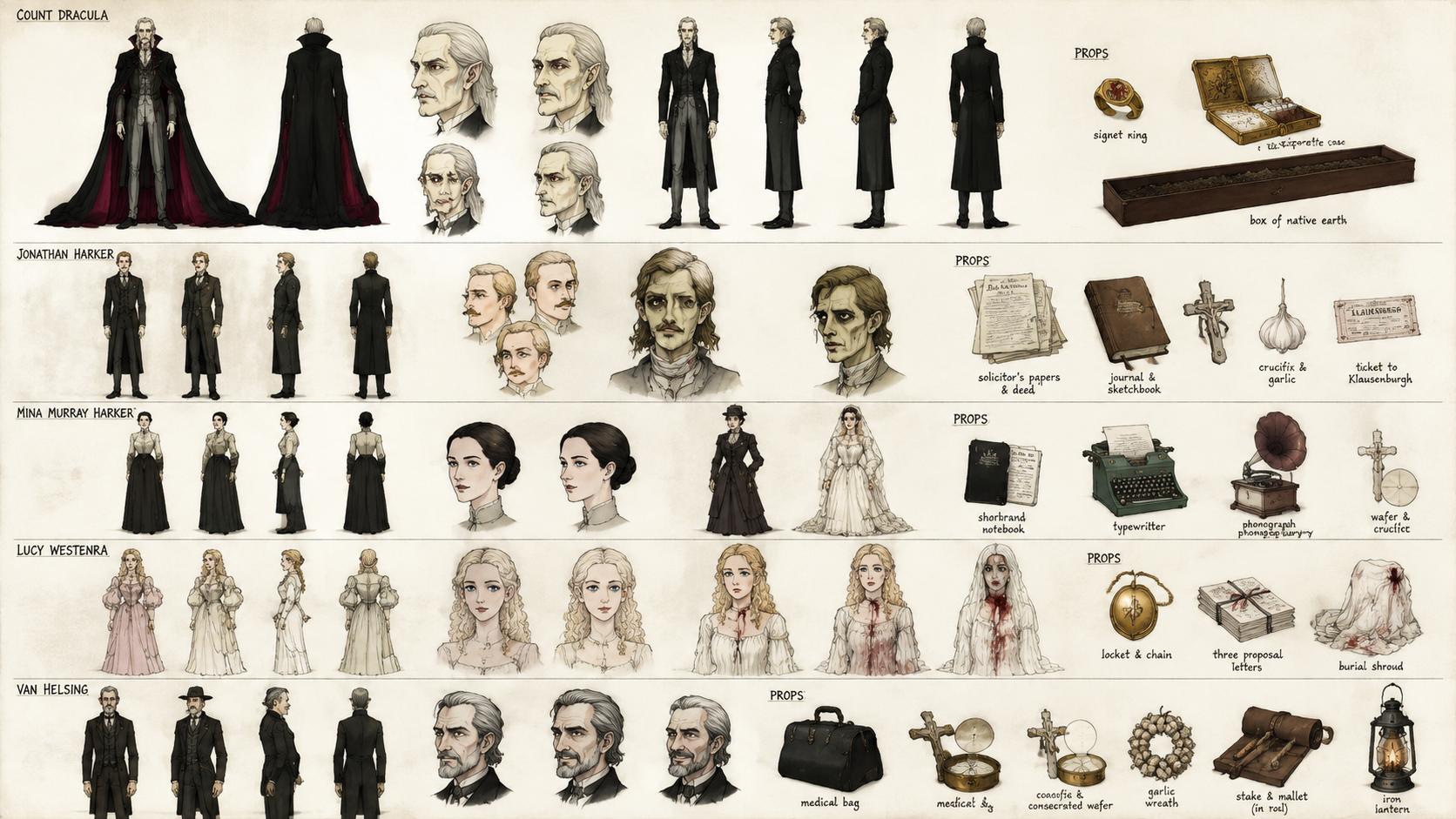
The core cast is small enough to count on one hand. There's only one villain: Count Dracula, an ancient vampire who calls himself a nobleman and holes up in a castle in the Carpathian Mountains, and who wants to ship fifty boxes of his native soil to London so he can put down roots there and spread. The young solicitor Jonathan Harker goes out to handle the paperwork for his London property purchase and, without meaning to, becomes a prisoner the moment he sets foot in the castle. His fiancee Mina Murray is sharp and capable; she later marries him and, unexpectedly, becomes a kind of radar that can sense where Dracula is. Lucy Westenra is Mina's best friend, courted by three men at once, but in the end she dies under Dracula's fangs and is turned into a vampire herself. The first to see through all of it is the Dutch doctor Van Helsing — Seward's old teacher, a man who can wield the most advanced medicine of his day and still believe in crucifixes and garlic, welding modern medicine and ancient folklore together in one person. Seward is one of Lucy's suitors and also runs the asylum; Arthur Holmwood is Lucy's fiance; the Texan Quincey Morris is the third suitor; and there's Renfield, an asylum patient under Dracula's psychic control who eats insects — he serves the atmosphere rather than the main plot. This group looks nothing like heroes; they're more like an improvised support group — a doctor, a lawyer, an asylum director, a young lord, an American cowboy — thrown together to take on a monster that has lived for centuries.
Plot Thread One: A Prisoner in the Castle
The story opens on what looks like an ordinary business trip: Harker travels to Transylvania on behalf of an English law firm to meet Count Dracula and settle the paperwork for a London property purchase. The first few entries read like an ordinary diary — an odd host, dishes he won't touch, wolves howling outside the window — but the tone shifts fast. He finds himself locked in a tower of the castle, and his diary pages are quietly being tampered with. At night three female vampires creep into his room to kiss him and drink his blood, and he fends them off with a crucifix at the last moment. The craft is hiding in these very pages: Stoker uses small details — the gaps in Harker's own record, the pages swapped out overnight — to make you feel an invisible editor working against him. The fear isn't narrated; it leaks out through the holes in the paperwork.
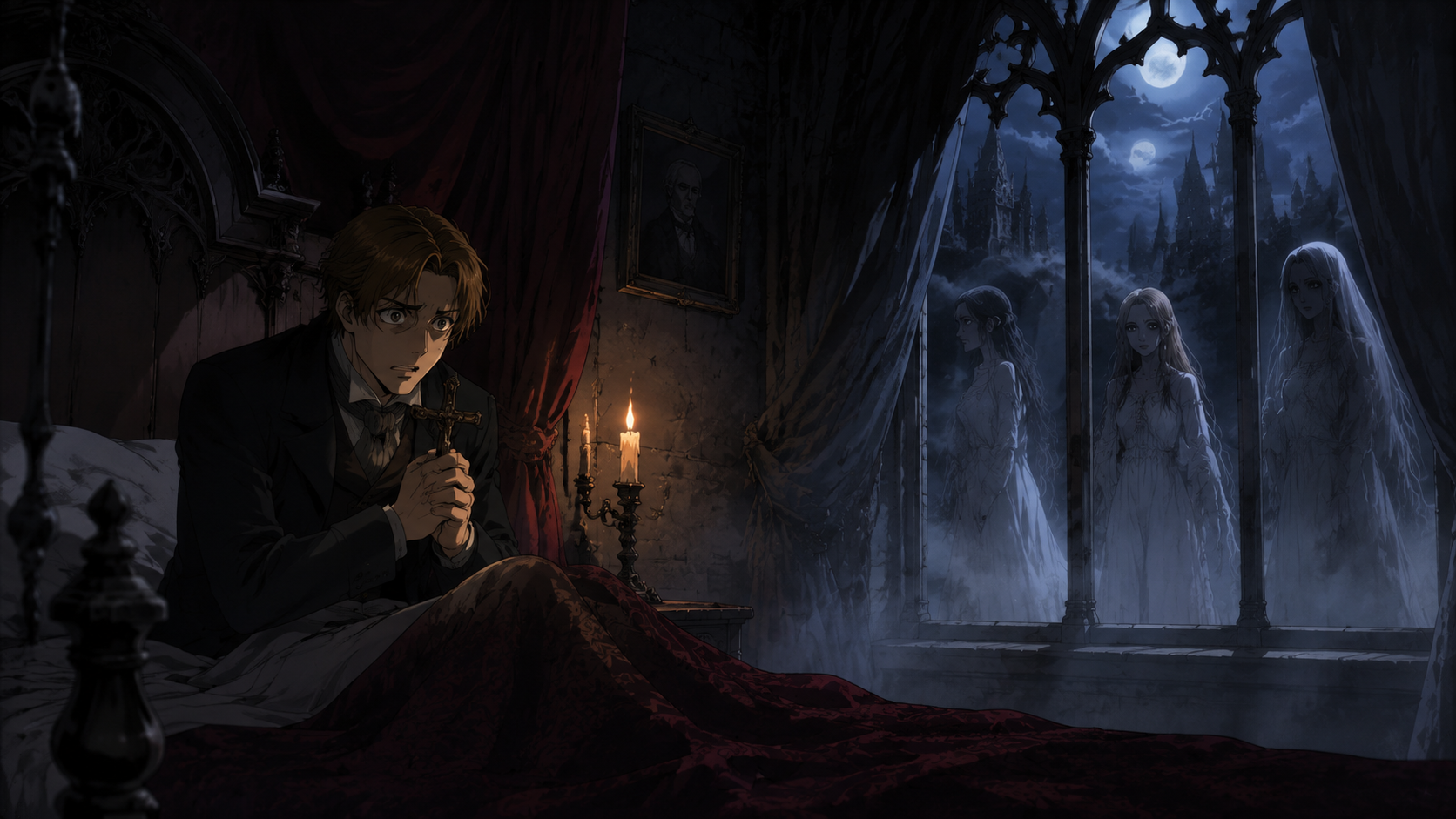
The fair girl, with a laugh of ribald coquetry, turned to answer him:-- "You yourself never loved; you never love!"
“那美丽的女孩发出一声放荡的嘲笑,转向他答道:‘你自己从未爱过;你永远不会爱!’”
原文金句 · 城堡之夜
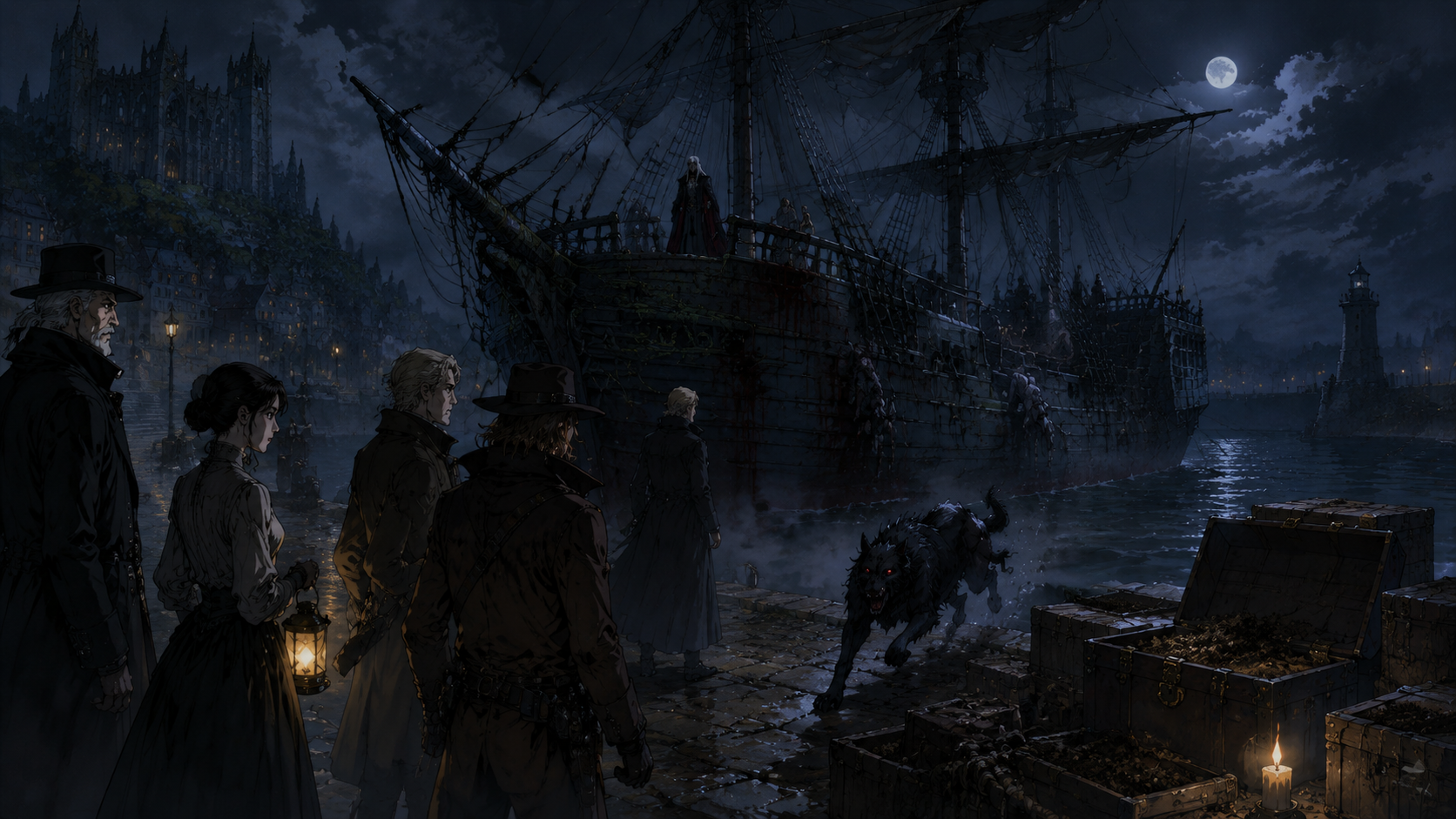
While Harker is trapped, the real invasion is quietly unfolding on another front. A cargo ship called the Demeter, carrying the fifty boxes of native soil, is sailing toward England; the only living thing aboard by the end is a captain's log written in an eerie hand, almost as if under duress, and every last crew member dies in some inexplicable way. The ship drifts into Whitby harbor like a message in a bottle, and something that looks like a great black dog leaps ashore onto Victorian England. The craftiness here is that the ship's tragedy is reported entirely from the side — through a clipped shipping bulletin and a log seemingly transcribed by a stranger's hand, it tells a ghost story almost in the flat tone of a news report, which is deeply anticlimactic and, for that very reason, more chilling.
Plot Thread Two: Whitby Harbor and Lucy's Death
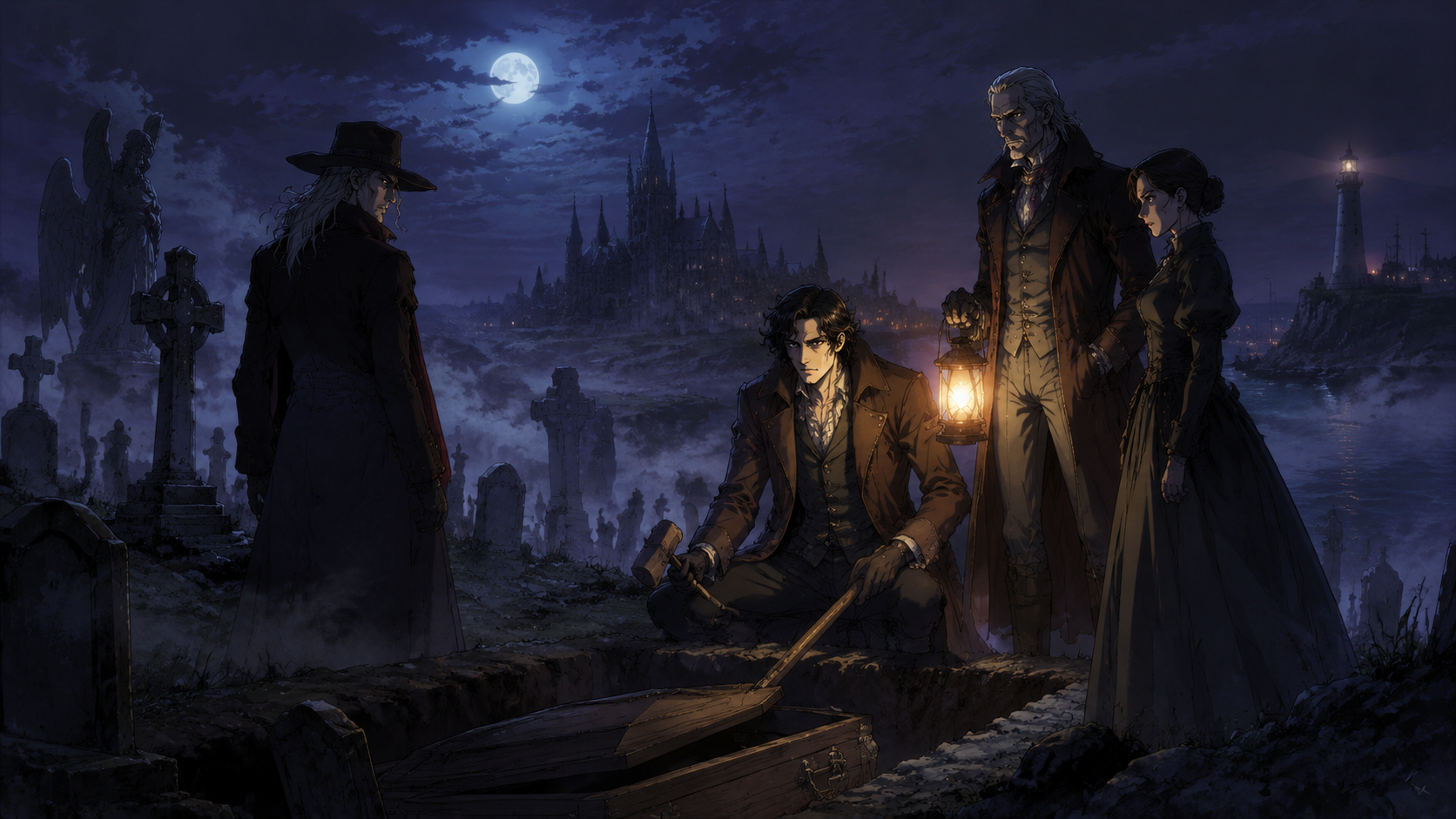
Mina is in Whitby waiting for Harker to come home while her friend Lucy is being courted by three gentlemen at once, and the lightness of that social scene is set right next to the weight of Dracula's landing. Lucy starts sleepwalking at night, two small unexplained wounds appear on her neck, and her health keeps declining. Dr. Seward can find no disease that modern medicine can account for — one of the book's sharpest moves of judo: the more confidence modern medicine puts on display, the more it gives itself away. Van Helsing is called in to consult, and the old man sees at a glance that something has been drinking her blood, yet he himself can't do without garlic, crucifixes, and blood transfusions — a spectacle of modern instruments paired with old-fashioned exorcism. Lucy finally dies in her bed, and within days — in a quiet echo of the gaps in Harker's own diary at the start of the book — she's confirmed to have turned into a vampire, preying on children in the neighborhood at night. Van Helsing and the three suitors quietly dig up her coffin and find something inside that is no longer human.
Dark figures are on the beach here and there, sometimes half shrouded in the mist, and seem "men like trees walking."
“黑影零星散布在海滩上,时而半掩在雾中,宛如‘行走的树木’。”
原文金句 · 惠特比海滨
The night they lay Lucy's spirit to rest is the most ritualistic scene in the whole book: a stake driven through the heart, decapitation, the mouth stuffed with garlic, each act carried out by a different hand, with the fatal blow delivered by Arthur himself. The craft here is that the scene gets described over and over across several people's diaries, and the accounts don't quite line up — each person remembers the details slightly differently, which makes you feel that what you're reading is the version this group arrived at only after comparing notes, the closest thing to the truth they could piece together. Here the documentary texture becomes a synonym for horror.
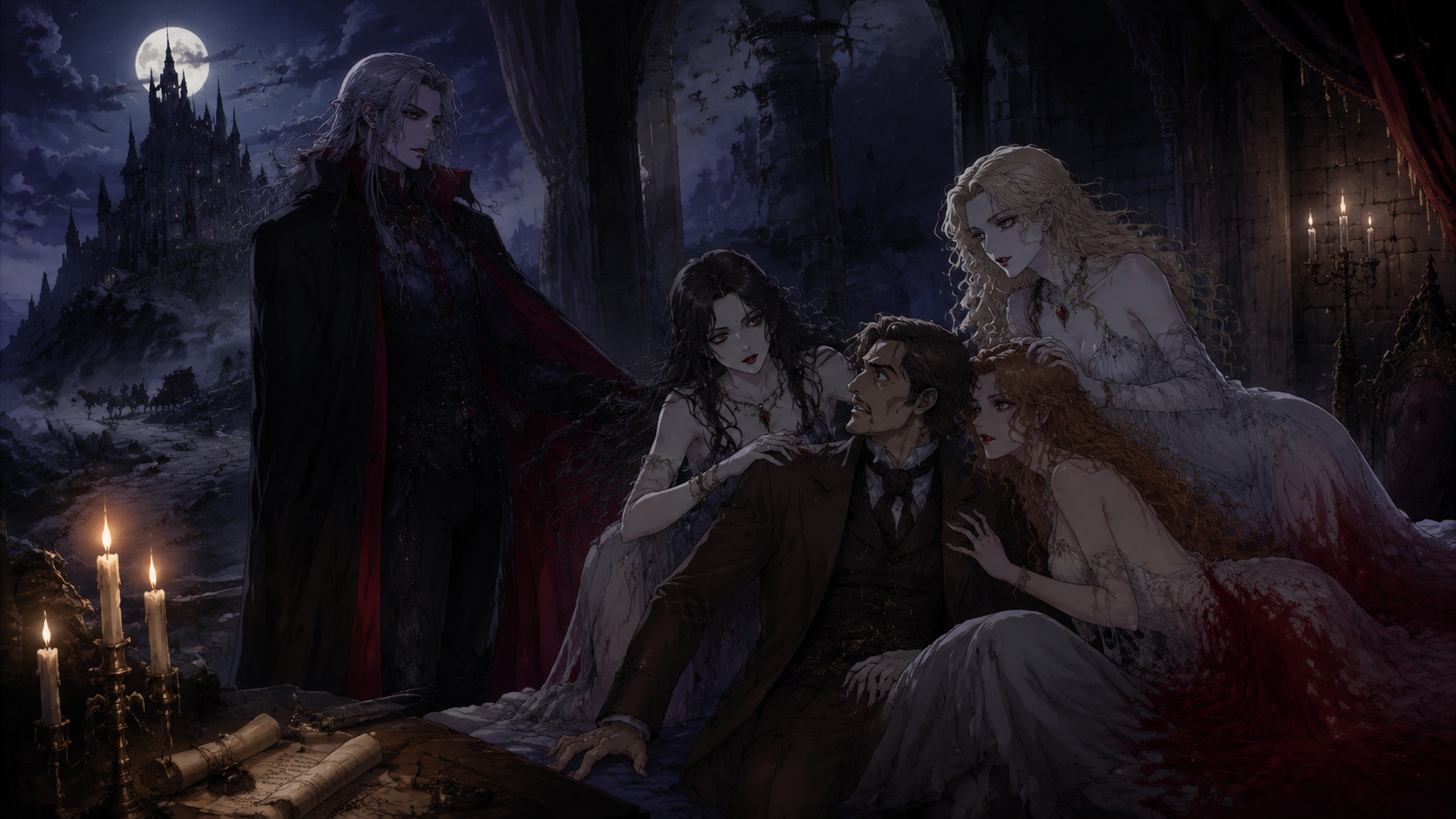
Van Helsing came and laid his hand on Arthur's shoulder, and said to him:-- "And now, Arthur my friend, dear lad, am I not forgiven?"
“范海辛伸出手,放在亚瑟肩上,对他说:‘现在,亚瑟,我的朋友,亲爱的孩子,我是否得到了原谅?’”
原文金句 · 墓室安魂
Plot Thread Three: The Notes Come Together, the Hunt Escalates
Harker finally makes it out of the castle alive and back to London, and marries Mina. For the first time, the whole group spreads out their diaries, notes, and clipped telegrams on a single table and reads them together — that moment of sudden clarity is a pleasure unique to the epistolary novel, where the reader pieces the puzzle together right alongside the characters. Once everything lines up, the fact that Dracula has already slipped into London with his soil is right there on the table, and this group of Victorian middle-class men decides to systematically destroy, box by box, the native soil he's stashed across his various properties. Without soil he has nowhere to rest — that's the villain's own rule, and now it becomes the hunters' strategy. The pacing here shifts from solitary Gothic dread to the logistics of a small unit at war, the turning point where the book stops trying to startle you and starts to stage a hunt.
Plot Thread Four: Mina Is Tainted, a Pure Woman Becomes the Battlefield
But Dracula is not just prey that hides. He changes targets, attacks Mina at night, and forces her to drink his blood, forging a psychic link across hundreds of miles — from then on she can sense where he is, and he can sense the hunters thinking about him. This is the darkest move in the whole book: an infected member now sits inside the hunting party, and she happens to be the once-pure, intelligent wife everyone had been protecting most closely. Van Helsing's handling of Mina carries a strong Victorian streak of disciplining the female body: he insists on a purification ritual before letting her help with the tracking, as if her body has to be washed clean of contamination before she can be allowed back into the fight. This section has always been a favorite of literary criticism — it welds the vampire-hunt plot to gender politics in a way nothing before it had done.
Plot Thread Five: The Chase Back to Transylvania, the Final Hunt
The hunters turn the psychic link forced between Mina and Dracula into a radar of their own, using it to track him as he flees home overnight, trying to bury himself in his native soil for good. The final battle takes place on the mountain road leading up to the castle: they intercept the gypsy convoy carrying Dracula's coffin. Notice the small detail here — Dracula is not found in some manor study; he has reverted, on the run, to just one more of the fifty boxes of native soil, so the group has to pry open the coffin itself to find the thing that keeps switching back and forth between human shape and earth.
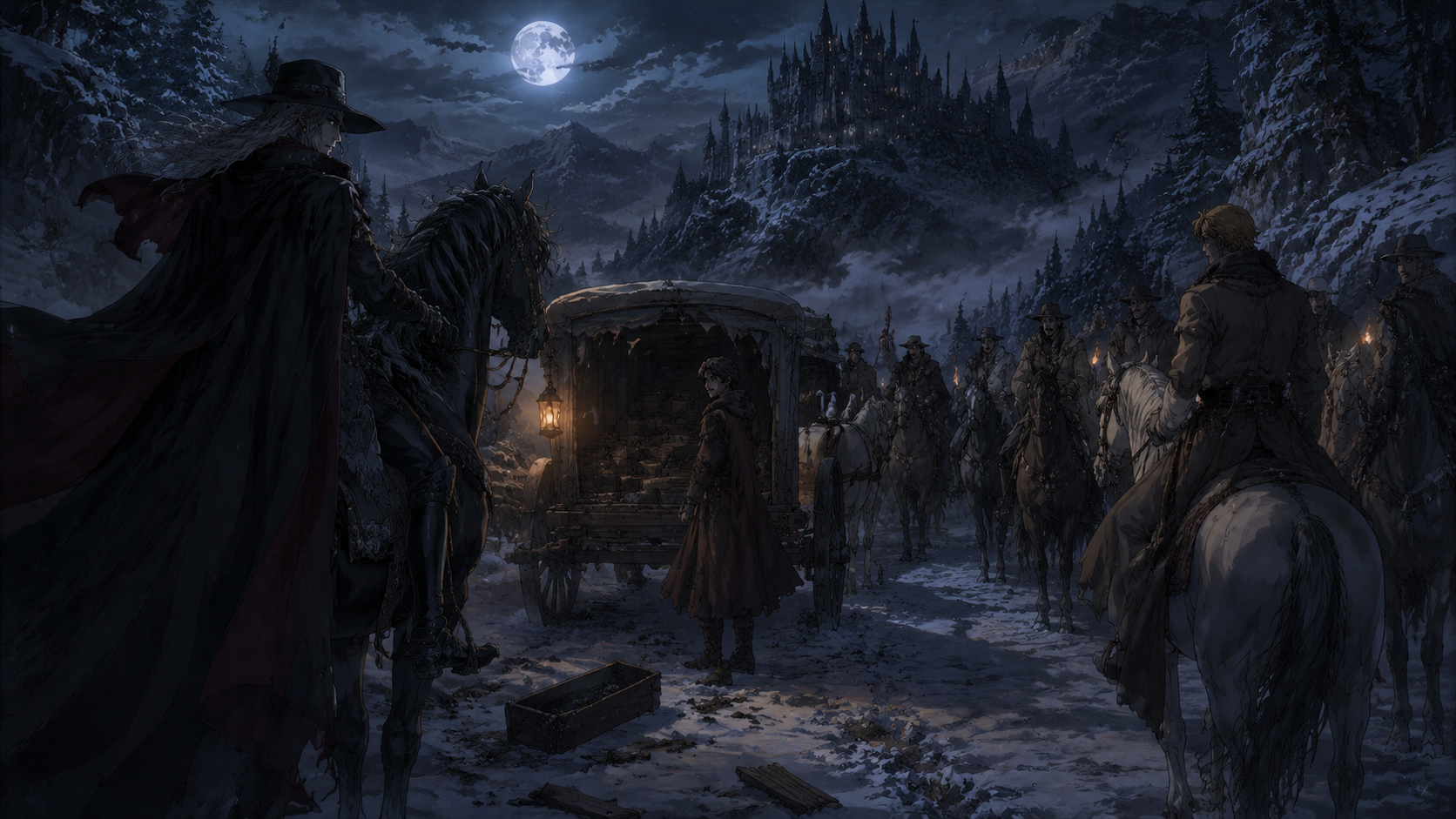
There was a pause, broken by Jonathan Harker's voice:-- "Now, God be thanked, we shall soon meet!"
“片刻的停顿之后,乔纳森·哈克的声音响起:‘现在,感谢上帝,我们很快就要相见了!’”
原文金句 · 终局追猎
Two knives finish the scene: Jonathan swings a kukri and cuts Dracula's throat while Quincey Morris's Bowie knife drives up into his heart from below. The ancient nobleman crumbles to dust on the spot. Note that this is not the simplified version the movies usually give you — not a plain beheading, not a plain stake through the heart, but a throat-cut-plus-heart-stab combination, which is also closer to how Slavic vampire folklore actually kills its vampires. Quincey is mortally wounded in the fight and dies, and Mina's curse lifts the same day. The novel closes seven years later with the birth of the Harkers' son, a boy they name Quincey.
What It's Really About
On the surface, Dracula is a story about a group of modern people staking an undying ancient nobleman. But its real weight has nothing to do with the ghost and everything to do with what Victorian society was afraid of at that exact moment. The era's collective panic about outsiders, about the contamination of a pure woman's body, about transgressive sexuality, is smuggled with real skill into the metaphor of an immigrant nobleman hauling fifty boxes of native soil south from Eastern Europe into London. Dracula arrives uninvited, yet by his own rule he can only cross a threshold once he's been invited in — and what makes him so frightening is precisely that he is being invited.
She sighed and positively a shadow of a smile stole over her poor, pale face as she put her arms round me and said softly:-- "Oh, thank God for good brave men!"
“她叹了口气,一丝微笑的影子掠过她苍白可怜的脸庞,她搂住我,轻声说:‘哦,感谢上帝赐予善良勇敢的人们!’”
原文金句 · 尾声
On a deeper level, the book runs a small-scale test of whether modern reason can actually contain ancient evil. The hunters use every cutting-edge tool of their day — typewriters, shorthand, the phonograph, hypnosis, even telegrams and shipping news — and yet in the end they can only close things out by falling back on the stake, the garlic, the crucifix, all thoroughly pre-modern rituals. The book's real power hides in that awkwardness of scientific men being forced to believe in the supernatural, an awkwardness that still feels fresh more than a century later.
Why It's Still Worth Reading Today
Knowing the gist of the plot is not the same as having read it. Its real strength is this: you have to piece the puzzle together yourself, out of that stack of diaries, telegrams, and clippings, before you can feel the fear that leaks out through the documents rather than being told to you, and before you can catch the fine differences in each narrator's voice — Harker's clerkly precision, Mina's attentive self-discipline, Dr. Seward's clinical detachment, Van Helsing's scientific patter tangled up with foreign phrases. Writing character through handwriting like this barely survives being summarized secondhand; only once you're turning the diary pages yourself does the surprise of realizing a horror novel could be built this way hit you, and no plot summary can give you that.
What's truly frightening about Dracula isn't the vampire — it's these civilized people realizing, for the first time, that all their prized modern tools still need a stake and a clove of garlic to finish the job.
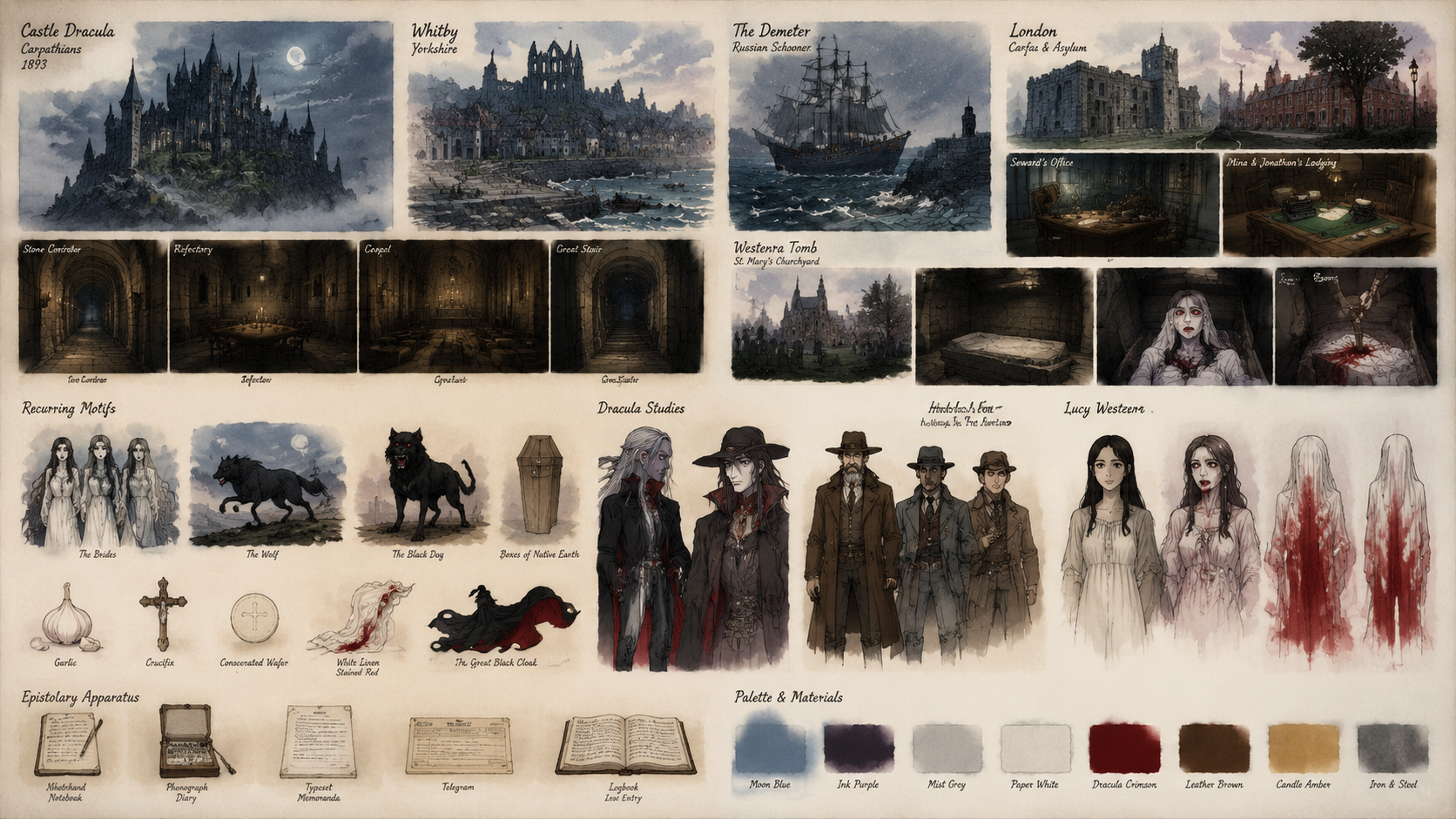
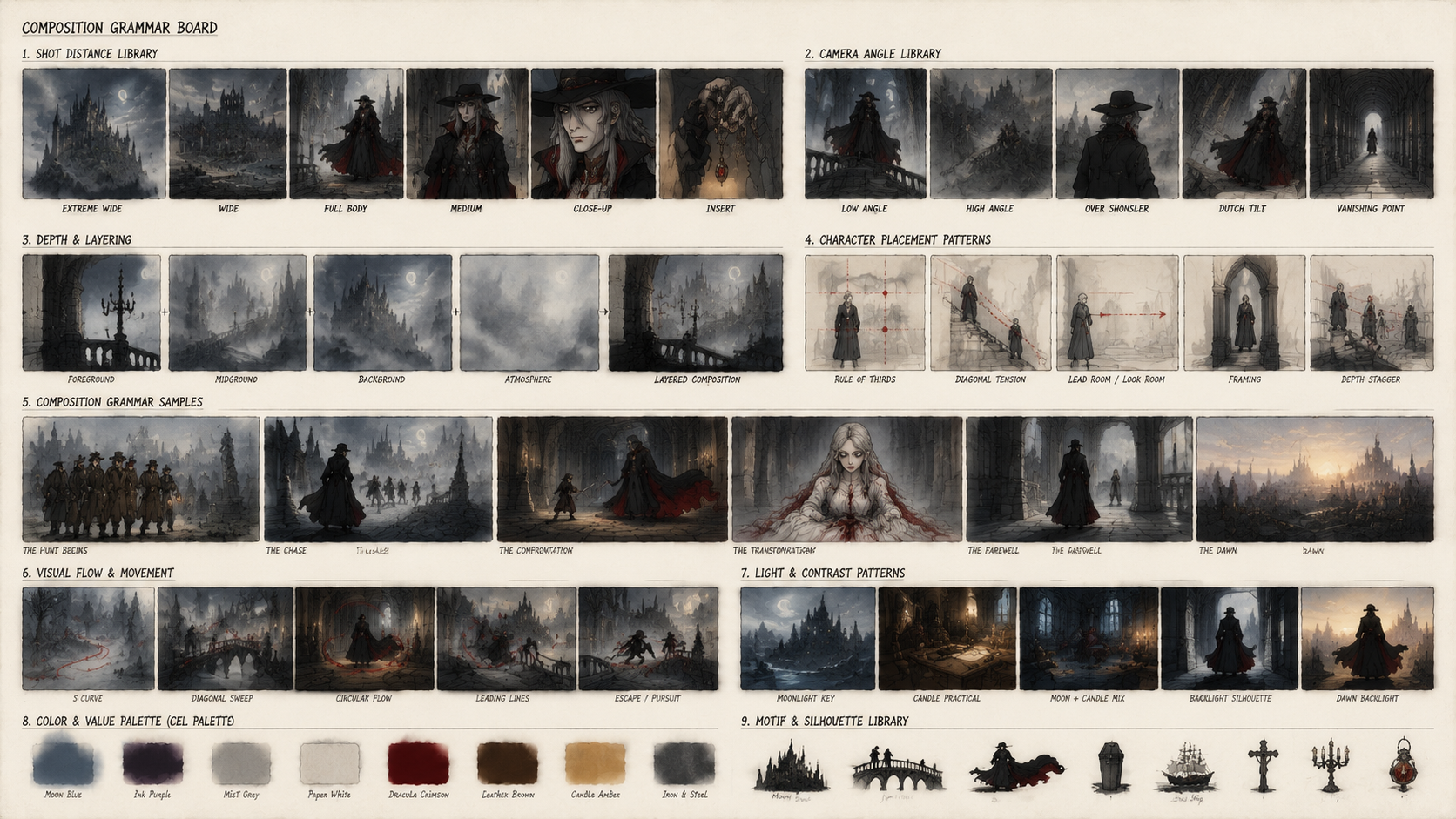
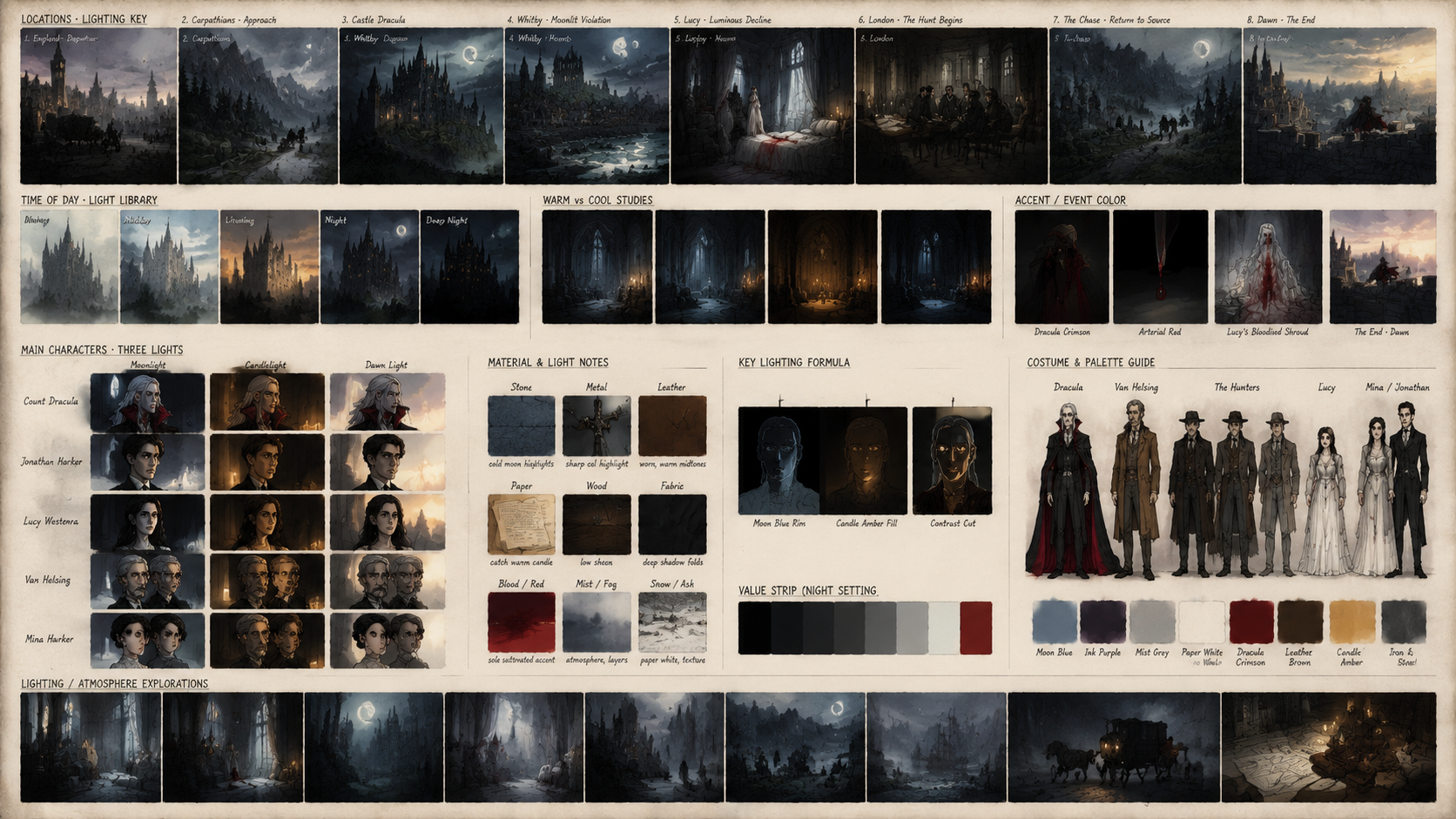
Art Direction4 plates
Before the guide was written, this book got a visual foundation — every illustration you just read grew out of it.