Egyptian Tales, Translated from the Papyri · Companion Guide
埃及故事集
一个牧人的心脏离地,化成了江边两株松——三千年前纸草上的变形链,后来长成了整个西方的神话根脉。
Opening Hook
A heart drops to the ground. The axe is still in the older brother's hand. A moment later the younger brother is gone — in his place, two pine trees by the river, leaves stirring in the wind. This is a scene some anonymous scribe wrote on papyrus more than three thousand years ago. The Greeks would later tell a version of it as Dionysus; the peoples of the Near East would tell it as Gilgamesh's reckoning with death. The original is a story about two brothers who herded cattle on the banks of the Nile.
What Kind of Book Is This
Egyptian Tales is a collection assembled and translated by the nineteenth-century British Egyptologist Flinders Petrie from a set of ancient Egyptian papyri, published in 1895. The papyri themselves date from Egypt's New Kingdom, over three thousand years old, written by priests or scribes whose names are lost. What makes them matter is that these are not later Greek or Roman retellings. They are first-hand literature translated straight out of the original hieroglyphic and hieratic script, one of the sources at the root of Western narrative, older than the Homeric epics ever took shape.
The three best-known pieces in the collection are The Tale of the Two Brothers, about a rift between siblings and a chain of transformations; The Shipwrecked Sailor, about a castaway who meets a giant serpent; and The Doomed Prince, about a man marked for death from birth. The three read nothing alike, but they share the same ground: an Osirian belief in the afterlife, echoes of the oracle of Amun, and an order that runs from Pharaoh down through the gods.
People and World
The world these stories take place in is not the monumental Egypt of pyramids and the Sphinx. It's the Egypt of the papyri: the marshes of the Nile Delta, pastures fringed with papyrus reed, river mouths where cedar boats drift out to sea, the sacred bull-pens deep inside the temples, the embalmer's workshop and the mummy case. The people herd cattle by the river, farm the fields, serve as attendants in the Pharaoh's household. Their days are lived in specifics, and the gods tend to turn up uninvited.
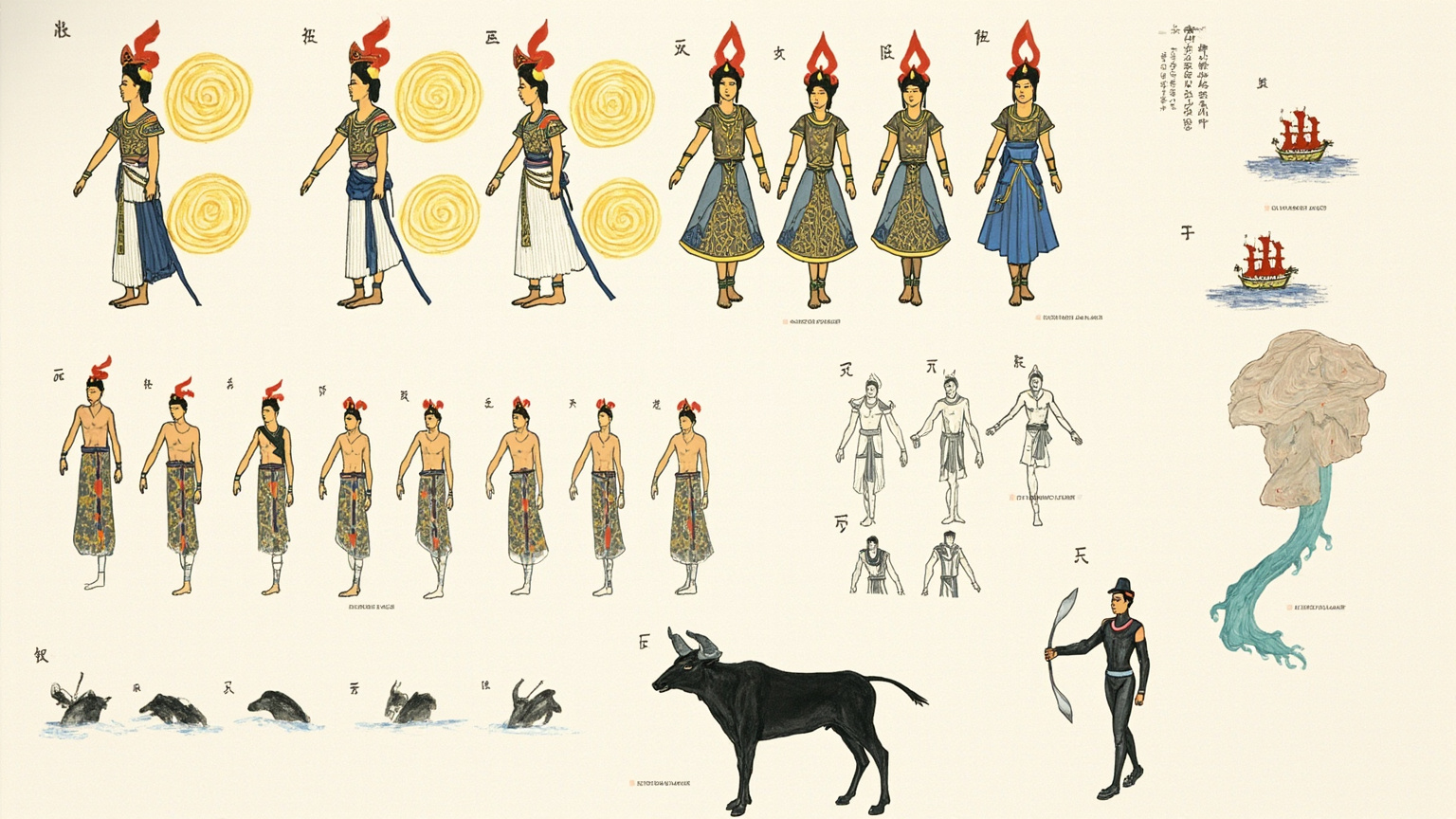
The cast splits into three groups. In The Tale of the Two Brothers there are Anpu and Bata: the elder steady and strong, the younger loyal and still young, both of them herdsmen who depend on each other, plus the failed seductress who sets the plot moving — Anpu's wife, who propositions her brother-in-law, is refused, and accuses him instead. In The Shipwrecked Sailor there is the royal attendant whose ship wrecks in a storm and who washes up on the island of a giant serpent, and the serpent itself, who calls himself the spirit of Ptah, gold-scaled, lapis lazuli set between his brows, keeping a nameless island alone. The third group belongs to The Doomed Prince: a foreign prince condemned to death by three goddesses of fate, a doom his mother cannot avert even by hiding him in a shrine, and the Pharaoh's daughter he later meets in Egypt. Running through all three is the Pharaoh, the secular authority the stories keep returning to: protector, recipient of oracles, the anchor that holds the world in order.
The Sister-in-Law's Accusation, the Brothers' Break
The break between the brothers is the oldest and most complete narrative in the whole book. Anpu's wife propositions Bata; refused, she turns around and accuses him of trying to force himself on her. Anpu hears this and goes after his brother with an axe. Bata runs ahead of him, pleading with his brother to turn back even as he flees. When Anpu finally turns away, his brother is simply gone. In his place stand two young pine trees by the river, branches swaying in the wind. A heart falls from Bata's body and lodges in the roots.
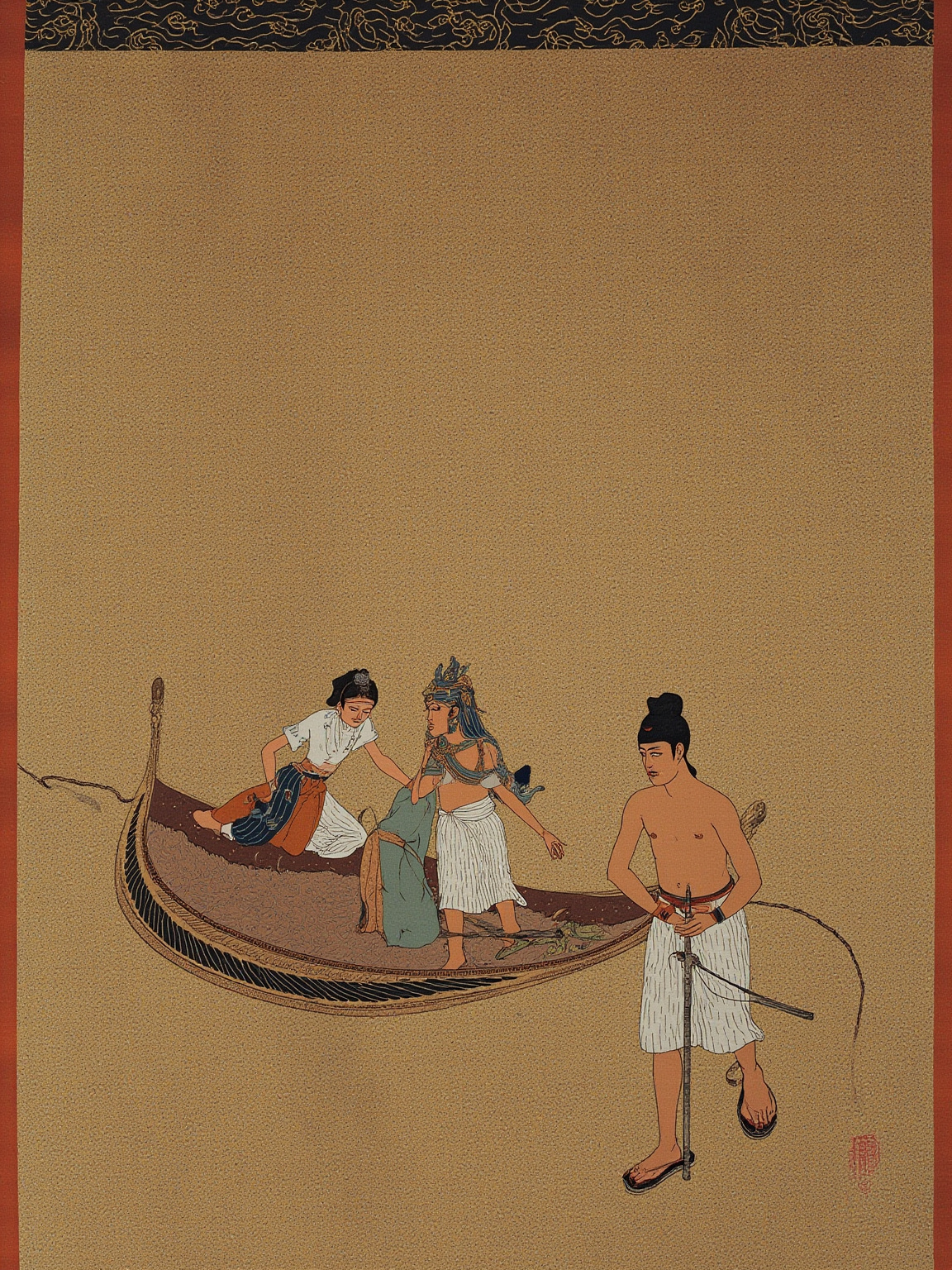
His heart stood still, and two cedar-trees rose upon the bank where he had fallen.
他的心静止了,在他倒下的河岸上,长起了两株雪松。
金句 · 《两兄弟的故事》· 江畔变形
Even three thousand years later, the way this scene is written stops you cold. The author skips the shouting match, skips the blood, never even lets Bata die under the axe. Instead Bata turns straight from a man into a plant, and the chase turns straight into a vigil. Only after Anpu goes home does he realize that the two trees are his brother. From that point his fate narrows to one task: keeping watch over that heart. With this single move, the story shifts from revenge to mourning. The remorse of a sibling who kills his own kin, which would later fill Greek and Roman tragedy, already has its full template here.
The Bull Sacrifice and the Sacred Tree Reborn
Before his transformation, Bata leaves word: if the trees are ever cut down, his heart will fall into milk and be reborn as a bull. Anpu does exactly that, and the bull appears, right on cue, and is presented at the temple within the Pharaoh's palace. On the day of the sacrifice the bull falls, a drop of blood from its heart lands beneath the temple's fragrant fruit tree and takes root there — the Ishtar tree, one of the most venerated sacred trees in the temple.
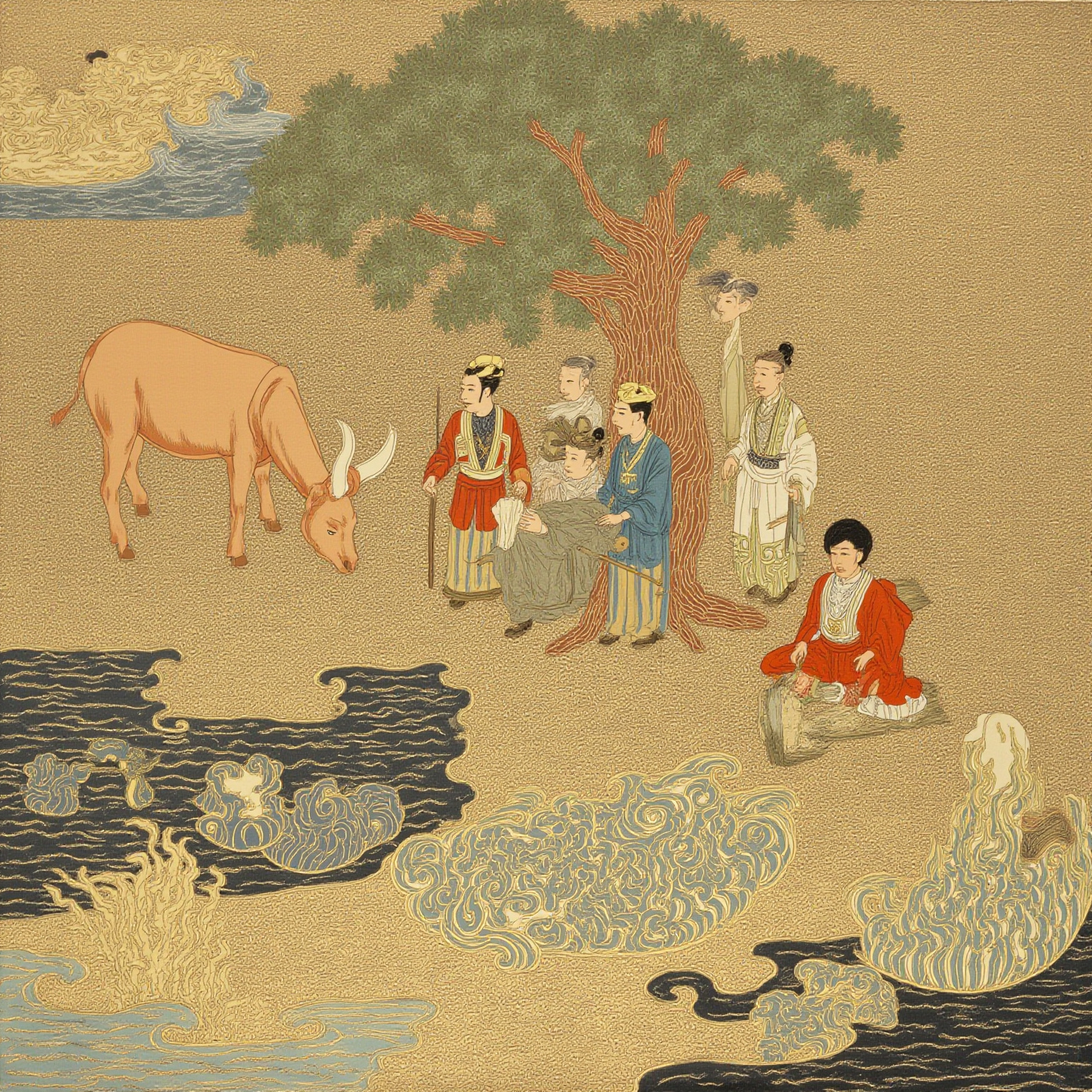
They offered the bull to the gods, and its heart dropped forth upon the sand.
他们将公牛献予诸神,它的心滴落在沙上。
金句 · 《两兄弟的故事》· 圣树再生
The sacred tree bears fruit almost at once. Everyone in the palace scrambles to eat it, and one piece ends up in Anpu's mouth. Bata is reborn in human form on the spot, brought into the palace by the Pharaoh, given a house, and married to the Pharaoh's own daughter. Buried in this sequence is the core of ancient Egyptian belief about the afterlife: death is not an ending but a change of vessel. First a plant, then an animal, then a sacred object, and finally a man again. Each transformation is not a loss but the same matter continuing on in a different form.
Bata's Dream Visit and Final Deification
Once revived, Bata marries the Pharaoh's daughter, but something unresolved sits under that marriage. His wife later turns against him again, and just as the Pharaoh foretold, she dies by her own lover's hand in the end. Bata does not stay around to see it. He appears to his brother in a dream and asks him to lead his wife to a valley and cut down a cedar tree. The instant the cedar falls, Bata rises into the sky as a star and stays there. After his death his body is installed as the foremost image of Ptah, the creator god of Memphis. He is no longer a mortal man; he has become part of the god himself.
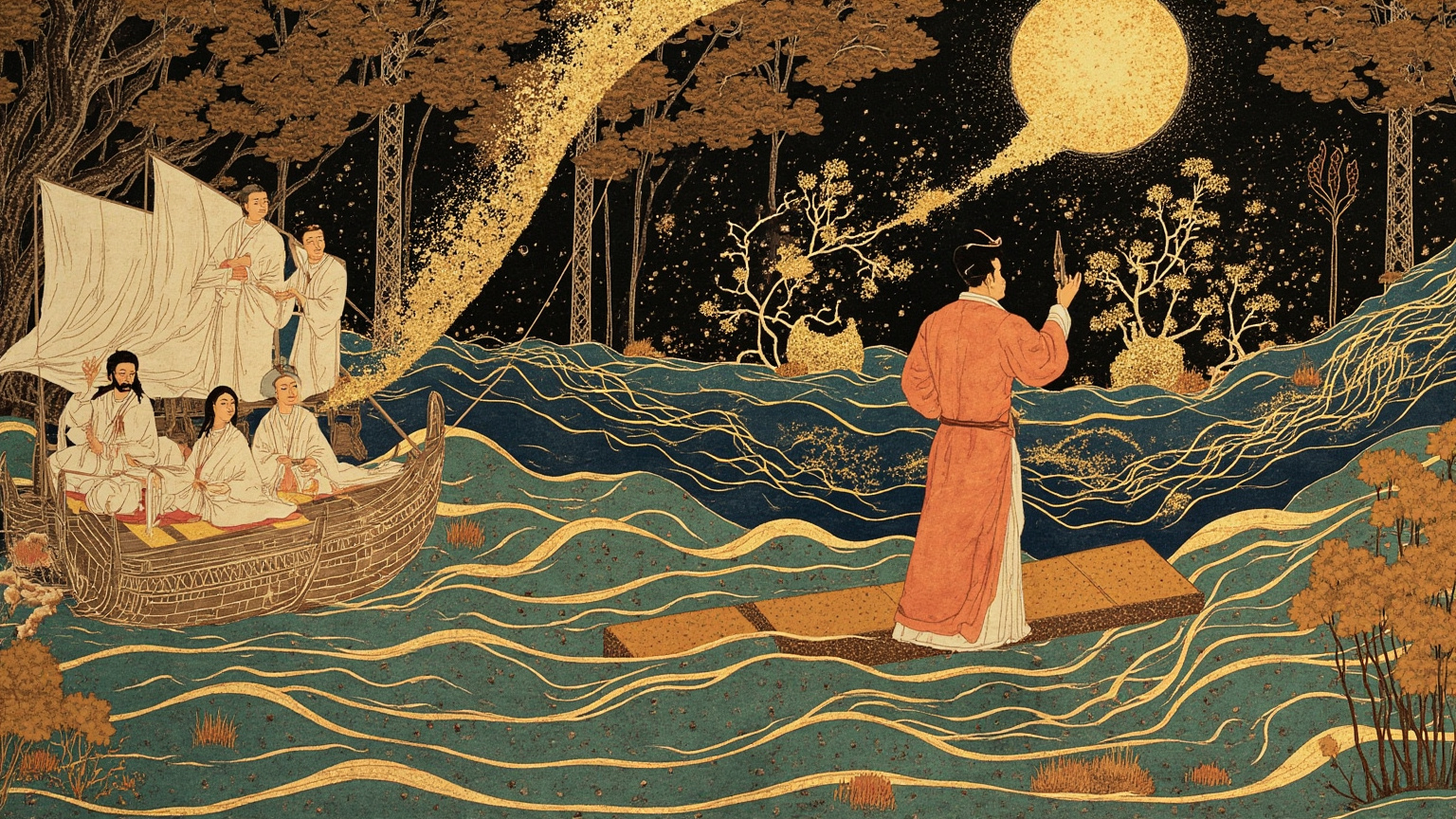
They cut down the cedar, and a star ascended from its heart to the sky.
雪松倒下的瞬间,一颗星辰自它的心升起,归于天穹。
金句 · 《两兄弟的故事》· 星辰升天
This is the capstone of the whole book. A young herdsman, falsely accused by his sister-in-law, wrongly killed by his own brother, sacrificed, dismembered, raised into a star, and finally made part of the body of Memphis's chief god. This chain of transformation is the fullest literary statement of the ancient Egyptian afterlife there is. Reading it, I keep going back to that earlier chase scene. The axe was never coming down on a man. It was the opening move of a god's incarnation.
The Shipwrecked Sailor Reaches Serpent Island
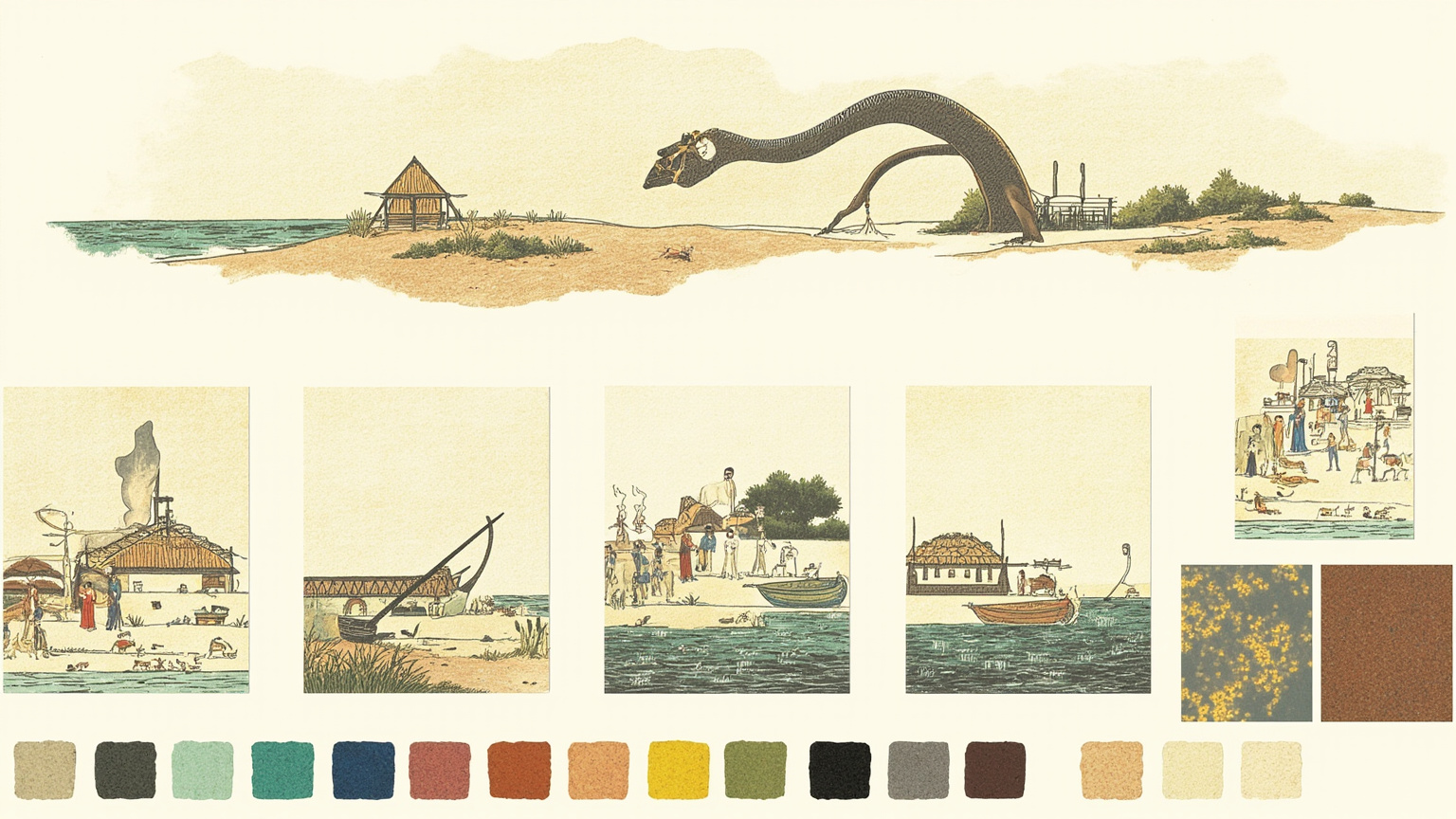
The second piece has an entirely different flavor. A royal attendant sails out on a mission across the Red Sea, the ship goes down in a storm, and he is the only one left, clinging to a plank until he washes up on a nameless island. Coiled there is a giant serpent, thirty cubits long, its back scaled in gold, lapis lazuli set between its brows. The serpent speaks, names itself the spirit of Ptah, and leads the sailor back to its den.
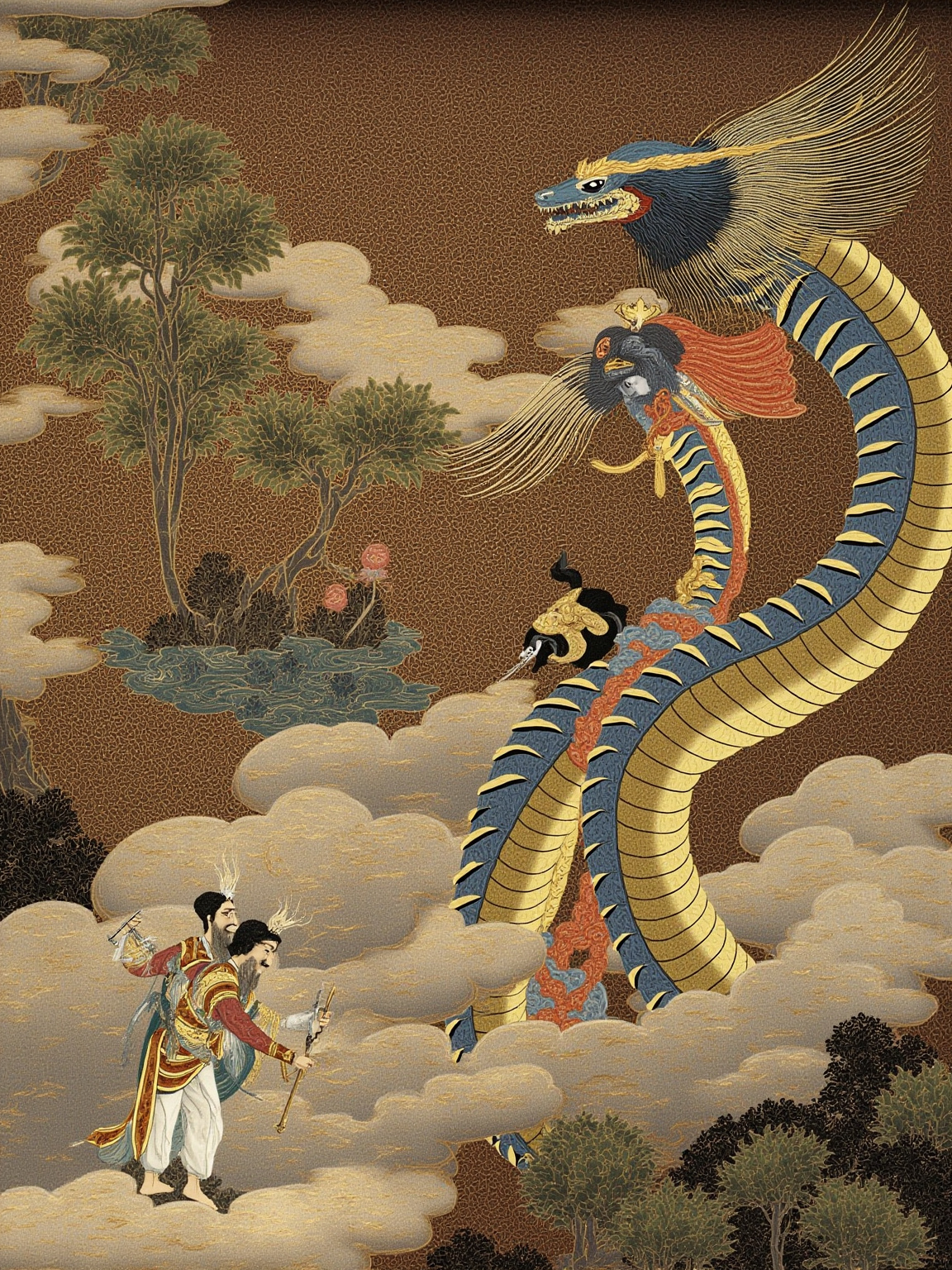
I am the Spirit of Ptah; my form is wrought with gold and lapis, and my length is thirty cubits.
我是普塔之灵,我的形貌以黄金与青金石铸就,身长三十肘尺。
金句 · 《海难水手》· 蛇岛初遇
The serpent tells the sailor about its own family: it once had seventy-seven children, a fire fallen from the sky killed seventy-six of them, and the one daughter left was given over to the Temple of Ptah. It had wanted to find her a husband, but every suitor who came died before the tablet of Ma'at at the temple's center. This is Egypt's own version of the wonder-tale of a far shore, and one of the earliest literary versions of the guardian-of-the-underworld figure. In Egyptian belief the serpent is both tomb-keeper and messenger of oracles, and underneath its lament is simply a father telling a stranger that he has lost nearly all his children.
One Night on the Island, Then Home to Egypt
The sailor spends only one night on the island. Before he leaves, the serpent gives him a boat, oars, a jar holding a heart, and the amulet from around its own neck. Four months later he arrives home in Egypt and tells the Pharaoh everything he saw, in order. The Pharaoh grants him a servant and keeps him on at court. The story ends cleanly, with no further disaster and no reversal, just a man who traveled far being sent home by a god.
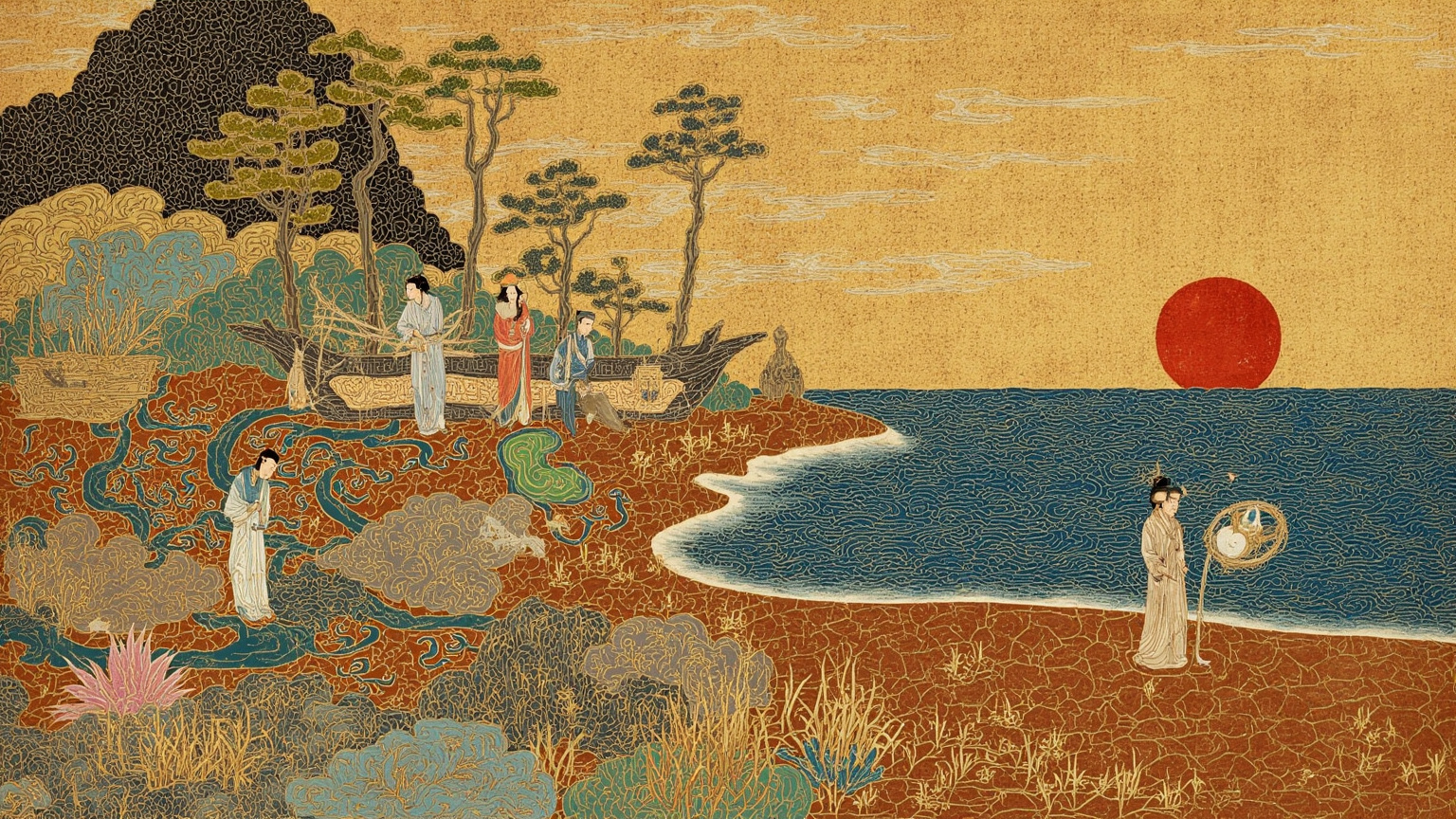
What makes this story work isn't the plot, it's the setting. A mortal man drifts onto an island ruled by something monstrous, and instead of eating him, it tells him about its family, gives him a boat, gives him an amulet, and sends him on his way. The ancient Egyptian idea of the far shore is far gentler than the Greek one. Distance isn't a punishment here — it's somewhere the gods let a person visit now and then.
The Doomed Prince and the Oracle
The third piece is the most damaged in the collection, and the most gripping. A foreign queen prays for a child, and on the day of his conception the Seven Hathors appear and pronounce his fate: he will die by a serpent, or a crocodile, or a dog. His mother tries to outrun the prophecy. She hides the child in a shrine, and once he is grown, sends him abroad to study in Egypt, thinking fate can't follow him past the border. In Egypt the prince meets the Pharaoh's daughter, and the two pledge themselves to each other. There the story simply stops. The papyrus is damaged, and the ending was never preserved.
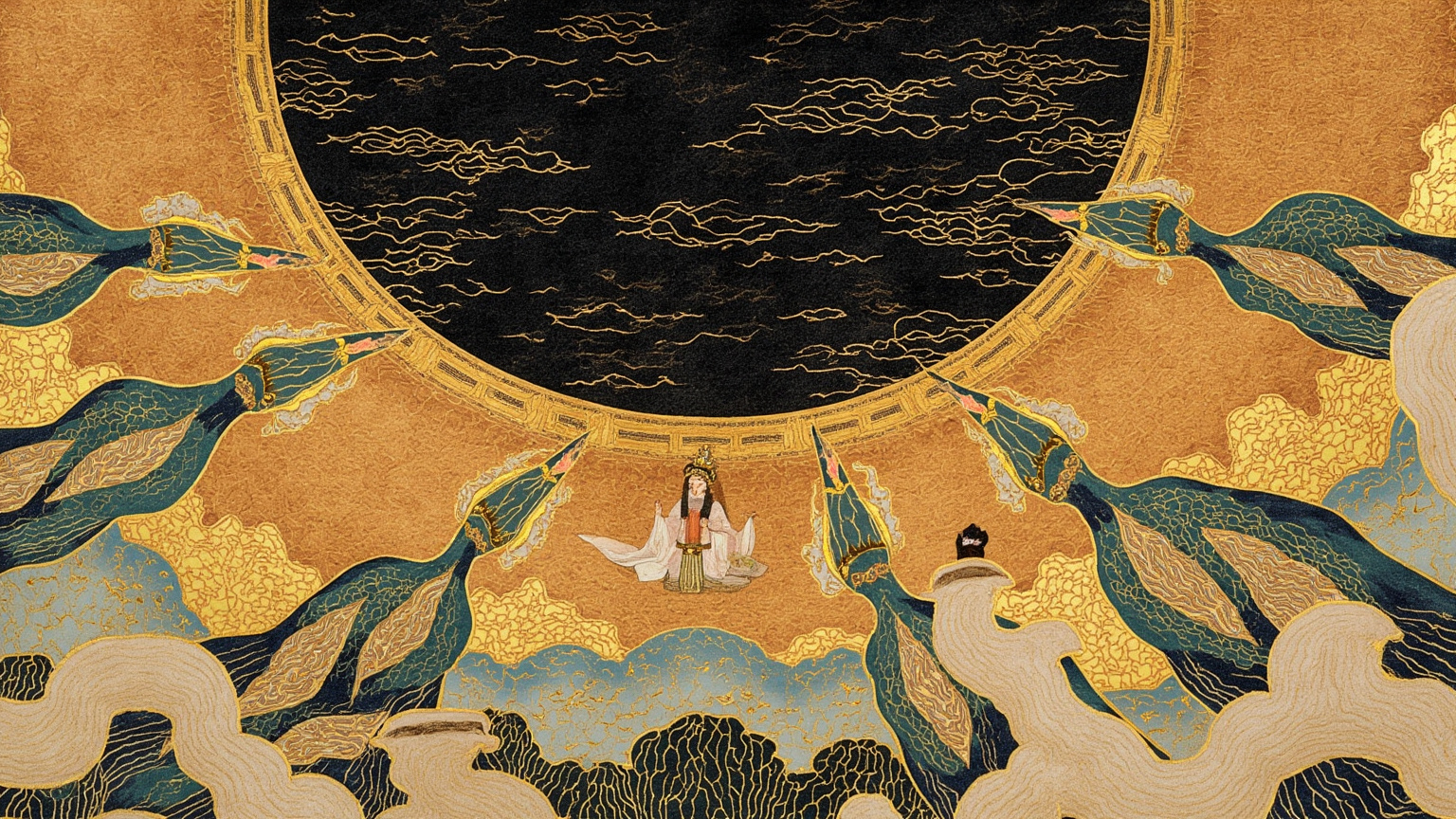
Hathor's seven goddesses decreed his doom before he was born: the serpent, the crocodile, or the dog shall take him.
哈托尔的七位女神在他诞生前便已签下判词:蛇,或鳄鱼,或狗,将取他性命。
金句 · 《命定的王子》· 神谕降生
Missing the ending is exactly what makes it unbearable. The Doomed Prince is one of the earliest surviving examples in Western literature of the theme that an oracle cannot be escaped — the Oedipus story, the Agamemnon story, both have a prototype here. The Egyptian scribe who wrote this down more than three thousand years ago had no idea Greece would come after him. He was simply putting down, on papyrus, the futility of a mother trying to keep her child out of death's reach.
Themes and Craft
What this book is actually about isn't mythology, it's three old anxieties, each taken up on its own. Can the dead live again: The Tale of the Two Brothers answers with a full chain of transformation. Can what's fated be changed: The Doomed Prince answers with a damaged papyrus in which a mother hides her son, sends him running, and the ending never arrives. Does the far shore devour a man: The Shipwrecked Sailor answers with one night on a serpent's island, a story told, a boat given, a safe way home. All three lean toward the same answer: not easily. Death cannot be avoided, fate cannot be outrun, and distance does no harm on its own. But a man can keep watch over a heart for years, can sit with a serpent's grief over the children it lost, can hide a son in a shrine and send him abroad anyway, even knowing it may not work. This willingness to accept fate without giving up on it may be centuries older than the Greek tragic stance of acting even while knowing the outcome is already lost.
As craft, what this book does best is transformation. Bata's story runs through a complete chain: man to tree to bull to sacred tree to man to star to the body of a god. None of these steps turns him into a monster; each one just carries him into another kind of matter. This cyclical transformation has nothing to do with the shapeshifting in Greek and Roman myth, where Zeus turns into a bull to abduct a girl. It's a sacred cycle instead, the Osiris myth working itself out in narrative form.
Most of the myth patterns you think belong to Greece and Rome were already waiting on papyrus by the Nile, three thousand years before either existed.
Why Go Read It Yourself
A guide can hand you a map. It can't hand you the ground itself. Petrie's 1895 translation has a texture all its own — the ancient Egyptian on the papyrus comes out in the plain, noun-heavy English of a Victorian scholar, with the coldness of a ritual text running under it. The moment Bata's heart hits the ground is, in the original, one dry sentence with no ornament at all, and it lands harder for being dry. The serpent's grief for its seventy-seven children, sorrowful without ever tipping into sentiment, and the last line of hieroglyphs before The Doomed Prince breaks off unfinished — none of that survives being paraphrased. You have to open the page yourself, the translation set against the papyrus facsimile, to feel how steady that scribe's hand was, three thousand years ago.
Art Direction4 plates
Before the guide was written, this book got a visual foundation — every illustration you just read grew out of it.