Text and illustrations produced by the pipeline
She starts out as a girl afraid of nothing, standing in the sun in her family's cotton fields, listening to dance music drift over from the neighboring plantation, chin tilted up in a laugh -- at that point she believes the world is nothing more than the red earth under her feet, and there is nothing in it she can't have. A year later, the whole old world burns to ash in front of her. She doesn't cry. She makes a vow instead. This is the first impression Mitchell leaves us with: a heroine who is beautiful, selfish, impossible to beat down, and gifted with something genuinely rare -- while everyone else is crying, she starts scheming.
A lot of people assume Gone with the Wind is a Southern belle's romance novel in a hoop skirt. It isn't. It's a survival story dressed up as one: a girl loses everything to the guns, then claws it back piece by piece out of the wreckage -- money, land, the right to keep living at all. The only cost is that while she's clawing it back, she's quietly shoving the man who loves her most out the door.
Gone with the Wind was written by Margaret Mitchell in the 1930s and published in 1936. It became one of the best-selling novels in the English language, won the Pulitzer Prize in 1937, and three years later was turned into one of Hollywood's founding classics on screen. The title comes from a line of verse meaning exactly that -- gone with the wind: the graceful life of the old white planter aristocracy of the South, along with its order, its balls, its rules for how a lady behaves, all scattered by the wind of war and never coming back.
The novel was written in 1936, but the story is set in mid-nineteenth-century America -- roughly 1861 to 1873, the Civil War and the Reconstruction that followed it. That history is the book's bedrock: the South lost the war, lost slavery, lost its entire way of life, and plenty of families fell from heaven to hell overnight. What Mitchell pulls off is making one girl's private wants turn in exact sync with the wheel of that larger history.
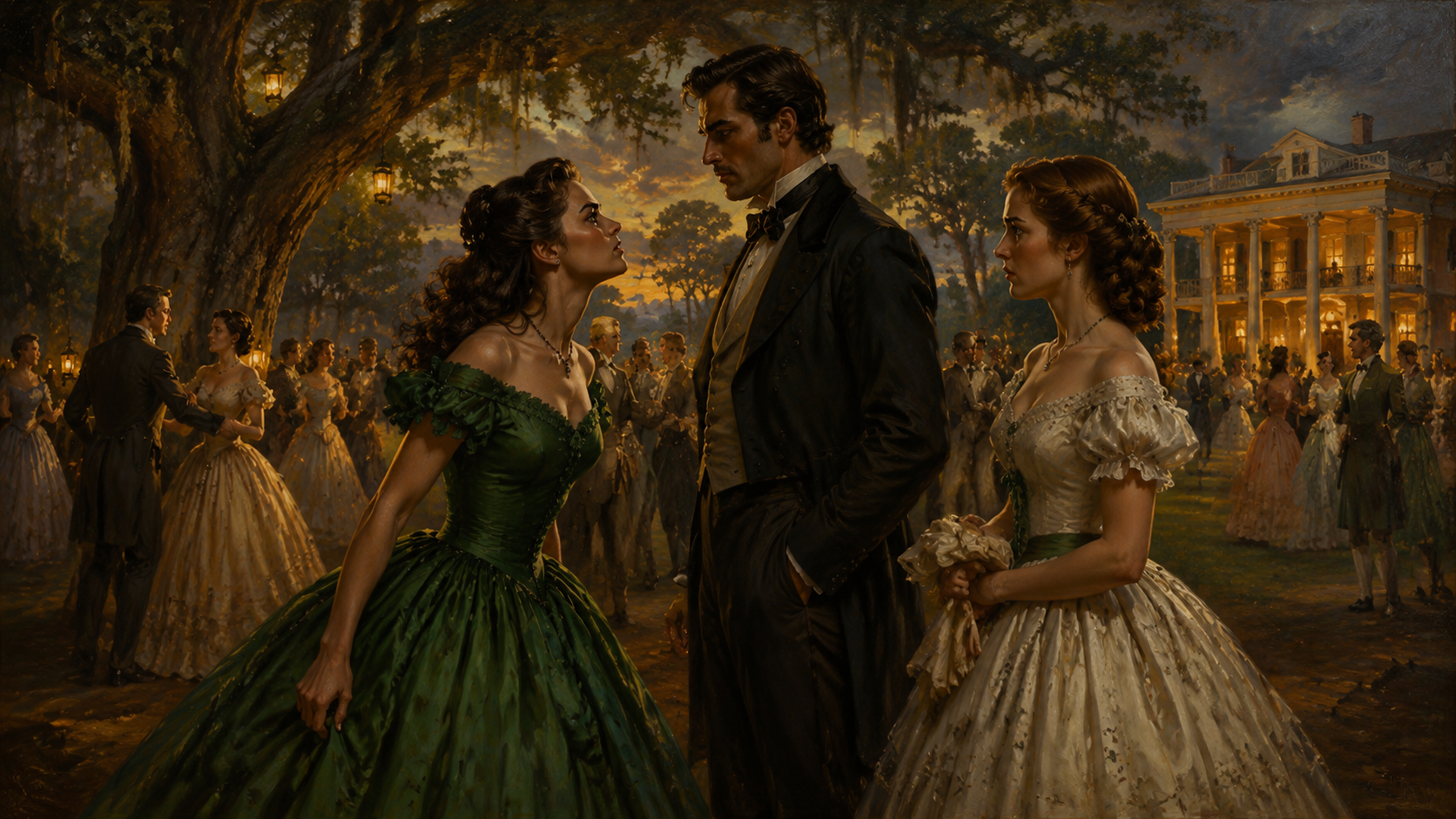
The core of it is four people: Scarlett, Rhett, Ashley, Melanie. Scarlett is the youngest daughter of Tara plantation, sixteen at the start of the book, spoiled, willful, wild, and before the war her only real trouble is that the man she wants doesn't want her. That man is Ashley Wilkes, the gentleman next door -- refined, well-read, plays the piano, and before the war the perfect vessel for every young girl's fantasy. But he doesn't love her. Ashley loves Melanie, Scarlett's cousin (and later her sister-in-law), gentle, pale, looking like she could be blown over by a breeze -- and yet the one truly unbreakable person in the entire book.
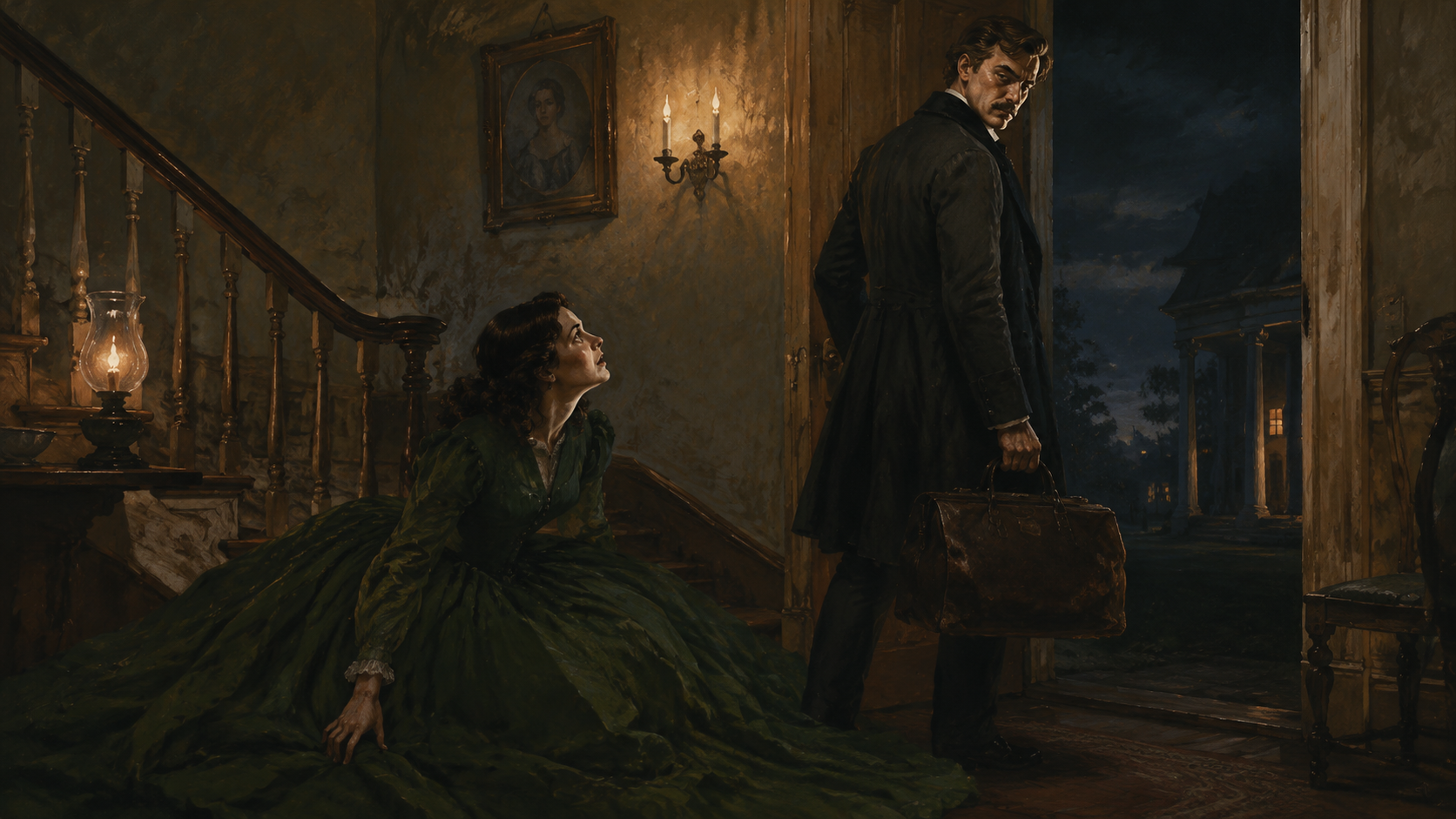
Rhett walks out of Melanie's room and tells Scarlett, calmly, that he's leaving. Panicked, she swears that she actually loves him, that it's always been him. Rhett smiles -- one of the saddest smiles in the whole book -- and says: My dear, I don't give a damn. The door closes behind him. It's the most famous line in the book, and the most painful moment of his entire character arc: he hasn't stopped loving her, he's just loved her too long and worn himself out. After this scene, Scarlett doesn't collapse. She goes back to Tara, looks down at the red earth under her feet, and tells herself: tomorrow is another day. The novel ends right there -- open-ended, unsentimental, and left for the reader to guess the rest.
What actually moves you about Gone with the Wind isn't a love affair set against war. It's a person who, even after disillusionment, refuses to let go -- except she's had the direction of her grip wrong from the very first page to the last.
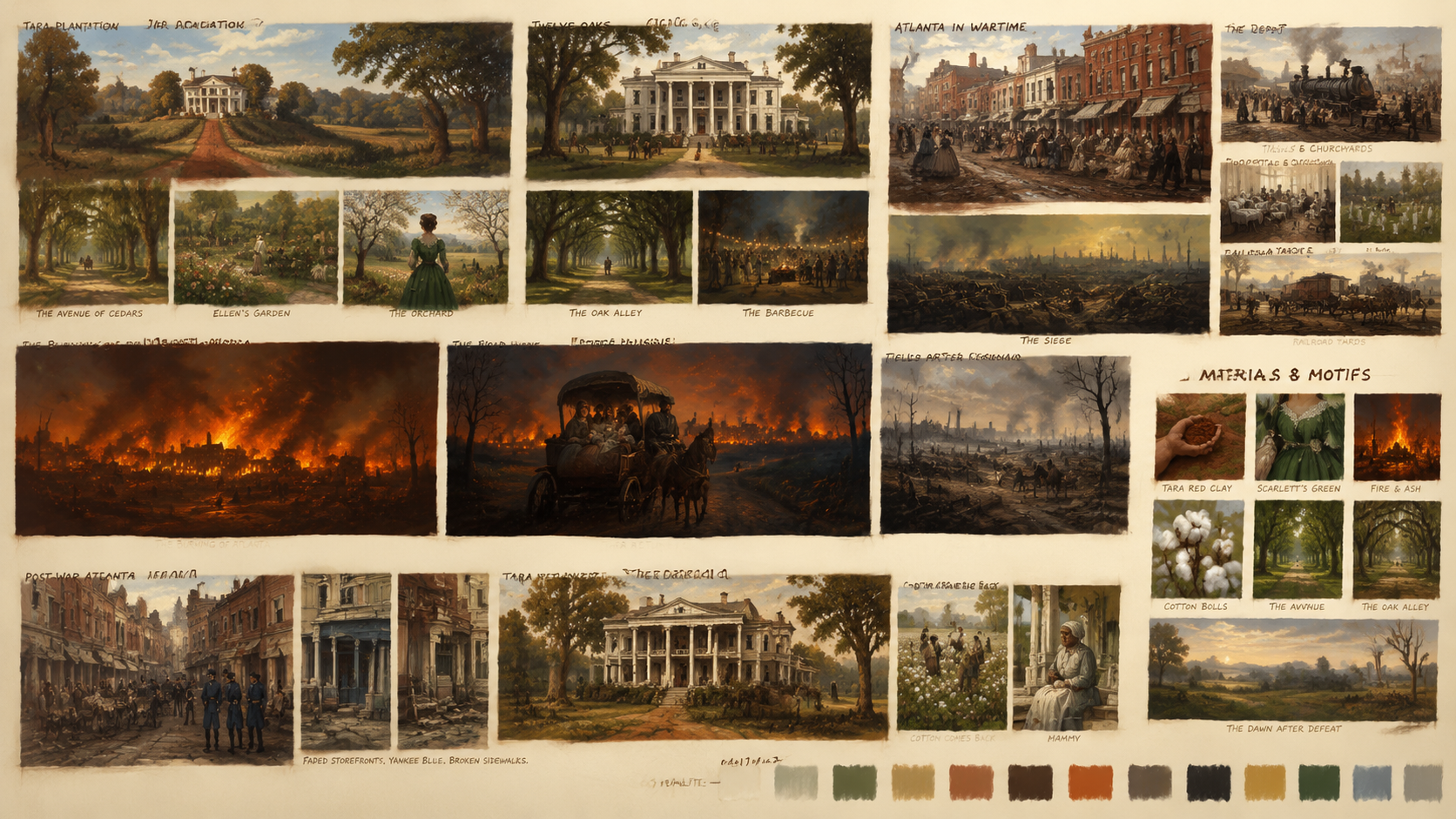
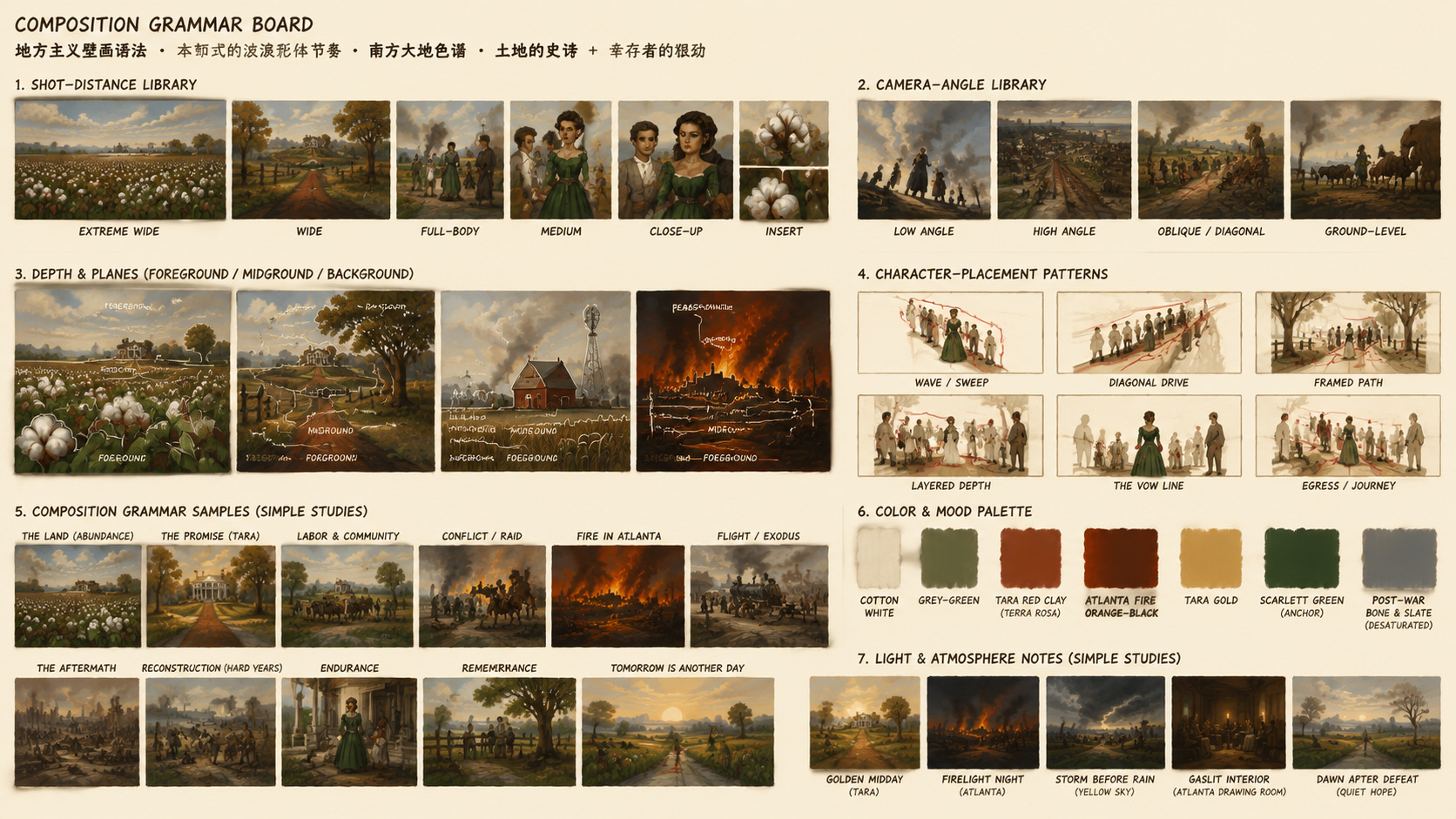
Before the guide was written, this book got a visual foundation — every illustration you just read grew out of it.
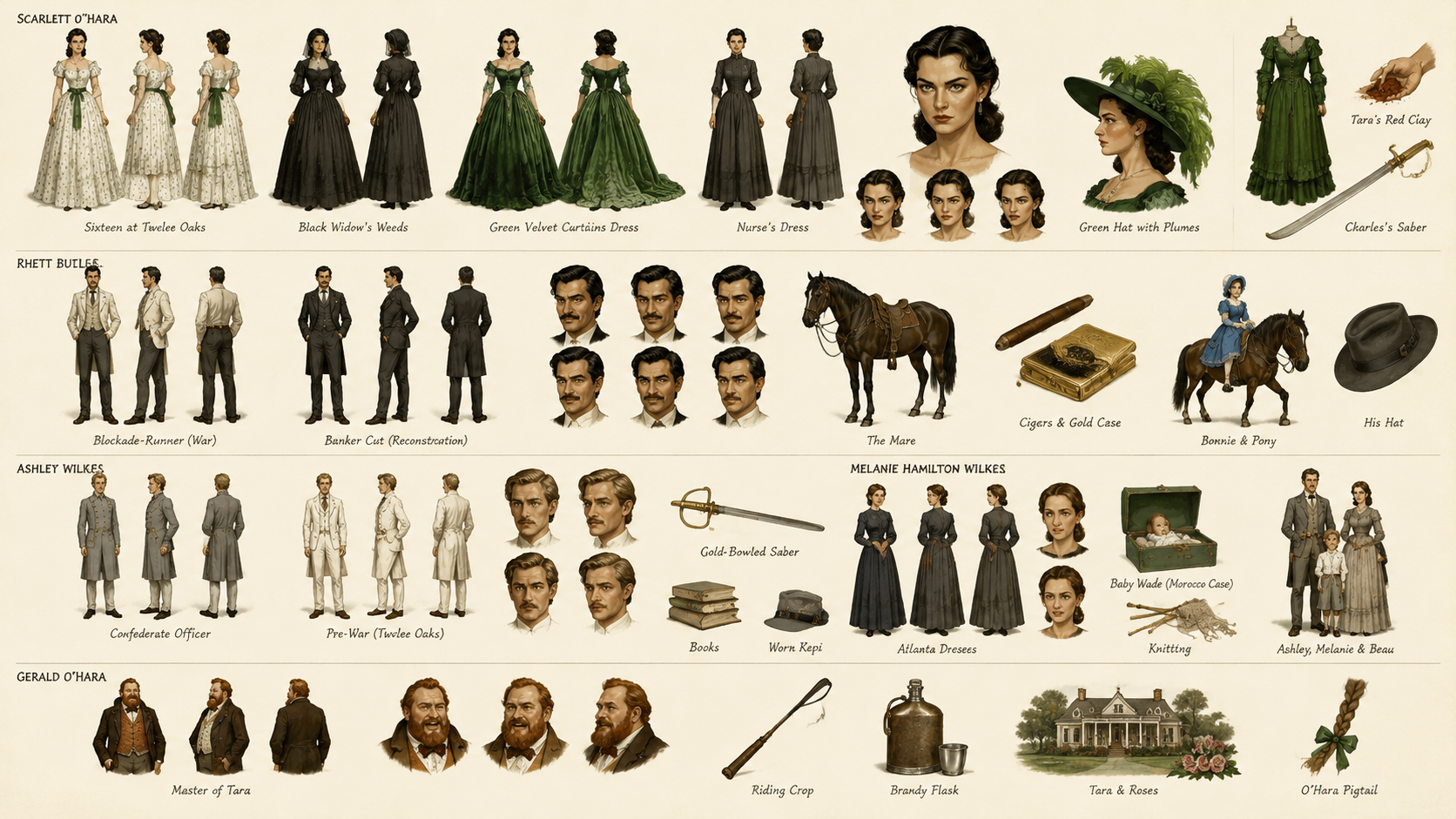
The fourth person is Rhett Butler, a few years older than Scarlett, a cynical opportunist who made his fortune running the blockade during the war. All of Atlanta calls him a scoundrel, and he treats all of Atlanta as one long joke. The first time he lays eyes on Scarlett, he sees straight through her, and she hates him for it -- because in her mind, only someone gentle and a little unattainable, like Ashley, is worth chasing. The result: she spends her whole life chasing the wrong man, while the man she actually loves waits outside her door -- and by the time she turns around, the door has already shut.
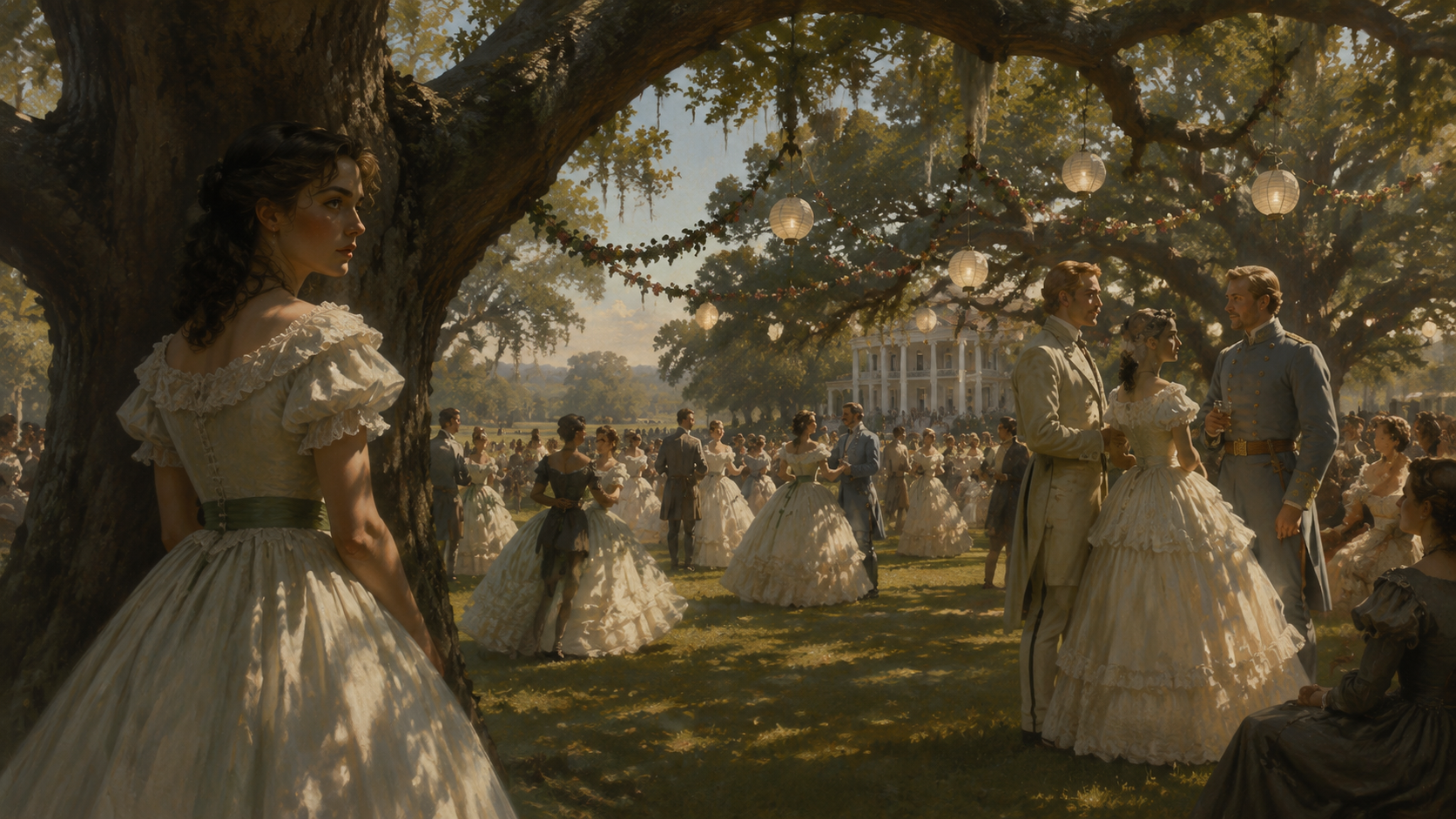
Act One: the barbecue at Twelve Oaks. The Civil War hasn't officially started yet. In a white dress at the plantation ball, Scarlett pours her heart out to Ashley and gets a gentle refusal in return -- the woman he's going to marry is Melanie. It's Scarlett's first taste of defeat, and from this moment on, Ashley becomes a wound in her that never heals. Mitchell is merciless about it: she has Scarlett lie to herself with he just hasn't realized yet that he loves me -- and keep telling herself that lie for well over a decade.
Act Two: out of spite, Scarlett marries Melanie's brother, Charles. Charles dies of illness soon after, leaving her a young widow, and by convention she moves with Melanie to Atlanta. There she starts living out the role of a proper young wife under the shadow of war -- the men ship out to the front in droves, the balls thin out, supplies run short. This is where Rhett enters, and the two of them fall into a strange push-pull, drawn to each other and needling each other in the same breath. On the eve of Atlanta's fall, with Melanie in labor and shells already landing at the end of the street, it's Rhett who drives a stolen wagon and gets the two women out of the burning city.
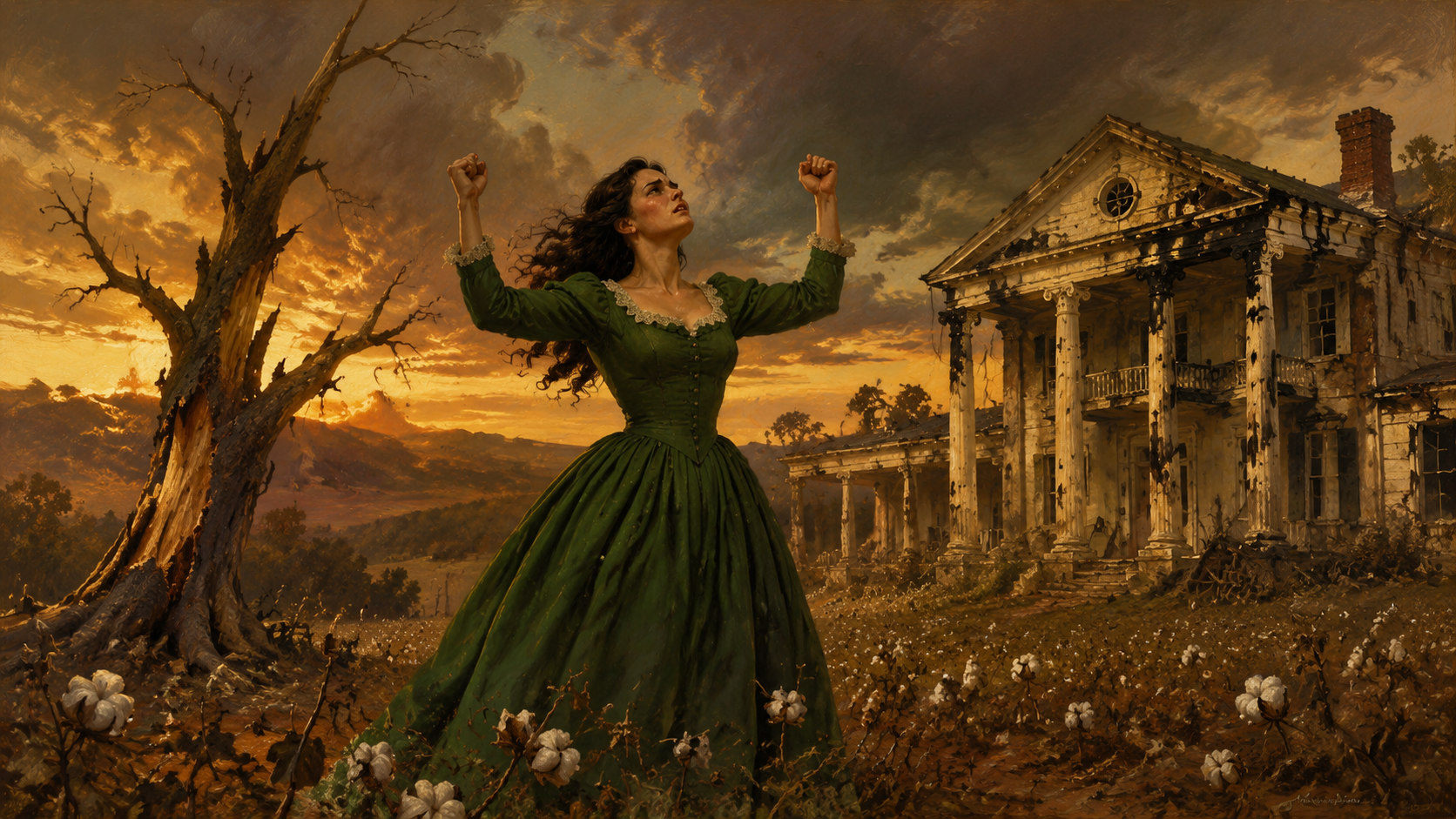
Act Three: Scarlett goes home to Tara. The war is over. Tara wasn't burned, but it's been picked clean: her mother is dead of illness, her father has lost his mind, the enslaved people who worked the place are gone, the cotton fields lie fallow, and all that's left in the house is Scarlett and a handful of women and children. Standing in the ruined yard, facing the setting sun, she makes a vow -- the one she'll later call her vow never to be hungry again. This line is the book's hinge moment: from here on, she is no longer the pampered Southern belle but a woman willing to do anything. In English it's short and hard, and Mitchell drives it in like a nail: As God is my witness, I'll never be hungry again.
Act Four: to keep Tara afloat, Scarlett marries her sister's fiance, Frank Kennedy, and takes over running a lumber mill. She hires convict labor, shoots a squatter who breaks into her land, and along the way every scrap of old Southern respectability peels off her. The neighbors gossip, the town whispers that she's no better than she should be -- a widow out running a business is scandalous enough on its own -- but she keeps Tara fed, pays off the debts, and gets the books into the black. This stretch is the most modern-feeling part of the book: nobody let her into the world of business. She kicked the door open herself.
Act Five: after her second husband Frank dies in an act of near-suicidal violence, Scarlett finally marries Rhett. He's a rich man by now, and he gives her the finest gowns, the grandest house, and a daughter, Bonnie -- nicknamed Bonnie Blue, the darling of the whole family. A Southern lady, a speculator, a golden-haired little girl: on paper it looks like a happy ending. But Mitchell was never in the business of happy endings. She has Scarlett keep a place in her heart for Ashley even after the marriage, and lets Rhett's disappointment grow, inch by inch.
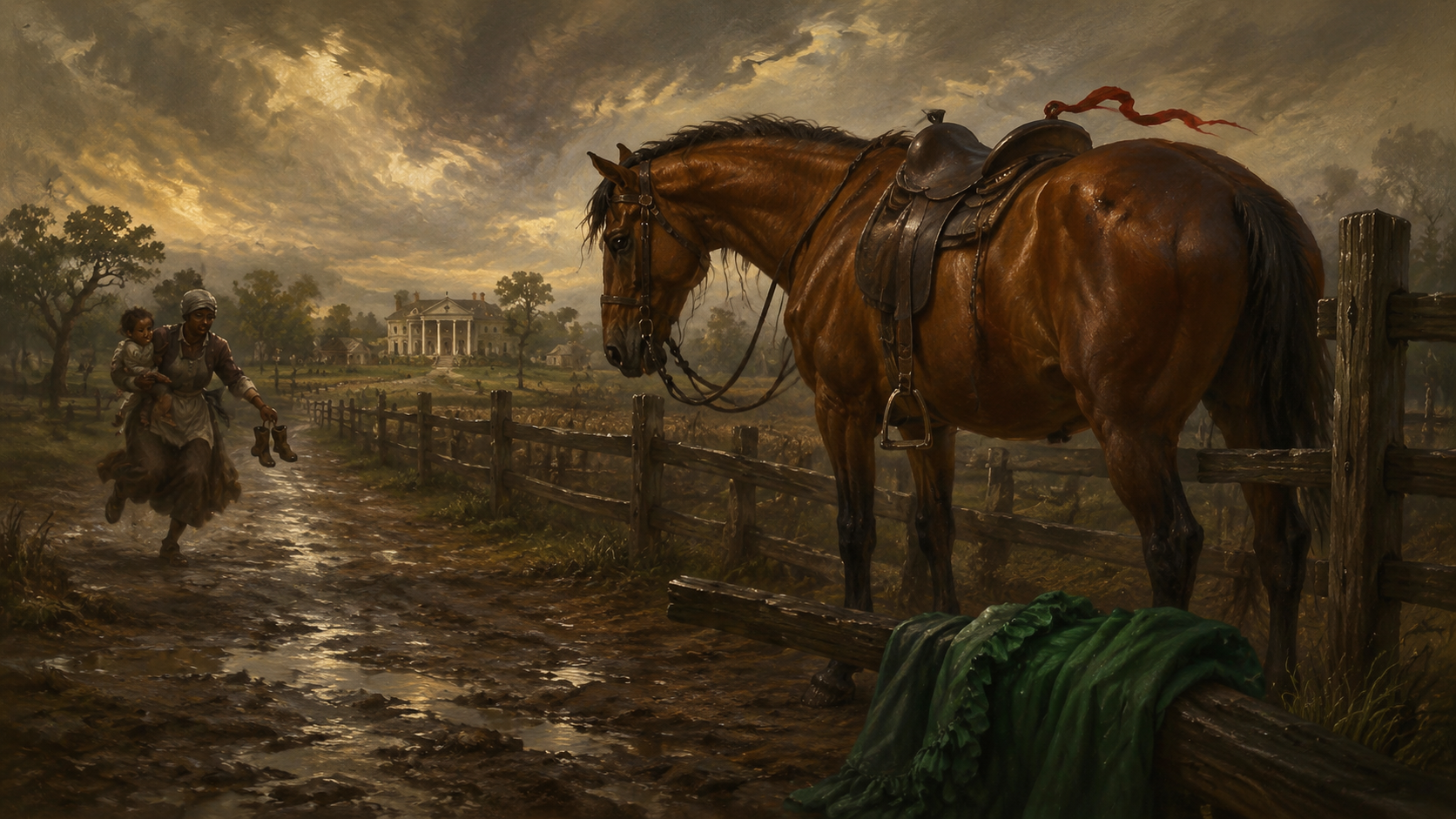
Act Six: Bonnie dies falling from her pony. This is a child Rhett adored like his own personal sunlight, and she never wakes up after the fall. Scarlett's reaction is hysteria mixed with her usual refusal to admit fault; Rhett simply breaks -- he cuts a lock of the child's hair, locks it away in his study, and afterward barely speaks to Scarlett at all. This is the coldest low point in the book: the crack between them can no longer be closed with love.
Act Seven: Melanie dies in childbirth. The one true support beam of the whole book goes down. As long as Melanie was alive, Scarlett never dared admit to herself that she loved Rhett -- because admitting it would mean saying a final goodbye to the old world she'd built out of her fantasy of Ashley. On her deathbed, Melanie asks Scarlett to look after Ashley and the children, and then she's gone. Only in that moment does Scarlett finally understand that this woman, gentle almost to the point of transparency, was the one real support she'd had her whole life -- and that the person she actually loves is Rhett, who has been waiting outside the door all along and has now decided to leave.
On the surface, Gone with the Wind is about love. Underneath, it's about starting over after everything is lost. Scarlett spends her whole life chasing a phantom named Ashley, whose real name is the Old South -- a world of order, of propriety, of pretty girls turning in circles at a ball. The war blows all of it away, and she refuses to believe it, so she keeps pretending, on top of the ruins, that it's still there. The way she pretends is by chasing Ashley, because Ashley is a statue of the Old South itself. The things she actually manages to hold on to -- the land at Tara, Rhett's love -- are things she only recognizes afterward, because at the start she simply refuses to see them.
The book earns its place in literary history for more than just its sales figures. First, because Mitchell built Scarlett into a woman who is both maddening and impossible not to love -- selfish, snobbish, dishonest, and yet possessed of an astonishing toughness, more capable and more unwilling to accept defeat than any man around her. Second, because she compresses a whole convulsive stretch of American history into one woman's lifetime of love and grudges: it reads like an epic, and yet, stop to think about it, and it's really just one family's business.
For today's reader, Gone with the Wind is also a mirror that needs to be held at arm's length: it's told from the point of view of white plantation owners, and it carries the era's unavoidable romanticizing and blind spots about slavery and race. That has to stay in mind while you read it -- you can admire its skill at rendering people and feeling without co-signing its blind spots. This is unavoidable with any classic: you have to acknowledge both where it sees clearly and where it doesn't see at all.
What a companion guide gives you is a map. The actual land is the text itself. Here you can learn how many husbands Scarlett has, what Rhett's last line is, when Melanie dies -- but Mitchell's real craft is hiding in details no summary can carry: the way young Scarlett spies on her father, the way Southern women wield I'm expecting like a social weapon, the way she and Melanie first open up to each other under the oak tree at Tara. No outline can deliver that. It lives in the breathing space between one sentence and the next.
More than that, Gone with the Wind is a genuinely gripping read -- it's thick, but it's never dull. Every couple of pages drops another choice at Scarlett's feet, and every time she picks the wrong one, you want to sigh on her behalf and, at the same time, can't help thinking this girl really has nerve. And when you finally arrive at that ending -- tomorrow is another day -- you suddenly realize you've just spent twelve full years with this woman: crying with her, laughing with her, driven half-mad by her. A map can't give you that. That's why it's worth picking up all thousand-plus pages of the actual book.