Great Tang Records on the Western Regions (Da Tang Xiyu Ji) · Companion GuideStories · Issue 00
10 minutes to Great Tang Records on the Western Regions — the monk's travel notes that reshaped world archaeology
Dictated by the monk Xuanzang and recorded by his disciple Bianji, this is a firsthand account of Central Asia and India, not the novel Journey to the West.
Text and illustrations produced by the pipeline
ImaReadFolio 02 — 07
I. A Horse, a Pool of Blood, a Mountain of Snow
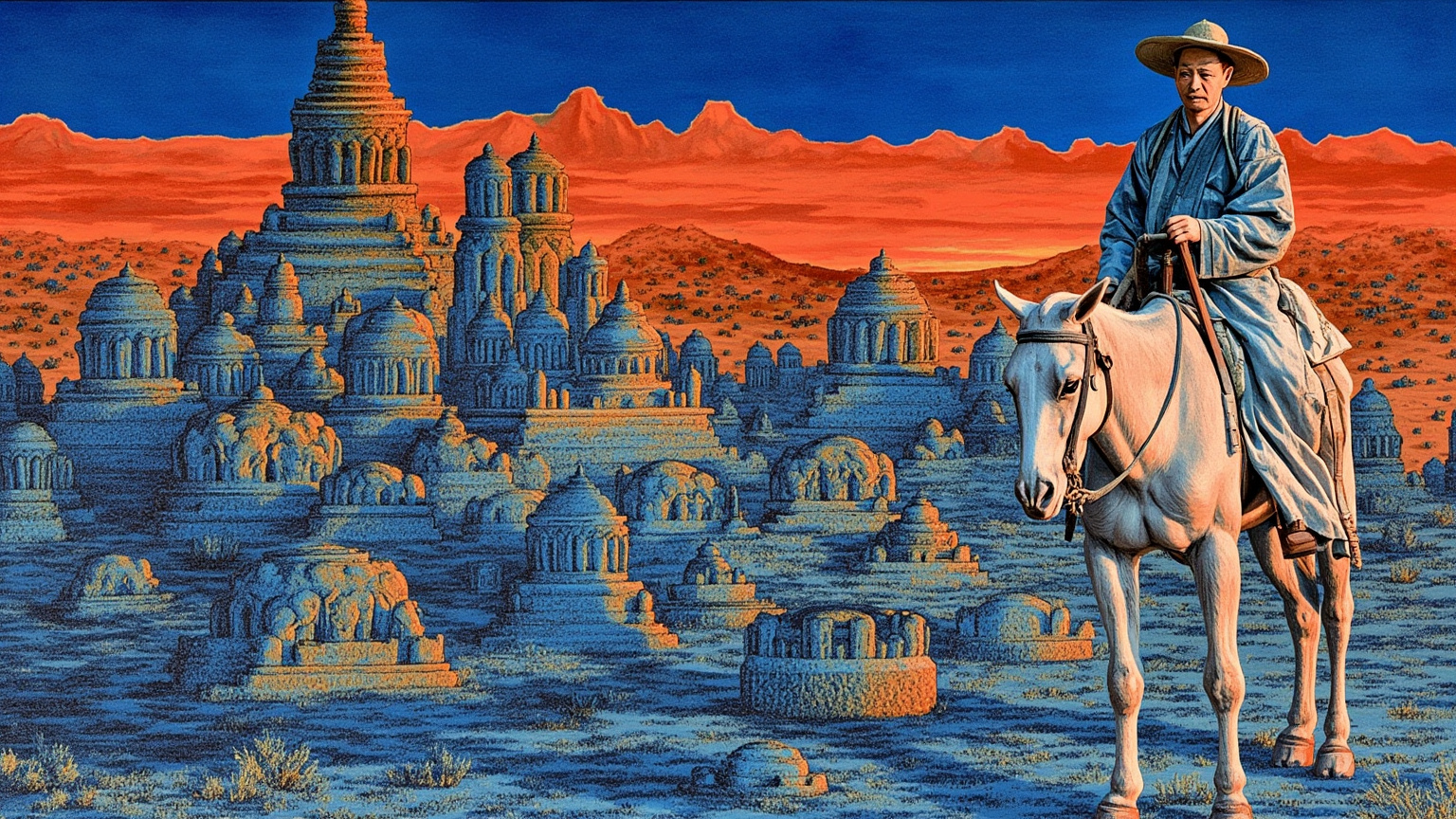
In the early Zhenguan years, while the lamps of Chang'an's western market still burned, the monk Xuanzang traded his robes for lay clothes, took an old horse that knew the road, and walked alone toward the Jade Gate Pass. The early Tang border was sealed tight, and the court had forbidden anyone to leave without permission. He went anyway, in secret. What made a monk brave enough for that? A stack of Chinese translations of Buddhist scripture, where the same line came out three different ways. The more he read, the more the contradictions gnawed at him, until he decided to cross half the world to India and check them against the Sanskrit originals. By the count everyone used at the time, he was gone seventeen years.
II. This Is Not Journey to the West
Let's clear up the biggest misunderstanding first. Around the third year of Zhenguan, roughly 629, Xuanzang defied the travel ban and headed west; seventeen years later he returned, and in 646 the account of that journey became the Great Tang Records on the Western Regions. Writers of the Ming dynasty did later spin it into Journey to the West, with Sun Wukong, Zhu Bajie, and the eighty-one trials. But the book in your hands is not the source material for that story. There are no demons here, no master and three disciples, no eighty-one calamities. It is a geographical record, dictated by Xuanzang and written down by his disciple Bianji, laying out country by country the mountains, customs, religions, and legends of more than a hundred lands he visited or heard about along the way. Xuanzang's own journey is just the thread that strings the entries together; the real subject is those four words, the kingdoms of the Western Regions. That is also why the book holds scenes like Prince Mahasattva feeding his own body to a starving tigress or King Śibi cutting his flesh to ransom a dove: these are Buddhist legends Xuanzang recorded at the sites where the Buddha's past-life stories were said to happen, not things that happened to him. Don't mistake the canvas for the man painted on it.
III. The Cast
At the center of the whole book is Xuanzang himself. He is not the emperor's sworn brother from the fantasy novel. He is a monk in search of the true teachings, a man who made his vow in his early thirties and would not turn back even when his feet blistered raw.
When he came home, he was received by Emperor Taizong, and Bianji took down his seventeen years of travels in writing. But on the road to India, the man who opened the way for him was someone else entirely: King Qu Wentai of Gaochang. This ruler of a small kingdom in the Western Regions was a devout Buddhist, and the moment he met Xuanzang he tried everything to keep him as the kingdom's spiritual teacher. Xuanzang went on hunger strike for days to make his resolve plain, and in the end the two swore brotherhood. Qu Wentai then gave him horses, attendants, and travel funds, and wrote letters to the kingdoms ahead asking them to let him pass. Without this one stop, the journey west would probably never have reached India.
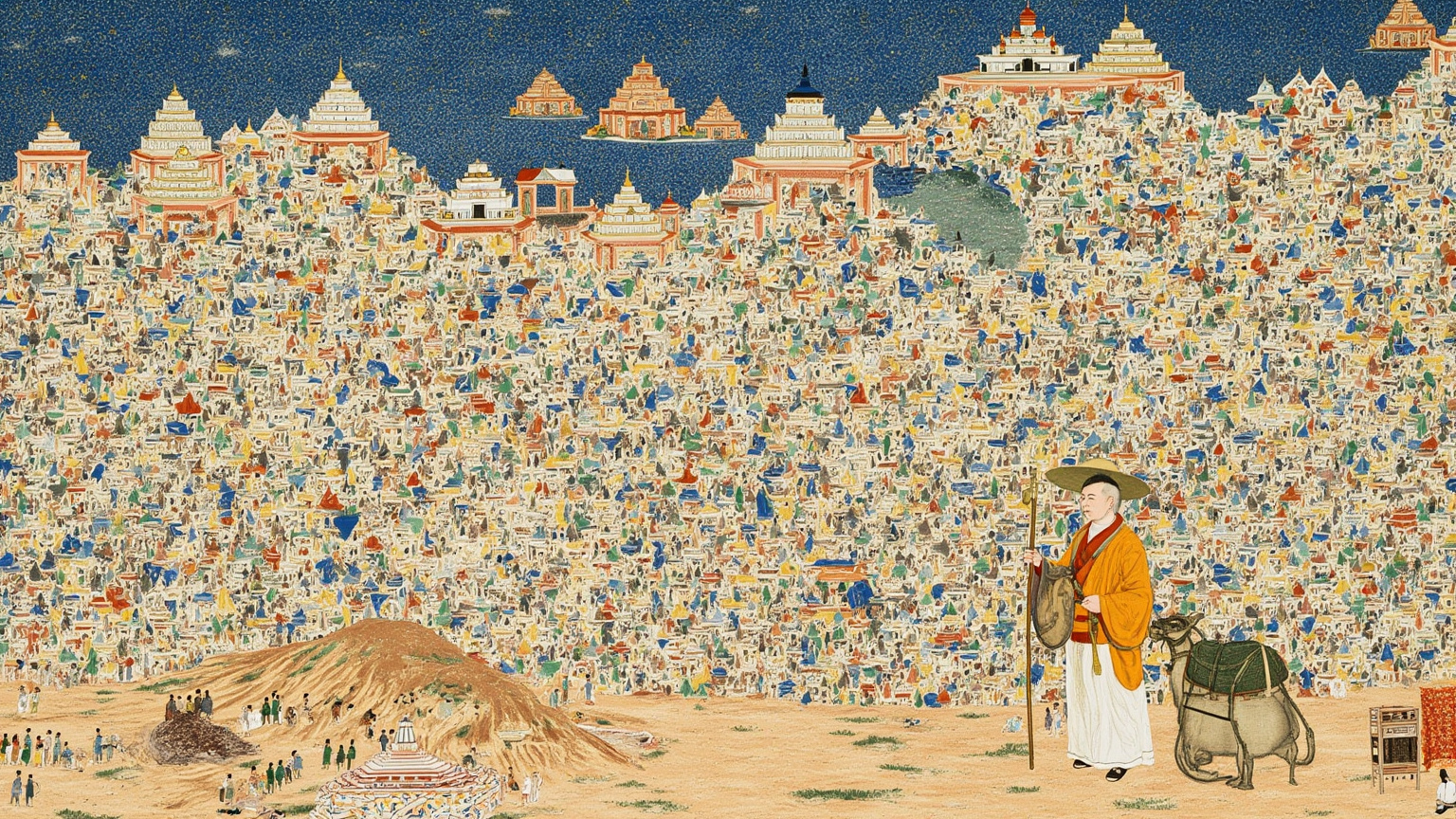
In India, the destination Xuanzang was really after was Nalanda, the leading Buddhist institution of the age, with thousands of monks and a library to match. Waiting for him there was Śīlabhadra, a scholar past his hundredth year, who taught him the Yogācārabhūmi in person, the very text he had traveled ten thousand miles to study. And it was King Harsha, the great ruler of northern India, who carried Xuanzang's reputation to its peak. Harsha staged an unprecedented public debate for him at Kanyakubja; Xuanzang took the stage and defended his positions, and for eighteen straight days no one could refute him.
ImaRead2
ImaReadFolio 03 — 07

ImaReadFolio 04 — 07

ImaReadFolio 05 — 07

ImaReadFolio 06 — 07

King Harsha and the monks of Nalanda tried more than once to keep Xuanzang in India, and each time he declined. In 645 he set out for home carrying 657 Sanskrit manuscripts, Buddha images, and relics, traveling the southern route through the Pamirs and Khotan back to Chang'an, deliberately avoiding his old path through Gaochang, since the Tang had by then conquered the kingdom and there was nothing left to return to. His arrival in the capital set off a nationwide sensation. Emperor Taizong received him formally in Luoyang and ordered him to dictate an account of everything he had seen in the west, with Bianji taking it down. In 646, the Great Tang Records on the Western Regions was complete.
V. Why This 'Geography' Turned Out to Matter So Much
ImaReadFolio 07 — 07
VII. You Know the Plot, So Why Read the Original
What a companion guide can give you is the skeleton of the map: who went where and did what. Open the original, though, and you find Bianji's pen is restrained, restrained almost to the point of coldness. He never editorializes on Xuanzang's behalf; the desert crossing gets one line about four nights and five days without a drop of water touching his throat, and the deaths on Lingshan get a single statistic. That coldness is deliberate. It leaves a reader thirteen centuries later to supply the desert heat and the mountain wind on their own. That is exactly why the book still doesn't feel distant today.
More to the point, the real weight of the book isn't in the seventeen years of travel. It's in the more than one hundred country entries. Some of the Central Asian kingdoms Xuanzang describes have vanished from the map entirely, their names unpronounceable to a modern reader; the legends attached to the holy sites are their own code for reading the Buddhist worldview. A companion guide can't carry that level of detail away with it; it only turns up if you go looking, page by page, in the original. A map can point the way, but you still have to walk the ground yourself.
You don't need a plot to understand it. But you can't understand what inner Eurasia looked like for that thousand years without it.
ImaRead7
Art Direction4 plates
Before the guide was written, this book got a visual foundation — every illustration you just read grew out of it.