Hamlet, Prince of Denmark (The Tragedy of Hamlet, Prince of Denmark) · Companion Guide
Hamlet
His uncle takes his father's crown and marries his mother; his father's ghost tells the truth from the castle ramparts — and the prince, thinking too much, drags revenge out into a bloodbath nobody walks away from alive.
Opening: a crown with no business on that castle terrace at night
Your uncle is wearing your father's crown. Your father died only a month ago, and already your uncle has his arm around your mother, taking the court's congratulations in the great hall. You stand there in mourning black while the whole court urges you to smile too. That would be rough in any family, and this one happens to live in a stone castle on the coast of Europe. The hero of the story is the young man in that castle who will not smile.
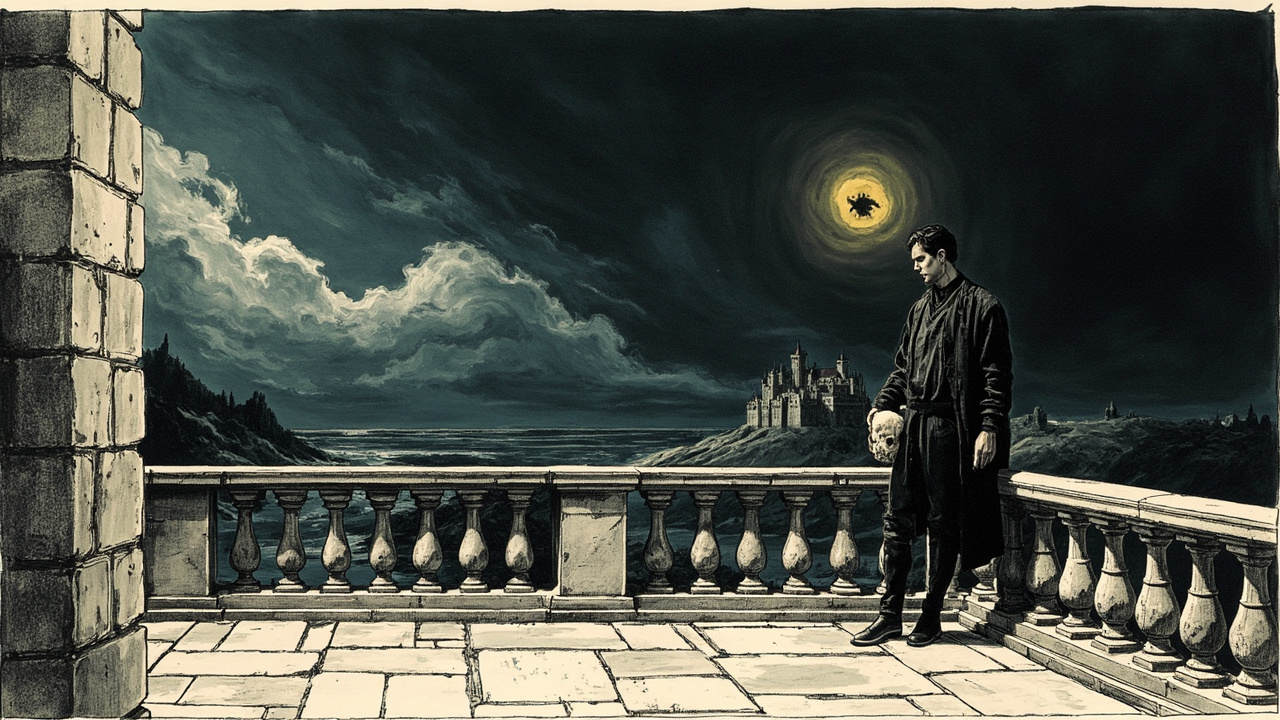
What kind of book this is
This is Hamlet, Shakespeare's play, written in London at the end of the sixteenth century and first printed in 1603. It is not a novel but a verse drama: the lines the actors speak on stage are mostly blank verse, with prose mixed in. It is one of the most quoted, most argued-over works in English literature, and a stage classic that every generation restages without tiring of it. The reason it has lasted is simple. Four hundred years ago an English playwright took a Danish prince's revenge story and turned it into a mirror that shows everyone their own hesitation.
The story's source is an older Danish legend, the ancient tale of a prince named Amleth avenging his father, first set down in a Latin chronicle, then carried forward through a French translation, before Shakespeare finally brought it to the London stage. So underneath, this play wears Danish skin over English verse.
People and world: the groups inside the castle
Let's meet the people first. At the center is Hamlet, prince of Denmark, who has studied at the University of Wittenberg in Germany, a very Renaissance detail for its time. His father has just died, he is still in mourning black, and his uncle is already on the throne. That uncle is Claudius, who killed his own brother, took the crown, and married his brother's widow, a middle-aged man who looks composed on the outside while his own guilt is crushing the breath out of him. His mother, Gertrude, is the queen of Denmark, and whether she actually knew what Claudius did is never made clear in the play. That is exactly where its ambiguity lives.
Then there is the younger generation's love tragedy. Polonius is the kind of courtier who is always full of advice and always ready to hide behind a curtain to eavesdrop. His daughter Ophelia is the girl Hamlet once loved, and his son Laertes is her brother, off studying in Paris and proud of his sister. And one more key figure: Horatio, Hamlet's fellow student from Wittenberg, rational and loyal, the only major character left standing when the curtain falls, and the one who will carry his dead friend's story to everyone after.
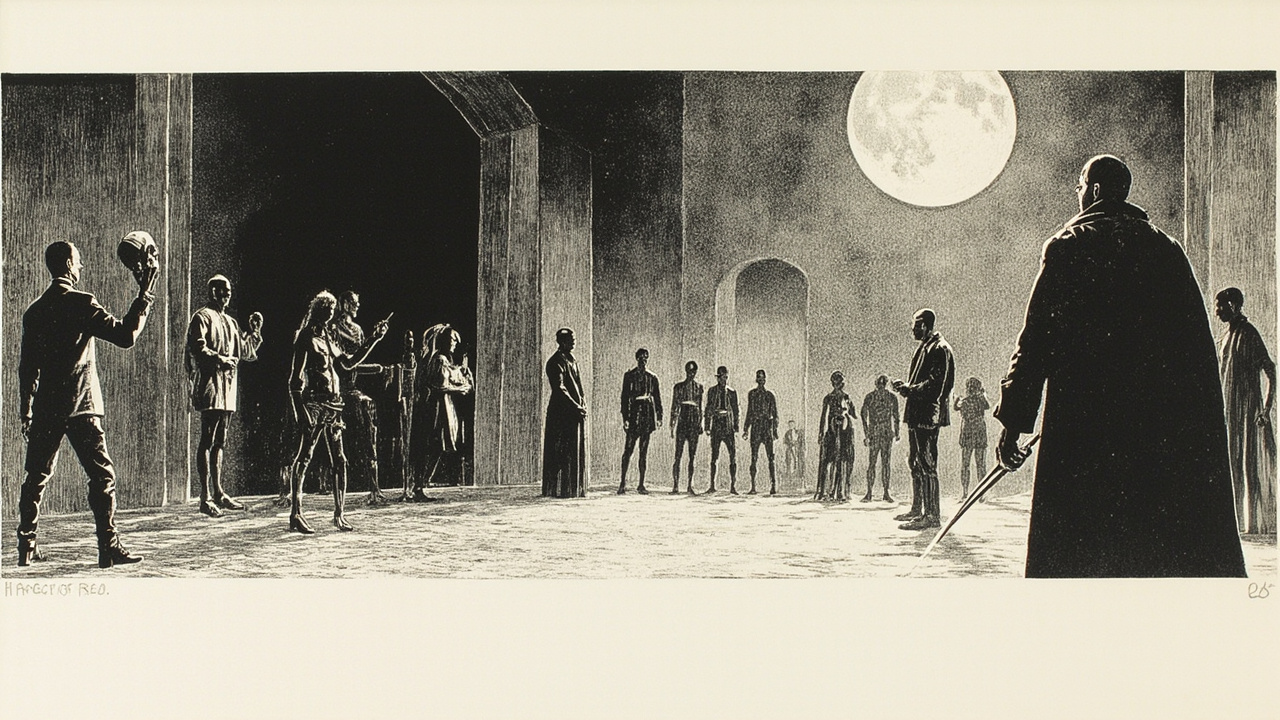
The story takes place in legendary Elsinore, Denmark, a medieval castle by the sea called Kronborg. The cold wind on the terrace at night, the curtain in the queen's bedchamber, the great hall where the court fences, the graveyard out past the shore: these make up the whole stage. The kingdom is like a drafty house, and once the king did something rotten, the whole house started to mold.
Plot line one: the ghost, the feigned madness, and that one question
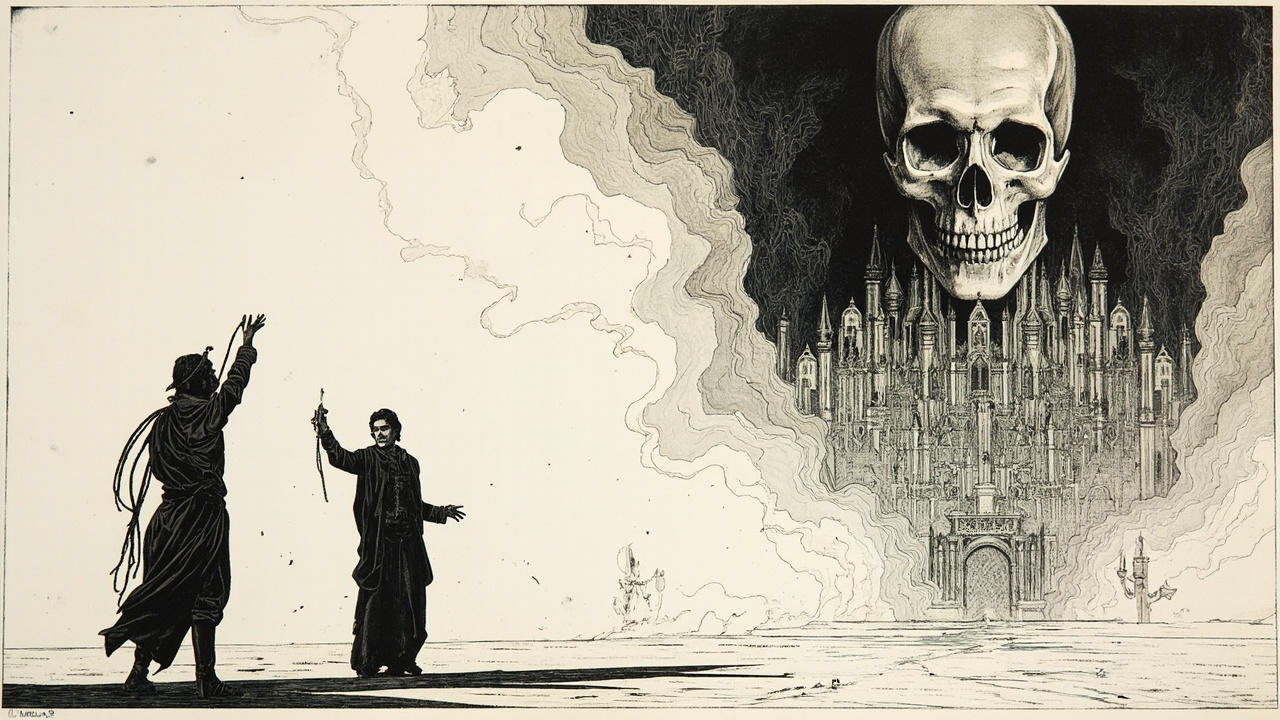
On a night in act one, an armored shape appears on the castle terrace: the ghost of Hamlet's dead father. It pulls the prince aside and tells him a secret. He did not die of illness; he was murdered, poison poured into his ear while he napped in the garden, by his own brother. The ghost orders Hamlet to take revenge, but adds one condition: leave his mother alone, and let heaven and her own conscience deal with her. This is the engine of the whole play. The task of revenge is handed down, but so is its boundary, and it is exactly that boundary that later ties Hamlet's hands.
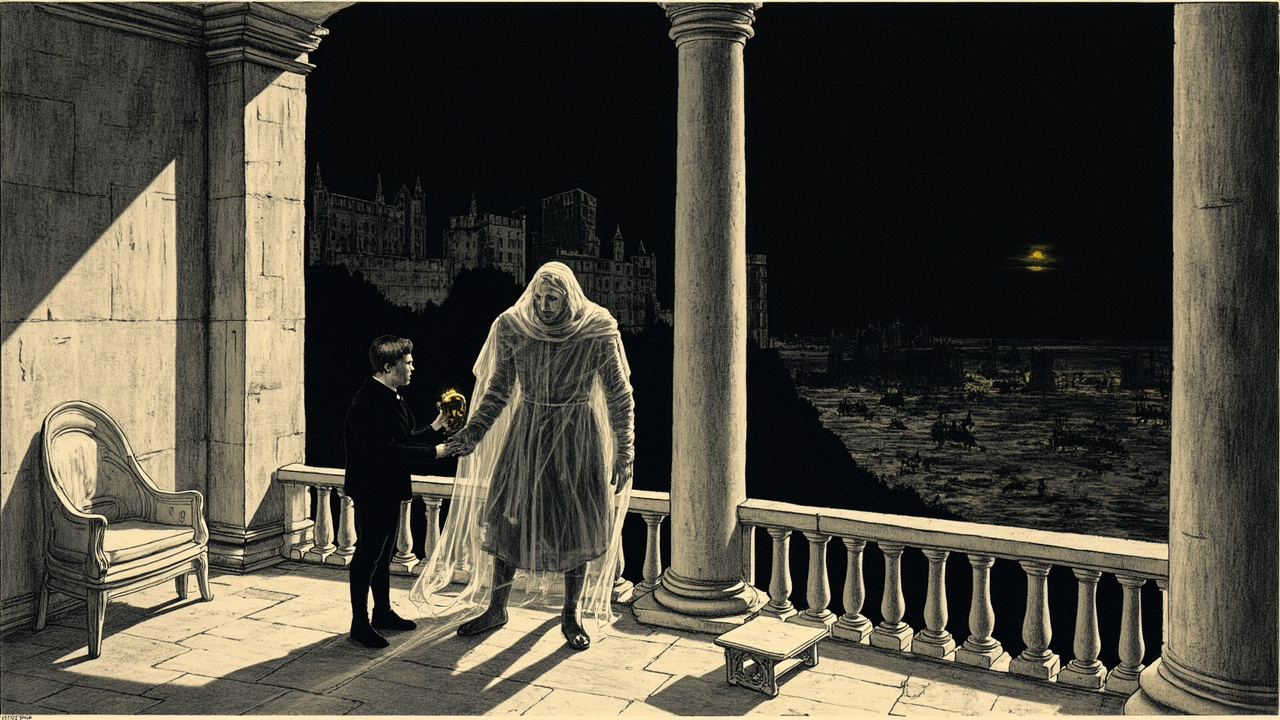
Murther most foul, as in the best it is; But this most foul, strange, and unnatural.
再没有比这更卑劣的谋杀了——而这一桩,尤其卑劣、离奇、悖逆天理。
Original line · Act I, Scene 5 · his father's ghost reveals the poisoning
From that night on, Hamlet makes a choice that looks clever: he feigns madness. He stops acting like a normal son and starts saying strange things to everyone around him, wrapping himself in a shell nobody can see through. The pretended madness is both cover and a test. He turns suddenly cold and distant with Ophelia, the woman he loves, setting the whole court talking. He is not failing to act; he is thinking too hard, snagged on one question after another. Was his father's death real? Could the ghost be a devil's bait? If he kills his uncle, does he drag his mother down with him? And once he has killed him, what happens to this rotten kingdom anyway? These questions spin faster and faster in his head, and the faster they spin, the harder it is for him to raise the sword.
Plot line two: the soliloquy in act three
The most famous scene in the whole play comes in act three. Hamlet stands alone in the castle and speaks the most famous soliloquy in all of English literature, asking himself whether to be, or not to be. In this moment there is no skull in his hand, no prop, nothing extra at all, just one man's mind fighting his own body. Endure the pain of living, or end it? Act on revenge, or keep thinking it through? He knows that doing nothing leaves his father's wrong unanswered, and he knows that the moment he acts, he will never again be the person he is right now. This is the first revenge play to make the avenger's true enemy himself.
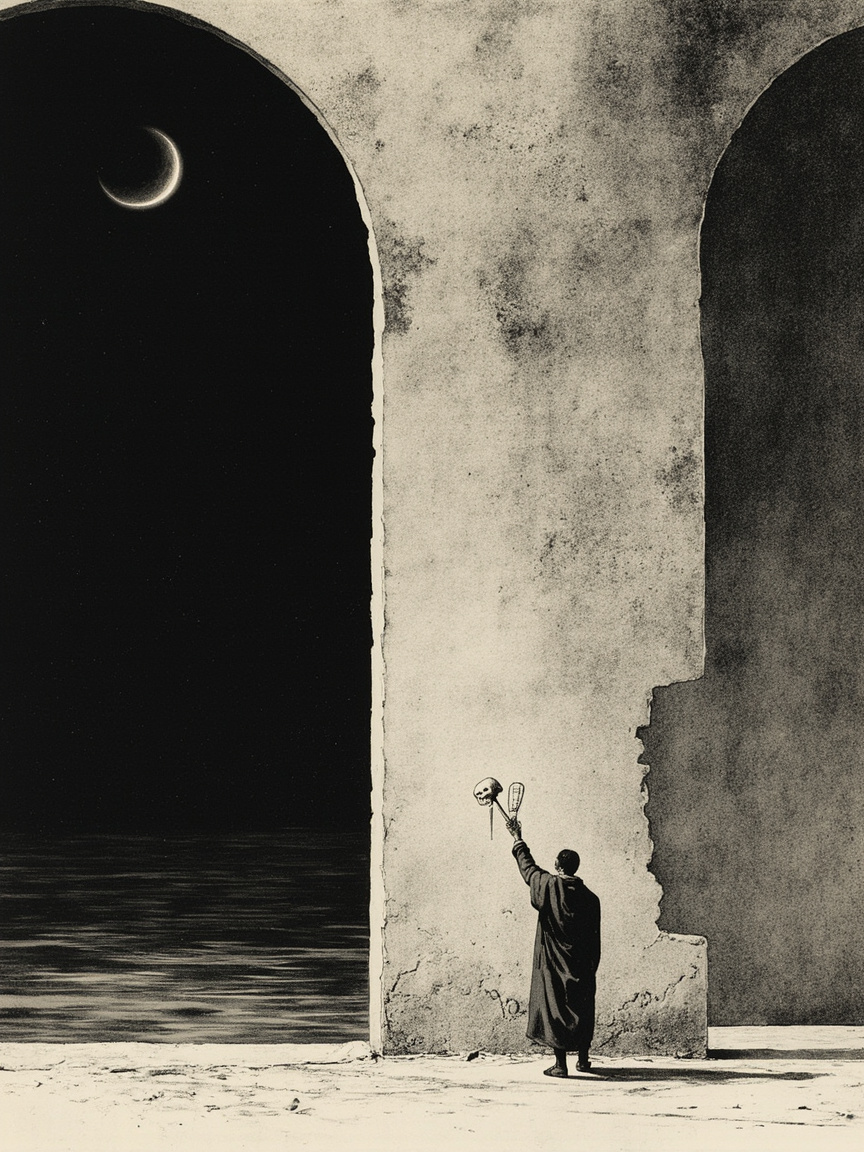
To be, or not to be- that is the question
生存还是毁灭——这是个问题。
Original line · Act III, Scene 1 · the most famous soliloquy in the play
Plot line three: the trick of the play within the play
Hamlet comes up with a brilliant way to test the truth. He hires a troupe of actors to perform a play before the court, one in which a king is poisoned in a garden, exactly the way his own father died. He sits to one side and watches only Claudius's face. When the poisoning scene arrives, Claudius bolts up from his seat, white and shaken, and the case for revenge upgrades from a ghost's word to hard evidence in front of everyone. This is Shakespeare's structural sleight of hand: he uses a play within the play to expose another play within the play. Claudius has been performing the role of a decent king for half a year, and a three-minute piece of theater catches him out on the spot.
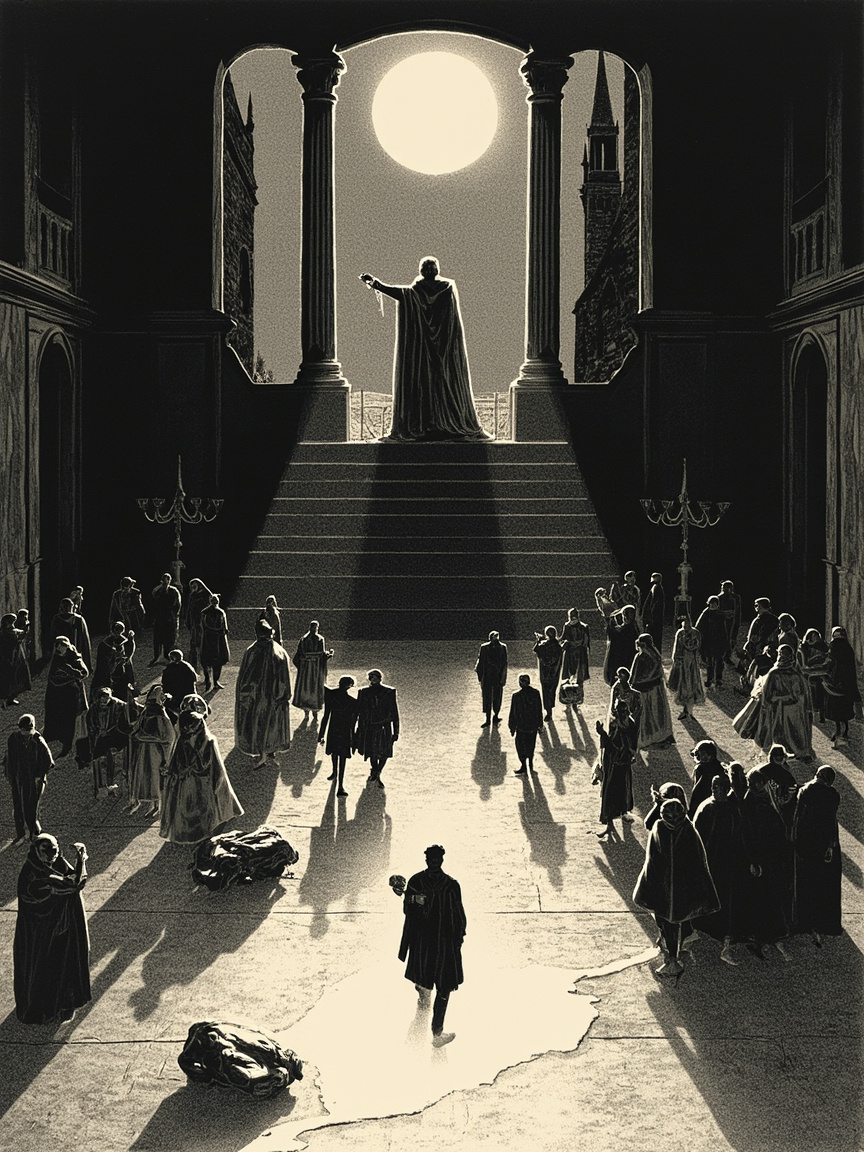
The play's the thing Wherein I'll catch the conscience of the King.
就靠这出戏了——我要用它逮住国王的良心。
Original line · Act II, Scene 2 · the play-within-a-play scheme
Plot line four: the sword thrust behind the curtain
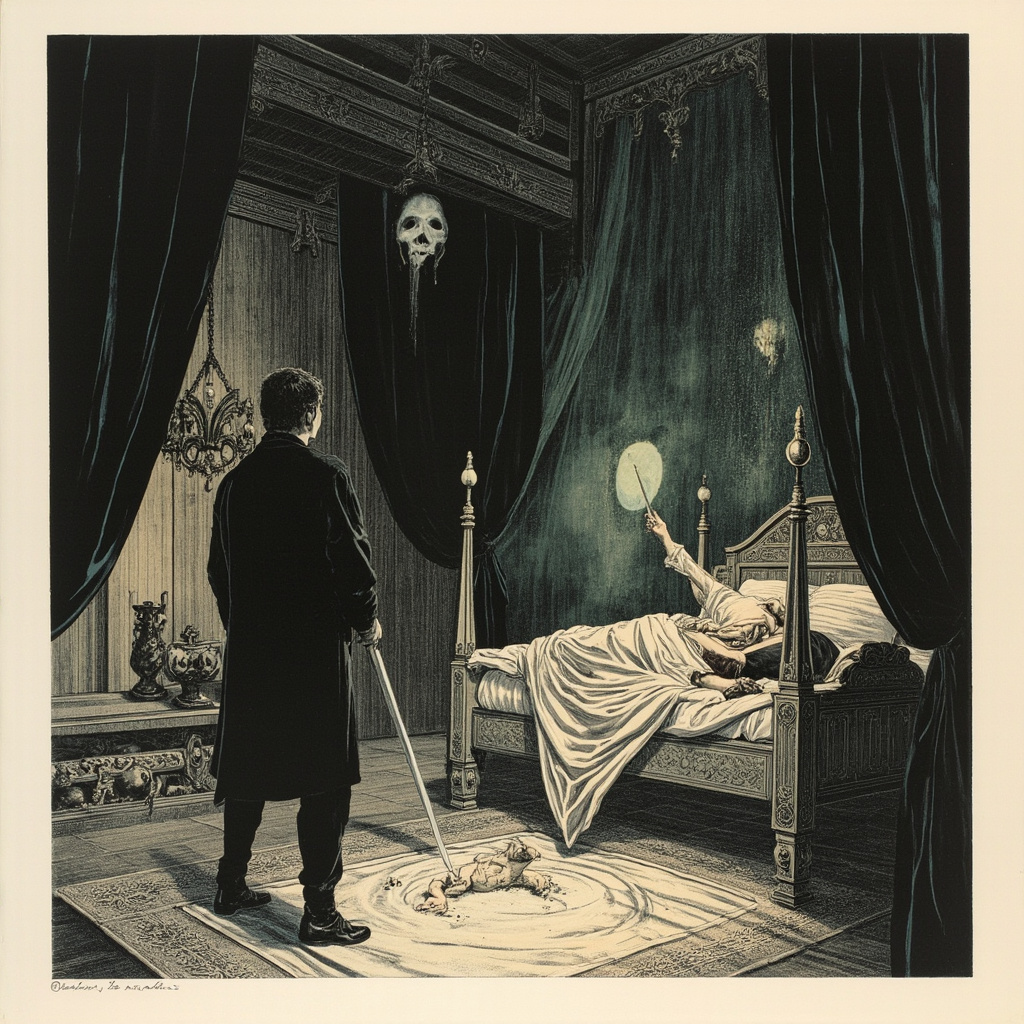
As soon as the play ends, Hamlet goes straight to his mother Gertrude's bedchamber to settle things with her face to face. He gets more and more worked up as he talks, until he hears a sound behind the curtain. Thinking it is his uncle Claudius hiding there to listen in, he drives his sword straight through the fabric. What falls out from behind it is not the king but Polonius, the meddling old courtier, Ophelia's father. This accidental killing is the turning point where the whole play pitches downward: Hamlet now carries a blood debt of his own, and the machine of revenge answering revenge is fully switched on.
Plot line five: Ophelia, and Yorick's skull
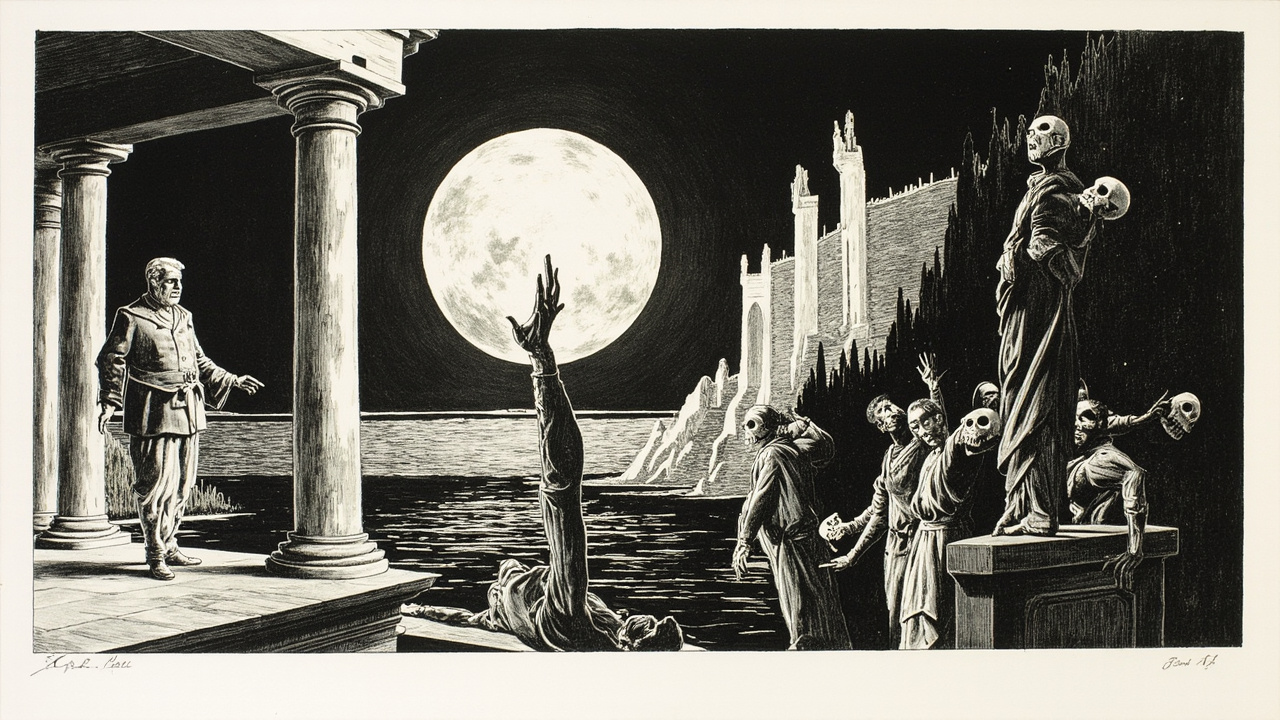
Claudius uses the killing as his excuse to ship Hamlet off to England, with a secret order for him to be executed once he arrives. Hamlet uncovers the letter at sea, swaps it for another, and escapes alive. But when he gets back to Denmark, a colder reality is waiting for him. Ophelia, the woman he loved, whose father was killed by her own lover and whose lover then turned cold and feigned madness, has actually lost her mind. She sings songs that make no sense, flowers in her hair, and finally drowns in a brook. In the original play, her death is never staged directly; it comes to us secondhand, through the queen's account, like an echo of something already shattered.
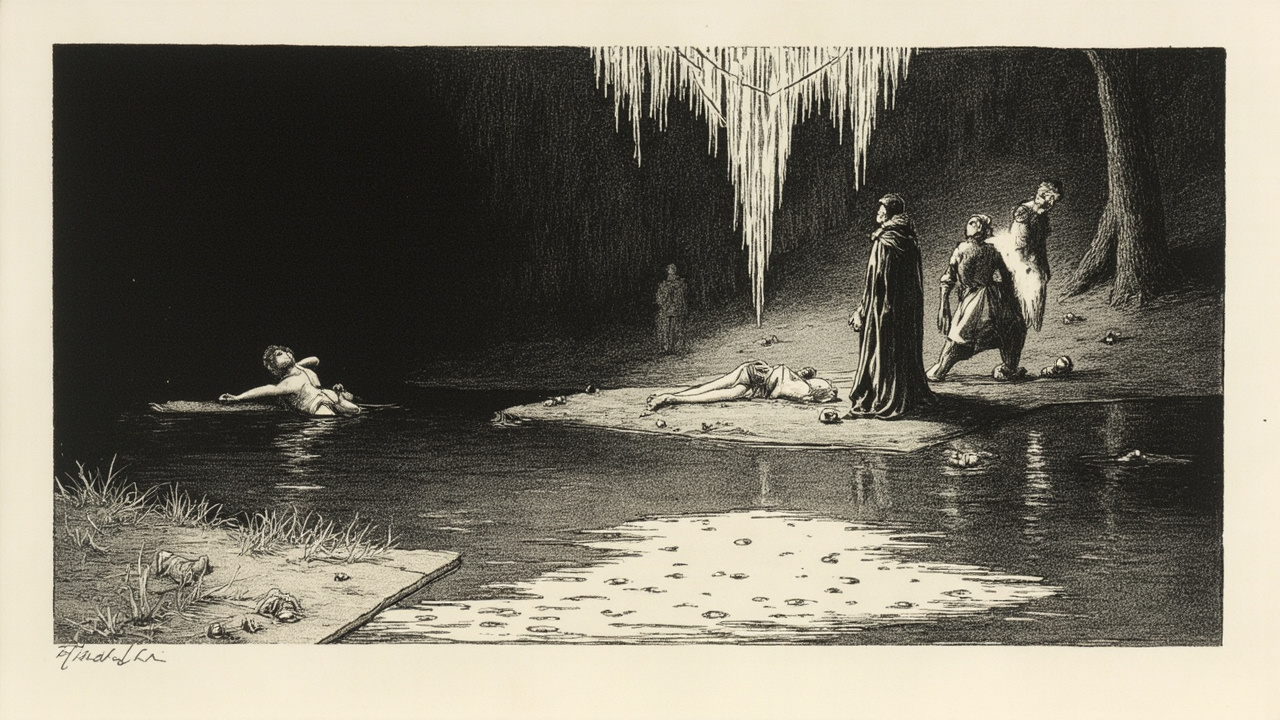
There is a willow grows aslant a brook, That shows his hoar leaves in the glassy stream.
小溪边斜生着一株柳树,把它斑白的叶子映在如镜的水面上。
Original line · Act IV, Scene 7 · the queen recounts Ophelia's drowning
Plot line six: the poisoned sword and the poisoned cup
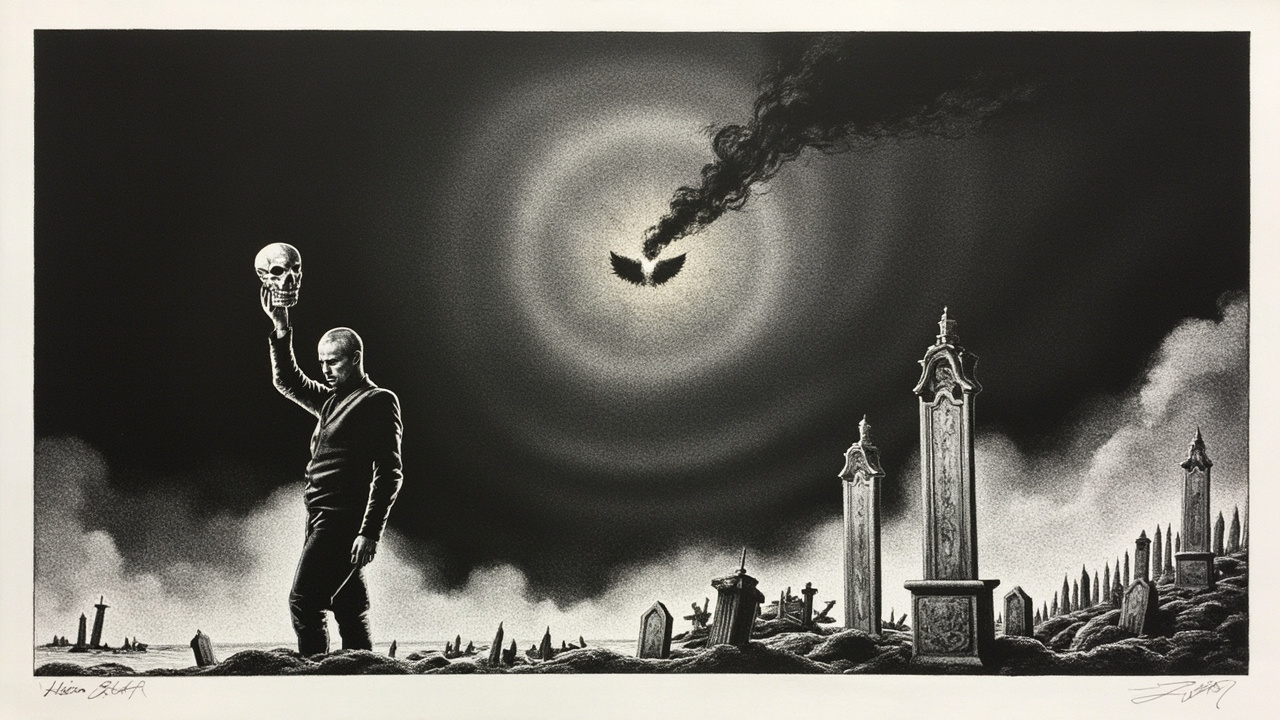
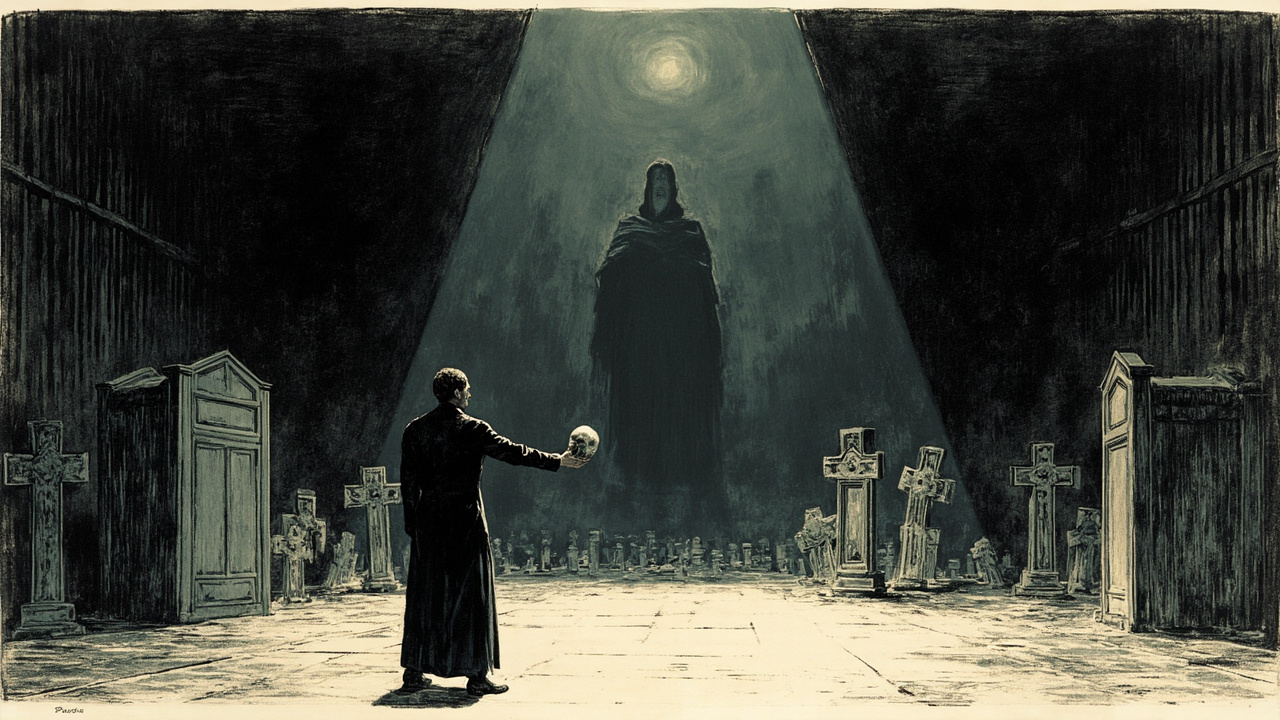
Ophelia's brother Laertes rushes back from France for revenge. Claudius seizes the chance to bring him in on a plan: at a public fencing match, one sword tip will be coated in poison beforehand, with a cup of poisoned wine standing by as backup, so that Hamlet dies in front of everyone. Act five opens with the quietest scene in the whole play, set in a graveyard. Hamlet holds the skull of Yorick, the old court jester, and speaks to it: alas, poor Yorick, I knew him. He sets a clown who once made the king laugh side by side with the empty skull he has become now. It is the play's memento mori: remember that you too will die.
The match begins. The poisoned sword wounds Laertes, then changes hands and wounds Hamlet too. Gertrude, unaware of the plot, drinks a toast to her son's health from the cup meant for Hamlet and drains it. As Laertes lies dying, he exposes the king's scheme, and Hamlet, using the last of his strength, runs Claudius through and forces the poisoned wine down his throat. All of it happens within a few short minutes: the three people who once sat around the throne, king, queen, prince, along with the whole Polonius family, go down almost together.
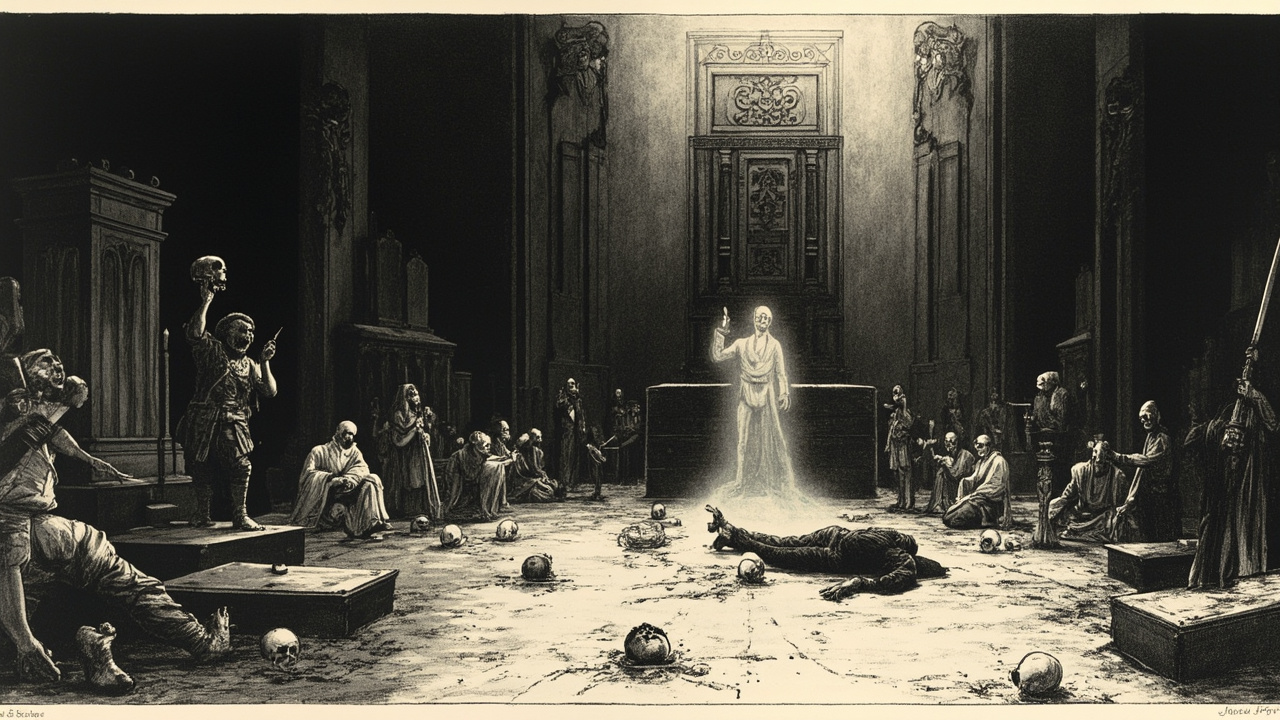
The point envenom'd too? Then, venom, to thy work.
剑尖上也淬了毒?——那么,毒药,去干你的活吧。
Original line · Act V, Scene 2 · Hamlet runs Claudius through
Total wipeout: what is left for the survivors to do
As he lies dying, Hamlet entrusts his one living friend, Horatio, with a final charge: tell the truth to the world. His last words are the rest is silence, and he closes his own mouth, handing his voice over to his friend. Right on cue, Prince Fortinbras of Norway happens to be marching through with his army, and is invited into this Danish court now littered with corpses to take charge of what is left. The throne falls to an outsider. This is not a triumphant ending where the prince avenges his father and is crowned; it is the total wipeout of a family, a court.
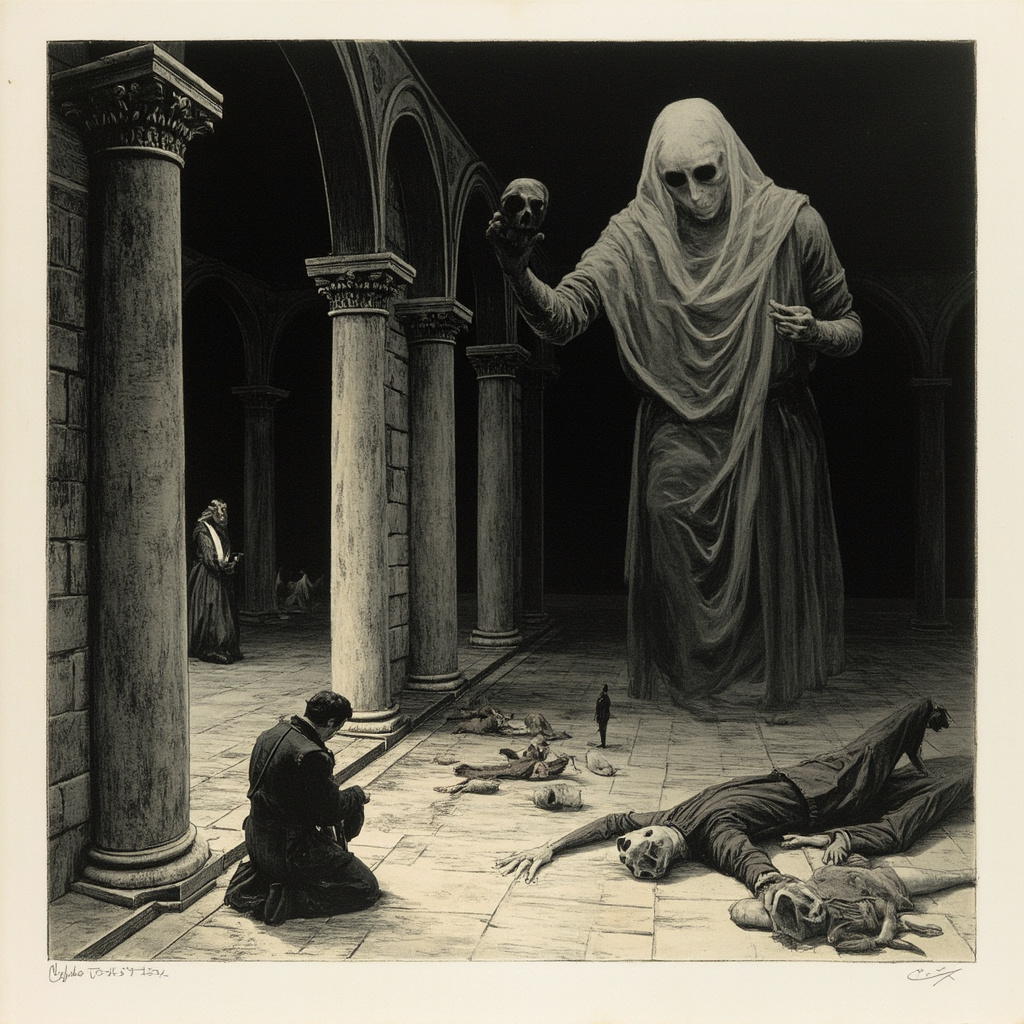
the rest is silence.
其余的,只是沉默。
Original line · Act V, Scene 2 · Hamlet's last words
Themes and craft: why it still has not finished playing after four hundred years
At first glance it is a revenge story. Look one layer deeper and the question it is really asking is: what does action cost? The ghost orders Hamlet to take revenge, but once revenge starts moving it drags in his mother, his lover, his friends, the whole state. Hamlet gets stuck not because he is a coward but because he sees the next step after every step, sees both the pain of living and the unknown of death, and to be or not to be hangs suspended right in that crack. Shakespeare takes a revenge that could have been settled with one thrust of a knife and turns it into a centrifuge spinning around human conscience.
It is also brilliant because of how it plays with appearance and reality. Hamlet fakes madness; Ophelia truly goes mad. Claudius performs the role of a benevolent king, the ghost performs the dead, the players perform a play. Everyone on stage is acting, and the play within the play exposes the play going on in real life. The audience is reminded again and again that what they are watching is not the truth, and that the line between true and false inside the play and inside the court is the same line.
It also lines up three revenge plots side by side for comparison. Hamlet thinks too much and so acts too slowly. Laertes acts the moment he thinks of it, and gets used as a weapon by the king for it. Fortinbras does not think much at all; he just marches. Three ways of moving through the world, three different endings. The playwright never openly endorses any one of them, but readers cannot help measuring themselves against all three. That is why it has never gone stale in four hundred years: every generation reads itself in Hamlet's mind.
Why it is still worth reading the play, even once you know the plot
The soliloquies only carry their real weight when they are spoken aloud on a stage, or when you read them yourself, word by word. Summed up in a single sentence, to be or not to be sounds like indecision. Read in the original, it turns out to be the thing all of humanity has said to the ceiling at three in the morning. The same goes for the graveyard scene, and the way everyone dies in the final minutes of the fencing match: no summary can carry the rhythm of the thing happening live. You have to hear the sword go through the air yourself.
This is not a story about a prince who failed to take revenge. It is the story of a man discovering that thinking something all the way through can kill the doing of it. For four hundred years, every generation has seen its own hesitation reflected in Hamlet's, that one second before you hit send.
Art Direction4 plates
Before the guide was written, this book got a visual foundation — every illustration you just read grew out of it.