
In Praise of Folly (Moriae Encomium) · Companion Guide
愚人颂
1509年,愚人女神登台自报家门——她是诸神之母,要替整个人间把账算清,可算到最后,连她自己也被算进了局里。
The Opening: A Fool's Cap Takes the Stage
A fool's cap strung with little bells, a wooden scepter carved with a grinning face at its tip — this is how she takes the stage. Her name is Stultitia, goddess of Folly, and she announces herself as the mother of all the gods, the one true deity behind falling in love, the madness of youth, drunkenness, and any willingness at all to keep living. She launches into an hour or two of unbroken monologue, working her way through the whole of Christendom, from the pope in the Vatican to the monasteries north of the Alps, from the market fairs of Germany to the lecture halls of English divinity schools, and by the end she tells you not to laugh at her, because you belong among the laughed-at too. This is Europe in 1509, and it is the sharpest pamphlet written in the eight years before the Reformation.
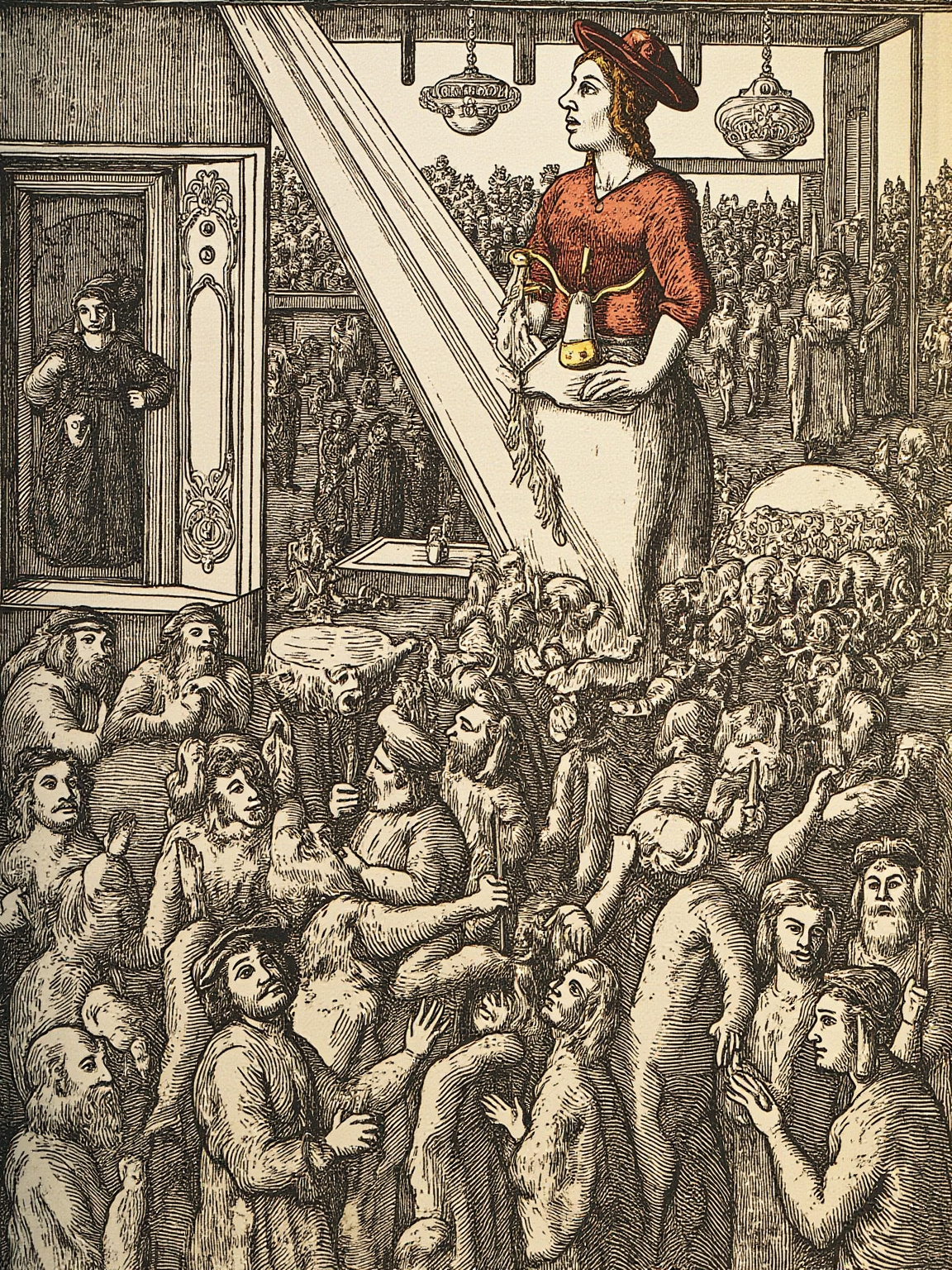
I am that Stultitia who alone, as you shall hear, am the goddess of all goddesses — without me not even the gods above can hold their feasts or be joyful.
我就是愚人女神,你们听好了——我是诸神之中唯一的神,若没有我,连天上的众神也不能设宴,不能欢喜。
金句 · 开场白 · 自报家门
What Kind of Book This Is
The author is Desiderius Erasmus, the most famous humanist of the Northern Renaissance. He spent his life drifting between the universities and courts of Europe, living off Latin, marrying no one, joining no order: the kind of man who could keep a foot in both the Church and the imperial court on the strength of his pen alone. In 1509 he was staying in London, at Sir Thomas More's house in Chelsea on the Thames. It took him a little over a week to write this slim book. The first edition came off Johann Froben's press in Basel and went through seven printings within a year, making it the best-selling satire in Europe on the eve of the Reformation. It is remembered because it swept the whole hierarchy of the Church, top to bottom, without ever sounding like a quarrel — eight years before Luther's Ninety-Five Theses, it had already worked the lid loose.
Folly and the People She Comes For
The star of this performance is not Erasmus but Folly herself. She arrives uninvited, takes over the room, and praises herself without shame — and as she talks, you start to suspect she is actually defending everyone she names. The first she goes after are the pope and the College of Cardinals in Rome, the men who have turned servant of the servants of Christ into a title that gets all of Europe kneeling to kiss a white slipper, who have mortgaged their souls to Plutus while wearing purple and living in palaces. Next come the scholastic theologians, old scholars who have spent their whole careers on questions like how angels digest their food or whether original sin passes down to your grandchildren. Below them are the monks and nuns: shaved heads, coarse rope belts, prayers kept through the night, waiting their turn for the thin spoonful at the bottom of the fish pot, while behind the scenes they are up to every trick in the book. The secular world does not get off either: kings, generals, courtiers, scholars, and merchants all take a turn under her tongue. Best of all, Erasmus himself is standing right there, calling himself one of Folly's own disciples, happy to supply the footnotes to her whole oration.
How She Goes After the Pope
Folly starts, as she likes to, with the money. Which pope these days isn't sitting on a fortune? Which one doesn't use Peter's own keys to open strongboxes Peter never dreamed of? Servant of the servants of Christ comes out of her mouth with a different flavor entirely — servant of servants, translated honestly, means boss of every believer alive. And the cardinals? Purple robes, palaces, the power of the sacraments treated like a hereditary title deed, which they then turn around and mortgage to Plutus. This is the sharpest stretch in the whole book, and it never lays a finger on doctrine itself: what gets exposed is the men who have turned holy office into a trade, not the faith they claim to serve.

Which of the popes today does not make the very name of piety serve as a cloak for greed? Which of them does not open with Peter's keys that he may shove in his own Peter-pence?
今日的教皇,哪一个不是拿『虔诚』二字替贪婪做幌子?哪一个不是举着彼得的钥匙,为的却是把彼得银钱往自己兜里塞?
金句 · 中段 · 教皇篇
Next, the Theologians and the Monks
The scholastic theologians get their own set piece. Folly admits, with obvious satisfaction, that these men live off her: take away the world's stock of foolishness and every one of her theological puzzles loses its footing. The doctors write books nobody can read and argue propositions nobody can follow, and the whole enterprise runs on pious fools willing to pay for the answers. The monks and nuns get the same treatment in two halves. First she lets them play at holiness: shaved heads, no white bread, dragged out of bed at three in the morning to pray. Then she lifts the robe: the thieving is right there, and so is the seducing of respectable women. She admits, almost gleefully, that these performers of sanctity are her own closest kin. This is the sharpest passage in the book — the formalism and the hypocrisy of monastic life, taken apart down to the seams.
Worldly Folly: Kings, Generals, and Poor Scholars
With the Church dealt with, she turns the same knife on kings, generals, courtiers, and scholars, and nobody comes out clean. Two things addle a king's head worst of all, Folly says: the speeches his courtiers write calling him the greatest and wisest man alive, and the fact that he actually believes them. Generals are even simpler — she folds an entire massacre into a joke about vanity, since butchers of men rely on Fortune, and Fortune happens to be family. Scholars are broke, and precisely because they are broke, the poorer they get the louder they insist they despise money. Does that sound familiar? Every corner she laughs at traces back to the same source: everyone is living inside their own flattery of themselves.

What chiefly delights a prince is flattery — a soft and downy plague; and princes are the readier to swallow it because they find it sweet, and because, alas, they have been bred up to it.
最让君主受用的,莫过于那柔软蓬松的瘟疫——阿谀奉承。他们吞得格外顺口,因为甜,因为自幼就被这样喂养。
金句 · 中段 · 君主与将军篇
A Turn: The Folly of Christ
After all of that, you might expect her to wind down. Instead Folly's voice drops, and she makes a claim that stops the whole performance cold: she is the true disciple of Christianity. She reaches for Paul's line in First Corinthians, fools for Christ's sake — only the ones who look foolish, only the ones who refuse to be stuffed full of worldly cleverness, deserve to call themselves Christ's followers. This is the ballast of the entire book. Every jab, every mockery, every worldly folly she has named gets quietly folded back into the spirit of the Gospel.

For ye are bought with a price; be not ye the servants of men. I would that all men were even as I myself, save these bonds. And be ye not foolish, but understanding.
你们是重价买来的,不要作人的奴仆。我愿众人像我一样,只是各人有自己的捆锁。不可作愚昧人,但也不可作聪明过了头的人。
金句 · 收束段 · 保罗之愚
The Strangest Turn of All
I stopped short here. She has just torn the whole of Christendom to pieces, and then she throws herself into the wreckage too. She calls herself the mother of the gods, the source of every worldly pleasure — and in the same breath she hands true folly back to the Christians willing to be laughed at. Put another way: laugh at Saint Peter's money bag, and you are Peter too; laugh at a monk playing holy, and your own heart is even more crowded with pretense than his. Every target of the satire turns out to include the reader, and includes Erasmus himself, nodding along in the audience.
The Speaker Is Implicated Too: The Closing Ritual
In the Western satirical tradition, the speaker usually gets to leave the stage clean: she finishes, the pope lowers his head, the king manages a rueful laugh, the scholars rub their temples, and everyone disperses once the laughter dies down. This book will not let anyone leave that easily. After Folly walks off, the audience stays in their seats, coming down slowly from the laughter — the cardinal notices that his money bag has been seen at his own feet, the monk realizes he was actually dozing through his prayers, and Erasmus, who called himself Folly's own disciple, realizes that he was nodding along because his own heart holds exactly the vanity he laughed at in the pope. This is not the settling calm of a victor's smirk. It is something closer to confession, and it rewrites the old rule of satirical endings: the loudest moment of laughter turns out to be the exact moment you are seen.

Good-bye, gentlemen, and applaud your Folly; farewell, applaud, and drink deep — that is, follow me still, and so be merry.
再会了诸位先生,为你们的愚人女神鼓掌吧;道一声珍重,鼓掌,尽情畅饮——就是说,跟我同去,且自欢娱。
金句 · 末段 · 散场辞
Why It Is Remembered: The Founding Text of Fool Literature
Later satirists (Rabelais, Voltaire, Maupassant) never fully escape this book's shadow. Its more concrete legacy sits in the margins of the physical pages themselves. When the painter Hans Holbein the Younger read the book in 1515, he filled the top and bottom margins of nearly every page with ink sketches: a dim-witted theologian drawn as a bald head with paper worms crawling out of his mouth, a pope drawn as a fat goose sitting on a pile of silver. Those sketches became the classic model for marginalia, and after them illustration was no longer decoration: it became a sparring partner to the text, undercutting it and completing it in the same breath. The whole later tradition of text and image talking back to each other really starts with these hundred-odd unruly margin drawings. That is the real reason to read this book on its own terms: it turned satire from a speech you listen to into something text and image could stage together.
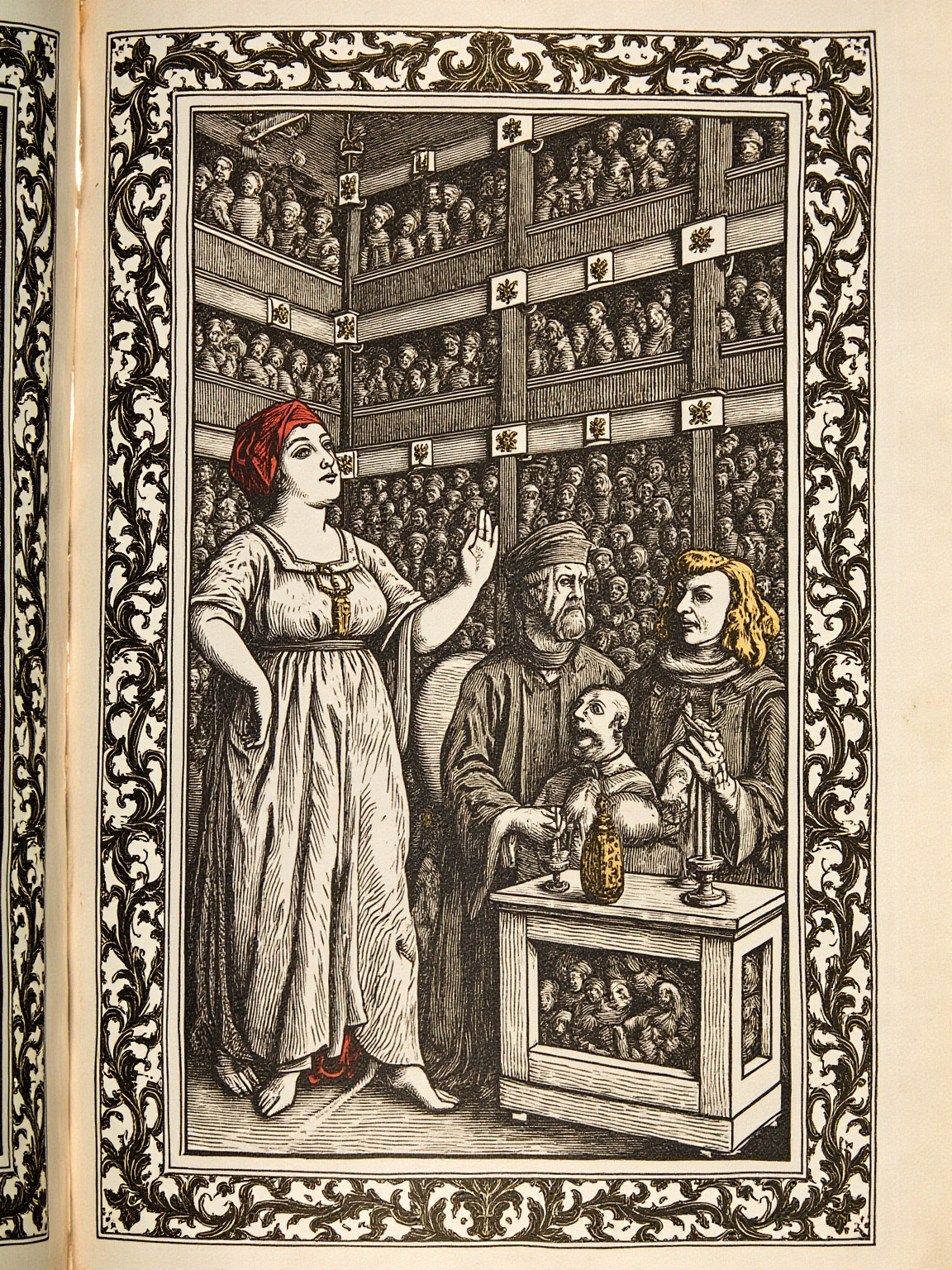
After the pope, the theologians, the kings, the scholars — the last person she mocks is you, because she herself is part of this whole game of self-praise too.
Art Direction4 plates
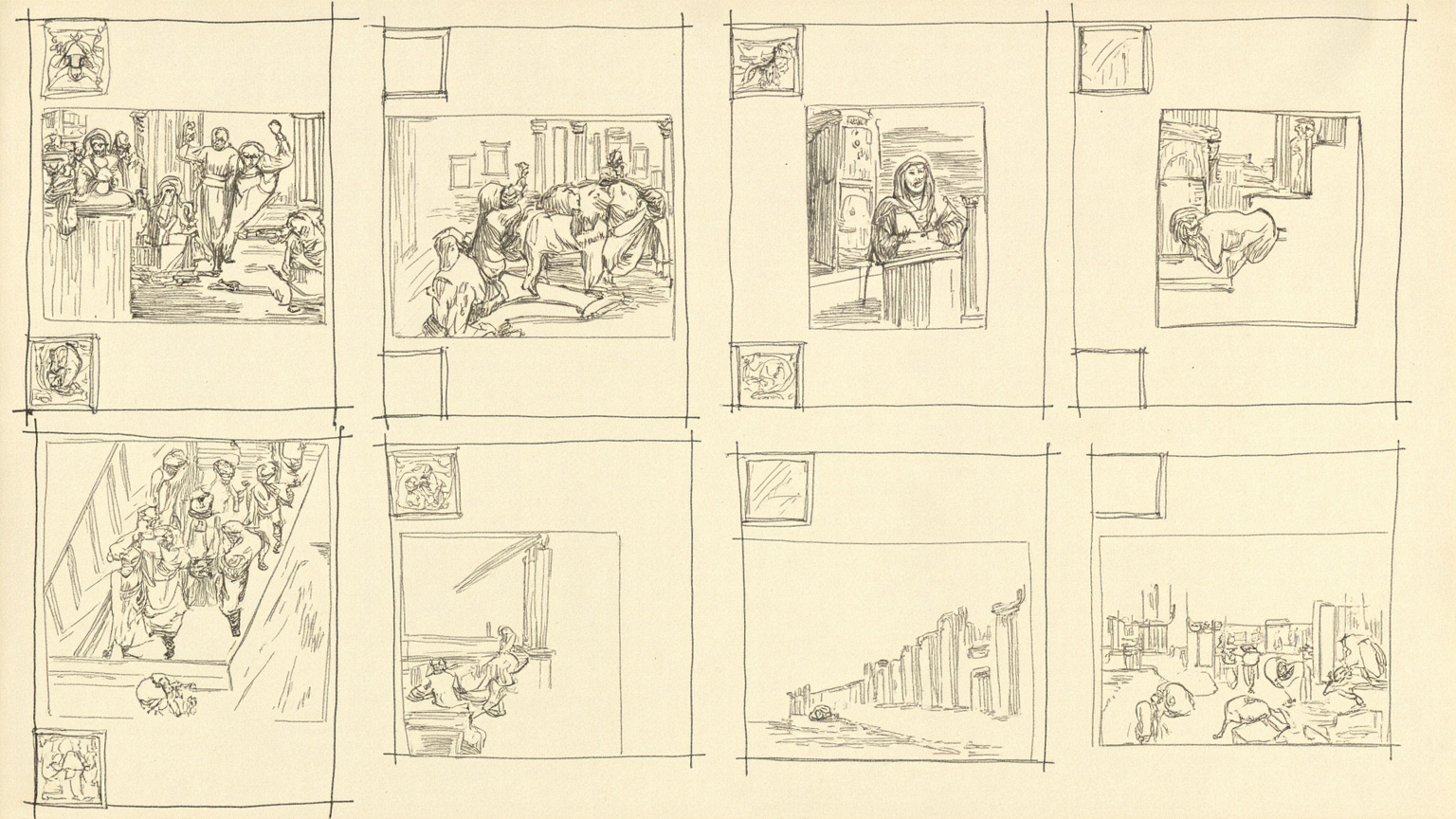
Before the guide was written, this book got a visual foundation — every illustration you just read grew out of it.


