A cauldron of water boils and churns. Outside it kneels a stranger, holding up in both hands a young man's severed head and a long sword that gleams cold. He asks to see the King of Chu, claiming the head belongs to a fugitive from the hills, fit to be hung from the city wall as a warning. The king leans in for a look. The moment his neck clears the cauldron's rim, the stranger draws his sword and takes his head too.
Three heads roll into the boiling water, boiled until the flesh comes apart and the bones crack, and no one can tell any longer which belonged to the king, which to the boy avenger, which to the swordsman. In the end the onlookers just scoop out the ruined flesh and bone and bury it all in one grave, side by side. That grave has carried a strange name ever since: the Tomb of Three Kings. This is not history. It is the shortest revenge story in In Search of the Supernatural, sitting at the headwaters of Chinese tales of the strange.
What Kind of Book Is This
In Search of the Supernatural was compiled in the early Eastern Jin dynasty. Its author, Gan Bao, came from Xincai, held the post of Imperial Historian, and also wrote the Jin Ji, a dynastic history in the proper official form. This was a serious court historian, not a street storyteller. Why did a man like that put together a book made entirely of ghosts and spirits? Because strange things had already happened in his own family. A concubine of his father's, buried alive as a burial companion more than a decade earlier, was found still living when her coffin was opened. His own brother once stopped breathing for several days, then woke and described what he had seen in the underworld. Those two events shook Gan Bao badly, and he went looking, through old records and scattered lore, adding accounts of strange happenings he had heard of in his own time, until he had twenty scrolls, nearly five hundred entries. His preface says plainly what he was doing: not writing for entertainment, but to make clear that the way of the spirits is no deception, to prove that gods and ghosts are real.
A guide like this is only a map. The ground still has to be walked. The original's short entries, three or four sentences each, carry a coldness that is Gan Bao's own. He almost never dramatizes, almost never comments. The son digging up the sword, Li Ji entering the den, the wife corroding her own clothes in secret: all of it is plain, unadorned description, delivered flat. That spare, sketch-it-and-move-on style is the actual prototype for short narrative in Chinese, and the vernacular short fiction we now take for granted grew straight out of that restraint. There's also something to the surviving text itself: the version we read today, stitched back together by Ming scholars out of broken fragments in old compendia, sometimes has more texture than a clean, unbroken original would. Read the original, and what you'll find are those seams.
Art Direction4 plates
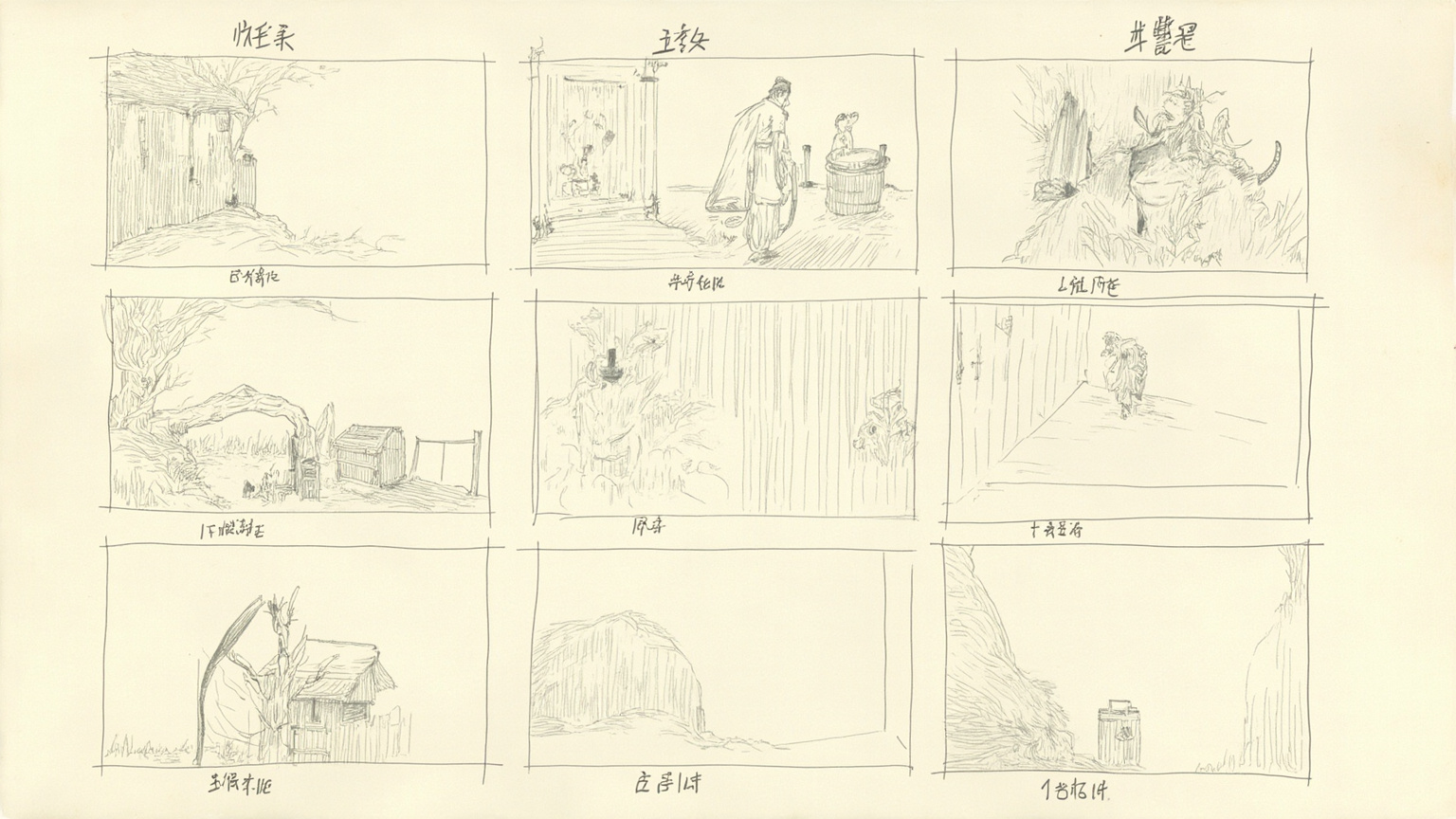
Before the guide was written, this book got a visual foundation — every illustration you just read grew out of it.
Unfortunately most of the original was already lost by the Song dynasty. The twenty-scroll version we read today was pieced back together by Ming-dynasty scholars, entry by entry, out of compendia like the Extensive Records of the Taiping Era, so the text no longer matches Gan Bao's original word for word. Because of that, there is no clean, authoritative original to quote from; what survives is only what later hands managed to recover. Still, this founding work of Chinese tales of the strange fed directly into the Tang chuanqi tales and into Pu Songling's Strange Tales from a Chinese Studio, and its best-known stories, of revenge, of slaying serpents, of turning into trees, of meeting immortals, have long since walked off the page into opera, New Year prints, and film, becoming some of the most deeply shared memories in Chinese culture.
People and World: Four Stories, Four Ways of Staking a Life
The easiest mistake in reading In Search of the Supernatural is to treat it as a novel with a protagonist and a throughline. It isn't one. It's a collection of strange accounts loosely sorted by subject, omens in one group, ghosts in another, immortals and magic in a third, and each entry is a short piece told in three or four sentences.
So this guide picks out only the four heaviest stand-alone stories, each built around someone staking a life to buy something. The swordsmith Gan Jiang of Chu, killed for missing the king's deadline on a pair of swords, leaves behind an unborn son; his wife, Mo Ye, memorizes where the hidden blade is buried in a pillar of pine and raises the boy to manhood. Grown, the son tries to kill the king with the sword and fails, flees into the mountains, and meets a stranger swordsman willing to die in his place. In the eastern Yue region, a giant serpent coiled on Yong Ridge demands a young girl in sacrifice every year; the youngest daughter of the Li family, Li Ji, volunteers to kill it herself. In the state of Song, the retainer Han Ping loses his wife, He, seized by King Kang of Song; husband and wife die one after the other, and from their graves grow two catalpa trees whose branches intertwine, with a pair of mandarin ducks crying above them. And the poor young man Dong Yong sells himself into servitude to bury his father, only to meet on the road a heavenly woman willing to marry him and weave silk to pay off his debt.
Gan Jiang and Mo Ye: Three Heads, One Grave
Start with this one, because it is the bleakest. The King of Chu gave Gan Jiang an order with a death sentence attached: forge a pair of swords, male and female, within three years. Gan Jiang worked day and night and finally cast the two blades. When the three years were up, the king turned on him and had him killed anyway.
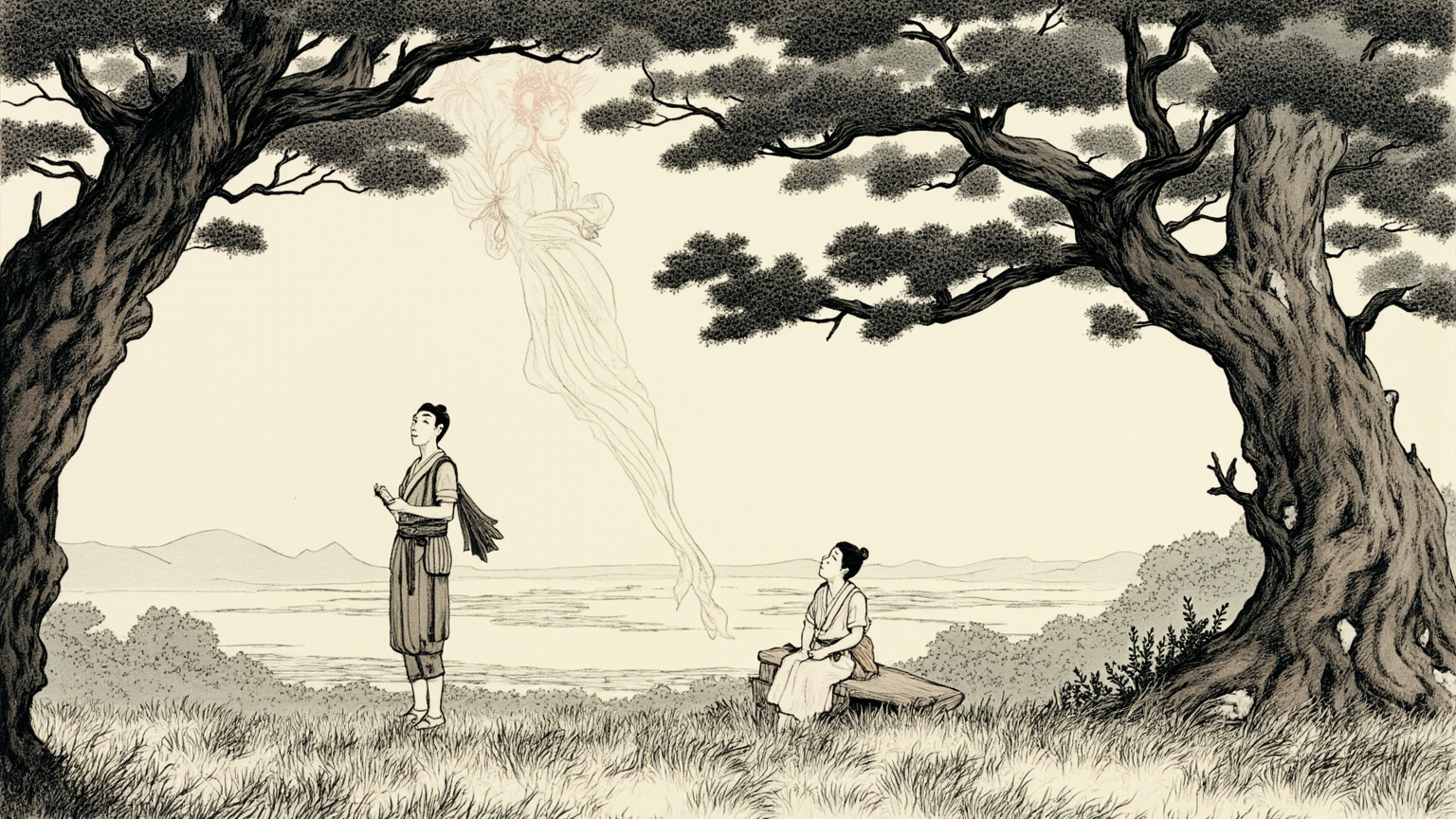
Before he was taken away, Gan Jiang said only one thing to his wife: hide the male sword, and tell our child about it once he's grown. The blade went into a pillar of pine in their own house. Worth pausing on this: when Gan Jiang was seized, his son had not even been born yet. What he was betting on was simple. The king could kill him, but Chu would still hold his bloodline, and the bloodline would grow up. The sword stayed hidden for more than a decade.
The son grew into a young man, dug up the sword, and went to kill the king with it. The palace guard was too tight, and he failed. He fled into the mountains, where he met a swordsman he had never seen before, who offered on his own: let me avenge you. The price: your head, and your sword. The young man cut his own throat without a second thought. He doesn't even get a name in the original text, which calls him only the son. The name Meijianchi, by which he's known now, only caught on later, when Lu Xun used it in his story Forging the Swords.
The swordsman carried the young man's head and the sword to the king, claiming it belonged to a fugitive from the hills, fit to be hung from the city wall. The king believed him and leaned in over the boiling cauldron to look, and that is the scene this guide opened with. Three heads boiled down to indistinguishable flesh, and the people buried them together, one grave for all three.
What makes this story work is two things. First, it pushes the cost of revenge as far as it will go. The young man dies, the swordsman dies, and by the end even the question of whether the revenge succeeded gets boiled down into the same mush. The king is dead, but is the debt paid? Second, it is the story that first sets firmly in place a motif that would run through Chinese tales of chivalry ever after: the stranger who draws his sword to help.
Li Ji: The Girl Who Slew the Serpent
ImaRead3
Gan Jiang's story is about men dying for men. Li Ji's turns in a different direction. Under Yong Ridge in Min territory coiled a great serpent that demanded a young girl to eat every year. Local officials combed the villages for girls to hand over, year after year, and still the deaths did not stop.
When it was the Li family's turn, the parents wanted only to take their eldest daughter and flee into the mountains to escape the debt. The youngest, Li Ji, stepped forward instead: don't run, she said, I'll go. She armed herself with a sharp sword, brought along a hunting dog, and packed a basket with rice cakes mixed with honey. At the mouth of the serpent's den she scattered the bait and hid nearby to wait. When the giant snake put its head out to swallow the sweet-smelling food, Li Ji whistled the dog forward to sink its teeth into the snake's body, then leapt out herself and hacked at it with her sword again and again until the writhing thing was cut into pieces.
Once the monster was dead, the King of Yue heard of it and summoned her to make her his queen. This ending is almost miraculously bright by the standards of In Search of the Supernatural. An ordinary family's youngest daughter, armed with nothing but her own nerve, a sword, and a dog, kills a creature the whole region worshipped as a serpent god, and wins herself a place in another class entirely. This is not a story about a girl handed over to be devoured. It is a hero's story, about someone who volunteers to end the killing, and what makes Li Ji likable is that she is never, from the first line, a victim.
Han Ping and His Wife: Trees After Death, Then Mandarin Ducks
ImaRead4
But the brightness of Li Ji's story only makes the next one darker by comparison. King Kang of Song saw that the wife of his retainer Han Ping, a woman named He, was beautiful, and ordered her seized. Han Ping was thrown in prison, and before long, grief and rage drove him to kill himself.
After she was taken, He did not try to die at once. Instead, in secret, she worked a corrosive substance into her clothes little by little, rotting the fabric through. What she wanted was not a quick death but the right place to die in. One day King Kang took her up onto a high terrace for a pleasure outing. When no one was watching, she flung herself off. Her sleeve tore and she fell, leaving behind a note: after I die, bury me with Han Ping.
The king was furious. He would not allow it. He had the two bodies buried apart, in graves facing each other.
But overnight, a catalpa tree grew up from each grave. Within ten days the two trees' roots had tangled together underground and their branches interlocked in the air; a pair of mandarin ducks came to roost in them, necks entwined, crying day and night. The people of Song mourned the couple and called the trees the Trees of Longing, and it was said the two ducks were the souls of Han Ping and his wife. Note: ducks, not butterflies. It's Liang Shanbo and Zhu Yingtai who become butterflies and fly off together, a different pair of lovers entirely, unrelated to Han Ping, though the two death-for-love stories often get mixed up in popular memory. What makes this story work is that it refuses the couple a reunion in death; it lets what remains of them still carry a human posture, calling to each other across the distance, and that makes the tragedy sharper, not softer.
Dong Yong and the Weaver Girl: Gratitude Repaid, Then Gone
ImaRead5
The last story is the one most Chinese readers already know: Dong Yong. He was poor. When his father died, he couldn't even afford a coffin. He sold himself into servitude for the burial money and went to work off the debt as a laborer in his master's household.
On the road a woman came toward him and offered to become his wife. Dong Yong was this poor, and someone still wanted to marry him? The woman followed him to his master's house and asked only how much silk would settle the debt. Three hundred bolts, the master said. She began weaving, and within ten days, three hundred bolts sat stacked neatly before him.
The debt was paid, and Dong Yong was a free man again. On the way home, the woman stopped with him under a locust tree and told him the truth: I am the daughter of the Emperor of Heaven, sent down to help you clear your debt. Then she rose into the air and was gone.
Dong Yong was left standing alone, looking up at the empty branches. This is the actual ending in In Search of the Supernatural: the debt repaid, and then she leaves. It is not a story about a happy marriage growing old together. The later opera Tianxian Pei, the Huangmei-opera version where husband and wife walk home together in a happy ending, is a gentle rewrite that folk tradition made to the original sometime after the Song and Yuan dynasties. What Gan Bao actually wrote is colder than that, and cleaner: a man with nowhere left to turn gets a hand from heaven, and then heaven lets go.
Why It's Remembered
ImaRead6
These four stories span several centuries: the Tomb of Three Kings belongs to pre-Qin Chu, Li Ji's serpent-slaying to folklore from Min around the Qin-Han transition, Han Ping to the Warring States kingdom of Song, Dong Yong to a filial son of the Han dynasty. Yet an Eastern Jin historian pulled them all together into a work of under twenty scrolls. Each story had its own separate origin; Gan Bao simply gathered them out of scattered old records and rearranged them by theme. So the real skill on display in In Search of the Supernatural is not in the prose of any single entry, but in the judgment behind compiling the book at all: he picked out the stories from Chinese culture that would still hold up centuries later.
Underneath that, Gan Bao's motive was to make clear that the way of the spirits is no deception. He wanted evidence that gods and ghosts were real. That intent is what keeps In Search of the Supernatural from being a later-style vernacular tale collection meant for entertainment. It's a serious work of documentation: an official court historian, outside the bounds of official history, opening a second archive for everything official history left out. That two-track approach, the standard histories keeping the ordinary record, the tales of the strange keeping the record of the extraordinary, is the most lasting legacy the book left behind.
Read These Four and You've Read the Grammar Underneath All Chinese Tales of the Strange
Look back at these four stories and a shared structure emerges: the weak stake their lives against something. The young man stakes his head, the swordsman his own head, Li Ji her sword-arm, He her body turned into a tree after death, Han Ping and his wife their transformation into birds, Dong Yong the body he had sold into servitude. Facing them stands a tyrant, a monster, or the will of heaven: human power, an alien force, or heavenly indifference, take your pick. Every one of the weak has to hand over some part of themselves, sometimes their life, to move the other side at all. This trading of flesh and blood for a single outcome is the core motif that Chinese tales of the strange and the marvelous were built on.
Reasons to Read the Original
ImaRead7
What makes In Search of the Supernatural remarkable isn't how well any single tale is told. It's that a court historian dared to open a second book outside official history, and set aside a whole archive for ghosts, for the defeated, for people who turn into birds. That act is the biggest story it tells.