She was poor, she was plain, treated like a plaything — and she refused to kneel
Text and illustrations produced by the pipeline
A ten-year-old girl is dragged up the stairs by two maids and thrown into a red room that has stood untouched for nine years — the room where her dead uncle's coffin once lay. The door is locked, the key taken away. She screams until her voice gives out, and no one comes. This isn't the opening of a ghost story. It's the first lesson a penniless, parentless, nameless orphan learns in nineteenth-century England: the world will not speak for you, so you had better learn to cut your own way out the door. That scene will keep reshaping itself throughout her life — into an attic, a schoolroom, a lover's lie — and each time she will have to carve herself out of the small room she's been shut in.
It was published in the mid-nineteenth century, written by a woman of modest means who had never finished a formal education, in her early thirties when it came out — under a male pen name, because she was afraid of being found out as a woman. The book went on to become one of the best-selling novels in the world, adapted into dozens of films, kept on the nightstands of generations of women readers. Its author lived to see it become a sensation, then died only a few years later, leaving behind something that everyone who has ever been shut in a small room could use as a key. Why has it lasted? Because at a time when the prevailing voice told women to be docile, silent, and grateful, she gave an orphan girl the words that shook the Victorian world: our souls are equal before God.
The protagonist is Jane Eyre — a woman who spends the whole book wrestling against something: against her aunt's cold stare, against hunger at boarding school, against her employer's lies, against her own heart. What she wants is simple: to live, and to be treated as a whole person rather than a useful object. Around her stand several forces pulling in entirely different directions. Rochester, master of Thornfield Hall, bad-tempered, hard-faced, hiding a shameful marriage. Bertha Mason, the mad wife who never once appears on the page, unsettling the whole book with laughter, with fire, with a torn wedding veil. Helen Burns, Jane's only friend at school, a quiet young Christian with a calm beyond her years, who teaches her that taking a blow without striking back is not weakness. St. John Rivers, the clergyman cousin who saves her life, cold as a blade, wanting to take her to India as a missionary's wife. The world runs on the rules of nineteenth-century England: an orphan eats on her relatives' charity, a woman trades marriage for her keep, and respectability is the only currency there is. None of it runs in Jane's favor.
Jane Eyre is not a love story. It's a novel about how a woman with no one to depend on can go on living without giving up her self-respect. Her courage was never the absence of fear — it was walking on afraid, walking on hungry, walking on while someone pointed a finger and said you're nothing more than this. At the very end, Jane tells the reader she married him. Many people read that as a romantic declaration. It's really Jane's answer back to the reader: you've sat through the whole book watching me get thrown over, starved, burned, struck by lightning — and look, in the end I still went and married him. But in her own telling, marrying Rochester was never getting something. It was choosing it. That kind of choice, made clear-eyed, free to say no, and still saying yes, was a rarity Victorian England had no way to offer a woman. More than a hundred years later, it still is. Go read Jane Eyre. You'll feel cold, you'll feel hungry, you'll shiver with her on the moor. But when you close the book, you'll stand a little straighter than when you opened it.
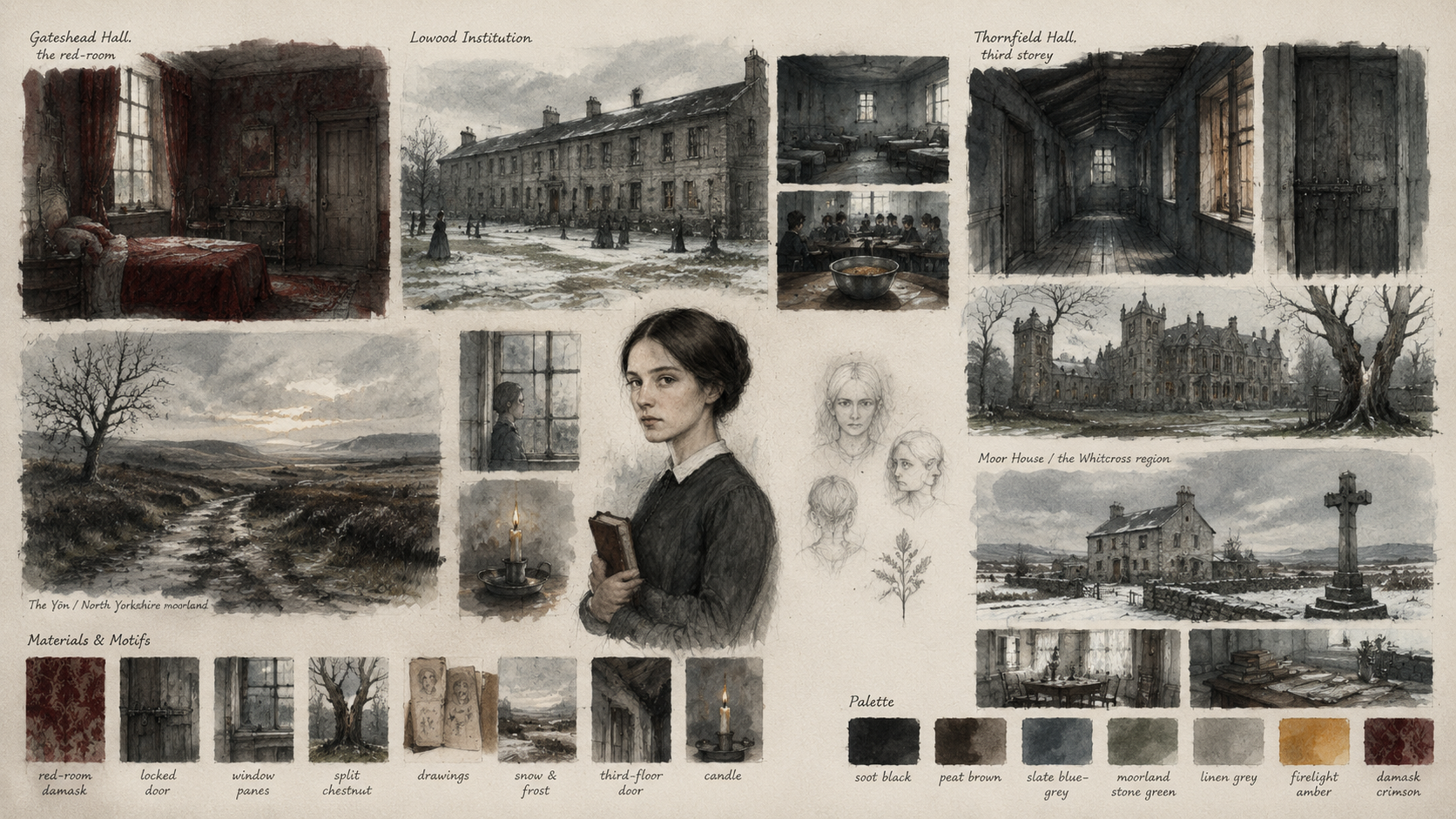
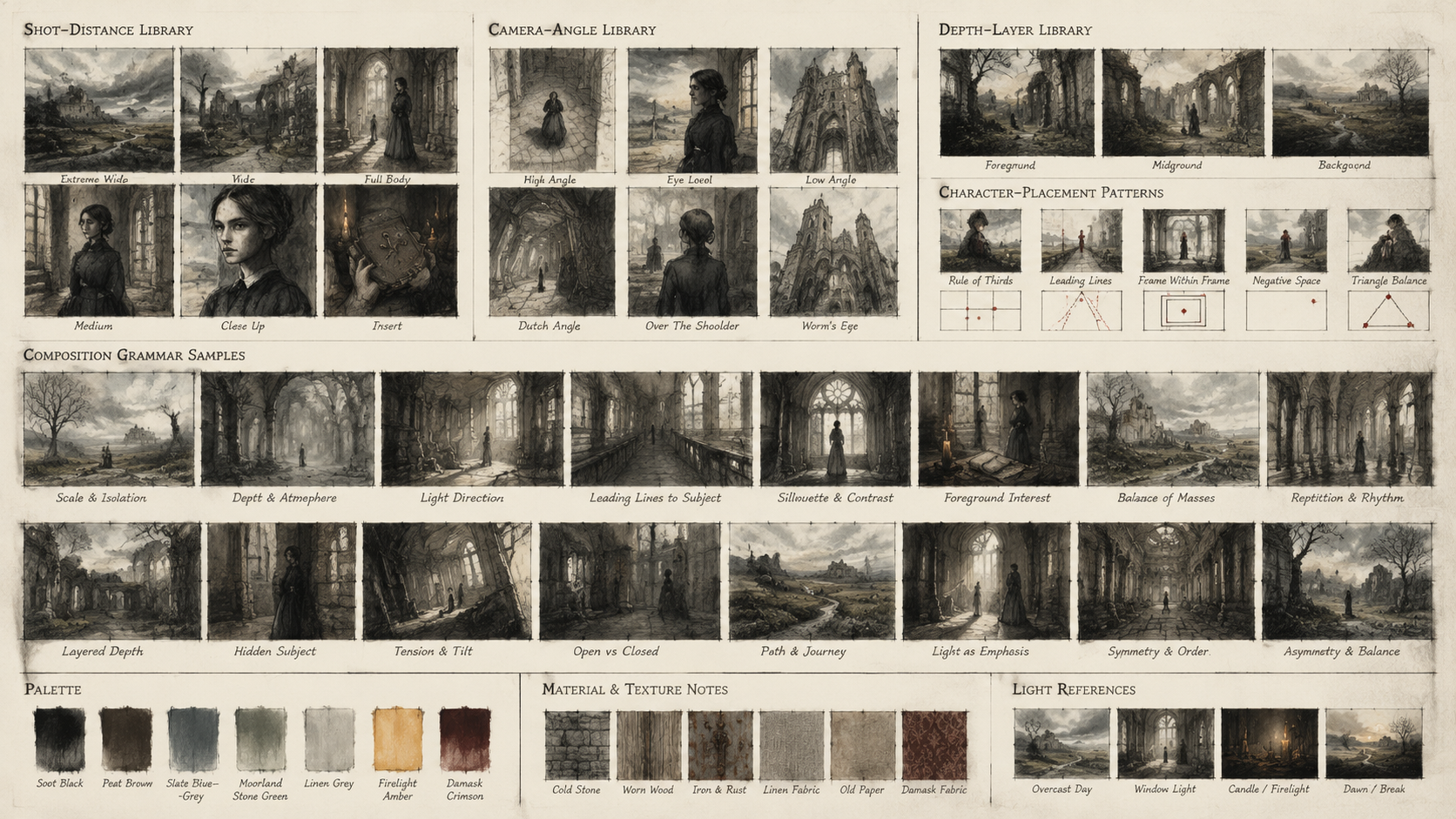
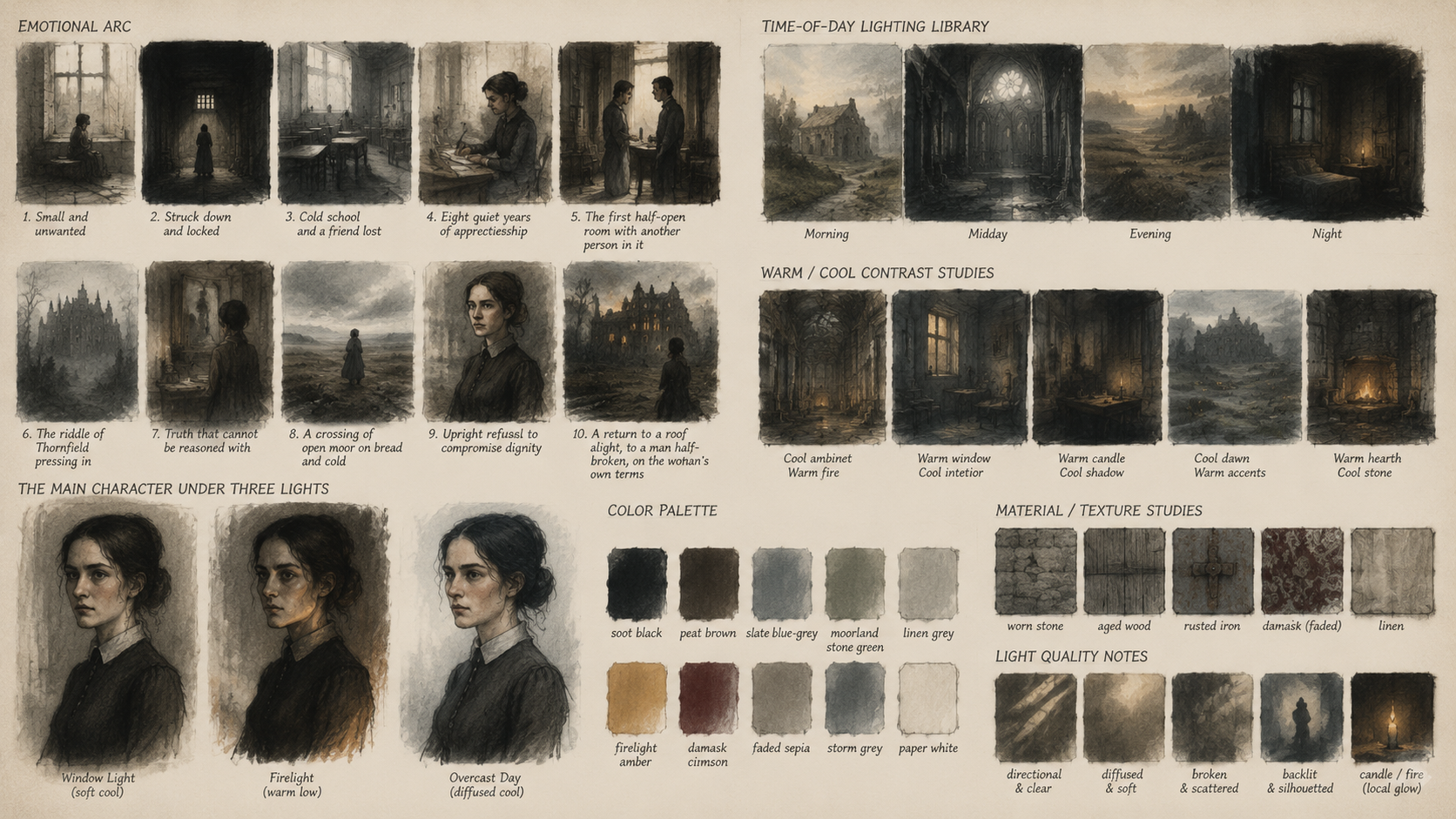
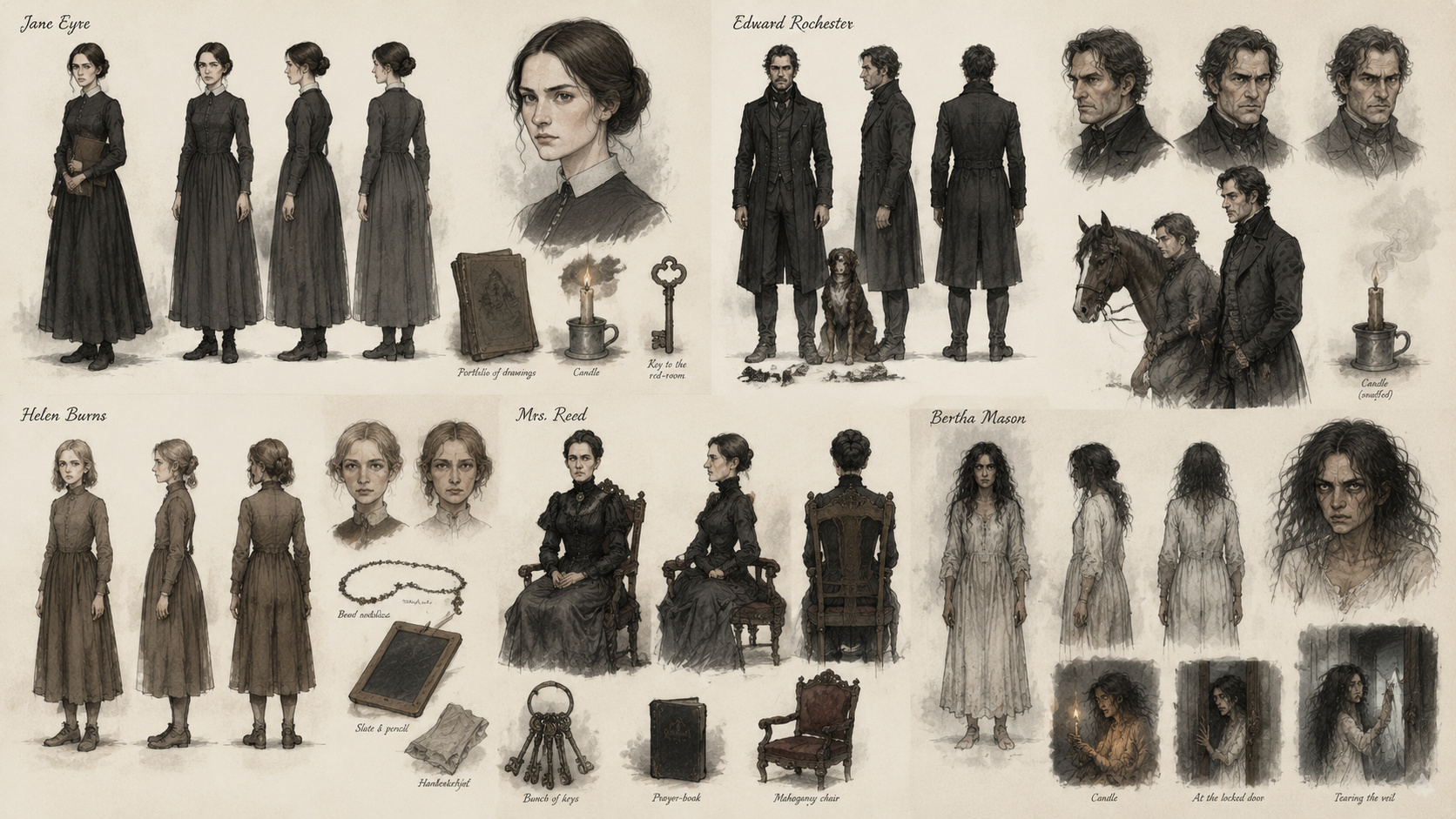
Before the guide was written, this book got a visual foundation — every illustration you just read grew out of it.
At ten, Jane is living on the charity of her aunt, Mrs. Reed — eating leftovers, wearing hand-me-downs, beaten by her cousin. One day her cousin hurls a book at her and blood runs down her face. For the first time in her life — and the only time in that house — she hits back. Her aunt flies into a rage and has her dragged into the red room and locked in. The room has stood untouched for nine years, its deep crimson hangings like congealed blood, a carved face on the wardrobe looking down from above. She sits there alone, screaming until her voice gives out, and no one comes. Worth noticing: this isn't a fairy-tale ghost story, it's the bodily truth of someone who has actually been shut away — she can't tell whether what she hears is her own heartbeat or footsteps in the empty corridor, and she feels herself sliding down into the dark. By the time a servant finally forces the door open, she has fainted. What she learns in that room will last her a lifetime: I am alone, I am small, the world does not love me — and none of that discounts me.
SCENE: In a dim, narrow dormitory at night, two girls share a small iron bed pushed against a stone wall. Helen Burns li…
The truly frightening part of the red-room scene isn't the room — it's how every adult responds. Her aunt says she only fainted from a fit of temper; the servants think she shouldn't have been locked in there, but not one of them says so out loud. This is the book's central tension: an injustice happens, and no one will call it unjust. What Jane learns in that room isn't a fear of the dark — it's the knowledge that no one in this world will speak for you unless you stand up for yourself first.
Her aunt can't stand her any longer and packs her off to Lowood boarding school. The gates open onto something like an unclaimed parcel — porridge burnt black, washbasins frozen solid, firewood rationed out like bread. The headmaster, Mr. Brocklehurst, is a hypocrite dressed in black with eyes like nails; he stands Jane before the whole school and calls her a liar, makes her stand on a stool to be stared at, and orders a teacher to crop her hair to the scalp — simply because she once took pride in it. Worth noticing: the audience here isn't a bystander, it's the entire school. Public humiliation is Victorian discipline's favorite trick — you aren't just punished, you're punished in front of everyone.
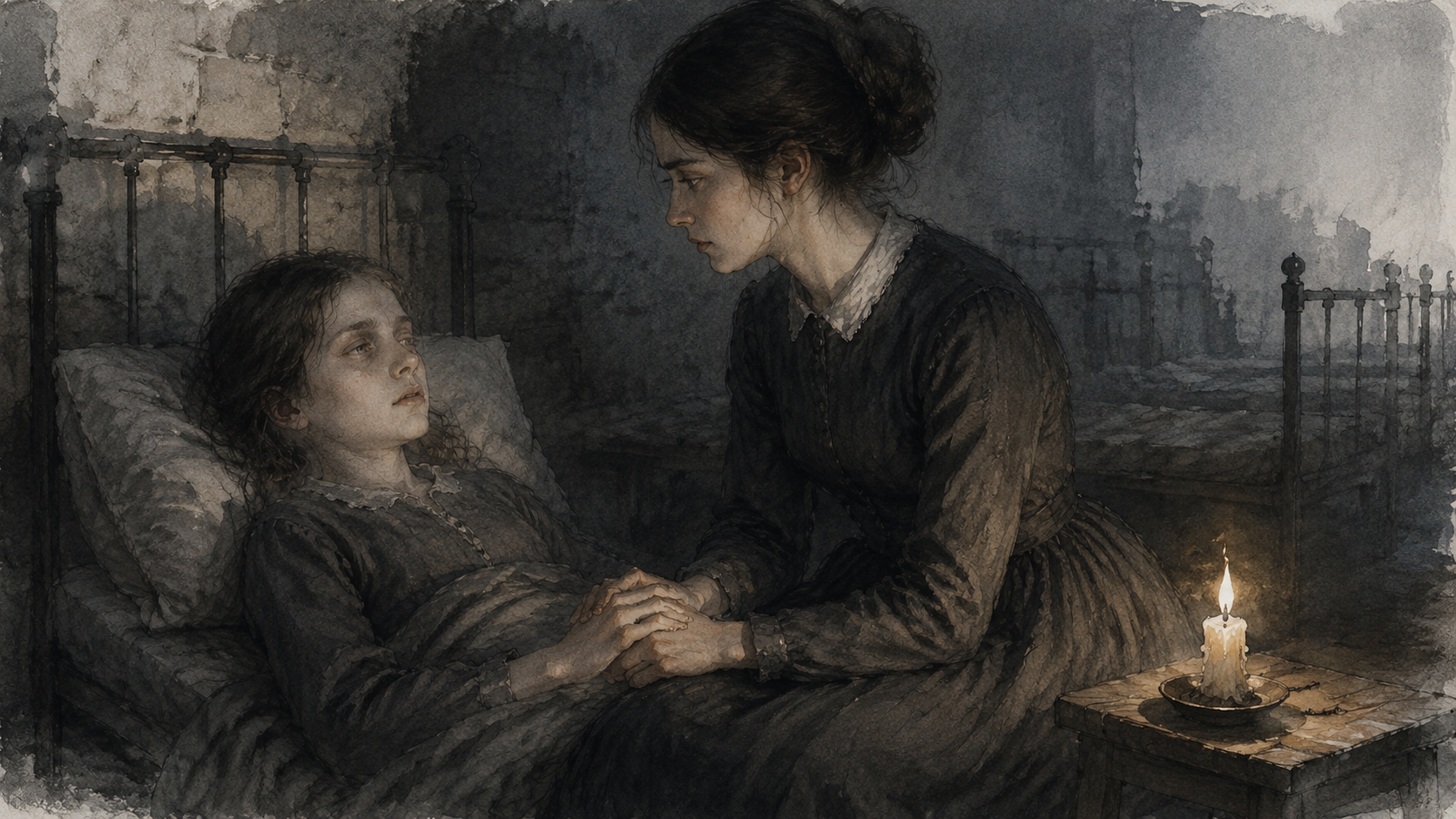
At Lowood she meets two people. One is Helen Burns, who never grows angry even when bullied, and who talks to her about Plato, about how forgiveness and contempt are not the same thing. Helen dies of consumption, and Jane sits at her bedside as she breathes her last. Worth noticing: Helen's death is written slowly — the candle burns low, the breathing grows shallow, and Jane holds her, because there is no one else in the world to hold her. Brontë doesn't make this death a spectacle; she lets it be as light as falling asleep — and it's the lightness that carries the weight. The other person is Miss Temple, the only adult at the school who treats her as a person with a soul.
SCENE: A heavy-browed, dark-featured man leans forward in a deep armchair, one hand resting on its arm, his eye measurin…
Jane endures eight years at Lowood — six as a student, two as a teacher. She places an advertisement, is hired, and arrives by carriage at Thornfield at night. It's a dust-gray old house that looks, in the moonlight, like a patient holding its breath. The housekeeper, Mrs. Fairfax, tells her she's to teach a young French girl, and that the master, Mr. Rochester, is rarely home. On her first night there she hears a laugh from upstairs — not a human laugh, more like something laughing at itself. The housekeeper says it's Grace Poole, the seamstress, whose mind isn't quite right. Jane knows this is a lie, but chooses to let it pass for now. Worth noticing: she isn't frightened here, she's deceived. Every explanation the housekeeper gives is too smooth, too even, as if rehearsed in advance. She doesn't call it out, but she keeps the account. What's remarkable about this whole book isn't passion — it's this cool, ledger-keeping restraint.
Jane goes out one evening and on her way back, crossing a frost-white lane, hears a horse stumble and a man cry out. She goes to help him up. A tall man with heavy brows and no great claim to good looks leans on her shoulder to stand, in a manner that refuses to let even his own clumsiness show. She doesn't recognize him, takes him for a stranger passing through. Only back at Thornfield is she told: the man you helped up is your employer. That night Rochester calls her into the library, the fire crackling between them, and instead of asking her questions he needles her with them. She doesn't flatter him; when he asks whether she thinks him handsome, she says plainly that she does not, and he throws his head back and laughs. Worth noticing: their first exchange clatters like two knives struck together on a table. But watch how Brontë hides the feeling — she doesn't write a blush, doesn't write a racing heart. She writes that Jane answers him with words she's never used in her life, and that his burst of laughter pleases her more than any compliment could. This is romance wrapped in pride.
SCENE: A slight young woman in a thin white nightgown kneels on the floor beside a smoking bed, an emptied ceramic pitch…
Their relationship doesn't warm steadily — Rochester keeps testing her with words, asking whether she's cold-blooded, asking whether she finds him handsome, then parading a poised beauty like Blanche Ingram in front of her to watch how she reacts. Jane sits in her corner giving nothing away, though her nails leave marks in her palm. She tells herself not to look out the window, and looks out the window anyway. The craft here is deft: attraction is pressed down under pride, and whoever admits it first loses — so neither of them will admit it first.
There are two fires in the story, and both are set by the being locked upstairs. The first: deep in the night Jane smells smoke, rushes into Rochester's bedroom, finds the bedclothes burning around his pillow, and finds him unrousable, as if drugged. She douses the fire with a water jug, her own hands blackened with soot; he wakes and thanks her the way he'd thank a servant for doing something useful, then wheels out Grace Poole again to shut down her questions. The second is more frightening: a man named Mason is bitten in the middle of the night, and Rochester rouses Jane from bed to help stop the bleeding, then pays the doctor to keep quiet. Worth noticing: lying and complicity are welded together here — she has promised to keep his secret, so now she isn't only keeping her employer's secret, she's keeping her own heart's secret too. She has fallen in love with this man, and that is why she is willing to stop asking questions for his sake.
SCENE: Jane kneels half-risen at the foot of a narrow inn bed in a near-bare white room at night, one hand reaching towa…
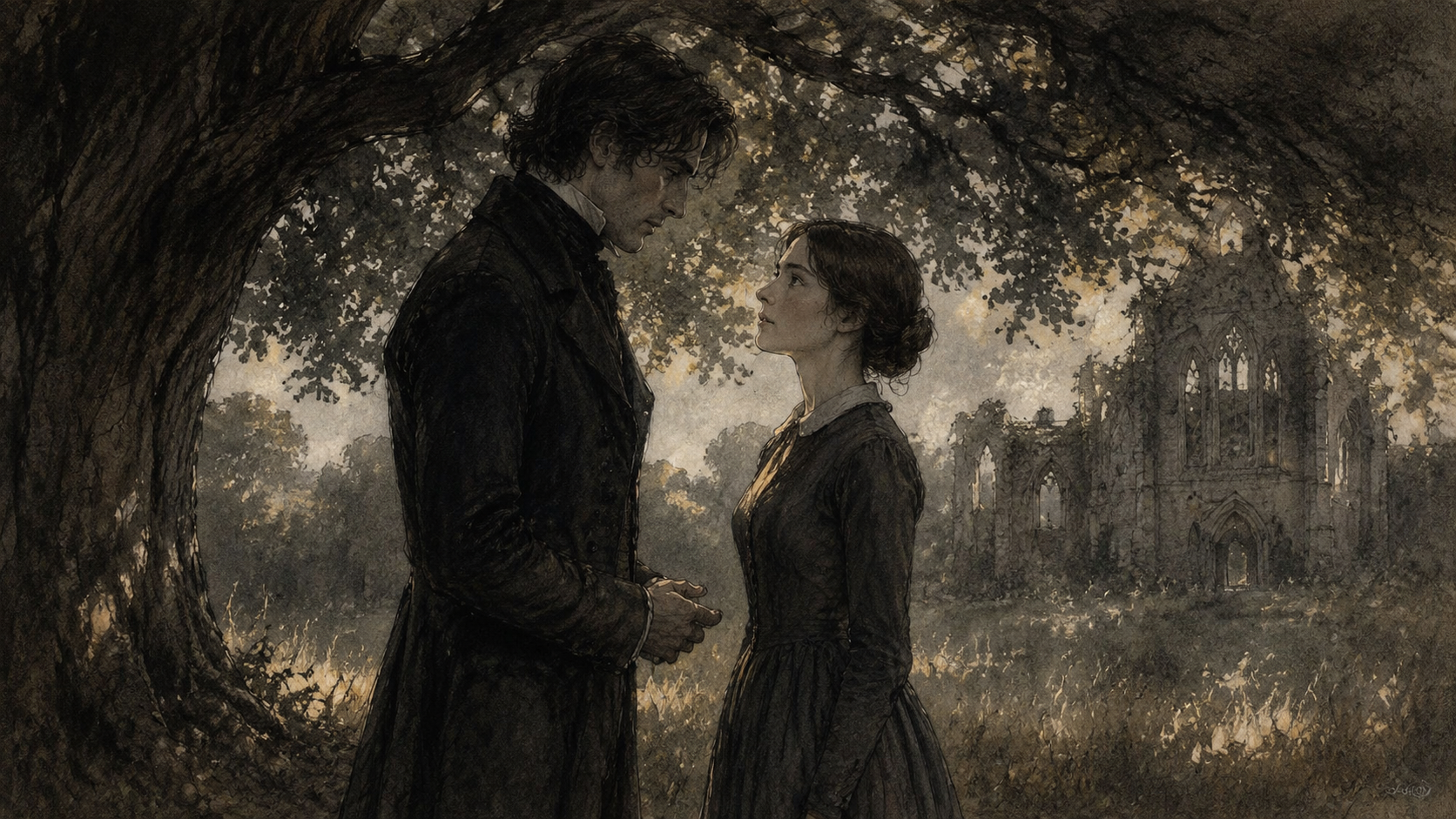
Her aunt is dying, and Jane goes back to see her through it. The old woman, stubborn to the last, never once says she's sorry, and Jane gives her everything owed anyway. On the road back to Thornfield she suddenly understands: this is home. Not the home she was born into, but one she has earned for herself, room by room. On a midsummer night, under the great chestnut tree in Thornfield's back garden, she has it out with Rochester. She doesn't say I love you. What she says is: I am not a plaything you've hired, not a pet you can pick up today and drop tomorrow. I stand before you as an equal in mind and in conscience. My heart knows its own name. Worth noticing: this is the moment the whole book should slow down for — Brontë writes Jane standing, not crying, not throwing herself at him, not pleading, speaking in the tone of a creditor collecting a debt. This is a woman claiming, for herself, the one shred of dignity Victorian women were never given to ask for.
Her courage was never the absence of fear — it was walking on afraid, walking on hungry, walking on while someone pointed a finger and said you're nothing more than this.
The night before the wedding, Jane is trying on her veil at the inn when a draft sweeps through and the candle gutters — a dark shape tears her veil in two straight down the middle. She sees the face, which takes a long moment to vanish. She tells no one. The next day, in the church, before the clergyman has finished the reading, a lawyer steps forward, with Mason — the man Jane has met once before — standing beside him, and announces that Rochester already has a wife, a living wife. Rochester doesn't deny it. He takes everyone up to the attic and unlocks a door secured with two locks. Inside, kept prisoner, is Bertha Mason — his lawful wife, daughter of a Jamaican planter, mad for years now, brought back to England from the West Indies and hidden away for decades. The laughter, the fire, Mason's wound, the torn veil — every mystery closes on this one lock.
After his confession, Rochester defends himself: how he was tricked into it as a young man, dragged into an arranged marriage, trapped for decades. He begs her to stay — offers to take her to France, to give her half his fortune, to give her a place beside him that isn't his name. Worth noticing: Brontë doesn't let Jane cry. She makes her do something harder — hear out the entire defense and still say no. She says: I am my own. I cannot hand myself over to a lie just because I love you. And she leaves. This refusal isn't coldness, it's clarity — she knows exactly what she'd be buying with that arrangement isn't security, it's a shadow. She has spent her whole life being treated as a shadow, and she will not become one again, even in the arms of the man she loves.
Jane boards another coach with nothing to her name. The driver looks at her like she's mad; she has no money and nowhere to go. By morning she's set down at the edge of an unclaimed moor. She walks, telling herself: to stop is to turn back, and to turn back is to fail. Rain drives sideways at her and she has no umbrella. She knocks on one door and begs a piece of bread, not daring to ask for more. She doesn't have proper shoes, the soles wear through, her feet bleed, and finally she curls into the heather, pulls her shawl over her head, and tells herself: I can die here, but I cannot surrender. Worth noticing: this chapter deserves to be singled out. Brontë doesn't rescue her right away — she lets her go hungry, cold, unable to walk any further on the moor, and makes the reader lie down with her in the heather for the night. That night is nothing to the reader, but to Jane it is the longest reckoning of her life — why, when she has never once gotten anything easy in this life, should this be the time it comes free?
She doesn't die. Someone passing by carries her to a house called Moor House. Three people — Diana, Mary, and their brother St. John — nurse her back to health as if trained for it. She lies in a stranger's home for weeks, slowly turning what feels like a debt into what it actually is: taking someone in. St. John gets her a post teaching farm girls in the village, and she takes it — the word useful, to someone who has never once been treated as useful in this world, is warmer than gold. In the week that follows, two strokes of fortune land back to back: the uncle in Madeira she's never met dies and leaves her his entire estate; and St. John tells her his father had a sister who married a Mr. Reed of Gateshead — her aunt — which makes him her cousin, and Diana and Mary her cousins too. She weeps, and the woman who has always prided herself on composure cannot stop crying, for the first time, by someone else's fire. Worth noticing: Brontë does something here that looks almost foolish on purpose — Jane doesn't simply accept the inheritance, she splits it apart, keeping for herself exactly the share that lets her stand independent, without having to depend on the person she loves. She refuses to let love double as a ledger.
St. John is going to India as a missionary. He needs a wife who won't fall ill in the tropics, won't complain about scarce food, and will let herself be used as a tool. He proposes to Jane not because he loves her, but because she can endure. She very nearly says yes — comes within an inch of it. She's exhausted, poor, wearing borrowed clothes, tired enough to mistake surrender for devotion. St. John's particular gift — standing perfectly still and letting silence do his talking for him — makes her feel herself being erased line by line: go to India, teach, bury herself so deep she'd never find her way back. Worth noticing: St. John is the most dangerous figure in this book — not because he's wicked, but because he's right. His God, his calling, his discipline are all genuine, and it's precisely because they're genuine that he's harder to resist than Rochester's lies ever were. In the end she resists him not because his God is wrong, but because she refuses to hand herself over to anyone as an instrument — that line she never lets slacken, from the first page to the last.
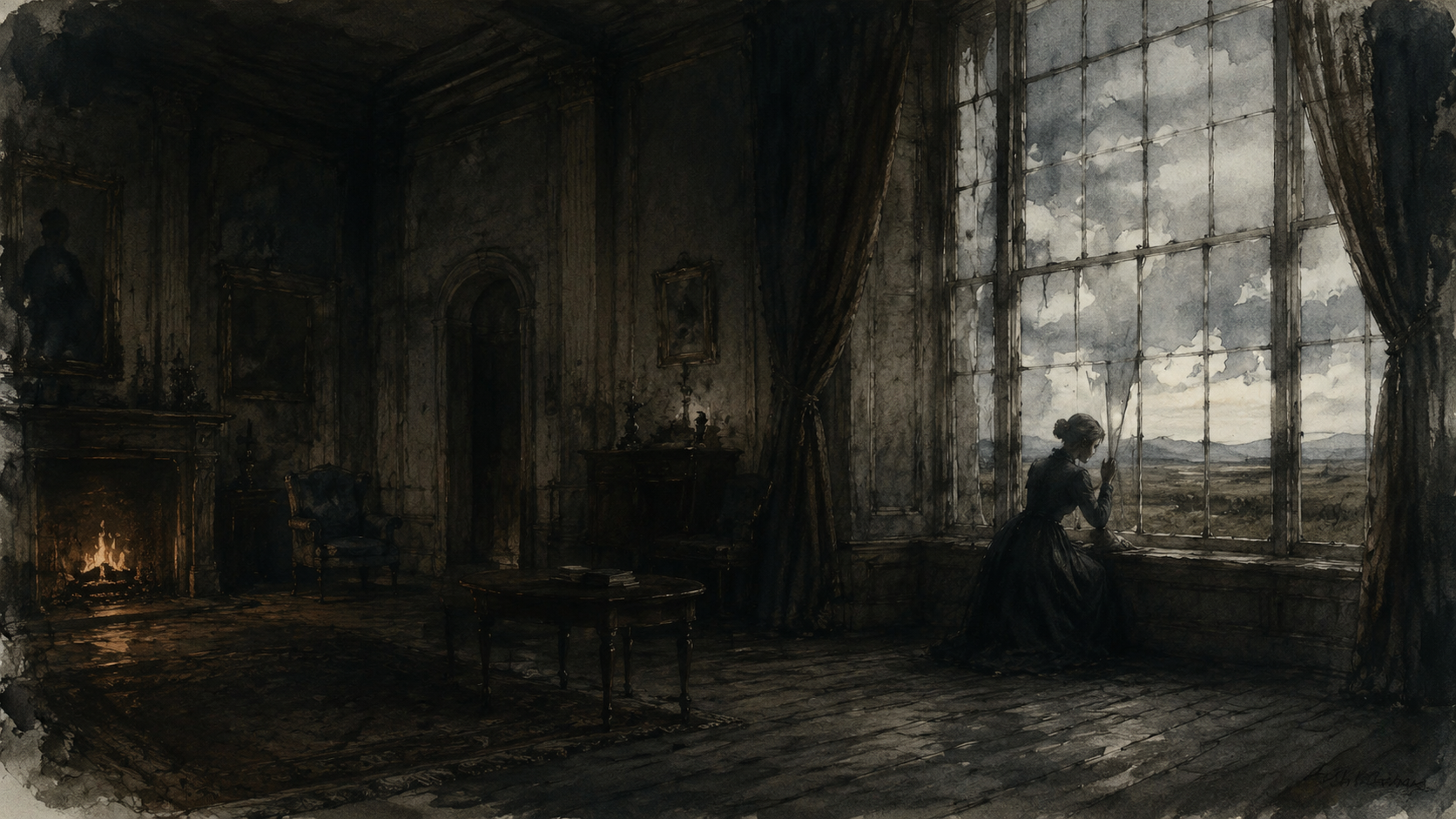
That night she sits alone at the window, forehead against the cold glass, the moor wind bringing nothing with it — and then she hears it. Not with her ears, but with her whole body. Rochester is calling her name. Three miles away, and how she knows this doesn't matter — she simply knows. She's out the door before daylight, without waiting for anyone's leave, without packing a bag — some things won't fit in a trunk. Worth noticing: this is the most irrational passage in the whole book, and Brontë knows it. She offers no explanation; she asks the reader to believe alongside Jane, because this is exactly this character's logic. She has done every correct thing she was ever supposed to do, and at this moment she follows the voice inside her instead. Brontë doesn't make this shameful. She makes it reasonable.
SCENE: In a narrow passage of Ferndean Manor washed by cold gray-green light from a far window, a blinded man sits on th…
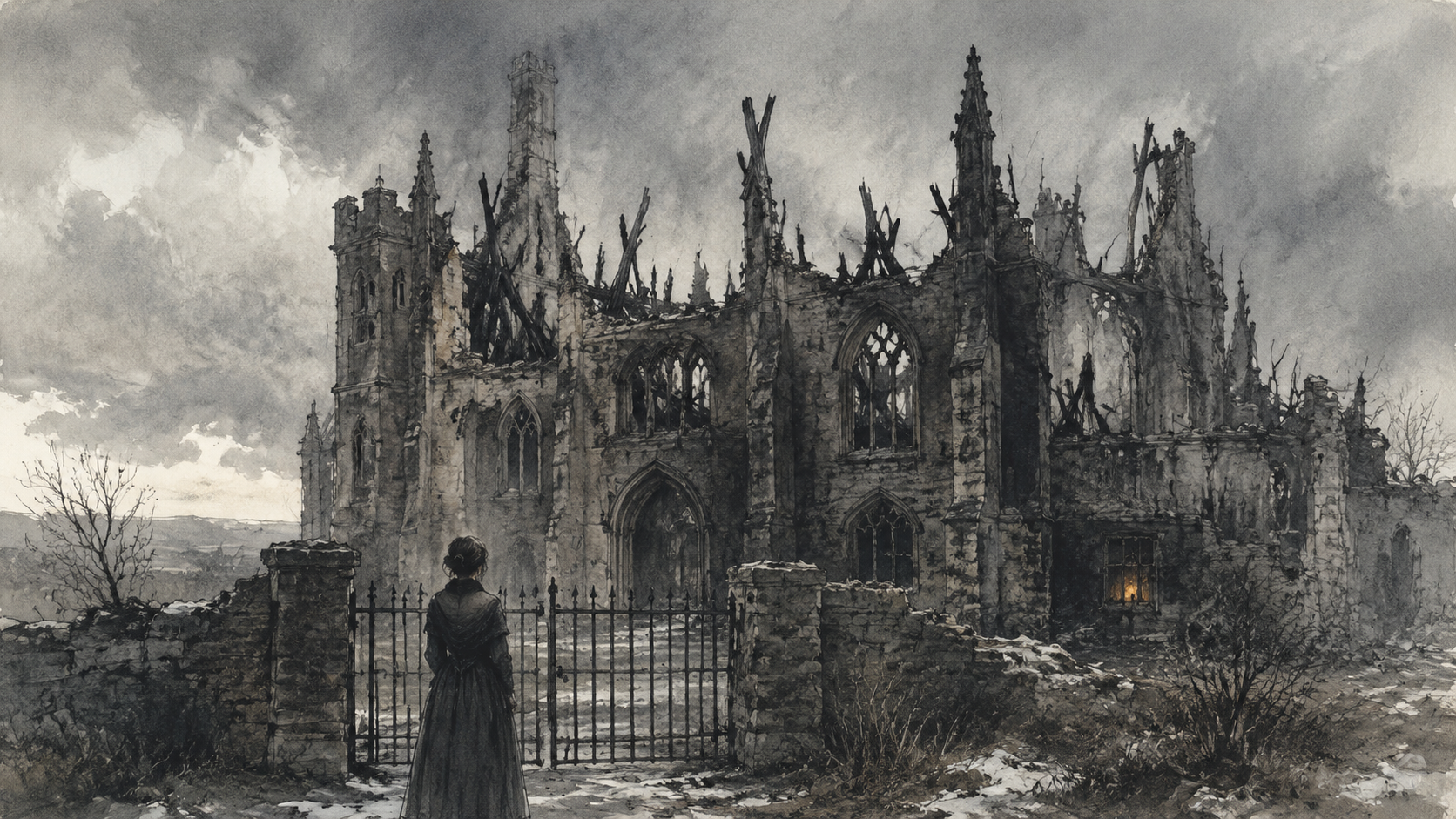
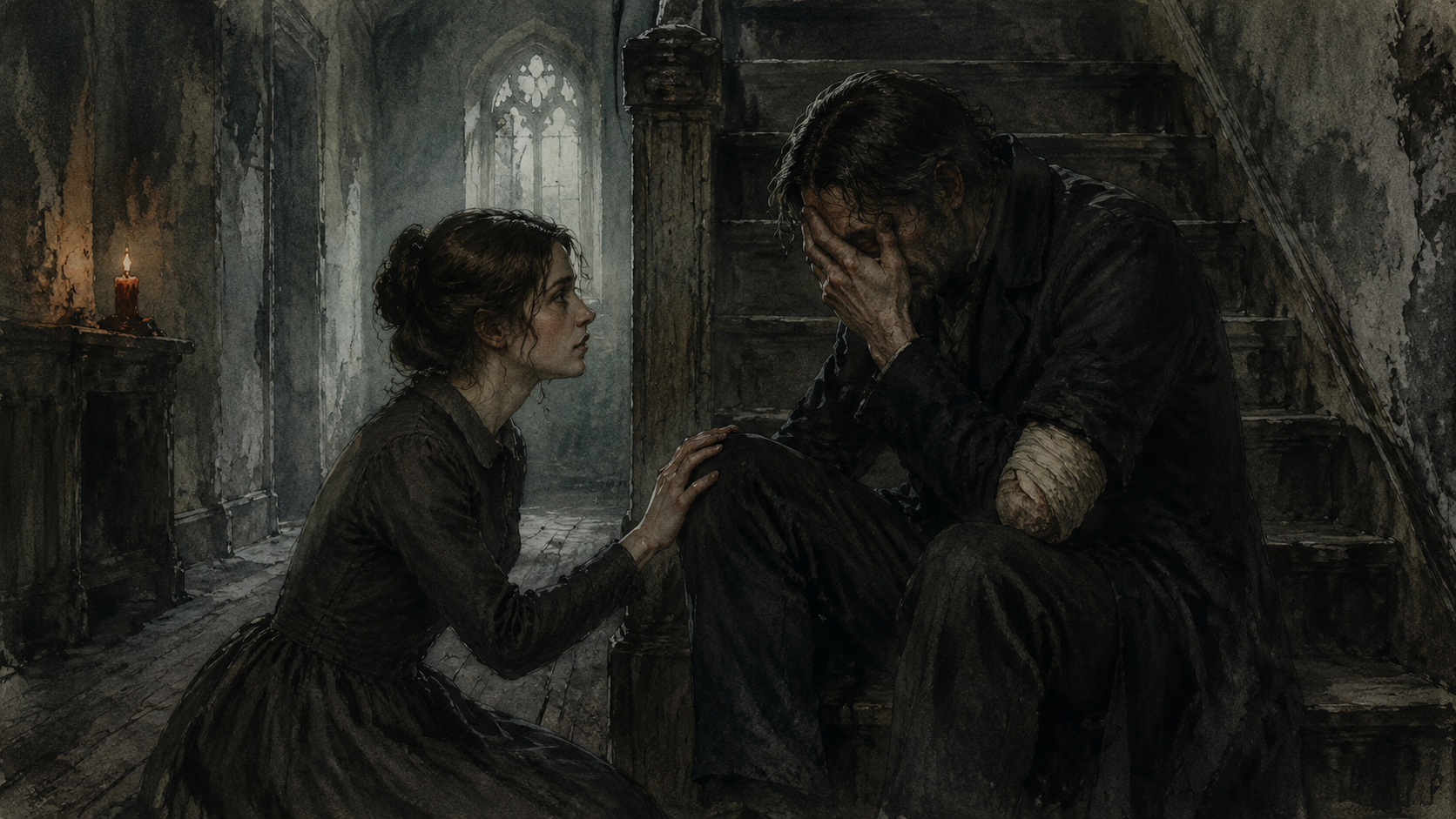
Thornfield has burned. The roof is gone, only the skeleton left jutting into a gray sky. The villagers tell her what happened — the woman locked in the attic was let loose, set the house on fire in the night, and when someone went up to save her, he came down missing a hand and blind in both eyes. Bertha is dead. Rochester is alive, but alive the way a tree struck by lightning is alive — still standing, still green, but never the same again. He has moved deeper into the woods, to a place called Ferndean, with only two old servants left beside him. Jane walks to his door; the house inside is damp and old, carrying a patient kind of grief. He comes down along the wall, one hand feeling for it, his ruined face turning toward her like a sunflower toward the sun — he cannot see her. She says: I am Jane Eyre. He says her name twice, three times, then his knees give way and he sits down on the stairs, burying his face in his one remaining hand, and the two of them weep together.
This time he proposes not as a master, but as a man with nothing left to offer, asking whether she still wants him. She does. The wedding is quiet, the church almost empty. Two years later, sight begins to return, faintly, to one of his eyes — enough to see his son, to see her, to see the thing he nearly lost twice and will never let go of again. Rochester and Jane are not written as a storybook couple. They are written as a tree struck by lightning, caught by another hand before it fell.
What gives Jane the standing to say her most famous line — poor, obscure, plain, and yet a soul equal before God? It's earned in the red room, where she was thrown down and still knew herself when she crawled out. Earned at Lowood, where her feet went white with cold and she never learned to beg forgiveness. Earned on the moor, where she starved to the point of near-death and never learned to turn back. Earned in Rochester's arms, at the exact moment she wanted his tenderness most, when she could still do the math on what it would cost her. Victorian England offered women two roads: marriage, or the convent. Jane takes neither. She cuts a third: build her own footing first, then stand beside the right person as an equal. She opens that road herself. Worth noticing: Brontë's greatest achievement is writing a woman who wants love and refuses to be bought, both at once. More than a hundred years later, women writers who can make both impulses equally strong on the page are still rare.
Once you know the whole of it, she doesn't marry because she got him — she marries having been fully free to say no, and having chosen, clear-eyed, to say yes. That kind of yes was something Victorian England had no way to give a woman. A hundred years on, it's still rare.
What a companion piece like this gives you is a map. The novel itself is the moor that bruises your feet and smells of rain. Reading this, you learn that Jane refuses Rochester, walks the moor, marries St. John or doesn't — you get the events. What you don't get is: the fear of that night in the red room, when she can't tell her own heartbeat from footsteps in the empty corridor; the unnameable this shouldn't be this way sitting with her at Helen's bedside as the candle burns low; the taste of the thunder that breaks over Thornfield the night she finishes speaking under the chestnut tree, and how she matches it in her mind to the words she's just said; the smell of earth and rain as she curls into the heather and decides not to surrender. None of that lives in the plot. It lives in Brontë's sentences. And there's something else only the full text can give you — Jane's narrating voice. The way she tells her own life is itself a kind of character: no complaining, no coyness, no playing for sympathy, laying out every injustice she's suffered as plainly as testimony in court. She's cool, self-mocking, sometimes sharp, but at certain corners something suddenly lights up — that's Brontë's own laughter, leaking through more than a century later.