Epic of Jangar / Jangar · Companion Guide
江格尔
一团红球里跳出来的孤儿可汗,率十二雄狮守住草原上不老不死的梦。
Opening Hook
The queen goes into labor, and what she delivers is not an infant but a ball of red light. The instant it touches the ground, it becomes a boy, strong, eloquent, already a fighter. That is the epic's opening frame. This child grips a blade and mounts a horse at three, is raised to the khanship at seven, and tonight, lying on the felt blanket, he does not yet know that the night his parents fell in their own blood is the scene he will spend every future campaign returning to fight. Among China's three great heroic epics, Jangar is the only one built around an undying, unaging utopia as its poetic core. The others are about fighting; this one is about why: fighting to hold on to a steppe that stays twenty-five forever.
What Kind of Book Is This
Jangar was not written by any one person. It was carried for generations by the jangarchi, the professional oral performers of the Oirat Mongols, taking shape gradually from around the fifteenth century and only committed to writing in the early nineteenth. Along with the Tibetan Gesar and the Kyrgyz Manas, it ranks as one of China's three great heroic epics and was among the first works named to the national list of intangible cultural heritage. Western Mongolia, Kalmykia in Russia, and Hoboksar in China's Xinjiang: the same epic is still sung across all three places, in versions running anywhere from twenty-five chapters to more than sixty, roughly a hundred thousand lines, and still growing.
As a living epic, it is a rare specimen in the world. Homer's poems froze on the page long ago; Gesar is sung mainly within Tibetan regions; but Jangar's oral tradition has never broken. Master jangarchi in Xinjiang are still singing it, still teaching it, today. To read it is to do more than follow a story. It is to put a hand on a craft that is still beating.
Characters and World
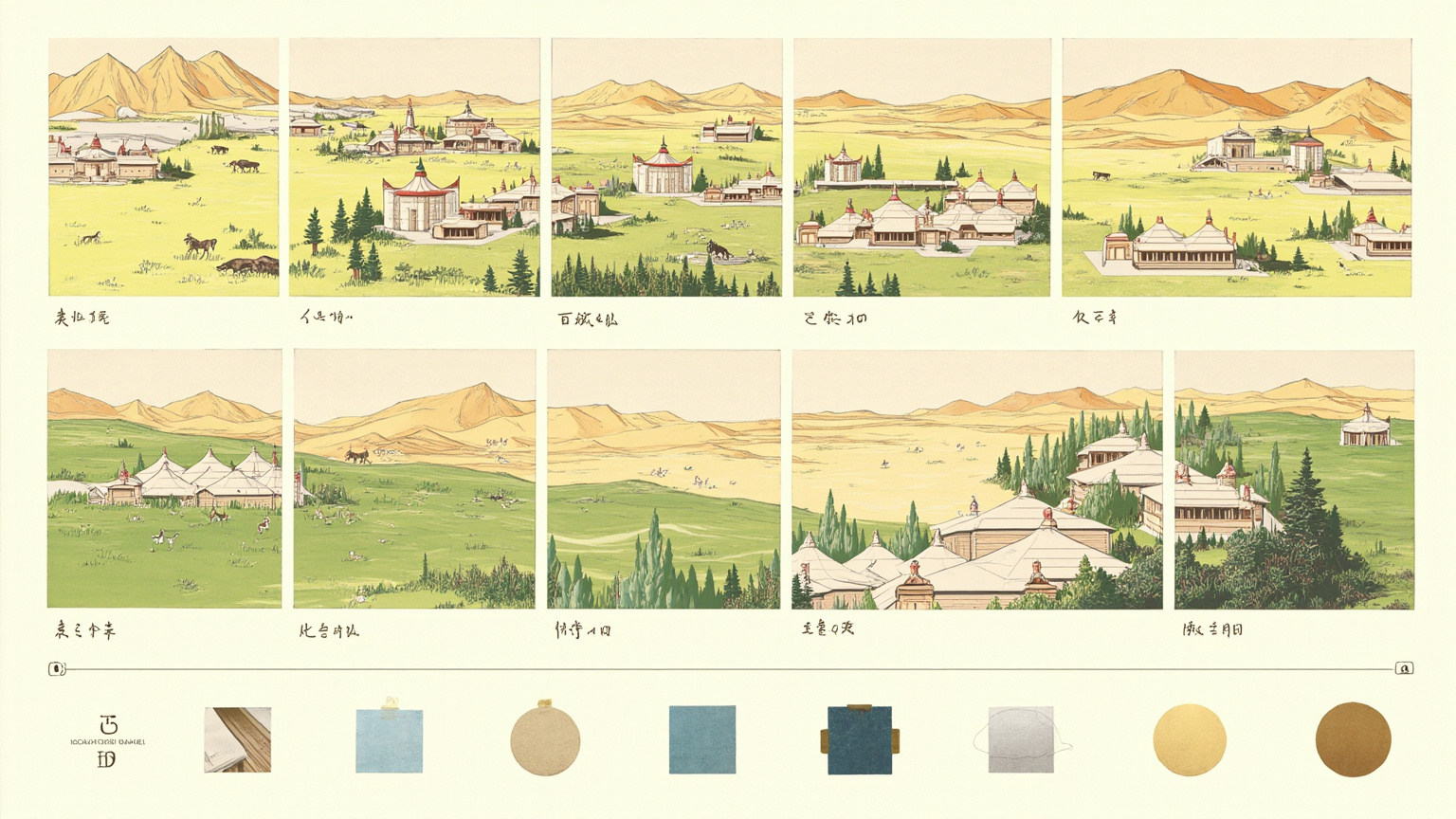
The story unfolds on the Oirat Mongol steppe around the Altai and Tianshan ranges in the far west. At its center stands Bumba, the ideal kingdom passed down from Jangar's father: no winter, no death, everyone frozen at twenty-five, spring all year round, sheep and cattle scattered across every slope. It sounds like myth, but its real identity is the sum of everything a nomadic people ever wished for in a homeland. Whatever you wanted, Bumba had it; whatever you feared, Bumba had none of.
The hero, Jangar, is the third khan of this paradise. At two, the demon king attacked Bumba and left him an orphan; at three, he took up a blade and rode to war; at seven, having won his first victories, he was raised to the khanship. Around him stands a cast of fiercely individual heroes: Hongor, foremost warrior at his left hand, so wholehearted that people say all ninety-nine Mongol virtues can be found in him alone; Altan Tsedzhi, the strategist, who reads the signs and lays the battle plans before every campaign; and Savar Heavy Arm, one of the Twelve Lions, famed for the arm that gives him his name. Bumba's enemy answers to a single name: Mangus, the demon king, incarnation of malice, darkness, and ugliness, forever raiding from somewhere beyond the horizon, ravaging the steppe, and the one who killed Jangar's parents. He is the epic's enduring enemy.
Bumba is not a place. It is the pasture every nomad dreams of reaching, and Jangar's task is to keep that dream standing.
How the Plot Moves
The story opens with Jangar's great-grandfather's generation. They led their people west and spent ten years building Bumba on the steppe, an undying paradise. By the third generation, the queen goes into labor: what she delivers is not an infant but a ball of red light, which becomes, the moment it touches ground, a boy already strong, eloquent, and able to fight. In the joy of the birth, the father lets his guard down, and the demon king Mangus attacks by night; both parents die. At two years old, Jangar becomes the origin point of every grievance the epic carries, and the center every later chapter keeps echoing back to.
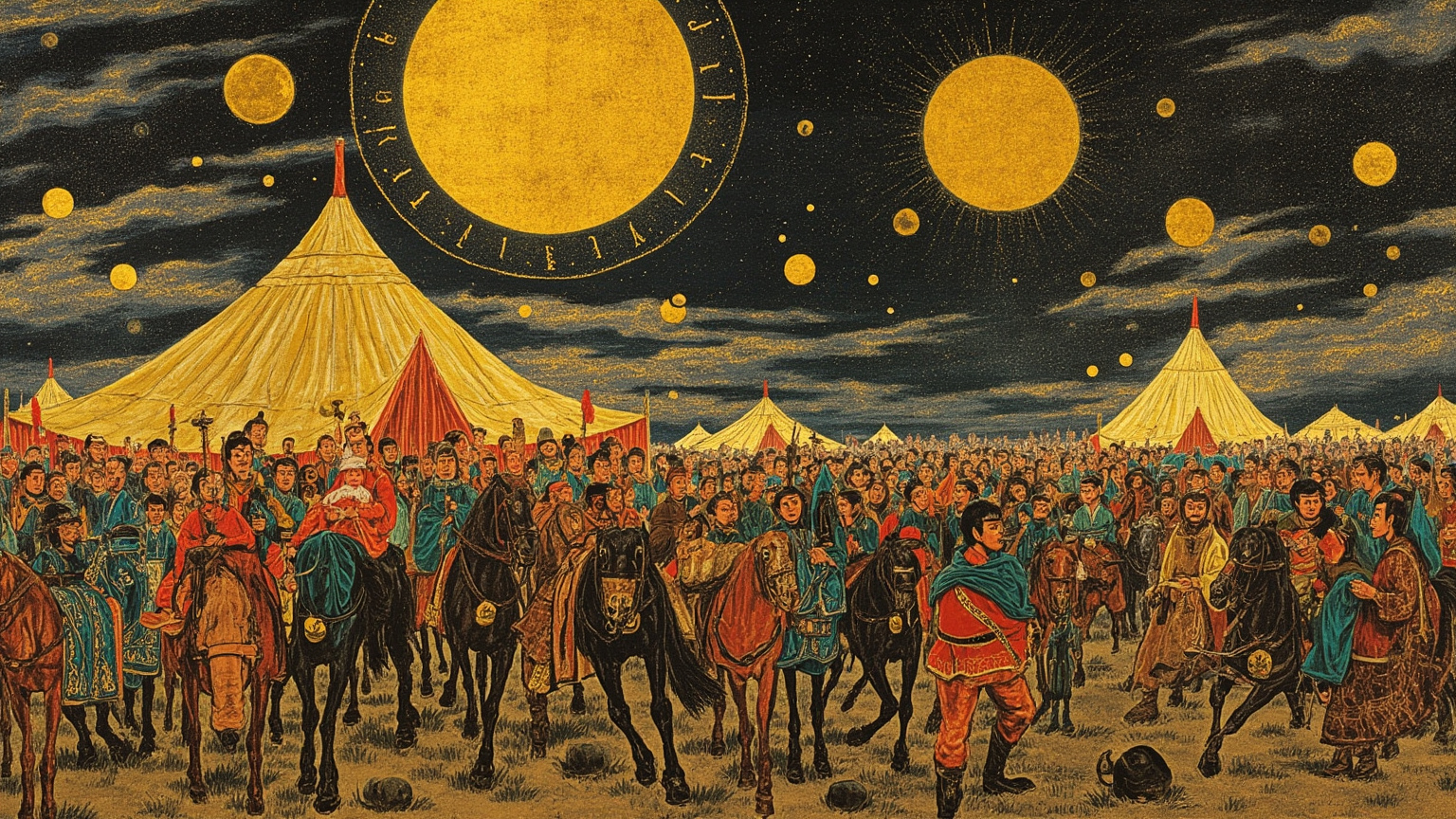
From a crimson ball cast upon the felt, the infant leapt forth—already strong of limb, already armed with speech, already sworn to battle.
王后产下的不是婴儿,是一团红球;那红球一落地,便化作一个力大、能言、能战的男童。
金句 · 序诗篇 · 红球降生
At three, he takes up a weapon and mounts a fine horse; at seven, he has already won enough glory to be raised up as Khan Jangar. What generation after generation of jangarchi keep singing is exactly this: a child born from a ball of red light, who loses everything in a pool of blood, and is then carried by the steppe itself onto the throne. That is the epic's recurring theme. It is not an ordinary coming-of-age story. It is a child pushed onto a throne before his time, spending the whole of his youth working through the night he lost at two.
But if you think the whole epic is just Jangar fighting from start to finish, you would be wrong. Its real structure is what scholars call linked-chapter form: dozens of independent chapters, each answering the others, strung together like a loose necklace. Jangar himself is more often a name, a banner, the backdrop the story happens against; the ones who actually live out their fates chapter by chapter are usually his generals, Hongor, Altan Tsedzhi, Savar Heavy Arm. A skilled jangarchi opens with a prologue describing Bumba in its glory, then moves into whichever chapter the audience calls for. There is no line you must read from start to finish, and no chapter number you must reach before the rest makes sense.
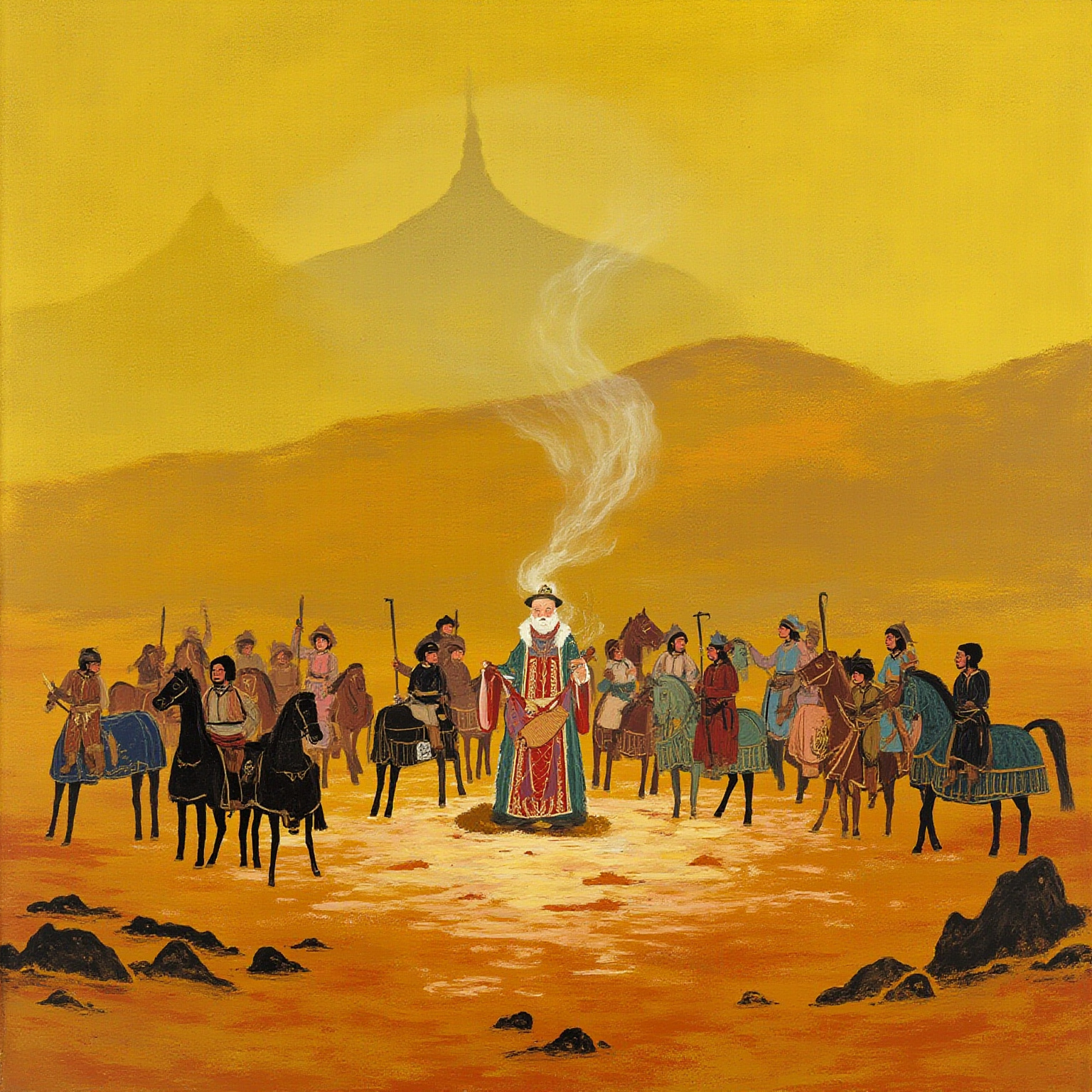
Where Jangar reigns, there is no winter, no decay; his people are forever as they were at twenty-five.
宝木巴没有冬天,没有死亡,人人永远停在二十五岁的模样。
金句 · 序诗篇 · 宝木巴乐园
War, marriage, sworn brotherhood: these are the three axes running through the linked chapters. The war chapters follow Jangar leading the Twelve Lions, the Thirty-Five Tigers, and six thousand or eight thousand warriors against Mangus. The marriage chapters put heroes through tests of wrestling, archery, and horsemanship to win a bride, the same three skills still contested today at the Mongolian Naadam festival. The brotherhood chapters show heroes swearing blood oaths to one another. Together, the three kinds of chapters weave a gallery of Bumba's defenders. A utopia is not held up by one man, but by an entire generation of them.
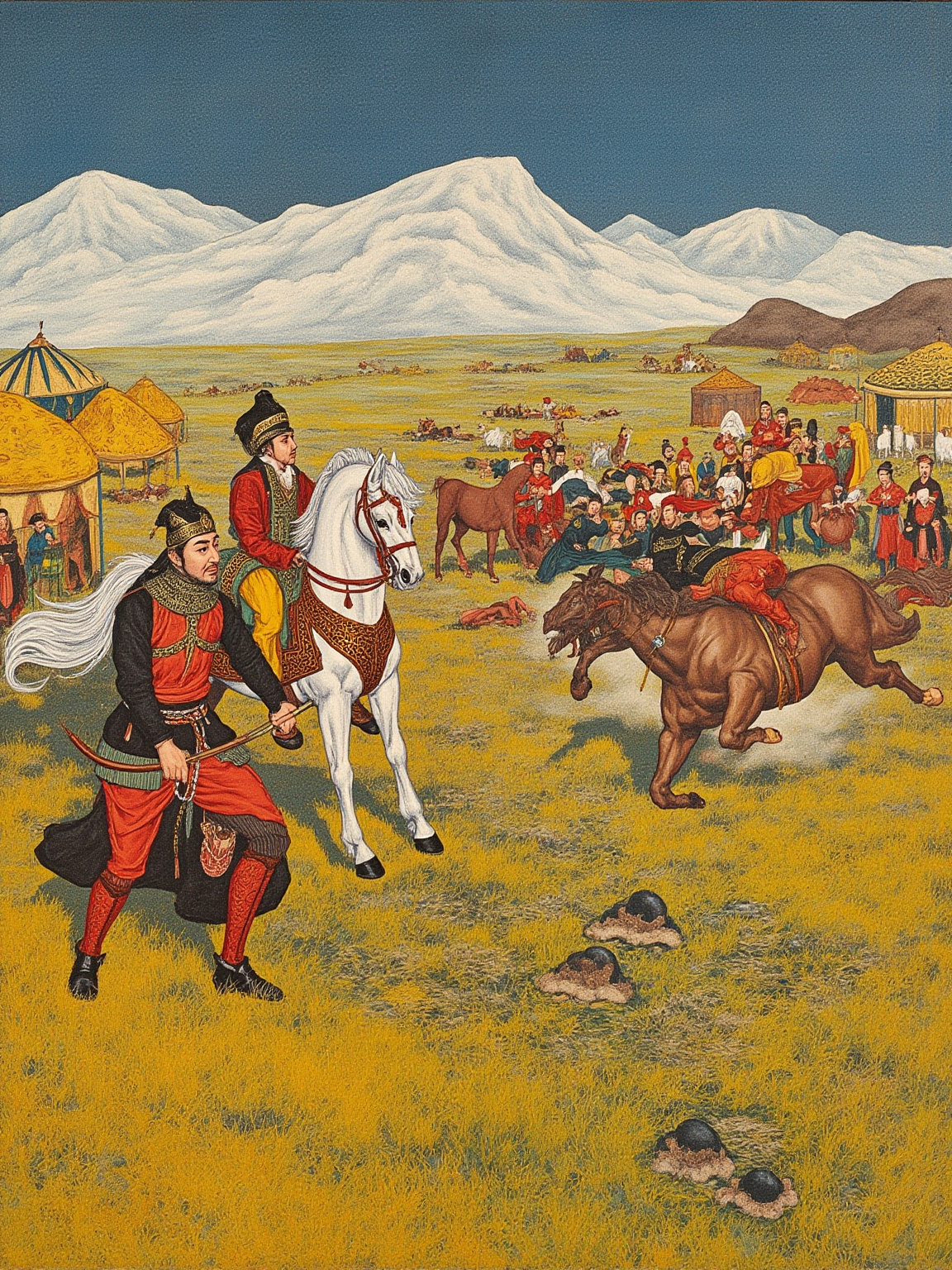
First among his warriors, Hongor—at whose name the heart of every foe turns to water.
左手头名勇士洪古尔,一片赤诚;只消报上他的名,敌手的心便先软了三分。
金句 · 征战篇 · 洪古尔赞
Women are scarce in this gallery, but the prologue sets aside a radiant passage of praise for Aga Shabtala, Jangar's wife and Bumba's queen mother. Her beauty is written as rivaling the sun and moon, celebrated in the same breath as Bumba's splendor. Half of the utopia is her.
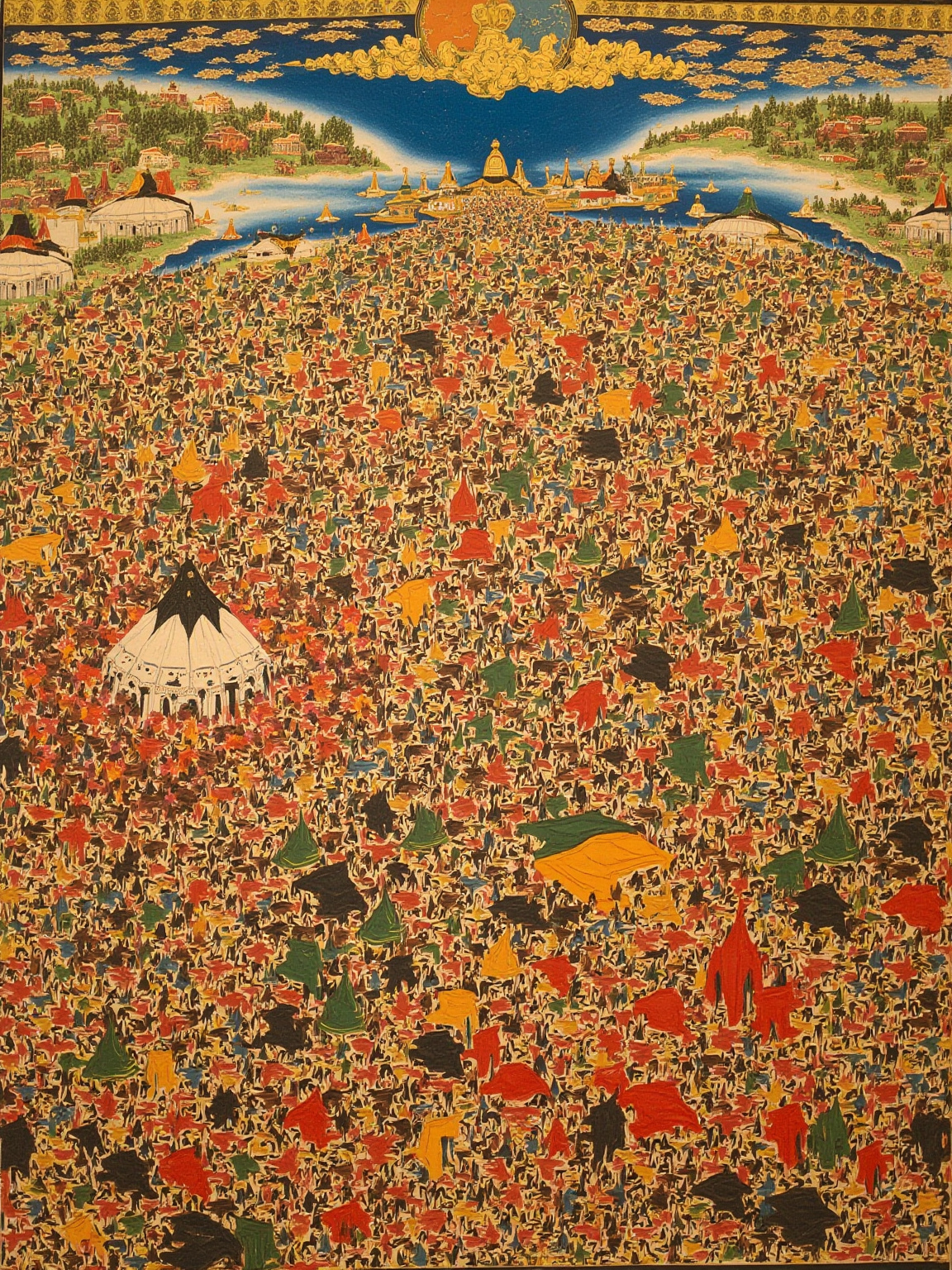
And at the center of the feast, radiant as twin suns, sat Agai-Shabtala, queen of Bumbra.
光芒可比日月的,是宝木巴的国母后阿盖·沙布塔拉。
金句 · 序诗篇 · 光艳夫人颂
To understand how a jangarchi can carry a hundred thousand lines by memory, you have to look at the formulas they perform with. A prologue first praises Jangar's origins, the paradise of Bumba, its splendid tents, its radiant queen, and its wise, brave warriors, before the main story begins; woven through the telling are horse-praise passages, long strung-together descriptions of a mount's coat, gait, and saddle, and interludes of blessing verse and proverb. Alliteration, end rhyme, and internal rhyme run through the whole performance. This highly formulaic system is the technical foundation that lets them improvise and recompose on the spot, which is exactly why the epic can keep growing.
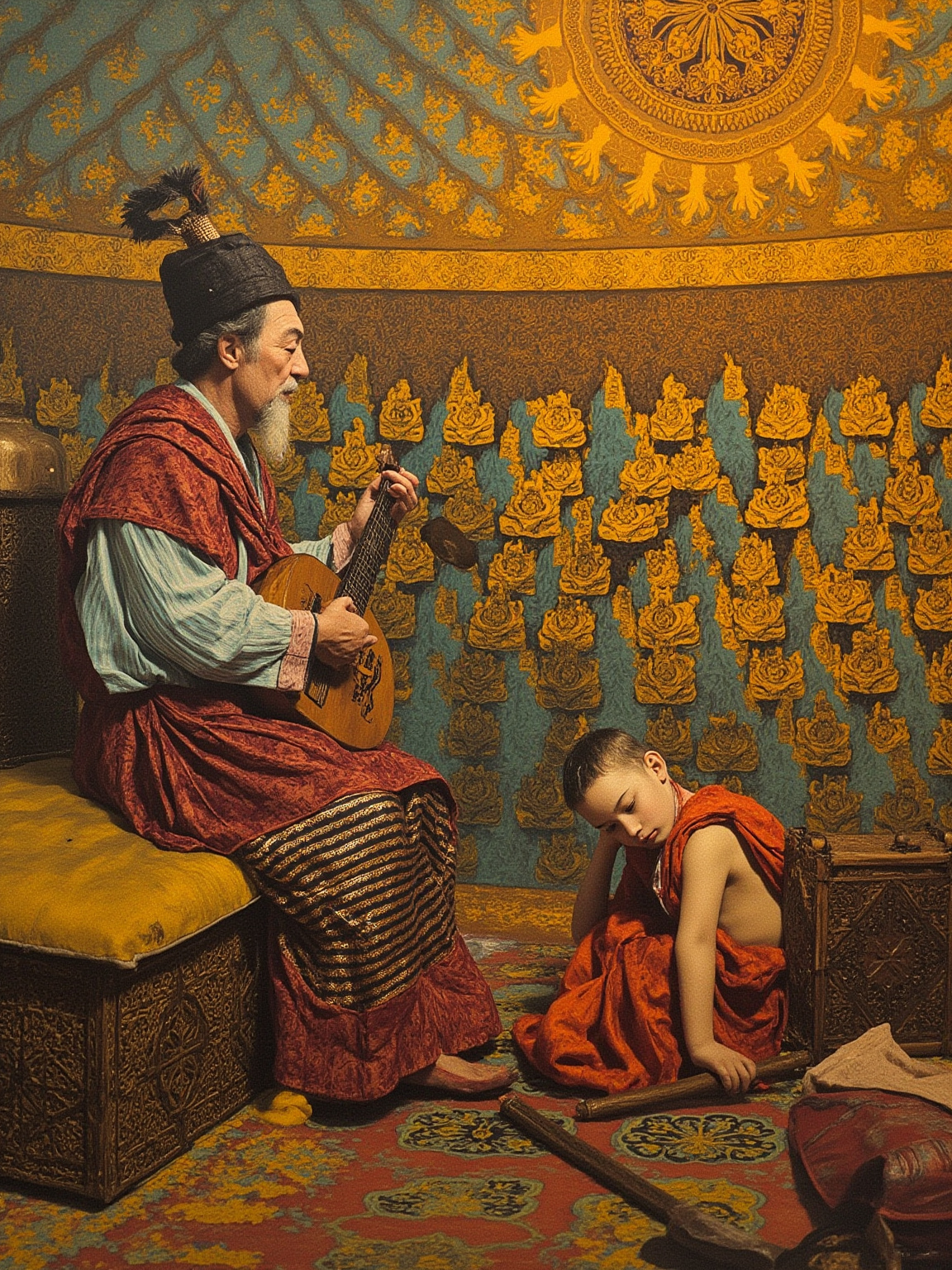
Sing of his dappled hide, of his hooves that strike like drums, of the saddle that sits upon him as if he had been born to bear a hero.
先赞他的毛色如豹,再赞他的步伐似鼓,最后赞那副鞍具,仿佛为他与他的英雄一同生就。
金句 · 赞马段 · 程式化套语
Theme and Craft
The real subject of Jangar is not fighting demons. The demons never run out; every time Jangar returns from one campaign, a new shadow rises somewhere else. The real subject is holding on: holding a steppe where nothing dies, a people who stay twenty-five, a paradise with cattle and sheep scattered across every slope. This is what sets it apart from Gesar and Manas. Jangar runs on the drive to protect a utopia, while the other two epics carry their own separate concerns.
Its craft is distinctive too. Homer is a continuous long poem, one thread pulled taut from beginning to end; Jangar is built from linked chapters that can be split, combined, or reordered in performance, each with its own protagonist. This structure is rare among the world's epics, because it was never written, only sung. It passed chapter by chapter through jangarchi mouths for centuries, and every generation added something of its own: today's version runs past sixty chapters; tomorrow's might run past seventy. Calling it a collective work does not mean people once sat down together to write it. It means centuries of throats, one relay after another, carrying it forward.
For a reader today, the thing most worth carrying away from this epic is not any single story. It is a capacity that has nearly disappeared: the capacity to listen. This was never made to be looked at. It was made to be caught by the ear. The moment the prologue opens, a steppe unfolds in your mind; the moment the horse-praise passage starts, you already know the animal's coat and its gait; the moment the blessing verse lands, you already know why these people deserve your trust. Reading the page gives you the skeleton. Hearing a jangarchi sing is the only way to feel its warmth.
Why Read the Original
A guide like this one can hand you a map: where Bumba sits, the names of the Twelve Lions, how one campaign leads to the next. What it cannot hand you is the one second of vertigo when the prologue first opens its mouth. It cannot hand you the rhythm of a horse-praise passage, alliteration falling like hoofbeats. It cannot hand you the moment an old jangarchi closes his eyes on the Hoboksar steppe in Xinjiang and begins the first chapter, and the cattle outside the tent go quiet. Knowing the plot does not make the original expendable, because what you would be opening is a throat that is still beating, not a storybook.
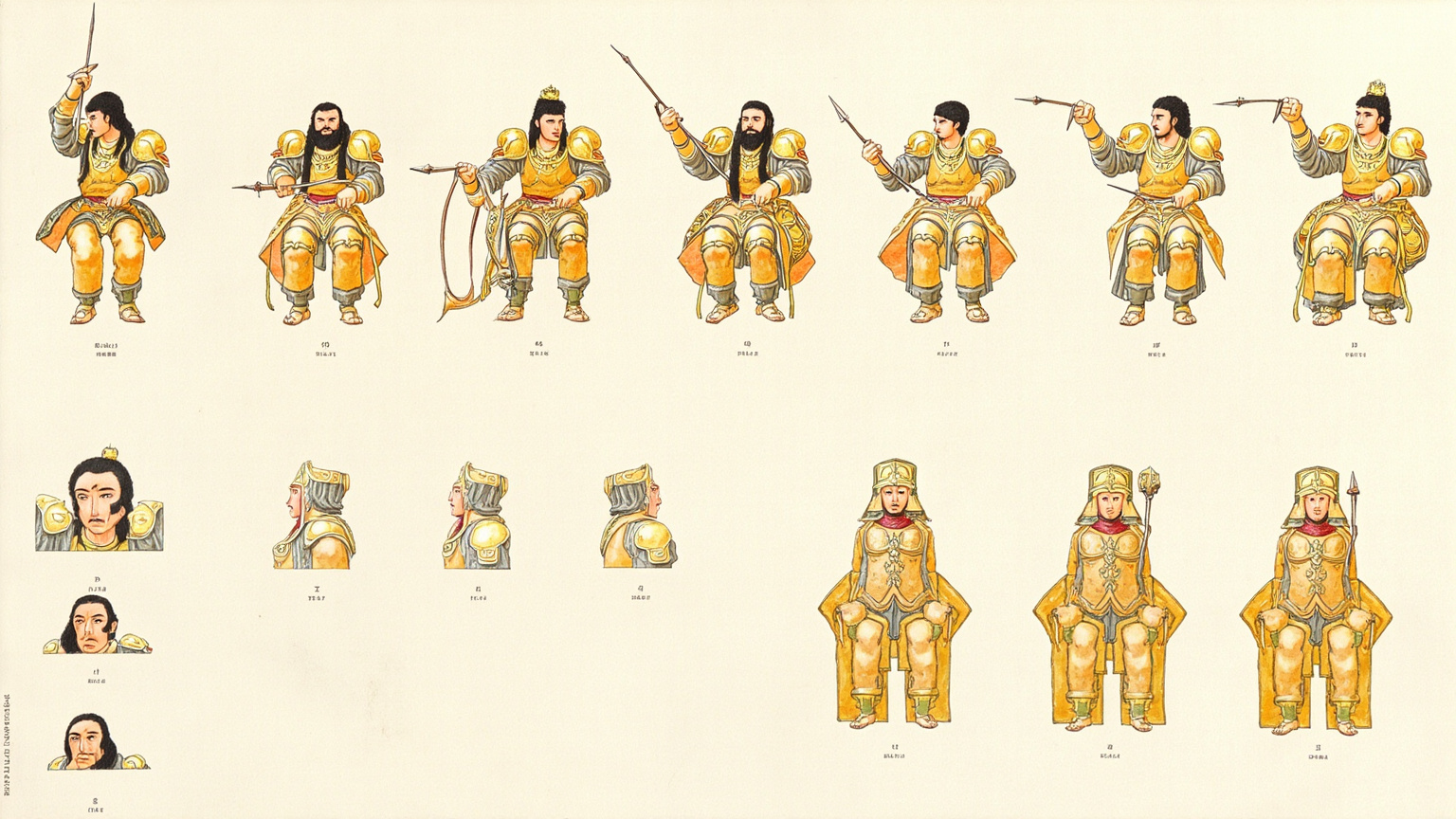
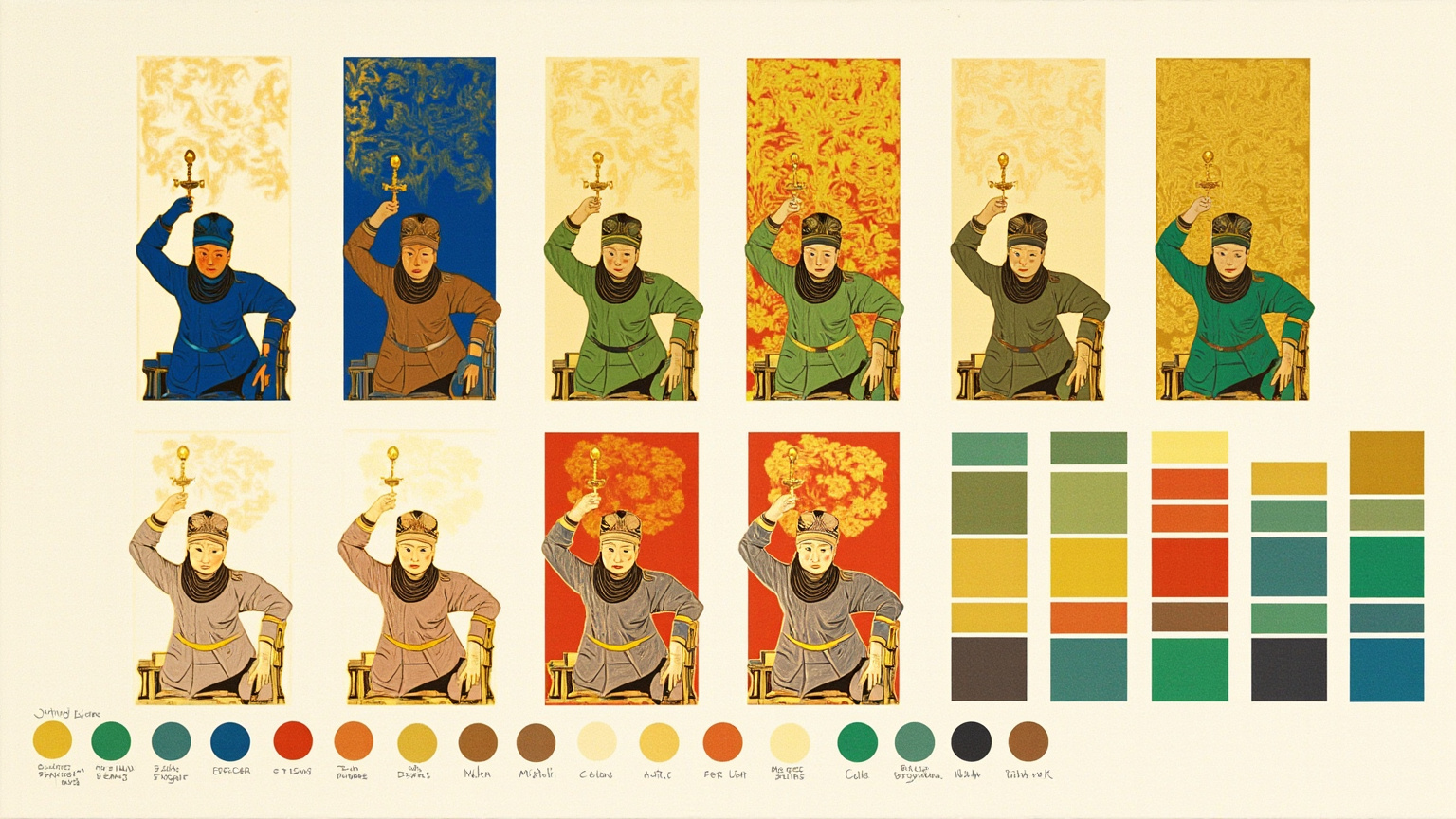
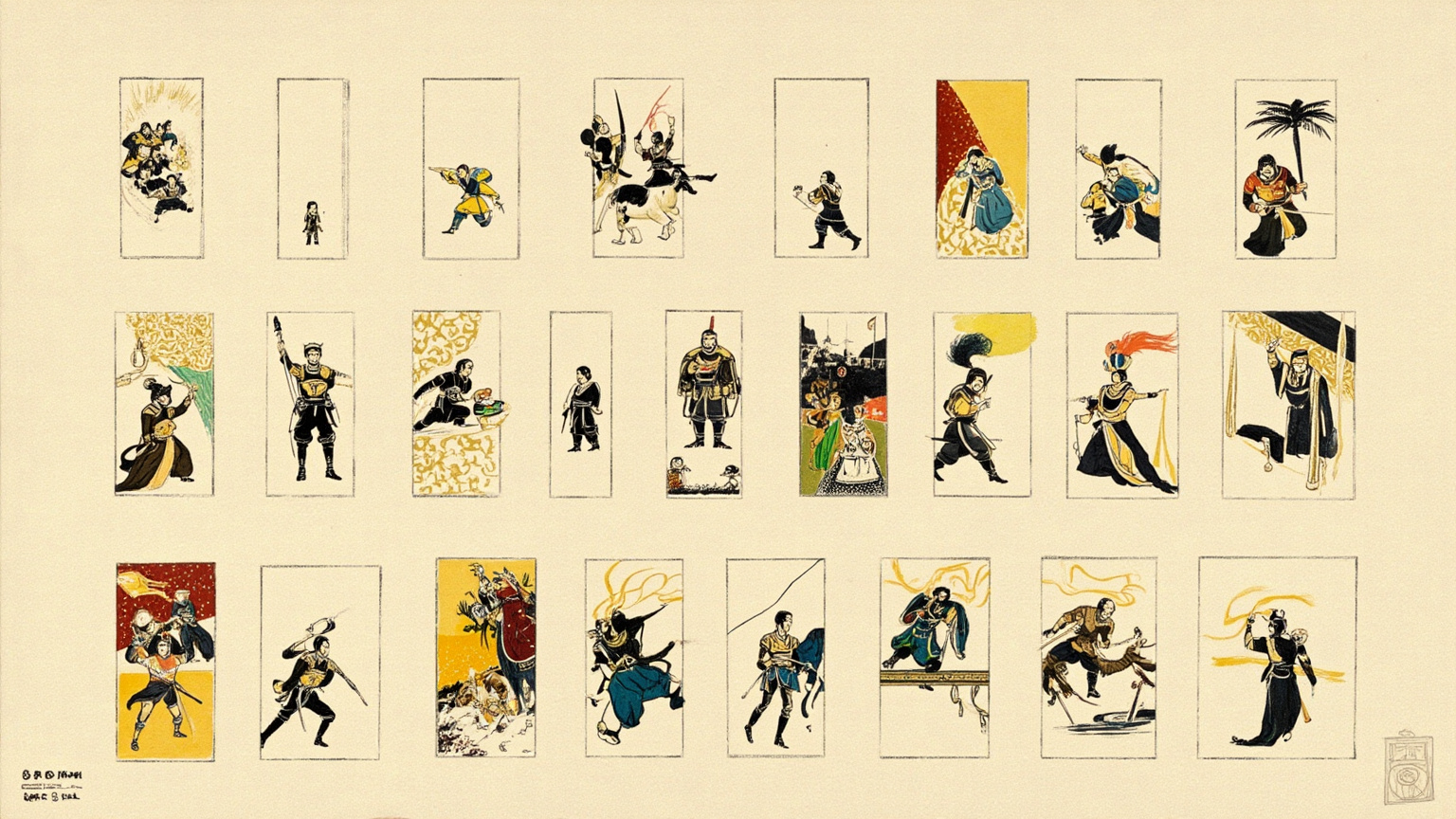
Art Direction4 plates
Before the guide was written, this book got a visual foundation — every illustration you just read grew out of it.