Le Morte d'Arthur · Companion Guide
Le Morte d'Arthur
The boy who drew the sword from the stone builds the Round Table's golden age, then watches it burn to ash in his own hall, inch by inch, undone by love, vengeance, and betrayal — the sword returns to the lake, the king sails to the isle.
Opening: a hand reaching out of the water
Before dawn, over the surface of a lake, an arm wearing a silver bracelet rises out of the water bearing a sword, hilt up, toward a sky not yet light. The king's knight takes it, turns, and walks toward a companion in a broad-brimmed helm. A little further on lies a plain — the blade already wet with his own son's blood. You could take this for a painting, or the opening shot of a film, but it is older than either: written slowly, by one account, by a knight in prison, then set in movable type by a printer and sent out onto the desks of Europe. From that grip onward, this is what Arthur has looked like for five hundred years.
What kind of book this is
It is called Le Morte d'Arthur, written by Sir Thomas Malory — a medieval English knight who spent much of his life at war and tangled in lawsuits, said to have finished off years of accumulated drafts inside Newgate Prison in London. The book was completed in the late fifteenth century, around 1469-70, and printed by William Caxton in 1485: twenty-one books, more than five hundred chapters, the first work in English to fuse the scattered Arthurian legends into a single continuous prose narrative. From Tennyson's Idylls of the King and T.H. White's The Once and Future King to the musical Camelot, films, and the Fate franchise, nearly every Arthur you've met since traces back to this one. It is remembered for one reason: it hammered Arthur out of scattered ballads and French romance into a myth the whole English-speaking world could share.
It is not the story of how a hero wins. It is the story of how an ideal collapses at the hands of its own people.
People and world: a Round Table doomed to break up
The story is set in Britain's age of legend, in a kingdom called Logres, with its court at Camelot. Around the Round Table sit these people: Arthur, son of Uther Pendragon, fostered out in the countryside as a boy by a wizard named Merlin, who as a young man goes to a churchyard in London and is recognized as king by pulling a sword from a stone; Guinevere, daughter of neighboring King Leodegrance, who brings to the marriage a precious Round Table and a company of household knights, becomes queen, and becomes the powder keg of everything that follows; Lancelot, first knight of the Round Table, unmatched in arms and fame, who lives by a lake and so is also called Lancelot of the Lake, Arthur's most trusted companion in arms and the man the queen keeps hidden in her heart; Galahad, Lancelot's son, spotless in spirit, prophesied to be the only one who can safely take the Round Table's Siege Perilous; Gawain, Arthur's nephew and a pillar of the Round Table, upright, jealous of his honor, fierce in defense of his own kin; Merlin, the unseen hand behind Arthur, the one who makes him and who will be trapped underground by the very magic he taught; and Mordred, Arthur's illegitimate son by his own half-sister, fated to run his father through in the last battle. The whole cast forms a set of concentric circles: the ideal at the center, and the cracks starting from the ring nearest it — a son who kills his father, a wife who loves the champion, the champion who shields the wife, a nephew bent on revenge — each crack running along an old seam of blood and oath.
Rise: the sword in the stone, the sword from the lake, the first golden age
When Uther dies the realm has no king, and Merlin sets up a stone in a churchyard with a sword driven into it, inscribed: whoever draws this sword is king of England. A young man tries it, almost in passing, pulls the sword free, and the whole crowd falls silent. This is how Arthur is recognized — his claim to the throne rests not on lineage but on a stone that stamps its approval. This is the first thing worth noticing in how Malory writes: he refuses to make Arthur a prince born to greatness, and makes him instead a boy suddenly struck by destiny, who hasn't even caught up with what just happened to him. That sword from the stone later breaks in a duel with King Pellinore. The break isn't there for drama — it exists so Malory can bring in the second sword, the one later ages remember best. Merlin leads Arthur to a still lake, where an arm wearing a bracelet rises from the water holding Excalibur, its scabbard offered along with it. Merlin adds one thing: the sword can wound you, but the scabbard protects your life, and is worth more than the blade. This is the second thing worth noticing: the sacred weapon isn't a gift, it's a duty, and the most precious part of it is the part you can't see — Arthur later loses the scabbard, and it is exactly that invisible loss that puts him, in the end, under his own son's spear. With the fighting settled, Arthur marries Guinevere, whose dowry is her father's Round Table, big enough to seat more than a hundred knights. What makes the Round Table's story so compelling is that it is not just a table — it means no seat outranks another, honor asks nothing about birth, and every knight keeps the same oath. The world enters a brief golden age. This is the brightest, most fairy-tale-like stretch in the whole book, and Malory uses that brightness deliberately, to lay down the color everything that follows will be mourned against.

Whoso pulleth out this sword of this stone and anvil, is rightwise king born of all England.
谁能从这石与铁砧中拔出此剑,谁便是天生受命的全英格兰之王。
Original line · The Sword in the Stone · the king England was born to rule
Rising action: the Grail appears, and the knights ride out
One day in the hall of the Round Table, the Grail appears, carried by some unseen hand and covered in white cloth, then vanishes just as suddenly — no one sees who bore it, no one sees what it held. Every knight in the hall swears on the spot not to return until he has found it. This is Malory at his best for dramatic pacing: he lights the whole room's longing in a single stroke, then tests it across a long journey that scatters into countless smaller stories. Malory isn't just writing quest completed, Grail found — he builds the whole book around a vertical contrast: the greatest fighting man alive, Lancelot, cannot reach the Grail; the purest soul alive, Galahad, can. So Lancelot walks the whole road to the Grail castle only to be stopped by some force at the threshold; all he can do is glimpse the Grail from a distance and ride away in tears. No amount of searching the ends of the earth helps — worldly glory has a ceiling. This is the single most important thing to notice in how the book is built: the Grail does not score on prowess, it deducts for sin.
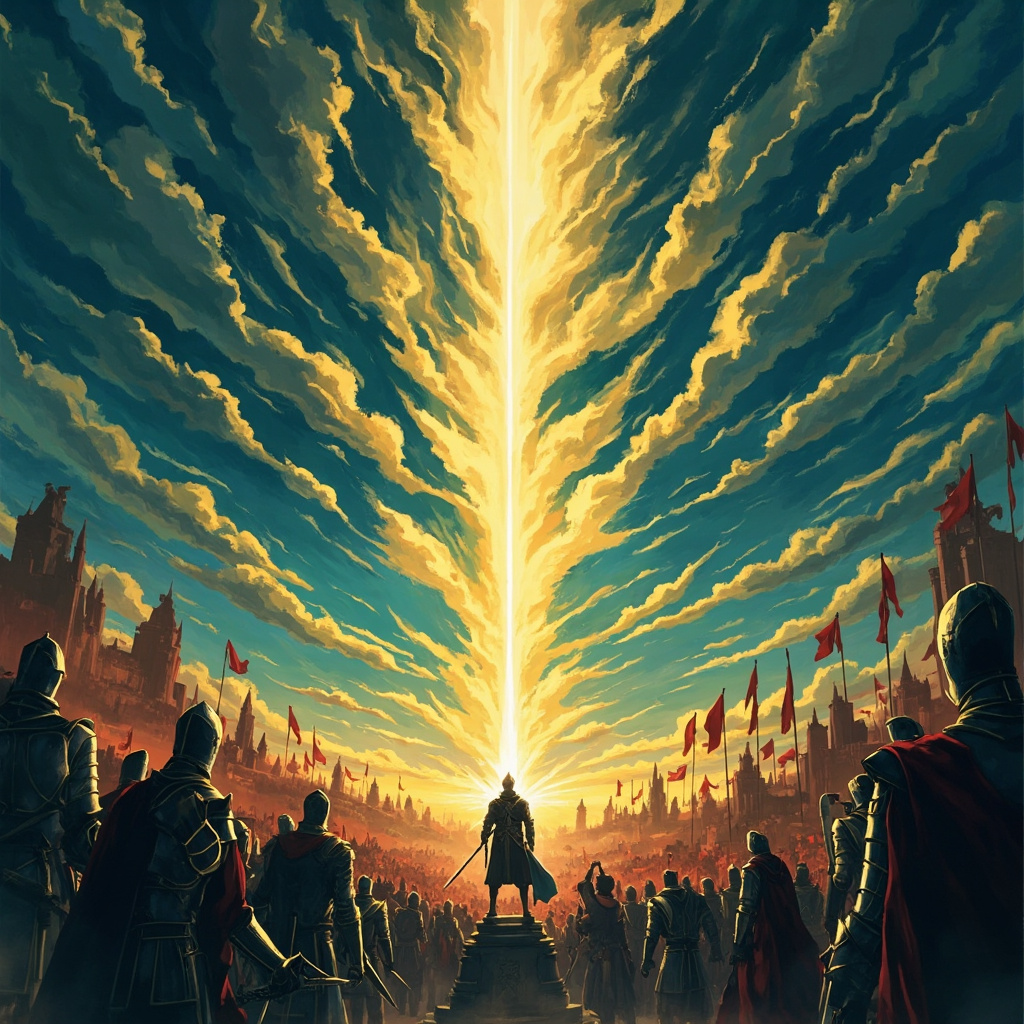
Unto this were all the knights sworn of the Table Round, both old and young.
圆桌骑士,无论老少,都对此立下了誓。
Original line · The Round Table Oath · the knights' Pentecost vow
An entire generation of knights rides out, and almost none come back. A few die as martyrs; most simply never rejoin the fellowship, dying in some nameless inn, some strange castle, some empty stretch of wasteland. The Round Table is drained, year by year, by the quest for the Grail. It looks like adventure on the surface; underneath, it is a collective attrition. Long before sunlit Camelot ever falls, it has already been emptied out.
Turn: the affair comes out, the stake, the rescue, the first crack
Lancelot and Guinevere's affair had been the golden age's biggest secret. It finally comes out, and the queen is condemned to burn at the stake for adultery — the most wrenching, most brutal passage in the whole book. With the fire about to be lit, Lancelot cuts his way into the execution ground and carries the queen off to France by force. In the chaos, his men accidentally kill two of Gawain's brothers, Gareth and Gaheris. Which is to say: the first knight, the light of the Round Table, has with his own hand driven a mortal wound into the house of the Round Table's own pillar. Malory writes this passage with real restraint: one image is the queen being dragged away from the stake, the other is Gawain standing over his brothers' bodies. Malory lets you see both sides at once, and this is his harshest move in handling the knightly ideal: honor tears a man in two, and no one gets to be entirely right. After this battle, the crack in the Round Table never closes again.
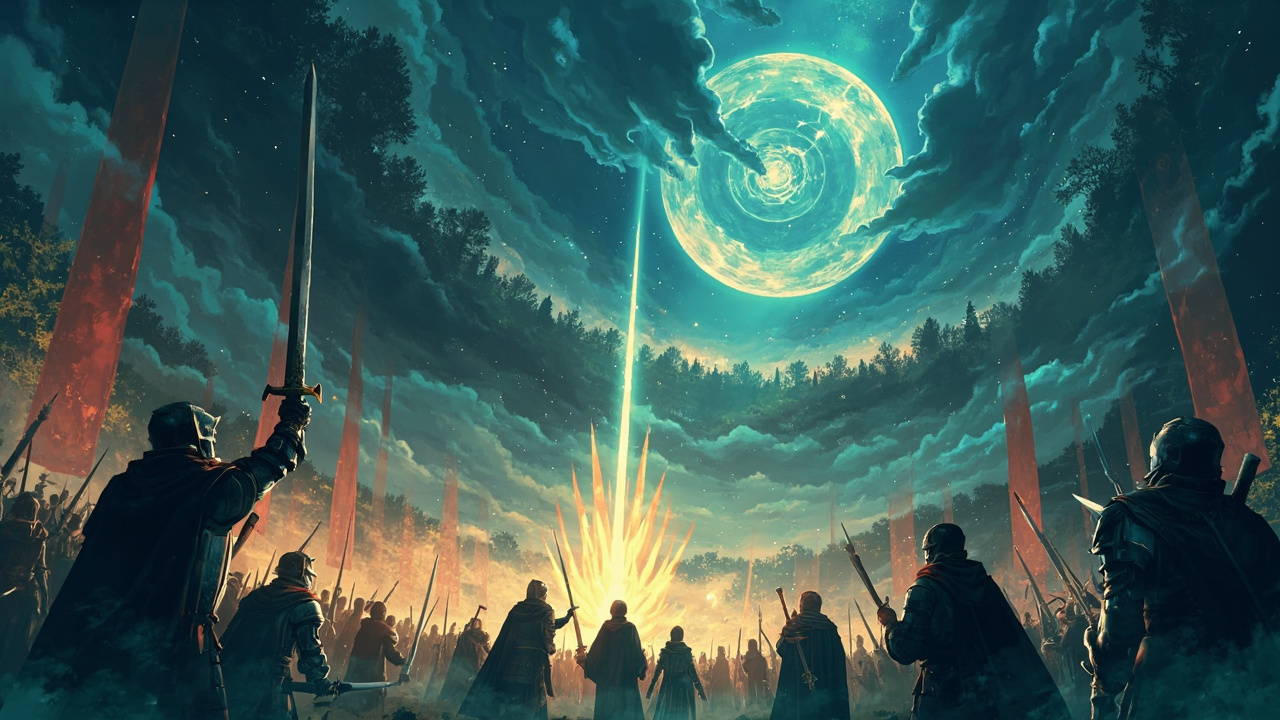
for her he did many deeds of arms, and saved her from the fire through his noble chivalry.
他为她建下无数武功,又凭一身高贵的骑士气概,把她从火刑中救了出来。
Original line · Lancelot and Guinevere · salvation and ruin at the stake
Another turn: Gawain's revenge, and Mordred's opening
Gawain is a man who lives for honor. With his brothers dead, he has only one thing left to live for: forcing Arthur to raise an army against Lancelot. It is his right as a nephew, and his duty as a knight. Arthur does not want to go — he knows that going means the family comes apart. But he cannot override his own system of oaths, and he cannot override his own blood. The army sails, the court stands empty, the garrisons on the frontier stand empty, and far off, on the other side of everything, Mordred moves: with Arthur away on campaign, he raises his standard, declares himself king, and moves to marry Guinevere into his own household — he is Arthur's illegitimate son, and he wants Arthur's throne. This section reads almost like the plotting of a coup: the war abroad is fought for a private grudge, the rebellion at home is fought for ambition, and Arthur is torn open from both directions at once. Malory is utterly without mercy on the subject of trust — whoever you trust is the one best placed to cut you deepest, and this cut comes from his own son's hand.
Resolution: Salisbury Plain, father and son and the Round Table go down together
Arthur marches his army back. The two of them meet in the heart of England, in a place later ages usually call Camlann. Malory writes this battle at extraordinary density: he keeps calling the roll, this lord, that old retainer, of all who were there in that first battle, only these few are left now. By the time both sides have fought themselves out, almost the whole generation of the Round Table is gone. Arthur himself drives a lance through Mordred's chest. As Mordred falls, he strikes back with his last strength and wounds Arthur mortally. This is tragedy in its most classical shape: two men each do the thing fate assigned them, and once it is done, they fall together. What is worth noticing here is the pacing: Malory gives you no grand strategy, no formations, only names and the manner of each death. For a knight of the Round Table, how he dies is his epitaph. The tighter and more crowded this section gets, the sadder it becomes.
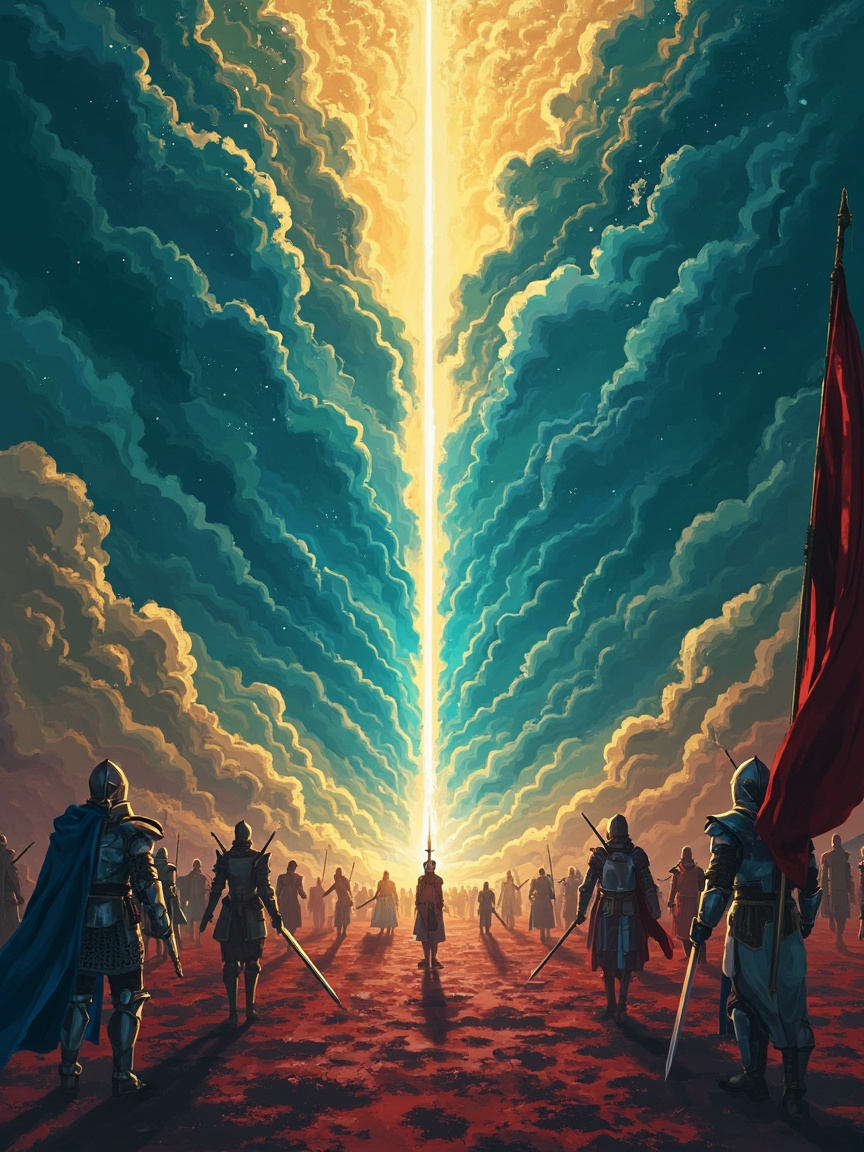
ye have gotten a child that shall destroy you and all the knights of your realm.
你在她身上得了一个孩子,这孩子终将毁灭你,以及你王国里所有的骑士。
Original line · Merlin's Prophecy · the child who will topple the Round Table
Coda: the sword returns to the lake, the king sails to the island
Arthur knows his time is nearly up. He gives Bedivere one last task: go to the lake and throw Excalibur back into the water. Bedivere stalls twice, unable to let it go, wanting to keep the sword for himself. Malory makes the sword refuse to sink until it has been thrown back three times, the most famous scene in the whole book and the most often quoted. Making it take three tries before a hand finally catches it is Malory's way of telling you that giving up something given by the gods takes three apologies, not one. Arthur is carried aboard a small barge, surrounded by a company of queens in black, and ferried away to Avalon. Whether the island heals him or simply lays him to rest forever, the book leaves as one of the oldest silences in literature: Arthur's epitaph in two lines, the once and future king, he is both the one who was and the one who will come again. Guinevere retreats into a convent and becomes a nun; Lancelot spends his last years as a hermit; the hall of the Round Table never seats a full table again. A utopia, in the end, is not ended by an enemy trampling it flat. It is taken apart, piece by piece, by its own people's hands.
What it is really about: a world built on an ideal that the ideal itself cannot hold up
The whole book's real subject fits in one sentence: how a utopia built on channeling brute force into honor, loyalty, and mercy collapses into ash in its own hall. This is not an anti-hero novel — it loves the knights it writes, it lets Lancelot repent, lets Galahad become a saint, lets Arthur go to his death grieving rather than embittered — but its honesty lies in refusing to let any single loyalty win outright. The best love story eats away at loyalty to the king; the most justified revenge eats away at mercy toward a friend; the holiest quest stops cold in front of private desire; the most lawful throne gets overthrown by the hand of the person closest to it by blood. What makes it feel modern is not the swords and horses, it is a disappointment we can still recognize today: any institution, any round table, any set of principles, if it is held up by people, will inevitably be worn hollow by people's weaknesses. That is exactly why fantasy literature five hundred years later, from Tolkien to A Song of Ice and Fire, keeps rewriting its structure. It invented a way of telling a story: write the fall, not the triumph.
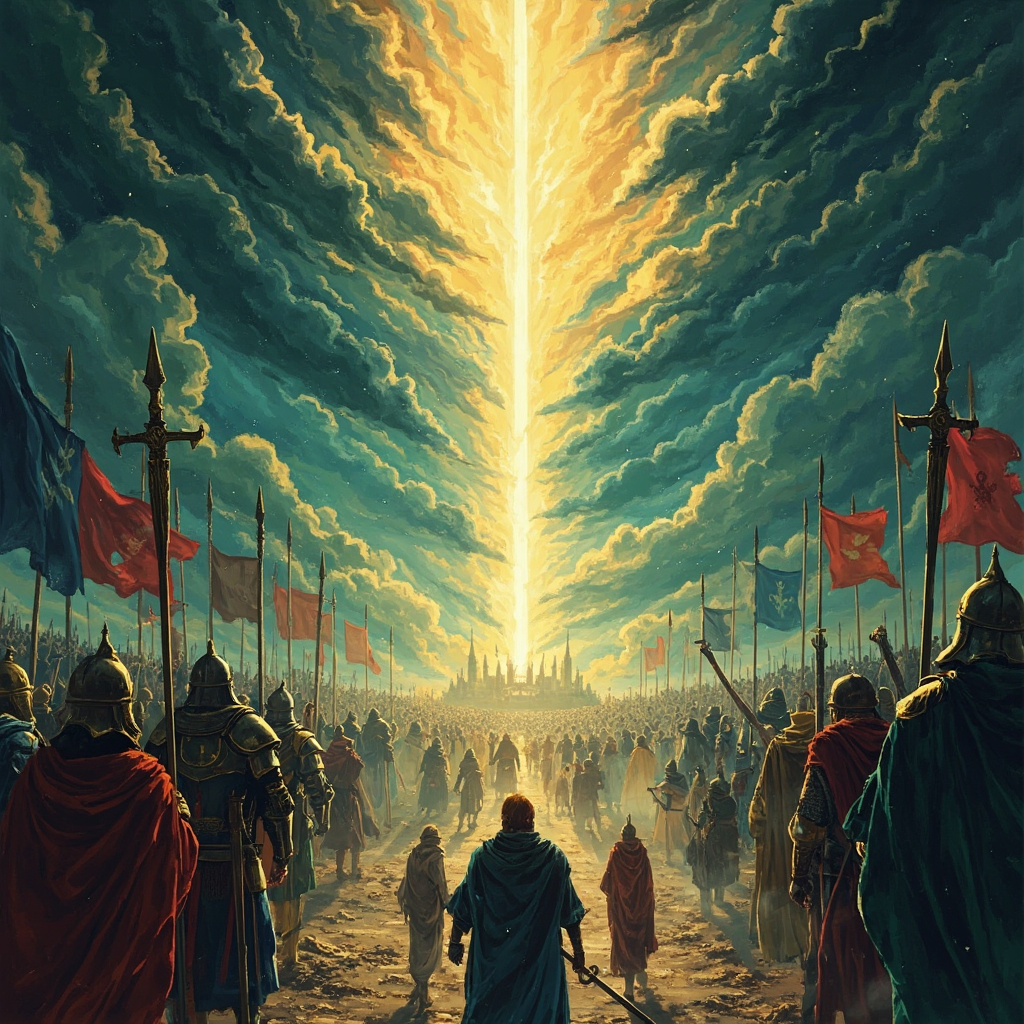
by no means to be cruel, but to give mercy unto him that asketh mercy
绝不可残忍,对凡是求饶的人,都要施以慈悲。
Original line · The Round Table's Vow · the ideal, before it crumbled to ash
Why read the original
An explainer can tell you how the Round Table came apart, who died where, where the enchanted sword ended up, but no summary can hold two things this book actually has. One is texture: Malory writes in a sentence-shape that is both archaic and short, and a few pages in you fall into a particular rhythm, almost like a prayer book, the real voice of a knight writing in prison five hundred years ago. The other is presence: the plain facts of what happened have already been told, but you still need to go read, yourself, the silence when that knight pulls the sword from the stone, the faces of the crowd before the fire is lit, that last sword that only agrees to sink on the third throw, moments a summary can only report to you secondhand, while the original lets that stretch of English hit you directly. Read it, not because you do not know how it ends, but because this is a book worth walking through whole, slowly, on your own.
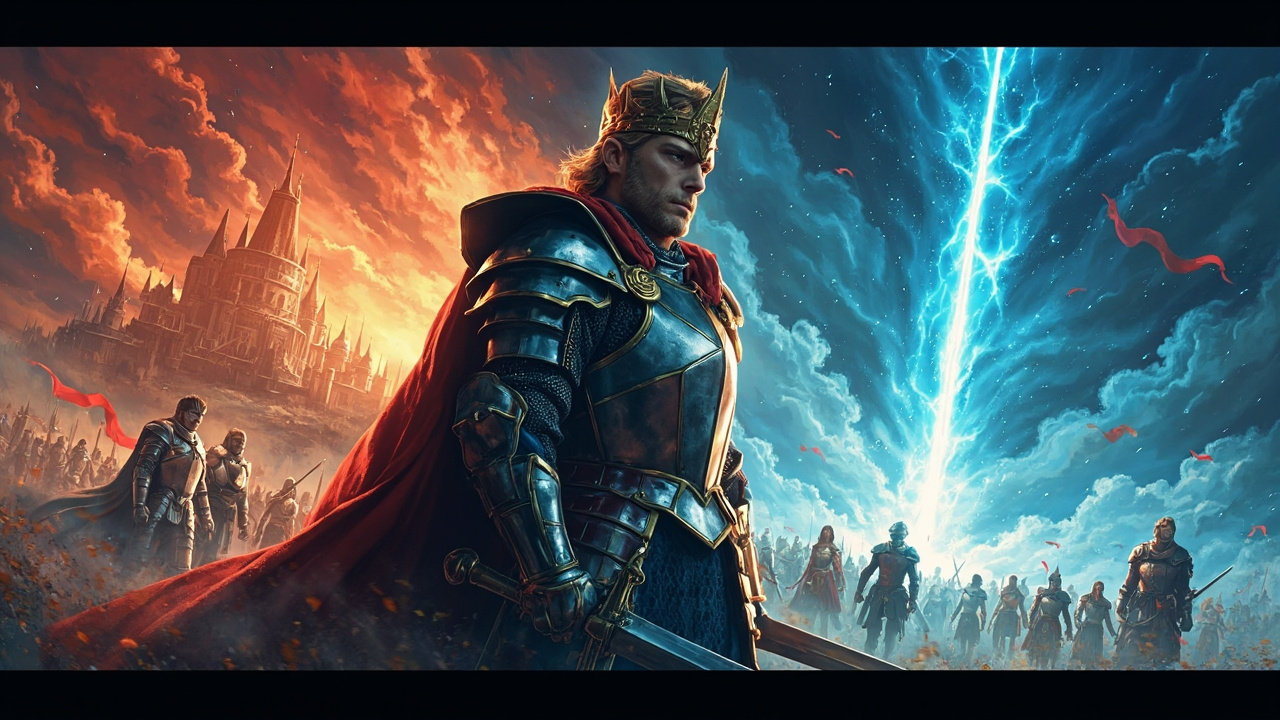
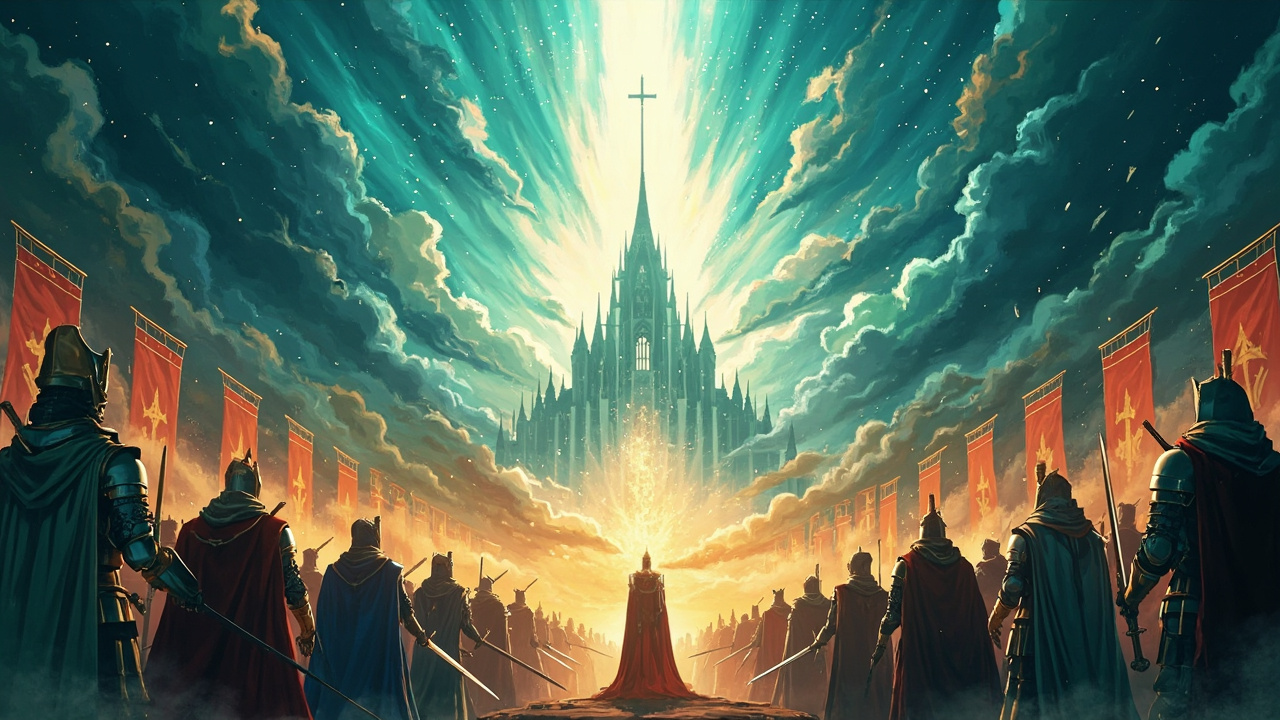
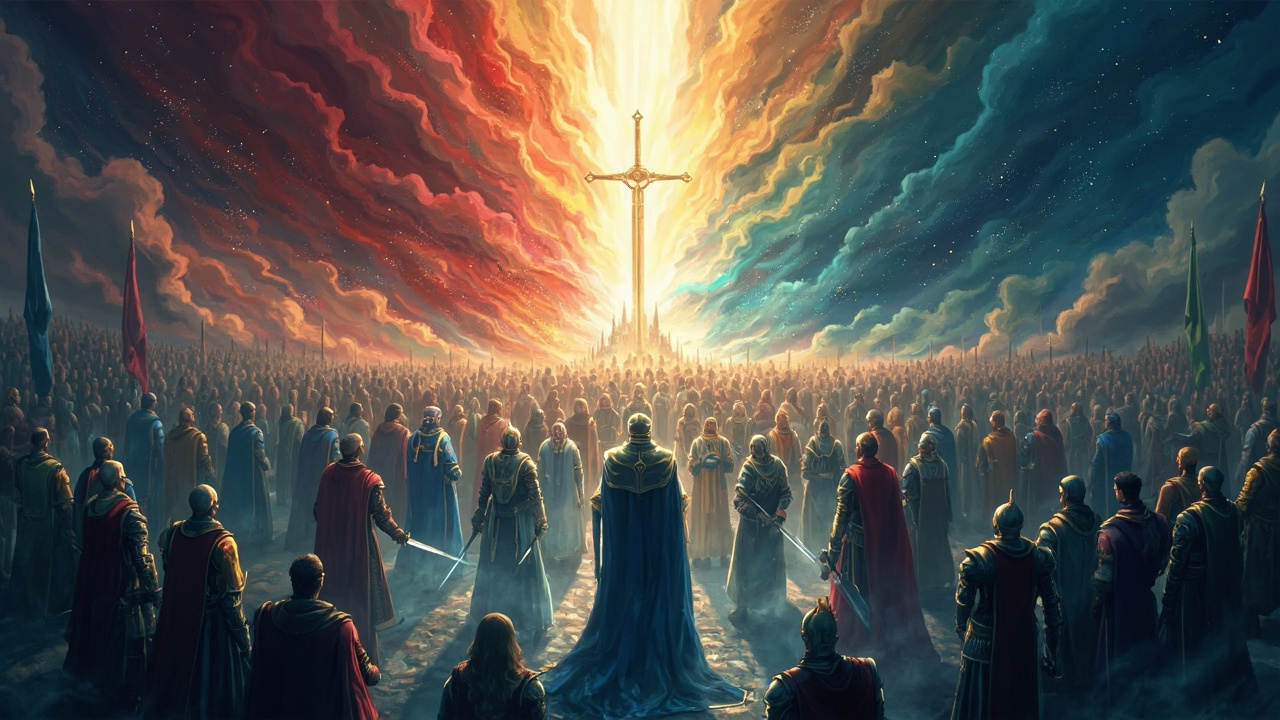
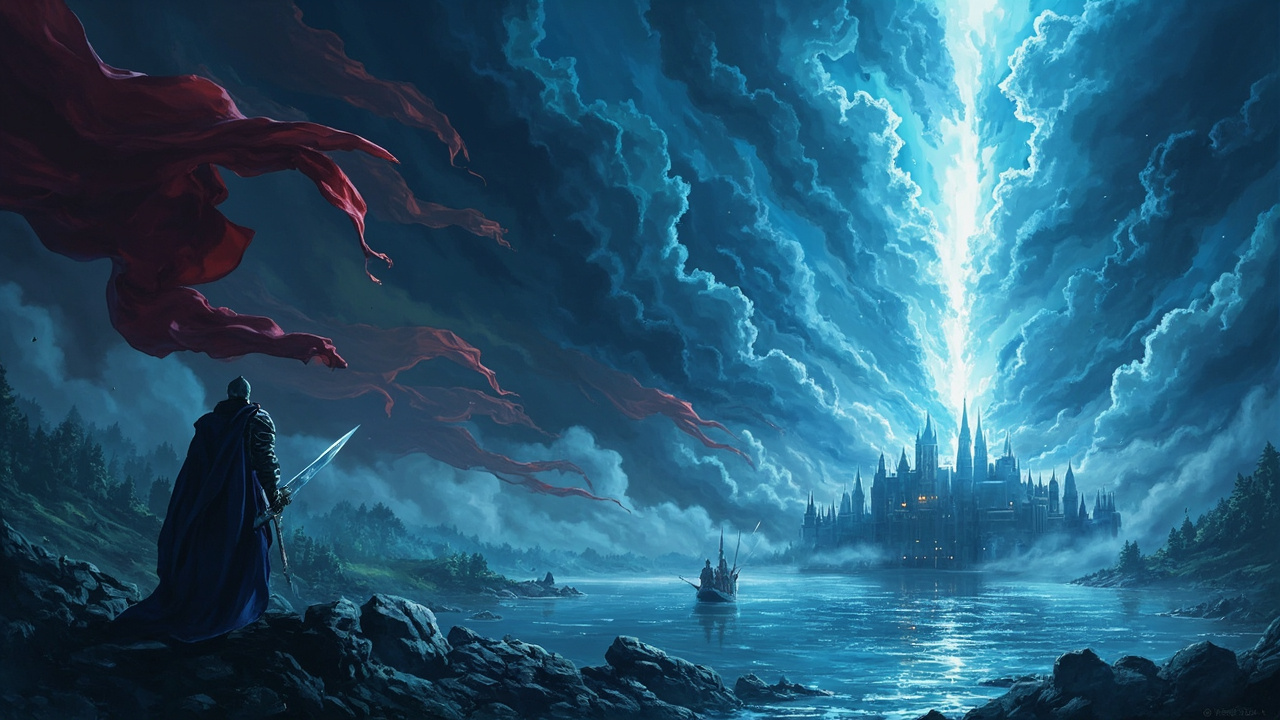
Art Direction4 plates
Before the guide was written, this book got a visual foundation — every illustration you just read grew out of it.