Les Misérables · Companion Guide
悲惨世界
一个苦役犯用一生行善赎回灵魂,法律与贫困却从未放过他。
Opening: A Question Worth Asking
One loaf of bread. Nineteen years of hard labor. You're starving, your sister's children crying in the next room, and you smash a bakery window and break off a loaf to feed them, and for that you're sentenced. That is the gut-punch Les Misérables opens with — it makes you admit something up front: what the law gets right is not necessarily justice. The whole novel keeps circling back to one question: if the system will always see a man as a criminal, can he ever become anything else?
What makes it worse is that Hugo refuses to give you a feel-good answer. A former convict builds a factory, becomes mayor, rescues an orphan, and spares the policeman who has hunted him his whole life — and after all that, society still won't let him go. The cruelty of this book is that goodness isn't a pass out of your past. It's a heavier burden to carry.
What Kind of Book This Is
Victor Hugo wrote this novel in the mid-nineteenth century, and its story spans nearly twenty years of French history, from Napoleon's defeat to the Paris republican student uprising. The French title translates literally as 'the wretched ones,' and the book's most notorious villain isn't Javert — it's poverty itself. Hugo spends an entire doorstop of a novel writing the poor's indictment of society, which is why this is more than a story; it's a conscience file on nineteenth-century France. That's exactly why, more than a century later, across Broadway, film, and comics, everyone can still find their own miserable world hiding inside it.
Characters and World: A Web of Fates
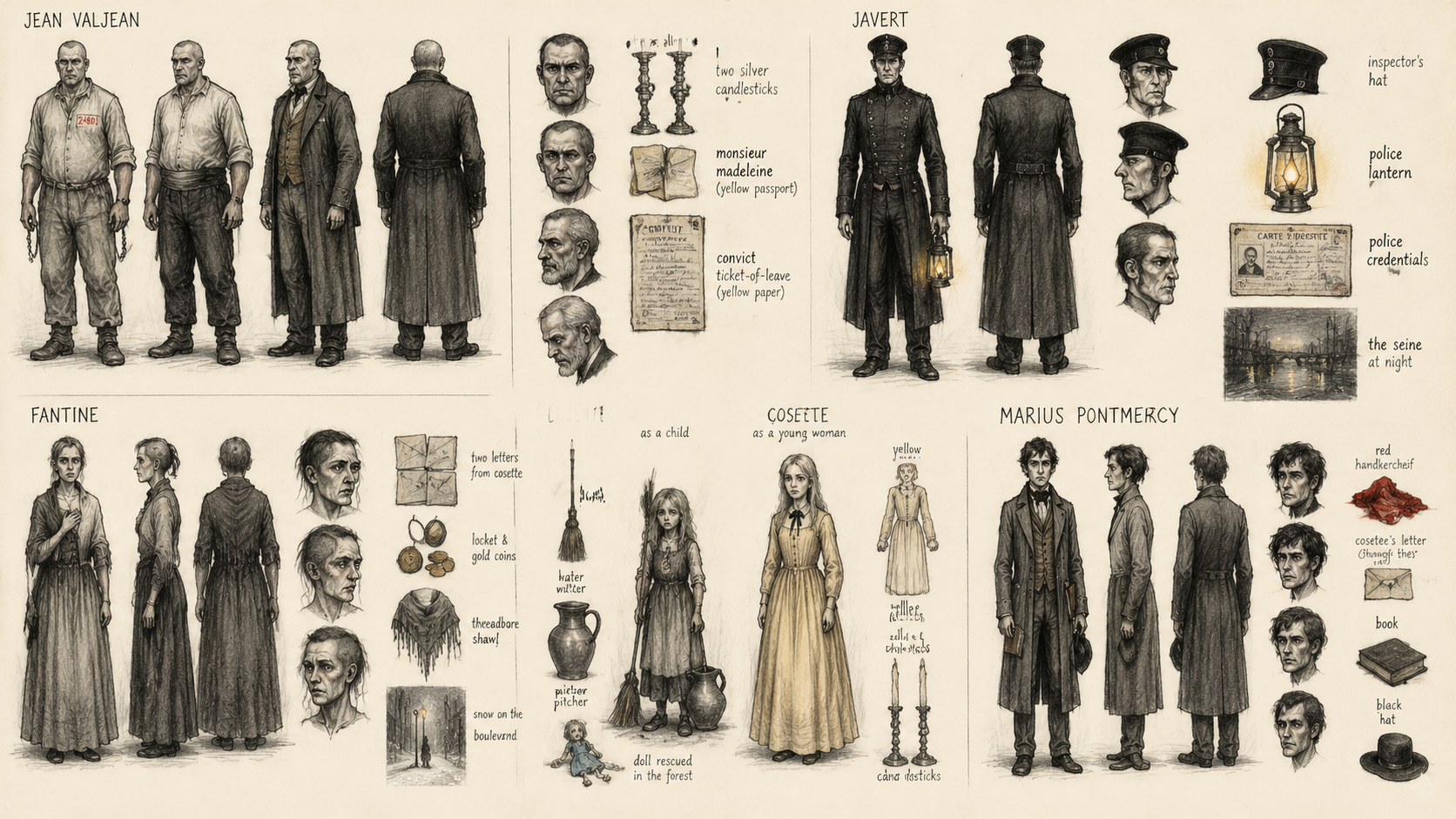
The novel's protagonist is Jean Valjean, a former convict. The law nails him to the pillory for the first half of his life; in the second half, he redeems himself one act of goodness at a time — changing his name, building a fortune in industry, becoming a mayor, then giving up everything for the orphaned daughter of a dead factory worker. His lifelong opponent is the police inspector Javert: born into a family of convicts himself, he believes the law is always right, and follows that belief past the point where it leaves any room for humanity. Javert chases Valjean for decades, and it is precisely Valjean's goodness that finally breaks him, driving him to throw himself into the Seine.
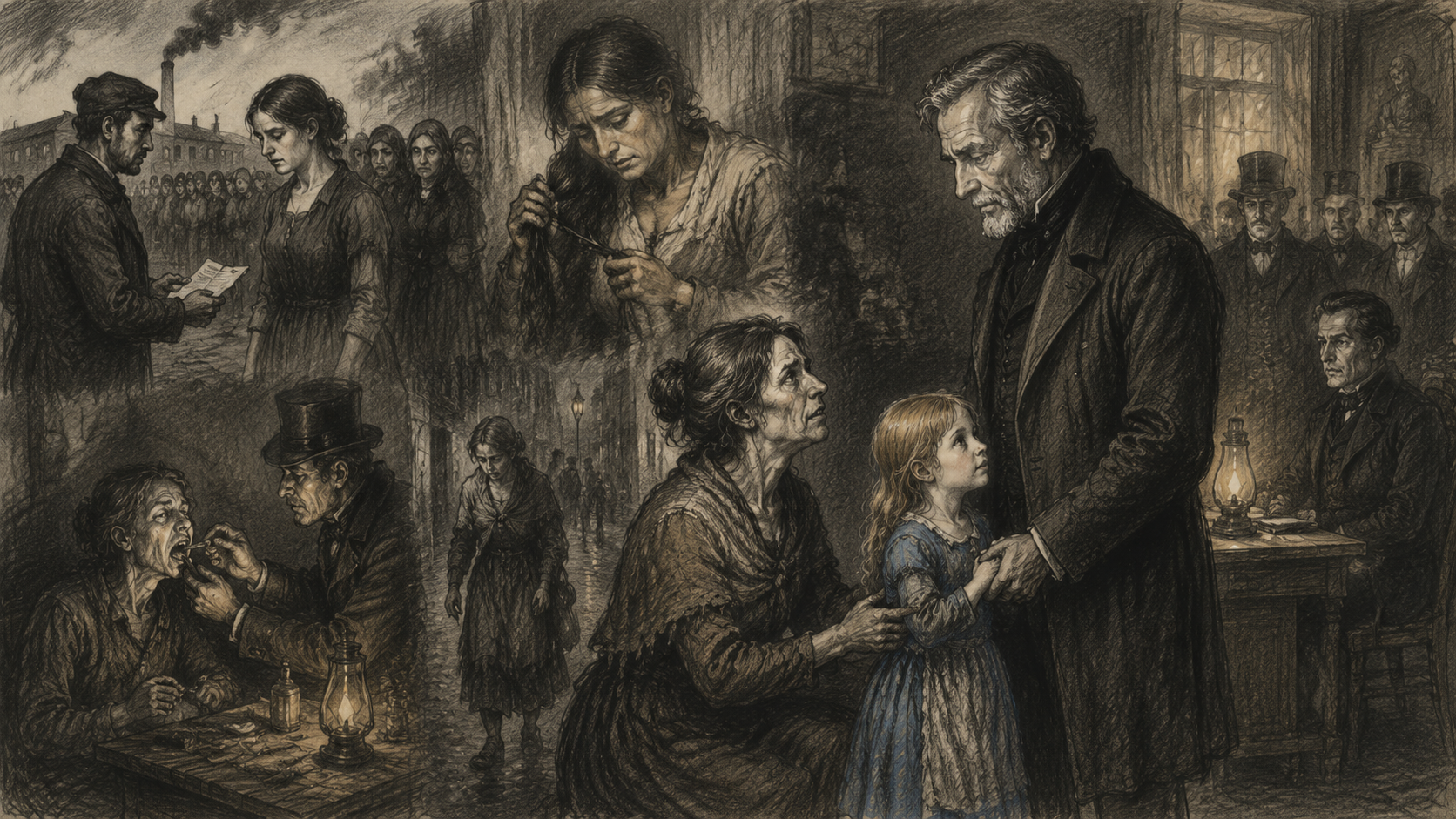
Valjean's fate turns on three women and a child. Fantine is the factory worker who gets fired, sells her hair, then her teeth, then herself, and finally dies in poverty and sickness — on her deathbed she entrusts her illegitimate daughter Cosette to Valjean, and he spends the rest of his life paying off that promise. Cosette is abused as a child laborer by the Thénardiers, a couple who work her like traffickers, and grows up to fall in love with Marius, a republican young man estranged from his own grandfather. Woven through it all is Gavroche, a street urchin of Paris — the Thénardiers' own discarded son — who becomes the brightest light in the whole book, singing as he scavenges bullets on the barricade until he's shot dead.
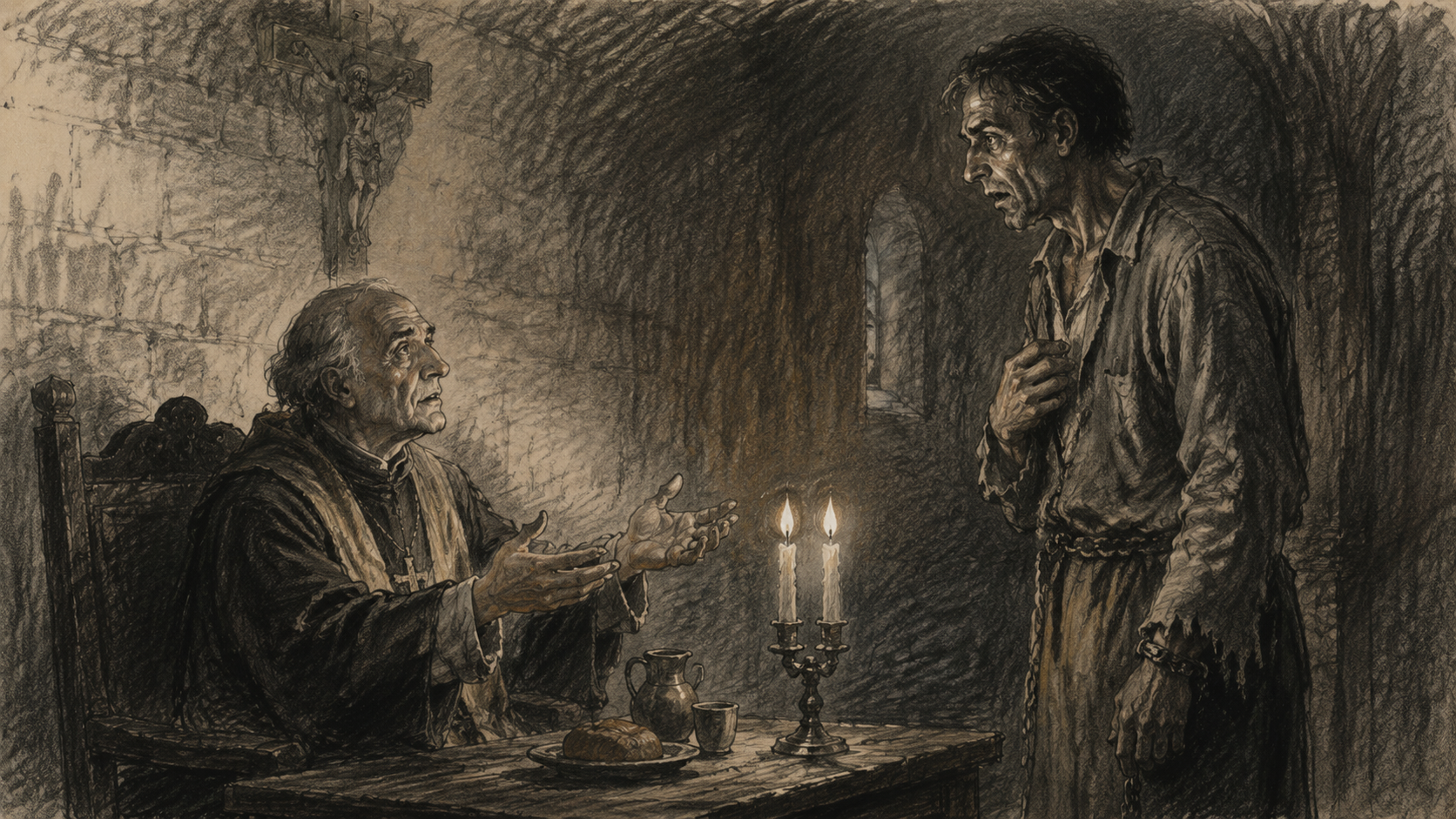
She seized the Thénardier's hand, looked at her fixedly, and said:- "Will you keep my child for me?"
你会收留我的孩子吗?
原文金句 · 第11章 · 芳汀托孤
The rule of this world is simple: it offers the poor no way back up. A woman's virtue, a child's birth, one youthful impulse — any of these is enough to ruin generations. The law is cold, the streets of Paris are cold, the sewers are cold — only a few people choose to stay warm.
The Plot: A Redemption in Seven Acts
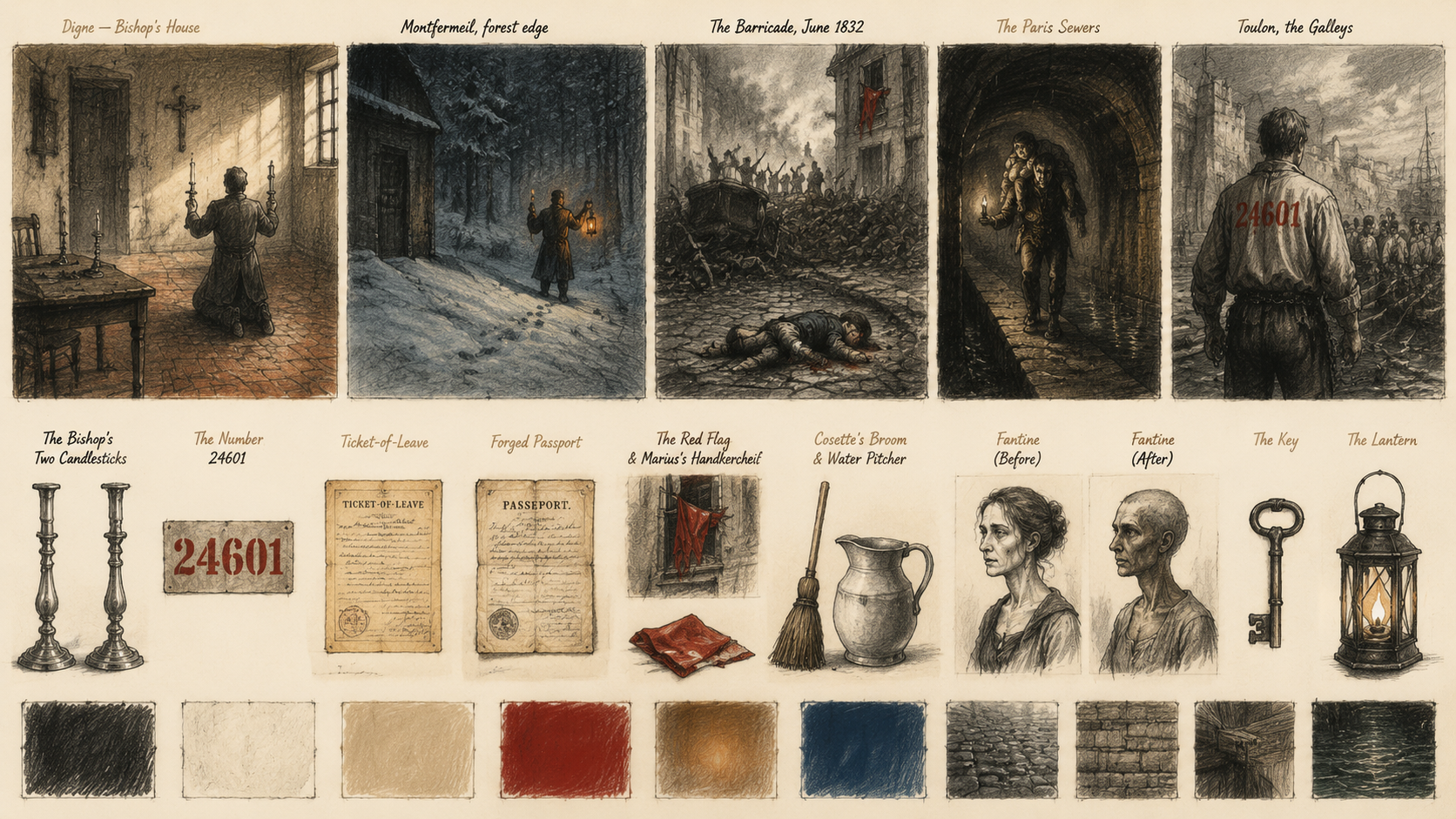
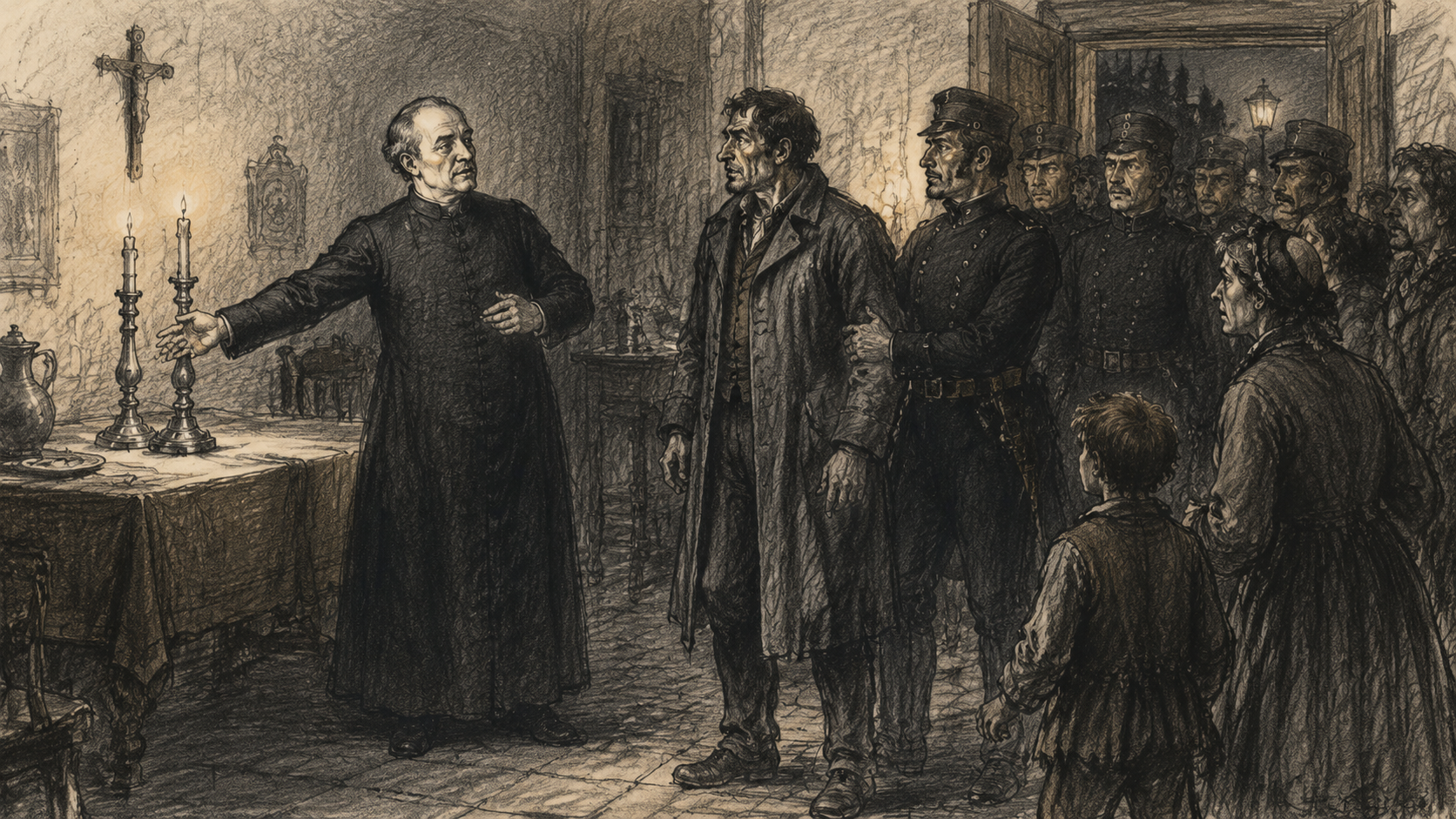
Act one is where the redemption begins. A man who has just finished nineteen years of hard labor asks a bishop to put him up for the night. He steals the silverware and runs, and the gendarmes drag him back. The bishop doesn't turn him in — instead, right in front of the police, he insists he gave Valjean the silver candlesticks too. That lie lands on Valjean like a slap: in half a lifetime, he has never once seen a stranger willing to lie for him. Hugo's insight here is sharp: what saves a man isn't forgiveness — it's someone believing in him more than he believes in himself.
The Bishop drew near to him, and said in a low voice:- "Do not forget, never forget, that you have promised to use this money in becoming an honest man."
不要忘记,永远不要忘记,你已承诺用这笔钱成为一个诚实的人。
原文金句 · 第2章 · 主教与银烛台
Act two is the entrusting of a child. Valjean, now living under a new name as Mayor Madeleine, watches a factory worker named Fantine get fired the moment her employer discovers she has an illegitimate daughter. She slides from respectable working woman to the street in stages — cutting off her hair, pulling her own teeth, finally selling her body — until she dies of illness and poverty. On her deathbed she seizes the mayor's hand, weeping, and begs him to take her daughter. Valjean agrees, and that promise becomes the fuse for every hardship of the rest of his life. Hugo's method here is merciless: he makes the reader watch a decent woman get crushed by a society whose cruelty arrives one 'reasonable' decision at a time.
Act three is the snowy night he claims his daughter. Valjean tracks down the Thénardiers' inn, where Cosette, thin as a sparrow, fetches water at night and is beaten for her trouble. He shows up after dark, buys the child out of that den with a small fortune, and walks her out into a heavy snowfall, holding her hand. Hugo writes this passage with real beauty: freedom here isn't an abstraction — it's a pair of small feet trudging through snow, a small hand held tight.
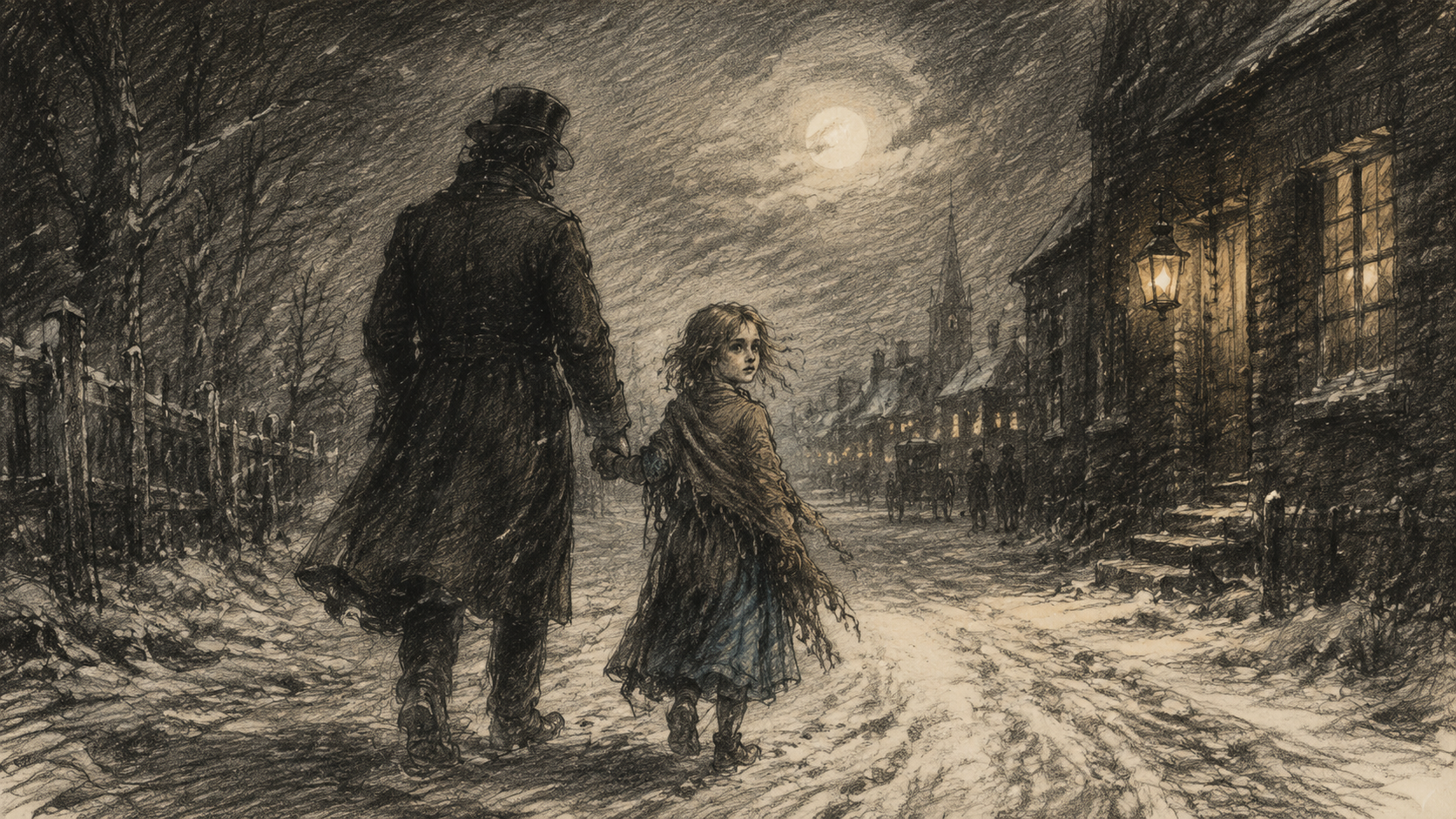
The child raised her great eyes, in which hung a tear, which was not visible because of the darkness, and replied gently:- "Yes, sir."
孩子抬起大眼睛,眼里悬着一滴泪,在黑暗里没人看见,她柔声答道:‘是的,先生。’
原文金句 · 第28章 · 风雪夜珂赛特
Act four is history crashing in. The timeline jumps to 1832, when young republican students raise barricades in the streets of Paris and stand off against government troops under a red flag. Cosette is grown now, and her lover Marius, estranged from his grandfather, joins the men on the barricade. The most affecting figure here is Gavroche, the street urchin — he has never read a book, has no idea what any ideology means, and still goes barefoot into gunfire, singing as he collects bullets for the fighters, until he falls dead on the cobblestones. Hugo gives this child's death an entire chapter, because he wants readers to remember that revolution isn't only a slogan — real bodies stand in front of the bullets.
Act five is the most suffocating and the greatest scene in the whole book. The barricade falls, and Marius lies unconscious with grave wounds. Valjean finds him and hoists him onto his shoulders — because this is the man his daughter loves — then descends into the sewers of Paris: pitch black, foul-smelling, one rising tide away from drowning him. He claws his way to the exit and survives, only to find Javert waiting there. After a standoff, Valjean chooses to let go of the enemy who has hunted him his whole life, and lets Javert take the unconscious young man away. Hugo writes the sewer passage with an almost physical claustrophobia — he wants you to smell the stench and walk that stretch of hell alongside him.
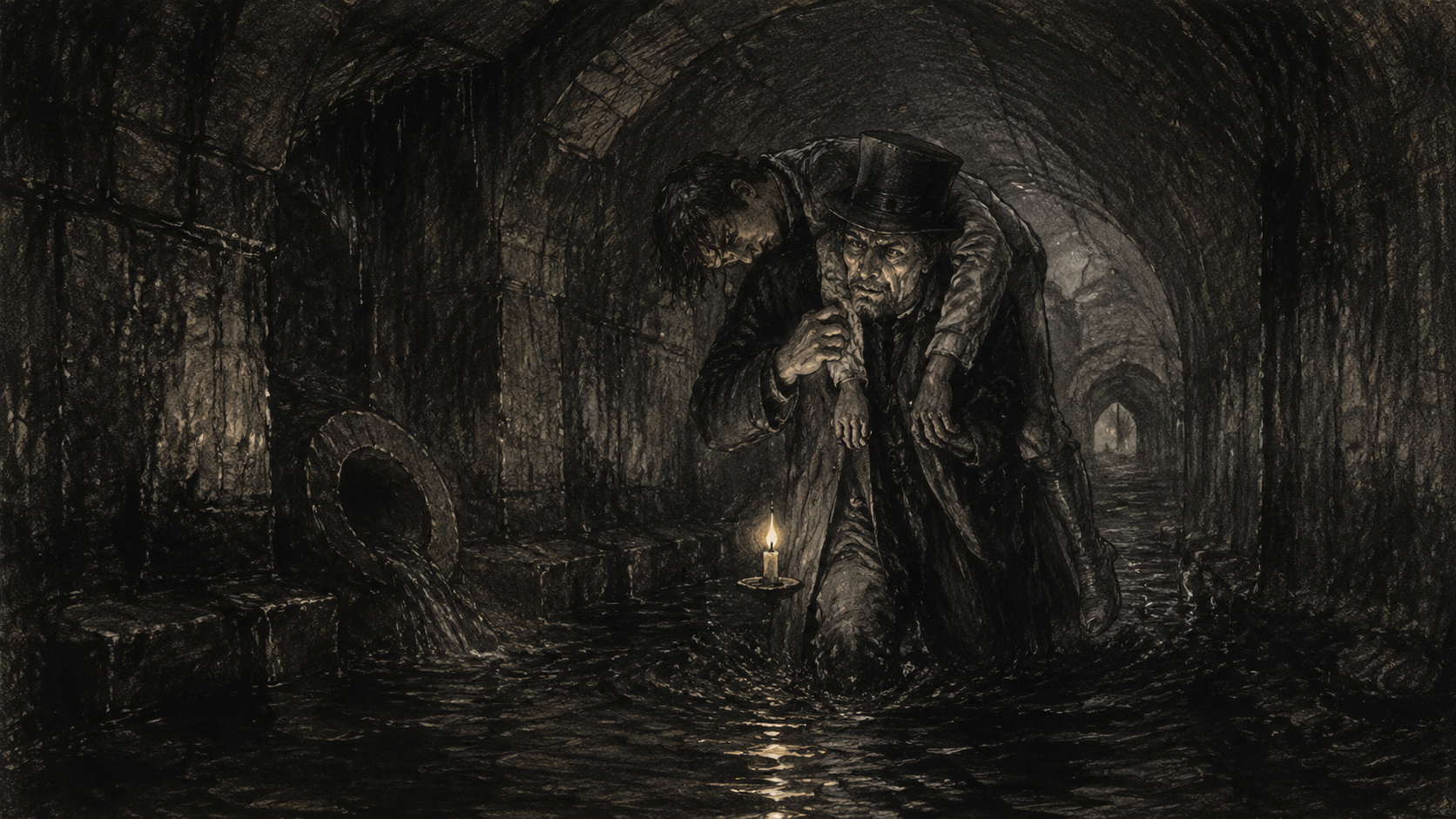
He had hardly uttered this word, when he felt a hand laid on his shoulder with the weight of an eagle's talon, and he heard a voice saying to him:- "On your knees."
跪下。
原文金句 · 第76章 · 沙威被捕
Act six is a collapse of faith. After that night, Javert falls apart. He has spent his whole life believing in the law — a convict is a convict, good and evil must stay separate — and yet he has just been let go by a fugitive he could have arrested. The law has no loopholes; human nature does. That night he stands at the edge of the Seine for a long time, then steps in. Hugo writes it with restraint, no melodrama, no accusation, letting you simply see that when a man's entire belief system is shattered by an act of goodness, it can kill him. This scene is the moral hinge of the whole novel — the reader suddenly realizes that Javert, too, is a victim, chained by the very system he believed in.
Act seven is the epilogue, and the quietest scene of all. Valjean is old now, finally able to set down the burden of running. Cosette and Marius keep watch by his side, and he dies peacefully by candlelight. His gravestone carries no name, only an epitaph with no words on it. Hugo leaves it blank on purpose: the things that matter most were never the kind that can be carved into stone.
Themes and Craft: What Hugo Is Really Saying
What Hugo really wants to talk about is the eternal tug of war between law and mercy. The law deals in rules, evidence, prior convictions; mercy deals in people, possibility, repentance. Valjean spends his whole life proving that a man is not the worst thing he has ever done. But society doesn't see it that way — society sees your old prisoner number. That's what makes this book modern: it isn't really about nineteenth-century France, it's about everyone who can't move forward until a label gets peeled off for good.
Hugo makes two startling choices as a writer. First, he isn't afraid to digress — he'll suddenly spend a dozen-plus pages on the battlefield at Waterloo, the layout of the Paris sewers, the dim corridors of a convent. Second, he uses those digressions to pull you deeper into the characters, not away from them: without that defeat at Waterloo, you wouldn't understand the despair of young men under the Restoration monarchy; without the real geography of the Paris sewers, that escape would carry no weight. This stitching of individual fate into an entire era is the deepest reason this book has stayed with us.
Why Read the Original: The Map Is Not the Territory
I've laid out the skeleton of the story, but you should still read the original. What Hugo gives you isn't just plot — it's physical sensation: the stench of the sewers, the cold of a small hand in the snow, the silence of a policeman standing motionless all night by the Seine. No summary can hand you those. I can tell you what Valjean did, but only Hugo can make you feel it — how, the moment he took Cosette's hand on that snowy night, the stone that had pressed on his chest for nineteen years shifted, just an inch.
The cruelty of this book is that goodness isn't a pass out of your past. It's a heavier burden to carry.
What saves a man isn't forgiveness — it's someone believing in him more than he believes in himself.
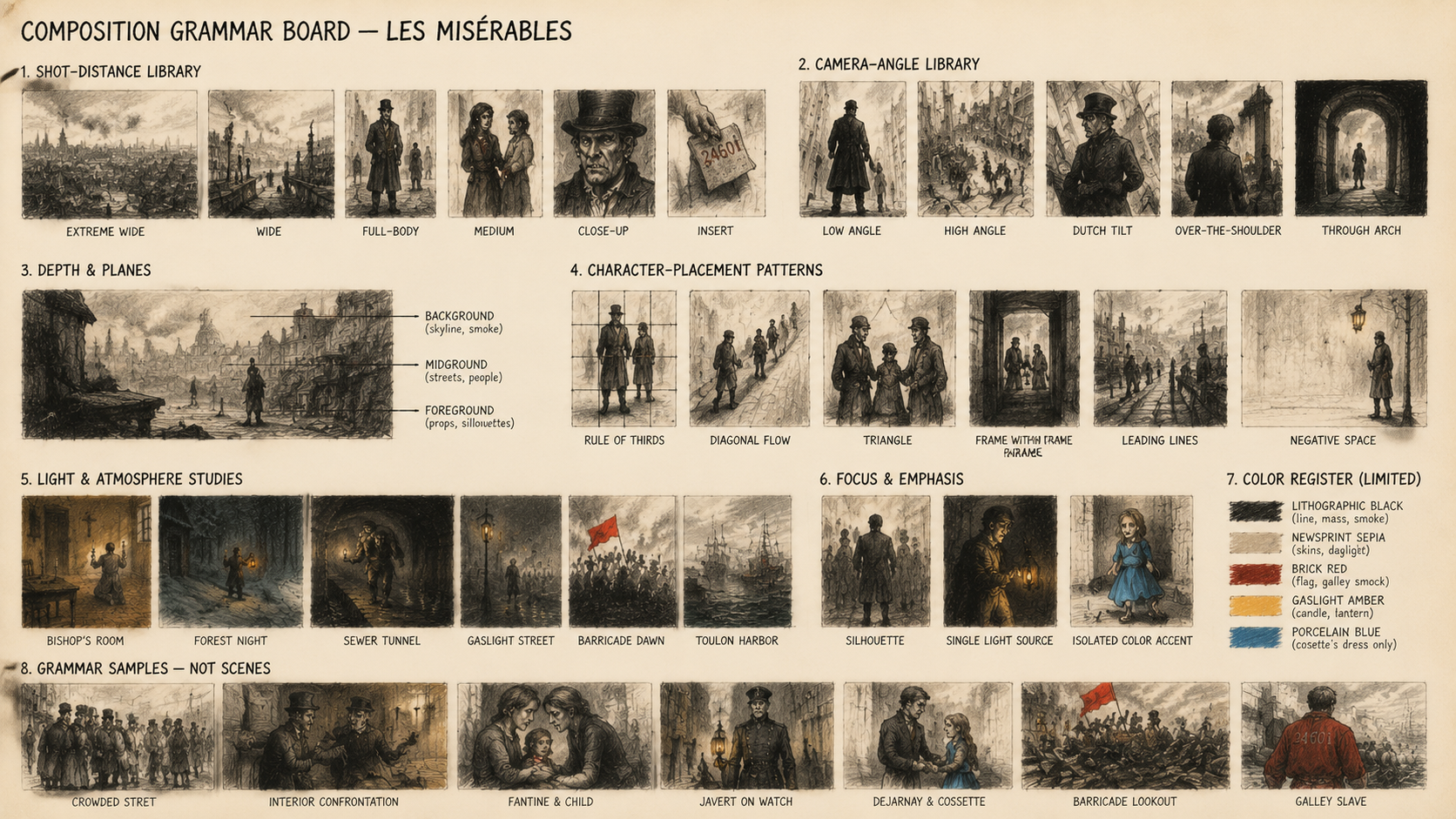
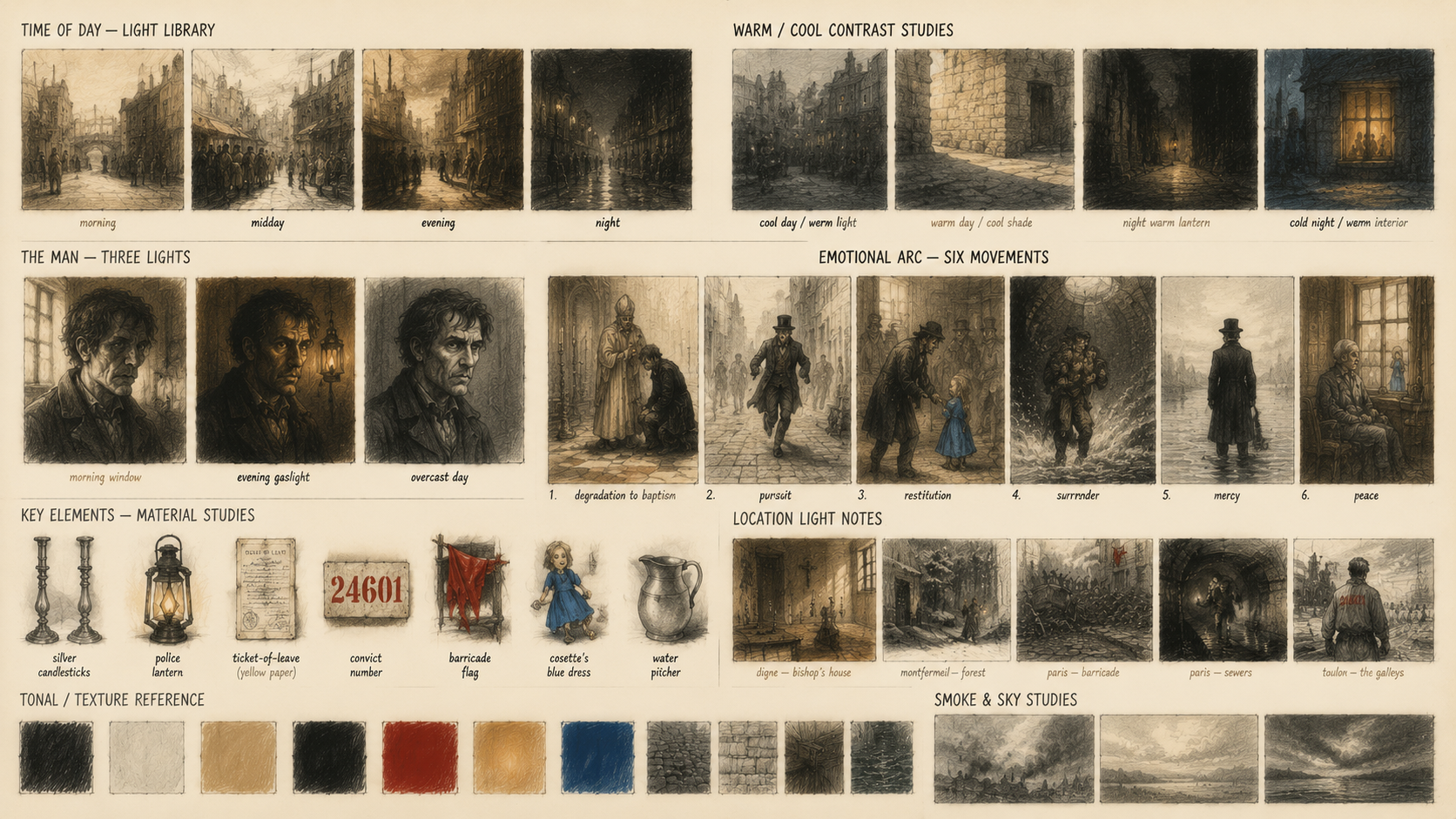
Art Direction4 plates
Before the guide was written, this book got a visual foundation — every illustration you just read grew out of it.