Manas · Companion Guide
玛纳斯
婚礼之夜的刀落马嘶:一个英雄倒下,八代人的歌才刚刚开唱——毡房里库姆孜琴不断,一部活着的史诗从葬礼长进童年。
Opening: A Gray Horse, a Wedding Never Finished
White felt tents stand in a circle, the komuz is still playing, the mutton broth is still simmering. The hero Manas lies on the ground on his wedding night — and Akkula, his gray horse, is still standing, whinnying, refusing to leave. His book does not end here, because this was never the story of one man. It is the story of eight generations.
What Kind of Book Is This
Manas was not written by a scholar at a desk. It is an oral epic that has been sung at the foot of the Tian Shan since around the ninth or tenth century, carried forward generation after generation by Kyrgyz manaschi, and no one can say who first composed it. The longest recorded version runs past five hundred thousand lines, something like twenty times the length of Homer's epics. Alongside the Epic of King Gesar and the Epic of Jangar, it is one of China's three great heroic epics, and in 2009 it was inscribed on UNESCO's Representative List of the Intangible Cultural Heritage of Humanity.
So what you are opening is not a dead classic but a song that someone eventually caught on paper. One of its most celebrated modern singers was the Kyrgyz elder Jusup Mamay, who lived nearly a century and sang it from boyhood into old age.
People and World: Tribes Under the Snow Peaks, Songs Inside the Yurt
The setting is the high country of the Tian Shan and the Pamirs: alpine lakes under the snow line, horse herds moving with the seasons, and the legendary tomb of Manas in the Talas valley. In the foreground are the grasslands and mountain passes the Kyrgyz have inhabited for generations, in an age of tribal warfare and migration around the ninth or tenth century, roughly the era of the Kara-Khanid Khanate. The round white tent is the boz üy; the floor is covered in shyrdak, felt rugs stitched with pattern. The outside threat goes by one name, Qalmaq, a catch-all for the strong enemy on the northern steppe that made every tribe suffer. It is the epic's stand-in for an outsider, not a claim about any people on a map today.
Manas is the hero of the first book, riding Akkula and carrying a seven-jointed spear. Beside him always walks the white-haired elder Bakai: advisor, comrade in arms, and the voice that tells the hero's own history back to him. His antagonist is a Qalmaq khan to the north, who forced Manas's mother into marriage and threw the infant Manas off a cliff. He is not a simple villain; he is the fate Manas can never quite shake off.
One kind of person never appears in the story, yet carries the whole book on their back: the manaschi, the living performers of the epic. They sing with a komuz in hand or a set of wooden clappers, in the yurt, at weddings, around the fire past midnight, for days and nights at a stretch. Every line you read on the page once came out of one of their mouths.
The Main Thread: The Child Who Was Abandoned, the Horse That Would Not Fall
The story opens on a tribe already coming apart. The Kyrgyz clans are scattered and under raid from the Qalmaq in the north. Manas's father is old and blind; his mother is forced into marriage with the Qalmaq khan. The infant in her arms is the future hero, and when the khan learns of him, he has the child thrown off a cliff. A hawk catches him and raises him in the mountains. This is where the whole legend starts: the hero begins as someone left for dead.
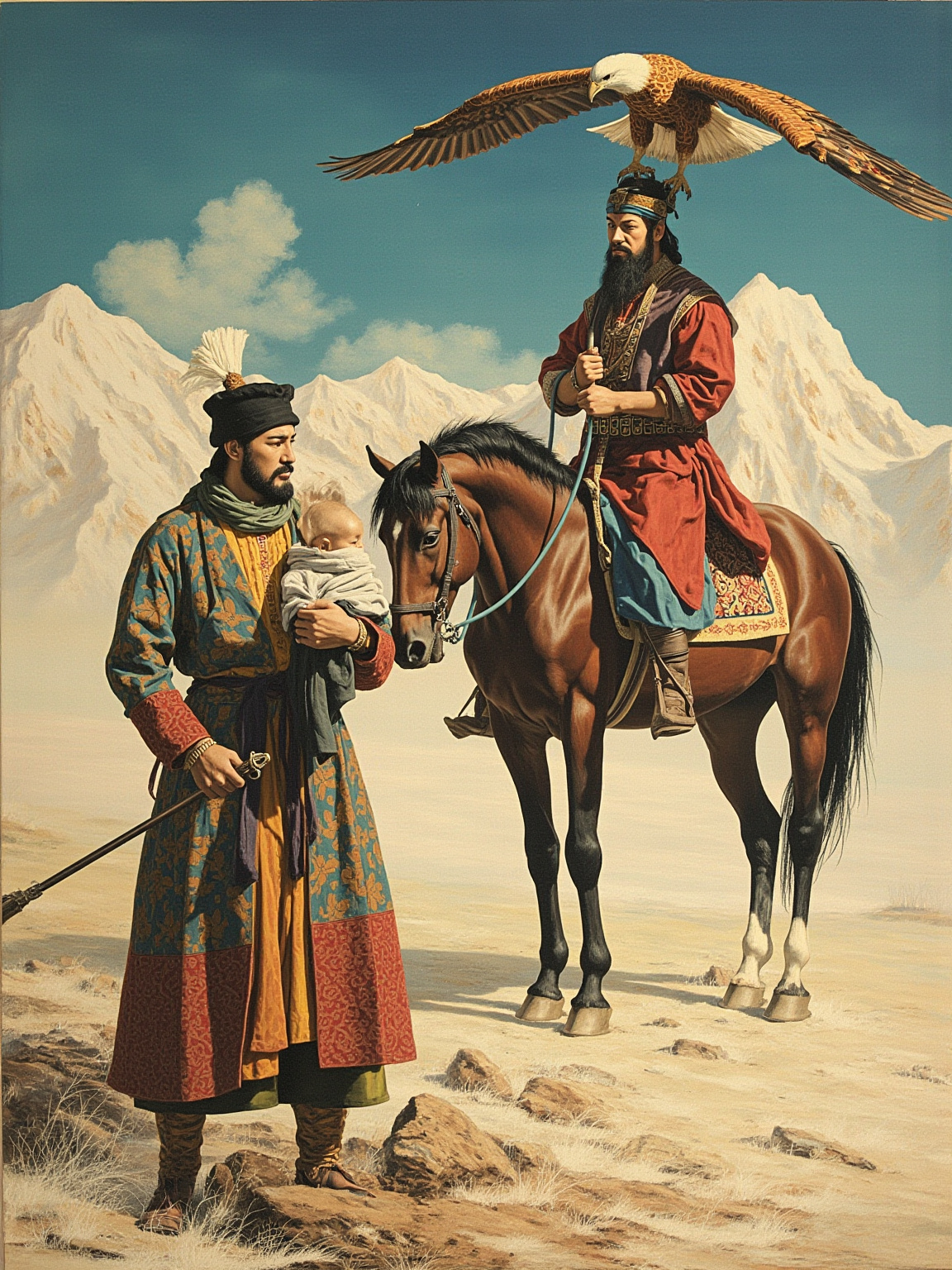
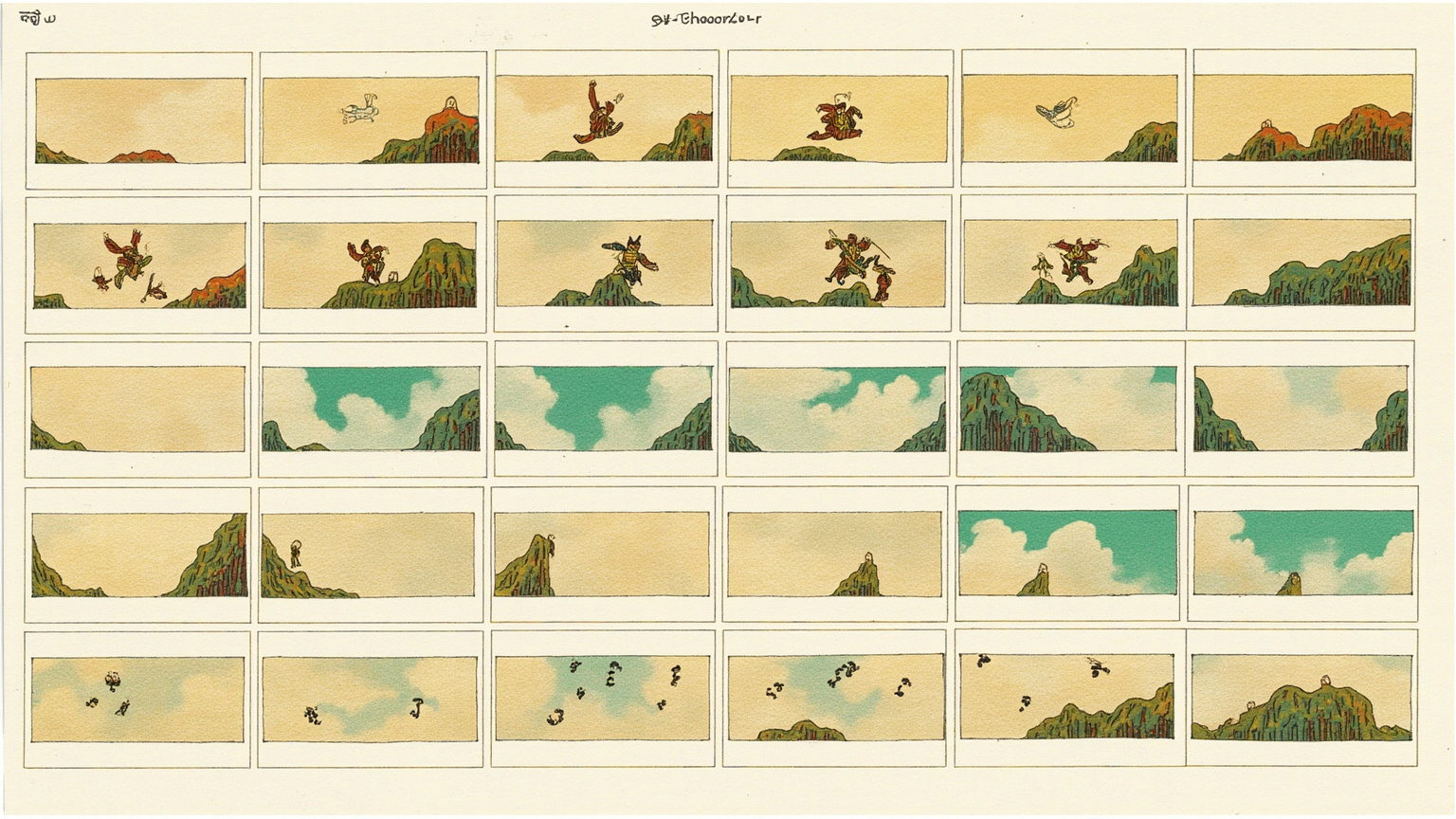
Cast down from the cliff, the infant was borne aloft by the golden eagle and cradled in the mountain's keeping.
婴儿被抛下山崖,金雕将他托起,养于山中——这是部族把英雄先交还给了天山。
金句 · 起源与孕育 · 金雕救子
Manas returns to the tribe as a young man. He is given Akkula, the gray horse, and the seven-jointed spear, and he swears brotherhood with forty companions in arms, among them Bakai, the white-haired advisor who stays at his side for life. The old man's laments and praise songs for Manas would later become the very posture the singers themselves take up. This is a scattered people pulled back together into a single force.
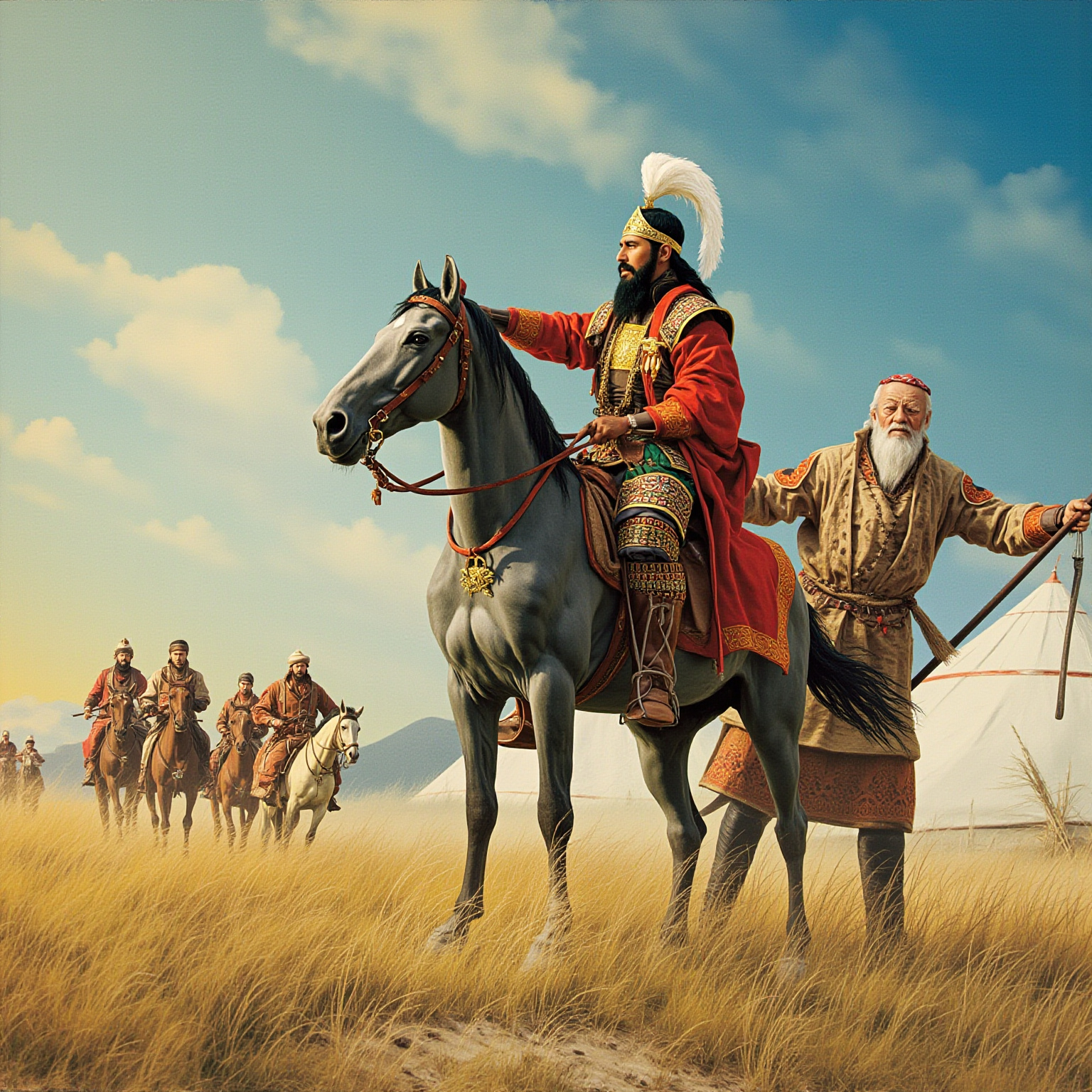
He took the grey-blue stallion Ak-Kula for his mount, the seven-jointed spear Kök-Töbüz for his hand, and forty sworn brothers for his back.
得灰青马阿克库拉,得七节长矛阔克托布孜,与四十勇士歃血为盟——玛纳斯从此不是一个人,是一支队伍。
金句 · 崛起 · 宝马、长矛与四十勇士
He marches south against the Tatars and north against the Qalmaq, forging the scattered tribes into a force that can stand against an outside enemy. The epic's stage moves with him: the Altai, the Tian Shan, the northern rim of the Tarim Basin, the steppe of Central Asia, and every one of these places is ancestral ground the tribes have lived on for generations, not an abstract battlefield. The place names are where the epic actually carries its feeling.
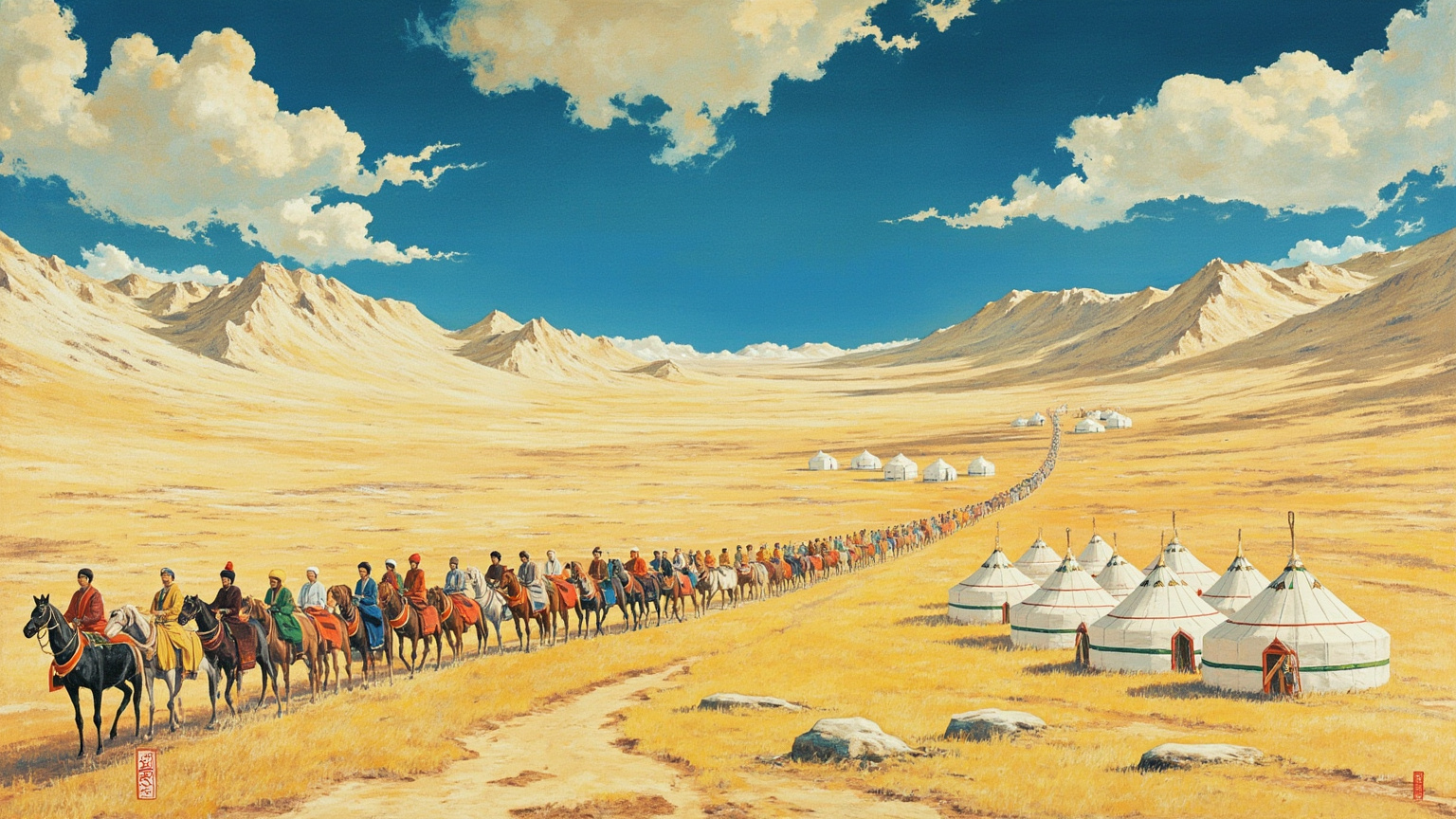
From the broken Kirghiz tribes he forged one people, riding from the Altai to the Tian Shan, from the Tarim's rim to the steppe.
他把四分五裂的柯尔克孜诸部捏成一支队伍——阿尔泰山、天山、塔里木北缘、中亚草原,都是部族世代栖居的祖地。
金句 · 南征北讨 · 祖地即战场
The climax of the first book is a wedding held on the wrong day. Manas comes home in triumph, the tents go up in a circle, the shyrdak rugs are laid out, the komuz starts up, and the manaschi opens his throat and sings on and on, the single most joyful, most crowded scene in the whole epic. White boz üy tents, shyrdak stitched with pattern, horses and sheep herded in close, a feast that runs from dusk deep into the night.
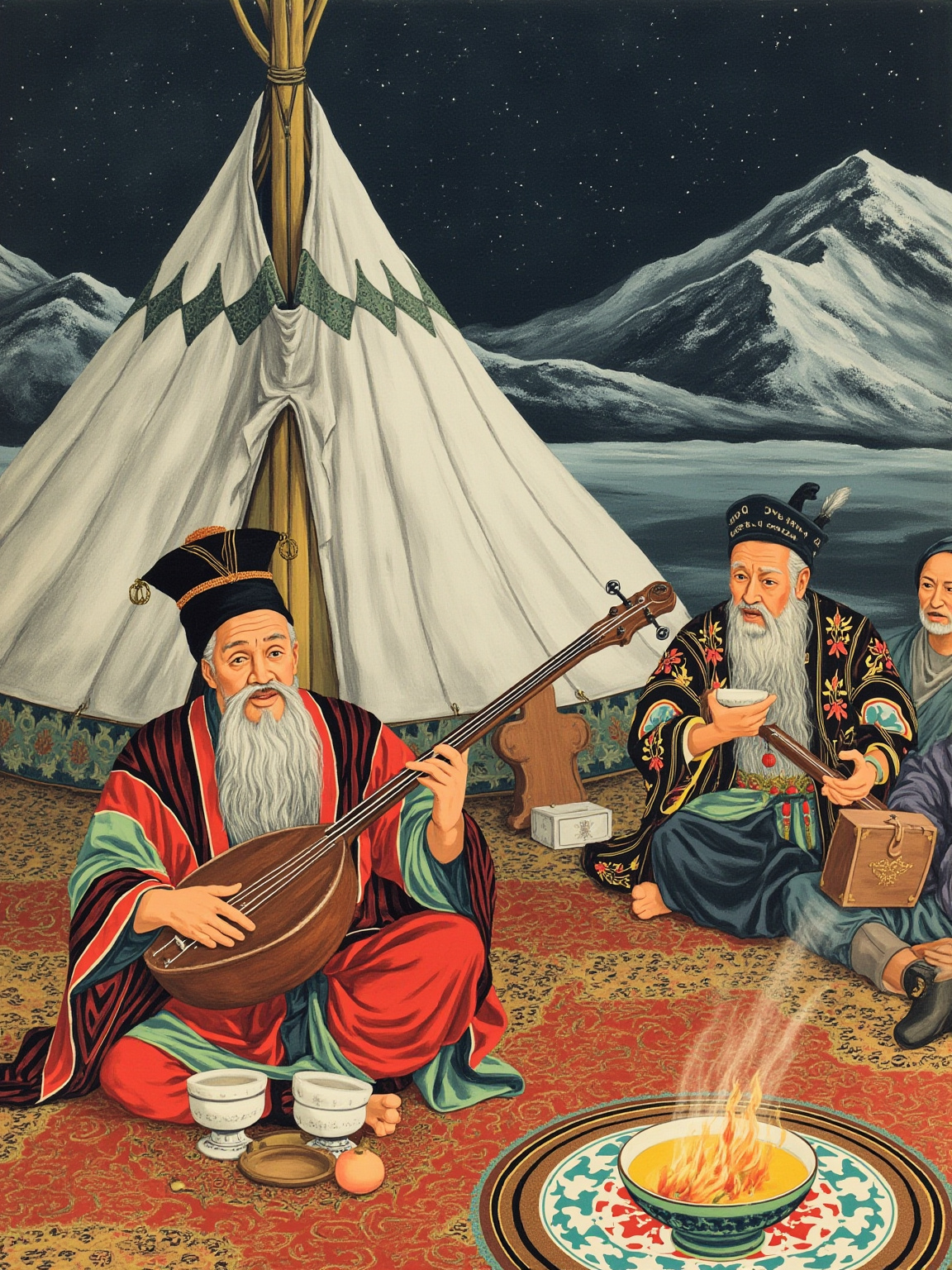
The white yurts ringed the field, the shyrdaks were spread, the komuz began to sing — the night the bards opened the longest feast.
白色毡房 boz üy 围成圈,花毡 shyrdaq 铺起来,库姆孜琴响了——这是整部史诗里最热闹的一夜。
金句 · 婚礼 · 最团圆的一幕
On the wedding night, the plot against him succeeds, the traditional telling pointing to a traitor's betrayal, and Manas falls. The first book breaks off on that whiplash: one verse he is still being sung to, the next verse the hero is gone. What makes this epic hardest to sit still through is not the fighting. It is this turn.
But the horse did not fall. Akkula stood over his master, whinnying in alarm, refusing to leave. The bloodline did not end either: Manas's son Seitek, carried off by the Tatans as a child, returns as a grown man to find his roots, a birthmark on his shoulder the proof of who he is; his wife, from the Alash tribe, crosses tribal lines to come to his aid, and stands in this epic for a woman's courage.
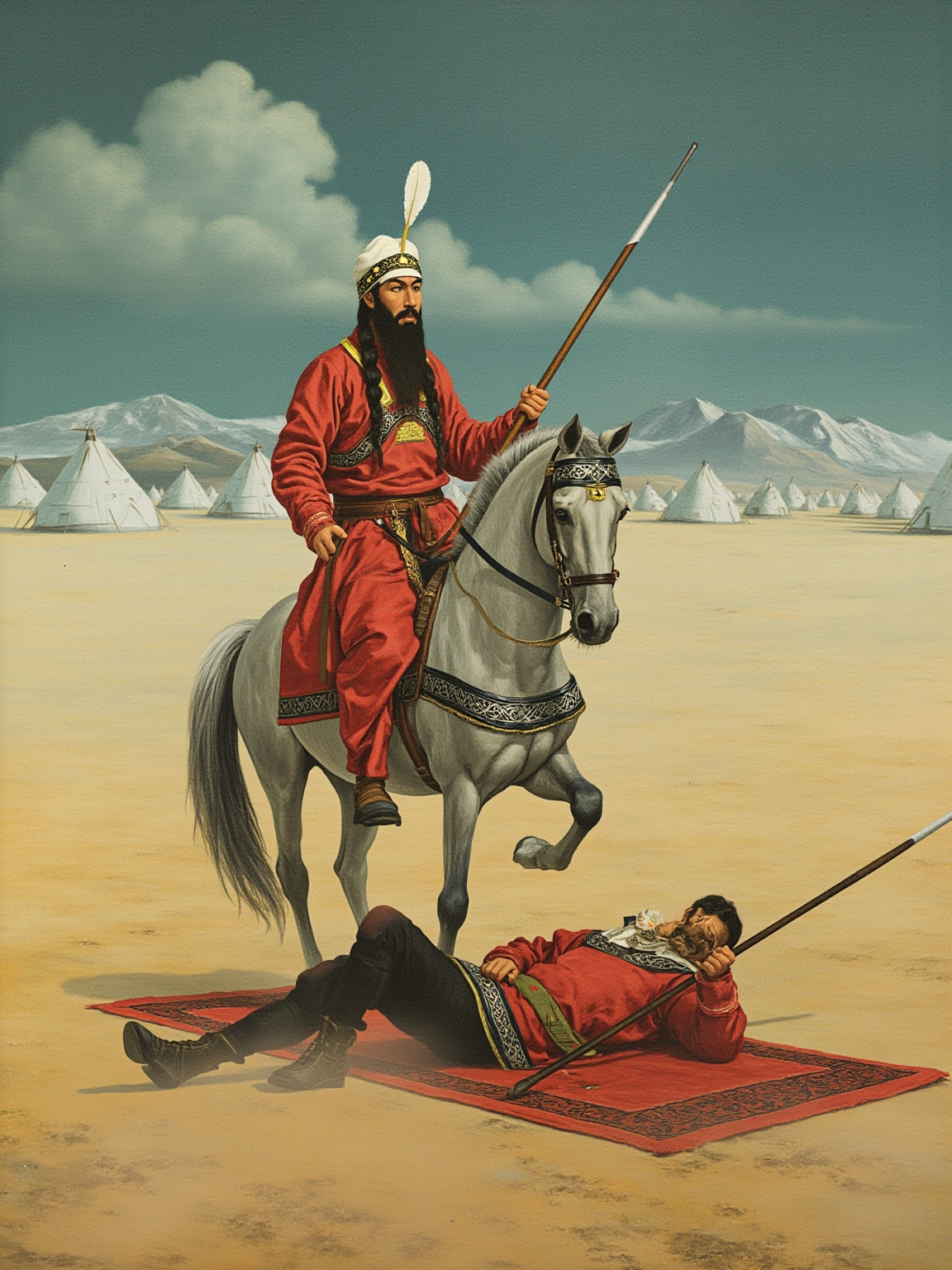
The hero fell in the night of the wedding; but Ak-Kula would not leave his master, and the bloodline did not break.
婚礼之夜玛纳斯倒下了——但马未倒,血脉未断,赛依铁克肩上的痣,是认亲的印记。
金句 · 英雄之死 · 马嘶与子嗣
So the living performance simply carries on: Book Two, Semetei; Book Three, Seitek; and on through two more generations of descendants in the books that follow. The relay runs eight generations deep. This is what sets Manas apart from most revenge epics: the hero can die and the epic does not end. One man falls, and the people keep singing.
What It Is Actually About
On the surface it is an army marching south and north. Underneath, it is a hymn to how a people becomes a people. How did the scattered Kyrgyz clans turn into something with a name that could be called out as one? That is the question this epic answers, not with an essay, but with eight generations of marriages, revenge, seasonal migrations, and funerals.
Underneath that, it is about a particular way of passing things down: this song was never written, it was sung. The sound of the komuz, the manaschi's gestures and the look on his face, the nights inside the yurt — none of that is decoration. It is the substance of the work itself. The Epic of King Gesar and the Epic of Jangar carry the same idea, but Manas is still the most alive of the three in performance, one of the few epics you can still hear sung live, night after night, without a break.
Why This Is the One Worth Picking Up
On a shelf, Manas usually sits next to the Epic of King Gesar, but of the three it is the one with the widest international reputation and the liveliest ongoing performance tradition. Its language was built for the ear, not the eye: short bursts of sentence, a clear beat, strong pictures, so that opening the book, you can hear an old man's voice in your head before you have read a page.
Its images are also immediately recognizable: the yurt, the horse, the snow peaks, the alpine lake, the komuz, a night with everyone gathered around the singer. A reader needs no background briefing to step into the scene. That is also why it lends itself so well to a singer-and-steppe-and-snow-peak kind of visual.
The Case for Reading the Text Itself
A companion guide, in the end, is only a map. A map has no smell of mutton broth inside the tent, none of the stubbornness of a manaschi still singing on the fourth day with his voice gone hoarse, none of the sound Akkula makes when he will not let anyone near his master's body. That kind of thing, the physical weight of it, the voice, how long the night actually runs, only comes through if you open the text itself and sit inside a passage for a while.
There is one more thing a guide cannot give you: when you reach the wedding-night scene, you look back and realize every earlier detail about Akkula, about Bakai, about Manas's mother, was quietly laid in place for this. That echo only arrives if you have turned the pages yourself. It is the kind of thread in the text you only see on a second reading; I sat with it a moment the first time I got there too.
A hero falls and the song does not end — that is the one structure of this epic you never forget.
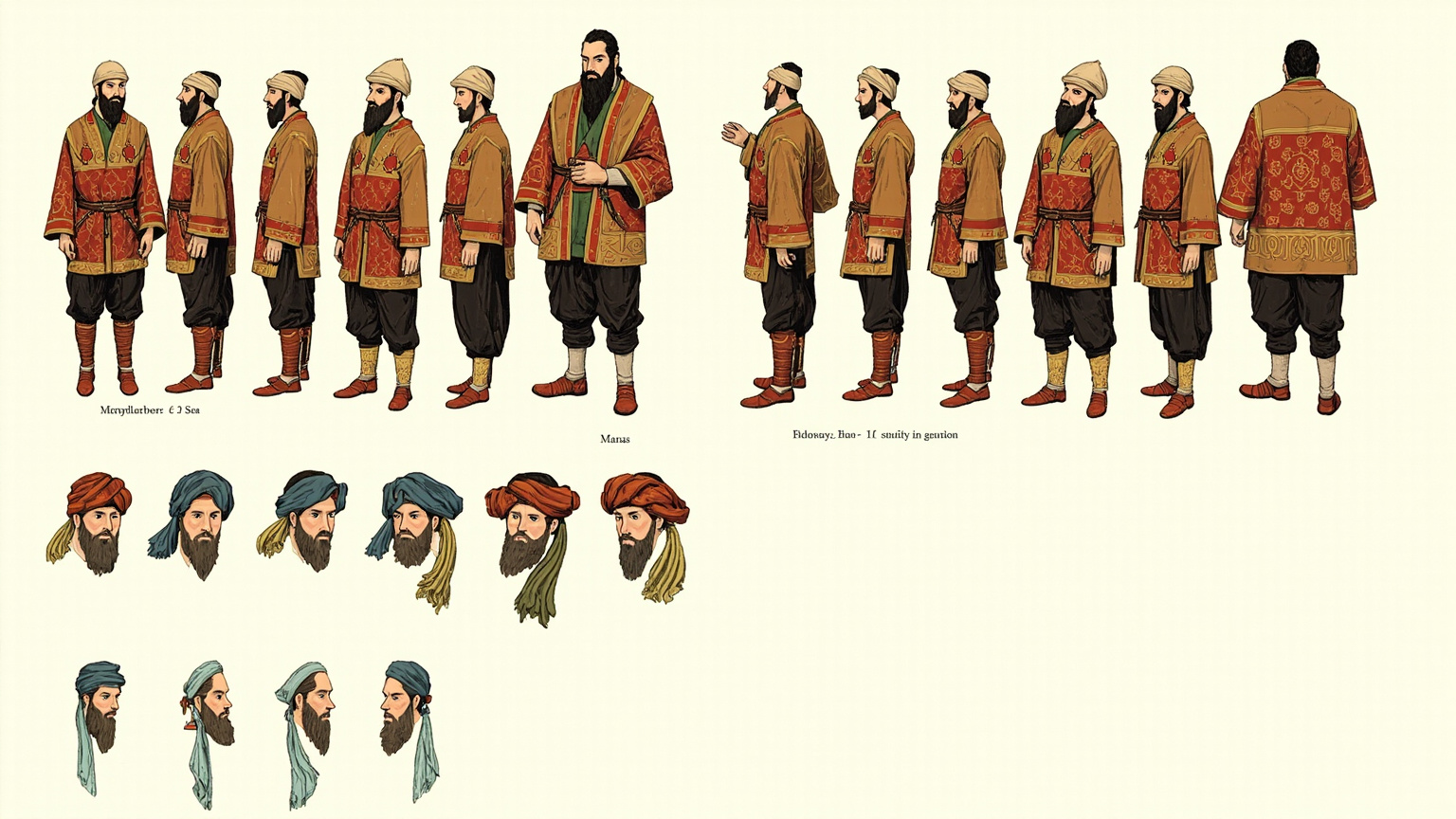
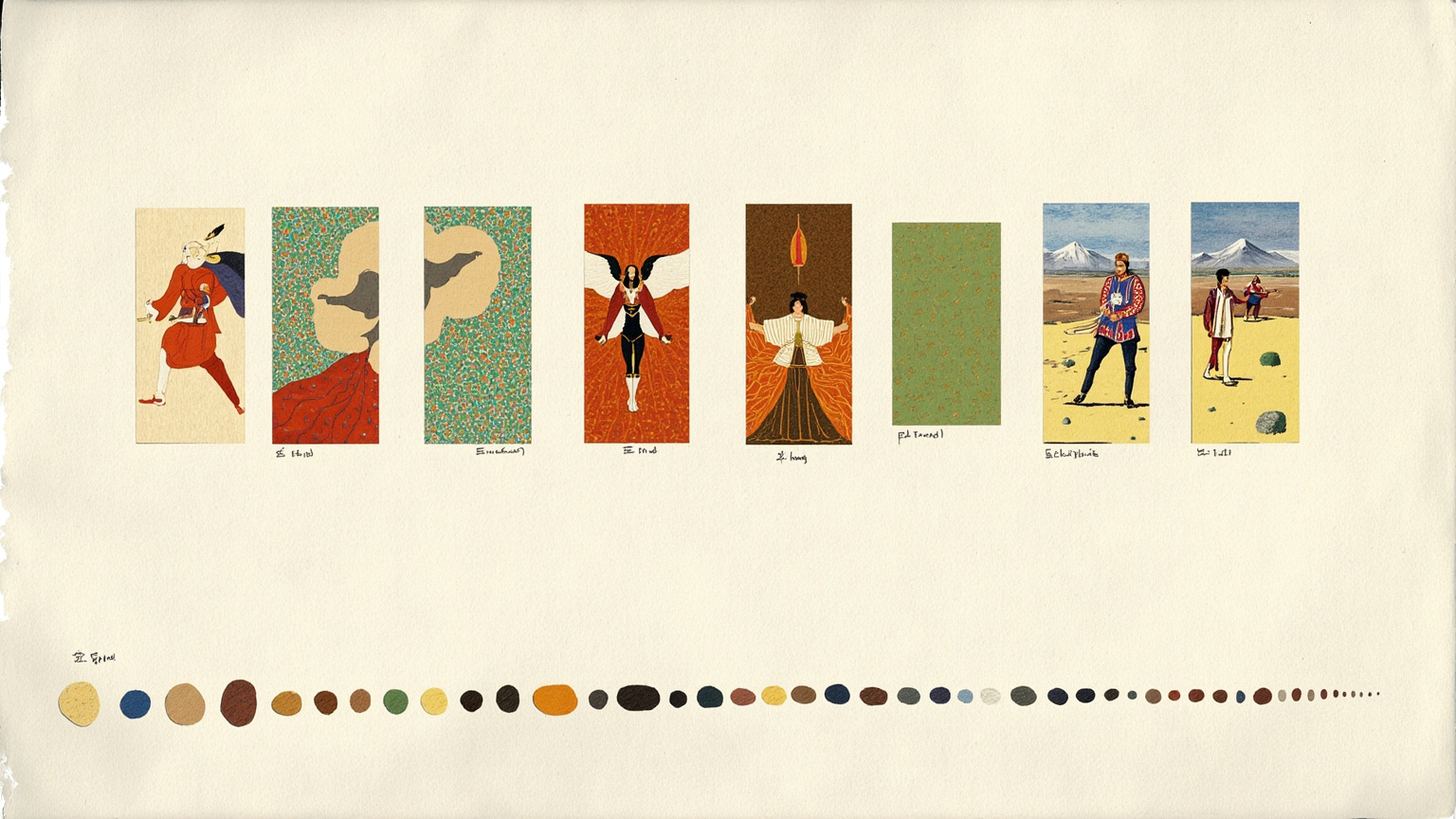
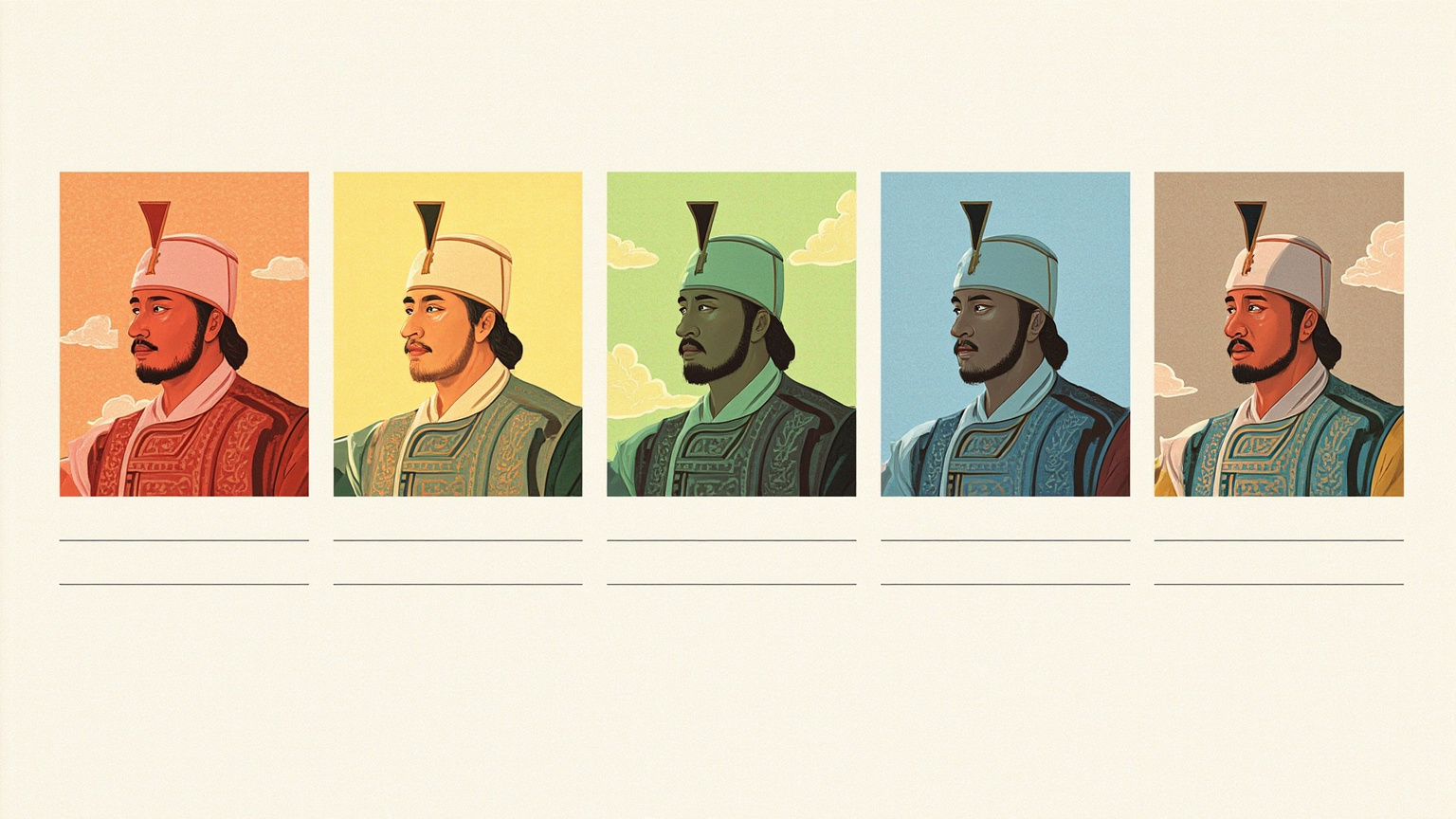
Art Direction4 plates
Before the guide was written, this book got a visual foundation — every illustration you just read grew out of it.