A man paralyzed in his early twenties works out death inside a four-hundred-year-old altar park, and slowly, afterward, learns how to live.
Text and illustrations produced by the pipeline
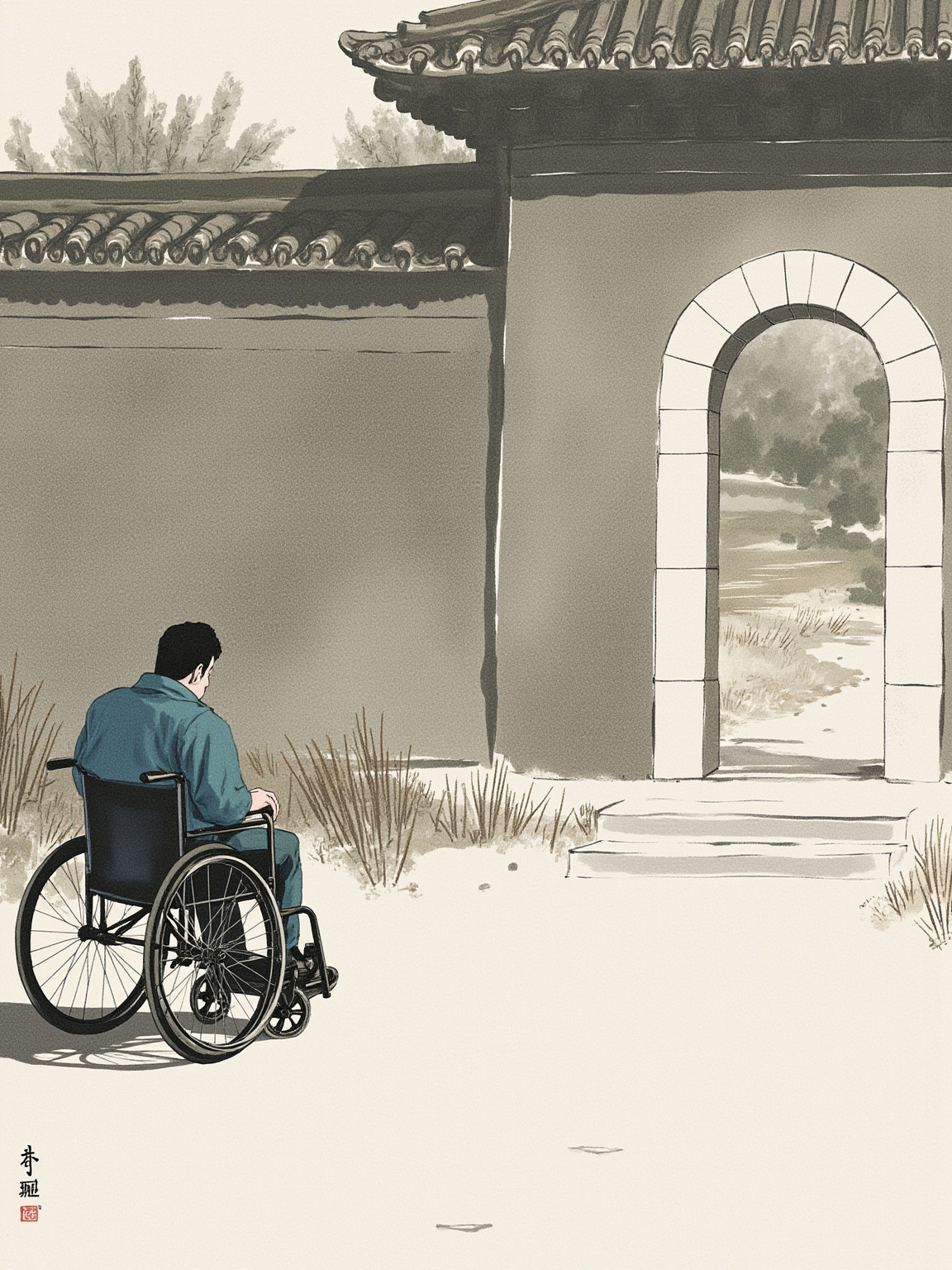
The vermilion walls have faded, the glazed tiles have crumbled away, weeds and wild vines shoot up through the cracks in the sunken steps, and old cypresses stand dense and dark. A young man in a wheelchair rolls into this ruined park nearest his home, day after day. He is at the age when a man is supposed to be reckless with his own strength, and his legs have suddenly stopped working. He sits in the shade for hours at a stretch, turning over the same question again and again: whether to die.
Me and the Temple of Earth is an essay Shi Tiesheng published in 1991, and one that no account of modern Chinese prose can skip. Shi was born in the middle of the twentieth century; he was paralyzed around 1972, later developed kidney disease, and lived for decades on dialysis. He wrote this essay after he had come through the worst of the breakdown that followed, and it has been printed in nearly every edition of the middle-school Chinese textbook since, a shared memory for generations of readers. Say the words Temple of Earth to a Chinese reader today, and the park itself is probably not what comes to mind first. This essay is.
A ruined park, a broken body, and a long reckoning with whether to go on living: out of these three things he wrote the quietest, most piercing chapter in modern Chinese prose.
There is only one short cast list to keep in mind: the author himself, his mother, and a handful of strangers he kept running into in the park over fifteen years. Shi Tiesheng is both narrator and subject, paralyzed in his early twenties, sent home from work to his family in Beijing, wheeling himself out every day to find somewhere he could sit unwatched. His mother is never given a name in the essay; she is simply a quiet woman who worried alone and died young, gone before her forties were even out, before her son had made anything of his writing. Everyone else lives in the Temple of Earth: a young man who trained for years as a long-distance runner and kept getting shut out by bad luck, a boy who sang among the pines and cypresses every morning, an old man who sat alone pouring his own wine, a middle-aged couple who walked the same loop at the same hour year after year, a pretty girl with a limited mind and the brother who never let go of her hand. For fifteen years they pass Shi Tiesheng's wheelchair again and again, with no names, only outlines.
The setting is simple to state: the Temple of Earth is the altar where Ming and Qing emperors made sacrifices to the earth, built in 1530, the ninth year of the Ming dynasty's Jiajing reign, and by Shi Tiesheng's time it had sat neglected for centuries, the nearest patch of forgotten ground to his home. He spent the years from the early 1970s to the early 1990s here, rebuilding himself mentally after the breakdown while his body only grew harder to move, even in a wheelchair. There is no invented world here, no premise beyond one man, one park, and the plain facts of birth, age, sickness, and death.
The essay closes on the seasons of the Temple of Earth. Sunset light shifts through the old cypress branches while Shi Tiesheng wheels himself around the park, loop after loop. He never claims the park saved him, and he never claims to have found sudden enlightenment; he never walked again in his life, and in his later years kidney disease set in, keeping him on dialysis for decades. He simply carries the old question of whether to die forward in a different form: since death is in no hurry, what do you intend to write while you're alive? The essay itself is his answer. He writes the seasons not for lyricism but to give time a shape you can see: falling leaves, cicadas, snow, new shoots. Through them the reader can feel, inch by inch, how one man endured fifteen years.
Before the guide was written, this book got a visual foundation — every illustration you just read grew out of it.
This should have been the age when he walked with the wind at his back. Instead his legs simply stopped obeying him. He came home to his family in Beijing; there was no going back to work, and friends were hard to face. He needed somewhere nobody would stare at him, and the nearest such place was the Temple of Earth, a few hundred meters away by wheelchair. From then on he rolled into the park every day, found a quiet corner, and sat there for hours. Four hundred years had worn the park down: the glazed tiles gone, the vermilion walls faded, weeds and wild vines pushing up through the broken steps. He sat in the middle of that ruin and thought, with total concentration, about dying.
Through those long, empty afternoons in the park, the question he kept circling back to was really just one: whether to die now. The line he finally arrived at, and later put into the essay, was that death is a festival bound to come, so there is no need to rush toward it, and once that was settled, what remained was simpler: how to live. This is not a comforting slogan. It is the scarred conclusion of a paralyzed young man in his twenties who had actually thought the question of life and death all the way through. Shi Tiesheng writes the heaviest thing here with an oddly light touch: he does not dwell on the pain or stage an emotional storm the way most people would. Instead he compresses the whole realization into a single image, and that image becomes the philosophical anchor of the entire essay. The question quietly shifts from whether to die to how to live, and that is the essay's real turning point: no dramatic event, just one young man's mind moving one notch over.
His mother, in fact, never once tried to stop him. Every day he wheeled himself off to the Temple of Earth, and every day she was sick with worry, but she never said so out loud; she was afraid that if she held him back, he would stop going outside altogether. Only later did he piece the truth together from a neighbor: while he was gone, she would often slip into the park herself, search it for his wheelchair, and once she found him, say nothing. She would just look at him from a distance, then withdraw before he noticed. She was afraid of interrupting his thoughts, and afraid that the sight of her would upset him. Shi Tiesheng writes his mother through her exits, not her presence; the full emotional weight of her lands precisely at the moment she turns and walks away. He had no idea, at the time, that his mother was pacing that park looking for him. It took him years before he could write about it without the pain stopping him.
Worse still, he understood almost none of her devotion while she was alive. In his worst moods he even shouted at her; in those first years after the paralysis, his temper frightened even himself, and his mother was the easiest target for it. By the time writing had started to pull him back out, she was already gone: liver disease, and it took her fast. She never lived to see her son make his name as a writer, never got to hear anyone tell her that her son had become an author. That late, useless regret is the most piercing passage in the whole essay. He never simply writes I regret it. Instead he keeps returning to the details of his mother searching for him in the park, retracing the same path and the same turn of her back again and again, and each retelling cuts a little deeper.
Partway through, Shi Tiesheng sets himself aside to write about the people he kept running into in the park over those fifteen years. His method turns suddenly spare here, like a charcoal sketch: only the outline, none of the shading. The one who moves him most is a young long-distance runner, who trained hard year after year and was good enough long before he needed to be, yet kept getting shut out of the official selections by nothing but bad luck, not because he failed to try, but because in that era plenty of effort simply didn't count. A boy who loved to sing belted out a few lines under the pines and cypresses every morning; Shi Tiesheng rolled past him for fifteen years and never once spoke to him. An old man sat alone pouring his own wine, came, and left again. A middle-aged couple walked the same loop at the same hour, and fifteen years later their clothes had changed several times over but their pace never had. None of these people gets a name or an ending, only a silhouette that keeps reappearing, and it is exactly that omission that makes each one seem to stand up off the page. Readers can't help filling in a whole life for them in their own heads.
Hardest to watch are the girl with a limited mind and her brother. She is pretty, and entirely unaware that she's different from anyone else, crouching by the path to gather blades of grass, pebbles, shards of glass with total seriousness. Her brother is always right behind her, holding her hand, never taking his eyes off her. In them Shi Tiesheng sees another kind of brokenness, not a ruined body but a twisted fate, and another kind of steadfastness. He never turns the two of them into a sentimental set piece; it's a few strokes of plain description, and the power of those strokes is exactly that they don't explain or exclaim. That hand, holding hers the whole way through, never gets a single line of dialogue, and it carries more weight than words could.
What makes this essay work is that it never leans on plot. There's no conflict, no antagonist, no twist, only one man and one park settling an inner account that took fifteen years. It writes about death in the most restrained words it can find, pressing the whole realization into a single image instead of any wailing. It writes about a mother's love through her exits: she comes quietly and leaves quietly, and that carries more than any embrace could. The prose is so plain it's nearly colorless, yet every word feels worn smooth against the steel rim of a wheelchair. Reading it doesn't feel like being lectured. It feels like a friend crouched down beside your wheelchair, staying with you until you've finished thinking something through.
A companion guide can tell you what he thought, how his mother died, who else was in the park, but it can't give you the physical sensation of sitting inside a four-hundred-year-old ruin under the shade of old cypresses. The original has long passages describing the park's weeds, its peeling walls, the sunset, the cicadas, writing built to press the reader's whole body into that scene. It also has the details of his mother's quiet exits, scattered across the essay and returning again and again, and every rereading brings a new edge of the blade. Knowing the outline in advance actually makes it easier to read the original: you won't be tripped up by plot, and you can go straight to meeting his sentences, plain to the point of nearly having no color at all.