My Universities (Мои университеты) · Companion Guide
我的大学
一个外省少年揣着上大学的梦走进喀山,却被门挡在外面——于是码头、面包房与贫民窟的深夜,成了他真正的课堂。
Opening: He arrives carrying his dreams, the door closes behind him
Sixteen-year-old Alyosha stands on the stone steps of Kazan, behind him the barges and the haulers' chants at the Volga wharves. He has almost no money in his pockets, but in his head he carries the most absurd idea a provincial boy can have: pass the university entrance exams. An unschooled orphan raised on his own reading wants to knock on the door of Kazan University — and the door, of course, doesn't open. Yefreinov, a gymnasium student who brought him to Kazan, takes him in out of kindness and gives him a corner in a garret. But no garret, however small, can hold two people for long. So the boy with the university dream is kicked by fate into a different classroom: the Volga wharves, the cellar of a bakery, the crooked wooden houses of the slums.
What kind of book is this
My Universities is the third and final volume of Gorky's autobiographical trilogy — the first two, My Childhood and In the World, cover his childhood at his grandfather's house and his years of wandering; this one lands him in 1880s Kazan. Gorky's real name was Alexei Maximovich Peshkov; 'Gorky' is a pen name meaning 'bitter.' His standing as a founder of socialist-realist literature rests in large part on these autobiographies: personal hungers and freezings welded to a cross-section of the era's underclass. He finished and published My Universities in 1923; that was the last piece of the puzzle.
Characters and the people around him
Alyosha is the story's legs and stomach, and its eyes. He is sixteen, thin, hungry, consumed by books, and bent on figuring out why people are alive. Yefreinov, the gymnasium student who brought him to Kazan, has mathematical ambitions; he is warm-hearted, but his own livelihood leaves him nothing to spare, and he can be Alyosha's first guide — but never his savior. At the docks and in the slums, Alyosha meets Guri Pletnev, a young typesetter his own age. The two share a broken bed, and Guri presses banned books into his hands and walks him into his first underground-circle meeting. Then there is the figure who can't be left out: Andrei Derenkov, who runs a small grocery-cum-bakery and sympathizes with the revolutionaries. He gives Alyosha work in the back kitchen and, along with it, a table at which he can eavesdrop on debates among the Narodnik youth.
And finally, Mikhail Roman — a steady, practical-minded Narodnik revolutionary, considerably more grounded than the young men who run on theory. He later leads Alyosha out of Kazan proper and down to a village on the Volga, to meet actual peasants. Roman is less an enlightener than an uncle who keeps his own counsel; through him Alyosha sees, for the first time, what happens when the slogan 'go to the people' runs into how Russian villages actually work.
The docks and the bakery: his first classroom
Alyosha goes down to the Volga docks looking for work. Kazan's liveliest and roughest corner: dockers hauling sacks sway along the gangplanks, sweat mingling with the river's stink, the foreman's shouting and drunks' cursing-laughter all tangled together. He does the heaviest labor and earns black bread, a bowl of thin soup, and a bunk that lets him collapse to the floor. Gorky writes this stretch with real physicality — not "he suffered a great deal," but "the red welts the sacks pressed into his shoulders turned purple the next day."
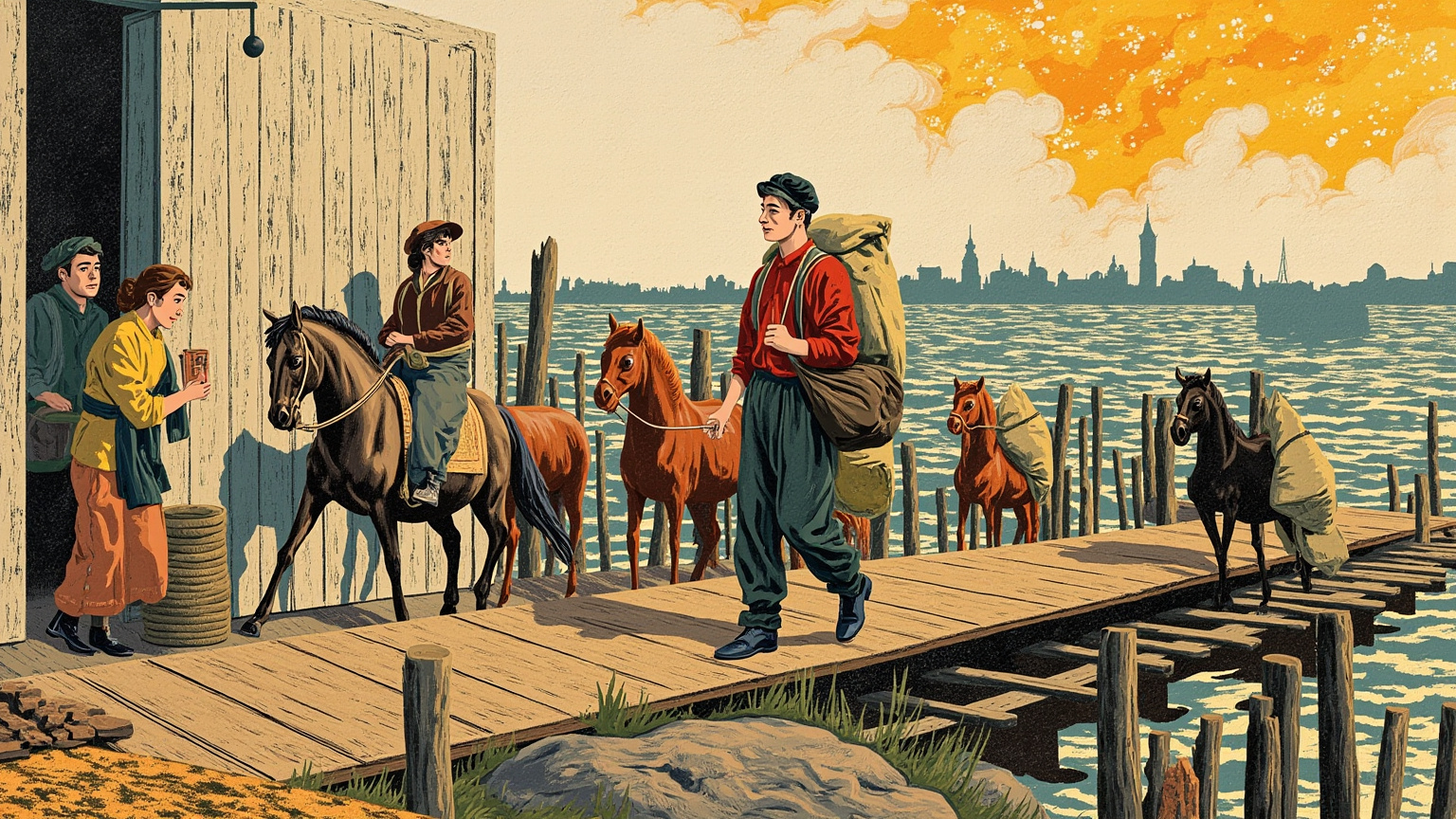
I stood on the gang-plank, feeling the sullen thud of the Volga against my feet, and watched the freighters run past with their backs bent like bows.
我站在跳板上,伏尔加河的浊浪拍着脚踝,搬运工们弯成弓一样的脊背从我眼前一道道掠过。
金句 · 第1章 · 码头的跳板
Then he lands at a shopkeeper's grocery and bakery. The cellar oven runs hot, the flour sacks are white, but that warmth has to be earned hand over hand. The shopkeeper is an interesting man, a small proprietor bent under the weight of his own life, who quietly turns over the back room of the bakery to a pack of dubious young people for meetings, reading, and argument. Alyosha hears, for the first time, the words "peasant," "land," "revolution" spoken with the gravity they deserve. In craft terms, Gorky doesn't write that Alyosha "was shaken." He writes Alyosha crouching by the oven, still clutching a piece of burnt bread, ears pricked, a contrast that hits harder than any psychological description.
The slum's midnight oil: stolen books and underground circles
What truly changes Alyosha is the world Guri Pletnyov pulls him into. The slum's wooden shanties crowd together crookedly along the low riverbank, seven or eight families to a room, too poor to light more than a few lamps at night. Guri's bedside is always stacked with books, books banned under the tsar, the kind no bookseller could put on open display. Late at night, by the lamp, Guri turns the pages and explains in a low voice to Alyosha, while outside drunks curse and babies wail.
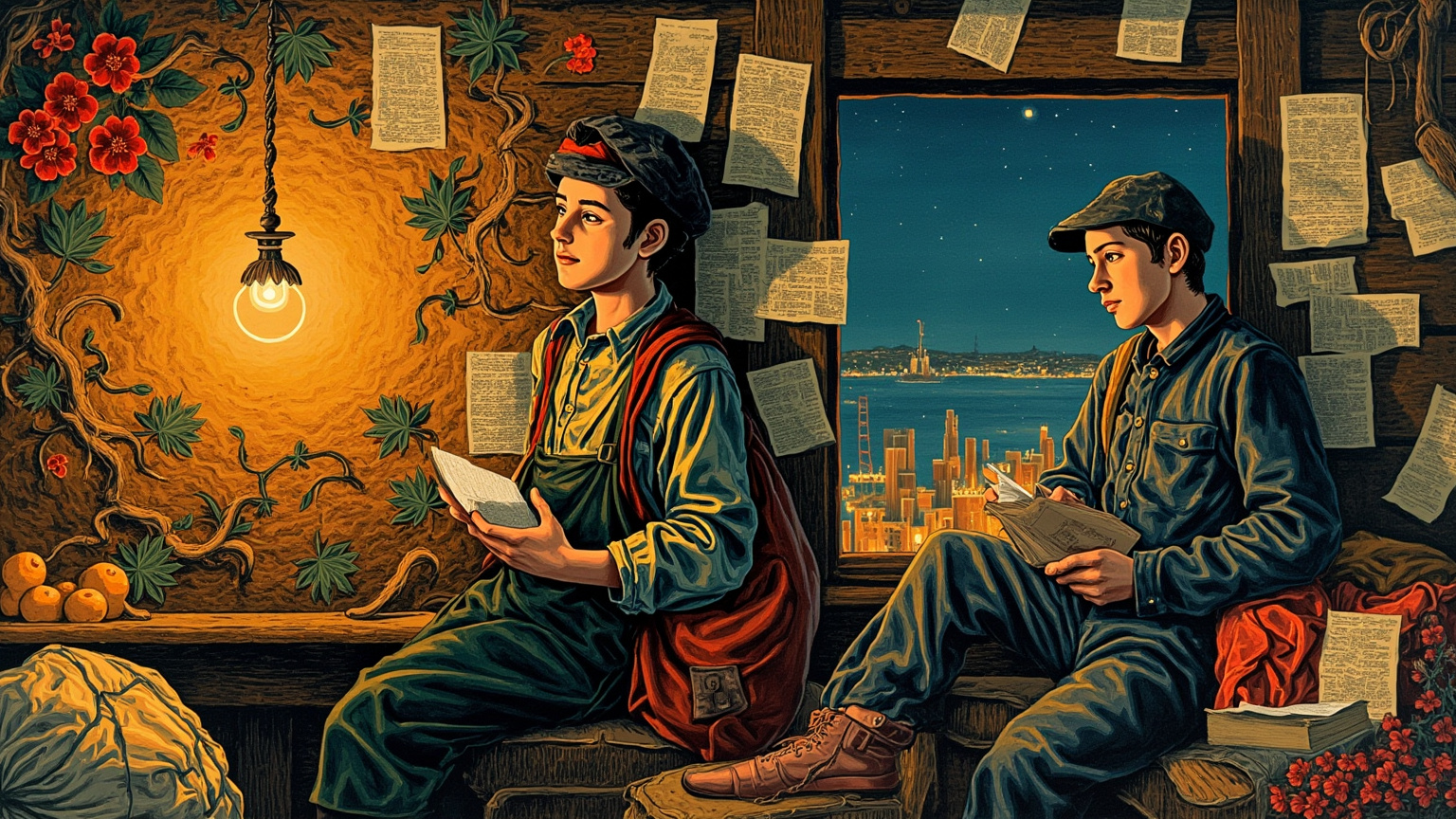
He brought forbidden books the way others bring bread — folded under his coat, in the dark, as though each page were a small, smuggled life.
他把禁书像面包一样带进屋——揣在大衣底下,趁着夜色,仿佛每一页都是一小条偷运来的命。
金句 · 第3章 · 贫民窟的木屋
The Populist underground meets here. Mostly students, young workers, restless high-school boys — they debate "going to the people," debate bringing the truth to the peasants. Gorky doesn't build these gatherings out of adjectives. He writes who shouts loudest, who falls asleep mid-argument, who gets refuted into silence, and the reader follows Alyosha into the back room, listens to them quarrel, and gets caught up in the same excitement, the same doubt. It is a clever piece of writing: he does not cast the Populist youth as saints, but as twenty-somethings, awkward, sincere. Alyosha sees, for the first time, what "idealism" looks like when worn by a living person.
The morning after the gunshot
Alyosha's crisis doesn't arrive all at once. It wears him down, piece by piece, through hunger, loneliness, doubt about his own worth. The Kazan winter is long, he can't find work, only a thin coat on his back, half a loaf in his belly that won't see him through to dark. He borrows an old pistol and one night fires it into his own chest, and lives. Pulled back from the edge, he comes out harder than before, not numb but carrying "I've got to figure this out" like a fresh resolve. This stroke carries real weight in the original: Gorky doesn't frame it as the climax of suffering, but as a boy passing sentence on himself, then being overruled by life.
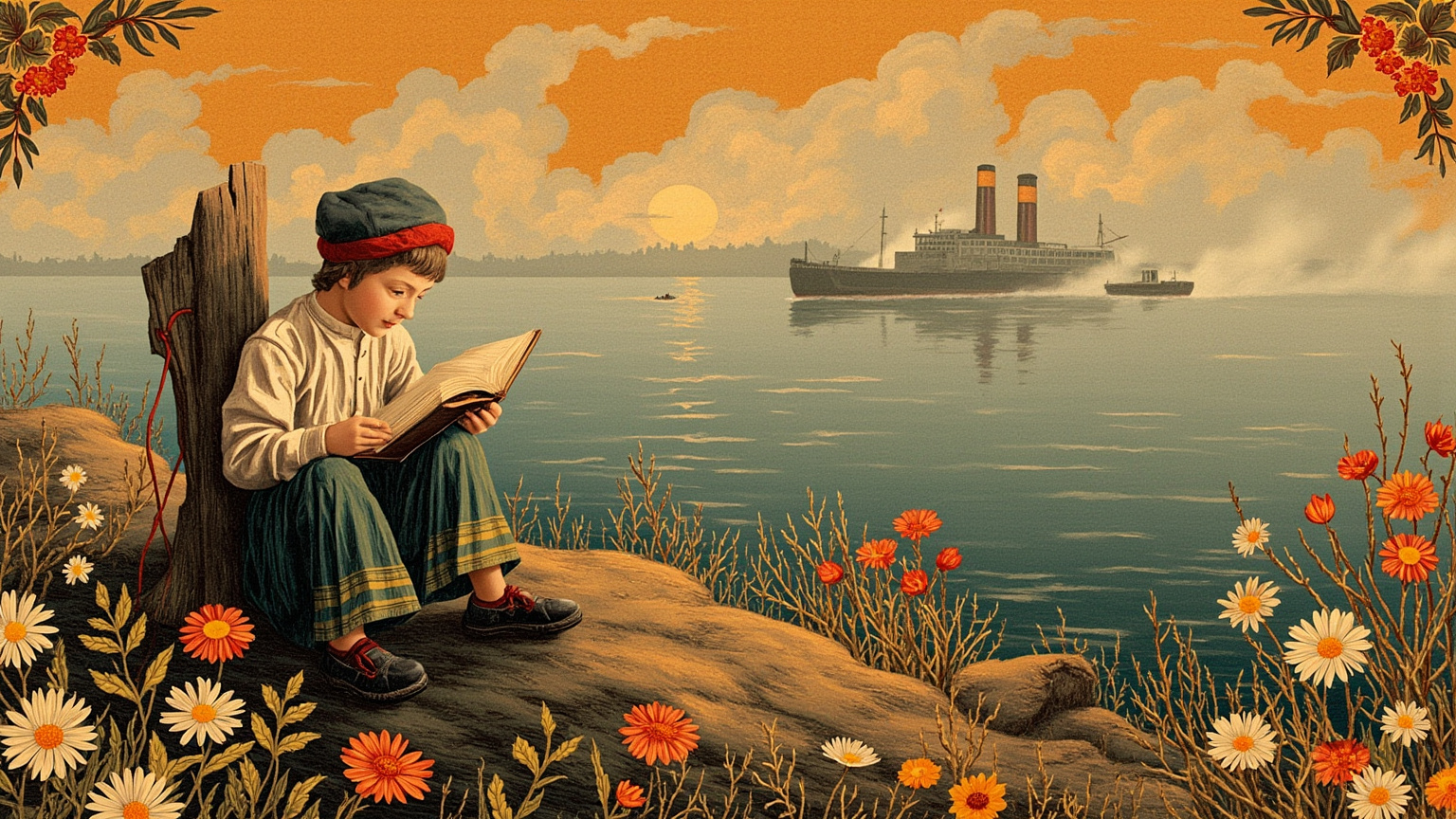
I pulled the trigger — and missed, or was missed by — my own chest. The shot was smaller than the hunger that had driven my hand.
我扣下扳机——那一枪比我举起它的饥饿还要小,没能打中胸口,也没打中心里真正疼的地方。
金句 · 第5章 · 喀山的冬天
Going to the countryside with Romas: ideals meet the mud
Once his body recovered, Lomas took Alyosha to a village on the Volga, to 'go among the people.' This is the part of the book most worth reading closely. Two young men from the city walked into a village with leaflets and pamphlets, expecting the peasants to crowd around and hear the truth. Instead the peasants looked at them with wariness, suspicion, and in some cases a curl of mockery. They had assumed that suffering made the peasants ready to welcome an explanation of the revolution. But the old Russian peasant had his own way of suffering, his own way of believing, and his own silence, pressed into him over centuries.
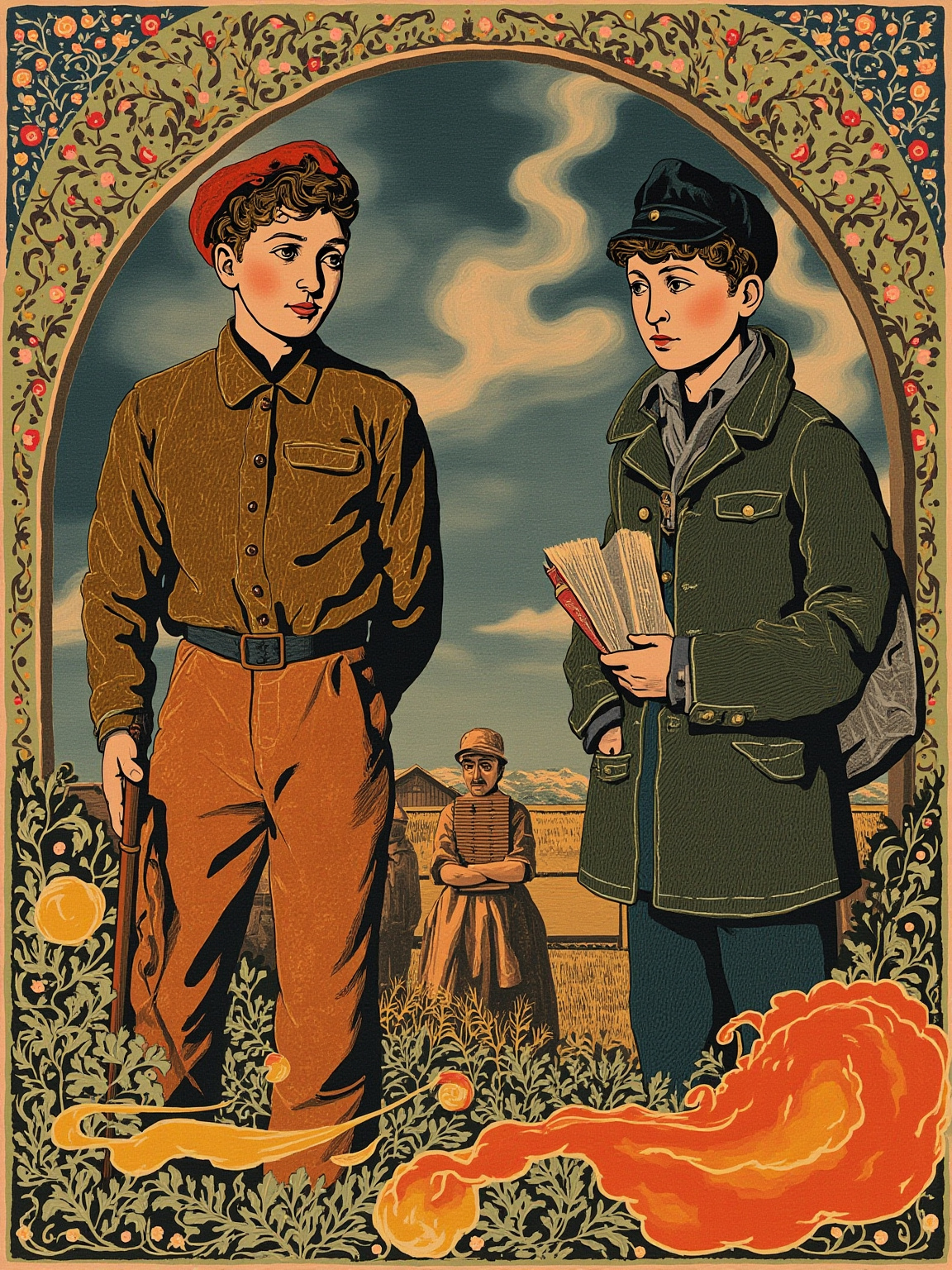
The muzhiks listened to us the way one listens to a stranger's dog — politely, and without the least intention of letting it in.
农民听我们讲话,就像听一条外人家跑来的狗叫——客客气气的,却根本没打算让它进门。
金句 · 第6章 · 到民间去
Gorky writes this stretch with considerable restraint. He doesn't let Alyosha achieve political awakening, nor does he let him fall into disillusionment. Instead Alyosha notices for the first time that between him and the peasants there stands a wall he cannot see. For a boy in his early teens, that is heavier than hunger. He discovers that 'understanding the people' cannot be done with passion alone. I paused here too, taken aback. A writer who writes revolutionaries, daring to make his youngest one so inadequate on the page.
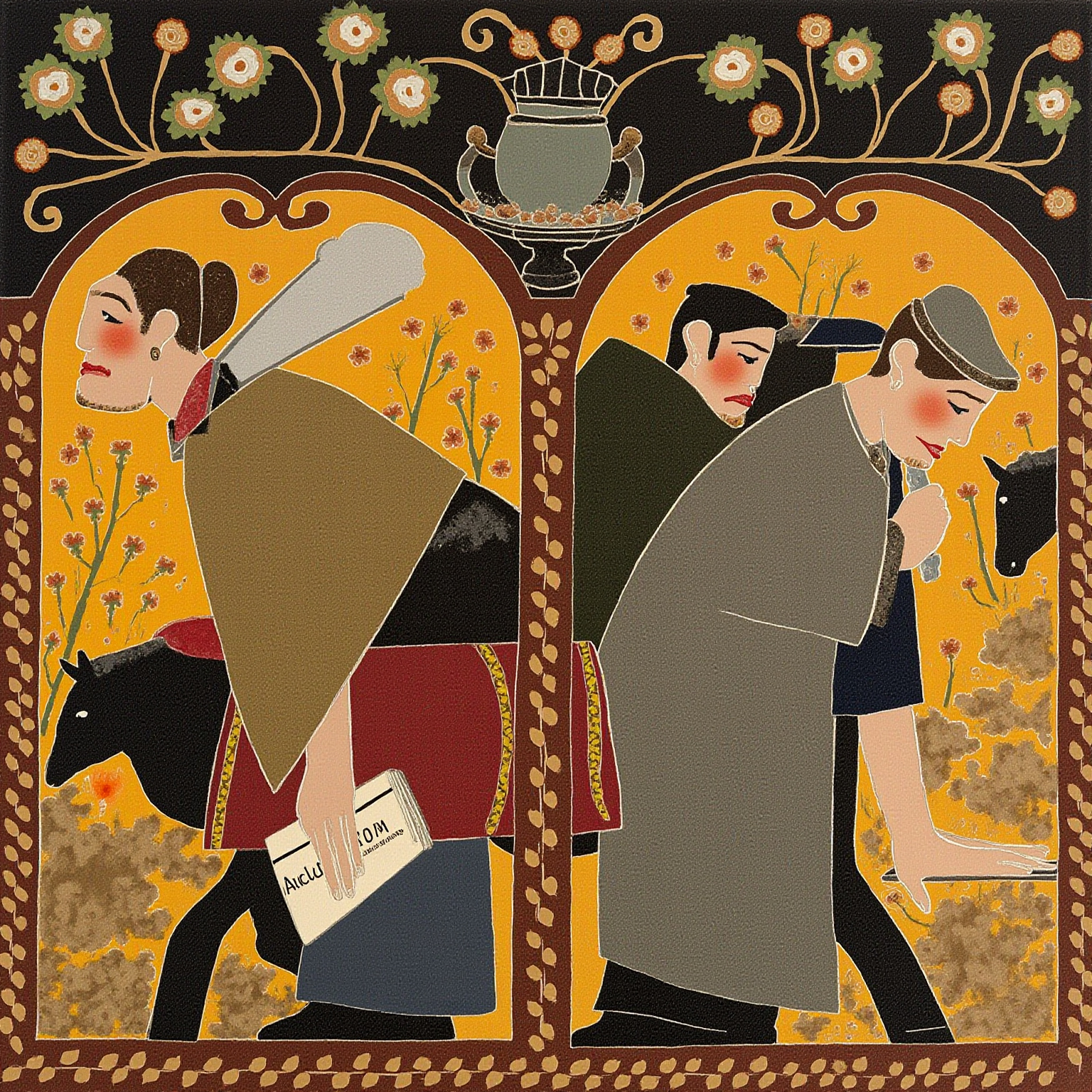
It was the first time I clearly saw the wall that stands between a man and the people he has come to love and instruct.
那是我第一次清清楚楚地看见——一个人和他想要去爱、去教导的人民之间,原来隔着一堵墙。
金句 · 第6章 · 村子里的一天
Leaving Kazan, the trilogy closes
Alyosha finally leaves Kazan. He never got a diploma, never became a university student, never became anyone particular. But he carries with him everything he has 'read' from the docks, the bakeries, the slums, and the underground circles, and he keeps walking. That is the whole irony of the book's title, and its most moving part. With My Universities finished, Gorky's autobiographical trilogy closes. Childhood is about being crushed under his grandfather's roof. In the World is about drifting along the bottom of society. My Universities is about starting to dig down into himself and the world. Read together, the three are a diploma no one can take back, paid for in hunger.
What the book is about, and why it is still worth reading
The theme sounds simple enough: for people at the bottom, what shapes a person is never the classroom. It is life itself. Gorky's real skill is that he doesn't shout this as a maxim. He kneads it into the shoulders that carry Alyosha's daily loads, the charred crust of bread, the dog-eared banned book read by lamplight past midnight. A reader today finds more than a Russian boy's old story. They find an old question about self-teaching and self-education: when the proper doors are closed to you, are you willing and able to dig a schooling out of the mud of life itself. The question never goes stale.
What makes the writing work is also worth pointing out. Gorky writes about the bottom not through pathos but through smell, temperature, and sound: the sting of flour in the face, the crack of breaking ice on the Volga in winter, the cry of a slum child at midnight. He doesn't sanctify his idealists either. They are just a group of young people arguing seriously in a shabby wooden house. That honesty is what has kept this autobiography from wearing away.
Alyosha never got a diploma, but he read the docks, the bakeries, and the slums after dark as his textbooks. That is the degree Gorky earned with a lifetime of hunger, and no one can take it back.
You know the plot — so why bother with the book itself?
An explainer can hand you the skeleton, but it cannot give you the moment Gorky's pen runs across Alyosha's skin. Open the book and you meet the boy crouching by the oven, gripping a charred crust of bread. You hear the Volga barge's whistle in a winter fog. You find Guri on the wooden bed, lowering his voice over forbidden pages while drunks curse outside the window. No summary can bring back details this bodily, this sonic, this redolent of bread and river. Once you know Alyosha never passed the university entrance, once you know what his "university" actually was, you find yourself reading the book more slowly, not less. Every hunger he suffered, every page he turned, every fist he took now has somewhere to land.
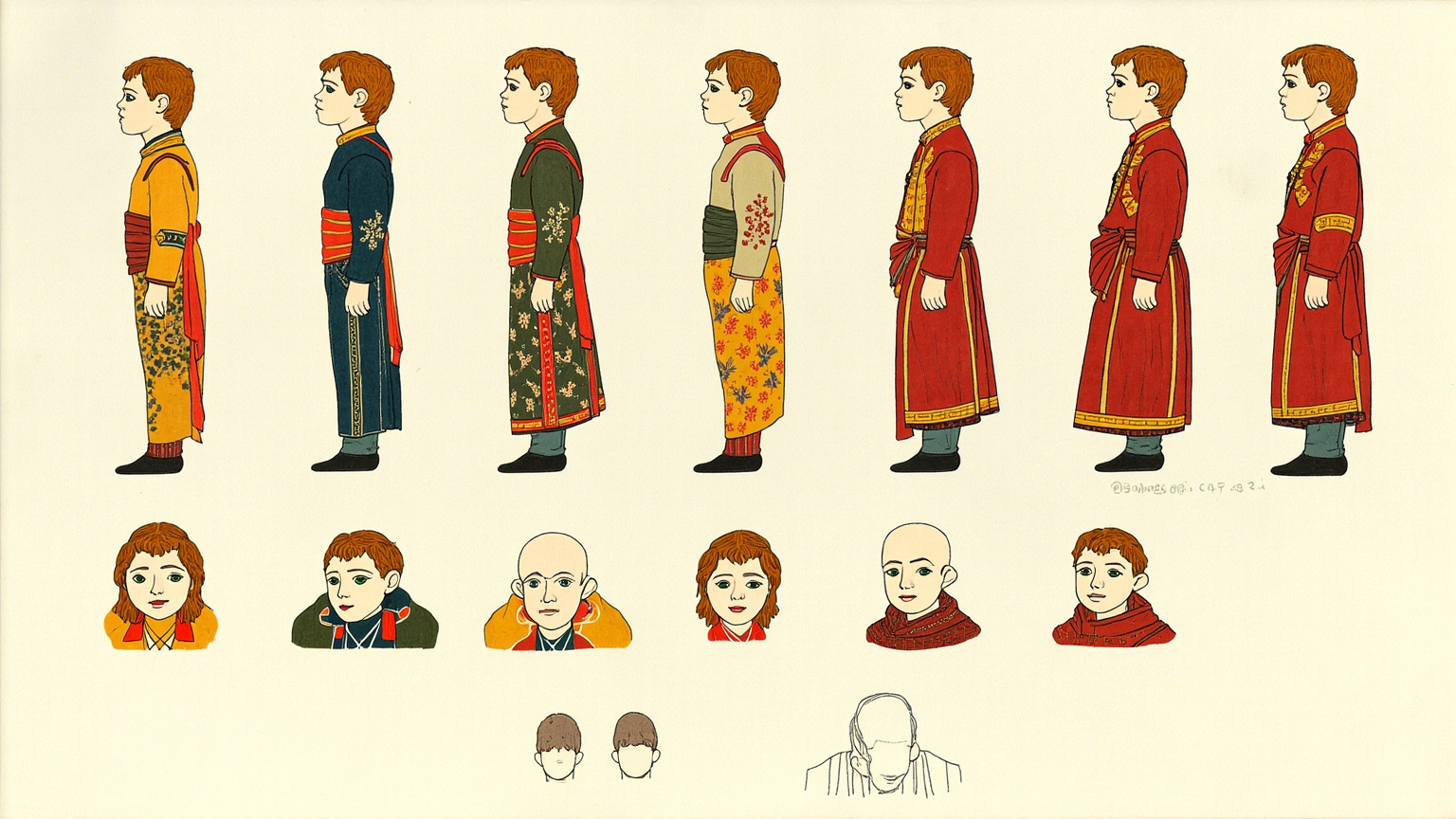
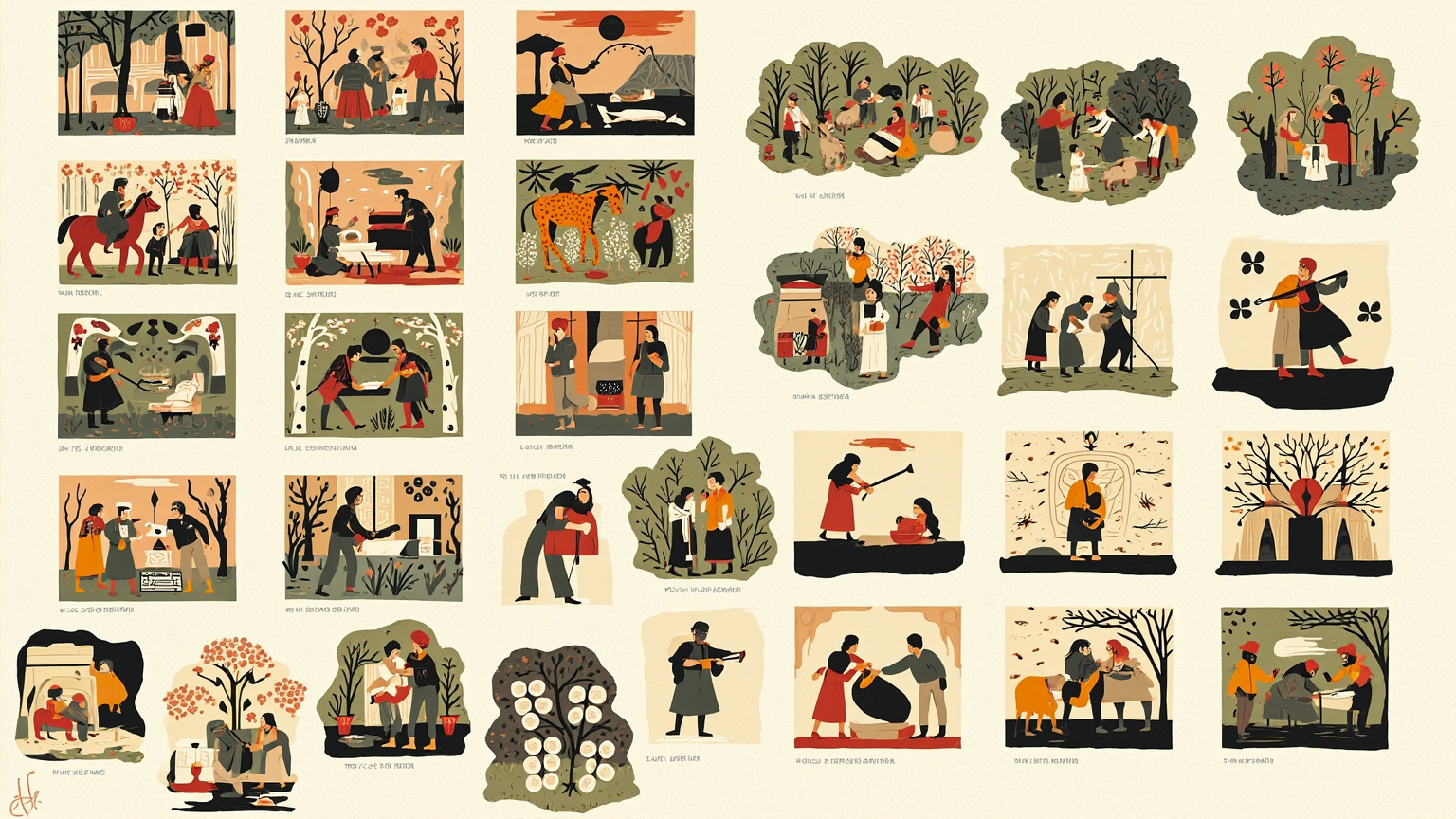
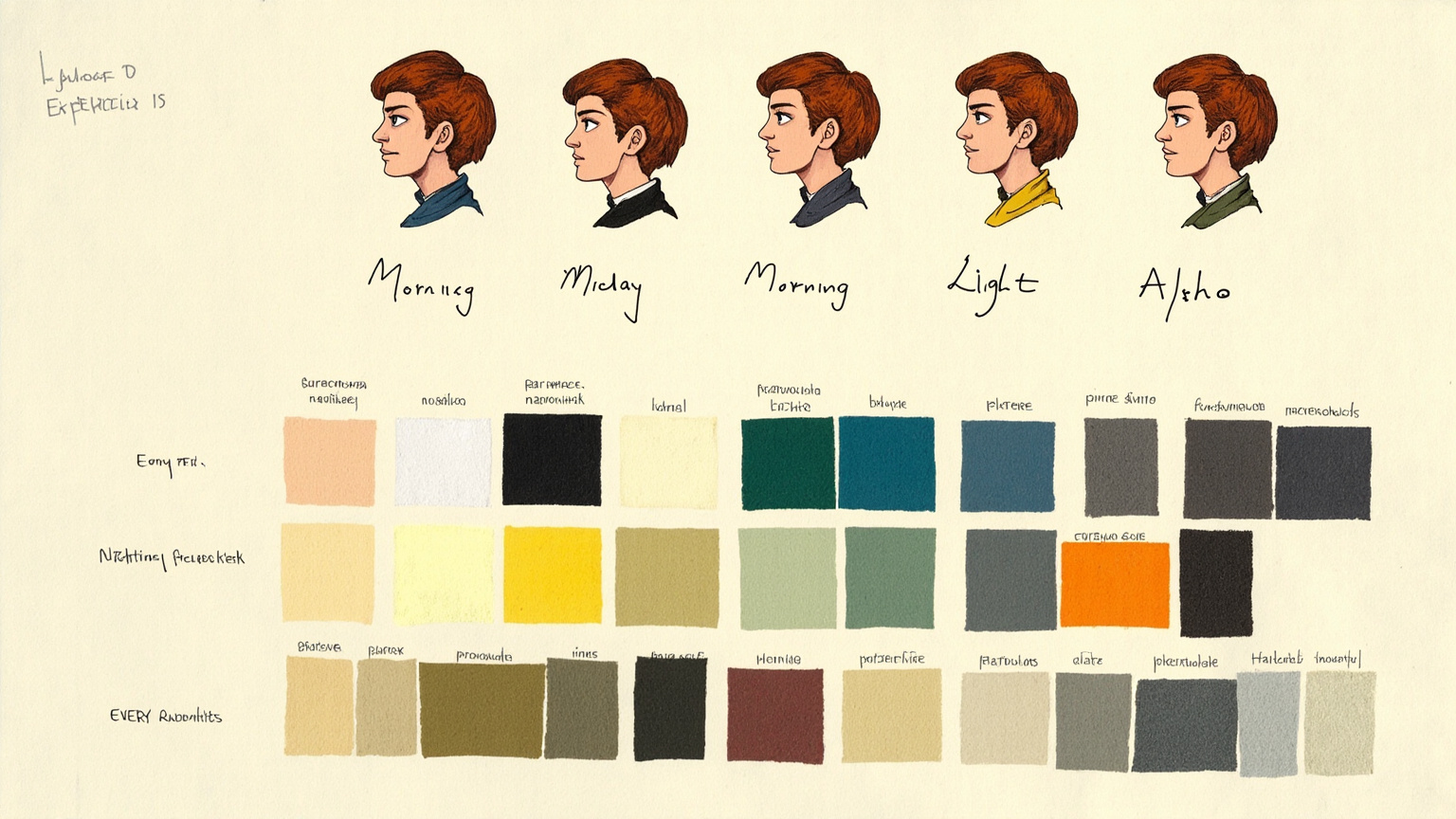
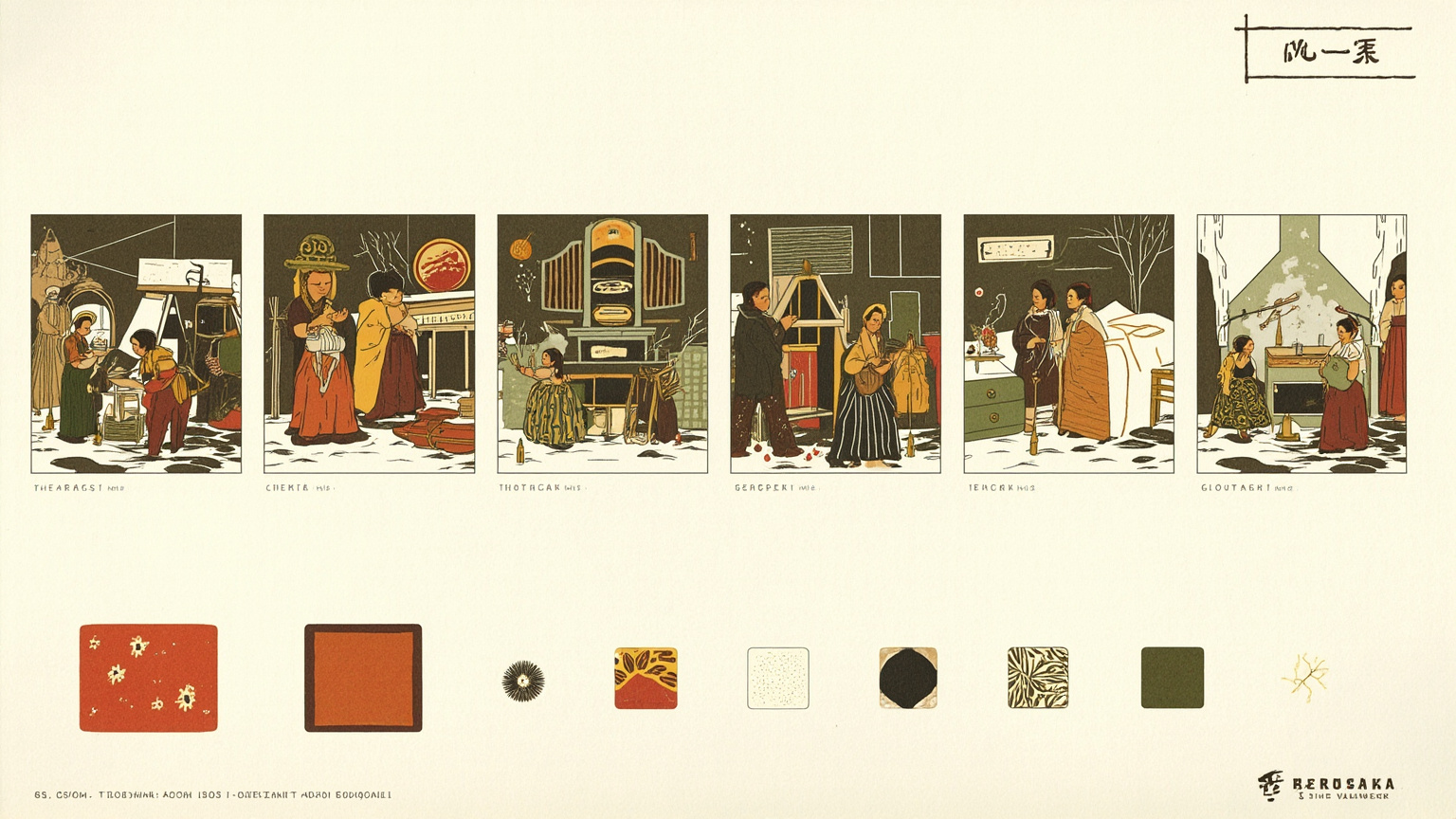
Art Direction4 plates
Before the guide was written, this book got a visual foundation — every illustration you just read grew out of it.