A lonely boy's journey across the galaxy, the unfinished work Kenji Miyazawa left behind
Text and illustrations produced by the pipeline
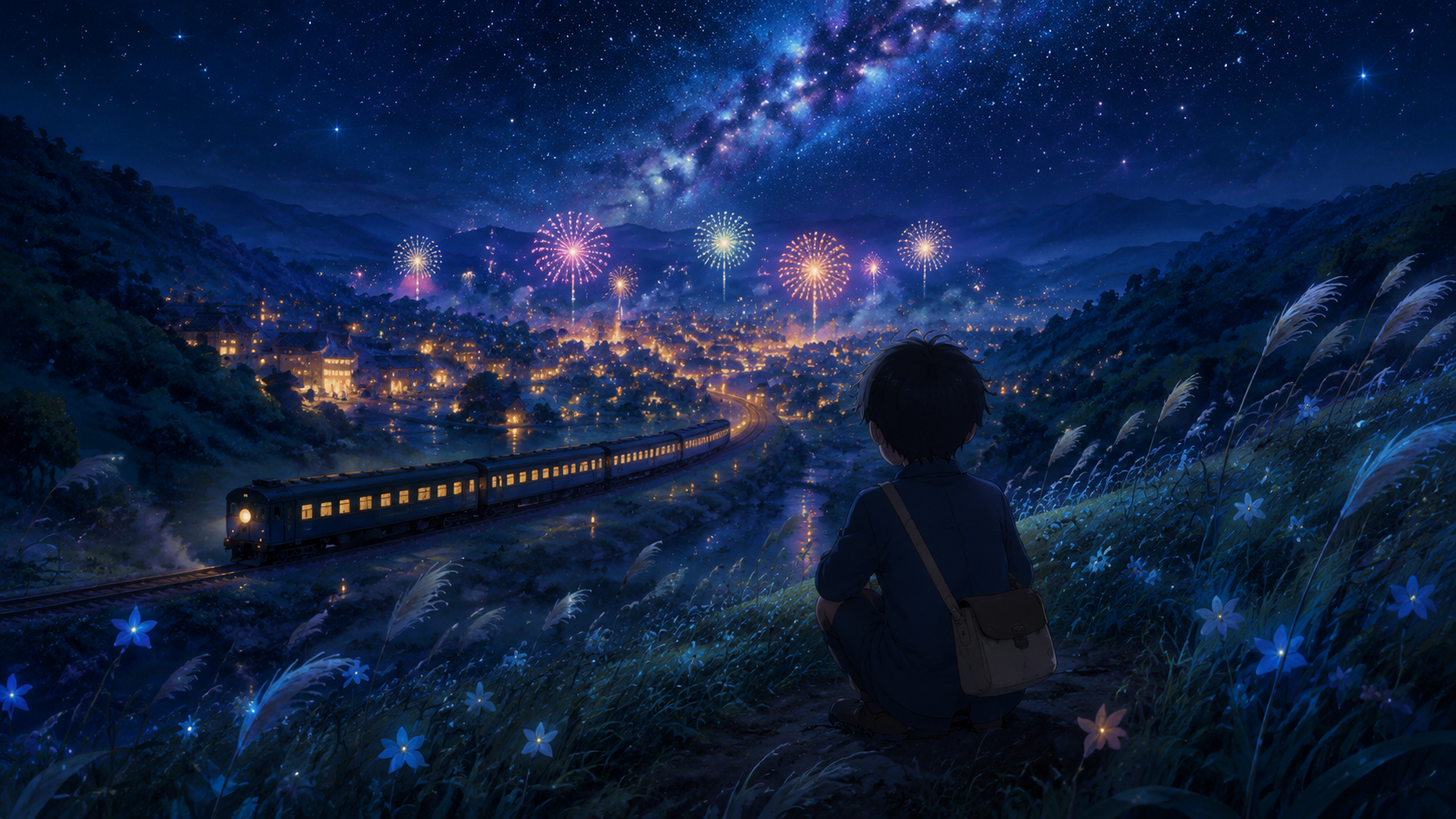
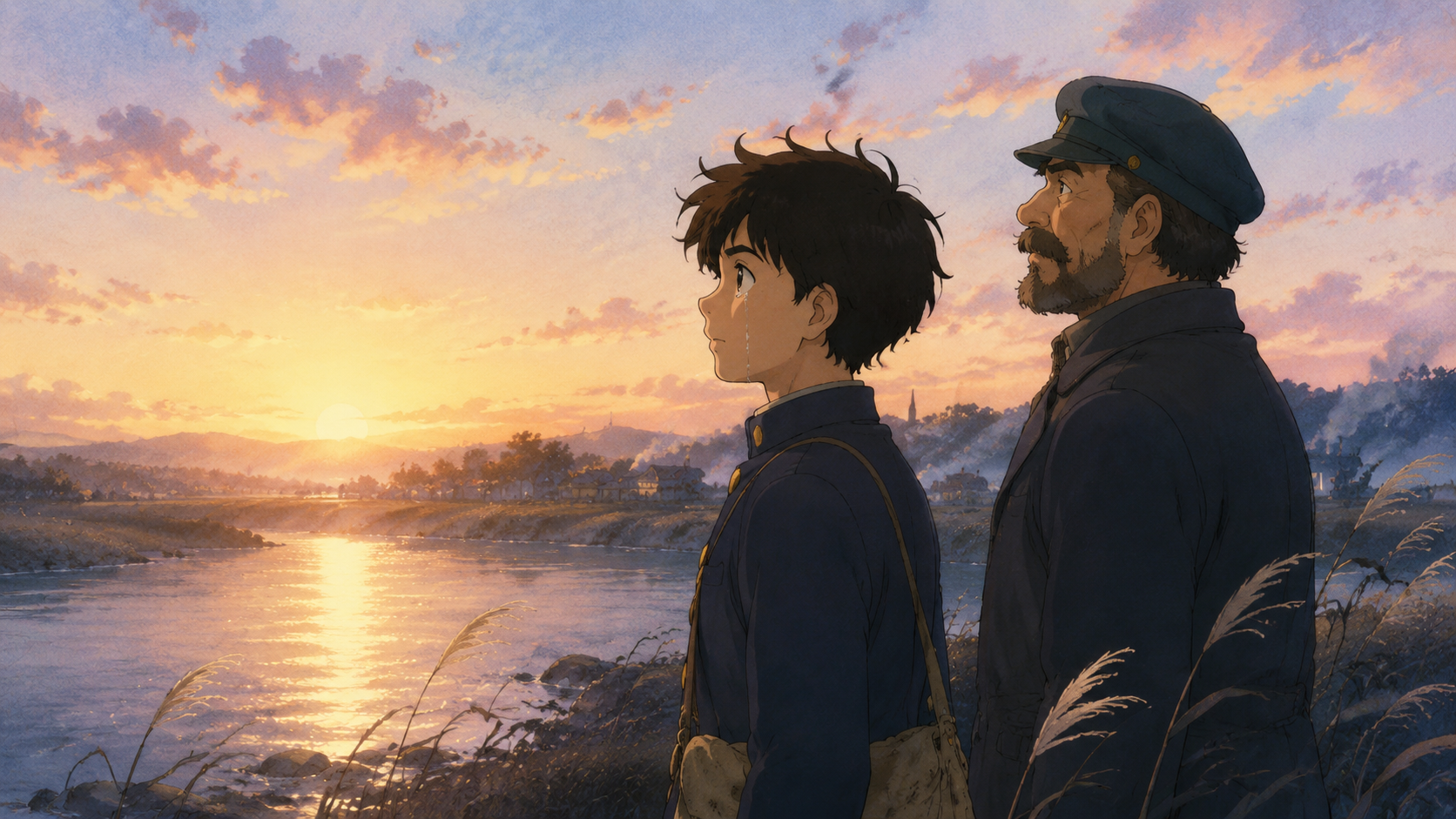
A boy crouches on top of a hill, while behind him the town holds its biggest night of the year, the Milky Way Festival — fireworks bursting overhead, the streets loud with people. No one is watching with him. His family has fallen on hard times: his father has been away for months with no word, his mother is sick in bed, and his job tonight is to go to the dairy and collect a bottle of milk that never arrived. He isn't tired in his legs. He's tired in his chest. Without quite meaning to, he wanders up the hill outside town, lets the wind blow past him, and stares blankly at the lights scattered across the distant valley. Then, as if in a trance, a strange train lights up on the tracks below. It stops. The door opens. Something pulls him aboard. On the surface this journey is called the Galactic Railroad, but underneath, it is a train bound for death and whatever lies past it. Kenji Miyazawa is writing about one boy's loneliness, but the question he's really asking is the one everybody eventually has to answer: how are you going to live this life? What does real happiness even look like?
Night on the Galactic Railroad is the work of the Japanese writer Kenji Miyazawa. Born in Iwate Prefecture in the last years of the nineteenth century, Miyazawa came from a well-off family, yet he spent his whole life caring about farming villages and the poor, and put himself through the same hardships his own protagonist suffers. He was a devout follower of Nichiren Buddhism, built around the Lotus Sutra, and held firmly to the idea that a person should live for others. He started writing this novel in his mid-twenties and kept revising it for more than a decade without ever calling it finished. He died of pulmonary tuberculosis in his late thirties, leaving the novel an unfinished manuscript; a friend edited it the following year and it appeared for the first time in the Bunpodo edition of his Complete Works — which means the book readers hold today is one its own author never once saw in print. And it's precisely this unfinished fragment that has become one of the most studied, most adapted, most reread fairy tales in modern Japanese literature. It's remembered partly because it makes death sound as gentle as a lullaby, and partly because it leaves so much unsaid that every generation can pour its own reading into the gaps.
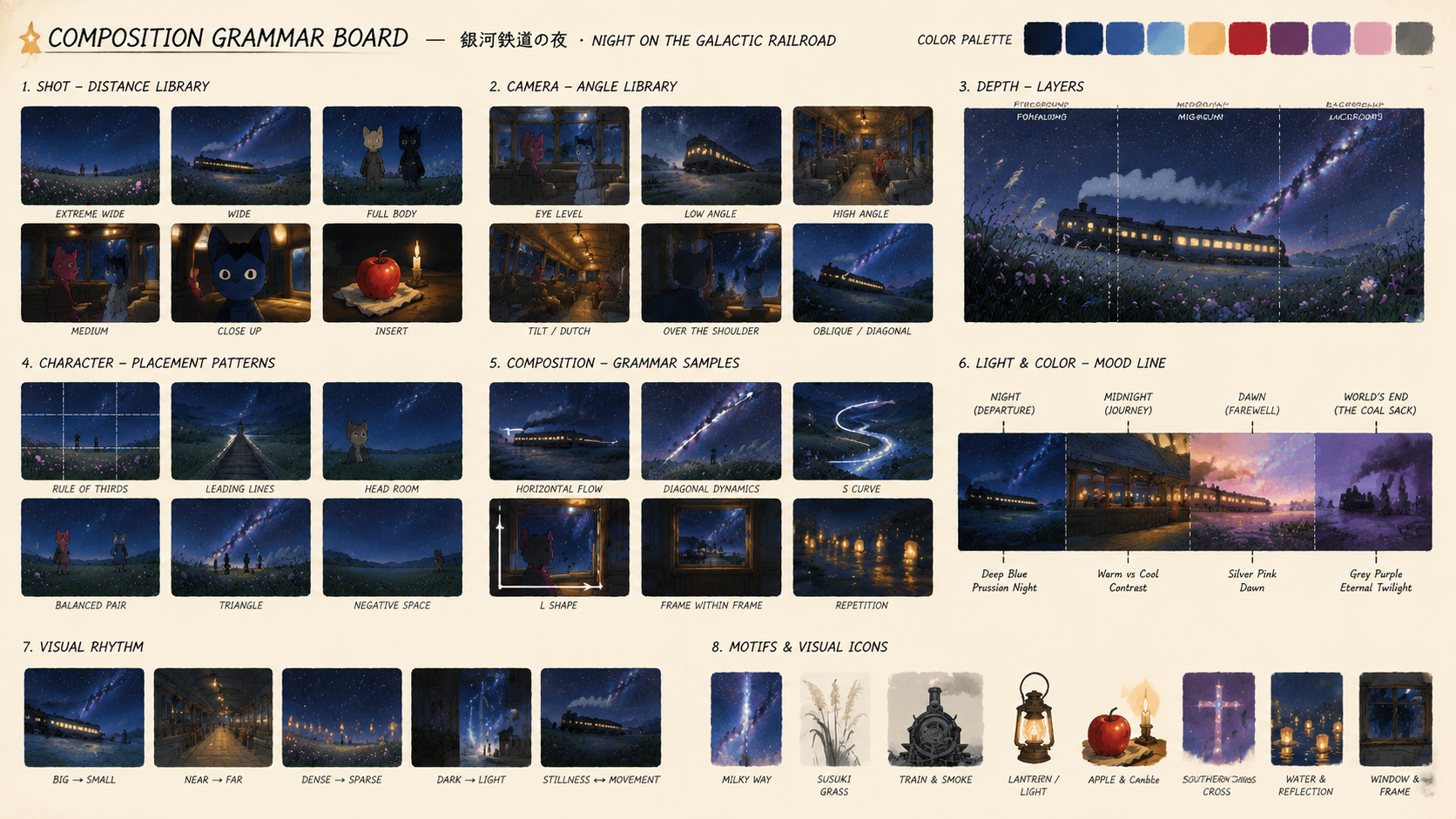
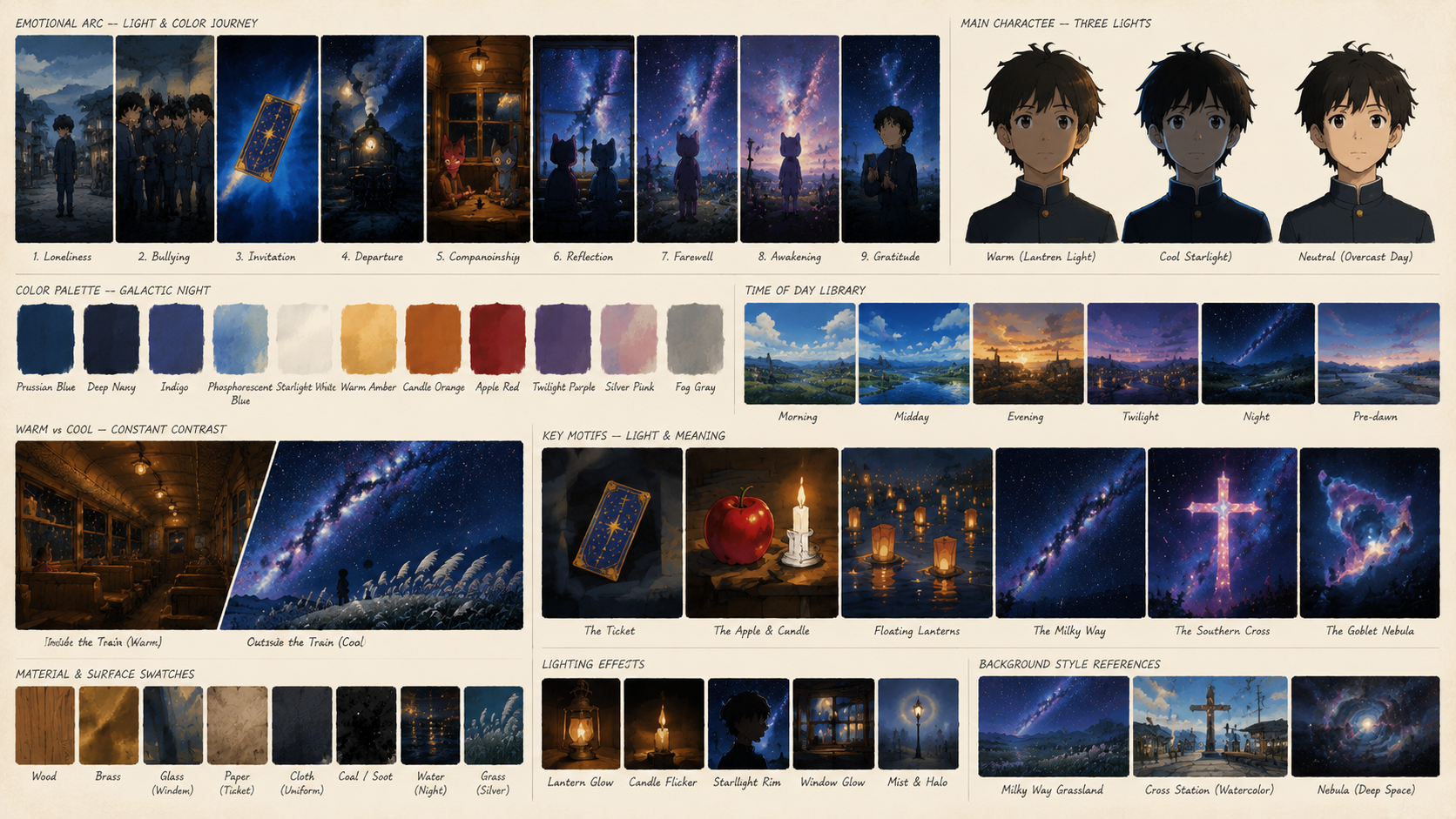
Before the guide was written, this book got a visual foundation — every illustration you just read grew out of it.
There aren't many characters in this book, but each one burns as bright as a constellation. The protagonist is a boy named Giovanni — poor, withdrawn, and kind, mocked and picked on by his classmates, keeping the softest part of himself hidden away. What makes him remarkable is that he never complains; he just keeps pushing at one question: why does anyone live, and what does real happiness actually mean? His best friend, Campanella, is his opposite — gentle, quiet, with a light in his eyes. The two have gone to school together since they were small, the kind of friends who don't need many words to understand each other. But right from the start of the story Giovanni can't find him. Word around town is that on the night of the Milky Way Festival, a classmate fell into the river and Campanella jumped in to save him — and never came back up. Two more people join them on the train: a lighthouse keeper, and an older sister and her younger brother traveling with the young tutor who looked after them, all three of whom died in a shipwreck. Together with Giovanni and Campanella, they take up the question of what real happiness is — the question that sits at the heart of the whole novel. The rules of this world are strange: the train runs through an actual night sky, and the stations along its route are named for Cygnus, Aquila, and the Southern Cross. Passengers step off one by one at each stop, and every departure feels like a quiet goodbye.
The story opens on the night of the Milky Way Festival, roughly Japan's equivalent of Obon, when the town lights its lamps and every family gathers together. But there's no company at Giovanni's house — his father is away, his mother is ill, and even the dairy owner treats him badly. On his way home from school a knot of classmates corners him and jeers that his father has abandoned them for good. Giovanni swallows the insult, goes to the dairy to collect what's owed, comes away empty-handed, and — tired and hungry — ends up climbing the hill alone at the edge of town. The craft here is worth noticing: Miyazawa never once writes that Giovanni feels sad. Instead he sets an entire night of celebration against one boy standing by himself — the louder the town gets, the more alone he looks on the hilltop. It's a way of writing loneliness by showing how little the world cares.
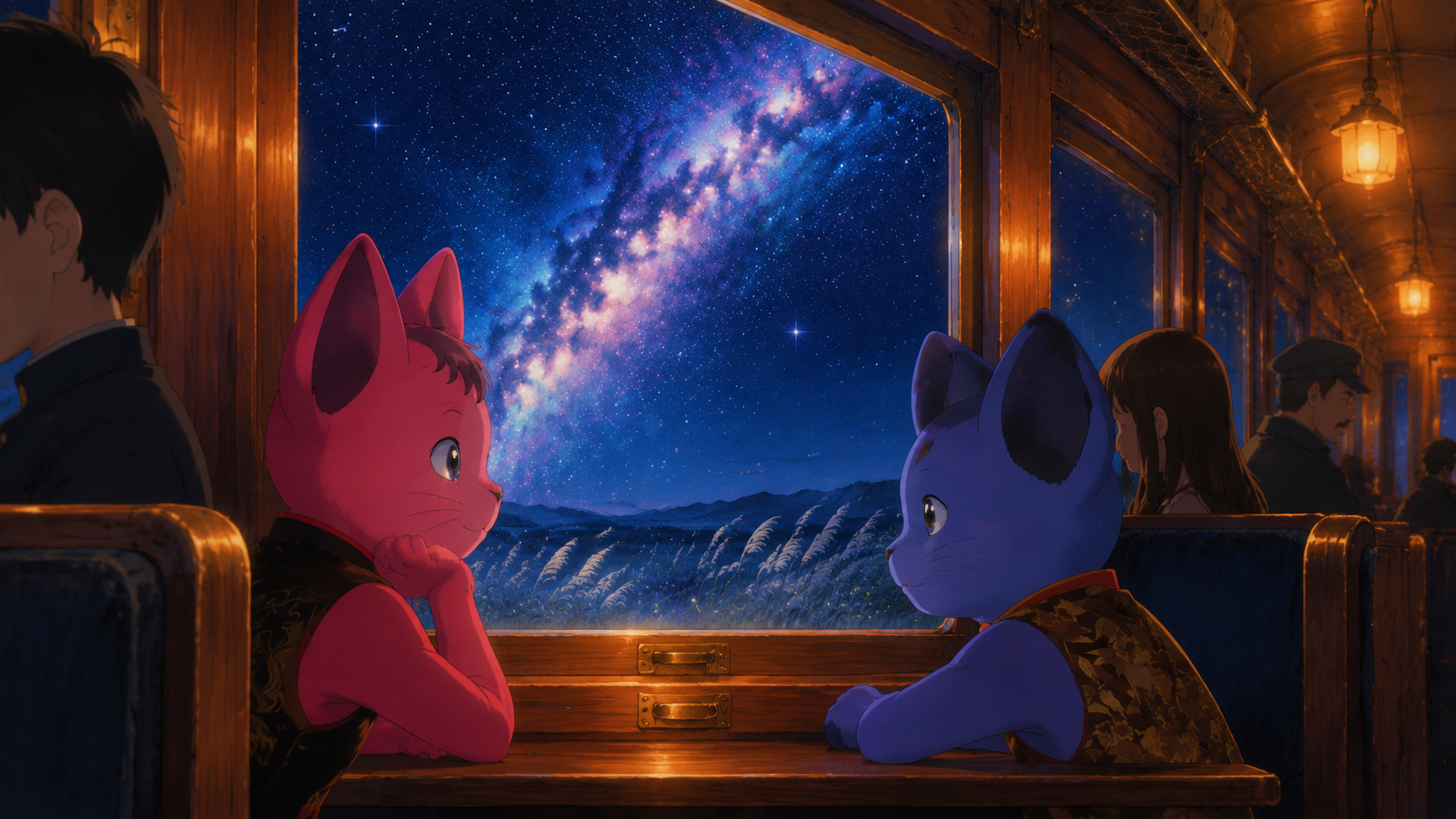
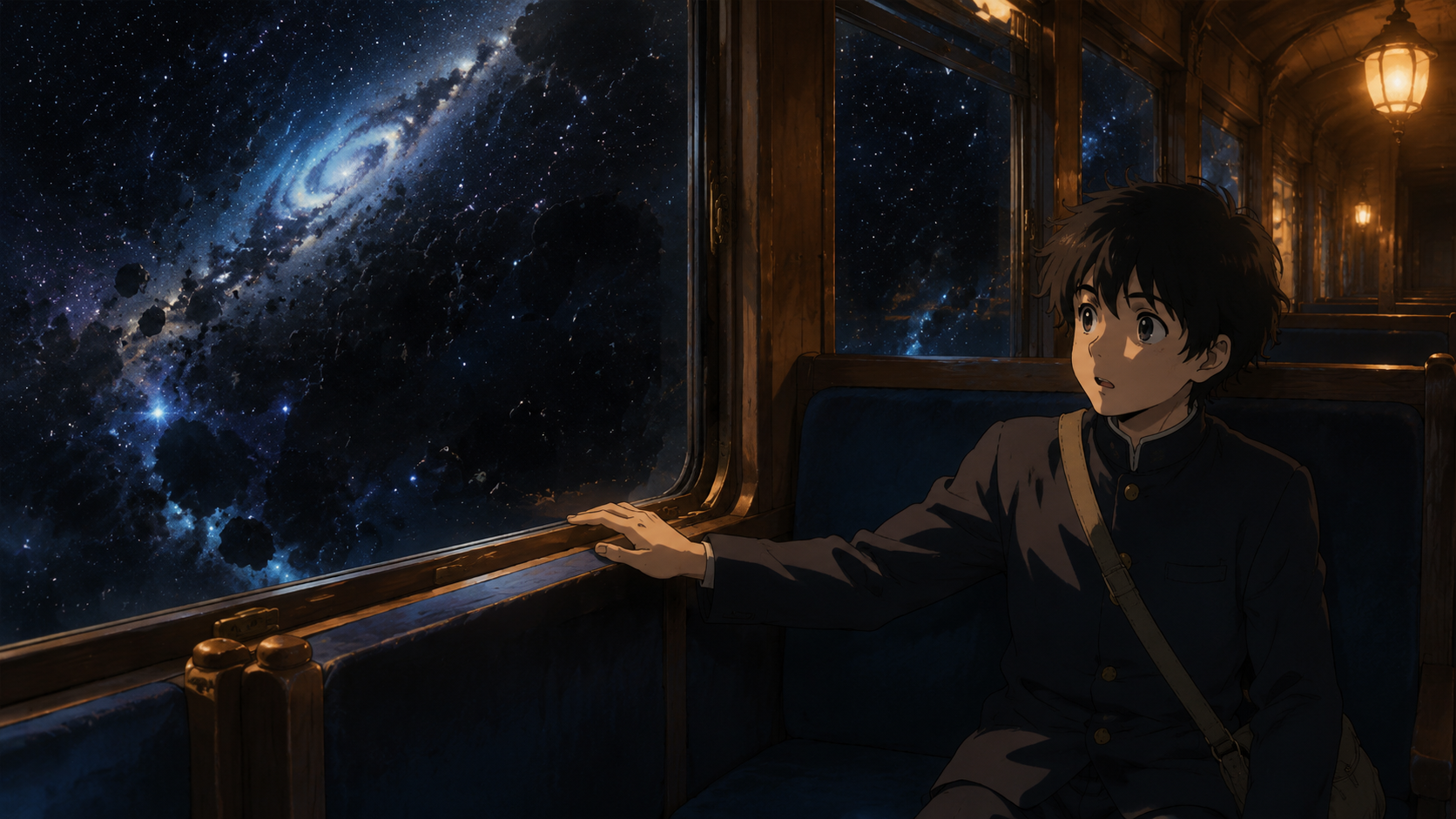
Just as Giovanni is lost in thought, a train he's never seen before appears on the tracks below — its body painted a handsome dark color, warm light spilling from its windows. The door opens, and something pulls him aboard. Once the train is moving, he's stunned to find, sitting across from him, the very friend he'd spent the whole afternoon looking for: Campanella. The two of them lock eyes. Neither says a word, but both their eyes go wet. The train breaks out of the atmosphere and rolls into the real Milky Way — outside the window is nebula after nebula, constellations spread like wings, cosmic dust glittering like jewels. The craft here takes a real risk: Miyazawa steps from the real world straight into a sky full of wonder without bothering to build a bridge between them. One moment the reader is on a hillside; the next, in the galaxy. That break, rather than feeling like a flaw, gives the story the kind of innocence only a fairy tale can have — you don't need it explained, you just follow Giovanni and believe.
The train passes one wondrous stop after another, taking on passengers and letting them off. Giovanni and Campanella meet an older sister and her younger brother, along with a young tutor — all three killed in a shipwreck. What they describe is the moment the ship went down: it was sinking, the lifeboats didn't have room for everyone, and the three of them could have fought for a seat, but chose instead to let others go first. As they tell it, their faces stay strangely calm — no fear, no bitterness, as if they're describing something that happened a very long time ago. Giovanni is stunned listening to them. That composure, the kind that lets you give up your own life and still smile about it, is something he can't begin to understand. The craft here: Miyazawa doesn't reach for long, swelling praise of self-sacrifice. He simply lets the characters tell it plainly and leaves the weight of it to the reader. That's the harder trick — making the heaviest thing sound the lightest.
The train keeps moving forward, and the sky outside grows deeper and darker. Passing a place called the Coalsack, Giovanni notices a huge patch of the Milky Way has suddenly gone black — true darkness, a pure black with no stars in it at all. Campanella stares into that darkness, then turns and says, simply, that he has to go find his mother. Before Giovanni can even react, the seat across from him is empty. There's no goodbye, no wave of the hand — Campanella is simply gone, as quietly as if he'd never been sitting there at all. The craft here: this is the quietest cut in the whole book, and the cruelest. No crying out, no chasing the train — just Giovanni, alone, staring at the empty seat across from him. Miyazawa understood something true: a real goodbye never makes a sound.
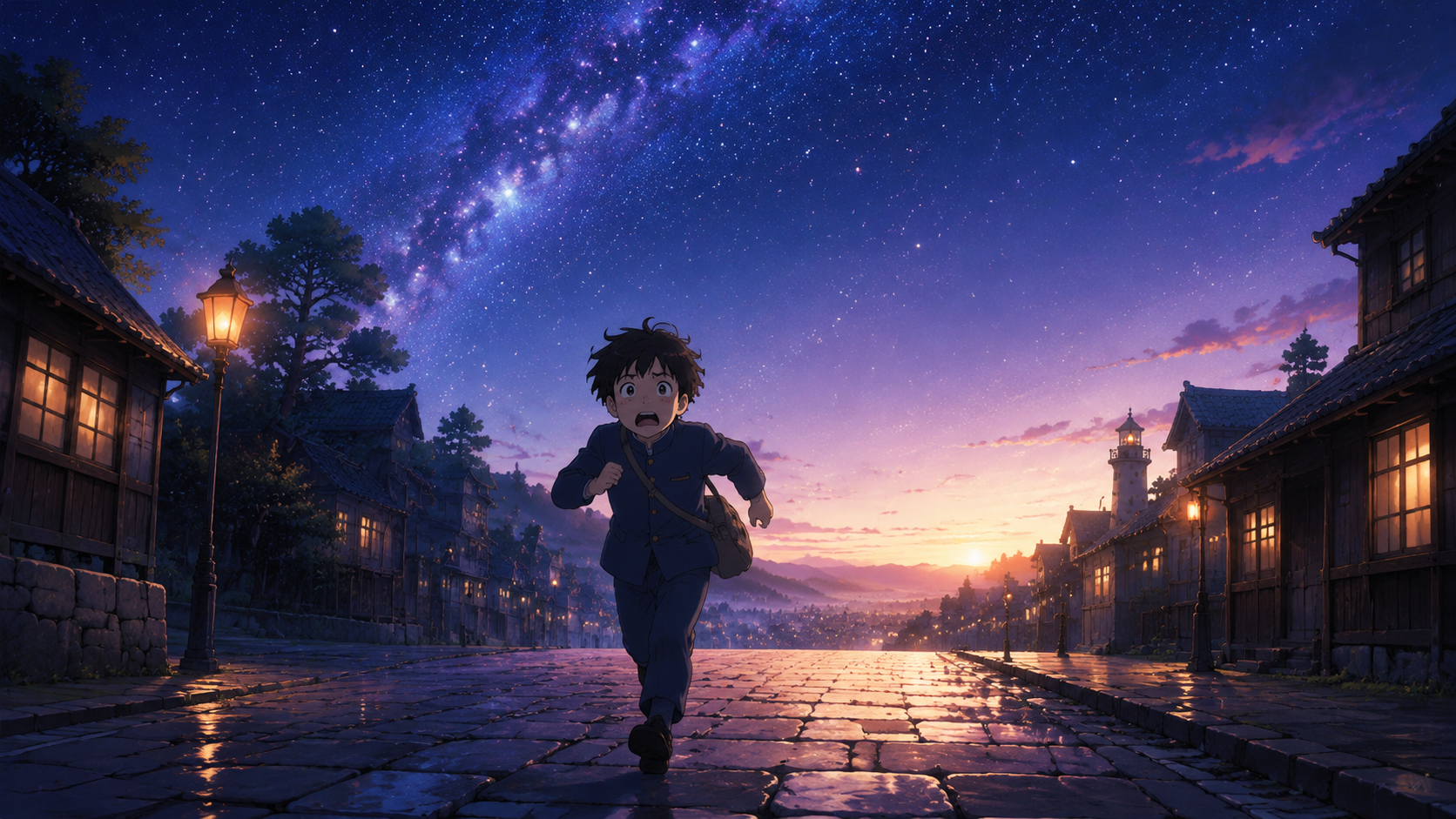
Then Giovanni wakes up. He finds himself still lying in the grass on the hillside. The Milky Way has sunk toward the west; dawn is close. He runs toward town like a madman, still holding on to some hope — maybe Campanella was just running late? But back in town he learns the truth: last night, at the height of the Milky Way Festival, a classmate named Zanelli fell into the river, and Campanella jumped in after him — and never came back up. The dream Giovanni had on the hilltop, the whole galactic journey, took place during the exact hours Campanella was struggling in the water. The craft here: this is where the book's imagined world and its real one collide. Only now does the reader understand — the Campanella on the train wasn't alive; he was the shape his soul took after death. That galactic train was the last leg of the journey Giovanni's own mind walked on his friend's behalf. Miyazawa splits death into two layers: one is the physical fact of drowning, the other is the parting that happens inside the heart. The second one hurts more than the first.
At the end of the story, Giovanni stumbles down to the riverbank and runs into Campanella's father. They don't exchange many words; the old man just pats him on the shoulder, and that's how Giovanni learns a piece of news that leaves him full of conflicting feelings — his own father is about to come home. Giovanni walks home alone, slowly. The streets are already stirring with new business, his sick mother is still waiting for him, and that bottle of milk he'd gone after is still sitting at the dairy, waiting to be picked up. He walks a long way before it hits him — the thing Campanella had been teaching him all along: real happiness isn't about getting something, it's about what you do for someone else. The lighthouse keeper tends his light, the sister and brother and their tutor gave up their seats in the lifeboat, Campanella jumped into the river to save a classmate — not one of them got anything back for it, and yet every one of them was happy. Giovanni wipes his eyes and steps into a new day. The craft here: at the saddest possible point, Miyazawa gives Giovanni the simple gesture of going home. The book doesn't end in collapse; it ends in the decision to keep living. That's a strength only a child has, and it's the greatest tenderness this book leaves behind.
On the surface, Night on the Galactic Railroad is a fairy tale; underneath, it's philosophy. Miyazawa spent his whole life believing in an ideal of living for others, so the book really has only one central question: what is real happiness? He never dares to pin down a final answer, but every passenger who steps off the train, everyone who gives up a seat in a lifeboat, everyone who jumps into a river to save a classmate, is answering it through action — real happiness is giving yourself away. Miyazawa's method here is unusual. He can write death so gently it makes you want to cry rather than flinch. The trick is that he writes it through a child's eyes: a child doesn't understand death as disappearing forever, so Giovanni never falls apart — he simply takes it as a matter of course that Campanella has gone to find his mother. That view, pure almost to the point of transparency, lets this fairy tale hold a child's innocence and an adult's grief at the same time. Add to that the fact that Miyazawa was something of an amateur astronomer himself — the constellations along the train's route are all real (Cygnus, the Southern Cross, and the Coalsack Nebula all exist) — and that he fuses the Christian imagery of sacrifice with the compassion of Eastern Buddhism, and Night on the Galactic Railroad becomes something without real peer in Japanese literature. It's hard to find another book that folds the cosmos, death, childhood, and faith together quite like this one.
Miyazawa died before he finished this book. Maybe he never meant to finish it — because the question of what real happiness is was never going to have a final draft.
By now you might be thinking: I already know Campanella is going to die, that the train is a dream, that he's not coming back — so why open the book at all? The reason is simple: an explainer only hands you the map. It's not the ground itself. First, Miyazawa's language has a quality to it that feels washed clean by starlight, and that quality can't survive being retold. Read the original and you can feel every sentence weighed and reweighed — which words carry weight, which stay light, where to leave a gap unsaid. That kind of restraint only comes through in the Japanese text itself, or at best in a fine translation, never in a summary. Second, that feeling Giovanni has on the hilltop — tired, wronged, and refusing to cry — is something you can only feel by reading page after page alongside him. Plot tells you what happened. Only the prose lets you become that boy for a while. Third, and most important — this book is an unfinished manuscript, and there is no single authoritative version. Different editions differ from one another: some include an extra exchange of dialogue on the train, some give Giovanni a different final line at the end. Reading the text itself means deciding for yourself which version comes closest to what Miyazawa meant. That's an experience no explainer can hand you.