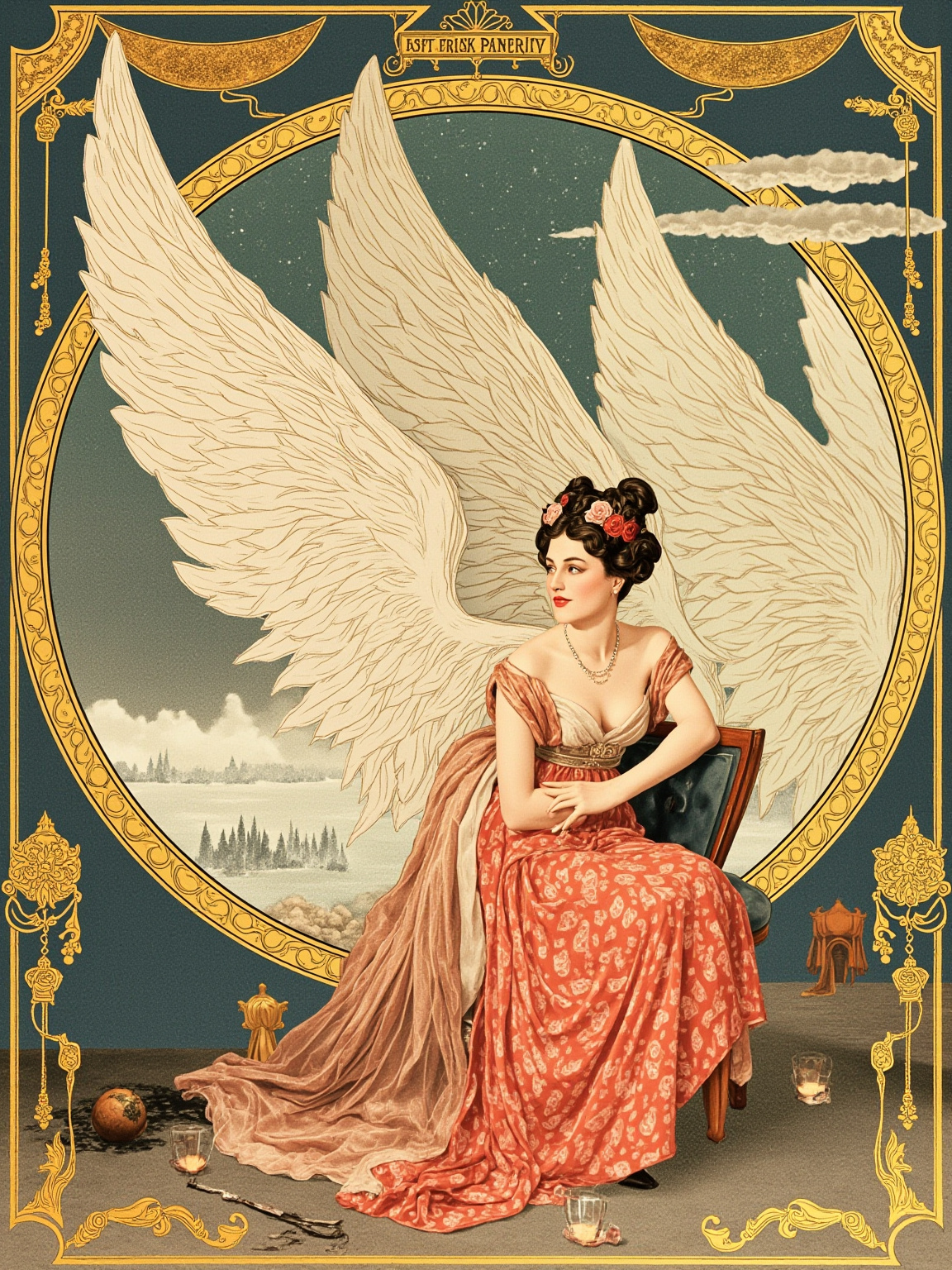
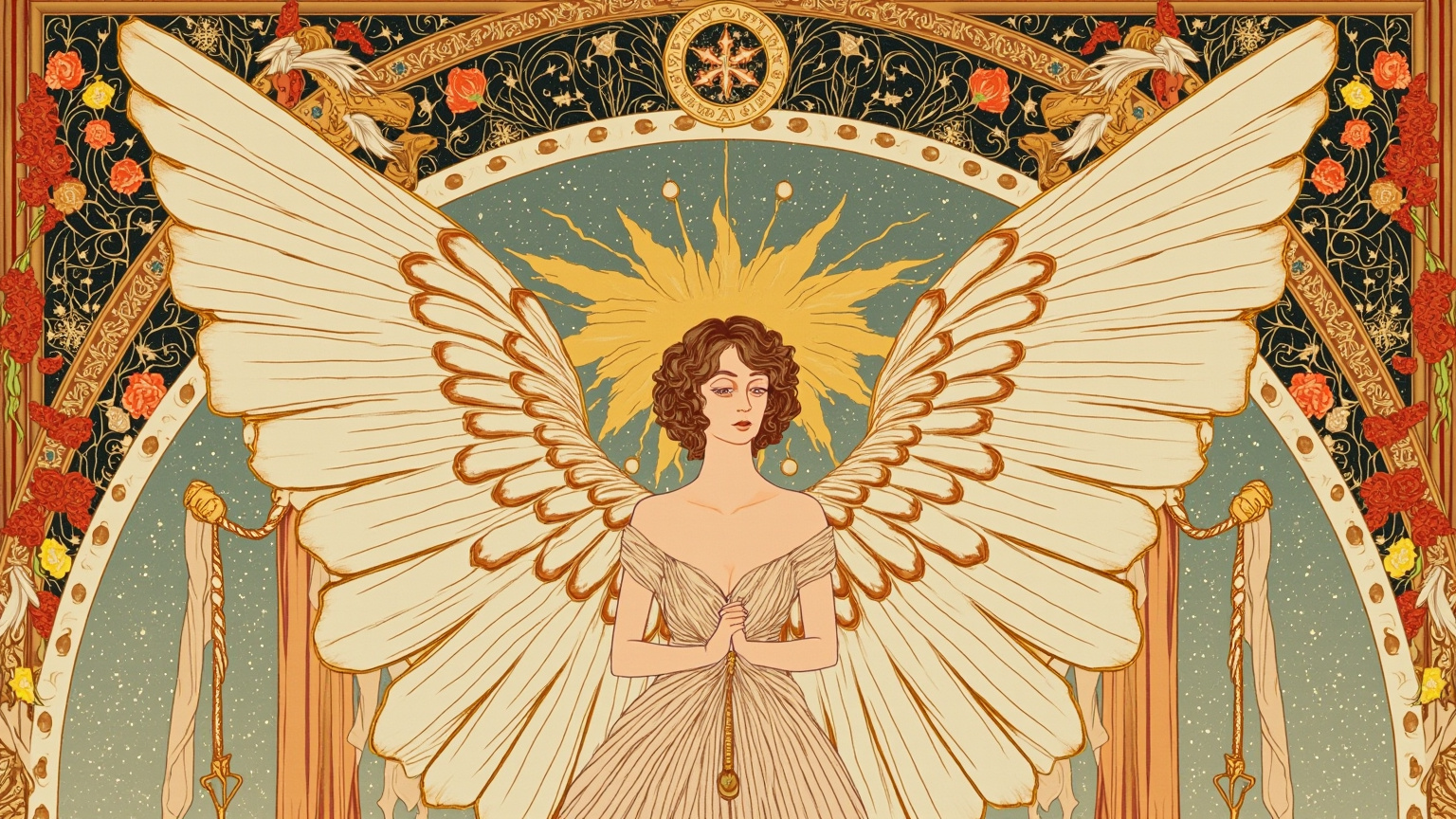
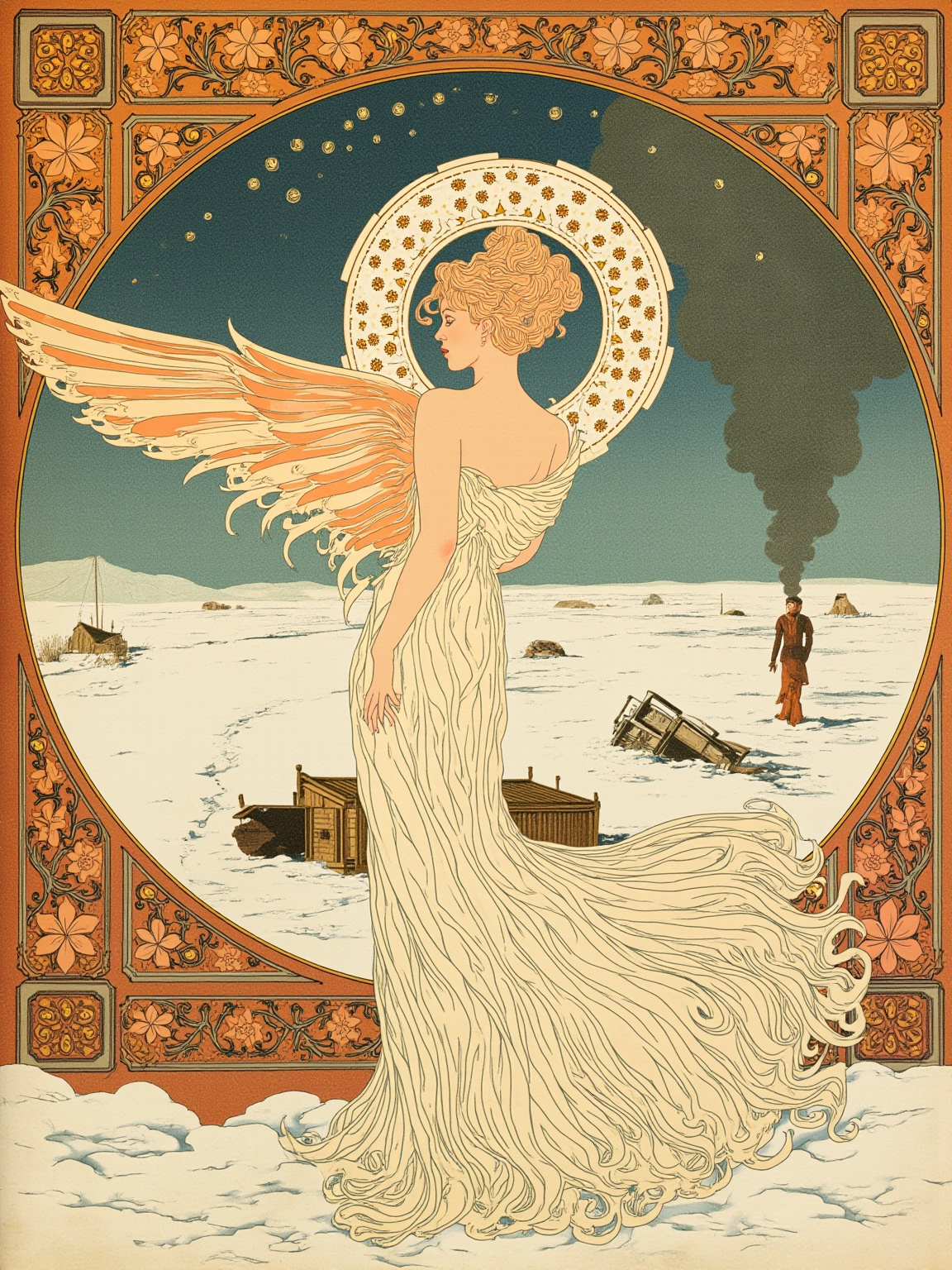
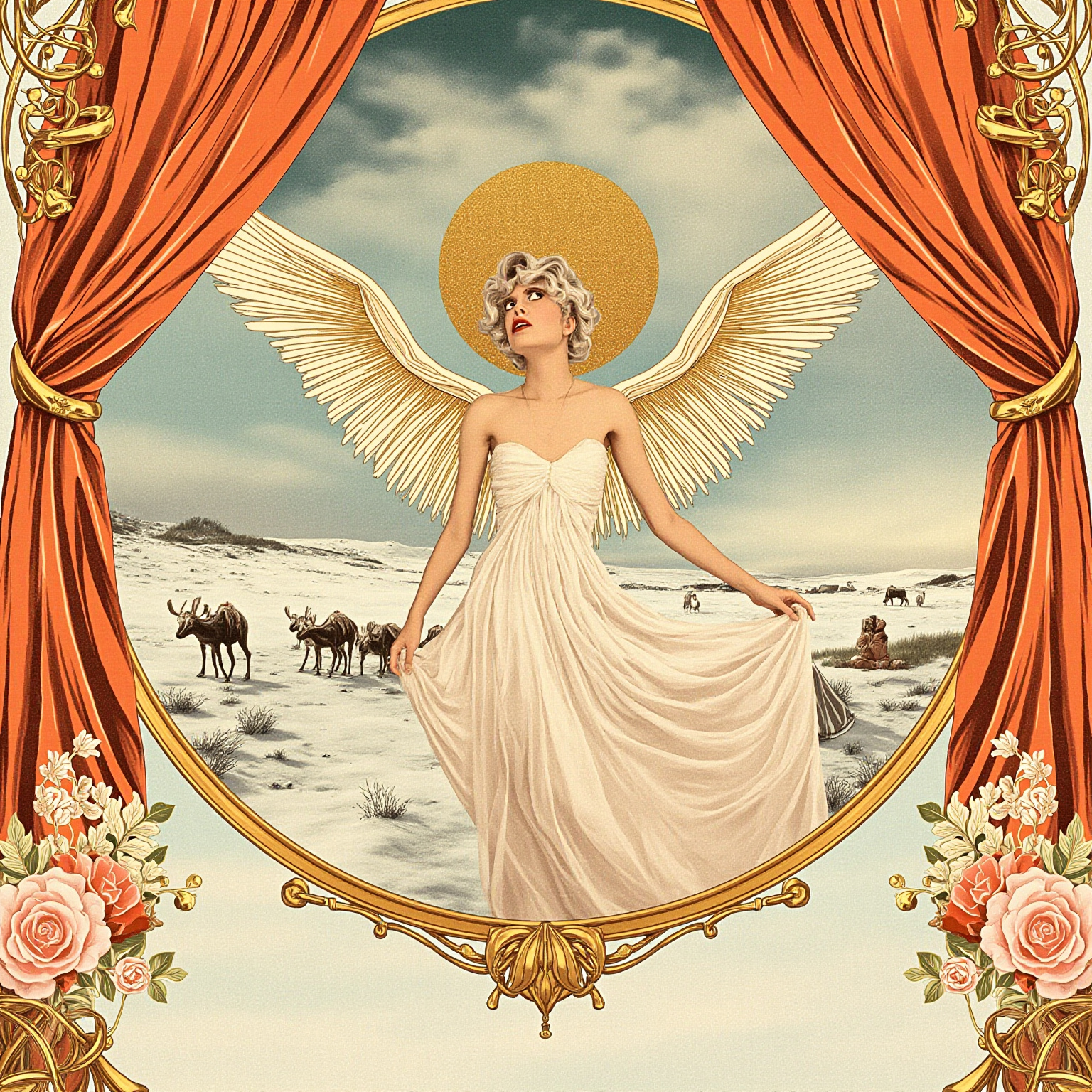
A burst of laughter on a snowfield at the turn of the century.
Text and illustrations produced by the pipeline
In front of the dressing-room mirror stands a woman with wings on her back. She tells the visiting American reporter she never had a father — she hatched from an egg. Outside the window is London, on the last night of the old century.
The question jumps out at once: is she real? Carter refuses to answer. The pleasure of this book lives exactly in that refusal.
Nights at the Circus came out in 1984. Its author, Angela Carter, was one of the most restless women novelists in late-twentieth-century English fiction. She rewrote fairy tales, and she wrote about how women get shaped by the male gaze, then wrenched loose again. This is her longest, most ambitious novel — set at the turn of a century, it throws circus spectacle, Gothic menace, a woman narrating her own life, and postmodern trickery all into one ring. It is widely considered her most celebrated novel, and a landmark of postmodern English fiction.
In the feminist lineage of English fiction, it is often read alongside Woolf's Orlando: a figure who crosses eras, blurs gender, and refuses to be pinned down. But Carter goes further — she gives her heroine actual wings, then lets every man who tries to verify them come up empty.
Fevvers is London's most famous trapeze artist: tall, loud, and adamant that she hatched from an egg and carries a genuine pair of wings. Beside her is her foster mother Lizzie, a sharp-tongued old Londoner with a socialist streak, who watches over her, manages her, and undercuts her at every turn. The American reporter who comes to see her is Jack Walser, out to write the story that exposes the hoax. Then there is the blustering American circus owner Colonel Kearney, who lets a supposedly clairvoyant sow make every decision for him — it is Kearney who moves the whole outfit from London to Russia.
The first dawn of 1900 comes up over the snow. Walser and Fevvers find each other again. He is no longer fixed on whether she is real or not — or, more precisely, he has finally understood that the question was never his to answer. Fevvers laughs, loud and long, and the laugh carries out across the empty snowfield. That is where the book ends.
Carter never tells you whether the wings are real. She ends with a woman laughing in the first light of the twentieth century. The laugh is the answer.
A guide can tell you who Fevvers is, what happens, how it ends. What it cannot give you: the laughter that keeps breaking through her talk, loud enough to fill the whole dressing room; the shame that loosens by degrees as Walser turns from reporter into apprentice clown; the smell of the St. Petersburg tent, lamp oil and animal musk and cheap perfume all tangled together; and that final laugh on the snowfield — you have to read it yourself to hear, inside that laugh, the whole nineteenth century coming to an end.
Before the guide was written, this book got a visual foundation — every illustration you just read grew out of it.
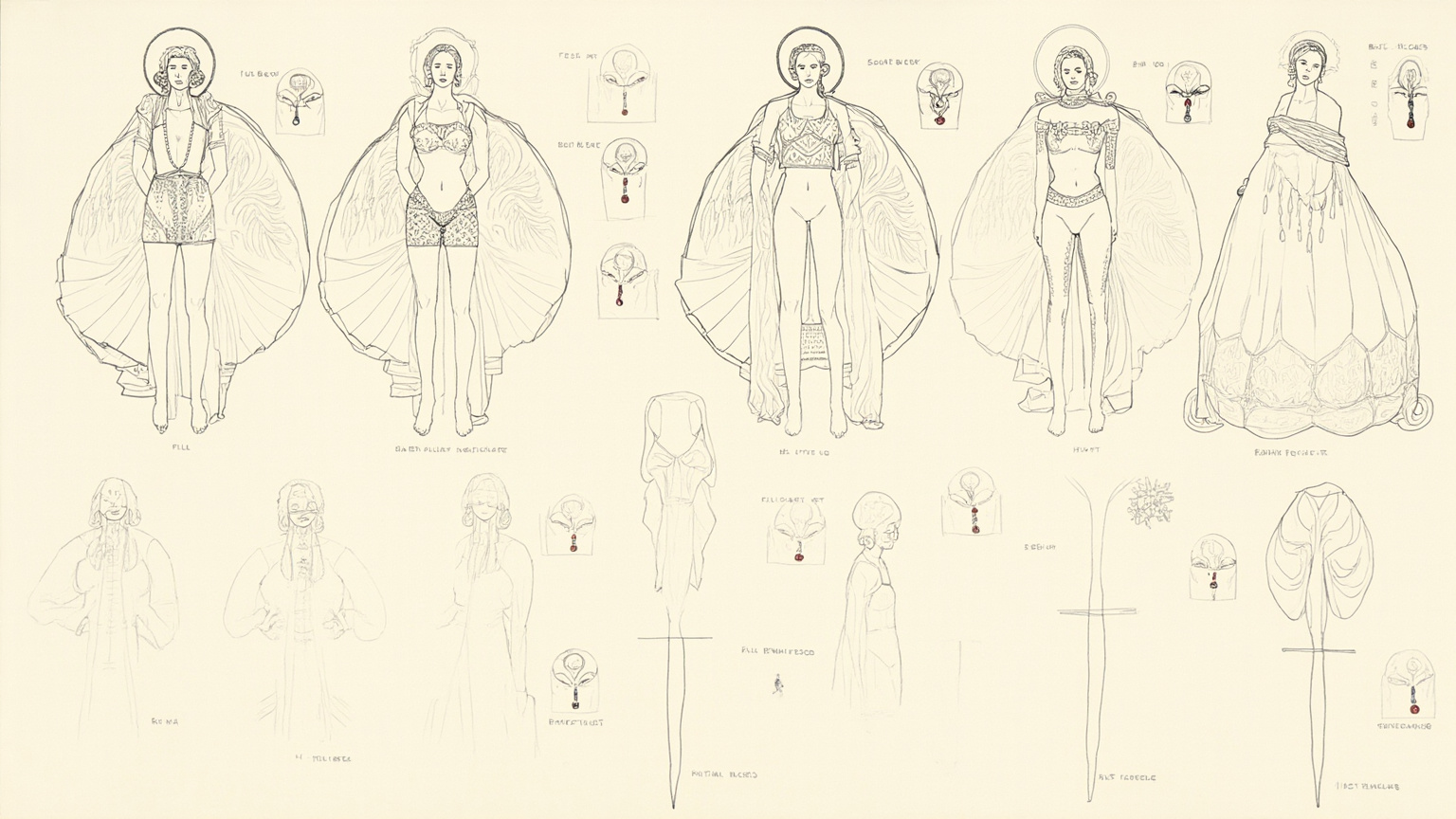
The book's world unfolds in three parts: first a basement dressing room in London on New Year's Eve, 1899; then the lavish circus tents and aristocratic salons of St. Petersburg; finally a train crossing Siberia and a snowfield dozens of degrees below freezing. Each part runs on its own rules — London is calculation and storytelling, St. Petersburg is traps and machinery, the snowfield is amnesia and rebirth.
The story opens with Fevvers at her dressing-table mirror. She spends the whole night telling Walser where she came from: taken in as a child by the one-eyed madam Ma Nelson, raised in a London brothel got up to look like a finishing school for young ladies; after the old woman died, she drifted into the circus world and was sold to Mr. Rosencreutz, an aristocrat obsessed with alchemy and necromancy, who nearly killed her as a sacrifice in one of his rituals — she talked and flew her way out of it. The telling keeps getting interrupted, corrected, and filled in, by Fevvers herself and by Lizzie, and she keeps the line between true and false deliberately blurred.
There is a lot going on here, technically. Carter makes an impossible woman — hatched from an egg? — narrate her own story, and she does it without apology, laughing the whole way through. Walser is pulled in deeper the longer he listens, until he finally drops the reporter's notebook, hides it away, and signs on as an apprentice clown in Colonel Kearney's circus, sailing east with the rest of the troupe. This is the novel's real turn: he stops asking whether she is telling the truth — or rather, he becomes a character inside the story instead of a witness standing outside it.
The circus reaches Russia and the stage widens. Carter fills it with a whole cast: Buffo the Great, the clown chief, drinking his way to the edge of madness; the Princess of Abyssinia, who barely speaks a word but tames her tigers by playing piano to them; and Mignon, a thin, battered young woman who flees her abusive husband, the Ape-Man, and finds shelter with the Princess.
Fevvers has barely arrived in St. Petersburg before she steps into a second trap: a Russian Grand Duke takes a fancy to her and lures her into his mansion with a jeweled mechanical egg. She comes close to being locked away in his collection for good. The scene is lavish and sinister at once, a sketch of the late-nineteenth-century Russian aristocracy's aesthetic of ownership. Reading it the first time, what came to mind was the mildewed palaces of Chekhov — but Carter is crueler than Chekhov. She has a winged woman tear herself loose from a private museum and fly out.
The circus boards a train crossing Siberia, and halfway through the journey bandits blow it apart. The cars overturn on a blank white snowfield. Fevvers's wings are hurt in the wreck, and for a while she cannot fly. Walser is thrown clear, and what breaks is not only bone — he loses his memory, is taken in by a Siberian tribe of shamans, and slowly forgets he was ever a reporter, ever a man who meant to expose the woman who could fly.
Fevvers and Lizzie search the snow for him. Carter writes this stretch loose and wide open, as if laying down an endless blank page in prose. The train, once a symbol of European industry, becomes scrap iron from a century about to be discarded the moment it overturns. Out on the snowfield, everything feels clean instead.
On the surface it is a circus adventure spanning the turn of a century. Underneath, it is a statement about who gets to define a woman. Fevvers refuses to let the male gaze settle the question — she tells her own story and decides for herself where the truth ends and the invention begins. Mr. Rosencreutz wants to confirm her on an altar, the Grand Duke wants to lock her in a jeweled box, Walser starts out wanting to expose her in print. Three men, three instruments, and she slips every one of them. Flight here is both a physical fact and a form of self-rule — whether she can actually fly runs through the whole novel, the way the question of how far a woman could go ran through the late nineteenth century.
Deeper still, it is an overturning of the reliable narrator, that old novelistic demand that a storyteller account for her sources. Carter refuses. She leaves the judgment to you, and when you cannot reach one, she does not help. The circus tent, the clowns, the acrobatics, the costume changes — all the places where the rules stop applying — become a Bakhtinian carnival space, where hierarchy and the true-false divide alike get suspended for as long as the show runs.
Whether she really hatched from an egg is beside the point. What matters is who gets to ask.
This is a novel fully aware of its own showing off — the sentences run long, like a baroque stained-glass window, then snap short, like a circus barker's pitch. Carter packs Gothic menace, the picaresque, feminism, fairy-tale rewriting, and postmodern self-commentary into three hundred pages, with barely a gap between them. It takes some patience to read. What it pays back is a heroine almost without equal in twentieth-century English fiction — a woman who needs no verification, whose existence is its own proof.