Notre-Dame de Paris · Companion Guide
《巴黎圣母院》
美与丑、信仰与欲望在十五世纪巴黎的钟楼与广场间猛烈相撞,四个男人对一个吉普赛少女的爱,最终全部通向绞架。
Opening: One Mask Hides Another Face
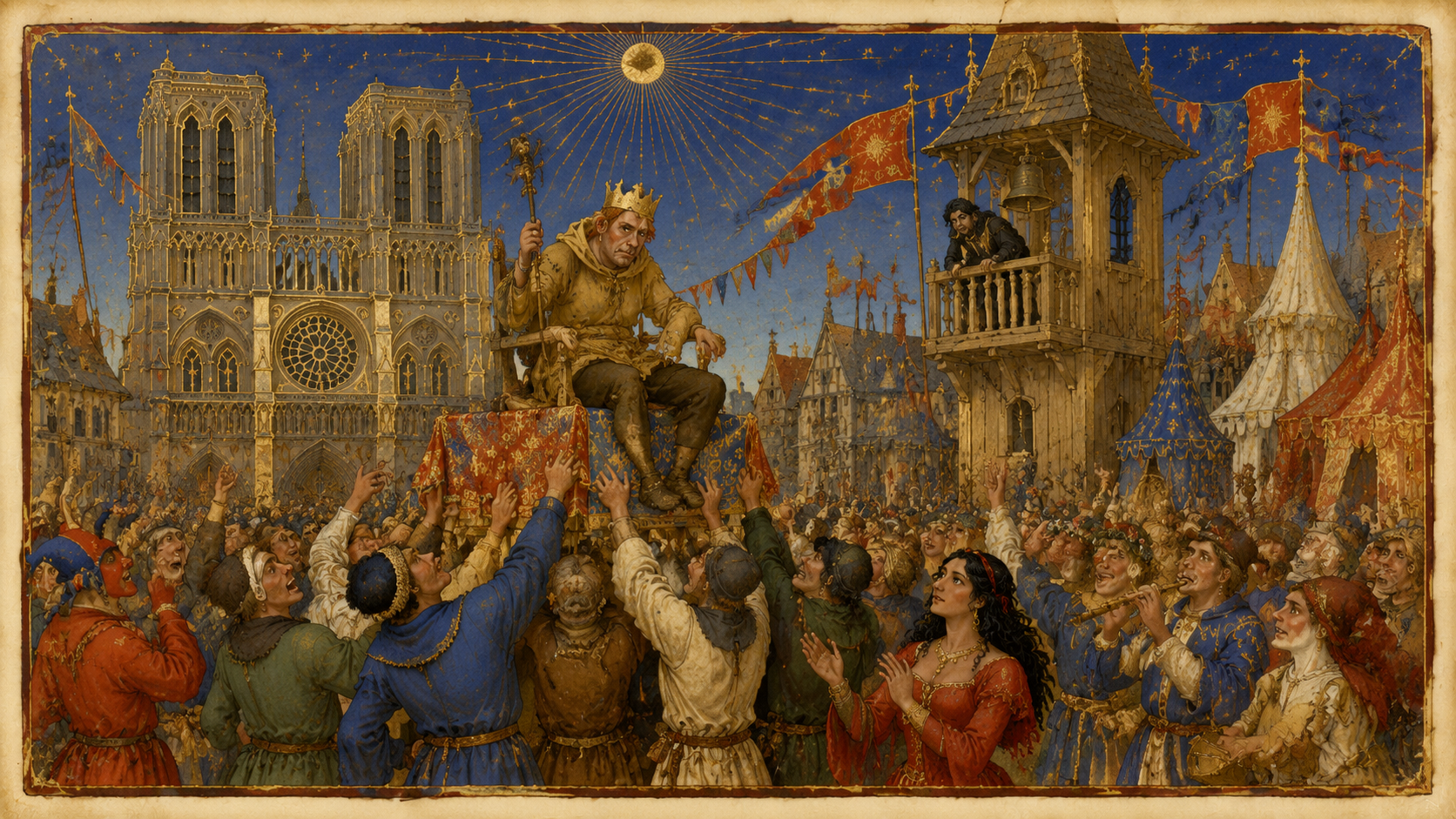
The carnival crowd hoists a man up, crowns him with a paper crown, hangs mocking bells on him, and shouts for him to be king for a day — his name is Quasimodo, hunchbacked, one-eyed, treated by nearly all of Paris as a joke. But no one notices that at the very moment he is pushed up onto the platform, a young Gypsy woman with a white goat in her arms is dancing barefoot in the square, dancing so well that everyone holds their breath — including the archdeacon watching from the gray bell tower above. The January wind cuts across the paving stones; the laughter of the Feast of Fools and the girl's tambourine ring out at the same moment. This is how Hugo opens the book: four threads of fate twisted together from the first page — ugliness, evil, purity, love — all colliding on the same afternoon.
What Kind of Book Is This
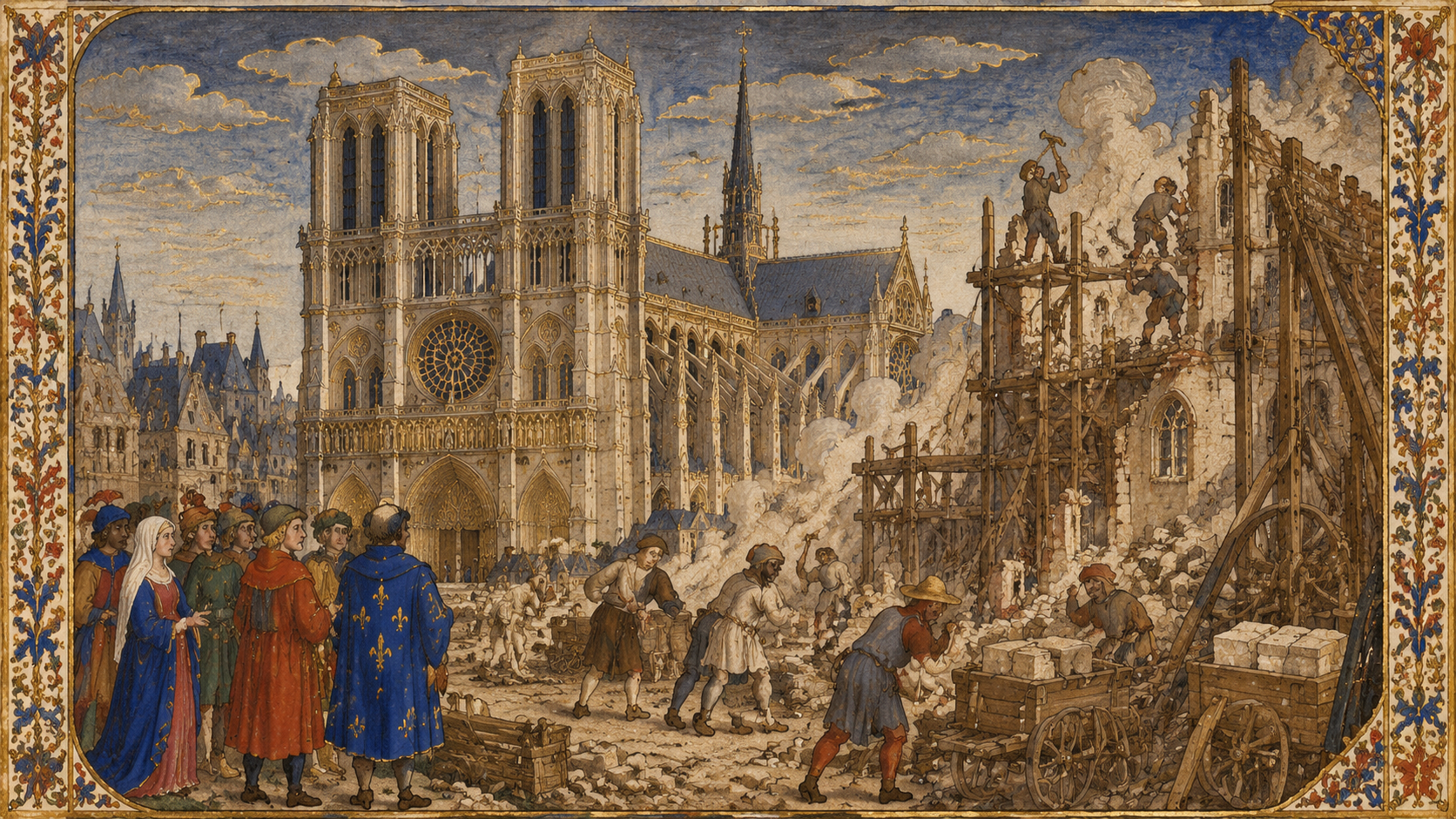
Notre-Dame de Paris is the novel Victor Hugo wrote in the early 1830s — in the first edition he didn't even put a character's name on the cover. The cover showed only the cathedral itself, with the subtitle simply reading '1482.' France was rebuilding its social order after the Revolution, and the old quarters of Paris were being torn down into rubble. Writing the book was half storytelling, half a cry for help: Hugo wanted the whole country to look again at a forgotten Gothic building, to see the flying buttresses carved into the stone, the light spilling down through the bell tower. The now-familiar title, Notre-Dame de Paris, is itself a later, easy-to-recognize label; in English today the book is often called The Hunchback of Notre-Dame — but Hugo's original ambition reached far beyond the tragedy of one hunchbacked man.
Characters and World: Four Fates Converge on a Cathedral
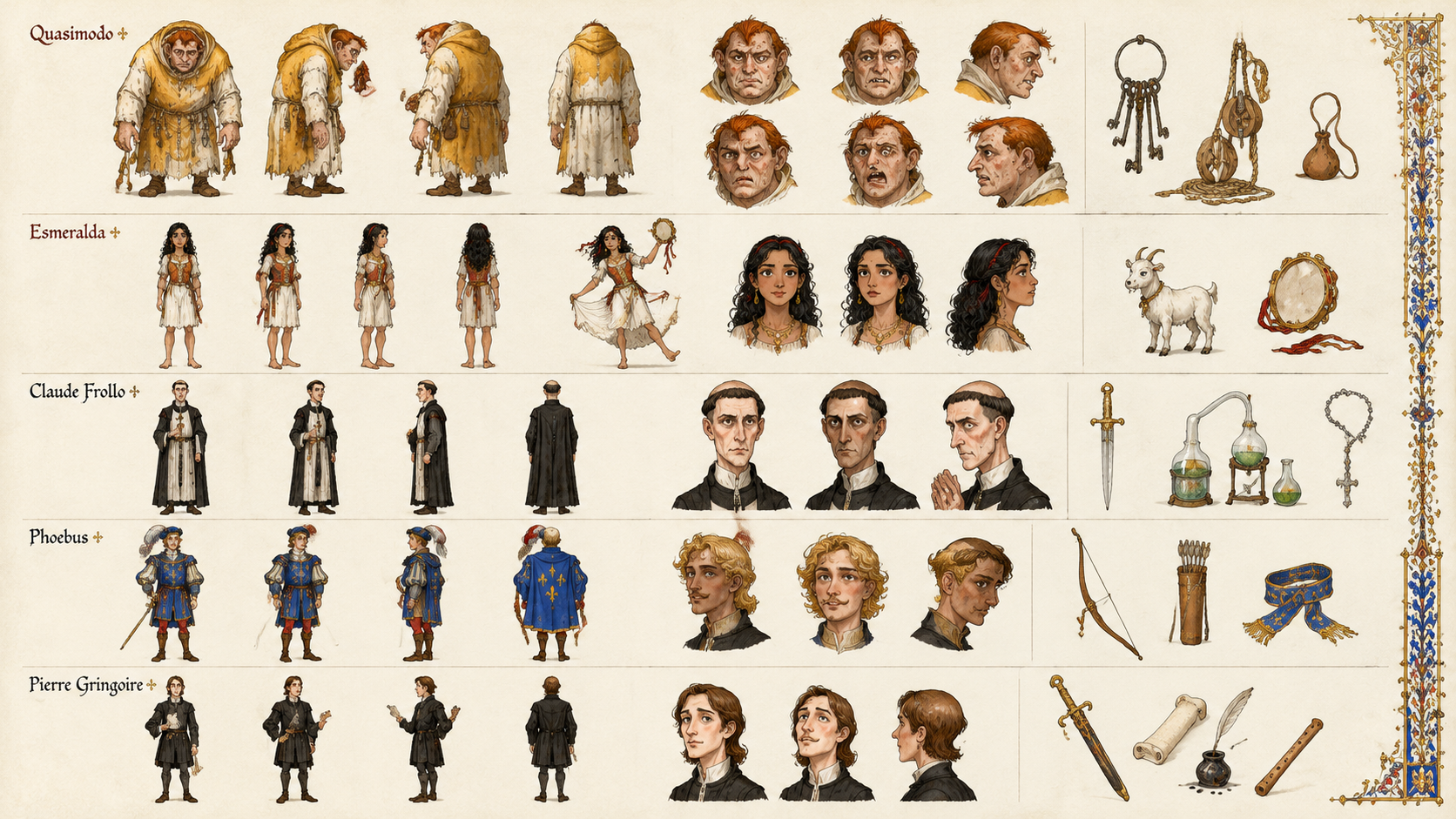
The whole novel can be summed up in one line: four men fall in love with one woman, and that woman is fought over by a cathedral, a court, and a horde of beggars. Quasimodo, the bell-ringer, is ugly, deaf, and was raised by the archdeacon; he grew up inside the bell tower, and the great bell's vibrations are the only language he has ever known. Esmeralda, the Gypsy dancer, is beautiful and kind, wandering the streets with a little goat named Djali and dancing for her living. The archdeacon Claude Frollo is learned, has lived in ascetic discipline for decades, and is shattered the moment this foreign girl bursts into the square. Captain Phoebus of the King's archers is a handsome, vain court pretty-boy, already engaged to be married, who saves her once and then simply helps himself to a stretch of her affection. The contrast Hugo wants isn't the simple 'beauty versus ugliness' — he wants you to see that a hideous body can hold the purest heart, and that beneath a splendid priest's robe can crouch a beast gone mad.
The Plot: Bell Tower, Gallows, Crypt
One: Twins of the Feast of Fools — Ugliness and Beauty Take the Stage Together
Paris in January 1482 is celebrating the Feast of Fools. Quasimodo, the ugliest man in the city, is hoisted onto a litter by the parading crowd, crowned with a paper tiara, capped with a cracked pot for a helmet, and named the Pope of Fools. That same afternoon, the Gypsy Esmeralda dances in the square for alms; caught up in the dance, she rests one small foot on a bystander's forehead, and her tambourine spins to a roar of applause. Hugo stages this scene like a piece of theater — he has you look at ugliness first, then at beauty, then back up at the pale face in the bell tower: the archdeacon Frollo, staring fixedly at the dancing girl, his right hand clawing marks into the balustrade without his even noticing. A carnival's opening scene, and already every ounce of the jealousy, possession, and ruin to come has been buried in that one look.
Two: The Abduction and the Sip of Water — the First Light in an Ugly Man's Heart
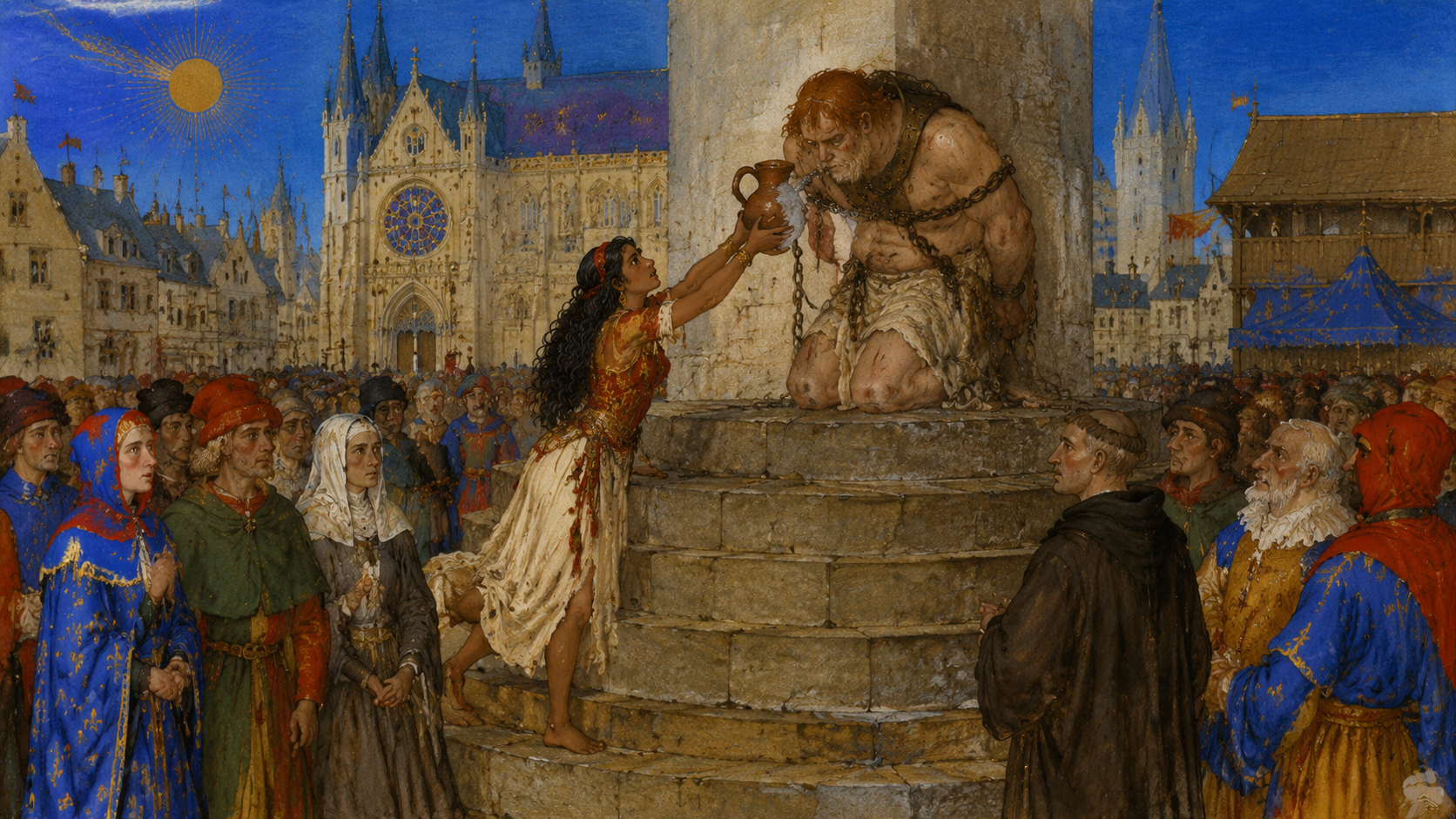
Late that night, the archdeacon orders Quasimodo to seize Esmeralda and drag her back to the bell tower. The order is a direct extension of that clawing grip from the scene before: Frollo doesn't dare act with his own hands, so he sends the misshapen child he raised to commit the crime for him. The abduction is interrupted by the patrolling archer captain Phoebus; Esmeralda is rescued, and Quasimodo is seized. The next day he is bound to the pillory in the Place de Grève, whipped until his flesh is torn open, then left to bake in the sun. The crowd jeers that he was born to be beaten, and no one will even give him a drink. It's then that Esmeralda walks past the scaffold. She doesn't spit at him — she uncaps her water flask and lifts it to his cracked lips. Hugo is working an old, stark contrast here: of all Paris, only she gives the ugliest man in Paris a sip of water. From this moment on, Quasimodo's entire capacity for kindness toward the world is bound to this one woman alone.
Then breaking silence first, she said to him, making her sweet voice still sweeter than usual,- "What is your name, monsieur le gendarme?"
请问您的名字,宪兵大人?
原文金句 · 劫持之夜 · 命运初问
Three: A Tryst, a Stabbing, and a Perfect Frame-Up
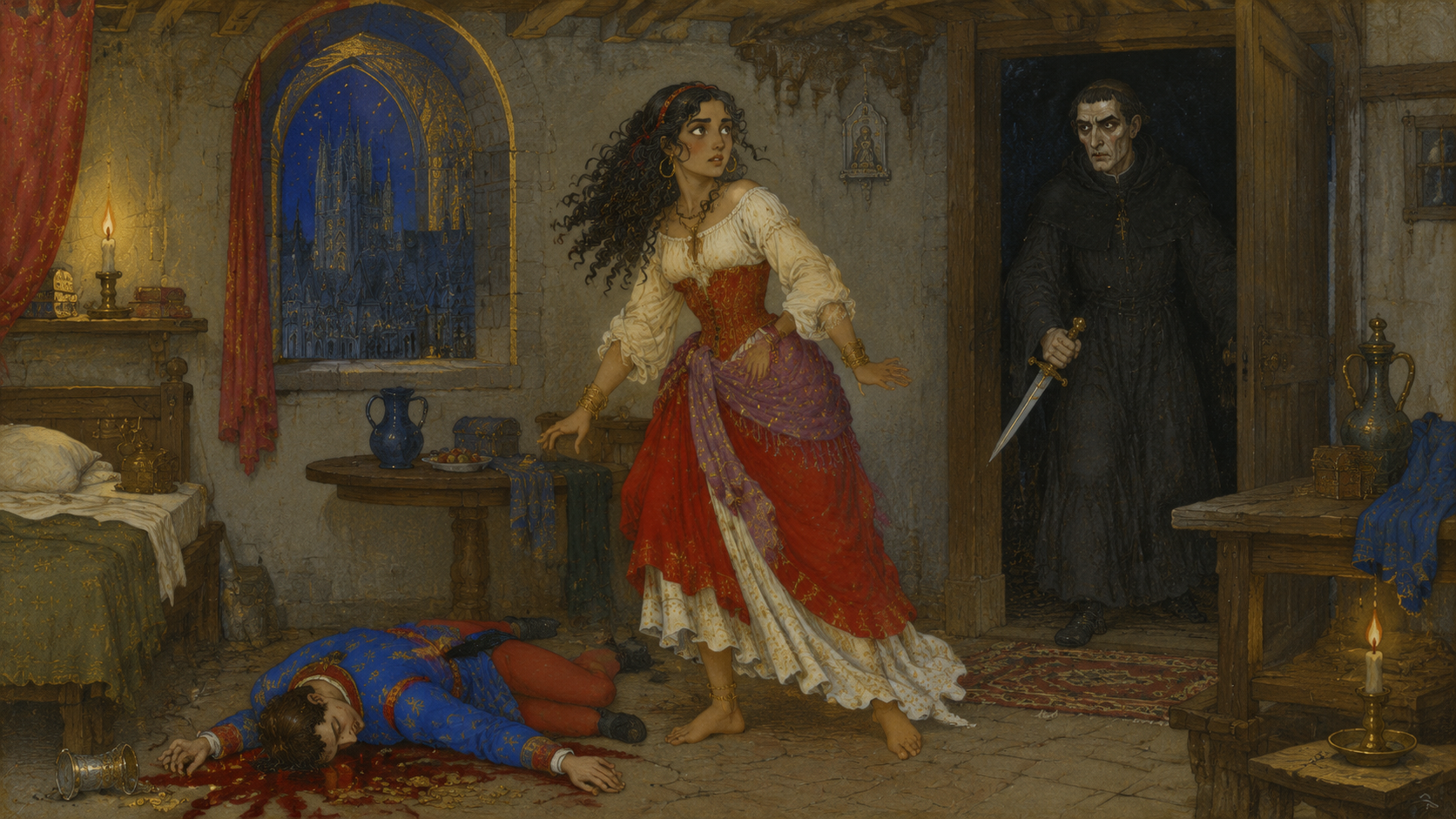
Esmeralda doesn't fall for Quasimodo, who saved her — she falls for Phoebus's handsome face. On a rainy night she goes to meet him at a small inn; just as the two of them are murmuring endearments, the archdeacon steps out of the shadows. He has followed them the whole way, and consumed by jealousy, draws a dagger and stabs Phoebus in the back. Phoebus falls, Esmeralda freezes in shock, and the archdeacon points a finger straight at her: she did it. The King's court moves with startling efficiency: Phoebus doesn't die, but can't be bothered to testify on her behalf, and she is swiftly convicted as a sorceress who tried to assassinate a royal guardsman — and there is only one sentence for that: the gallows. Hugo doesn't write this scene as a crowd-pleaser; he renders the court's logic like an assembly line: you are a Gypsy, you were at the scene, therefore you are the murderer. The most horrifying thing in the whole novel isn't the murder in the bell tower — it's this trial.
And when I grow old or ugly, Phœbus, when I am no longer good to love you, you will suffer me to serve you still.
等我老了、丑了,弗比斯,等我不再值得你爱了,你还会容许我留在你身边侍奉你吗?
原文金句 · 小旅店幽会 · 卑微的献祭
Four: The Bell Tower and the Right of Sanctuary — an Ugly Man's Kingdom
On the day of the execution, Quasimodo slides down a rope from the top of the bell tower, scoops Esmeralda up with one arm, and races toward Notre-Dame. The instant he bursts through the cathedral doors he shouts the loudest word in the whole novel — 'Sanctuary!' (asile) — the last legal refuge the medieval Church offered anyone with nowhere left to turn: once inside these doors, not even the King could drag you out. What follows are Esmeralda's quietest days: she settles into a loft in Notre-Dame, and every day Quasimodo brings her food, water, and a small straw bed, while Frollo slips into the tower night after night to beg her: 'Just say yes to me, and I'll save you.' These are some of Hugo's finest pages — reading them, you suddenly lose track of who the real monster is: the bell-ringer is ugly but restrained; the archdeacon is respectable but sinister. Here the bell tower isn't a sanctuary so much as a magnifying glass, showing exactly what is inside a person.
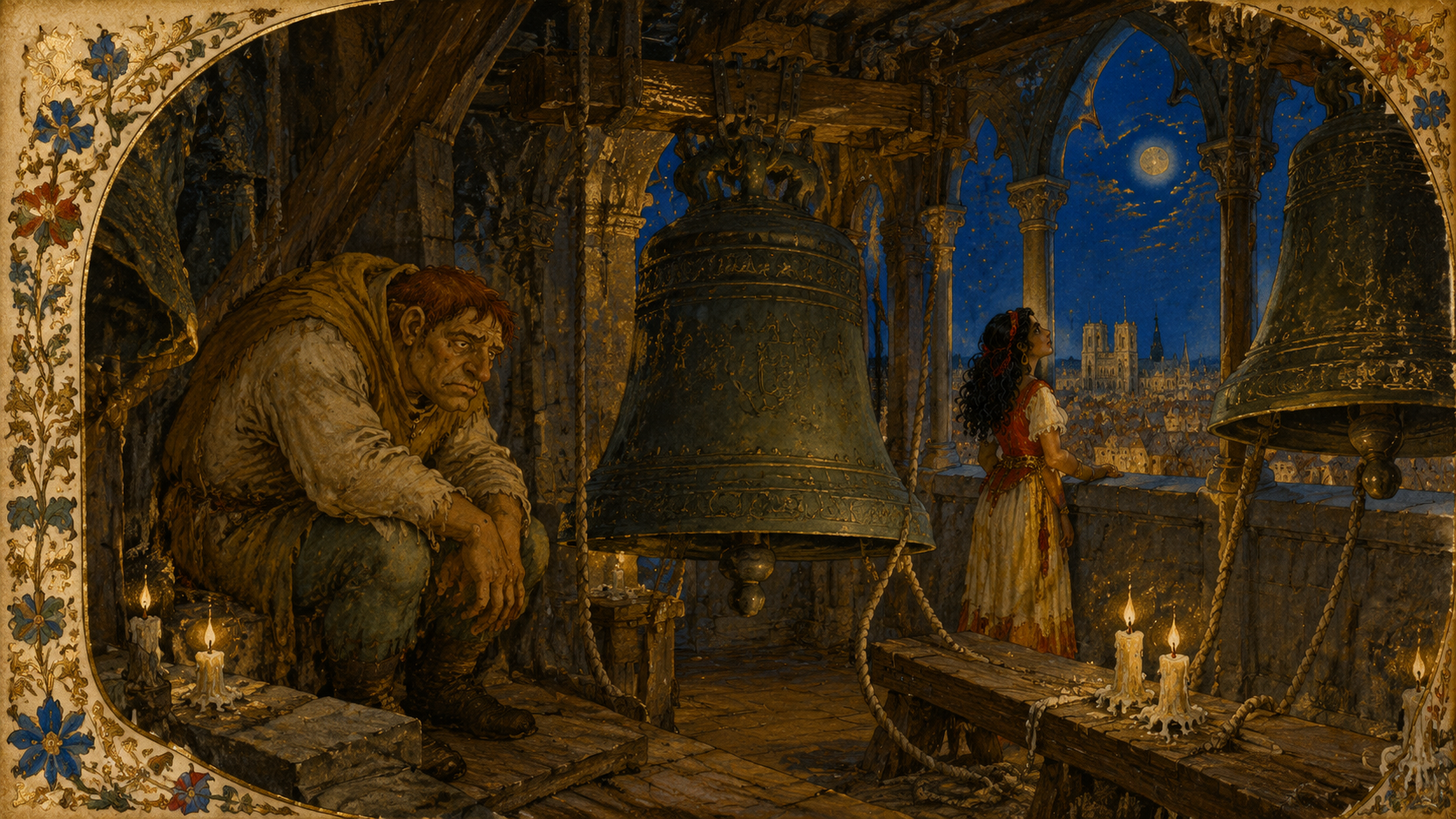
During the day you will remain here; at night you can walk all over the church.
白天你就留在这里;入夜,你可以在整座教堂里随意走动。
原文金句 · 钟楼庇护 · 石头的慈悲
Five: The Battle for the Cathedral — the Beggars' Backfiring Rescue
Then comes the irony: Frollo tells Quasimodo, all false concern, 'You're not well — go rest outside the city for a few days,' and the moment his back is turned, hands Esmeralda over to the soldiers. Word reaches the underworld of Paris, and Clopin, king of the beggars, leads an entire army from the Court of Miracles — vagrants, thieves, street performers — to storm Notre-Dame. It sounds like the setup for a hero's rescue. Instead, the fighting drags on all night, the beggars fail to free her, and their assault only tightens the soldiers' grip: the judges in the city, who had been only half-convinced of any real threat, now see an actual riot and rush Esmeralda to the gallows without further delay. Hugo has the most loyal people in the book perform the single most self-defeating act in it. The scene reads almost like a documentary — a sweeping set piece, a whole cast of minor characters each given their two or three lines — but all of it is there to show you one thing: the goodwill of the poor is often the fuse for someone else's disaster.
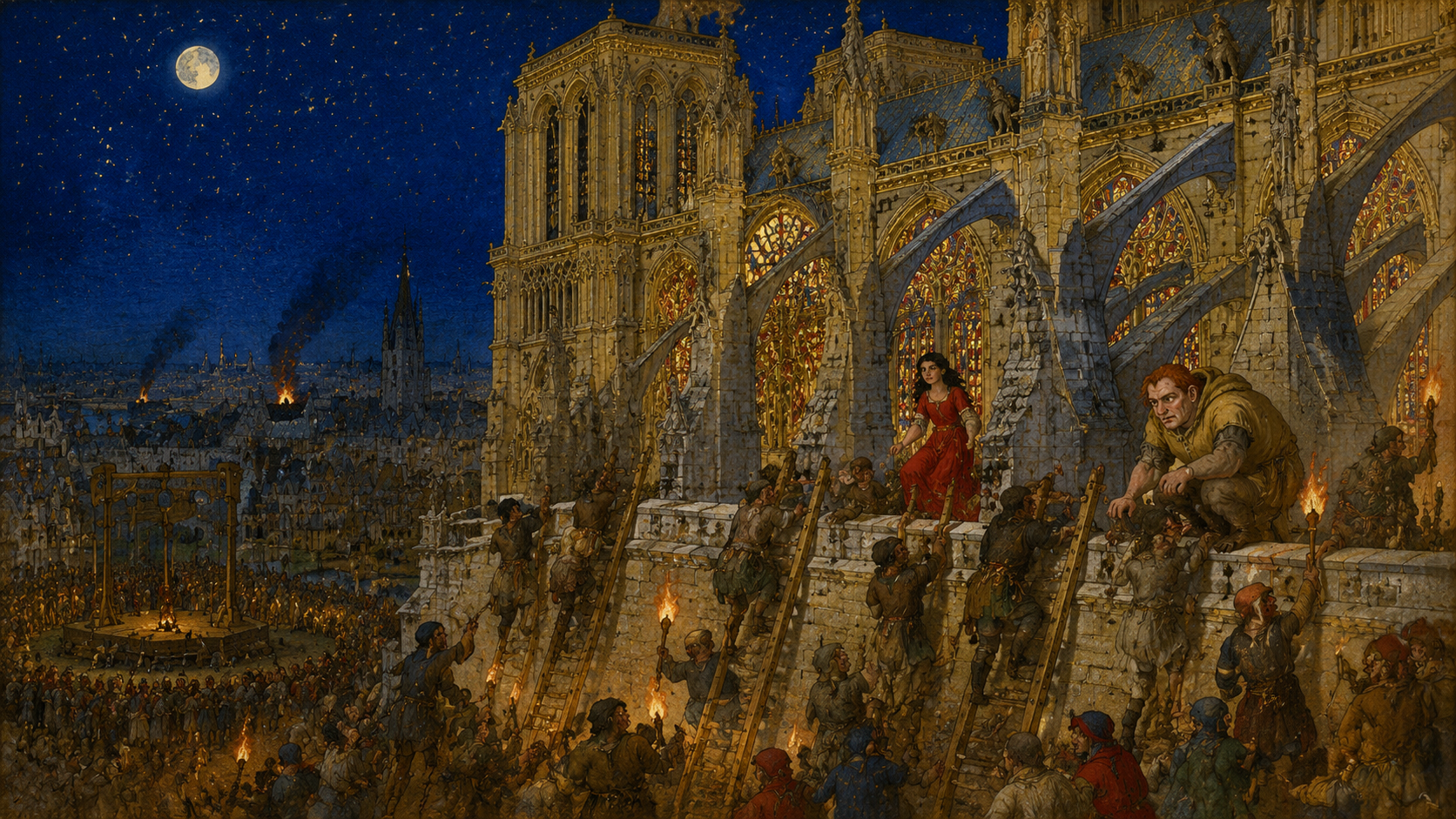
The priest broke the silence at length, by saying, in a tranquil but glacial tone,- "How do you do, Master Pierre?"
别来无恙,皮埃尔先生?
原文金句 · 血战之夜 · 虚伪的寒暄
Six: A Reckoning atop the Bell Tower — Pushed Off, Dying in Each Other's Arms
On the day of the hanging, Frollo has already tricked Quasimodo out of the city; by the time Quasimodo fights his way back, the noose has already closed. He climbs back up the tower and finds his adoptive father leaning on the balustrade, grinning out at the distant gallows — grinning because someone has taken care of his 'problem' for him. Quasimodo walks up without a word, puts both hands against him, and pushes. Frollo falls from the tower. Hugo doesn't have Quasimodo shout in triumph afterward; he simply vanishes into the city's sewers. Years later, when Esmeralda's tomb is opened to move her remains, two skeletons are found locked in an embrace inside it — one hunchbacked, one slender, impossible to pry apart. This is the novel's final image: the ugly one dead, the beautiful one dead, power itself dead, and what's left is stone and two skeletons holding each other. Hugo writes the ending from a vantage point 'years later' on purpose — so you step back far enough to feel just how bone-deep that cold really is.
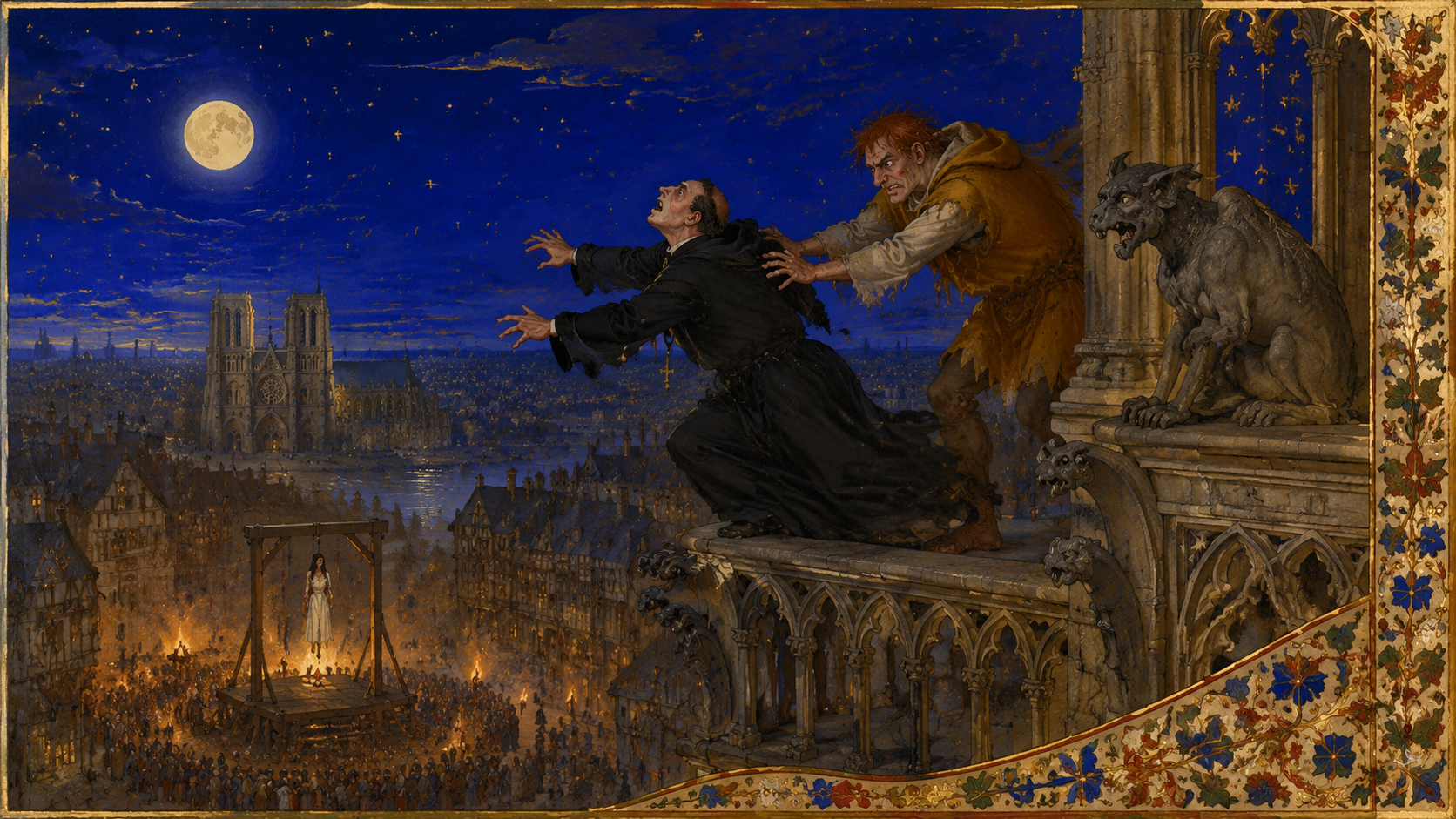
The hook lay open at this passage of Job, over which his staring eye glanced,- "And a spirit passed before my face, and I heard a small voice, and the hair of my flesh stood up."
有灵从我面前经过,我听见细微的声音,我身上的毫毛都竖起来了。
原文金句 · 终局 · 约伯的震颤
Theme and Craft: Even Stone Can Weep for You
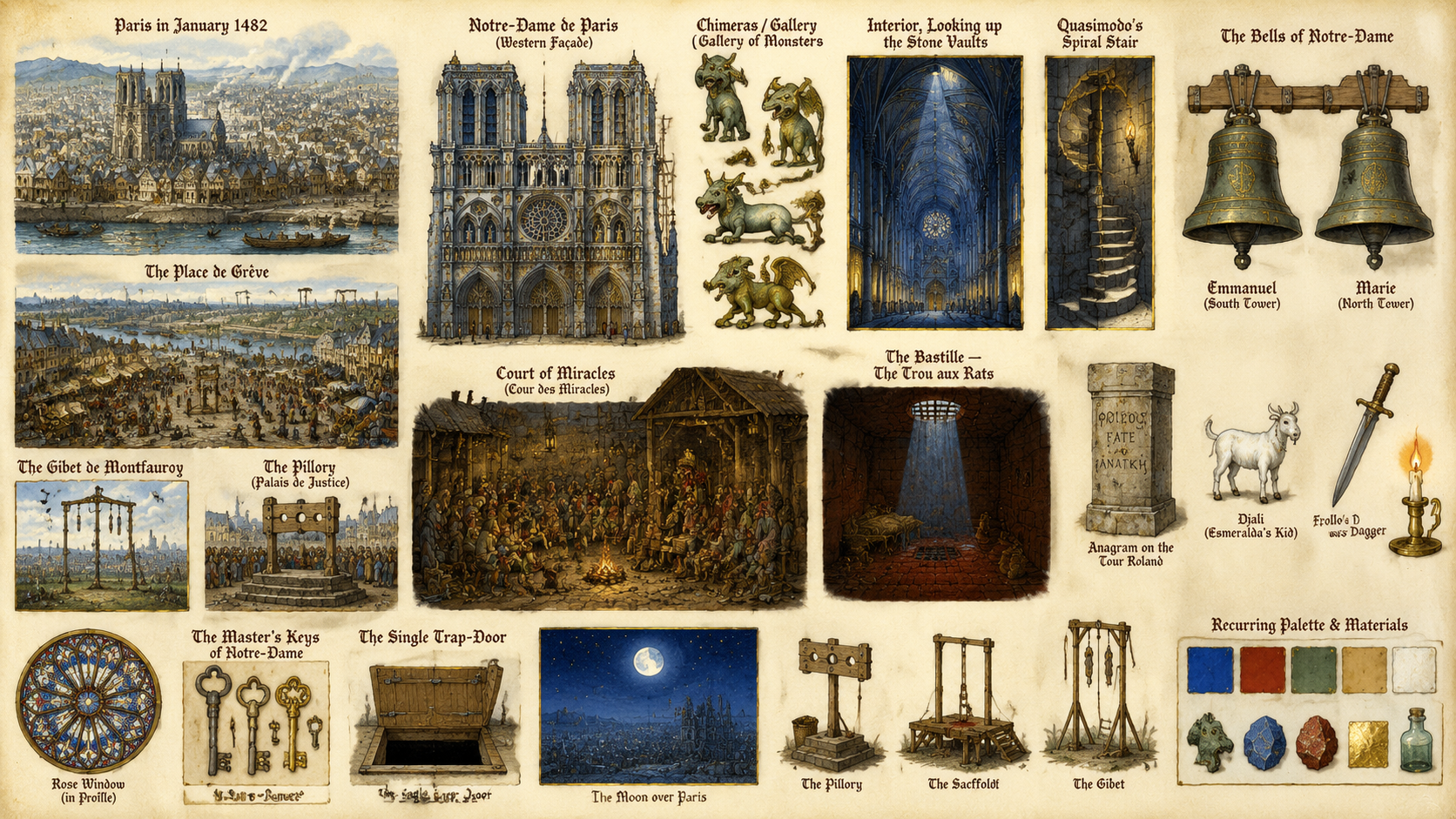
Notre-Dame de Paris is often read as a fable of beauty and ugliness, but it is really arguing three things. First, that desire warped by religious repression curdles into monstrosity — the archdeacon isn't born evil, he's been twisted by the strain of enforced celibacy. Second, how brutal society is toward anyone different: Quasimodo is ugly, Esmeralda is a foreigner, and neither of them is ever treated by the law as fully human. Third, that stone can bear witness too — Notre-Dame isn't merely a backdrop; across the whole novel it functions as a silent witness, torn down in places, burned in places, and finally still standing, and Hugo opens the book with an entire chapter devoted to writing this cathedral's 'biography.' Treating a building as a protagonist was genuinely groundbreaking for a nineteenth-century novel. Reading it feels different from reading fiction today: you get a panoramic sense of being walked, layer by layer, through streets, squares, rooftops, and tunnels — and that is also the deeper reason Hugo went on to shape generations of film, architecture, and historic-preservation movements after him.
Why Read the Text Itself: a Map Can't Give You the Ground Underfoot
You already know the plot, but what you don't know is how Hugo writes it. I can tell you that Frollo gets pushed off the bell tower, but I can't give you the actual sound of the bell — the one he never heard tolling while others fell in love, the one he heard while the girl was sobbing. You can know that she's sentenced to hang, but Hugo spends a good dozen pages on how all of underclass Paris lines up to walk toward the scaffold — a mother carrying her child, an old man selling roasted chestnuts, onlookers wearing every expression imaginable. What Hugo is writing is the breathing of an entire city, not the death of one person. This is the kind of thing you only run into by turning the pages yourself. There's also the chapter of pure argument about Gothic architecture built into Notre-Dame — Hugo writes it like a novel speaking on behalf of the stone itself. A summary can hand you the conclusion, but it cannot give you the feeling of being enclosed by that stone. Now that you know how it ends is exactly the time to go see how it's written.
The real villain of this book was never any one person — it is an entire city's indifference to difference itself: the ugly don't deserve to live, the foreign don't deserve to live, the disobedient don't deserve to live, and the one who survives is, more often than not, the most hypocritical one of all.
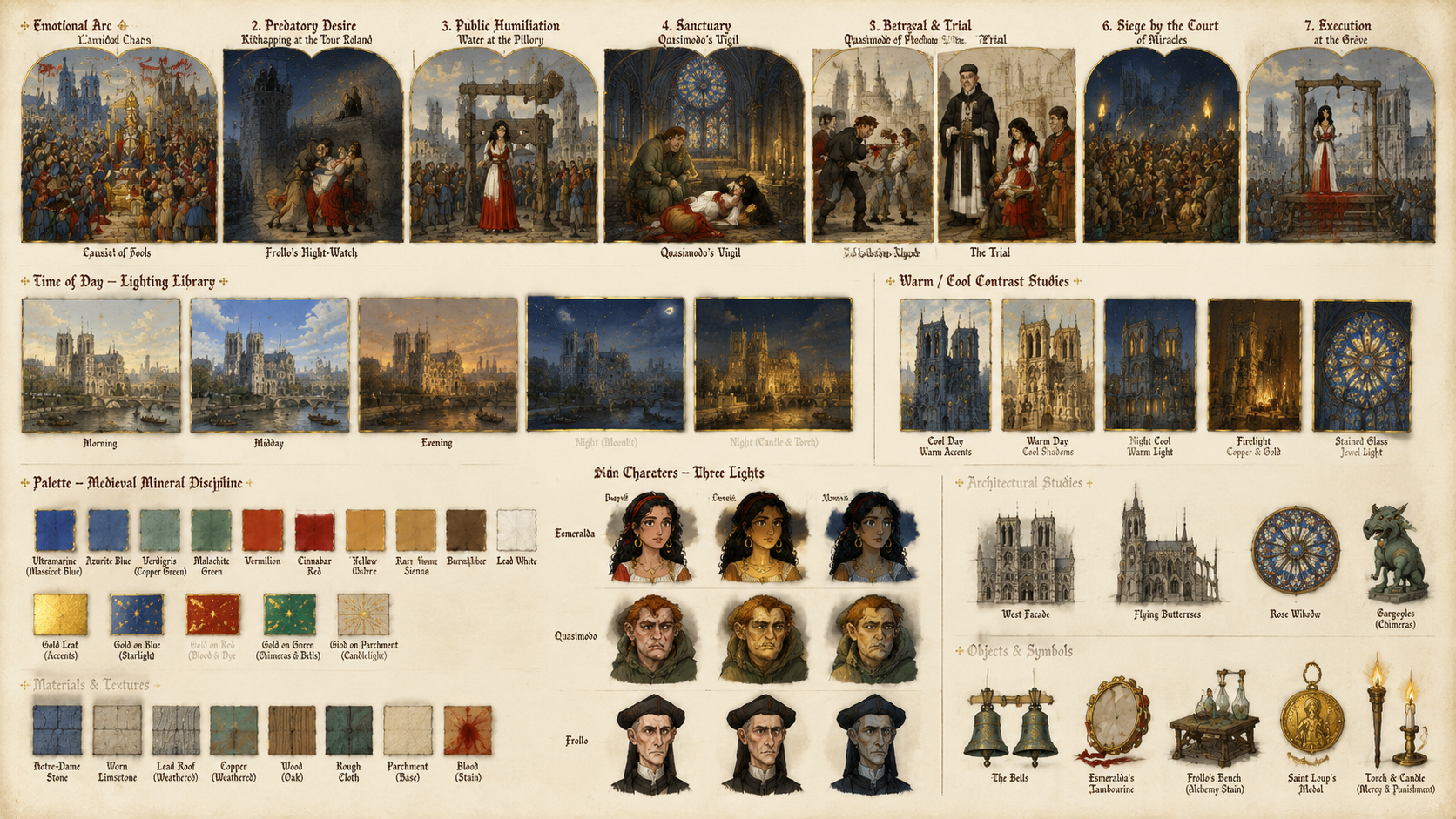
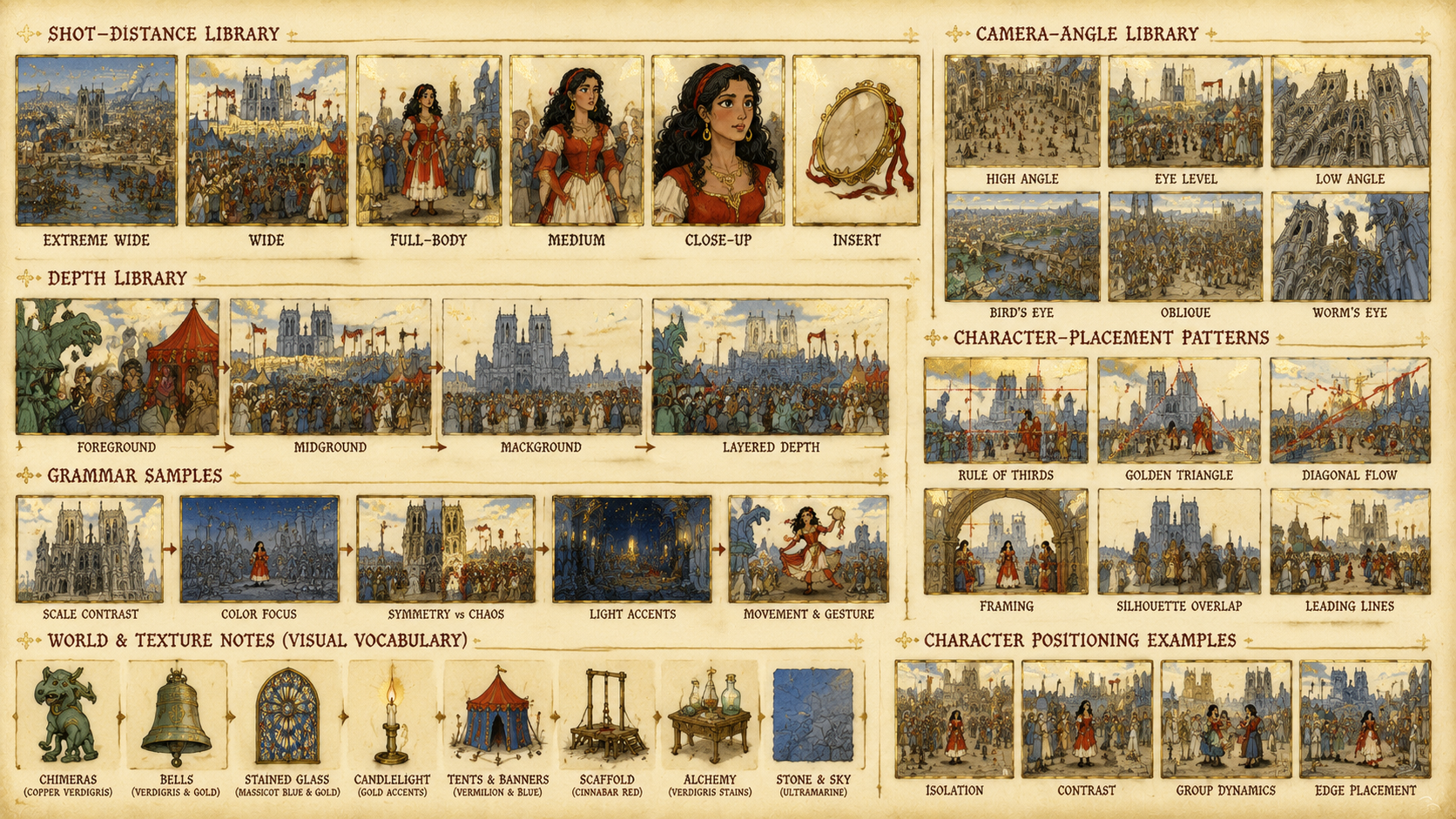
Art Direction4 plates
Before the guide was written, this book got a visual foundation — every illustration you just read grew out of it.