Pride and Prejudice · Companion Guide
傲慢与偏见
一句傲慢的评语,点燃了五个女儿未嫁家庭的婚姻焦虑,也引发了一场理智与情感的角力。
Opening: how far one rude remark can push a person
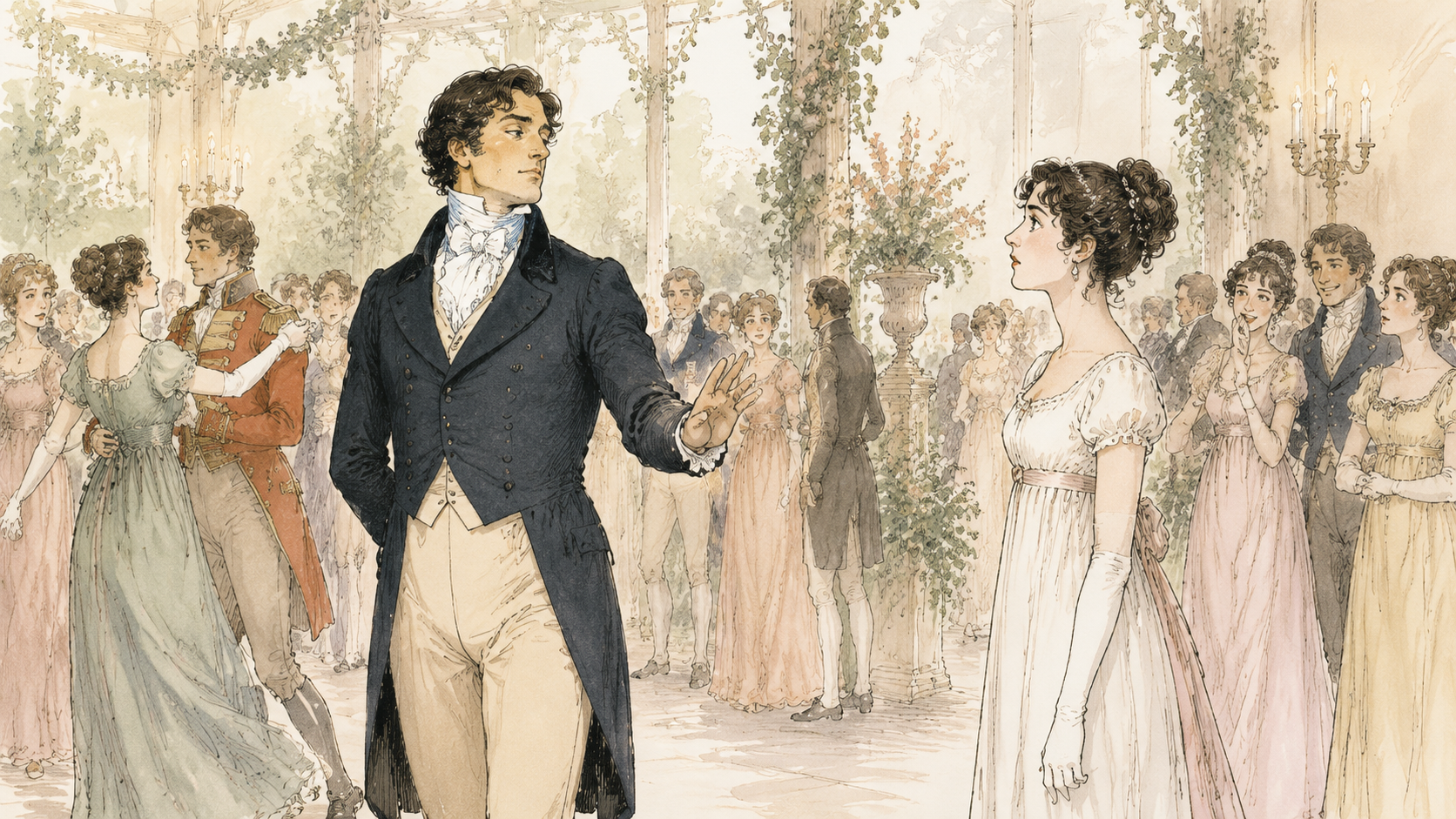
A country dance, candlelight. A young gentleman's daughter in a new gown, meeting a rich bachelor from town for the first time. She doesn't actually dislike him — it's just that, in front of half the room, he remarks coldly that she's tolerable enough, but not handsome enough to tempt him. She laughs it off, but something in her keeps score. Over the next few hundred pages that score only grows, until both of them are forced to admit the fault was their own. This is how Jane Austen opens her novel in the early nineteenth century — not with a sweet meeting, but with a failure of judgment. She shows you how a person can lock in an opinion of someone else within a single second, and how many detours it takes to spring that lock open again.
What kind of book this is
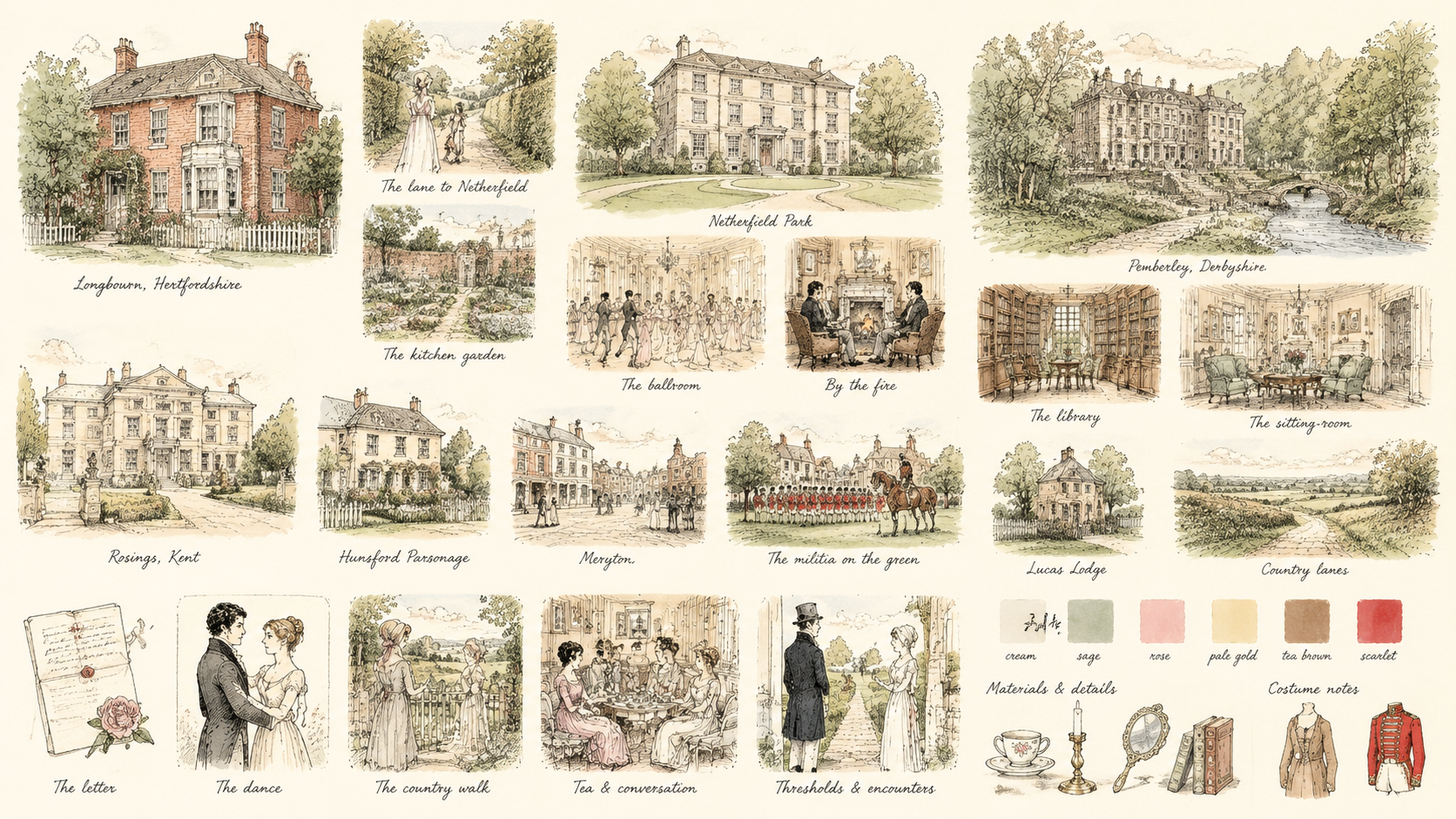
Pride and Prejudice is one of the earliest and most enduring courtship comedies in English fiction, published anonymously by Jane Austen in the early nineteenth century. The whole novel plays out on a few square miles of English gentry country — the village of Longbourn in Hertfordshire, a handful of families, a few balls, a few visits — and yet it has come down to us as the template for the English comic novel. It is remembered not because the ending is especially romantic, but because Austen, in a tone that sounds like idle gossip, turned the tightrope women of that era walked between marriage, property, and class into an ensemble comedy that is both sharp and warm-hearted. Two hundred years on, the Bennet family has become shorthand for any middling household with daughters to marry off.
The people and their world: five daughters, one assignment
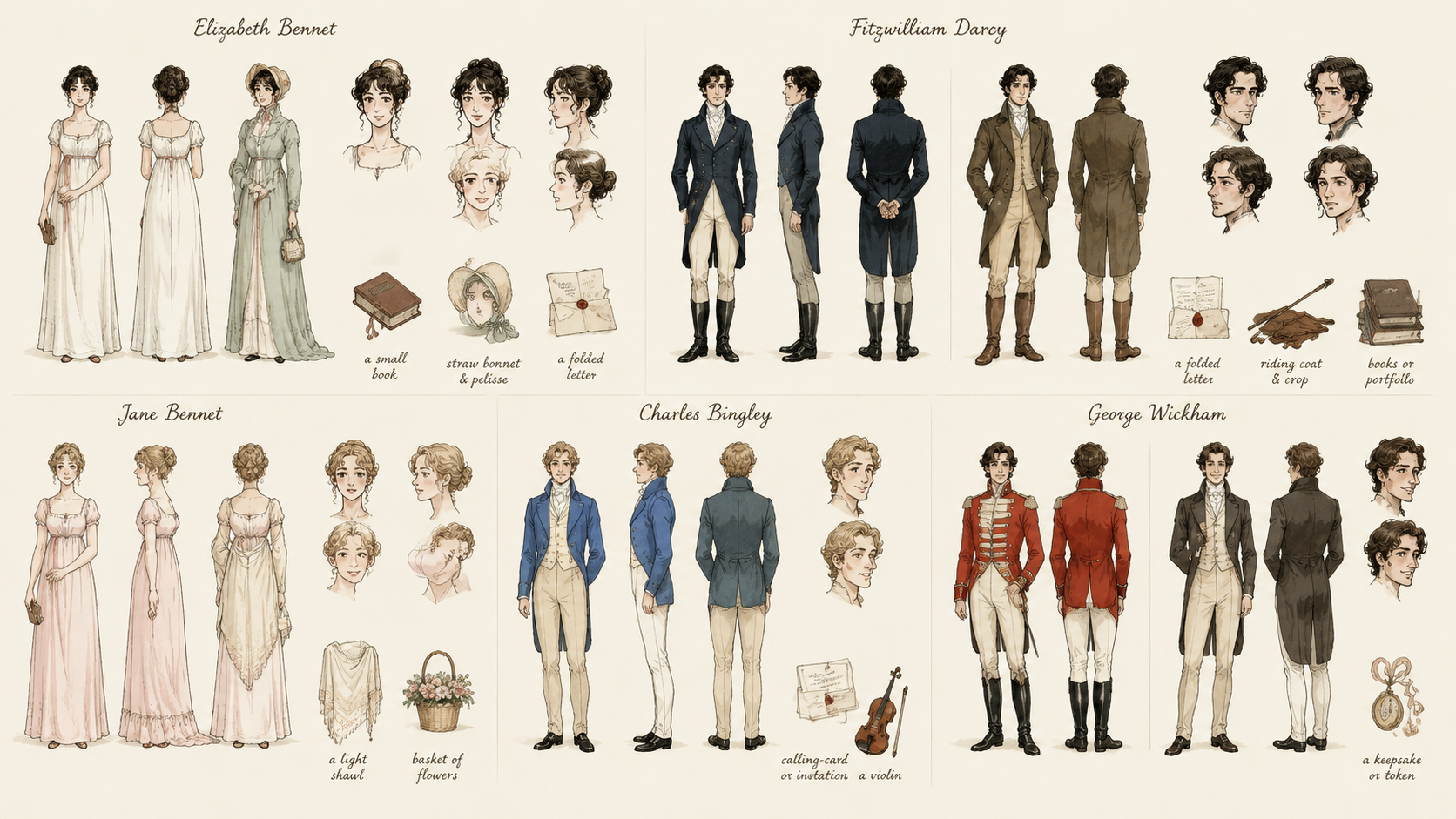
The Bennets have five unmarried daughters. In the gentry society of the time, daughters could not inherit their father's estate — the house will eventually pass to a distant cousin, Mr. Collins, who arrives later in the story. So for Mrs. Bennet, marrying off her daughters is not a matter of romance; it is a matter of survival. The five daughters are sharply different: Jane, the eldest, is gentle and beautiful; Elizabeth, the second — our heroine — is quick-witted and sharp-tongued, the one member of the family who watches closely and isn't afraid to judge; the younger sisters are, for the most part, either flighty or dull, there mainly to set the others in relief. Our two leading men: Mr. Darcy, a wealthy landowner, cold and proud; and Mr. Bingley, the good-natured young man of means who has just leased the neighboring estate. The story's real triangle is between an Elizabeth who observes keenly but also misjudges, and a Darcy who is proud but, underneath it, has real principles — each of them walks onstage carrying a flaw of their own.
Around them are a few more key faces: Bingley is drawn to Jane but is easily led, too ready to defer to Darcy's judgment; the handsome officer Wickham is charming on the surface and, underneath, a gambler and a liar — Darcy's old enemy. Lady Catherine de Bourgh is Darcy's overbearing, aristocratic aunt, the book's single biggest symbol of class authority. And then there is the ridiculous cousin, Mr. Collins, the novel's most important anchor for irony — the moment he appears, you know exactly which type of person Austen is mocking.
"There is, I believe, in every disposition a tendency to some particular evil, a natural defect, which not even the best education can overcome."
我认为,每个人的性格中都有某种不良倾向,某种天然的缺陷,即使最好的教育也无法克服。
原文金句 · 第5章 · 舞会初遇
The plot: pride and prejudice's tug-of-war in seven moves
The story opens at a ball. Bingley, the new tenant at Netherfield Park, brings his friend Darcy to the local assembly. Bingley and Jane fall for each other at first sight, but Darcy takes one look at Elizabeth and delivers the rude line that generations of readers have quoted ever since. That single remark is the story's first thorn — from then on, Elizabeth views Darcy through the harshest possible lens in every scene that follows. Craft note: Austen lets the wound land almost weightlessly. There is no dramatic confrontation, just a line or two of cold small talk at a dance — but the aftershock runs through the whole book.
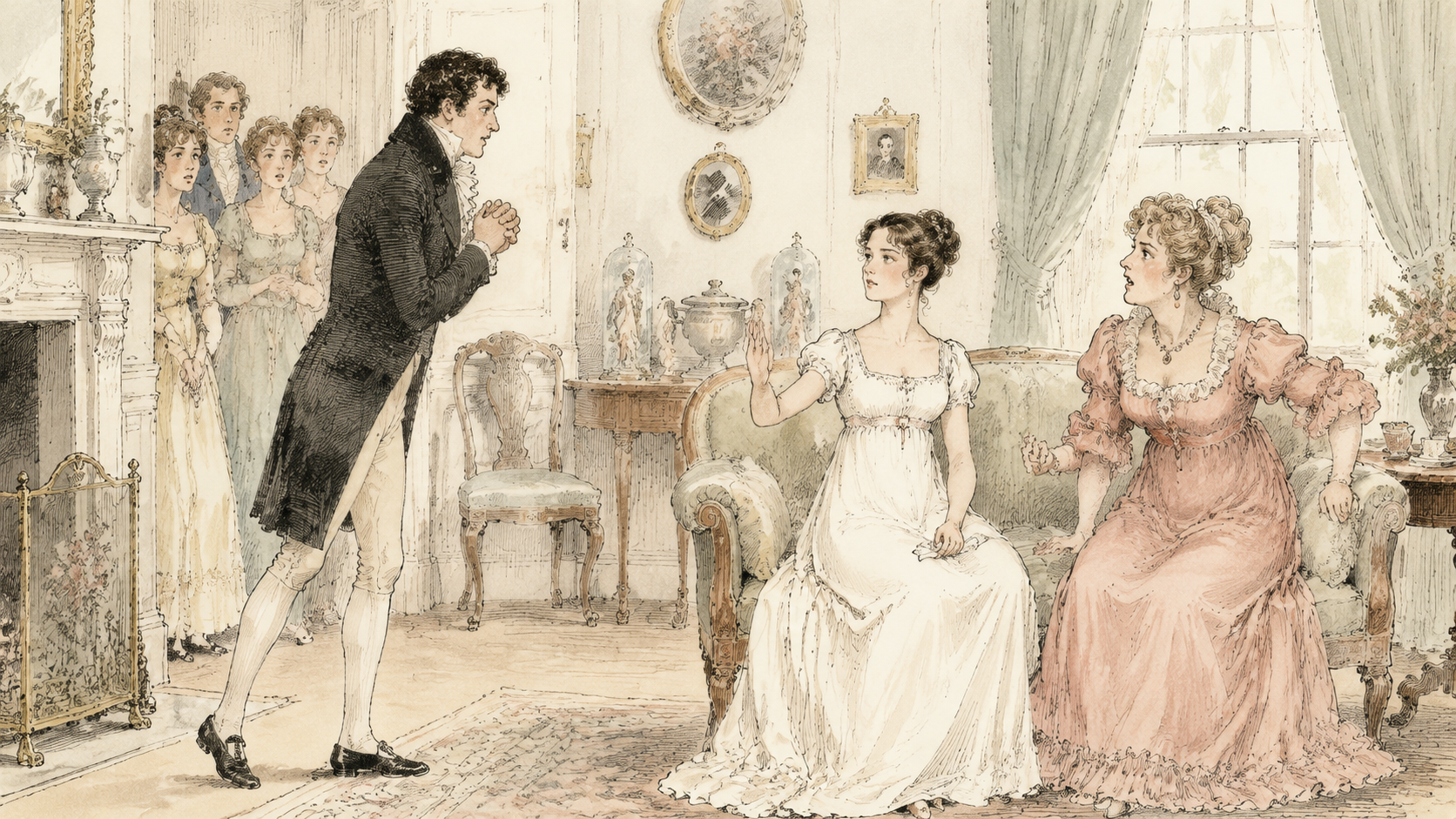
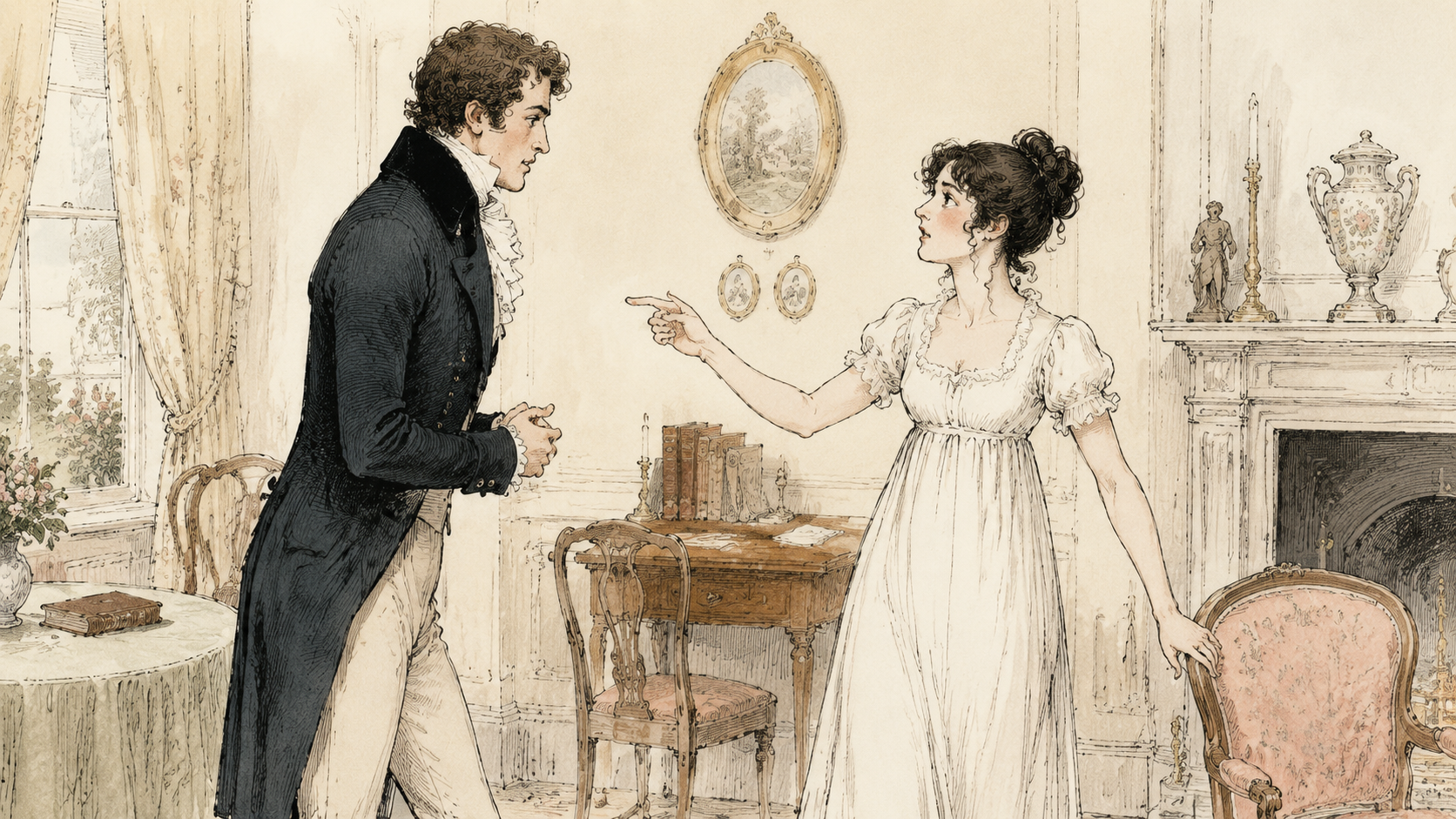
Next comes a scene in the Bennets' sitting room. The cousin, Mr. Collins, arrives to propose — his proposal is impeccably polite, every phrase correctly turned, and every phrase also faintly ridiculous with pomposity and self-regard. His reason for proposing to Elizabeth isn't love; it's that as the entailed heir, he feels obliged to marry the next Miss Bennet in line after the eldest — a debt of honor he owes the family. Elizabeth turns him down flat, and her mother is beside herself. Craft note: this is the first time the novel strips marriage bare as an economic arrangement — Austen serves up the least romantic possible reason for a proposal, wrapped in the most impeccable manners, and lets the irony do all the work.
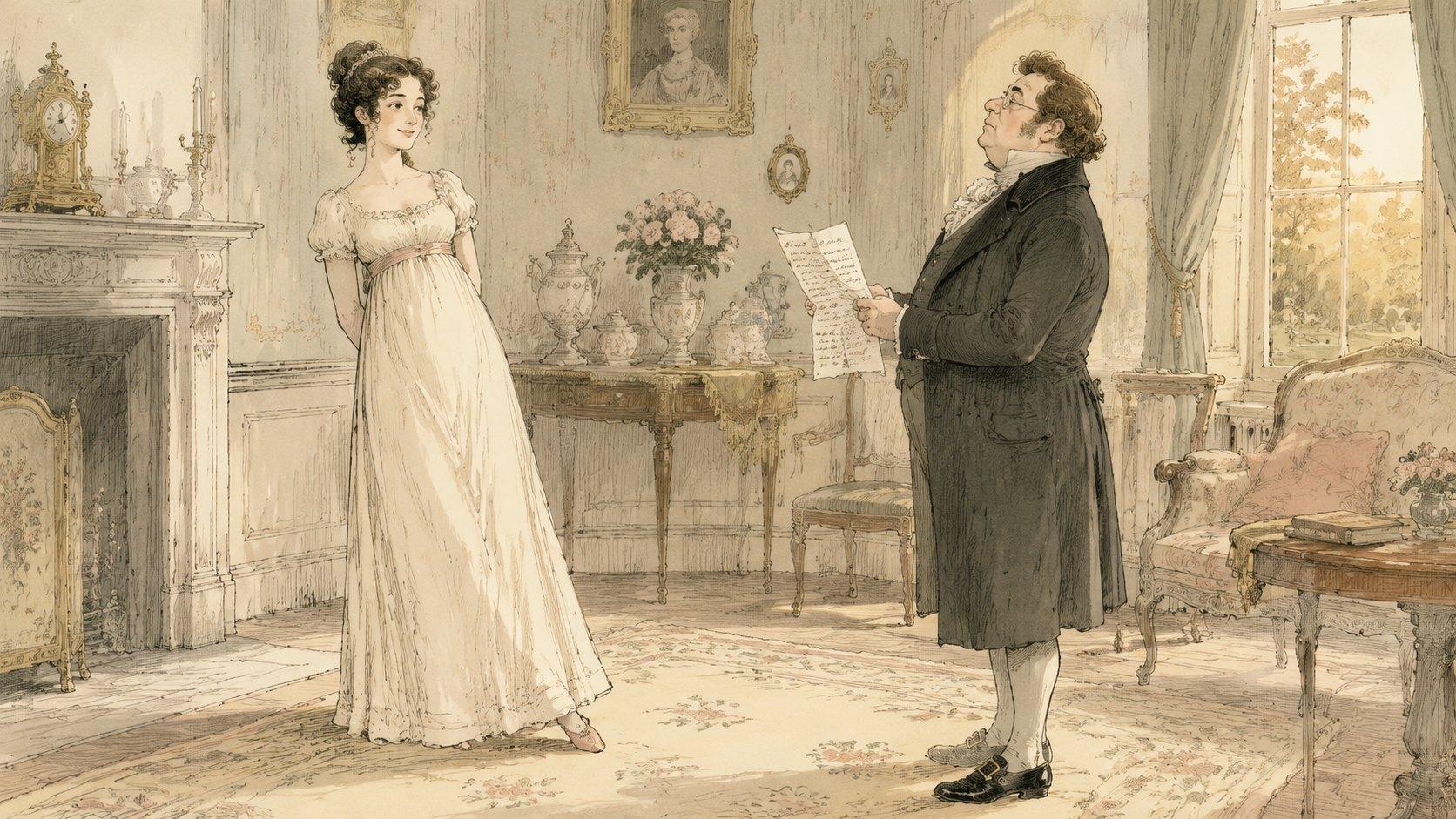
"Are you consulting your own feelings in the present case, or do you imagine that you are gratifying mine?"
你这是在考虑自己的感情呢,还是以为在满足我的感情?
原文金句 · 第19章 · 柯林斯求婚
Act three is the real centerpiece — Darcy's first proposal. Believing Elizabeth's family circumstances are passable enough, he declares himself in a manner that is almost condescending: her family's standing is beneath his, her relations barely fit for polite company, but he is still willing to overcome the disparity and marry her anyway. To Elizabeth's ear, this amounts to trampling her entire family in one breath. She goes on the attack at once, firing off her case point by point: first, that he broke up her sister Jane and Bingley; second, that he had wronged his old friend Wickham — however much he owed the man, he repaid it with sheer ingratitude. Darcy is stunned by the full broadside of accusations; the proposal collapses, and the two part on openly hostile terms. Craft note: this is the first time both characters expose their prejudice at once — he assumes love can erase class, she assumes morality can erase rank. Two clever people, in the same breath, say exactly what they mean and get almost everything wrong.
After the rupture comes the quietest and most pivotal night in the book. On a woodland path, Darcy presses a long letter into Elizabeth's hands. In it he makes no further declarations of feeling; instead he answers her charges point by point: Wickham is a spendthrift and a habitual liar who was helped generously by the Darcy family and, in return, once attempted to elope with Darcy's young sister, Georgiana, for her fortune. The story Elizabeth had believed without question — villainous Darcy, virtuous Wickham — starts to come apart, line by line. Craft note: Austen doesn't let Darcy defend himself in person; she uses a letter instead, handing both the defendant's case and the reader's cross-examination to Elizabeth at once — and to you, so you doubt your own earlier judgment right alongside her.
The letter is read, but the prejudice isn't fully dismantled yet. Only when Elizabeth tours Pemberley — Darcy's estate — with her aunt and uncle does she meet a different Darcy. He isn't expected to be home, and the housekeeper treats her almost as an honored guest; then Darcy himself returns, gentle and considerate with his sister and his servants alike, with none of the coldness he showed at the ball. Over her days walking the grounds at Pemberley, Elizabeth begins revising her portrait of him, piece by piece. Craft note: Austen builds character through the atmosphere of a house — you don't just watch Darcy change, you move into his home and see his actual life.
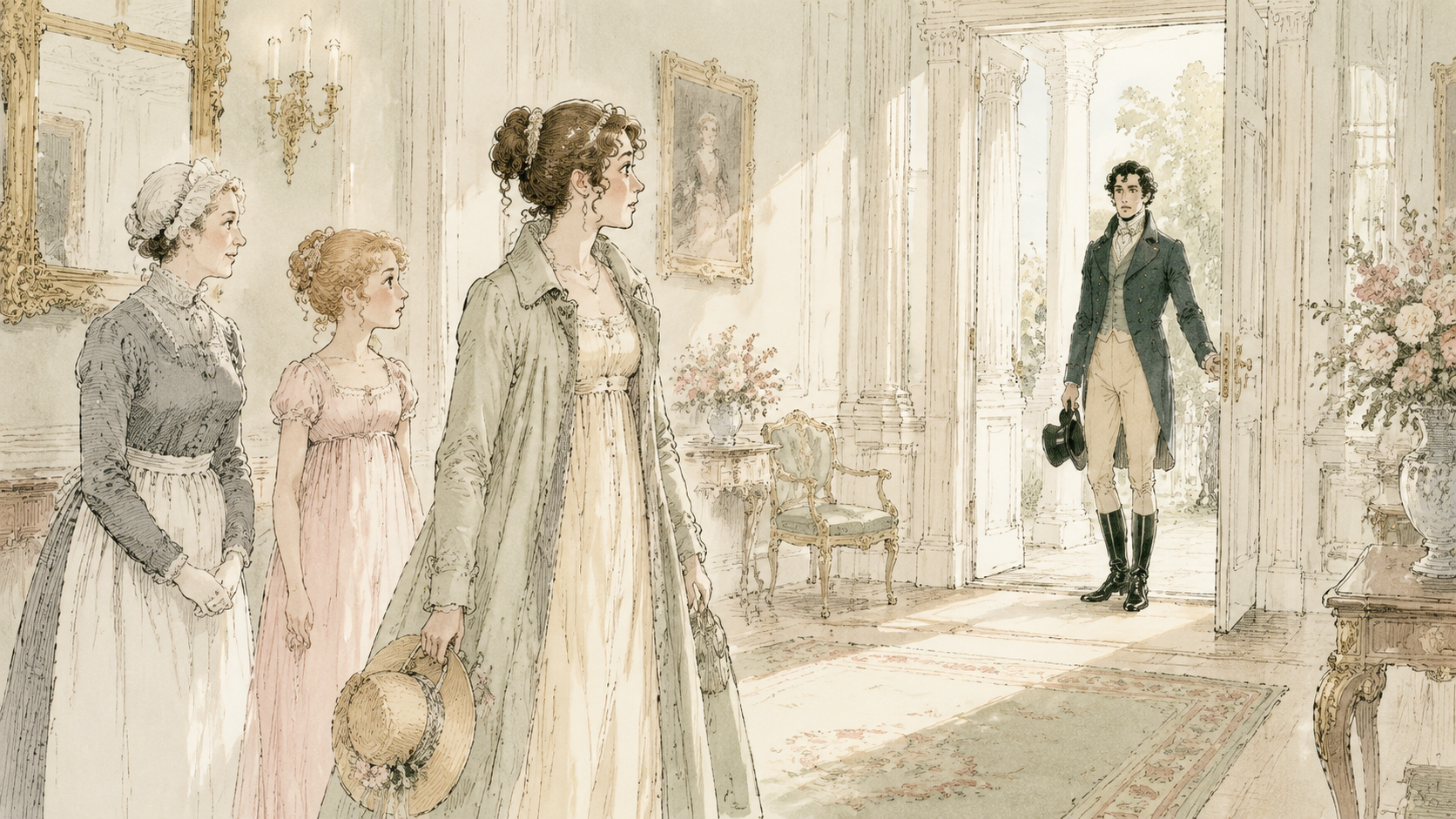
"Not so much as I could wish, sir: but I dare say he may spend half his time here; and Miss Darcy is always down for the summer months."
虽然不如我希望的那么多,先生;但我敢说他每年有一半时间住在这里;达西小姐也总是在夏季来住。
原文金句 · 第43章 · 彭伯利庄园
Before her change of heart can be spoken aloud, the sixth act turns the whole book upside down: the youngest sister, Lydia, elopes with Wickham. This is the worst possible scandal in early-nineteenth-century English gentry society — an unmarried daughter running off with a gambling officer, her reputation all but destroyed. The Bennet household is thrown into chaos, and Elizabeth is sick with guilt. What she doesn't know is that Darcy, working entirely behind the scenes, tracks Wickham down, pays off his gambling debts, and arranges the wedding — quietly saving a scandal that could have ruined the whole family. Craft note: this move is ruthless in the best way — the hero wins her over through action she doesn't even know about. She's still angry at him over his letter while he's already spending real money to save her family.
I am going to Gretna Green, and if you cannot guess with who, I shall think you a simpleton, for there is but one man in the world I love, and he is an angel.
我要去格特纳格林了,要是你猜不出和谁一起,我就当你是傻瓜,因为世上我只爱一个男人,他简直是个天使。
原文金句 · 第51章 · 莉迪亚私奔信
The seventh act brings the whole novel to a close. When Lady Catherine de Bourgh, Darcy's imperious aunt, hears that her nephew might marry Elizabeth, she descends on Longbourn in person to demand that Elizabeth swear never to marry him. She expects the Bennets to back down under pressure; instead Elizabeth answers her, coolly and without giving an inch. Lady Catherine leaves empty-handed — and, without meaning to, pushes Darcy to make up his mind. He proposes again, and this time his manner is entirely different: no condescension, no talk of overcoming a gap in rank, just a plain request. This time, Elizabeth says yes. Craft note: Austen uses an outside force to collide two people who would otherwise have stayed awkward with each other for months longer; Lady Catherine believes she's tearing them apart, when in fact she's the one who brings them together.
What this book is really about
On the surface, Pride and Prejudice looks like a romance: a proud hero meets a prejudiced heroine, misunderstandings clear up, and the two end up together. But what Austen is actually writing about is how dangerous judgment itself can be. She has both of them look at the world through a filter — Darcy through the filter of class, Elizabeth through the filter of morality — and as a result, each one misreads the other, and misreads themselves too. The relationship only moves forward once each of them admits, I might have been wrong. So the title isn't a pair of labels for two people; it's a diagnosis of what's wrong with both of them.
On a deeper level, it's about the property trap English women faced in the early nineteenth century: for daughters in a family with no son, marriage was the only route to a better station in life. So Mrs. Bennet's anxiety isn't vulgar calculation — it's realism. Austen carries this reality through an entire light comedy without ever spelling it out directly; she has you laughing while a chill runs down your back. Read it today, and you'll notice that things like being well-matched, having the right circumstances, marrying within one's circle have been renamed a hundred times since Austen's day, and haven't actually moved an inch.
The death of your daughter would have been a blessing in comparison of this.
你女儿死了倒比这好。
原文金句 · 第52章 · 父亲的愤怒
Why it still reads fresh after two hundred years
Austen's opening line is already an irony: It is a truth universally acknowledged, that a single man in possession of a good fortune must be in want of a wife. In one sentence she lays bare the entire marriage market of her era. This gift — to write social rules in the tone of casual gossip and still land a punch decades later — is her greatest strength. Elizabeth is also widely regarded as one of the earliest, most vividly alive independent women in English literature: she isn't rebellious, she's clear-eyed; it isn't that she can't love, it's that she refuses to say yes before she's seen clearly.
The real ending of Pride and Prejudice isn't the engagement — it's that both of them learn to downgrade a first impression to a hypothesis still awaiting proof.
You already know the plot — so why the text is still worth reading
The plot gives you a map, but what makes Austen genuinely great is the physical feel of her prose. A single comma's pause can tell you Elizabeth's heart just skipped; three lines of polite chatter can leave you laughing out loud, and three pages later one tightly restrained sentence can bring you to tears. Darcy's letter is a classic not because it clears up the facts, but because it captures how a single person can fold pride, guilt, and love into the same sentence. And then there's the scene where Darcy is away and Elizabeth tours Pemberley alone — that experience of imagining someone inside their own house is something no plot summary can ever give you. You already know they'll be engaged, but you only understand why the book deserves a second reading once you've actually walked through it yourself.
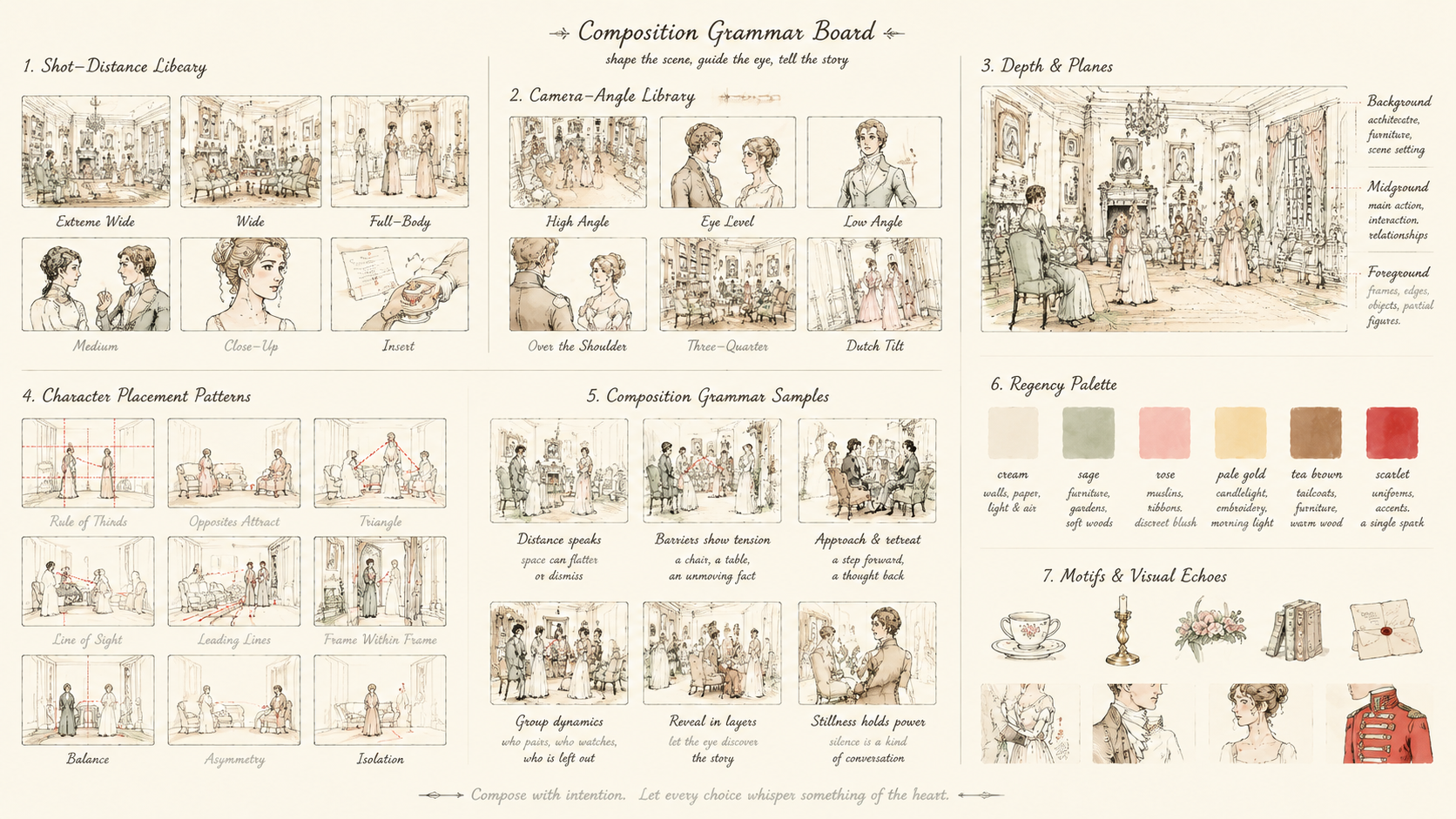
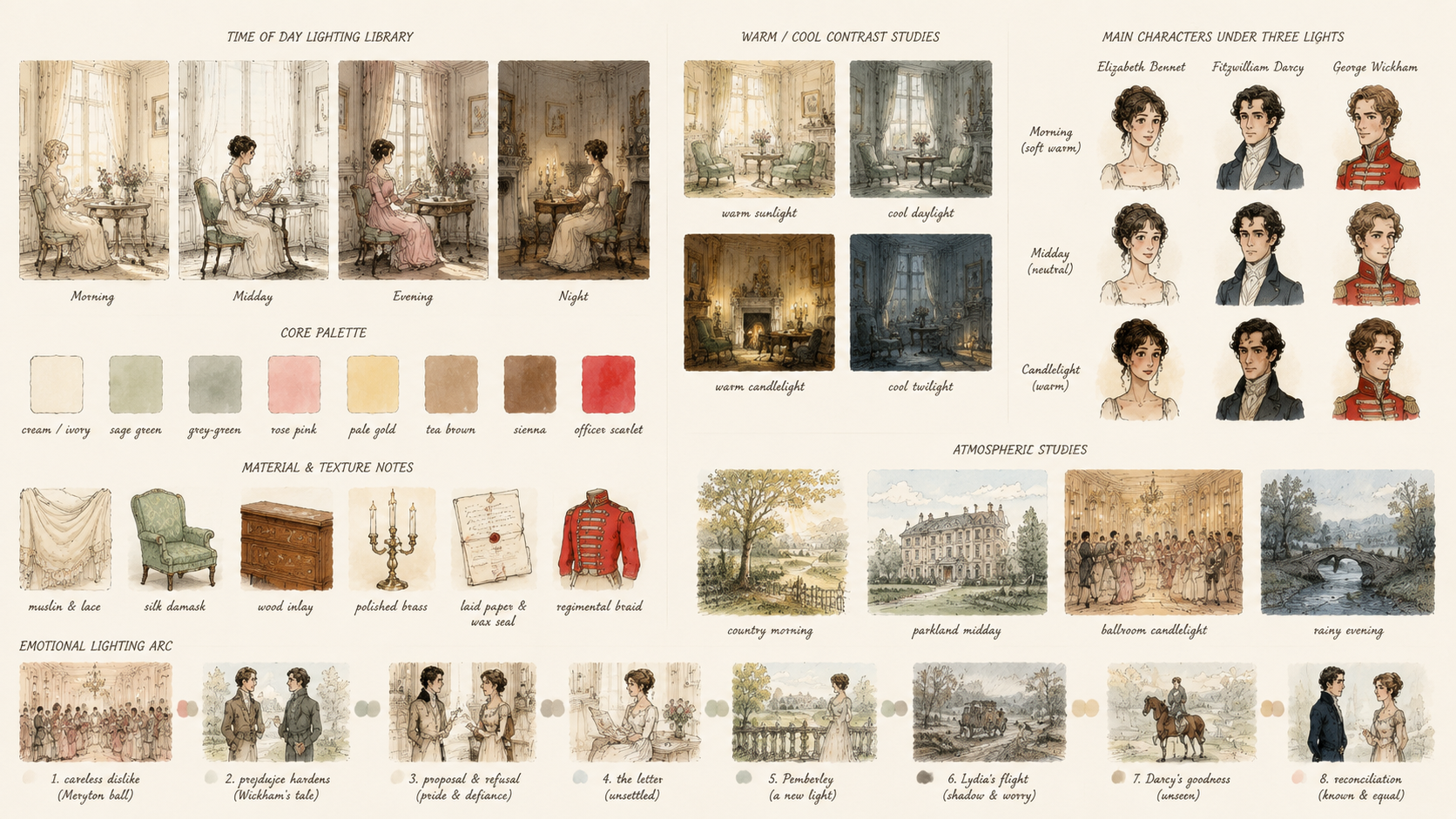
Art Direction4 plates
Before the guide was written, this book got a visual foundation — every illustration you just read grew out of it.