Quentin Durward · Companion Guide
昆廷·杜沃德
一个苏格兰穷少年单衣入网,被矮胖的蜘蛛国王捏在指尖——他要么穿齐军服去死,要么穿齐军服活下来改变欧洲
Opening: An Interview Among the Iron Cages
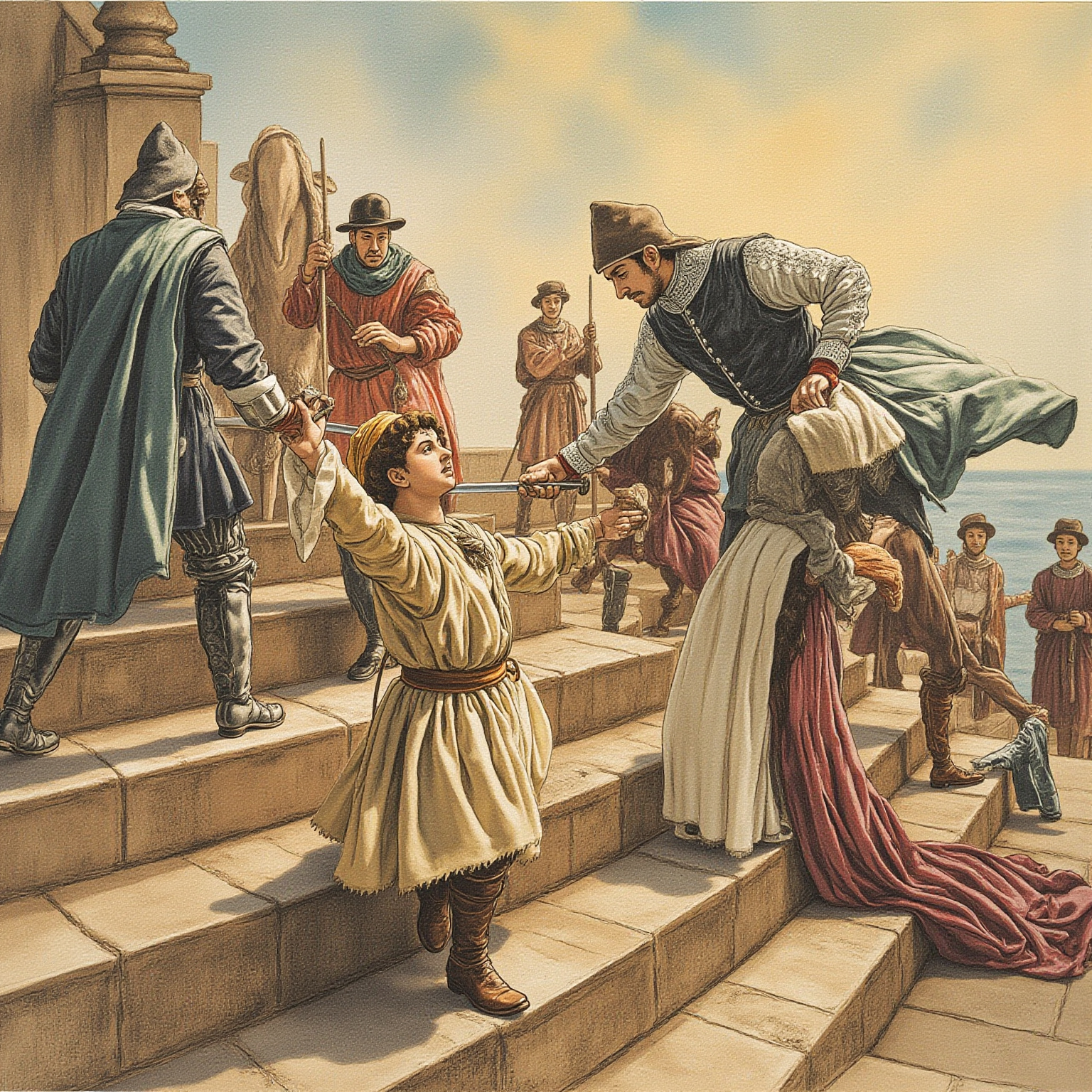
A leaden hat studded with holy medals sits on the king's round head. The stout, middle-aged man pulls a small silver image from his pocket, murmurs a prayer to the Virgin, tucks it back inside his coat, and turns to the young man kneeling before him — a Scottish youth he has just ordered put to death, because the boy's grandfather once quarreled with the king's father. The youth doesn't tremble, doesn't weep. He asks only one thing: before he dies, may he put on the full uniform of the Scottish Guard? The king narrows his eyes and smiles.
What Kind of Book Is This
Walter Scott published this in 1823, a three-volume set out of Edinburgh — the moment the founder of the Scottish historical novel first swung his lens off the Highlands and onto the European continent. It sold harder in Paris than in London, and gave France's own historical-novel school its start: Dumas and Hugo both learned from it. Scott had already earned the title father of the historical novel, but this is the book that put the word father on France's own doorstep.
Characters and World: Three European Temperaments on One Stage
Three men carry the book. Louis XI, called the Spider King, France's real ruler — stout, superstitious, tightfisted, cold-blooded, and formidably clever, with a former barber turned executioner, Oliver, as his closest confidant. Charles the Bold, Duke of Burgundy, a head taller and a head more violent, hung with the badges of the Golden Fleece, extravagant to the point of absurdity, willing to bet his own life when his temper caught fire. Caught between them is Quentin Durward — the son of a ruined Scottish noble family, newly arrived across the sea to seek out his uncle, who has landed him a minor commission in the Scottish Guard. He is penniless and proud. The Guard is made up entirely of Scots: a company of foreign blades that Louis keeps close at hand.
The story unfolds in the late 1460s. Europe has just finished the Hundred Years' War, and Louis XI is trimming away France's feudal remnants piece by piece. His greatest rival is the Duke of Burgundy, a neighbor richer than the French king himself, whose lands run from the Low Countries down to Lorraine. Quentin's journey cuts straight through that contested ground, and two more figures join him along the way: the Countess Isabelle de Croye, decisive and sharp-witted, who refuses to let anyone choose her husband for her; and his own elusive half-brother Hayraddin, endlessly resourceful, working as Louis's secret eyes and ears — the story's mirror held up to the other side of human nature.
Plot Line: From the Hunting Park to the Tower
I. The Iron-Cage Hunting Park: The Soldier Who Didn't Die
Not long after Quentin's uncle gets him into the Scottish Guard, Louis summons him to the hunting park at Plessis — a royal preserve walled in iron-cage traps, built for hunting game and for holding prisoners alike. Louis means to settle an old debt on his father's behalf, but halfway through the conversation the youth's calm, unhurried answers change his mind. The king doesn't kill him. Instead he writes him into the next round of his game against Burgundy.
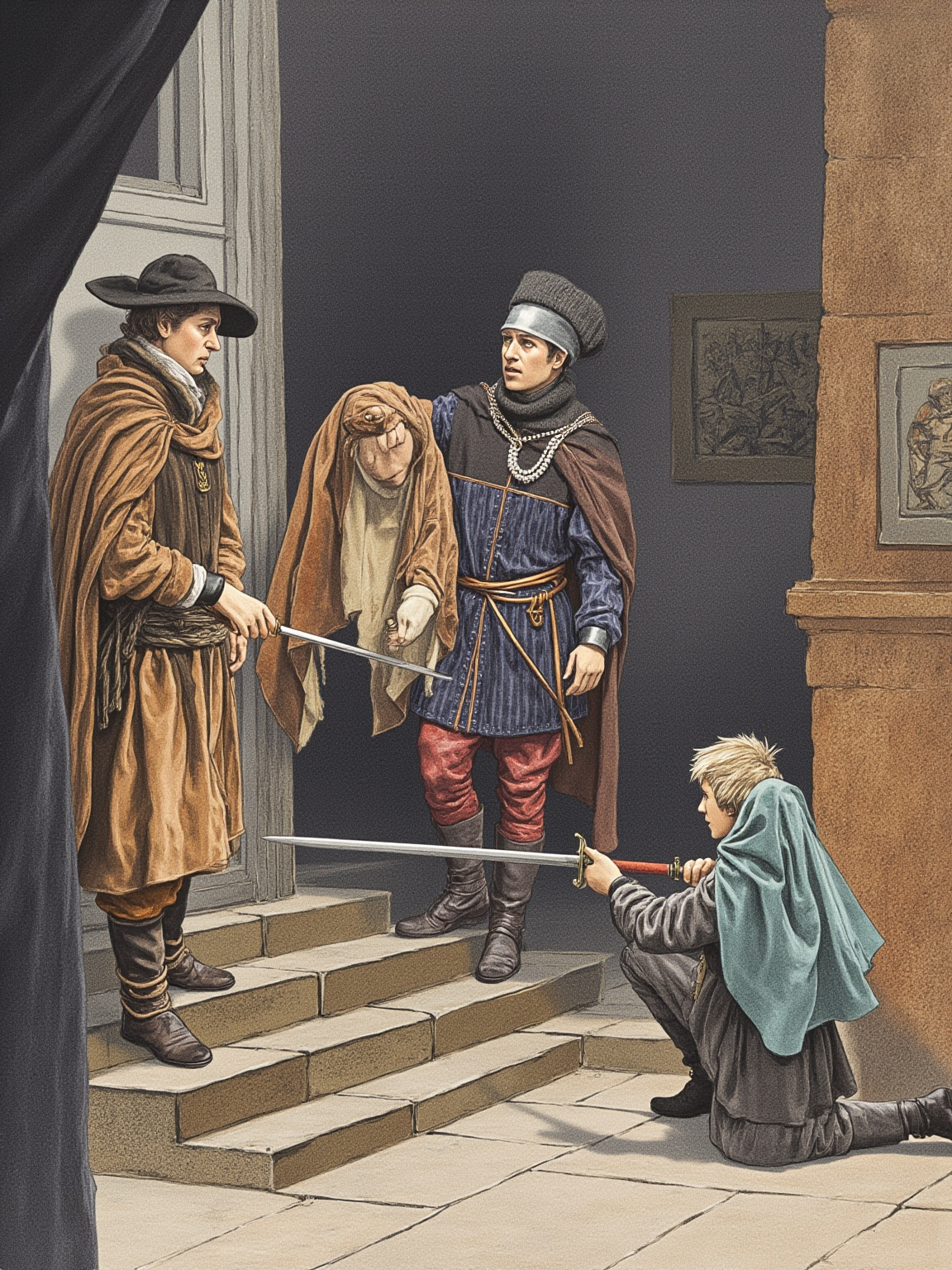
The Scottish archer was unappalled at hearing his doom pronounced, and even at seeing the slight, almost imperceptible, and therefore more nervous motion by which the King favoured his adviser Olivier.
那苏格兰弓手听到判决,并不失色——甚至在国王向刽子手奥利弗那道几乎不见的、却因此更令人心颤的眼色里,也没有变色。
金句 · 第6章 · 猎苑面试
Scott writes this scene with real restraint — no dwelling on old grudges, just Quentin's one line about putting his uniform on straight, and the boy's sense of honor stands up on its own. This is where the reader first understands: the hero isn't invincible, he's the kind of person who remembers who he is with a blade at his throat.
II. Escorting the Countess South
Louis gives Quentin his first assignment: escort Isabelle de Croye to Tours for a marriage the king has arranged — a political move to win over the Burgundian court. But Isabelle herself has no intention of going through with it; she means to choose her own husband. Along the road, his half-brother Hayraddin sticks close like a shadow, showing up now as a wanderer, now as a gypsy fortune-teller, now as a courier carrying a sealed letter for Louis, testing his brother a little more each time he appears. Burgundian riders block the road more than once as well. Quentin spends the journey outwitting his brother's tricks with one hand and holding off the duke's blades with the other.
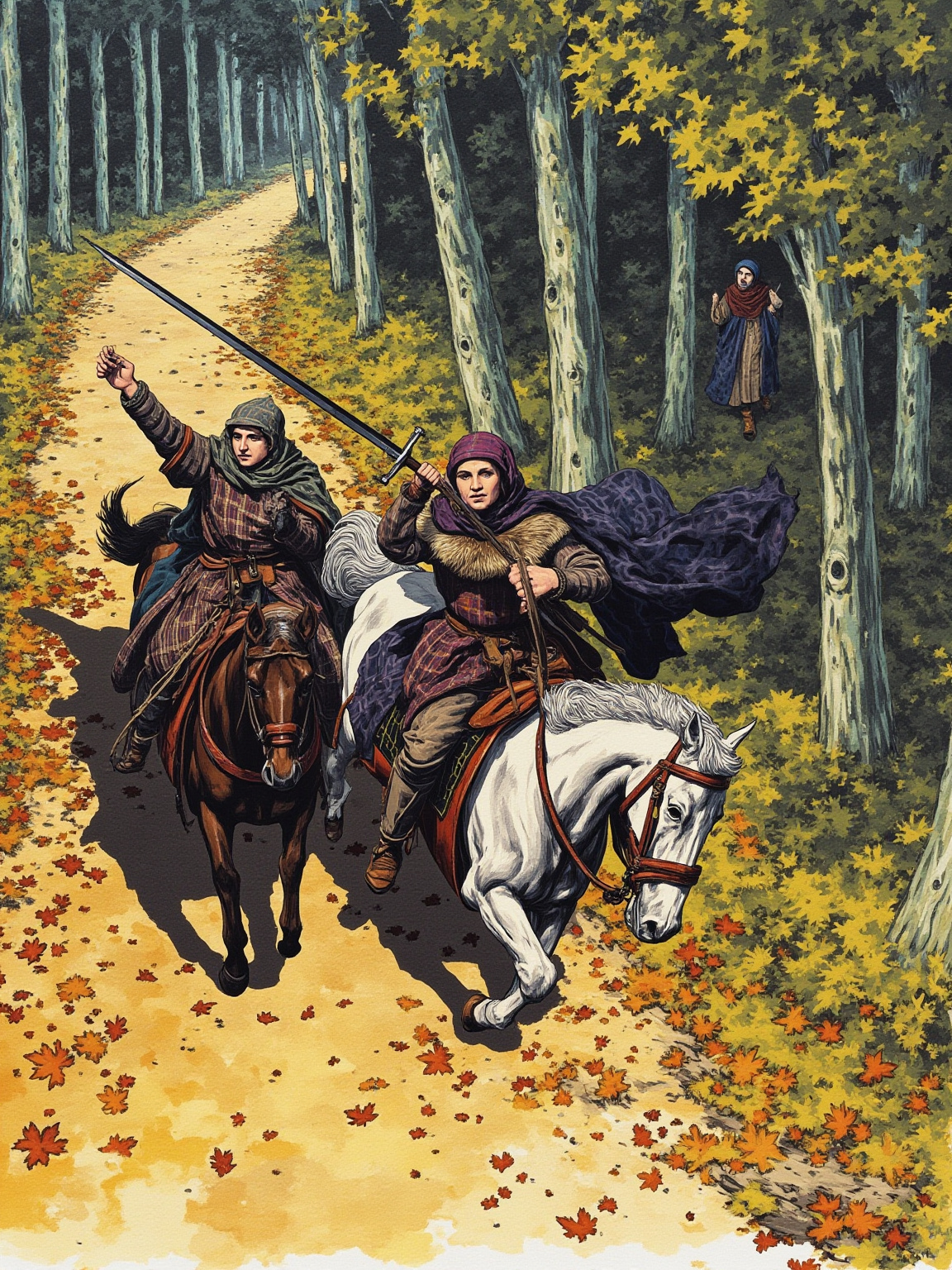
The Lady Isabelle... respected the brave and handsome young knight, by whom her route had been so much protected and accompanied.
伊莎贝尔小姐敬重这位勇毅而英挺的年轻骑士——他的剑与他的同行,一路护住了她的去路。
金句 · 第13章 · 南行护送
Hayraddin is one of Scott's best strokes — not a villain, but the other version of Quentin: restless, quick to improvise, unclaimed by any order. Here the reader wonders for the first time: if Quentin had been born ten years earlier, would he have grown into his brother instead? The original leans on the nineteenth-century European novel's stock language for 'Bohemians,' a leftover of its era's prejudice; today it's enough to read him simply as one restless individual.
III. Under the Tower at Péronne: The King Trapped
In 1468, Louis travels in person into Charles the Bold's territory to negotiate, and is held under guard in a small tower at Péronne — historians count this standoff as Charles's most reckless move. The book turns it into the climax: Louis is trapped, and word has to get out. Quentin fights his way through at swordpoint and gets the order for French reinforcements into the king's hands.
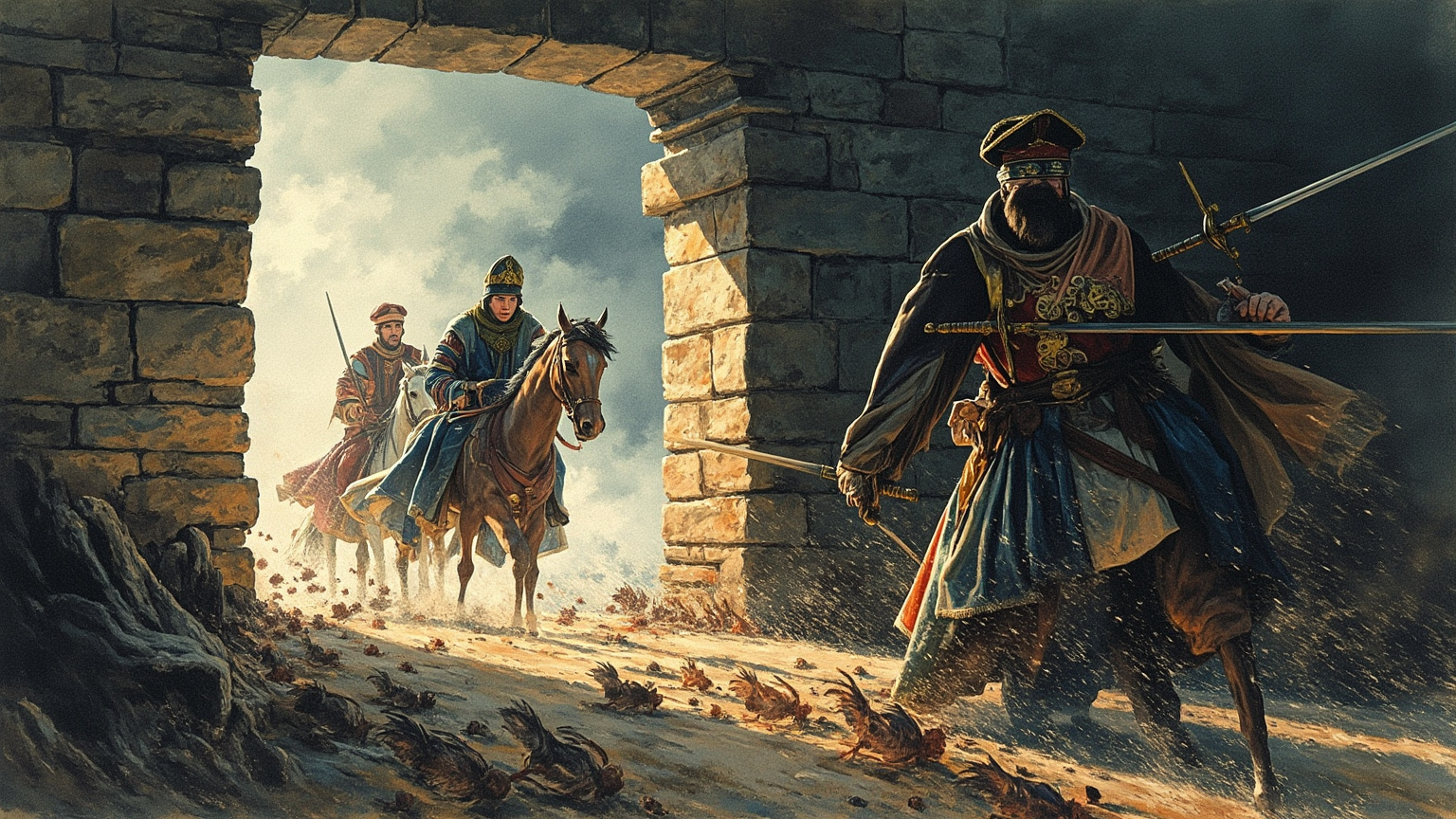
You are my king; and were your Grace exposed to such a peril in the meanest borough of your realm, the meanest Scotch archer in your guard should think it duty to bring you succour, if he broke his heart in the exploit.
您是我的国王——哪怕您被困在您治下最卑微的某座小镇,您卫队里最卑微的那个苏格兰弓手,也必当拼了一颗心去救您脱险。
金句 · 第25章 · 塔下突围
What makes the scene work is Louis's being trapped in the first place — he'd half-calculated for it, and gambled that the other half would be Quentin. This is the point where the whole book clicks into place: Louis XI never uses his pieces as pieces. He uses their characters.
IV. The Shadow of the Boar of Ardennes
As Quentin and Isabelle cross Lorraine and Flanders, another shadow hangs over the road — William de la Marck, called the Wild Boar of Ardennes. He is the hired brute Charles the Bold uses to stir up trouble in the bishopric of Liège: vicious, greedy, answering to no authority. The Liège uprising he leads and the bishop's murder are part of the book's plot chain, though the original only reports them rather than staging them. The reader just needs to know that this Boar is the rawest, least dressed-up violence on Burgundy's side of the ledger.
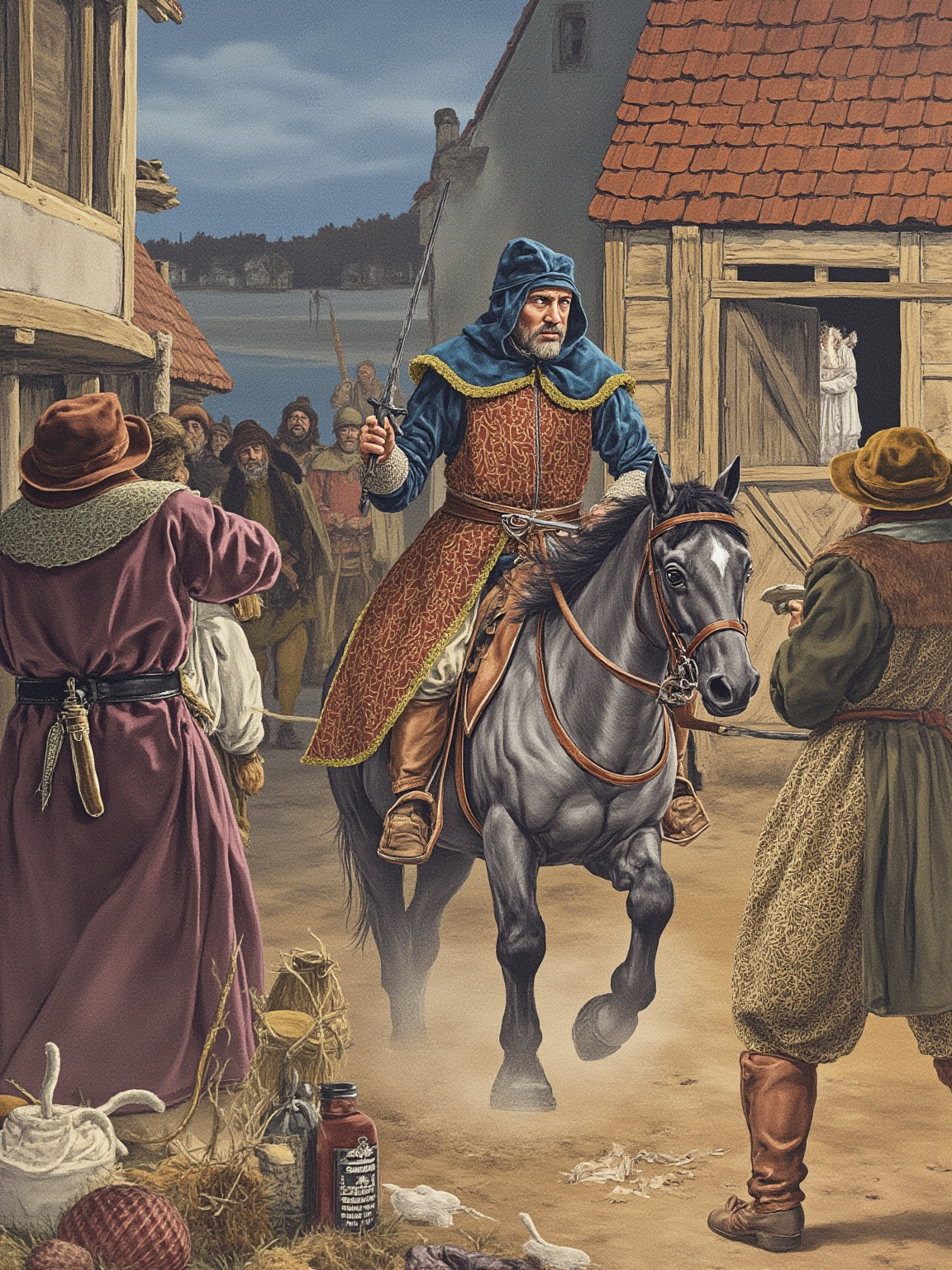
The Wild Boar of the Ardennes... a terrible and ferocious ruffian, who would scruple at no act of cruelty or treachery to forward the interests of his patron Duke Charles.
那阿登的野猪——凶狠至极的亡命之徒,为了他的主君查理公爵的利害,没有一桩残忍或背信的事做不出来。
金句 · 第28章 · 阿登野猪
Scott puts la Marck in the story on purpose — he wants the reader to see what's underneath the Duke of Burgundy's chivalry: men like this doing the biting for him. The two rivals turn out to be a matched pair. Louis has his barber Oliver do his dirty work; Charles has his Boar. Two crowns, two kinds of stain.
V. After the Escape from Péronne: Choosing Her Own Husband
Quentin brings the reinforcements, Louis gets free, and Isabelle's arranged marriage falls apart along with it. The countess doesn't go home to cry, and she doesn't wait for Louis to pick her another match — she chooses for herself, and she chooses Quentin. Scott doesn't marry her off to her cousin Gaston of Orléans, the French prince, and he doesn't give her to some Burgundian lord either. She picks a penniless Scottish soldier.
The Countess... took the resolution of choosing for herself such a husband as she could love and esteem—and that resolution she formed upon grounds which she thought justified.
这位伯爵小姐打定主意,要为自己挑一位她能去爱、能去敬重的夫君——她下了这份决心,凭的是她自己以为站得住的理由。
金句 · 第39章 · 自行择婿
It's the cleanest thread in the whole book, and its most modern moment — in the 1460s, on the question of a woman's own power, nobody speaks for her; she simply settles it herself. Scott writes it lightly, without applauding her for it, and that restraint is exactly what gives it weight.
VI. Coda: The Fires of Nancy
Louis grants the marriage and keeps Quentin close. The story closes on Nancy in 1471, where Charles the Bold falls beneath the city walls — the last page of this album of Europe's childhood. The violent giant loses to his own temper, while the Spider King goes on sitting at the center of his web, a little thinner, a little older, and still alive.
Theme and Craft: Three European Temperaments Compared
Louis, Charles, and Quentin sit side by side as three European temperaments: the Scottish Guard's poverty and loyalty, the Burgundian court's extravagance and violence, Louis's own court's dim, calculating cunning. Scott isn't asking you to pick a side; he wants you to see all three existing at once, each paying its own price. Louis is the cleverest and the coldest. Charles is the most dignified and the first to die. Quentin is the poorest and the cleanest — and cleanliness like his was a scarce commodity in the fifteenth century, one Scott hands to a foreigner because every native character is already too stained with it.
For a reader today, the book offers an unusual experience: its sense of history isn't scenery, it's skeleton. Louis's superstition is a real fear, not a costume. Charles's rage is the last flare of Europe's aristocratic politics. Quentin's sense of honor is one of the last things the Scottish Lowlands held onto before England swallowed them whole. None of it reads like the distant past — it reads like watching Europe grow into the shape it's in today.
One thing to notice: this novel's dialogue is enviably crisp — a few throwaway phrases from Louis XI compress a whole page of political calculation into the ordinary. It's Scott's most underrated skill: he writes medieval kingship like a meeting at the counting-house, with nobody in costume.
Scott has Quentin ask to put his uniform on straight before he dies — and that one line holds up the whole book: a man who dresses properly even to die has earned the right to live.
The Hook to Go Read the Original
A companion guide gives you the map; the novel is the ground itself. There are things here no summary can carry over: the clammy, superstitious air around Louis XI fingering his little silver icon in the hunting park; the closing-in, airless pressure of the tower at Péronne; the intimacy sharper than any blade in the way Hayraddin talks to his brother. You only feel how light and how fast Scott's pen really moves by walking through all three volumes yourself. More to the point, you'll find that Scott wrote the original blueprint for the continental medieval political thriller: Ivanhoe is an English chivalric romance, The Three Musketeers is a Parisian drawing-room drama, and Quentin Durward is the unfinished game between France and Burgundy. You haven't truly seen that game until you've read it in the original.
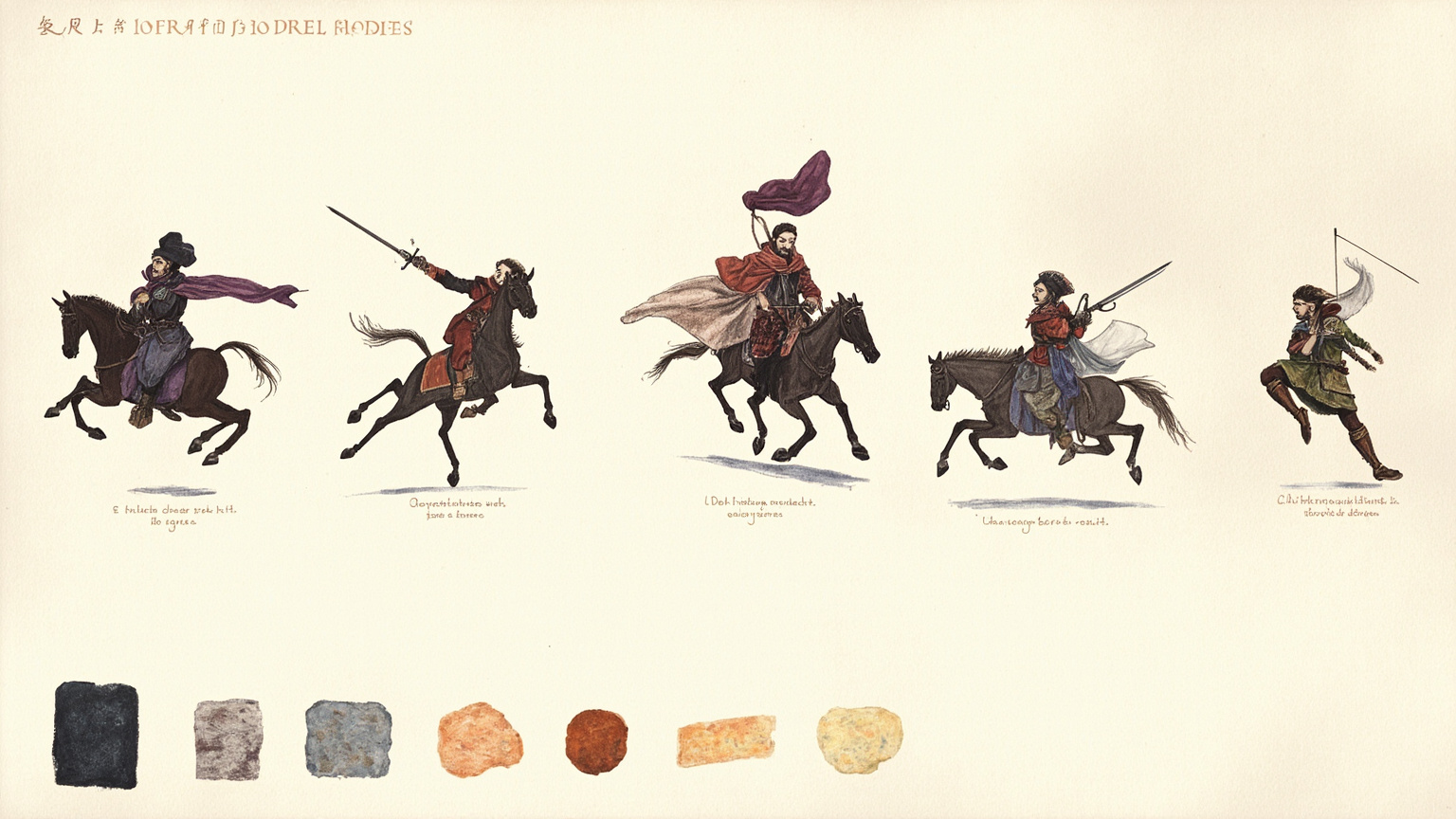
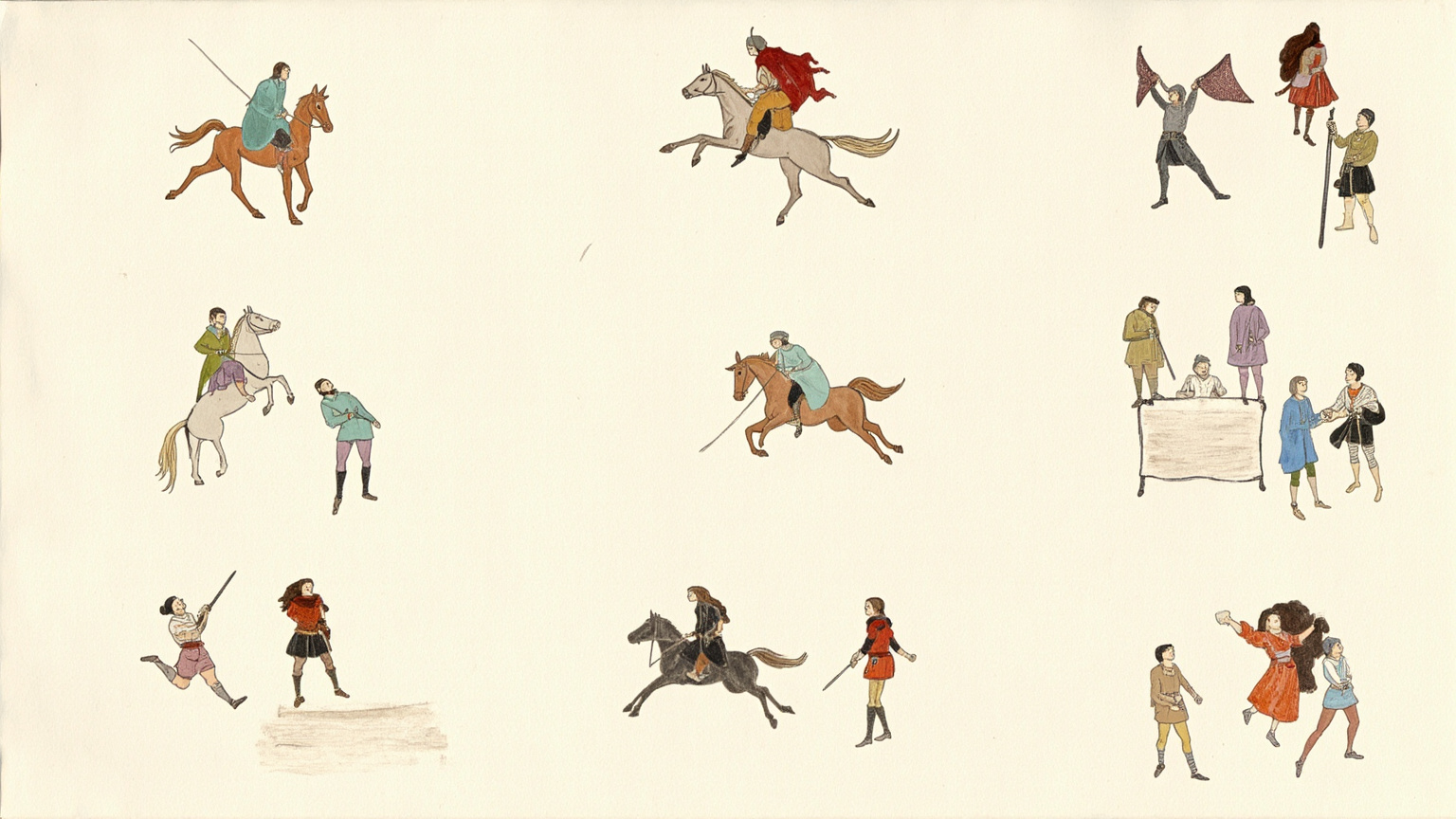
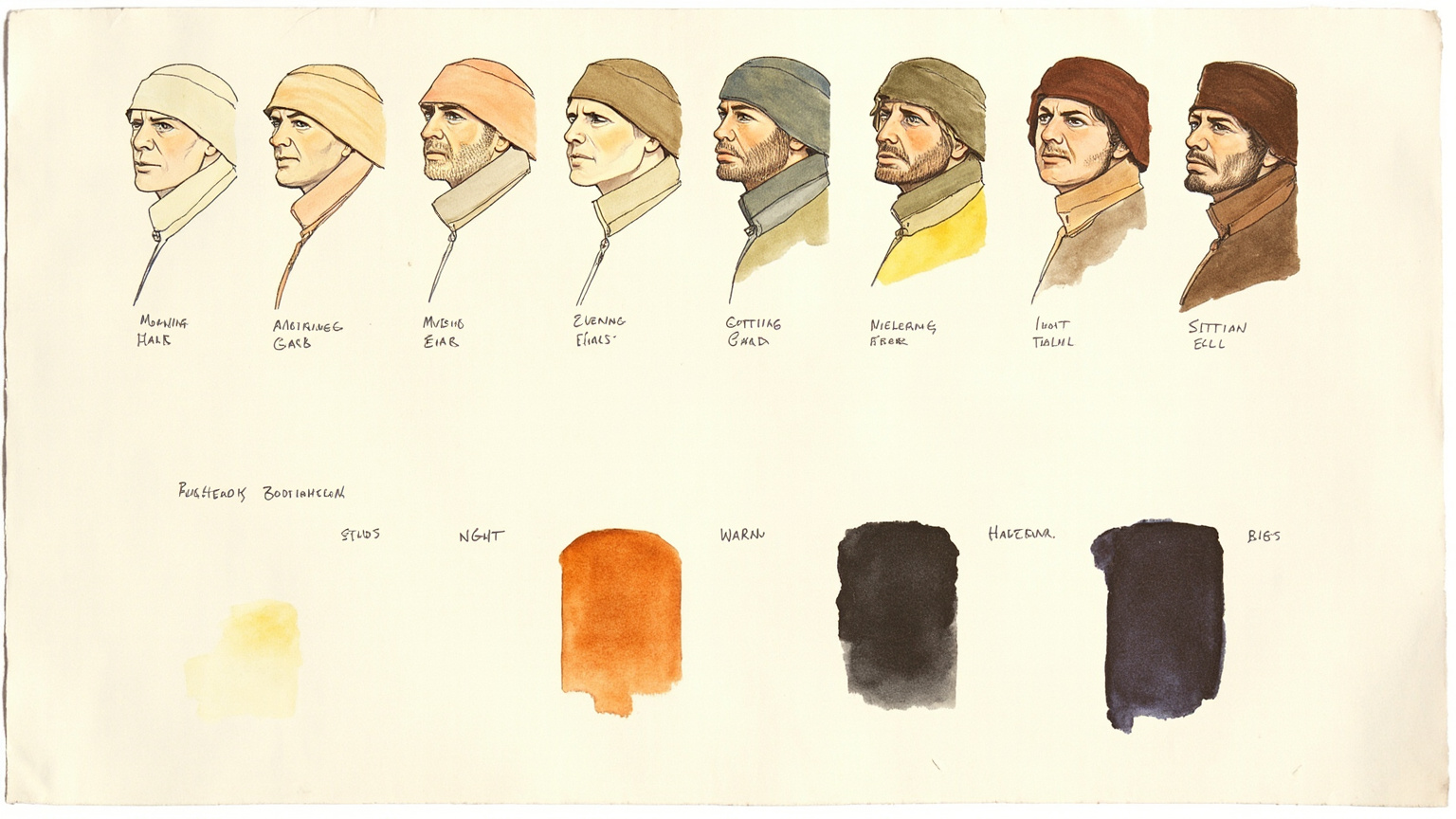
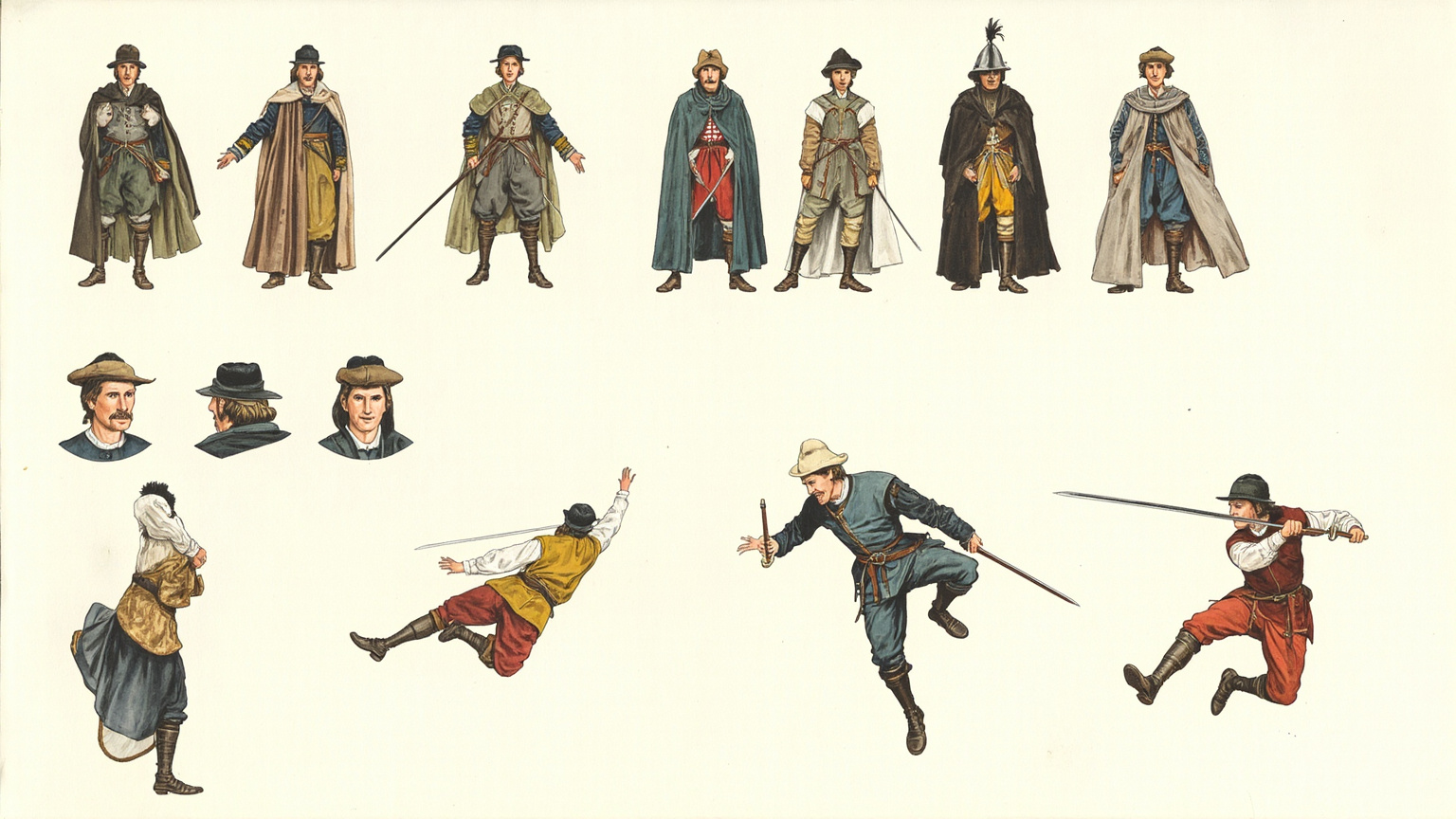
Art Direction4 plates
Before the guide was written, this book got a visual foundation — every illustration you just read grew out of it.