Rebecca in 10 Minutes: How a Great House Swallows a Living Woman
The living woman has no name. The dead one runs everything.
Text and illustrations produced by the pipeline
ImaReadFolio 02 — 05
Opening: the house in the dream is burning again
At night she dreams of Manderley again. Dead leaves lie thick on the drive, the hall stands empty, the lilies on the table have long since withered. She stands at the foot of the stairs, knowing the room upstairs is still there — Rebecca's room. Then she wakes in a foreign hotel, her husband asleep beside her. That is the book's opening line: last night I dreamt I went to Manderley again. The whole story burns backward from these embers.
What kind of book is this
Rebecca is the 1938 novel by the English writer Daphne du Maurier, named after the woman who is already dead before the story begins. By pedigree it's Gothic romance, heir to the Jane Eyre tradition of great houses and buried secrets — but it pushes suspense and psychology further than that: the book's real mystery isn't whodunit, it's whether the living can still face each other once the truth is out. Hitchcock filmed it in black and white in 1940, and Netflix put out another version in 2020, but neither adaptation fully carries over the force of the novel itself.
Who's telling this story, and who Rebecca is
One thing needs sorting out first, because it trips people up: the book is called Rebecca, but Rebecca is not the heroine. She's the first wife who drowned a year before the story opens, already lying on the seabed. The one who lives from the first page to the last is the nameless narrator — all the reader ever learns is that she is Mrs. de Winter, Maxim's second wife. She comes from modest means, works as a companion to a sharp-tongued American widow, and meets the recently widowed English gentleman Maxim de Winter at a hotel in Monte Carlo. Two lonely people marry in haste, and she finds herself, almost by accident, the new mistress of Manderley.
The estate sits on a cliff above the sea in Cornwall, rhododendrons lining the drive, the bay spread out below. On the surface it's paradise; underneath, it's a cell built out of rules and a dead woman's habits. The housekeeper, Mrs. Danvers, keeps Rebecca's bedroom exactly as it was, a kind of shrine — the sheets changed fresh every day, Rebecca's own hairbrush still laid out on the dressing table. The whole house runs like a museum, and the new wife is the living exhibit shut inside the case.
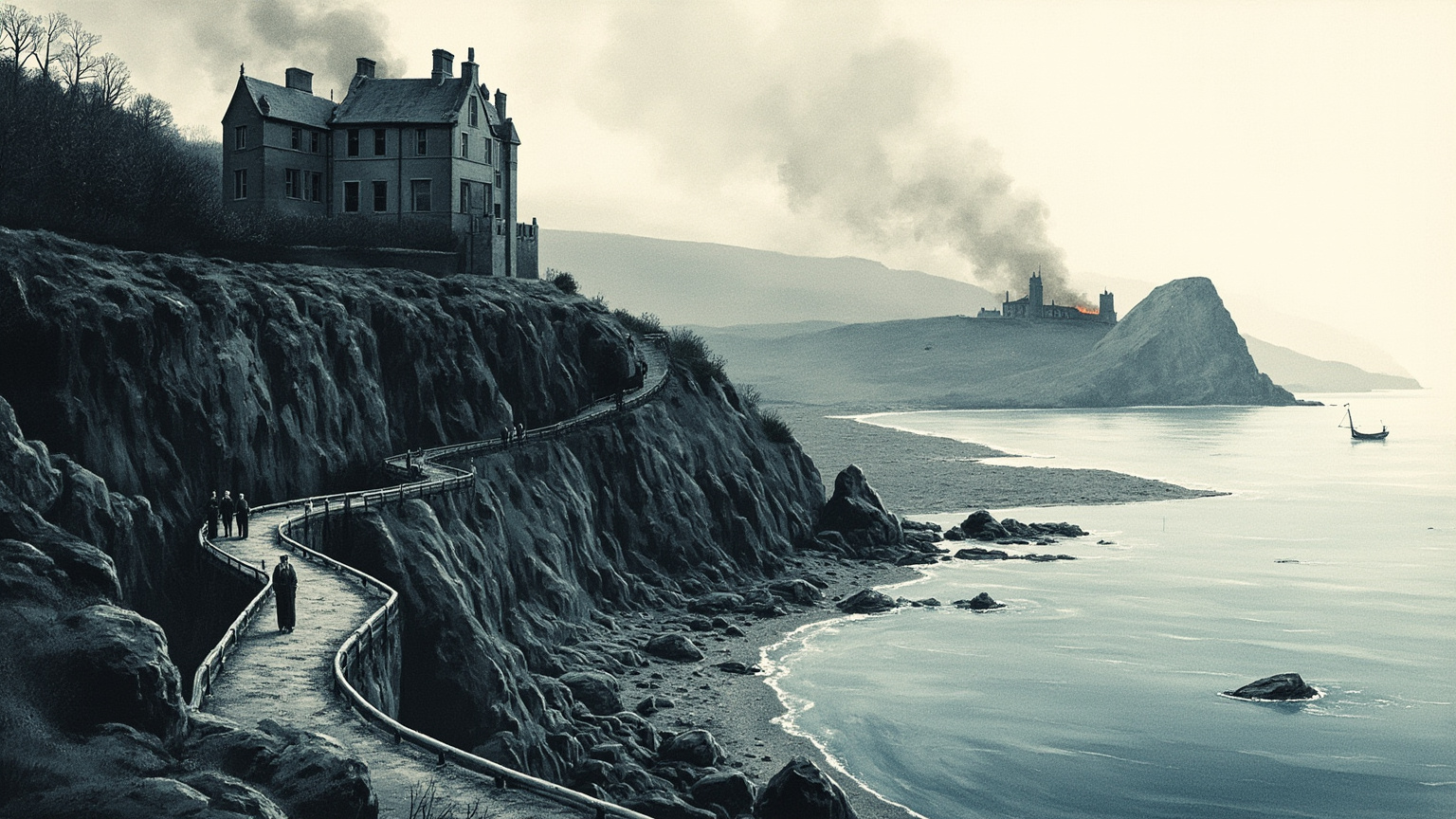
With the truth finally out, they drive through the night back to Manderley. Partway there, the sky ahead turns red — not the dawn, but the direction of the house. They stop on the hill and watch their home burning. The west wing goes up fastest; Mrs. Danvers has set fire to Rebecca's shrine and the whole house along with it. A woman that possessive would rather burn everything down herself than let a living hand touch what's left of Rebecca. The wind carries the fire, and the rhododendron drive turns into a corridor of smoke. Manderley is left a field of ash, nothing standing.
What this book is really about
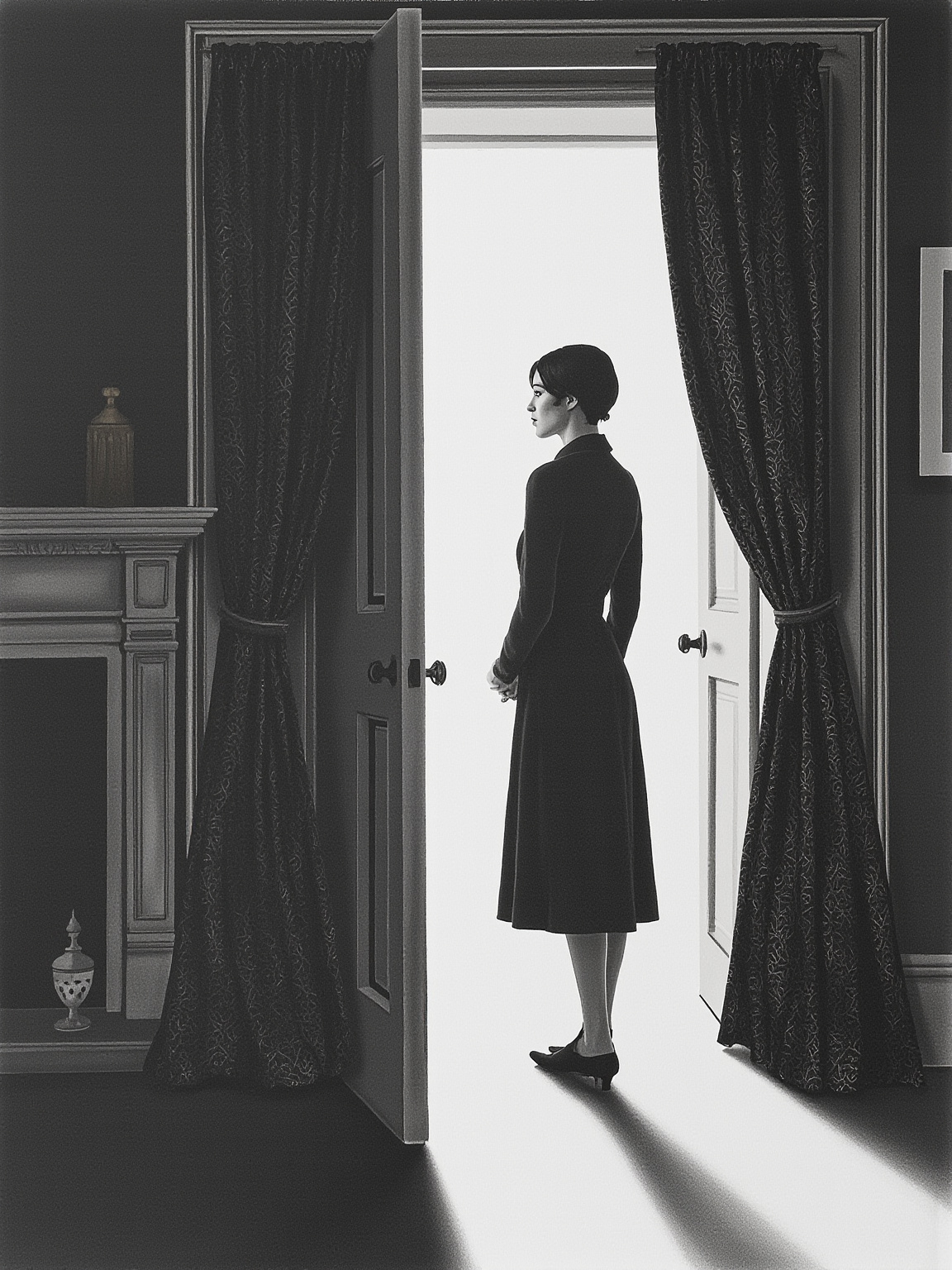
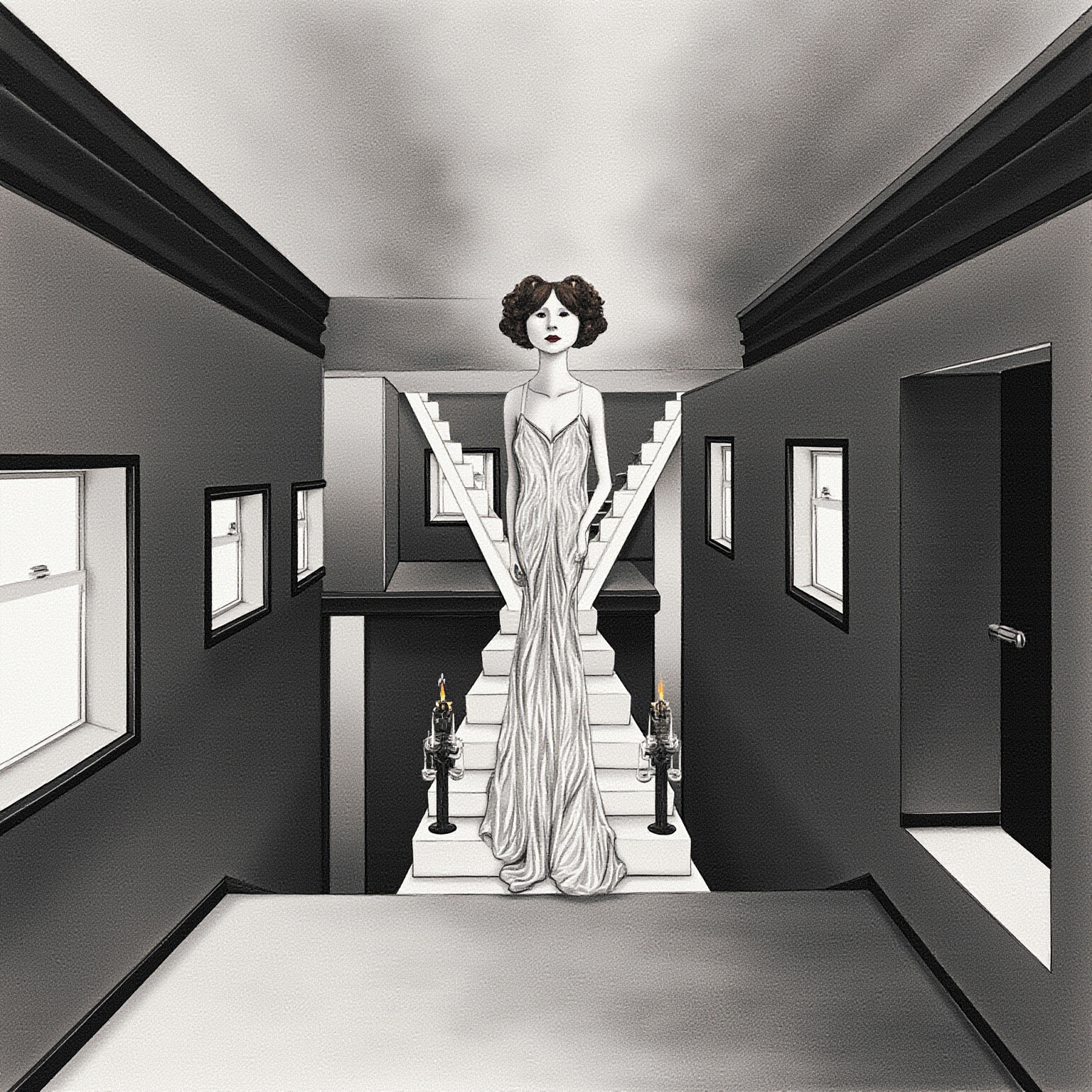
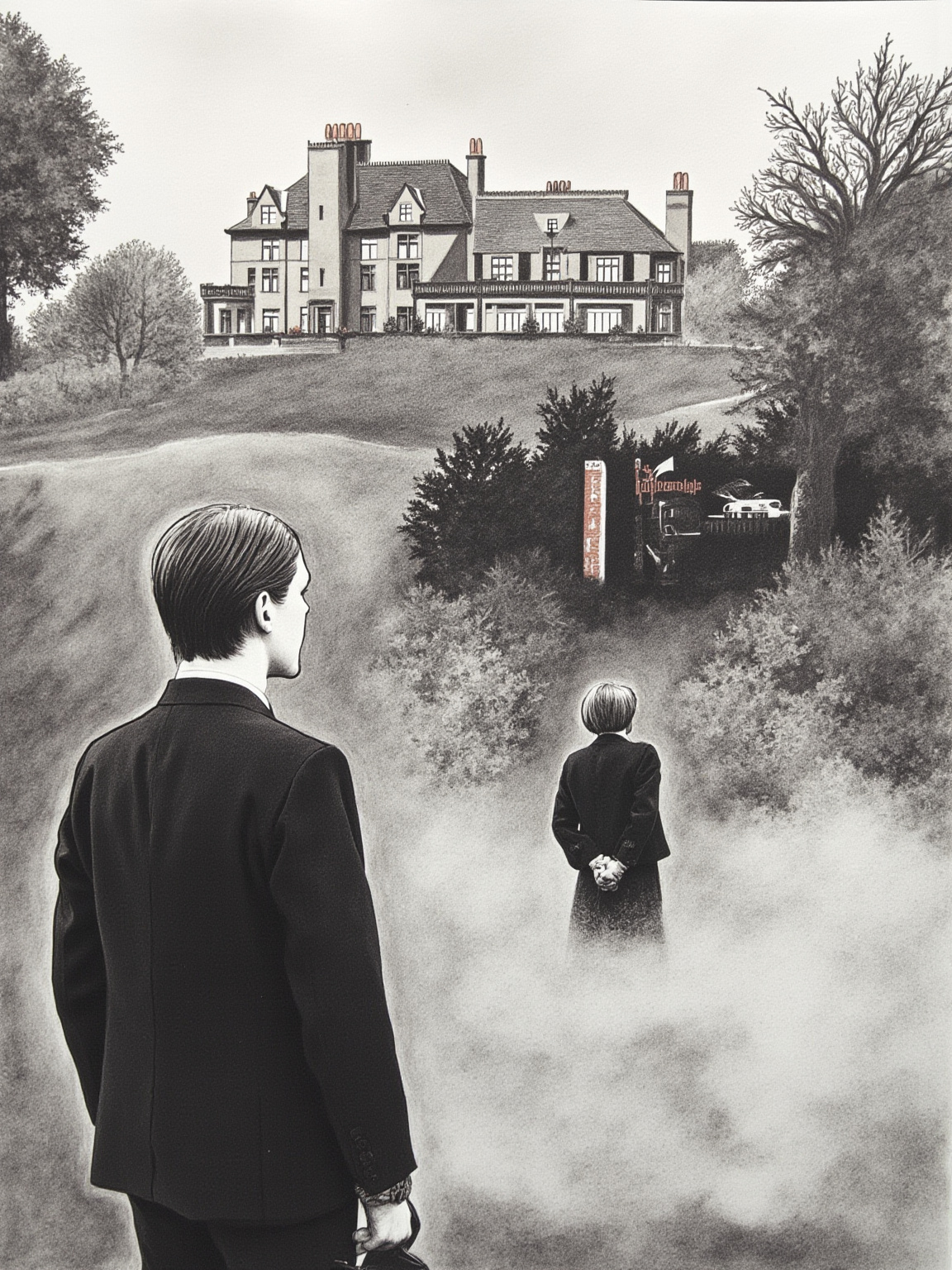
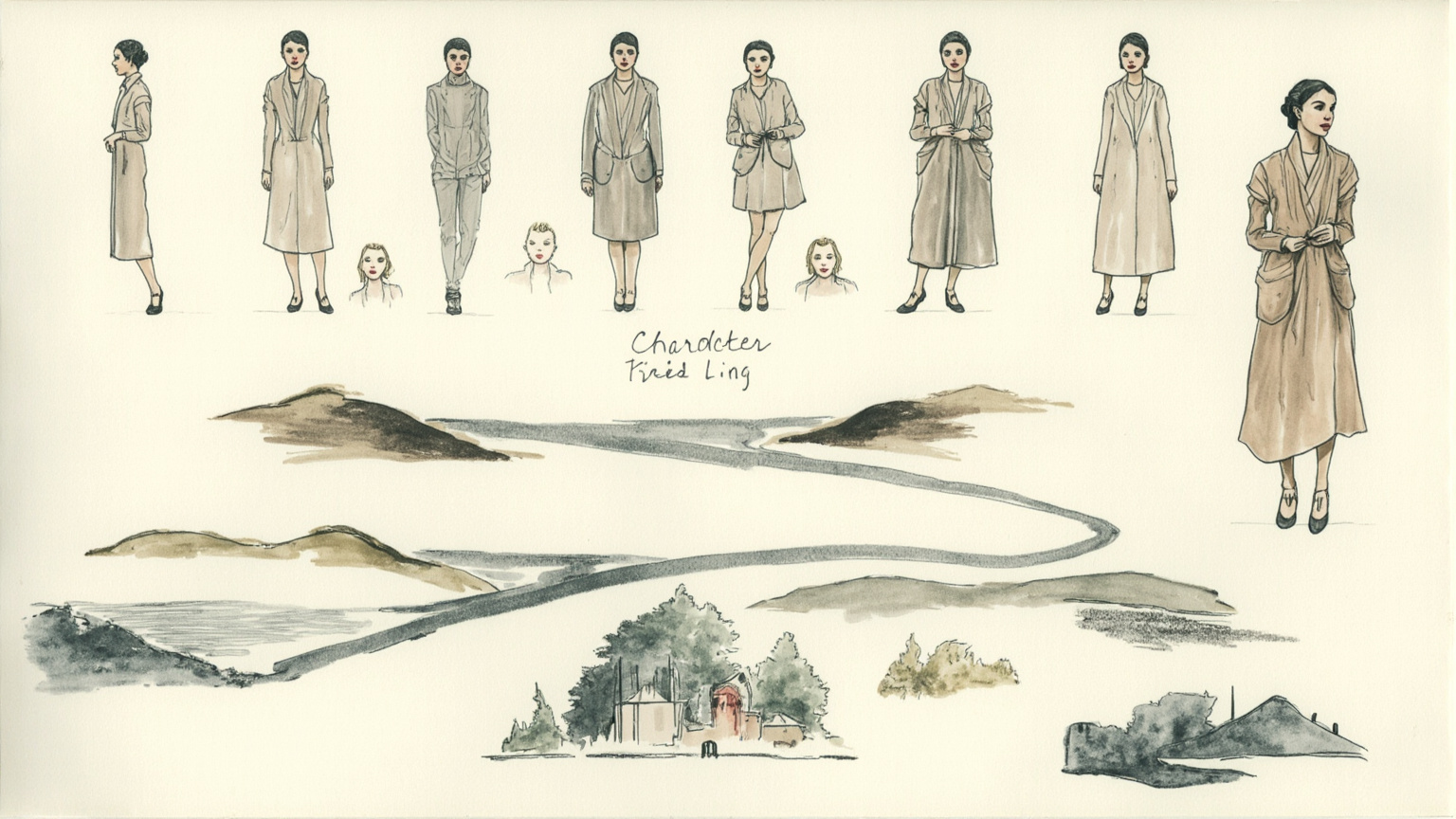
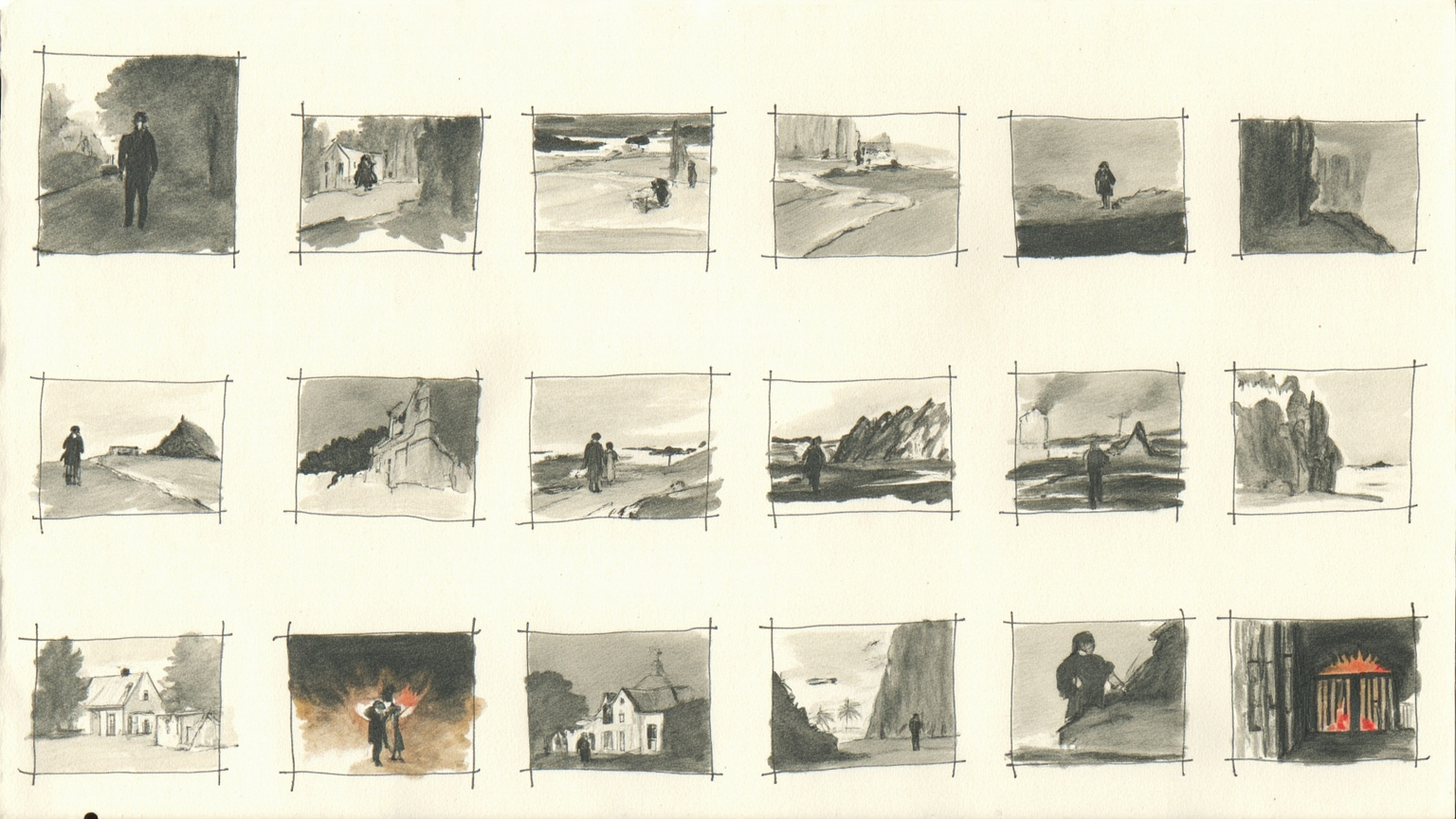
Art Direction4 plates
Before the guide was written, this book got a visual foundation — every illustration you just read grew out of it.
The honeymoon quickly gives way to ordinary days. When she wants to have friends over for tea, her first instinct is to ask Mrs. Danvers what flowers Rebecca used to arrange, which tea service Rebecca used. She wants to find her footing, and the only way she knows how is to imitate the dead woman. Maxim can't bear to hear Rebecca's name; every time his wife raises it carefully, he shuts the subject down. Mrs. Danvers, by contrast, answers every question, and always adds a small twist of the knife: this scent was Mrs. de Winter's favorite, that painting was one she chose herself. Wherever the living go in this house, a dead woman's fingerprints are already there.
She shrinks a little more each day. The flowers are wrong, the tea party is a disaster, even the way she walks feels wrong for the house. Mrs. Danvers never raises her voice — that cold, almost devotional composure presses down harder than shouting ever could. The little boathouse by the cove is off limits too: Rebecca used to spend time there, and Maxim won't let anyone near it. All of Manderley reads like an unfinished interrogation, asking her the same question from a new angle every day: do you belong here?
The costume ball: the dress she should never have worn
Manderley holds a costume ball every year, the social event of the county. Mrs. Danvers shows the new wife a portrait and suggests she copy the gown in it. The dress is elaborate and ornate, and what the new wife doesn't know is that it's an exact copy of one Rebecca once wore. She comes down the stairs that night; a guest gasps; Maxim looks up, his face goes white and then goes hard, and he walks out of the room without a word. She stands alone in the middle of the dance floor and understands, for the first time, that this house has never been hers.
That night nearly breaks the marriage. Maxim, cold-faced, pulls her back to their room and offers no explanation, only says: never touch that dress again. She decides she must be ugly, stupid, unfit to be Mrs. de Winter. In truth, what wrecks him that night has nothing to do with the wrong dress — it's that his dead wife's ghost has stepped out of the walls again.
The real body in the bay
ImaRead3
The morning after a storm, wreckage washes up in the bay. A diver goes down into the cabin of the little boat, sunk for over a year, and brings up a skeleton: Rebecca's. That means the body identified as hers back then belonged to someone else, and the accidental drowning was a lie from the start. Word reaches Manderley, and for the first time Mrs. Danvers's composure cracks. Maxim takes his wife's hand, and it's shaking.
The rainy night he finally spoke
He tells her the truth himself, late one night. He never loved Rebecca. The marriage was a mask from the start, worn by both of them: he was cold, she was reckless, and she took pleasure in tormenting him. The night it happened, Rebecca told him she was carrying another man's child — her favorite blade to twist. Maxim shot her in a fit of rage, then sank her with the boat and dressed it up as an accident at sea. Not a mishap, not a fall — deliberate.
The silence after he finishes weighs more than the gunshot did. For the first time, his wife understands that the man she loves has killed someone. But she also sees, for the first time, that the husband who's been bowed under his dead wife's shadow is, like her, Rebecca's prisoner. She doesn't leave. She sits down beside him. It's the quietest turn in the whole book, and the hardest one.
The terminal diagnosis, revealed at the inquest
The police reopen the case. Colonel Julyan, the local magistrate, presides over the inquest, and the decisive blow comes from Rebecca's own doctor: she'd been diagnosed with terminal illness a year earlier and had little time left. He brings her diary and appointment records with him. A woman who knew she was dying, provoking her husband into ending it for her — that would be quicker than being eaten alive by the disease. The case closes as suicide, engineered through another's hand, and Maxim is cleared of murder.
Rebecca's cousin and lover, Jack Favell, comes forward too, hoping to squeeze Maxim with the murder charge. The doctor's testimony pulls the ground out from under him — a dying woman asking for death is a different matter from a man killing for gain. His blackmail falls apart, and he slinks away from Manderley.
Manderley burns
ImaRead4
On the surface it's a mystery; underneath it's about identity. A living, breathing woman marries into a great house, and for the whole book she never gets a name — everyone calls her Mrs. de Winter, and everyone measures her against Rebecca. Her manners, her clothes, her smile, whether she looks the part of a lady of the house. The cruelest part is that the contest she's trying to win is against someone already dead. Rebecca is absent and yet always present; she doesn't want you dead, she wants you to live as her shadow.
Du Maurier inherits the Gothic-mansion tradition of Jane Eyre, but she operates on it in two places. First, she flips the madwoman-in-the-attic convention on its head — Rebecca isn't mad, she's more clear-eyed and more dangerous than anyone else in the book, and it's she who locks everyone else in the cell. Second, du Maurier invents a psychological kind of haunting: there's no real ghost at Manderley, no woman in white drifting down the corridor. The dread is built entirely out of a bedroom kept exactly as it was, a hairbrush nobody dares throw away, a housekeeper who answers without ever raising her eyes. That kind of unease is harder to shake than any corpse.
Read today, the book is about a woman's self swallowed by other people's rules, about the slow strangulation the perfect-wife story performs on women, and about the suffocation of someone who's crossed class lines into an old-money world. What makes Rebecca frightening is that she performed the part so well that even in death, no one doubted her perfection.
The real horror was never the ghost coming back — it was the living, with their own hands, keeping every trace of her in place.
Why you should read it even knowing how it ends
A plot summary gives you the skeleton; du Maurier gives you the skin — the wind off the cliffs, the smell of lilies, the creak of floorboards at the end of the corridor. She doesn't write "her heart tightened," she writes the new wife's palms sweating as she carries the tea tray across the hall, the tray slipping and almost falling. She doesn't write jealousy as an abstraction, she writes the heroine standing dazed in front of Rebecca's old wardrobe, reaching out to touch the lace at the collar, then pulling her hand back as if burned. A summary can tell you what happens. The novel makes you hold your breath for that nameless woman on every page.