
Rebecca of Sunnybrook Farm · Companion Guide
阳光溪农场的丽贝卡
十岁的扁箱子姑娘,被送进一间把体面看得比天大的新英格兰砖房——她不是去被收养的,她是去撬门的。
Opening
A flat trunk gets wedged into the back of the stagecoach, and on top of it sits a ten-year-old girl, a roll of needlework in her lap meant to impress the aunt she has never met. Every jolt of the coach jolts more words out of her mouth, and they do not stop for the whole ride. She has no idea yet that she is about to prise open an old New England house that prizes propriety above everything else.
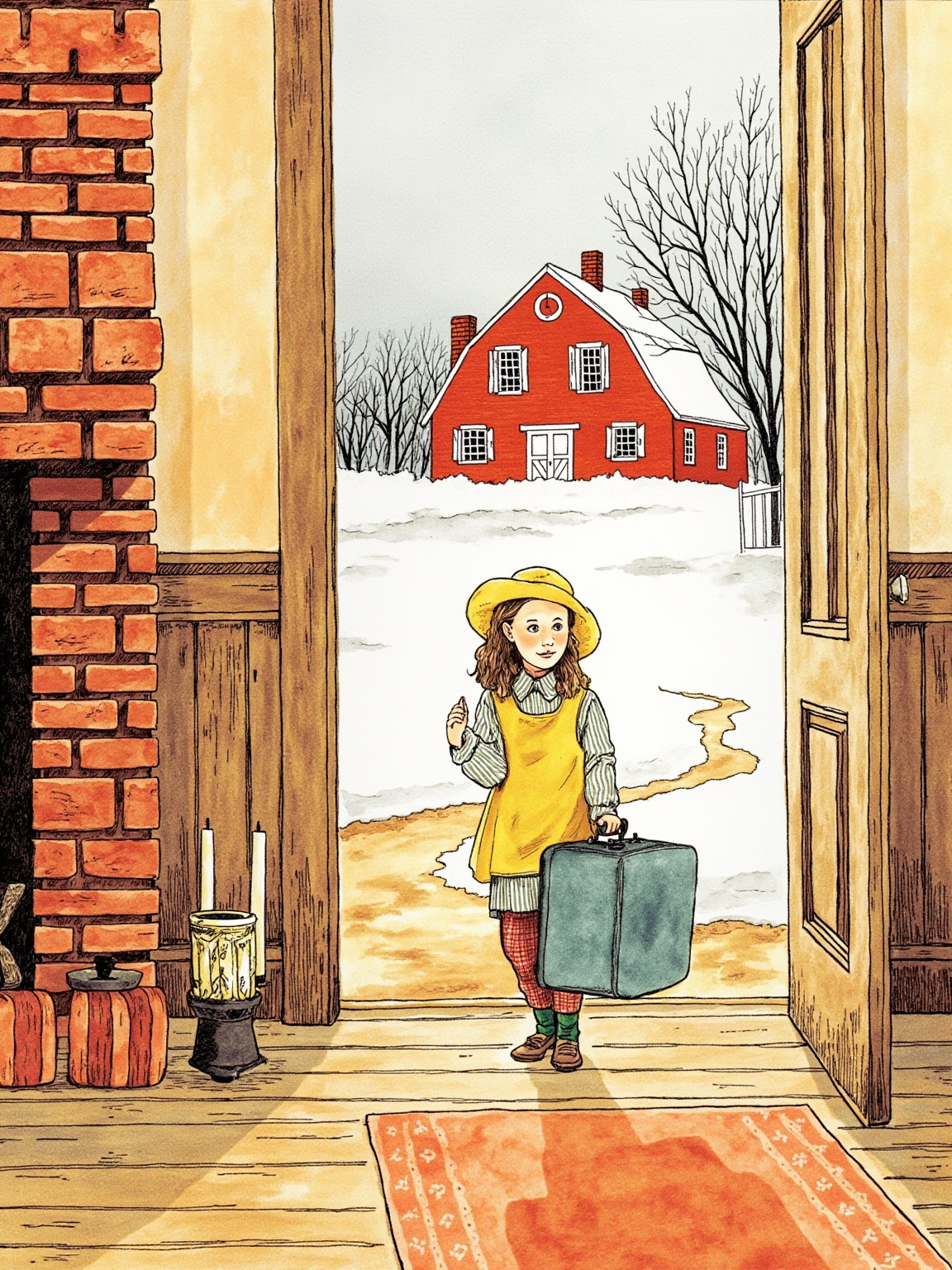
Rebecca Randall, ten years old, with a flat trunk at her feet and a bundle of self-made clothing in her lap, was sitting in the cart behind the old sorrel horse.
丽贝卡·兰道,十岁,脚边一只扁箱子,膝头搁着一卷自缝的衣裳,坐在那匹老栗色马身后的马车里。
金句 · 第1章 · 阳光溪
What kind of book this is
Rebecca of Sunnybrook Farm came out in the early twentieth century. Its author, Kate Douglas Wiggin, was born and raised in New England. Mark Twain called it one of the most touching books he had ever read almost as soon as it appeared, and Jack London wrote to Wiggin to say he had cried his way through it. L.M. Montgomery, who wrote Anne of Green Gables, later admitted this slim girls' novel had shaped her own work — so a shelf that holds Anne but not Rebecca has only kept the second half of the story.
It belongs to the first wave of children's fiction to remake a girl's world by sheer imagination, predating the more famous books built on the same premise by two years, and it plays rougher. It does not run on sweetness. It runs on the nerve to retell every house rule on its own terms.
The original is in English, first published in Boston by Houghton Mifflin; a free, proofread public-domain edition is available today from Project Gutenberg or Standard Ebooks. Chinese translations came out from several established mainland publishers through the mid-to-late twentieth century, usually under the title Rebecca of Sunnybrook Farm, sometimes shortened to just Rebecca.
People and world
The protagonist, Rebecca Randall, is sent away from Sunnybrook Farm, a house with too many children and a roof about to give in. Both her parents are gone, and she has already been shuttled through relatives on her mother's side; at ten, she lands with her two aunts, the Sawyers. An imagination she cannot rein in, a mouth that never stops talking, a real gift for letter-writing, and a habit of inventing pasts for herself and everyone around her — she stirs up every room she walks into.
The brick house's matriarch is Aunt Miranda Sawyer, who treats rules, propriety, and never stepping out of line as the highest law of the household. Her younger sister, Aunt Jane Sawyer, has spent years standing behind her nodding along, the kind of woman worn quiet by a sister's louder voice, and long since used to it. Emma Jane Perkins, a village girl of about the same age and warm-hearted, is her closest ally around the kitchen and the barn. The schoolmaster, Mr. Simpson, is caught flat-footed by her poems; Adam Ladd, a young man from the next town who writes and draws, is startled by her imagination and starts writing back.
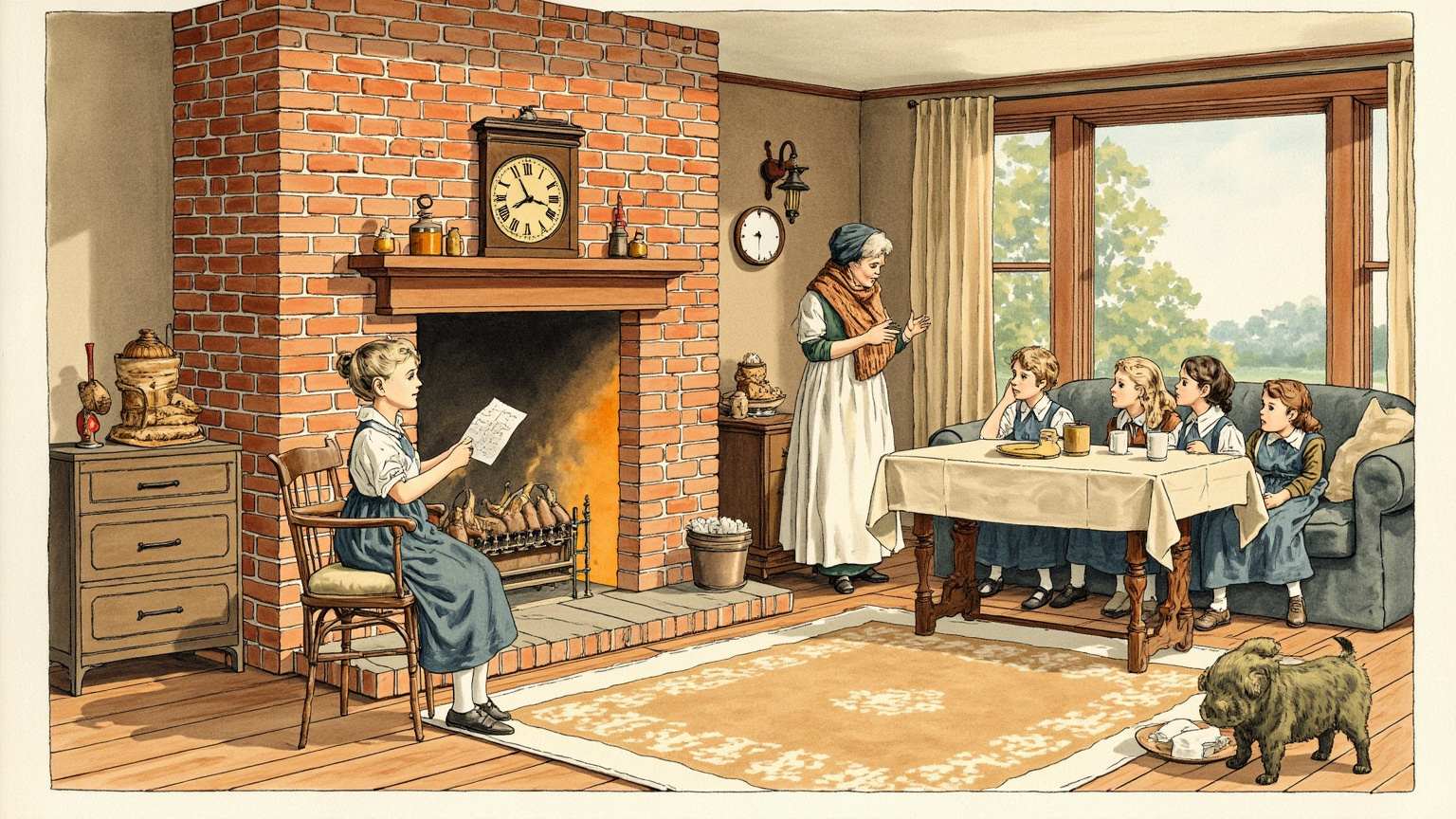
Miranda was always the important one; Jane was the one who kept still and agreed.
米兰达向来是说话的那一个;简向来是闭着嘴点头的那一个。
金句 · 第3章 · 砖房的两位
How the story moves
1. Moving into the brick house: an intruder meets a wall of rules
Rebecca turns the parlor upside down on her very first day. Whatever she looks at, she can spin into a story on the spot: the ornaments on the shelf, the portraits of relatives on the wall, all of it grows a plot in her mouth. For the first time in her life, Aunt Miranda meets someone willing to improvise on her house rules to her face. Then Rebecca goes out to the barn, paints a couple of old cowhides glossy, and hangs them up as decoration, and nearly gets herself shipped straight back to Sunnybrook Farm.

The barn was never quite the same after Rebecca had been there with a pot of paint and an imagination.
丽贝卡拎着一罐油漆和一脑子想象走进谷仓之后,那谷仓就再也不是从前那间谷仓了。
金句 · 第4章 · 谷仓墙上的太阳
2. Aunt Jane steps out of the shadow
At the start, Aunt Jane is only her sister's shadow, a woman who agrees and says nothing. Rebecca pesters her, teases her, treats her as the one safe ally in the house, and slowly pulls her out from behind the sofa and into the room. Rebecca does not speak for her — she gets her to speak for herself. At one point in the book, Aunt Jane talks back to her sister for the first time, over something trivial, and what she is really pushing against is not Miranda. It is decades of enforced silence. This is the novel's best-built subplot: the person remade by imagination here is not the child. It is the other adult standing behind the adult in charge.
3. Uproar in the country schoolroom
Mr. Simpson wants Rebecca to sit still and read her textbook like everyone else. Instead she submits a poem to the local paper, and he ends up shaking the page with her poem printed on it in front of the school board, furious and unable to do anything about it. She turns the classroom into a literary incident the schoolmaster himself cannot contain.
The picture of the schoolmaster crumpling that page and then flattening it back out to read it one more time says everything: an adult led by the nose by a child. That particular embarrassment is rarely drawn this precisely.
4. The soap-selling trip: imagination let loose beyond the brick house
With a stack of homemade soap piling up at home, Rebecca gets sent to town as the household's small-time saleswoman. Along the way she scatters her imagination over every stranger she meets: a peddler she stops to tell stories to, an audience at a village storytelling evening, a crowd at the county fair who go dead silent at one of her own poems and then burst out laughing. She even ghostwrites a love letter for a bashful young couple, one that comes out more tender than anything they would have said themselves, and the two of them blush every time they run into her afterward. Her imagination does not turn inward. It sprays outward, and wherever it lands, someone has to deal with it.
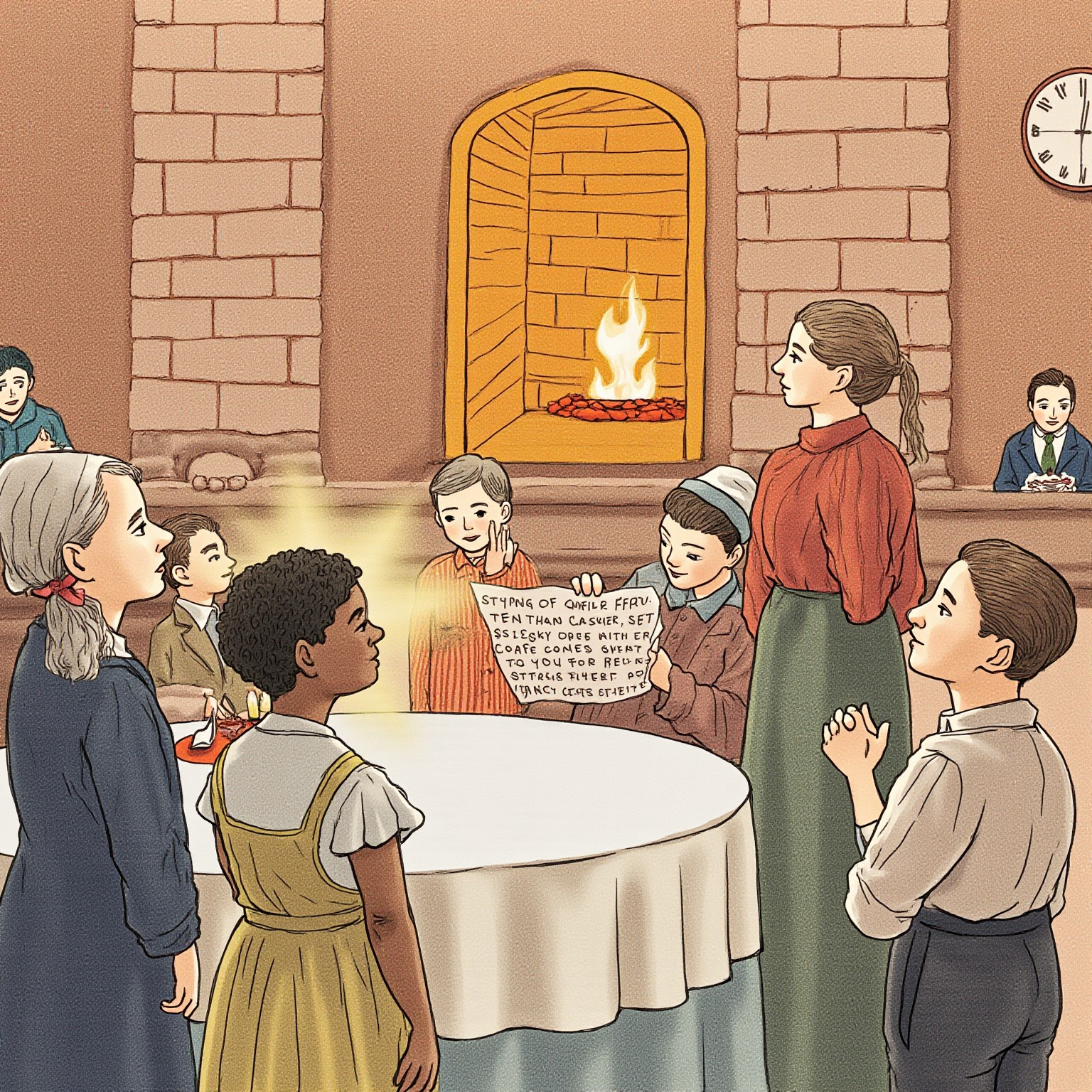
She had a tongue that nothing could stop once it had begun, and a heart that nothing could harden for long.
她那张嘴一旦开讲就没人拦得住;她那颗心,再硬的人在她面前也硬不了多久。
金句 · 第14章 · 推销路上的丽贝卡
5. Inside the brick house: prised open an inch at a time
Rebecca keeps pushing Aunt Miranda's house rules right to the edge of her temper, and just as often some illogical kindness of hers stops the scolding halfway through. In the end, Miranda does not lose. She just gets pried open a little by this intruder — the rules stay, but the woman underneath them loosens. Aunt Jane, meanwhile, keeps finding more nerve to speak for herself. Both aunts come out of the book a little changed.

Miranda did not yield; she was never known to yield. But something in the woman had loosened, though she would have died before she owned it.
米兰达并没有让步——她这辈子就没让过一步。可她身上有什么东西,是松了;只是让她亲口承认,她宁可先死。
金句 · 第19章 · 砖房松动了
6. Adam Ladd arrives: the man left stunned
Adam Ladd, a young man from the next town who writes poems and paints, is struck speechless the first time he meets Rebecca. He is not a storybook suitor come to court her; she is barely into her teens and he is already grown. He is more someone woken up by her imagination, someone who starts answering it. What is left between them is an ambiguity a modern reader will pause over — the neighbors, going by the habits of the time, call it something like a courtship, but the narrative itself never settles the question. In the gossip that closes out the book, nobody actually knows what the two of them are to each other, and the author leaves it that way on purpose.

7. The ending stops at the threshold of growing up
The story stops right at the edge of her adolescence. No engagement, no prince, no happily-ever-after chapter. What she actually wins is her two aunts, a village, and herself. The narrative pulls its foot back at the threshold before she grows up — even the season stops in autumn — and past that point, the author does not tell her story for her anymore.
What it is actually about
This is not a book about a charming little girl. It is a book about a key. Rebecca uses her imagination and her nonstop talking to pry loose a rigid set of house rules, a sister crushed under an older sister's weight, a classroom gone stale under a schoolmaster, an entire New England village, one lock at a time. She is not shaped by her surroundings. She is the one doing the shaping.
The real tension in the book runs between the two Sawyer aunts: Miranda stands for order, Jane for a personality kept under lock. Rebecca's victory is not beating Miranda into submission. It is loosening her, and giving Jane the nerve to speak. A change that seeps in through sheer, illogical kindness like this was rare in girls' fiction at the start of the twentieth century.
She had not been adopted by the brick house; the brick house had been adopted by her.
不是砖房收养了丽贝卡,是丽贝卡反过来,把砖房给收养了。
金句 · 尾声 · 阳光溪这一头
Why it is still worth opening today
Rebecca is not the girl the brick house raised. She is the one who came to pry it open.
Why the plot summary does not replace the book
A companion piece like this one tells you who Rebecca moves. The novel itself shows you how. Her crooked little poems, the backstories she invents on the spot, the stories she starts laughing at halfway through telling them, the mess she makes driving a wagon through the snow: none of that survives outside the original's chatty, dense-packed prose. How she pushes Aunt Miranda right up to anger without ever actually breaking with her is a matter of timing only the real dialogue can show you. Once you know how it ends, going back to read it, you will notice all over again the small barbs planted in every one of her lines.
Art Direction4 plates
Before the guide was written, this book got a visual foundation — every illustration you just read grew out of it.


