Revelations of Divine Love · Companion Guide
神爱的启示
一颗榛子托起一部神学,墙里斗室装下整个神的爱。
To open: a hazelnut resting in her palm
A hazelnut, lying in the open palm of her hand. It is the most famous image in the whole book — not the blood of Christ's passion, not the glory of heaven, but a nut so ordinary you would walk past it lying on the ground. Julian holds it in her vision and suddenly reads its entire meaning: everything that is made exists because God loves it and keeps it in being. The force of this book starts with that hazelnut.
She lived through an age the Black Death had just swept across Europe, when people were still dying in the countryside and every door on Norwich's cobbled lanes stayed shut. A woman just past thirty fell ill and lay dying; a priest came to give her last rites and held a crucifix up before her eyes. She looked at the crucified man and a single thought settled in her — let his blood run through me too. The book opens at that moment.
What kind of book this is
Revelations of Divine Love stands alone in medieval English devotional writing. It was set down decades after her visions, written by an anchoress from Norwich whose real name has never survived — later ages know her only by the church she lived beside, and the text itself names her simply as an unknown woman recluse. She is the first woman in English literary history to leave behind a complete book, the one name filling a gap in a lineage of English spiritual writing otherwise built by men like Bunyan, Thomas à Kempis, Augustine. She called the work itself the Sixteen Showings, then added a chapter to the longer text on the theme that all shall be well. The standard modern English translation, by Grace Warrack in the early twentieth century, carried this devotional text out of manuscript obscurity, where it had sat for centuries, and onto ordinary bookshelves.
People and world: inside the wall, at the window, by candlelight
There is only one central figure: Julian herself, both the one who receives the visions and the first-person narrator of the text. After the great illness at thirty, she resolved to stay faithful to what she had seen, and entered an anchorhold walled up beside St Julian's Church in Norwich. From outside it was a slab of grey stone flush against the church wall; from inside it was two small windows, a view of the churchyard, and now and then a wooden tray of food passed through. That cell became the whole of her world for the roughly forty years left to her.
And with this sight of his blessed passion, as he showed it to me at that same moment, my understanding was lifted up into heaven.
就在那一瞬,望着祂的受难,我的悟性被举入天乡。
金句 · 异象开端 · 神父举十字架于病榻
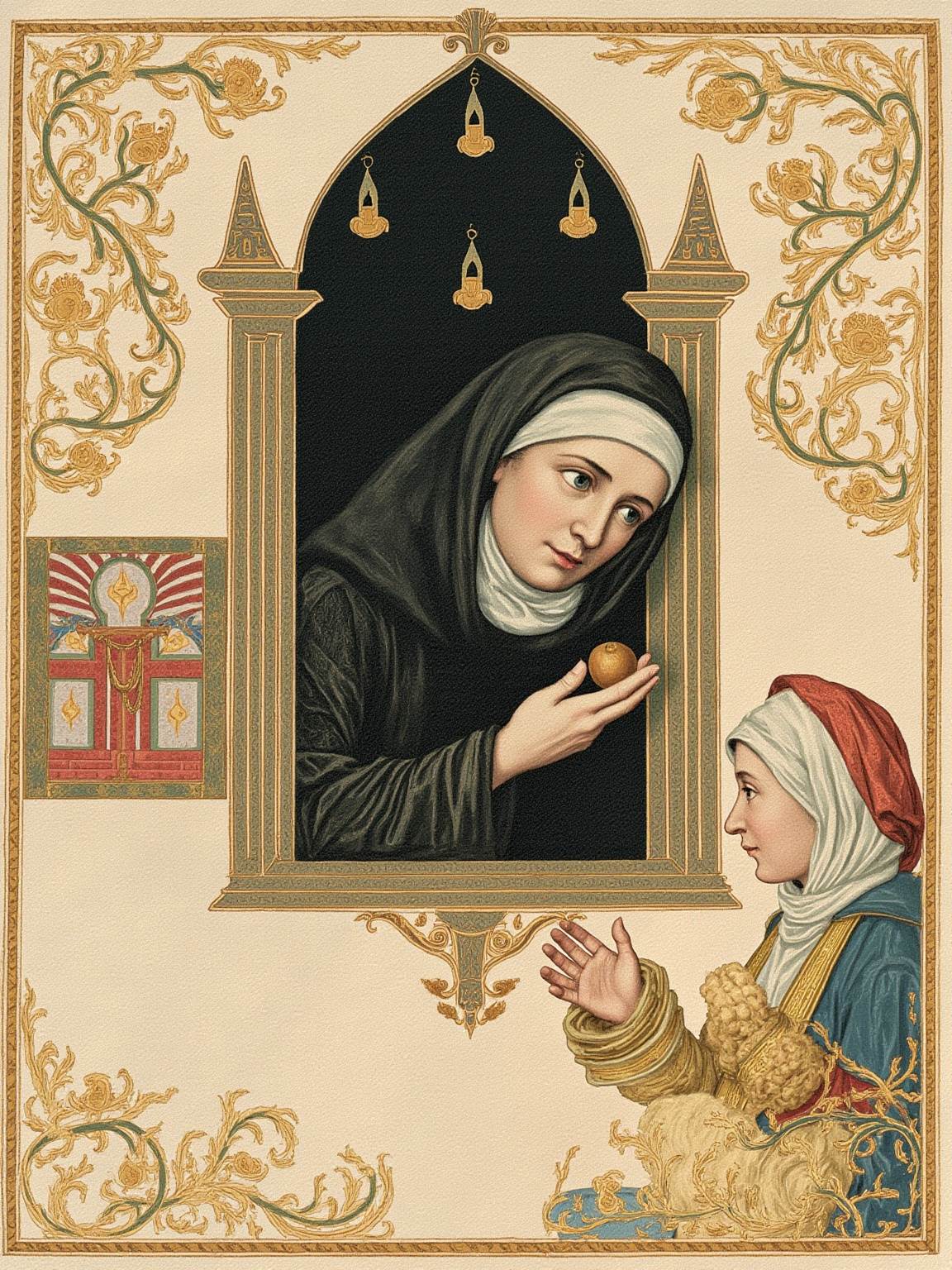
The cast of this world is thin. On one side is the curate, the priest she talked through the window with again and again, working out the theology of her visions — the one who put the questions to her. On the other are the people who traveled from Norwich and farther afield to seek her counsel, the bridge that let the book be heard and written down at all. And there is the little serving-girl, glimpsed almost as a silhouette, who brings the food, sets it down, and turns to vanish beyond the wall — Julian watches her go from the window and writes the gentlest line in the whole book. The entire vantage point stays fixed inside the cell, looking out, never stepping through the door.
Three anchors of the Sixteen Showings
The Sixteen Showings are the substance of the book, and Julian gathers them around three central objects rather than sixteen separate scenes. The first is the love of creation — the hazelnut resting in her palm. In that shriveled little fruit, God lets her see where every created thing comes from: not made to suffer, but brought into being by love. The second is the love of the Passion — Christ on the cross, which in her reading is not punishment but a price. Love does not fall out of nowhere; someone has to bleed to pay for it. The third is the love of the Trinity — creator, redeemer, and lover as three in one, love itself unchanging, active, forever at work. Hold these three in mind and the whole book has its warp and weft.
The first time I read the hazelnut passage, I flipped back and read the previous page again. Plenty of people wrote devotional works in the Middle Ages, and none of them built a chapter of theology on a snack-sized nut. She just holds it out on her palm and tells you — see that? That's love. No theological treatise written since has managed that lightness.
The cell: a whole world folded into two windows
After she recovered, she made a decision that must have looked unthinkable to everyone around her: she moved into the wall. Beside St Julian's Church in Norwich, someone built her a small cell, three sides of stone and the fourth shared with the church, with only two small windows opening onto the churchyard. From then on this woman just past thirty ate, slept, prayed, sat in contemplation, and dictated in that room — for close to forty years. Her world was framed shut by those two windows, but her theology pushed outward through exactly the same two windows.
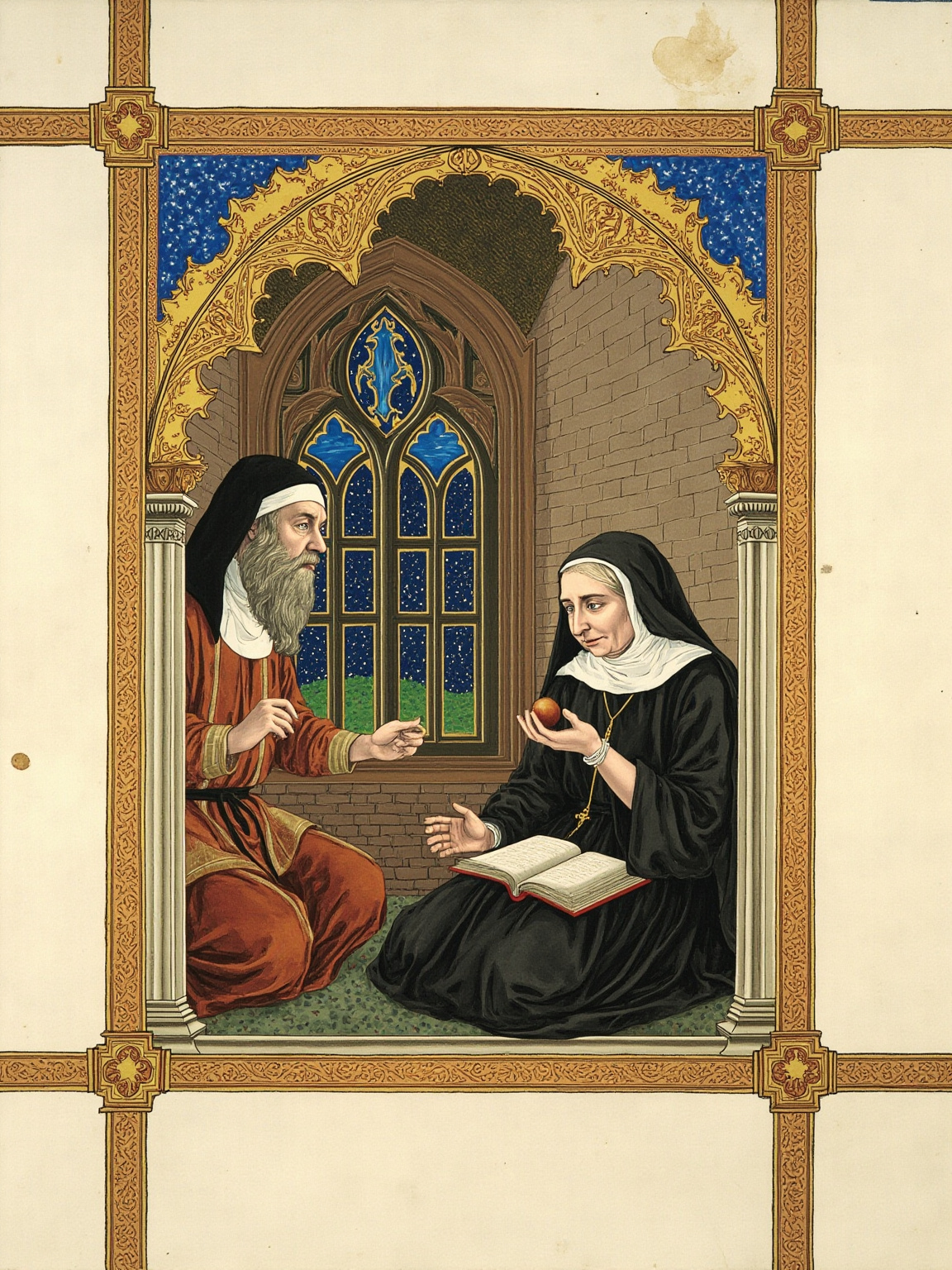
He that made all things for love, by the same love keepeth them, and shall keep them without end.
万物为爱所造,亦为爱所养,且将永受保守。
金句 · 第5章 · 论爱保守万有
Visitors came and spoke to her through the window. The curate stood outside, she stood inside, a wall and a window between them. This is exactly why medieval women's theological voices are so rare, and exactly why hers survived — she could not preach from a pulpit, but the windowsill was her pulpit. The curate would put a question through the window; each time, she would work back through what the visions had taught her and answer again, and those exchanges got written down, copied, passed on, and are still being read five hundred years later.
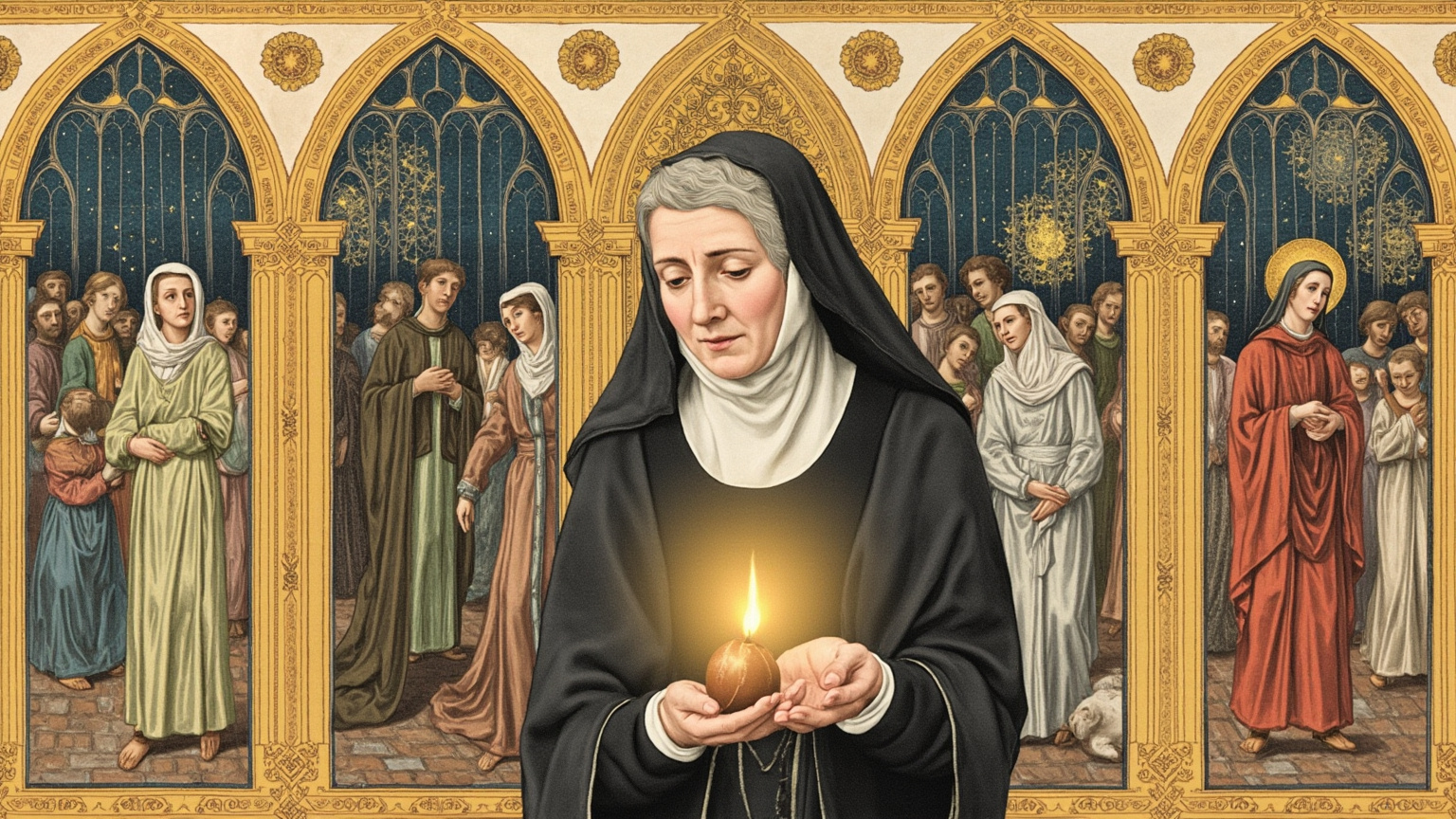
Our Lord showed me a spiritual sight of his love, how he beholdeth his creature with pity.
我主让我看见,祂以怜悯注视祂手所造的一切。
金句 · 第6章 · 论神以怜悯观看受造之物
The serving-girl walks away: the line that carries the whole book
One visitor asked the hardest question of all: is there really a hell in things? What about evil? What about suffering? How does anyone who has escaped death with their life still manage to believe? It was a question she had to answer, and it lands as the heaviest blow in the whole book. Julian offers no sermon. She simply watches from the window as the girl who brought the food turns and walks out of the courtyard, and says: she has gone, the child has gone, and God's love is still there.
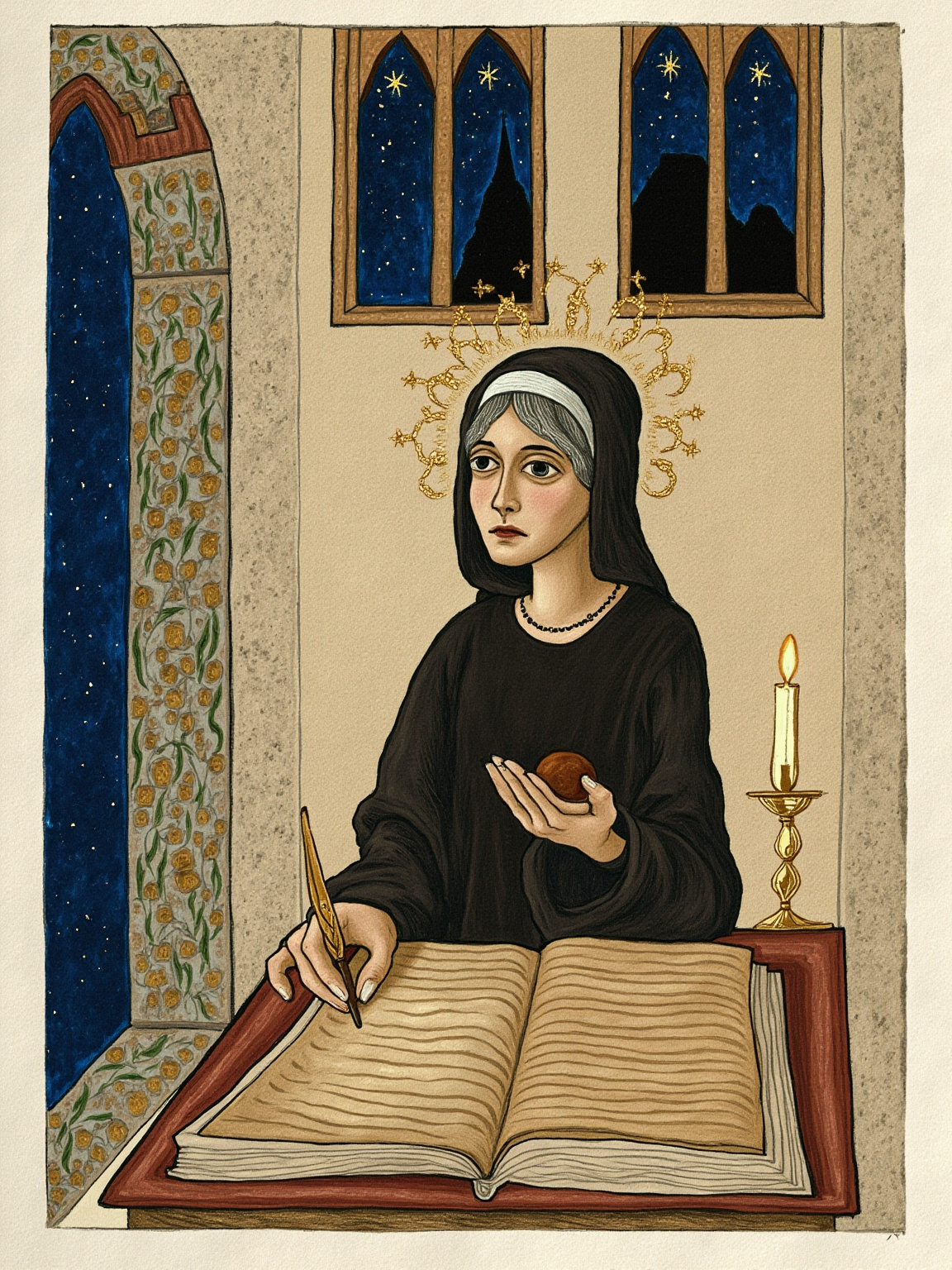
And he showed me that there is no manner of thing that is not well, and that all shall be well.
祂让我看见,没有一事不安好,一切终将安好。
金句 · 第13章 · 论一切终将安好
Three sentences carry the book from this moment on. The first: nothing can stop what he means to accomplish in us. The second: everything that is made was brought into being and is kept in being by the love of God. The third: our Lord shows through all of this that his tenderness runs past anything we can grasp, and never stops. Later readers call this all shall be well. Do not mistake it for comfort — it is the answer she boiled down, slowly, out of a hazelnut and a retreating back seen through a window, after the sharpest question anyone put to her.
She has gone, the child has gone, and God's love is still there — the lightest sentence in the book, and the heaviest.
Five hundred years on: how a voice from inside a wall got out
Julian died sometime in the early fifteenth century. The manuscript passed down for centuries before a copyist rediscovered and reprinted it in the seventeenth; in the early twentieth century Grace Warrack rendered it into modern English for Methuen in London, and later figures like Evelyn Underhill and the Modern Library carried it forward into the canon of English reading. It filled a gap that had stood open in Western Christian literature for a long time — medieval women's devotional writing. Julian belongs beside Hildegard of Bingen and Thomas à Kempis, but she is the one standing on the English side of that shelf.
Why it has been remembered for six hundred years
Three reasons. First, this is the first complete book in the English-speaking world written by a woman — that fact alone earns it a place in literary history. Second, all shall be well is one of the shortest, most universal, and most theologically dense sentences in the English canon — a single line holding up an entire book. Third, the posture of decades spent alone in a cell has an echo across cultures: Julian's anchorhold answers, across an ocean, to the plain small room in Japan's Hōjōki and Tsurezuregusa — different traditions arriving at the same practice of seeing the whole of things from within a few square feet.
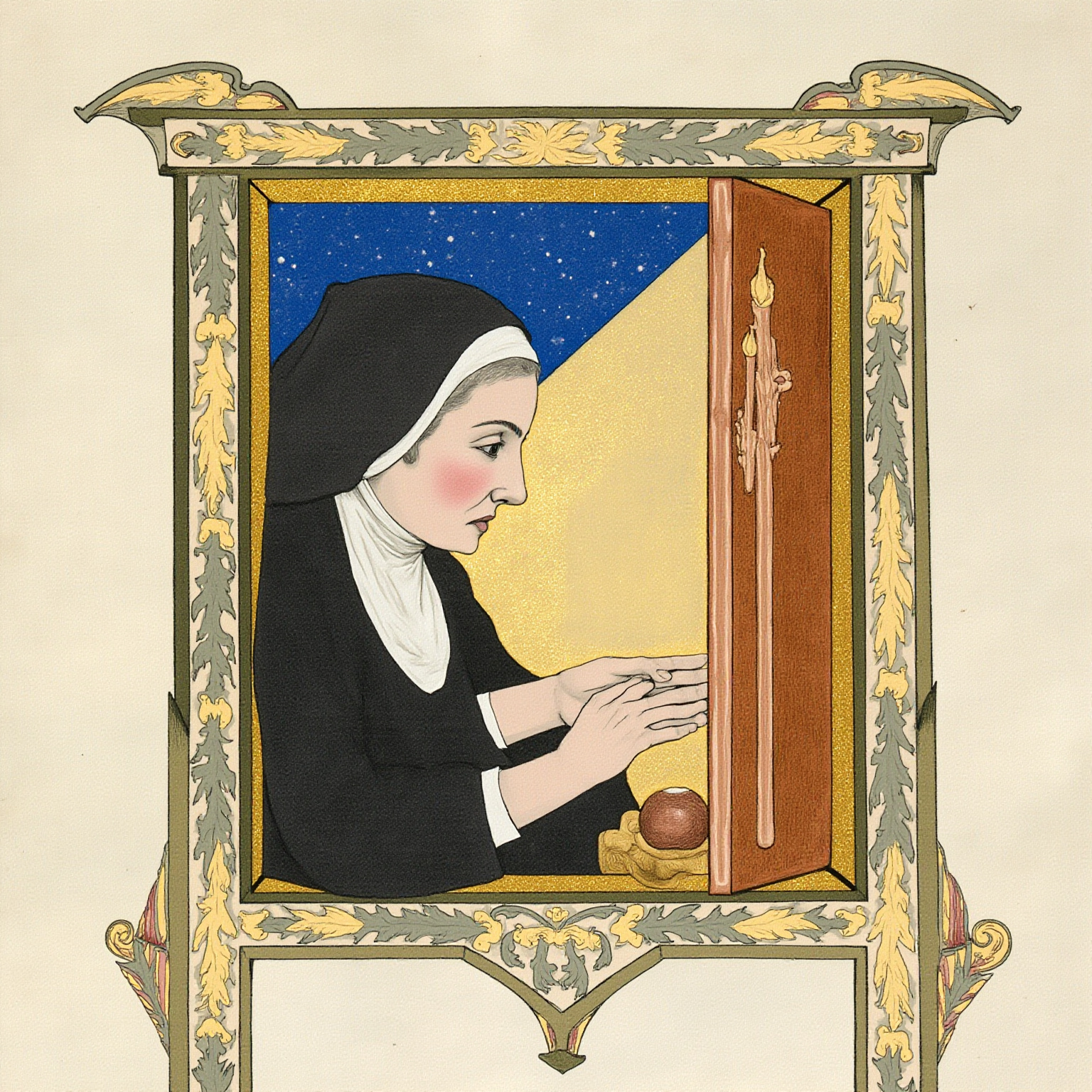
All manner of thing shall be well, when we see clearly that our Lord is our true ground.
一切终将安好——当我们看清,我主乃是我们唯一的根基。
金句 · 第11章 · 论我主为我们的真根基
For a reader today, the difficulty is not the plot — there isn't one — and it is not the language either, since Grace Warrack's modern translation reads easily enough. The difficulty is whether you are willing to spend a quiet afternoon looking straight at a woman walled into a room. She does not raise her voice, does not reach for sentiment. She just holds a hazelnut out on her palm and tells you — see that? That's love.
Why read the original once you already know what happens
What a guide like this can give you is a map. A map can plot the three anchors, the sixteen showings, five hundred years of silence — but it cannot draw how a candle flame wavers against stone, cannot draw the exact moment Julian's fingers curl on the windowsill as the girl's skirt disappears around the corner, cannot draw which line the wax dripped onto as she set those three sentences down on parchment. That kind of physical presence you have to go sit with yourself, in the original — find a quiet afternoon, make a pot of tea, start at the first chapter, and let her talk you through it slowly.
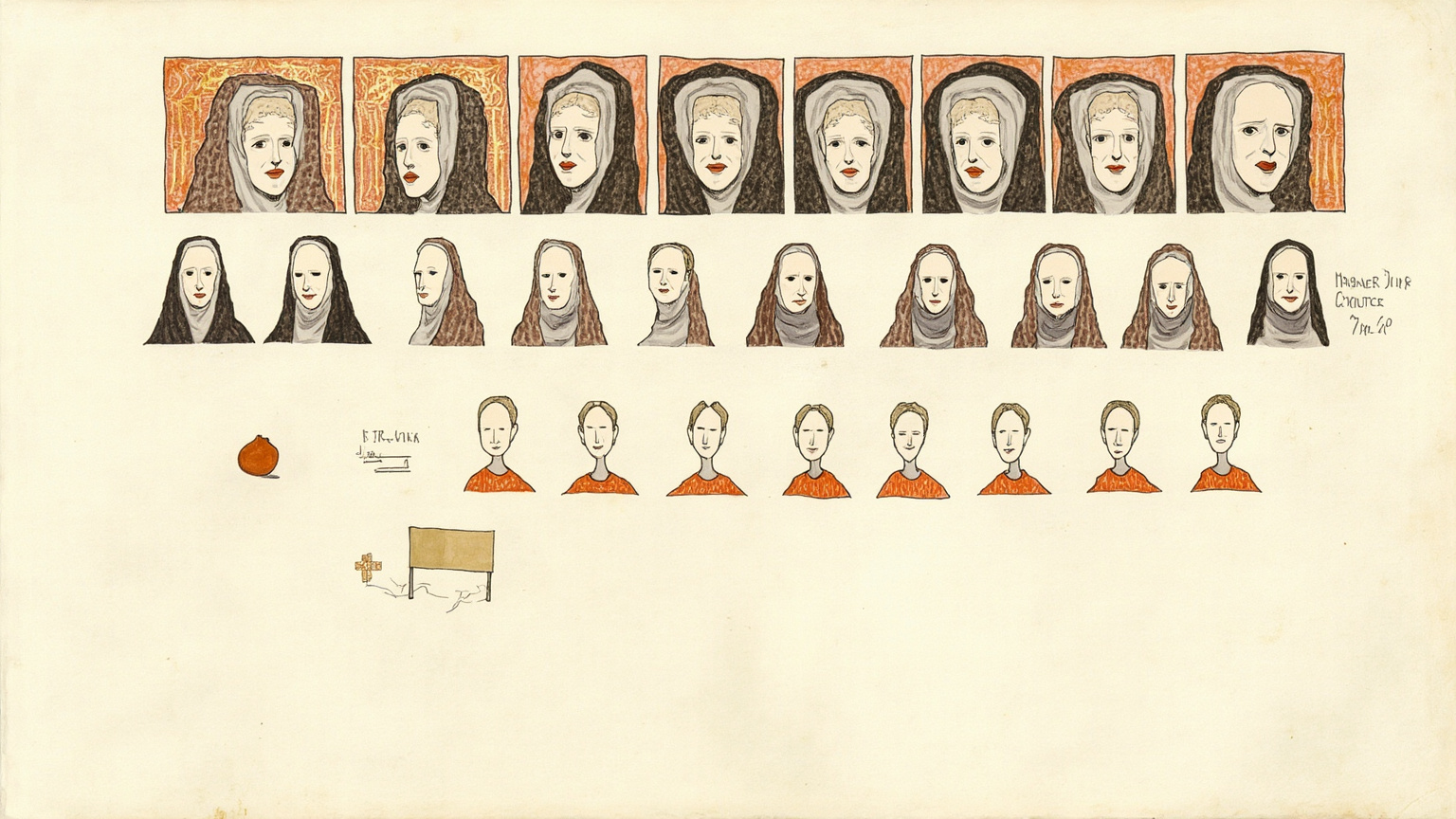
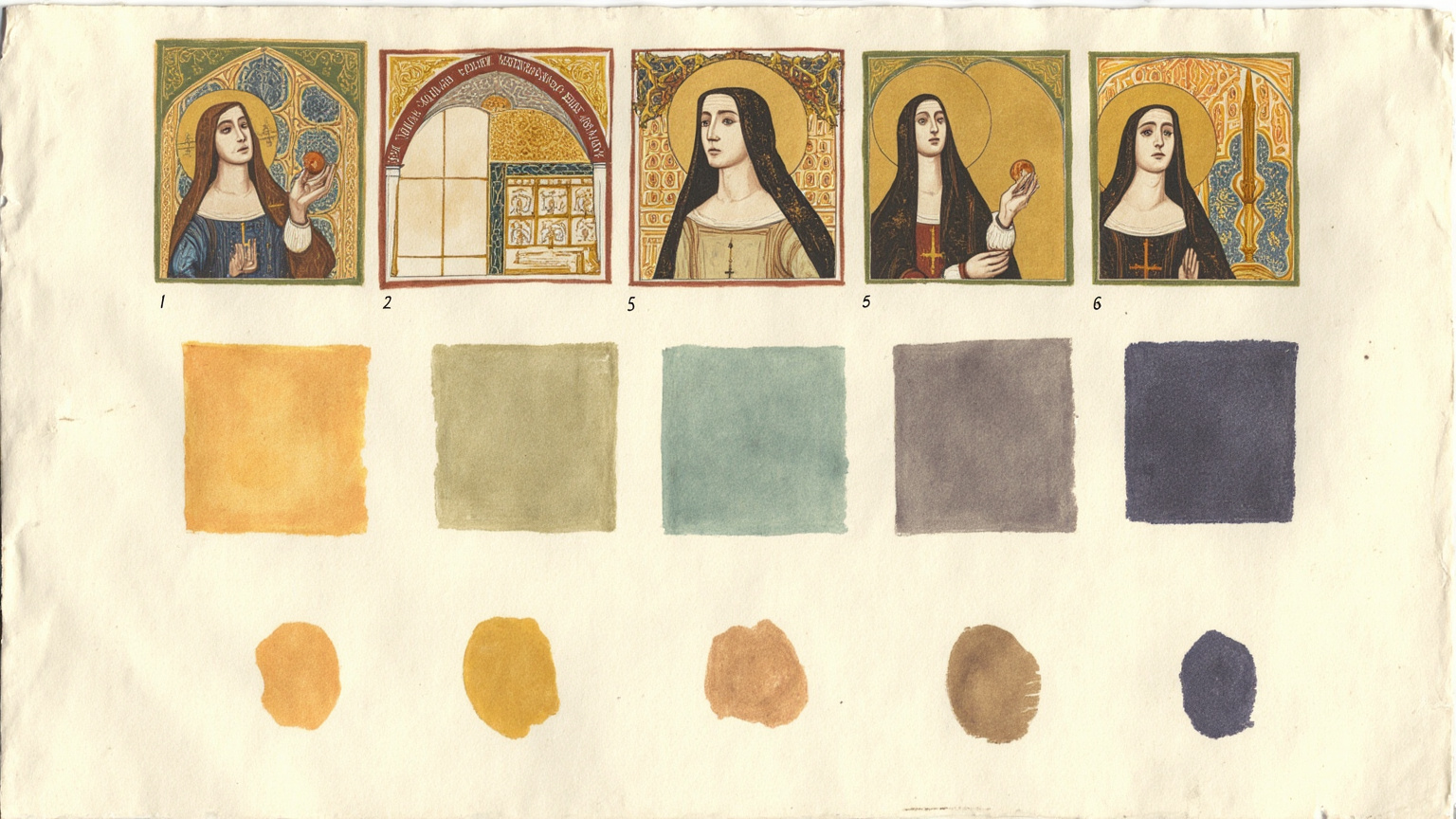
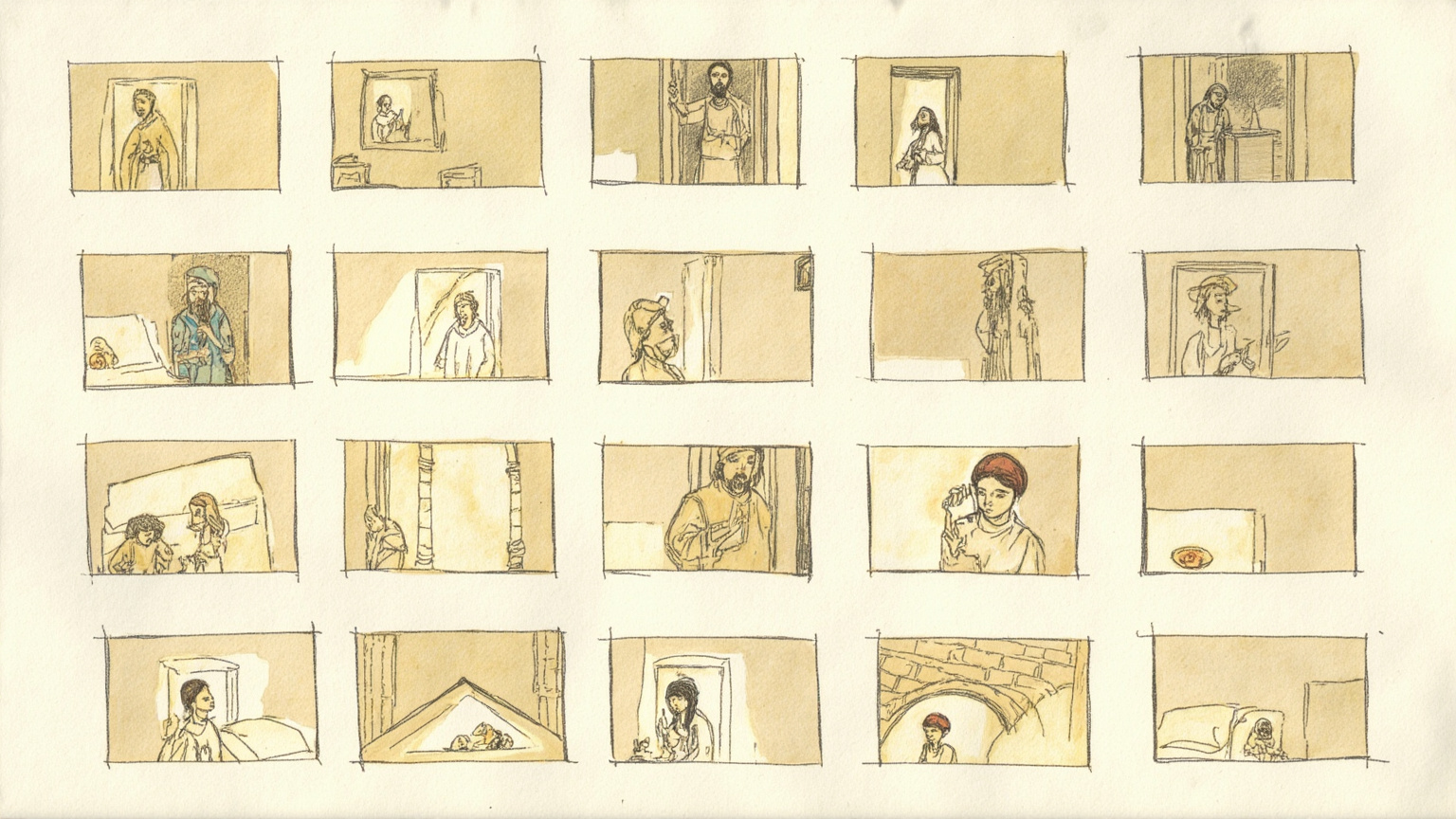
Art Direction4 plates
Before the guide was written, this book got a visual foundation — every illustration you just read grew out of it.