Siddhartha · Companion Guide
悉达多
一个婆罗门之子,放弃一切去求道,却在富足与情欲中迷失,最终在河边谛听中觉醒——这条路,必须亲历。
Opening: why people keep coming back to this little book
You've had this moment before — someone in your feed posts "feeling very Siddhartha today," with a picture of a river. You wonder whether that's a meme or a book. You open it, and it's slim, its sentences short as verse, and by the end it feels like someone has quietly pressed a hand to the back of your neck. So here's the question: why does a German novel written nearly a century ago keep getting picked up again by insomniac office workers, the newly heartbroken, people who just quit their jobs in their forties? Because it isn't about some ancient sage's miracle. It's about how a clever man peels back, layer by layer, everything he thought he understood, until he's finally willing to admit he never understood anything at all.
The book is called Siddhartha. Your first thought at the name was probably the Buddha, right? That's exactly where it trips people up — the protagonist, Siddhartha, is a young Brahmin Hesse invented, a different person from the historical Buddha, Gautama. Gautama does appear in the book, but only as a supporting character. It's this young man named Siddhartha who has to walk the whole road.
What kind of book this is: where it sits in literary history
Hermann Hesse was born in Germany in the late 1870s, later took Swiss citizenship, won the Nobel Prize in Literature in 1946, and died past eighty-five. Siddhartha is a work of his middle years, published in German in Berlin in 1922 — but the English translation didn't appear until 1951, and when it did, it landed right in America's 1950s and 60s counterculture, where young readers took it up as something close to a soul's handbook. Every hippie's backpack probably had a copy. It's classified as a philosophical novel, and also as a Bildungsroman — a German coming-of-age novel where the point isn't adventure but how a person grows on the inside. The Indian setting is just the costume; what Hesse actually wants to talk about is a lack sitting at the center of the Western spirit.
Characters and world: the young man, the best friend, the courtesan, the ferryman
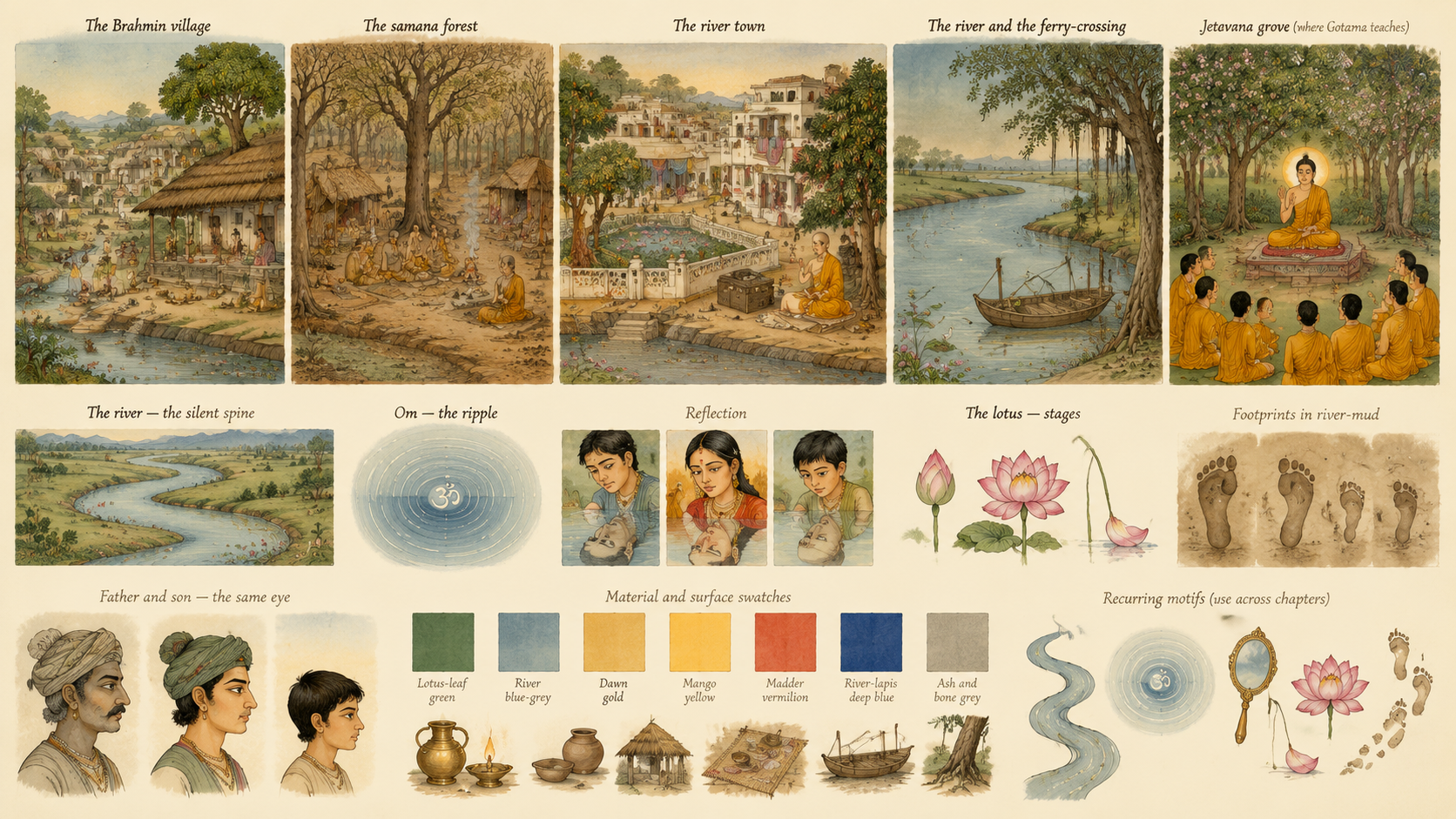
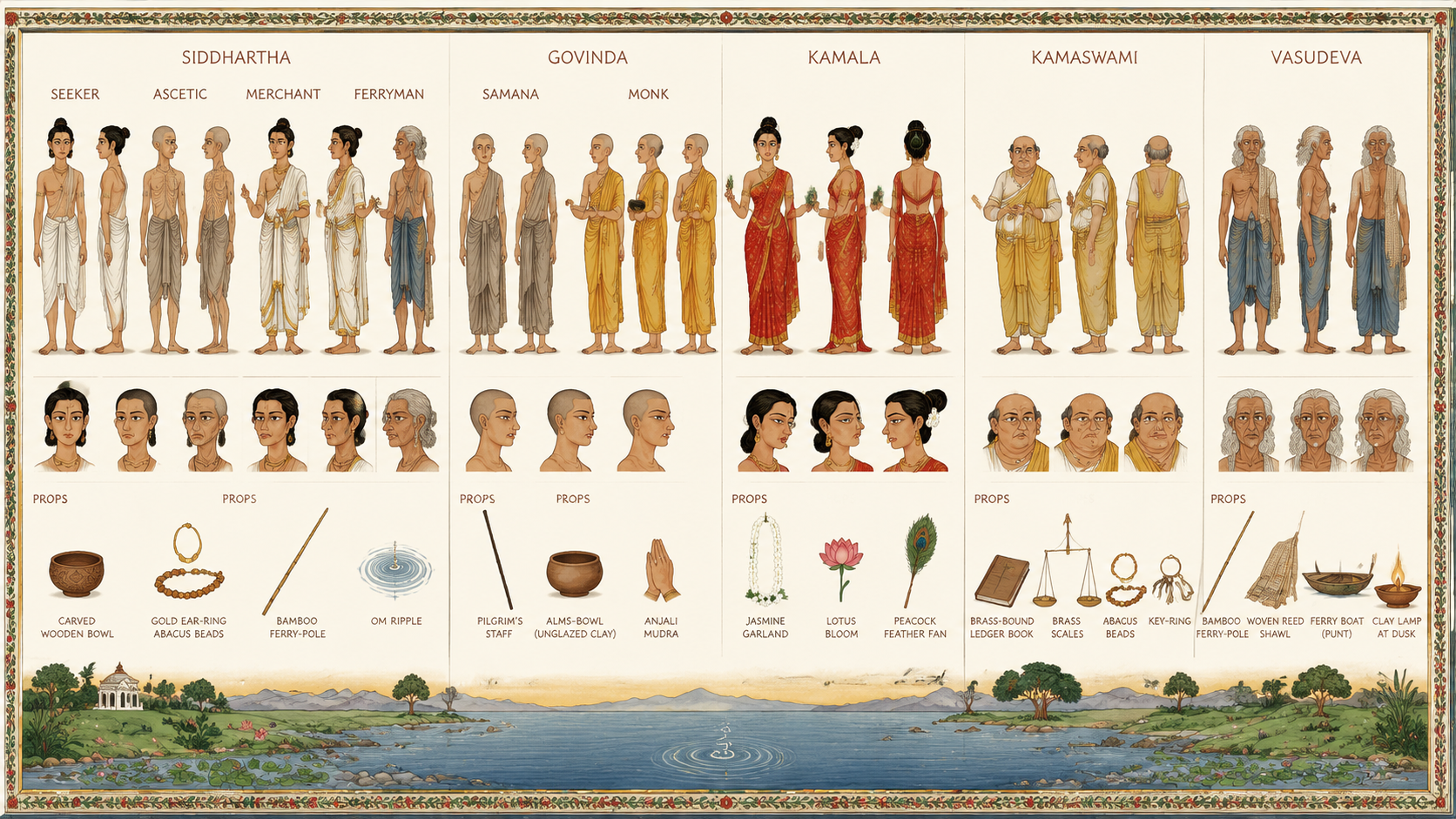
There aren't many characters, but each one is a mirror held up to some stage of Siddhartha's life. Govinda is his childhood friend. The two of them leave home together, practice asceticism together, and go together to hear the Buddha teach — and then they part ways at that crossroads: Govinda takes his vows and becomes one of the Buddha's monks, while Siddhartha decides, I have to walk this myself. That fork is the single most important thread in the book. Kamala is the most beautiful woman in the city, and she teaches Siddhartha something no ascetic ever will — desire, pleasure, how to actually live in the world. The merchant Kamaswami is her opposite number, the side of business, calculation, ledgers. Most important of all is an old man you won't notice at first — the ferryman, Vasudeva. He has been waiting by the river his whole life, and what he's been waiting for is Siddhartha. The world of the story is a legendary, half-imagined ancient India, not strict history or geography. There are only a handful of settings: the Brahmin village, the forest, the trading town, and the great river running through the whole book. The river isn't just scenery — it's one of the book's actual protagonists.
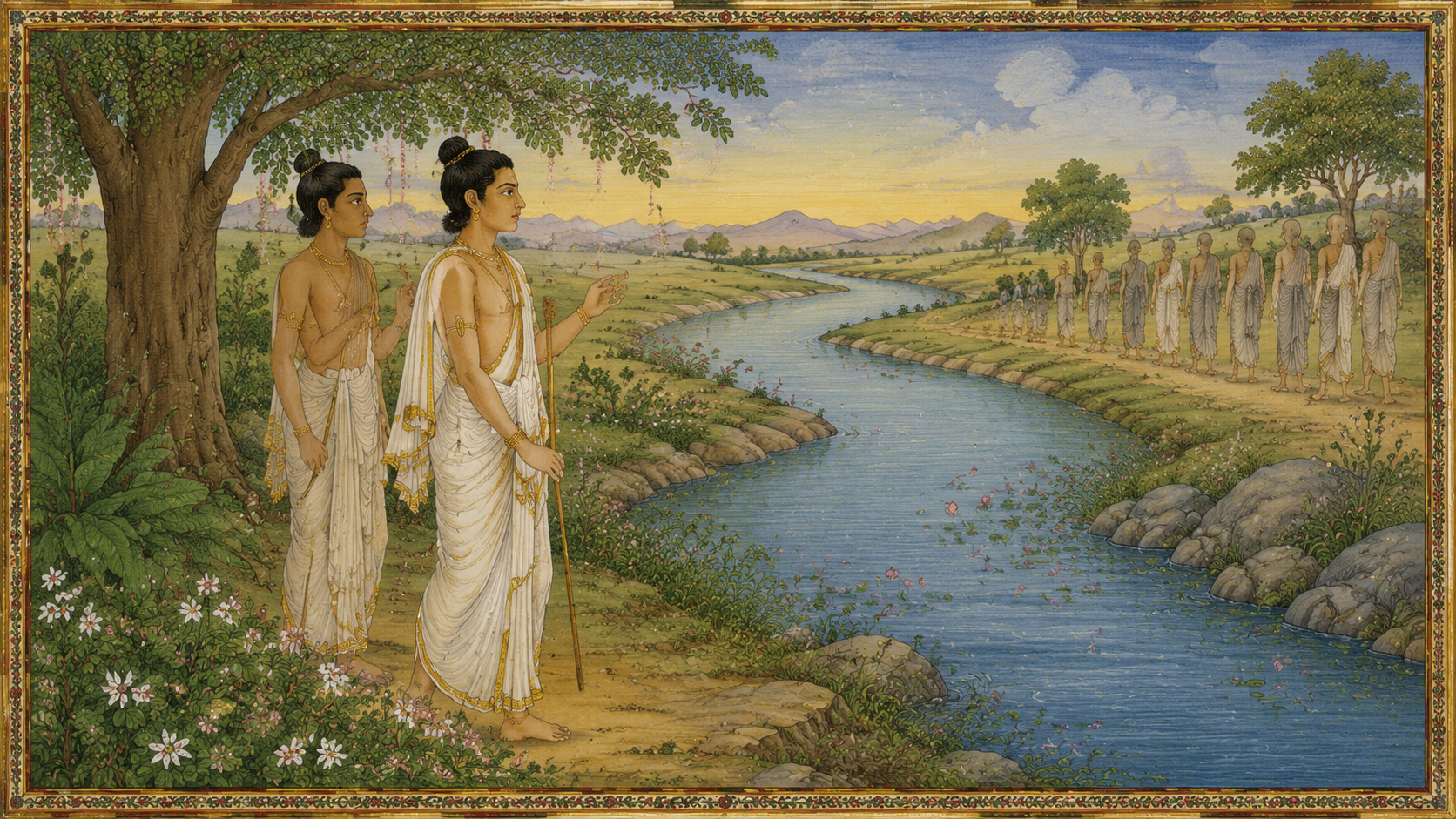
The ablutions were good, but they were water, they did not wash off the sin, they did not heal the spirit's thirst, they did not relieve the fear in his heart.
沐浴是好的,但那是水,洗不掉罪孽,解不了精神的焦渴,平复不了心中的恐惧。
原文金句 · 开幕焦虑
The plot line: one river, thirty years, three stages
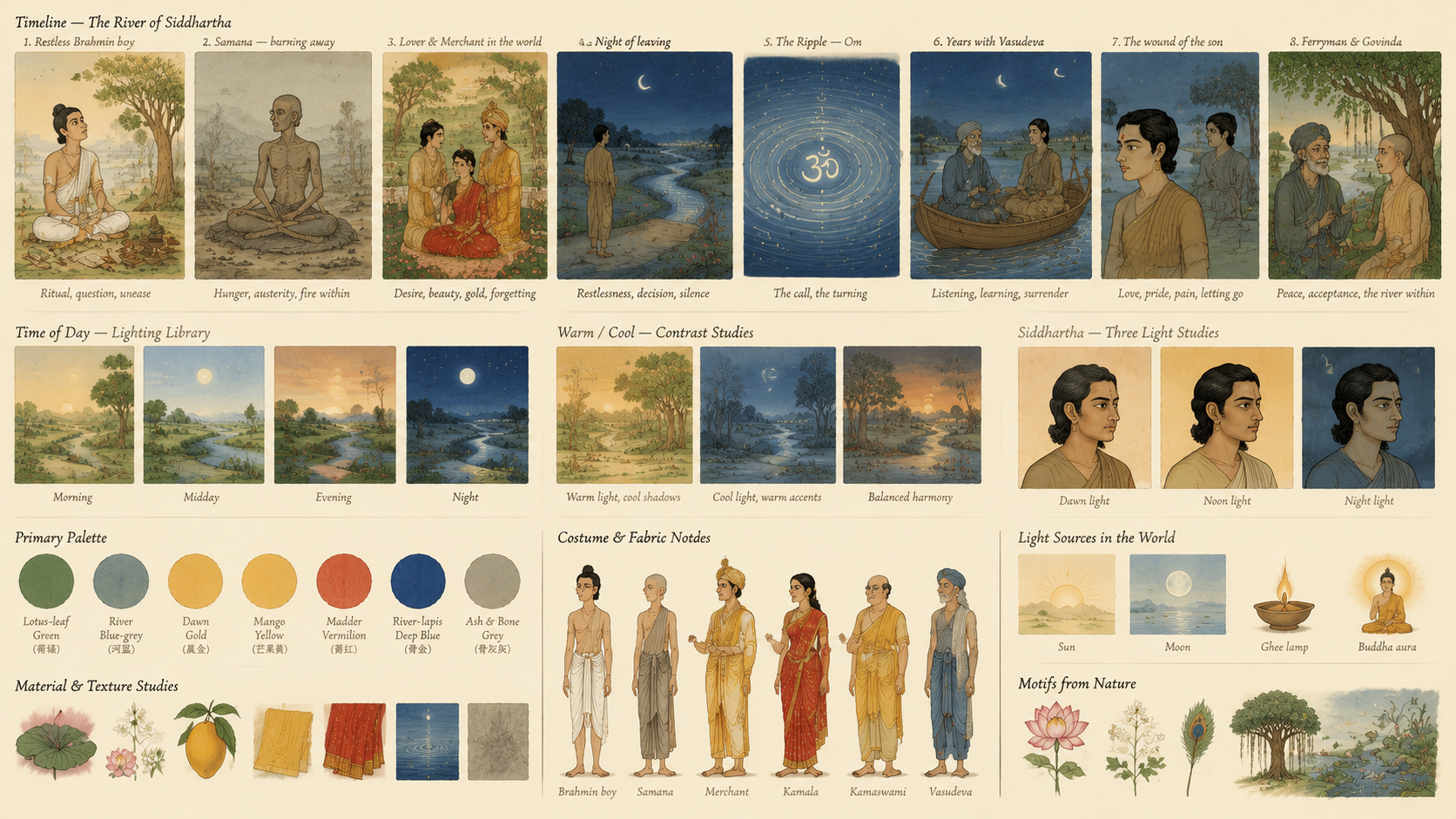
Stage one: leaving home. Siddhartha is a Brahmin's son, so clever that his elders are half afraid of him. But ordinary rituals and scripture can't feed him, so he leaves home with Govinda and joins a band of wandering ascetics, the Samanas. Fasting, enduring pain, holding his breath — whatever he can do to himself, he does it. Craft note: Hesse writes in very short sentences with almost no adjectives, like he's composing a prayer. That restraint is itself a kind of asceticism — reading it, you feel your own breathing go shallow.
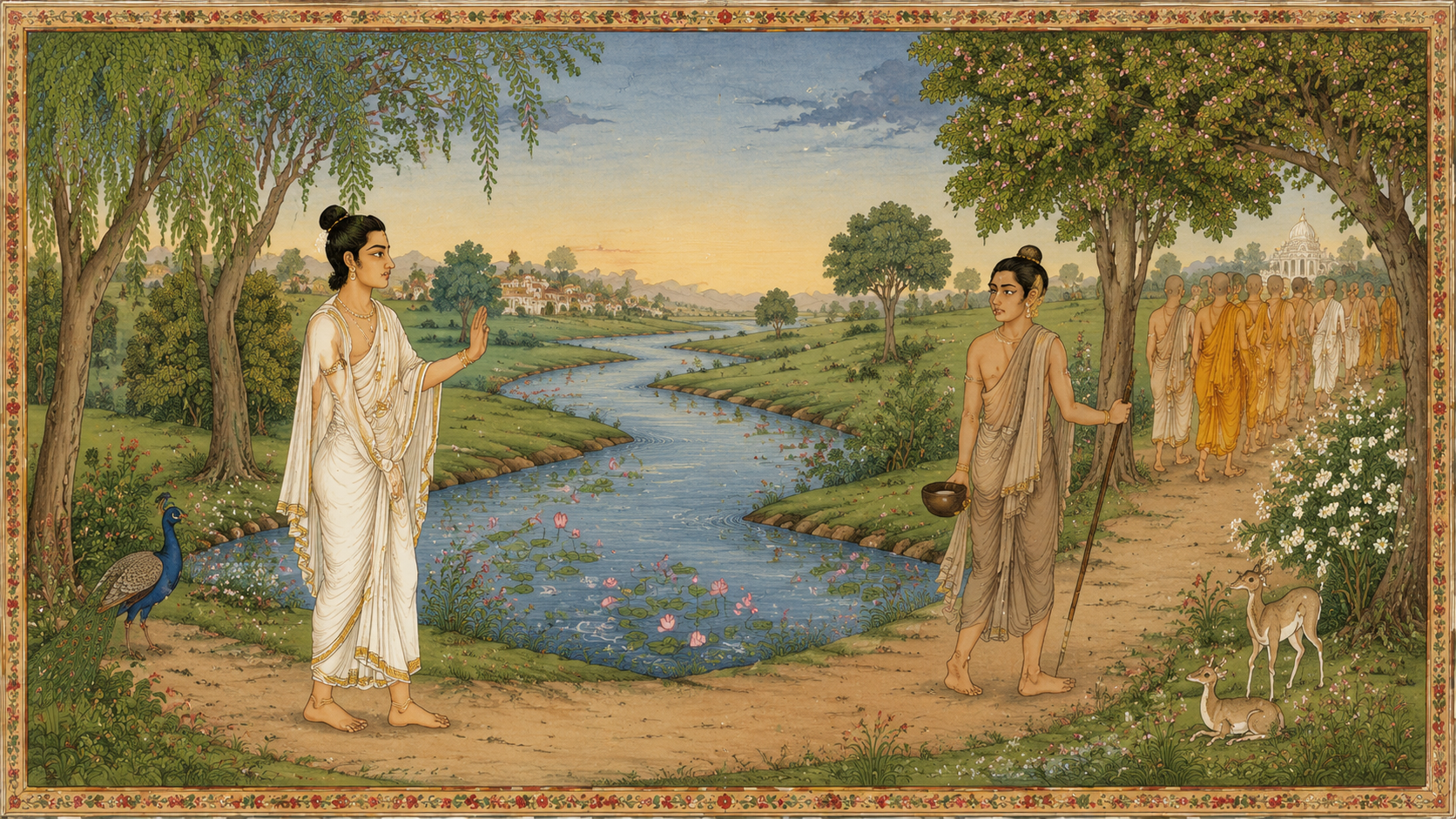
Stage two: refusing the Buddha. A few years into his asceticism, Siddhartha realizes something — he has nearly starved himself to death and is still no closer to the truth. Word reaches him of an enlightened teacher nearby named Gautama, so he goes with Govinda to hear him. The Buddha speaks well, radiates calm, and the crowd around him weeps and asks to be taken in. Siddhartha doesn't kneel. His reasoning is exact: enlightenment can't be handed over by someone else; if you simply hear it and understand it, it was never yours. Govinda stays behind with the Buddha. Siddhartha turns and walks away — the clearest-headed moment in the whole book, and the loneliest. Craft note: Hesse keeps the Buddha on the page but barely lets him speak — a deliberate restraint. He won't let the "right answer" simply appear, which forces the reader onto Siddhartha's side, holding out against the temptation to just say yes.
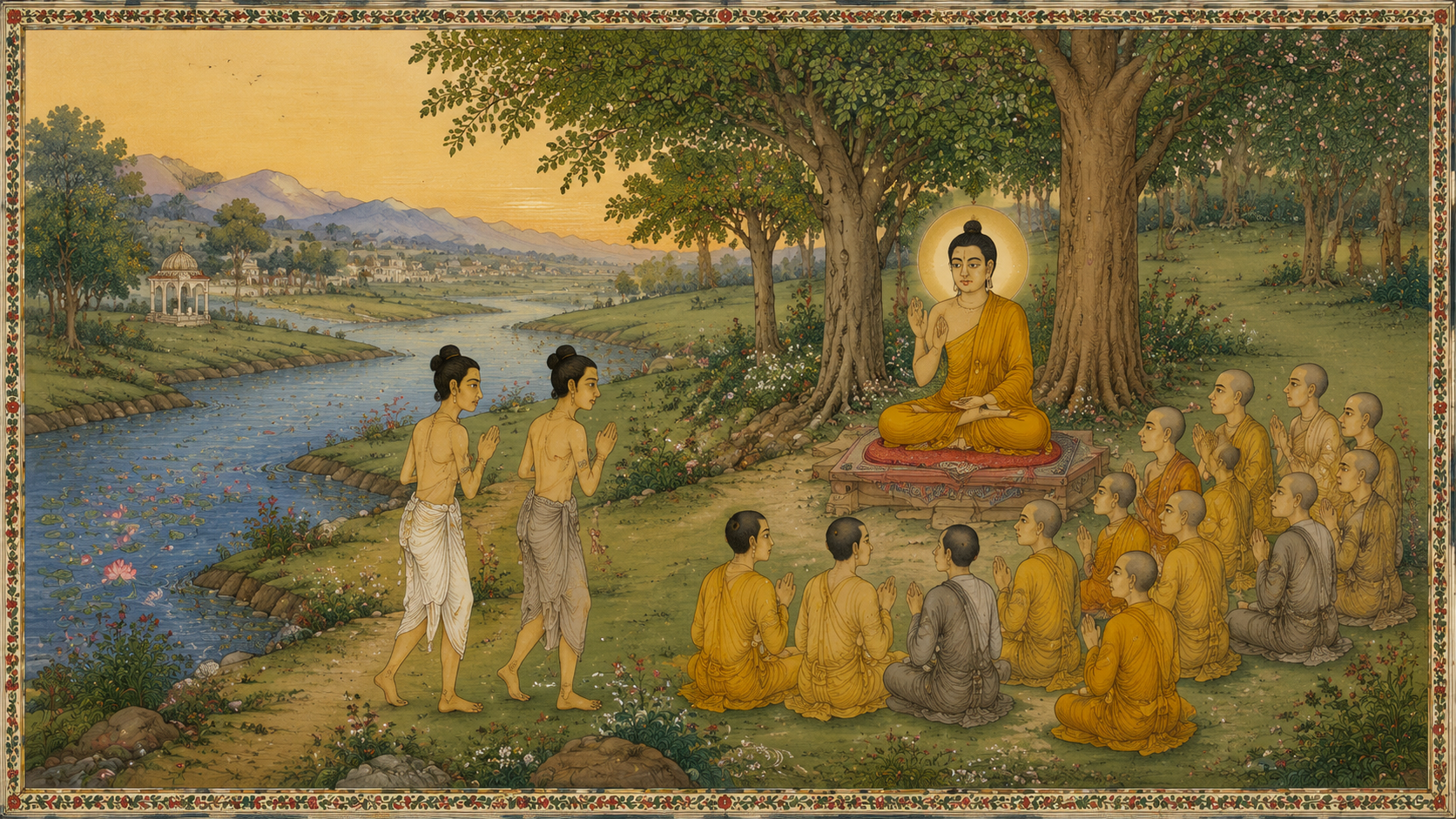
Only for myself, for myself alone, I must decide, I must chose, I must refuse.
我必须独自决定,独自选择,独自拒绝。
原文金句 · 23% · 拒绝佛陀
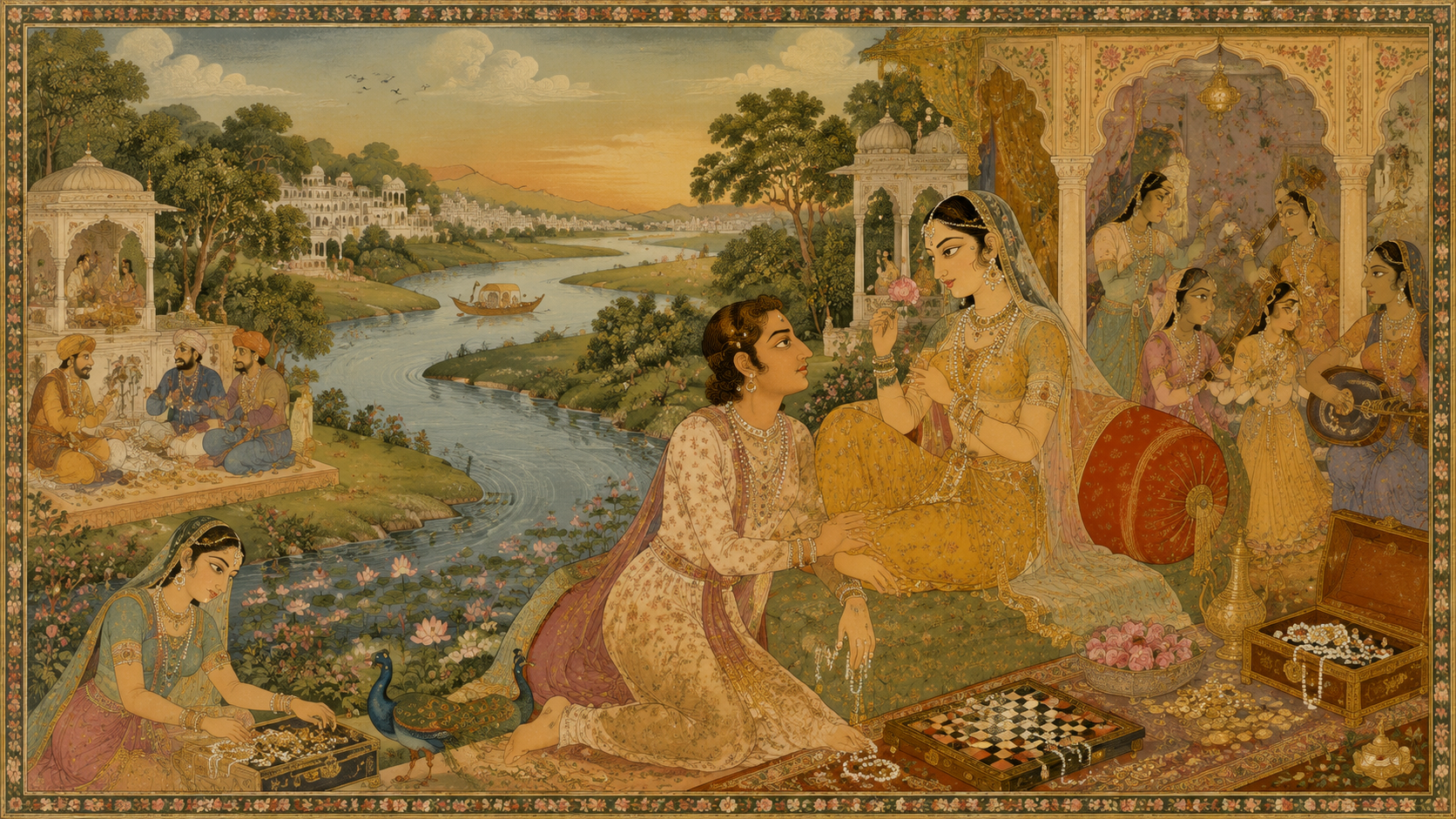
Stage three: entering the city. Siddhartha arrives in the city and meets the courtesan Kamala. He wants to see her, but she won't receive a man without money. So he apprentices himself to the merchant Kamaswami, learning bookkeeping, trade, gambling, drinking. An ascetic plunges headfirst into worldly pleasure — and stays there for over a decade. Craft note: Hesse renders the fall with strange calm. There's no dramatic collapse, just a slow, moneyed weariness, the kind you get from card games that run till dawn. That flatness is more truthful than any dramatic repentance would be.
Stage four: waking by the river. Years pass. Siddhartha has money, has love, has everything — and then he looks in the mirror and finds he has become a laughing animal: capable of calculation, capable of pleasure, no longer capable of feeling. Disgusted with himself, he walks out of the city in the middle of the night to the river, close to ending his own life. At that exact moment, half-dazed, he hears a sound rising from the water: Om, the oldest sacred syllable in ancient India. He wakes up, as if roused from a very long dream. Craft note: there's no pile-up of interior monologue here. Hesse writes just one sound. Short, exact, dropped in place like a needle. This is the book's turning point, and its most inspired stroke.
In those moments, he had a dream: Kamala owned a small, rare singing bird in a golden cage.
在那刹那,他梦见:迦摩萝有一只关在金笼里的珍奇歌鸟。
原文金句 · 52% · 笼中鸟之梦
Stage five: listening to the river. Siddhartha never goes back to the city. He stays by the river and learns to pole the ferry from the old boatman, Vasudeva. The old man says almost nothing — just one thing: listen. The water flowing past is new every second, and yet the river is still the same river; a person's whole life is like that current too, past, present, and future churned together, impossible to pull apart. Craft note: this is the emptiest stretch of the book, almost no events at all, just two men sitting by the river listening to the water. Hesse strips the plot out on purpose, so all you can do is slow down alongside Siddhartha. Read long enough and you notice your own breathing has fallen in step with the river.
Stage six: the pain of attachment. Just when Siddhartha believes he has let go of everything, Kamala arrives with his son. On the road to the river she is bitten by a snake and dies in his arms. The boy stays behind. Siddhartha becomes a father for the first time, and he botches it — he understands letting go too well, and turns that understanding into a demand he makes of his child, dressing up his own attachment as parenting. The boy can't stand this suffocating enlightenment and runs back to the city. This is the most painful stretch in the book: a man nearly at the edge of spiritual awakening, knocked back into ordinary humanity by a single blow from his own son. Craft note: Hesse makes the villain of enlightenment not greed but a father's love — the cruelest cut of all. Reading this, you suddenly understand that the book was never trying to actually enlighten anyone. It's just trying to make you see the shape of your own attachments.
You don't force him, don't beat him, don't give him orders, because you know that 'soft' is stronger than 'hard', water stronger than rocks, love stronger than force.
你不强迫他,不打他,不下命令,因为你知道“柔”比“刚”更强大,水比岩石更强大,爱比暴力更强大。
原文金句 · 78% · 爱的领悟
Stage seven: reunion. Many more years pass. Govinda, now old, hears that a ferryman by the river seems like an enlightened man, and goes to visit him. He doesn't recognize that this old boatman is the Siddhartha he once knew — he only knows that sitting beside this man, the part of him that still hasn't understood stops burning quite so much. Siddhartha doesn't reason with him, doesn't recite scripture. He simply kisses Govinda on the forehead. Govinda weeps, and understands. The book ends there. Craft note: not one line in the final scene says I am enlightened. Hesse lets enlightenment take the shape of a kiss instead — probably the most Eastern ending in Western literature.
This book teaches exactly one thing from start to finish: you can hear every piece of wisdom there is, but you still have to live your own life with your own hands — and only that living counts.
Themes and craft: why generation after generation keeps returning to it
Siddhartha really only says three things. First, enlightenment can't be taught. However clearly the Buddha explains it, understanding his words doesn't make them yours. This is exactly what makes the book land so hard in an age of bookmarked wisdom and info-anxiety — you've saved a thousand takeaways, but where's the part you actually lived? Second, asceticism, indulgence, and enlightenment aren't three opposing choices. They're three arcs of the same circle. Leave one out and the circle doesn't close. Third, attachment eventually comes knocking wearing the face of the person you love most. You can dodge desire. You can't dodge a child calling you father. And the writing itself preaches the same doctrine: sentences pared to the bone, the river image returning again and again, long stretches of prayer-like parallelism. Reading it isn't reading a story — it's a breathing exercise.
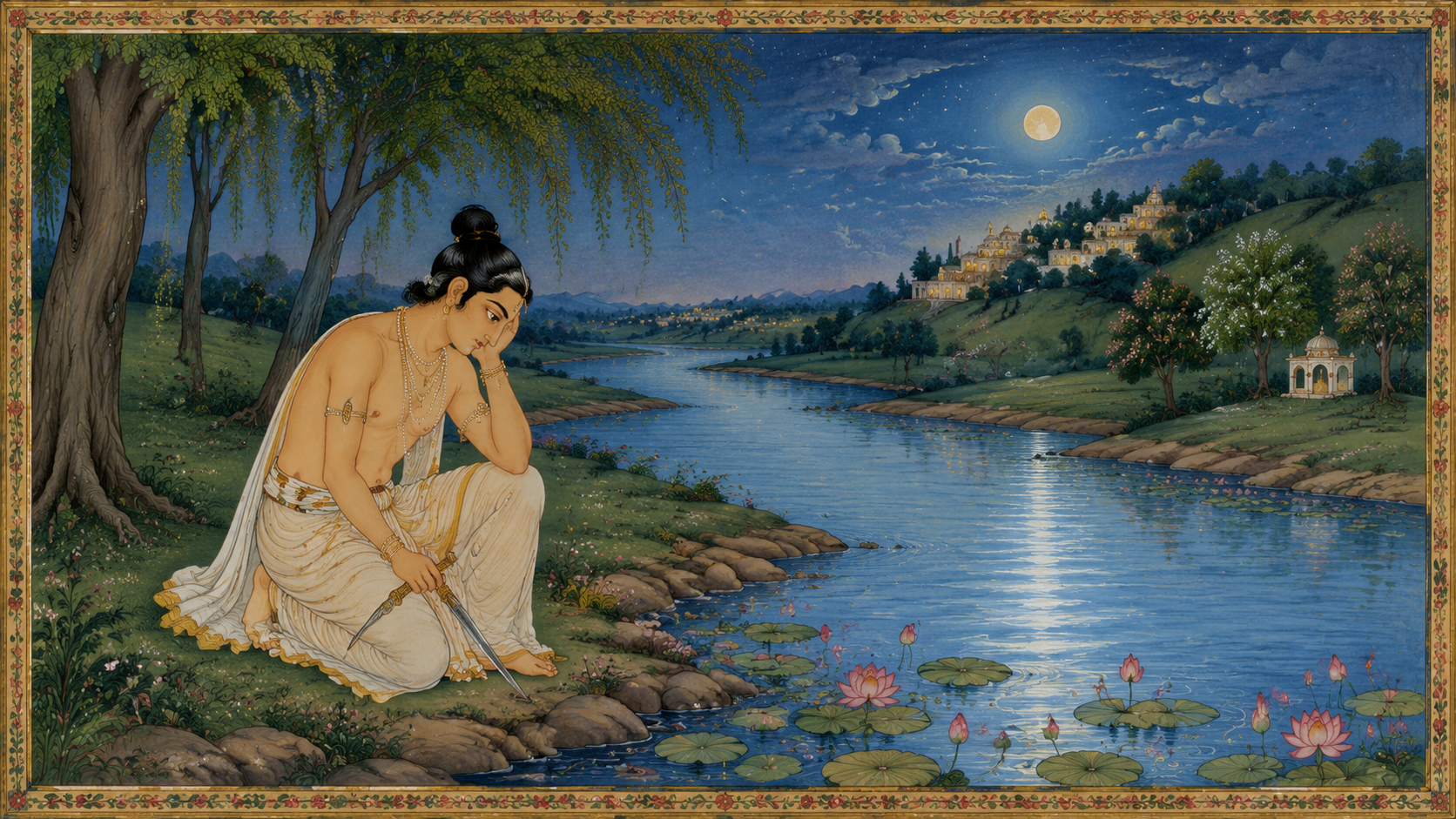
And now I know it, don't just know it in my memory, but in my eyes, in my heart, in my stomach.
现在我明白了,不只是记忆里明白,而是用眼睛、用心灵、用腹肠明白了。
原文金句 · 64% · 亲历之知
Why read the actual book: knowing the plot is not the same as reading it
You now know that Siddhartha leaves home, refuses the Buddha, falls into the city's pleasures, wakes up by the river, has his heart broken by his son, and finally kisses an old friend. That isn't the same as having read it. What makes Siddhartha actually work is the physical sensation of slowing down as you read it — a sensation no summary can give you. Its sentences have a rhythm, the river has a rhythm, even turning the page has a rhythm. Knowing the plot in advance actually helps: you're not racing toward the ending, so you can sit page by page with Siddhartha by the river. And you'll find that the part of you that felt so very Siddhartha lately is being loosened, a little at a time, by the book itself.
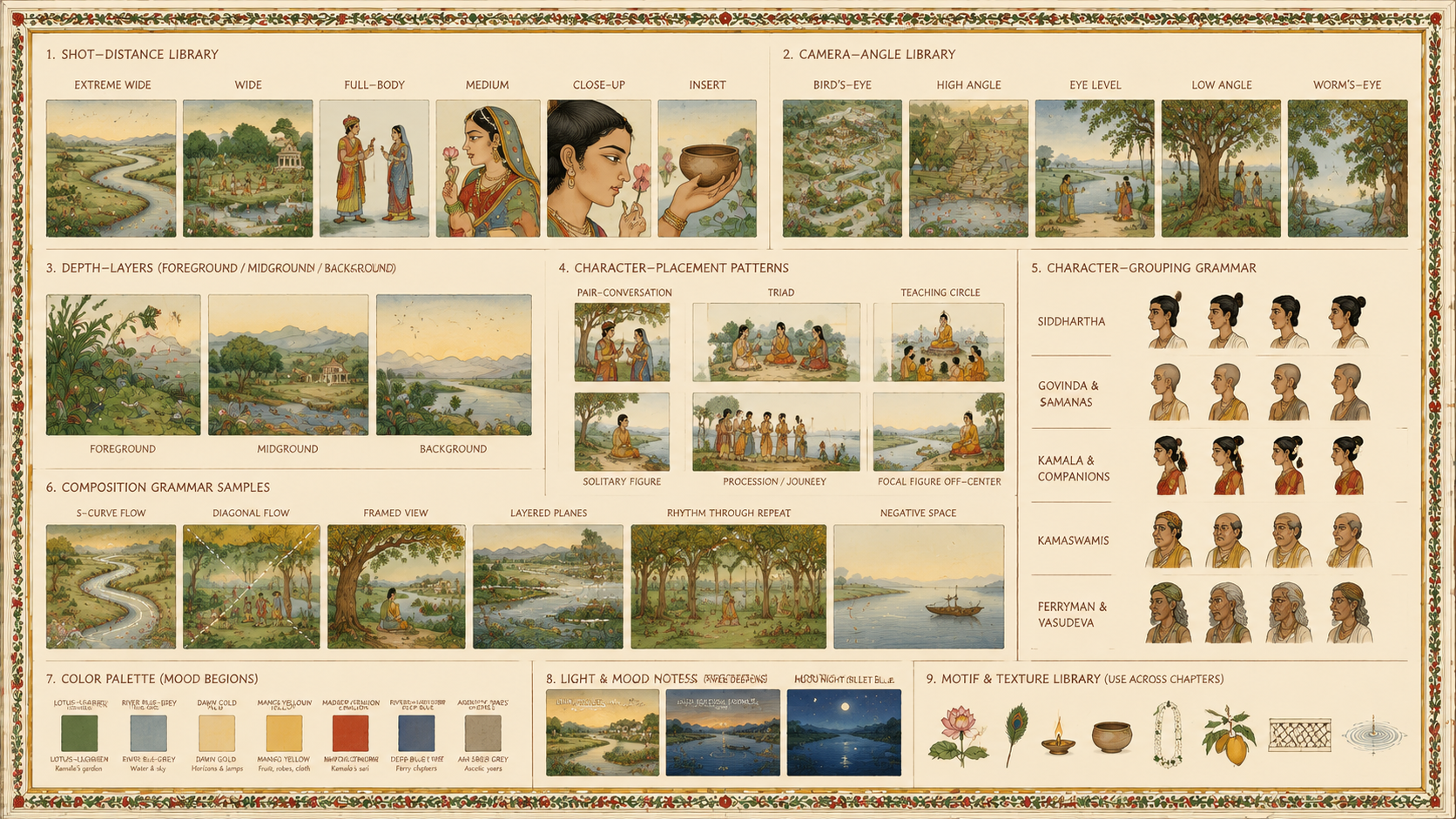
Art Direction4 plates
Before the guide was written, this book got a visual foundation — every illustration you just read grew out of it.