The Peacock Flies Southeast (The Wife of Jiao Zhongqing) · Companion Guide
孔雀东南飞
一桩被婆婆赶、被兄长卖的婚姻,两个年轻人以死守誓,把汉代家长权力写成了千古悲剧。
Opening
A pair of mandarin ducks call to each other, night after night, in the shadow of pine, cypress, and paulownia trees. Buried beneath them, before dawn ever comes, lie a young husband and wife -- she drowned herself in a clear pond, he hanged himself from a tree in the courtyard. This is not some folk tale. It is the ending of a Chinese ballad written seventeen hundred years ago.
What stings more is that neither of them had to die. A seventeen-year-old wife who could weave, play the harp, and recite poetry was accused by her mother-in-law of acting on her own -- and on the strength of a single order, go back to your family, she went. Before she had been home two weeks, her brother had already promised her to the prefect's household. On the eve of the wedding, she told the husband who came rushing to see her: I will meet you at the Yellow Springs.
What kind of book is this
Southeast the Peacock Flies is a long narrative poem in five-character lines, written during the Jian'an era at the end of the Eastern Han dynasty. Its author is unknown; it began as a folk ballad and reached its present form only after literary polishing. The earliest surviving text comes down to us in New Songs from a Jade Terrace, an anthology compiled by Xu Ling of the Chen dynasty -- Xu Ling lived at the turn of the sixth century, three hundred years after the poem was born. At three hundred fifty-seven lines and seventeen hundred eighty-five characters, it is the oldest and longest narrative poem to survive from China. Paired with the Northern Dynasties' Ballad of Mulan as one of the twin gems of Han ballad verse, it earned the verdict later given by the Ming critic Wang Shizhen: the sage of long narrative poems.
What does oldest and longest actually mean here? Before this poem, narrative in the Han ballad tradition tended to capture a single slice of life -- an old soldier comes home to find the family graves leveled, a poor man's husband sneaks off to steal a chicken. Southeast the Peacock Flies is different. It is the first to carry a marriage all the way through, from beginning to complication to climax to end, with more than a dozen named characters who each speak in their own voice. Every long narrative that came after it -- opera, fiction, drama -- owes it a debt.
People and world
The protagonists are a young couple. The wife, Liu Lanzhi, is the daughter of an ordinary family in Lujiang: at thirteen she could weave plain silk, at fourteen she learned to cut and sew, at fifteen she played the harp, at sixteen she could recite the classics -- a resume that already counted as top-tier in the Han dynasty. She married into the Jiao family at seventeen and worked the loom day and night, and her mother-in-law still complained she was too slow. Her husband, Jiao Zhongqing, is a low-ranking clerk in the Lujiang prefectural office. He loves his wife deeply, but above him sits a mother he cannot defy. This is not a tragedy that fell out of the sky. It is a net.
Four corners hold that net, and each is a parent. Jiao's mother complains that Lanzhi is ill-mannered, too free with her own judgment -- which, translated, means she will not simply obey. She pounds the bed in fury and shouts the line every reader remembers: this boy fears nothing, how dare he speak up for his wife! She has already picked out the next bride, the neighbor's daughter Qin Luofu. On Lanzhi's side the net is crueler still. With their father dead, she answers to her brother, a man of temper loud as thunder, and the moment the prefect's family comes asking, his eyes light up. Only her mother has a soft heart -- the poem shows her clapping her hands together and sighing, aching for her daughter but powerless to stop her son. Two mothers, one hard, one soft, with Lanzhi caught between them.
The story takes place in Lujiang commandery during the Jian'an era at the end of the Eastern Han -- roughly the area around today's Huaining and Qianshan in Anhui province. It is the household of a minor Han-dynasty official: a courtyard planted with pine, cypress, and paulownia, a pond and morning mist at the gate, and, when the prefect comes to claim his bride, boats carved with blue sparrows and banners painted with dragons and phoenixes. Confucian propriety and the interests of family standing already had the power to decide whether a marriage lived or died.
How the story moves
A short preface tells you where the story comes from: during the Jian'an era at the end of the Han, the wife of Jiao Zhongqing, a minor official in Lujiang, was driven from the house by her mother-in-law. She swore never to remarry; her family forced her to anyway, and she drowned herself. When Zhongqing heard, he hanged himself from a tree in the courtyard. People of the time were moved to grief, and this poem was written. The preface gives away the ending before the poem even starts. This is not a story built for suspense. It is a story that shows you, step by step, how a wound tears open.
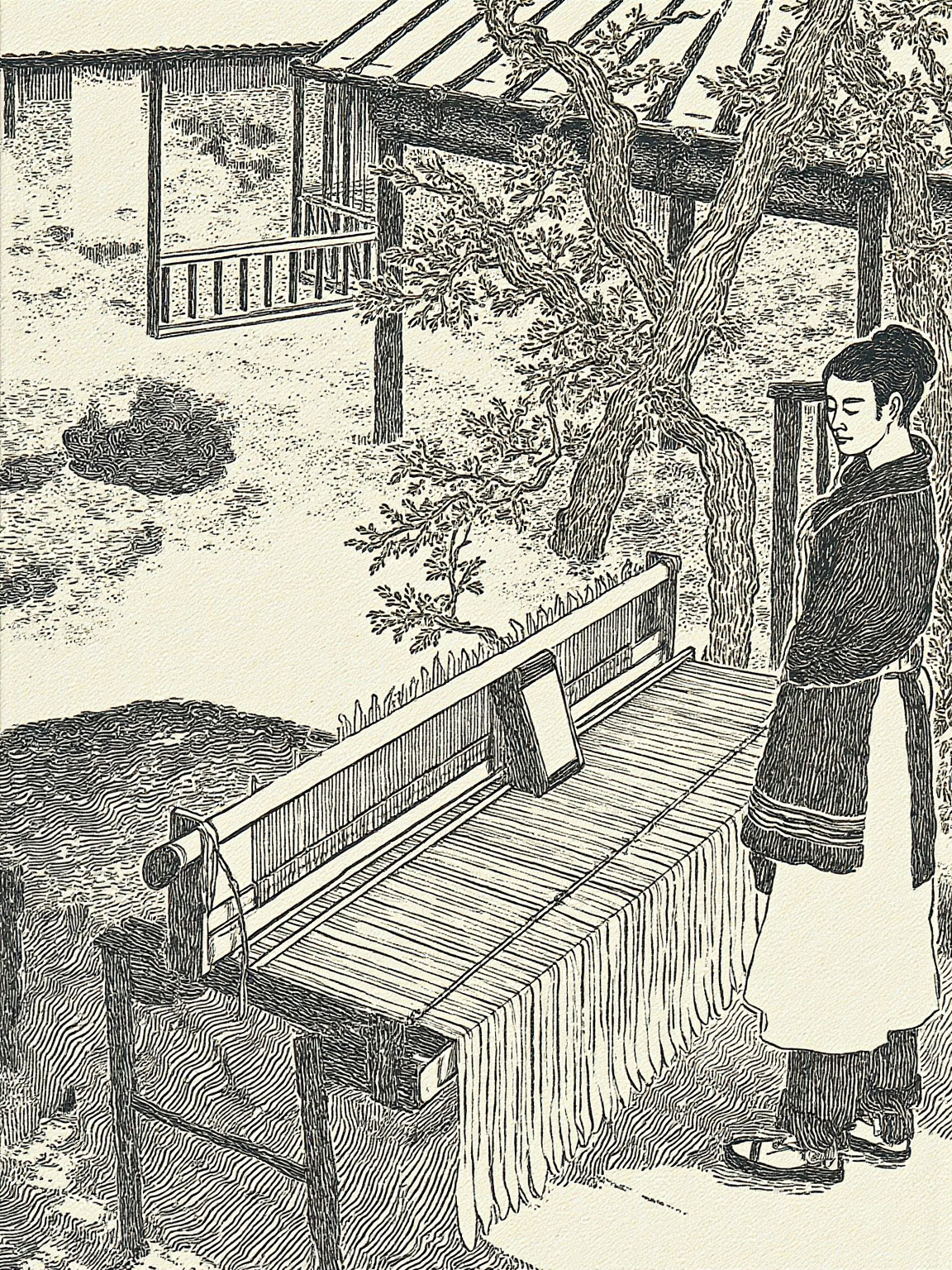
The peacock flies southeast, lingering every five li — reluctant to leave.
孔雀东南飞,五里一徘徊。
金句 · 序后起兴 · 孔雀东南飞
The opening couplet has outlived seventeen centuries: southeast the peacock flies, circling back every five li. Those two lines pin the reader in place -- even a peacock cannot bear to fly far, so how could a person? Lanzhi speaks next, introducing herself by counting from thirteen to seventeen, a new skill learned each year, married off to the Jiao family while still barely grown. She says nothing against her husband, makes no complaint, and simply lays out the facts: this is who I am, and I have worked your loom day and night, and your mother still calls me slow. What makes this speech so forceful is its composure. She does not weep, does not make a scene. She is the one who says it first: send me home.
Jiao Zhongqing is devoted, and he is weak. The moment he hears his wife is leaving, he drops to his knees before his mother: if you send this woman away today, I will never marry again as long as I live. His mother pounds the bed and drives the nail in with a single line: how dare you take her side? Do you have no eyes for me at all? This is where the poem's first real conflict shows itself -- not between husband and wife, but between mother and son, the instant a man who wants to protect his wife gets flattened by one sentence from his own mother. The first time I read this far, I stopped too. He knelt. He did not win.
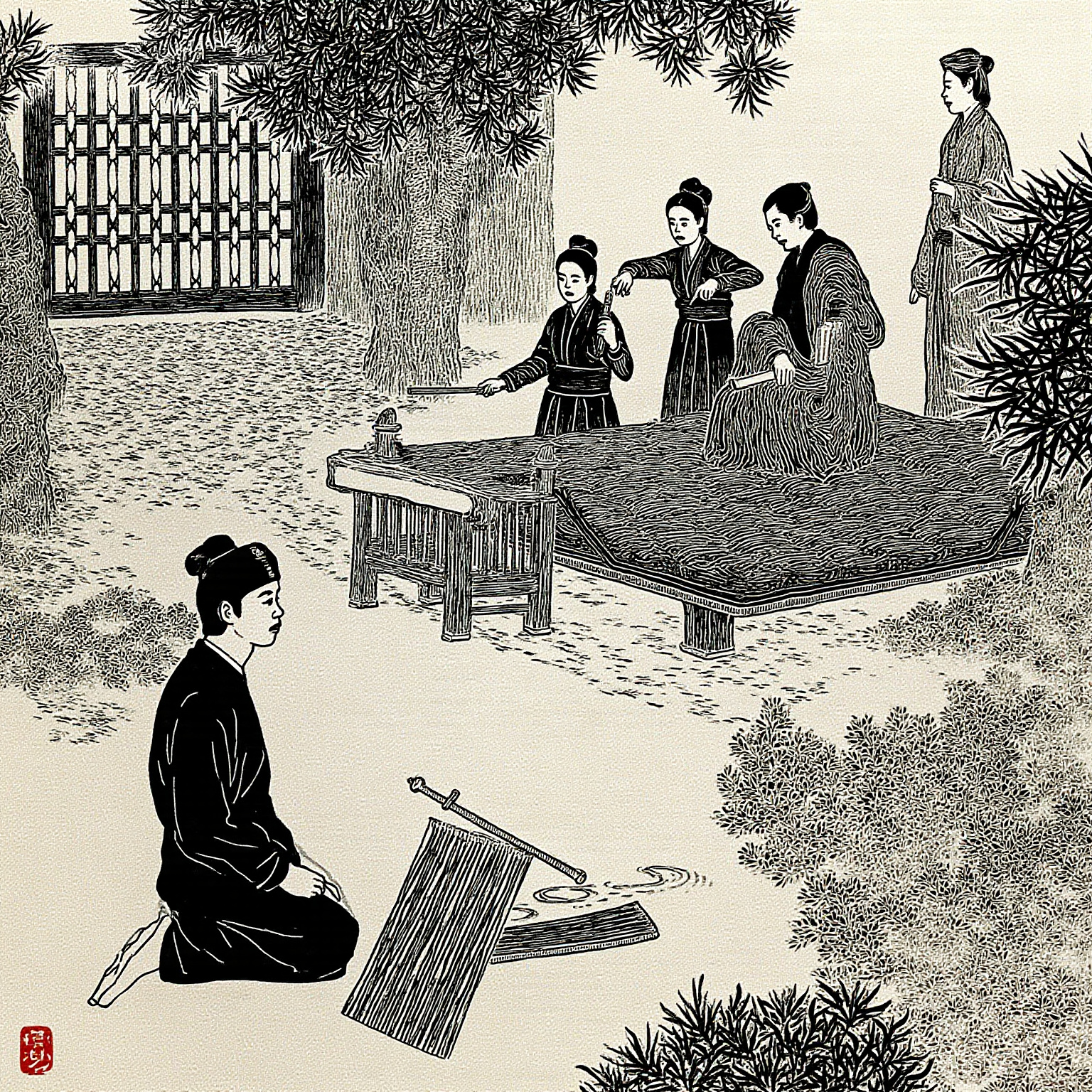
What lad so fearless, that he dares to take a woman's part!
小子无所畏,何敢助妇语!
金句 · 焦母槌床大怒 · 遣归
Zhongqing tells Lanzhi to go back to her family for now; he will return to his post, work on his mother, and come for her once she relents. Their parting is the poem's most dignified breakup, and one of Chinese literature's most heartbreaking scenes of a woman dressing for departure. Before she leaves, Lanzhi puts herself together with total care: jacket, skirt, shoes, socks, silk kerchief, nothing left undone, and goes to take her leave of her mother-in-law properly. No tears, no pleading, not one soft word. This is not a woman bowing to her mother-in-law. This is a woman closing out a marriage on her own terms, with her dignity intact. Only when she turns to say goodbye to her sister-in-law -- the one person in the entire poem who ever showed her kindness -- do the tears finally come.

I will be your wife in the next life, hand clasped, heart to heart.
蒲苇纫如丝,磐石无转移。我命绝今日,魂去尸长留。
金句 · 大道诀别 · 盟誓
Before she has been home two weeks, suitors start arriving. First the county magistrate sends someone to propose on his son's behalf; Lanzhi turns him down. Then the prefect sends his own envoy. Lanzhi tells her mother: I have already sworn I will not remarry. But her brother steps in, and five words, temper loud as thunder, are all it takes to establish exactly who he is. He is not a villain. He is an ordinary brother who treats his sister as family property: the prefect's betrothal gifts could turn the whole household's fortunes around. What she wants does not enter into it. Notice the shape of this: Jiao's mother pressing from one side, Lanzhi's brother pressing from the other. Where the two forces meet, Lanzhi is standing in the narrowest gap between them.
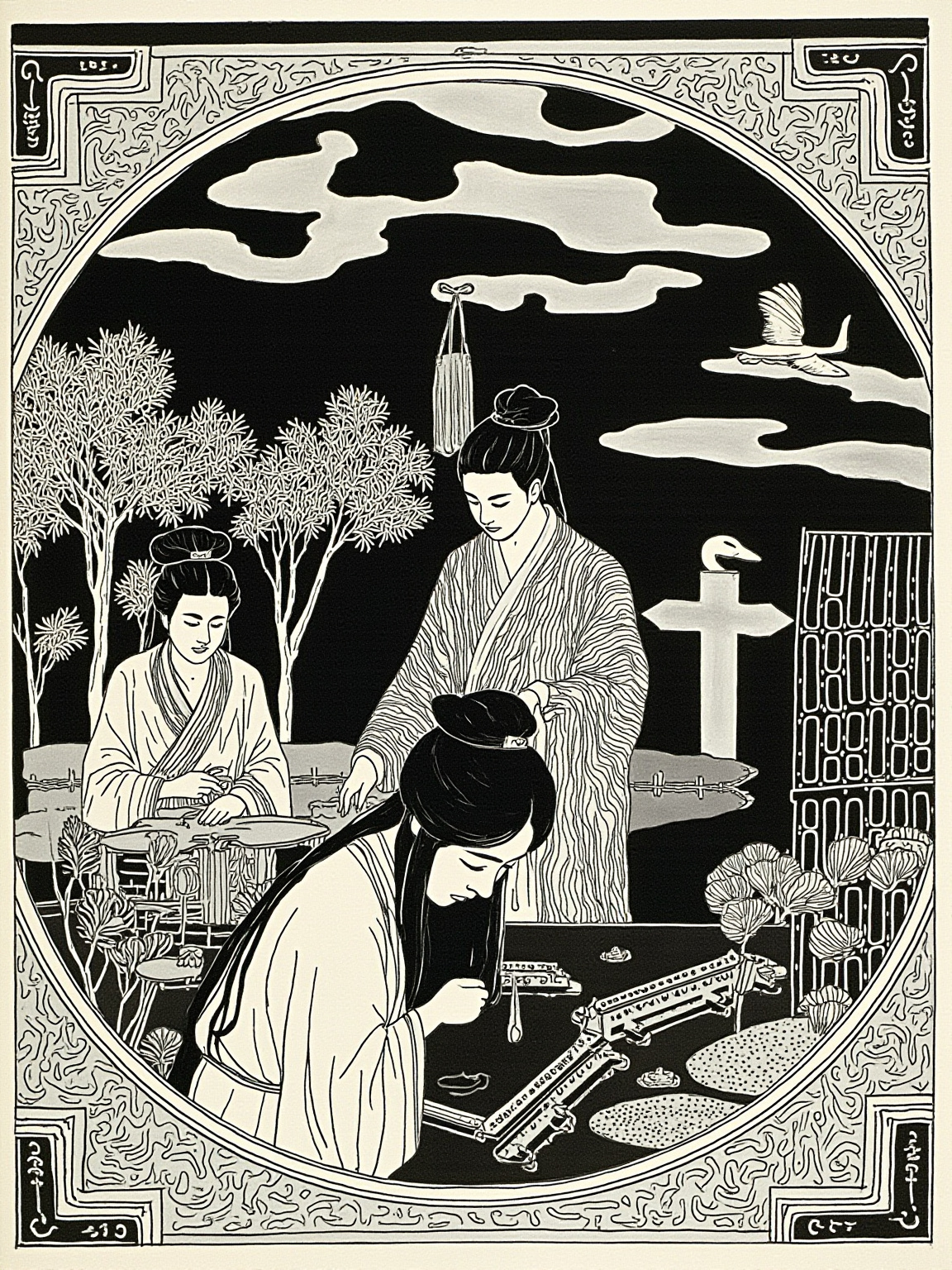
The day the wedding date is set, Zhongqing hears and comes running. With nowhere else to talk, they meet under a tree by the roadside. The poem renders this farewell with tremendous restraint -- no clutching each other in tears, no wailing at heaven. Lanzhi says: I have failed you in this life, I will marry you in the next. Zhongqing says: don't talk like that, wait for me, I'll resign my post and come for you. But each of them hears the intent to die underneath the other's words. Their parting vow -- I'll meet you at the Yellow Springs, don't break this promise -- is both a pledge and a sentence. From this line on, the ending can no longer be changed.
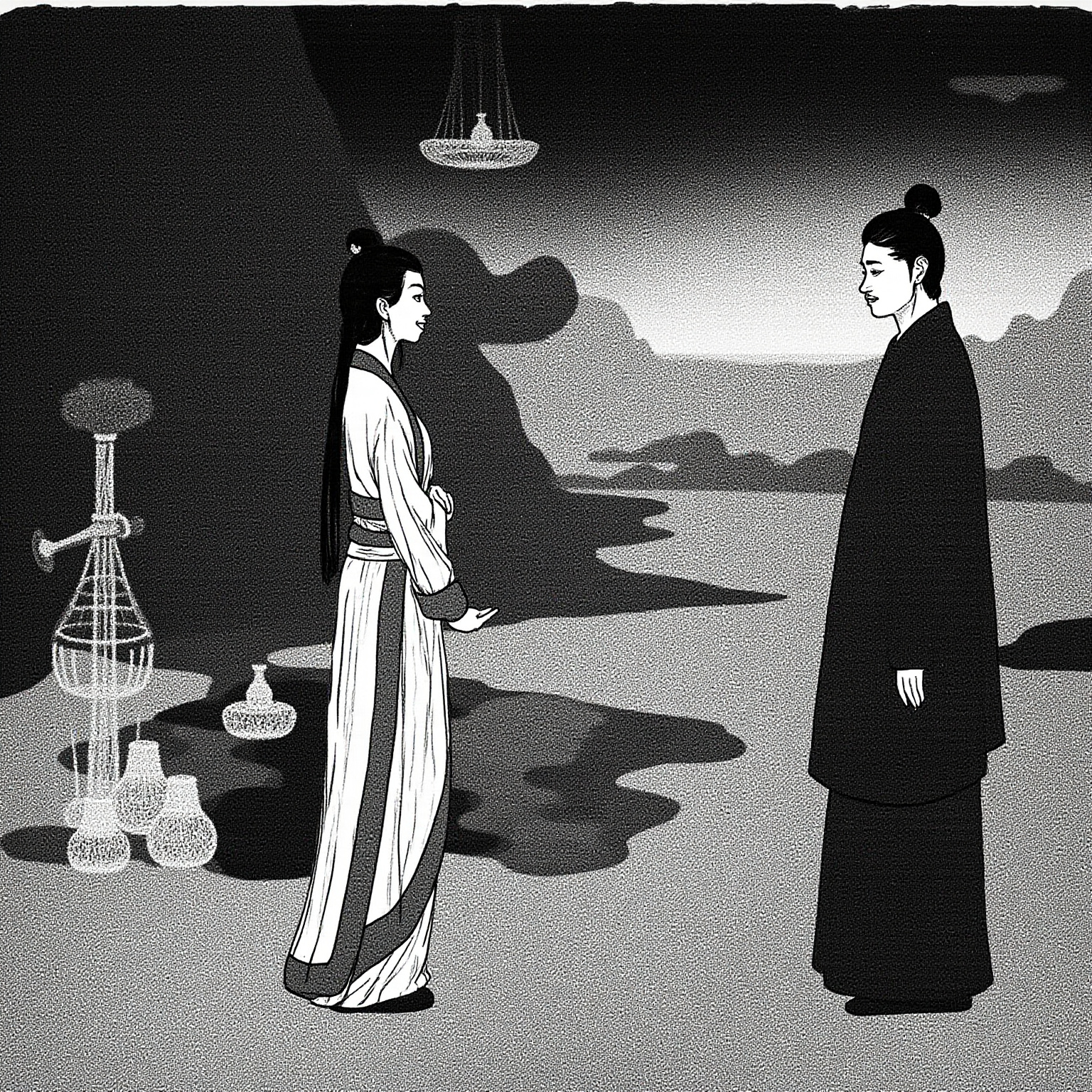
She threw her whole body into the clear pool.
举身赴清池。
金句 · 太守迎亲日 · 赴水
On the day the prefect comes for his bride, the blue-sparrow boat, the dragon-and-phoenix banners, the bridal palanquin all arrive. Lanzhi walks into her room, changes into traveling clothes, steps outside, and gives her whole body to the clear pond -- five words, one act of drowning, and a marriage is over. Zhongqing hears the news, rushes home, paces under the courtyard tree the whole night, and hangs himself from the southeast branch. Two parents thought they were tearing apart a disobedient young couple. What they actually tore apart was two lives. The poem does not linger on either death. It gives you the single action and leaves the rest for the reader to swallow.
The final passage is the breath the poem leaves the world. The two families bury their children together beside Mount Hua -- pine and cypress planted east and west, paulownia planted on either side, their branches overlapping, their leaves reaching into one another. Mandarin ducks nest on the grave and call until the fifth watch every night, and the wind sounds like someone still speaking. The poem's last line is: heed this, and never forget. A family tragedy, in the shadow of pine and paulownia, rises into a warning meant for everyone -- don't forget it, remember it, take heed.
Theme and craft
What this poem is actually about is not love -- love is only the straw that gets crushed underneath. It is about how parental authority and family interest can drive an ordinary couple to the edge and past it. When Jiao's mother calls Lanzhi ill-mannered, she means Lanzhi will not simply obey. When Lanzhi's brother forces her toward the prefect's household, he means his sister's marriage can be converted into family resources. The two forces close in from both sides, and the sharpest person caught between them cannot even find someone to cry to. Cry to her mother-in-law, an elder? Cry to her brother, the head of the family now that their father is dead?
That is why Liu Lanzhi is the earliest fully realized rebellious woman in Chinese literature. She is not an object of pity. When her mother-in-law wants her gone, she is the one who asks to be sent away. When she is forced to remarry, she is the one who chooses the pond. Every act of resistance in this poem is hers alone; no man steps in to fight it for her. Her dignity mattered to her more than her life did. Read the poem seventeen hundred years later, and the hardness and self-respect in her are not unfamiliar at all to a reader today.
What is worth studying in the craft here is not any single famous line but the counterpoint. Jiao's mother and Lanzhi's mother, one hard, one soft. Jiao's mother and Lanzhi's brother, pressing from opposite sides. Lanzhi and her sister-in-law, the only two women in the poem who show each other any kindness. Zhongqing sits in the middle of all of it, wanting to protect his wife and unable to, wanting to honor duty and unwilling to. Dream of the Red Chamber would later push this technique of setting characters in deliberate contrast to its furthest extreme, but the ballad tradition opened that door first. This poem also tells you its tragic ending up front, in the preface, then uses the opening image of the peacock to press you straight into the feeling of it -- a remarkably mature piece of narrative craft. An anonymous folk poet, seventeen hundred years ago, already knew how to control a reader's breathing.
Seventeen hundred years ago there was a woman who, driven out by her mother-in-law and sold off by her brother, never once knelt to beg anyone. Every decision was hers.
Go read the poem
A companion guide gives you a map. The poem itself is the ground. What no summary can replace is the breath of the thing across its seventeen hundred characters -- from the two lines about the peacock, to the parting where their hands linger and won't quite let go, to the restraint pulled almost unbearably tight in the five words that send her into the pond. Look again at the counterpoint: Jiao's mother and Lanzhi's mother speak as if answering each other, and Jiao's mother and Lanzhi's brother close their trap shut in perfect alignment though they never share a scene -- that kind of structural force can only be heard by reading it yourself. And there is the sister-in-law's single glance, the one woman in the whole poem allowed to be kind to Lanzhi -- her one tear outweighs every parent in the story combined. Even knowing the ending, it is worth reading, because by the last of those seventeen hundred characters you will believe it yourself: some debts are meant to be carried forever.
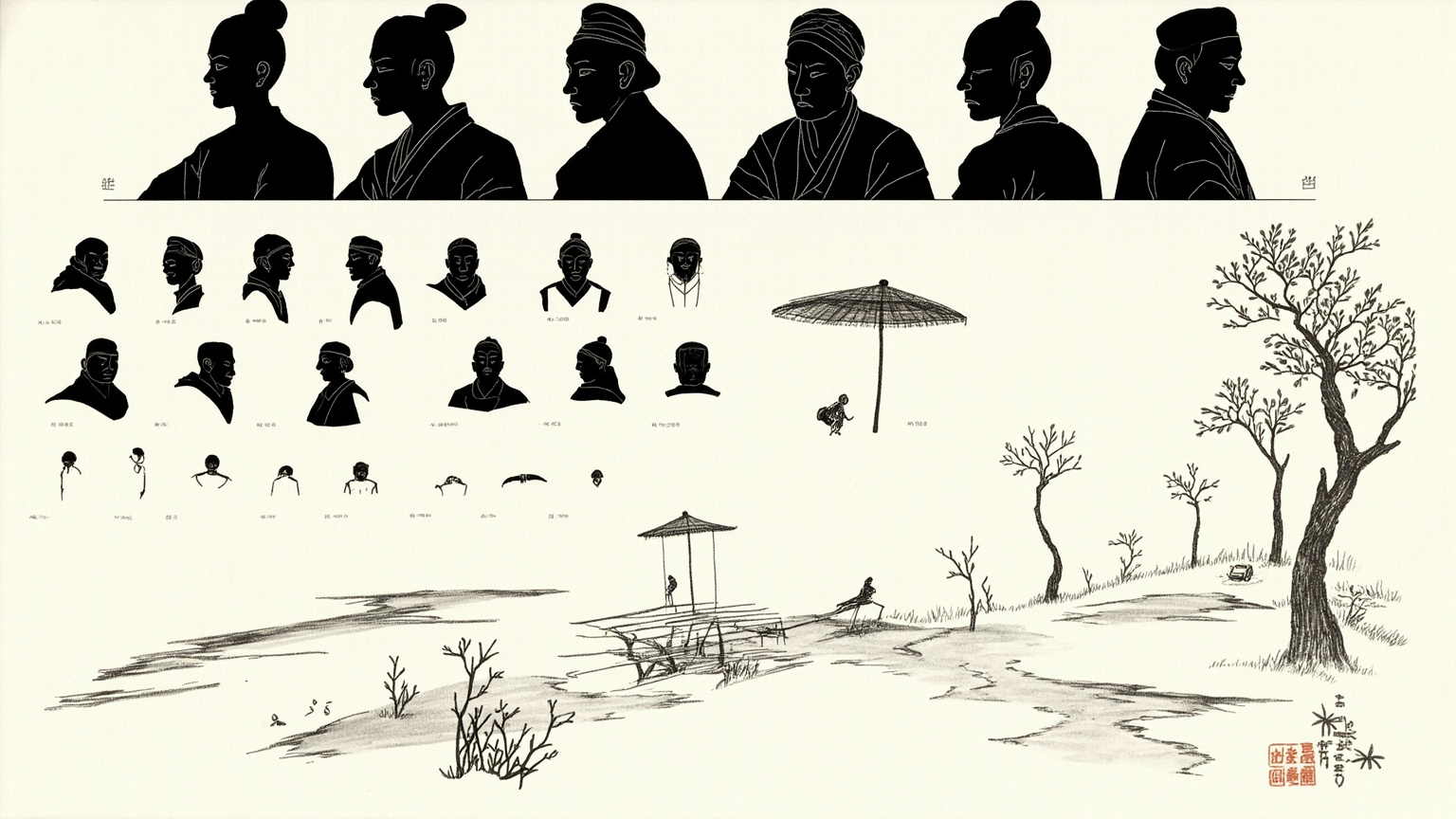
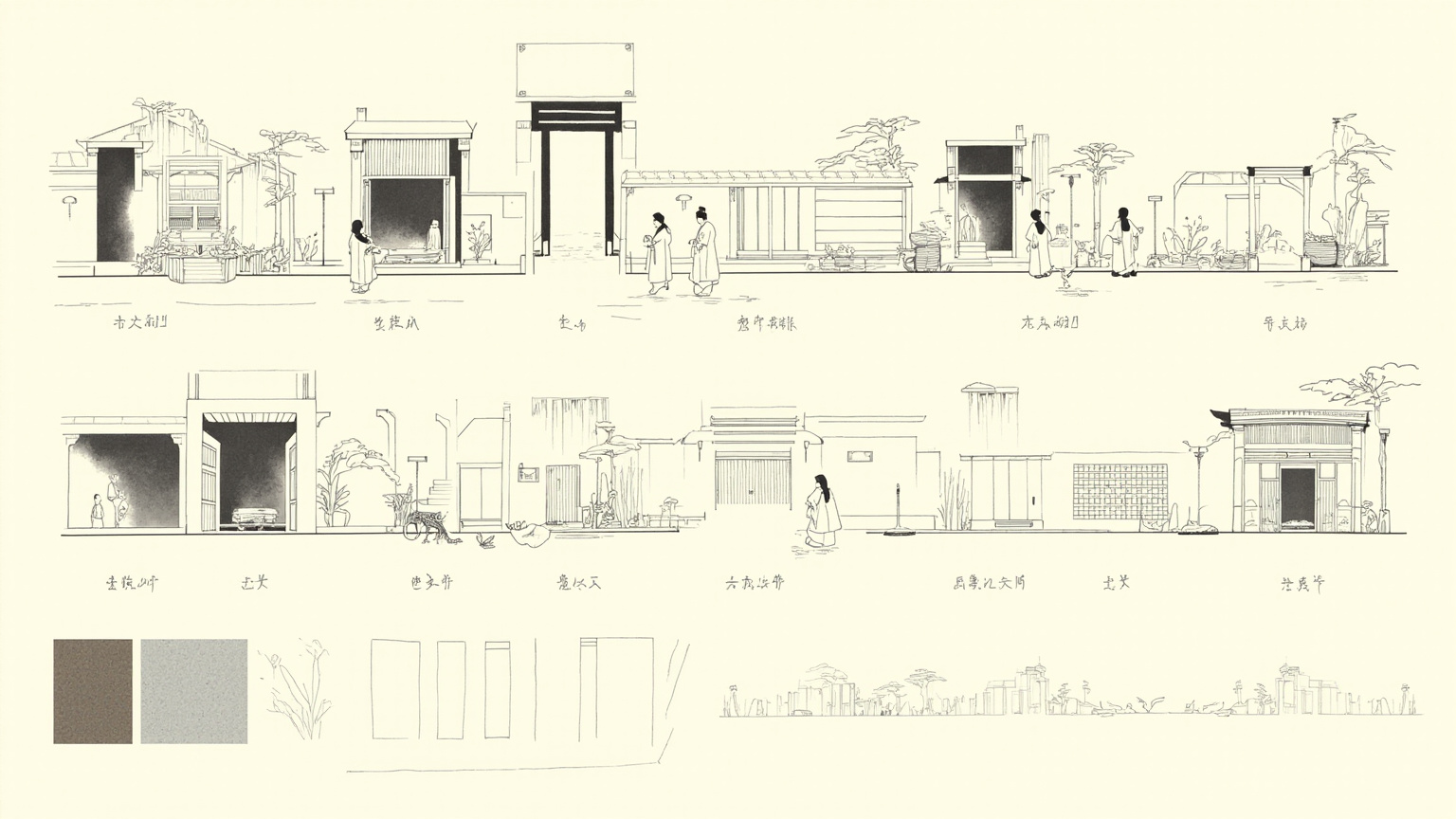
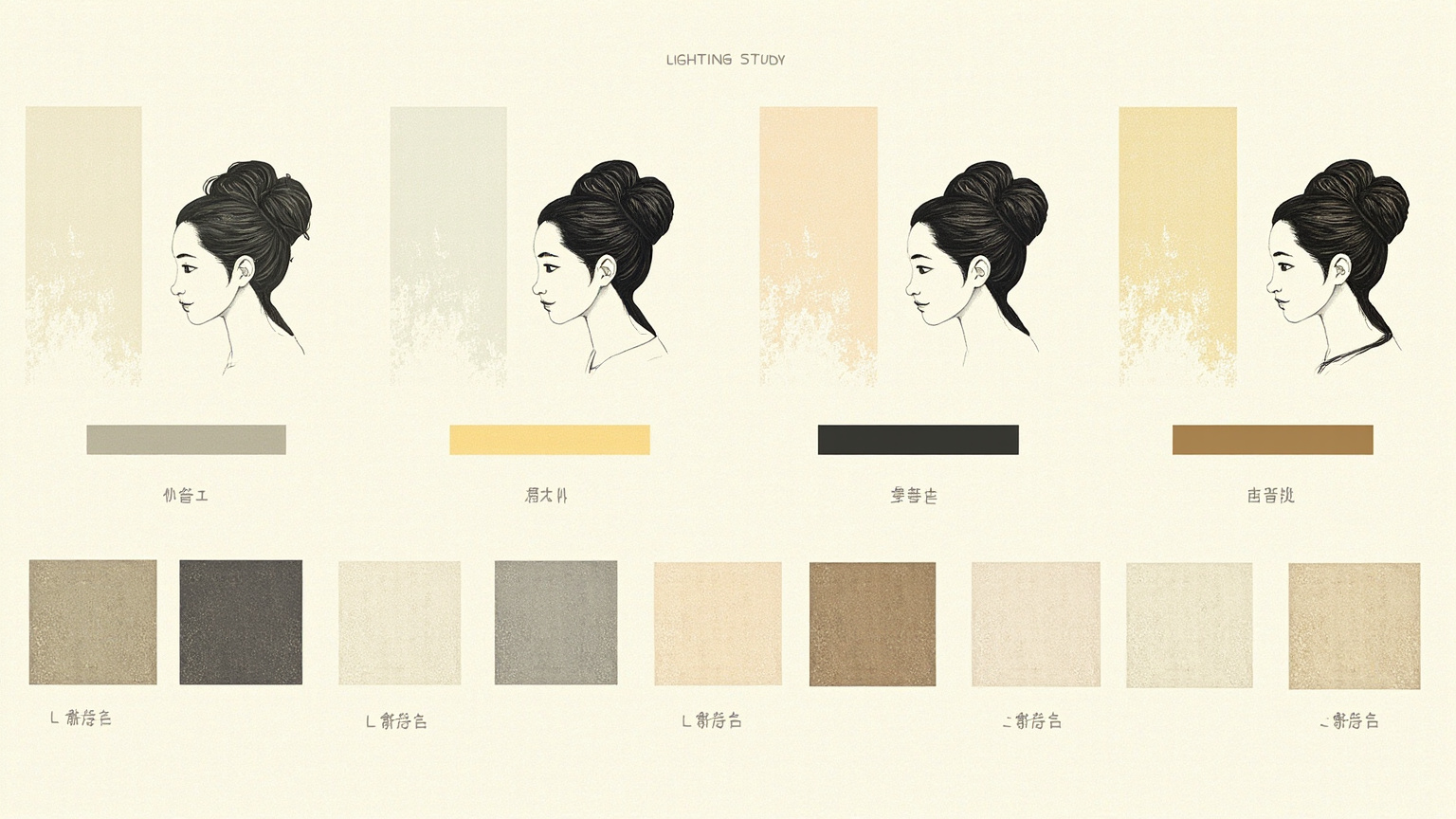
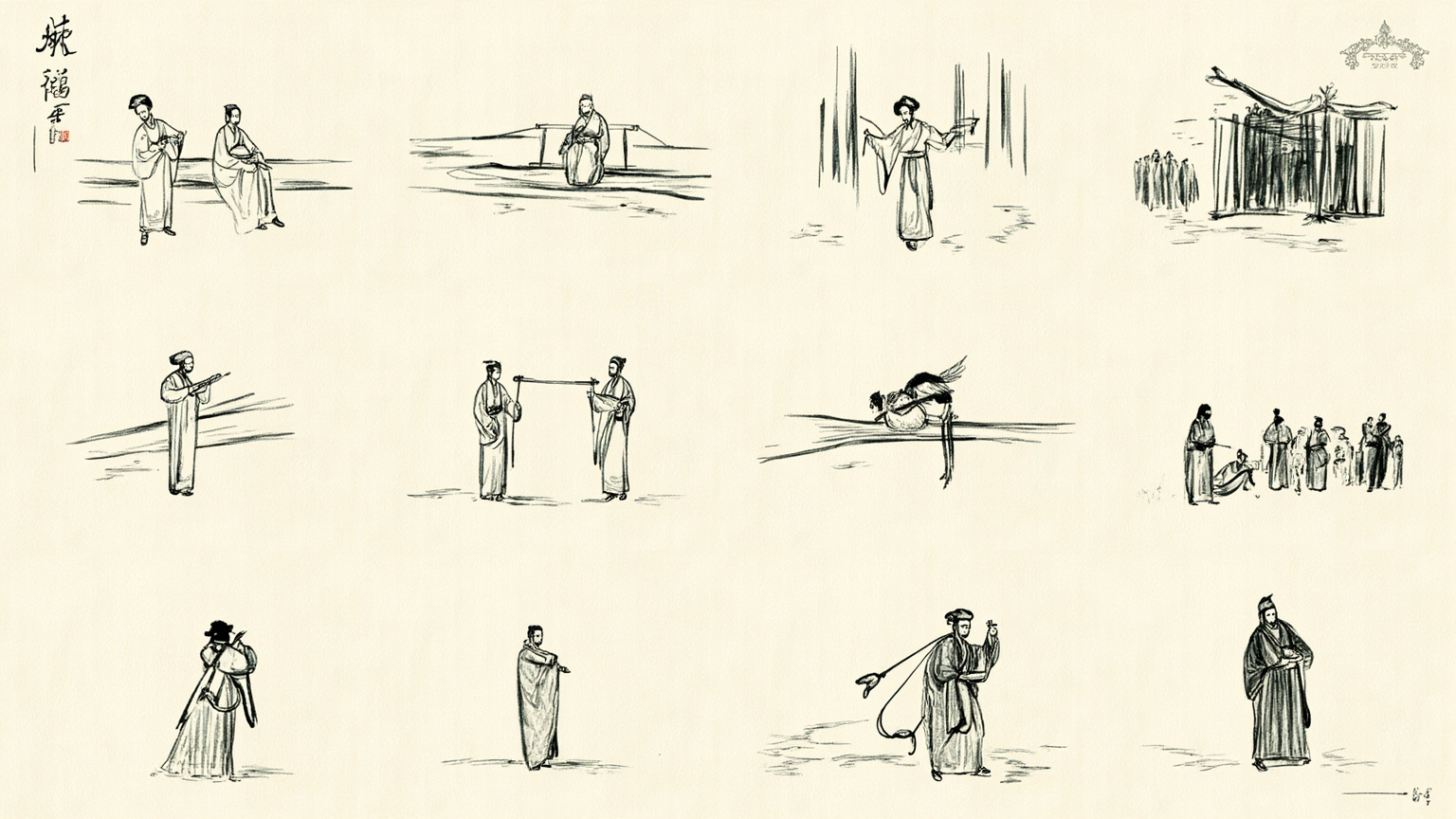
Art Direction4 plates
Before the guide was written, this book got a visual foundation — every illustration you just read grew out of it.