It sold almost nothing on its first printing in 1965. Half a century later, readers around the world rediscovered it.
Text and illustrations produced by the pipeline
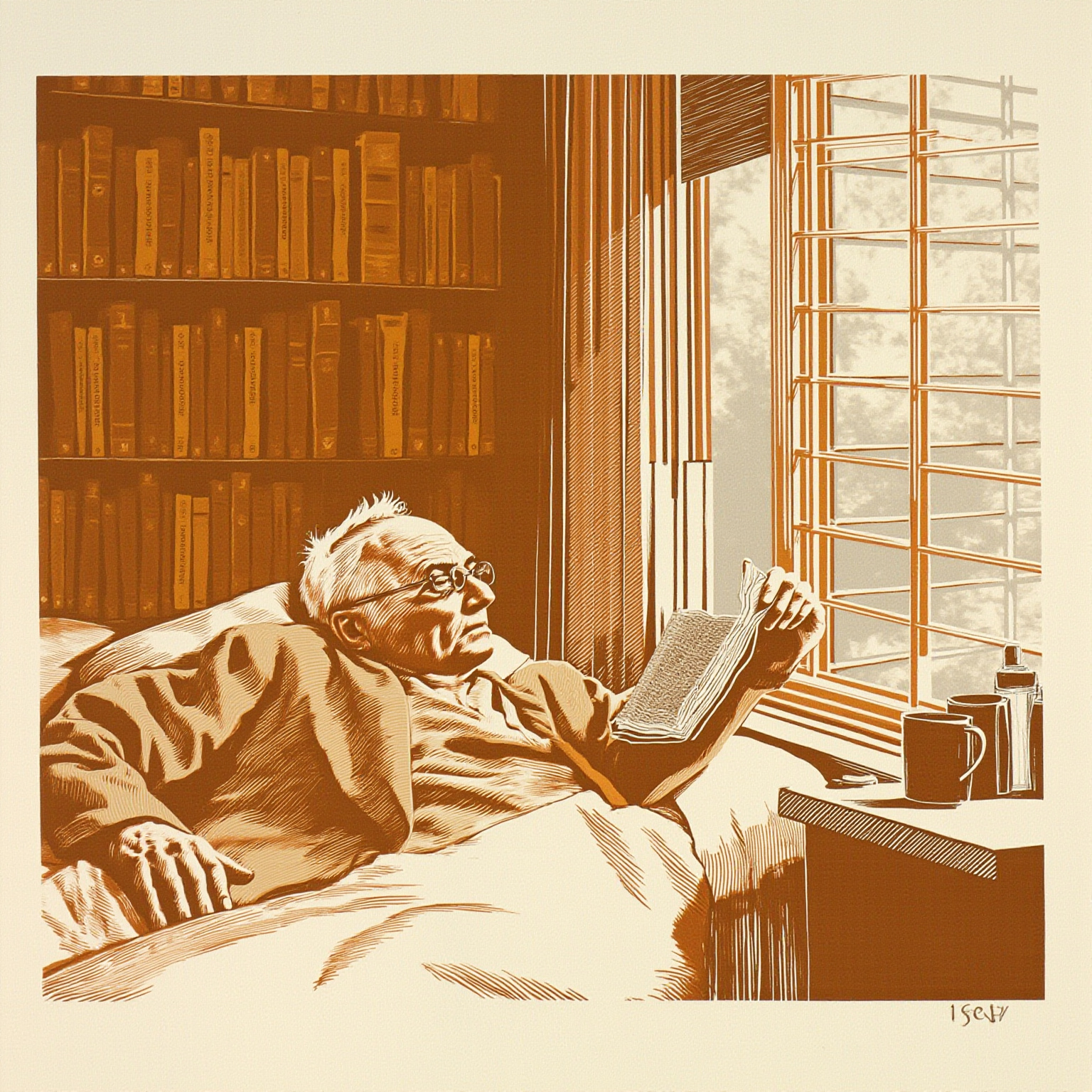
A rented apartment, the curtains half drawn. An old man lies in bed, clutching a slim academic book — one he spent half his life writing, and one almost no one ever opened. He has cancer, and not much time left. He is William Stoner, a teacher in the English department at the University of Missouri, a man in his sixties who never rose in rank, made no name for himself, lost his marriage, and drifted from his own daughter. Yet John Williams spent an entire novel — two hundred-odd pages — retelling this life in dead earnest, as if to say: even a life like this deserves to be written.
Consider me your reading companion. Ten minutes to walk through Stoner — then you can decide whether to pick up the book itself. One spoiler up front: his ending isn't tragic, and it isn't happy. He simply burns down quietly.
John Williams, an American academic novelist from the Midwest, was born in 1922 and died in 1994, leaving behind a body of work you can count on one hand. Stoner was published in 1965 to almost no notice at all, and it vanished from bookstores within the year. More than thirty years later it caught on first among readers in France and the Netherlands, then slowly burned its way back into the English-speaking world. Today it sits on countless readers' lists of the book they love most — and it has never been made into a film or a television series. There is something fitting in that: a novel that owes nothing to images, that stands entirely on its prose, came back to life purely by word of mouth.
Most of the story stays put at the University of Missouri — not an Ivy League name, but a plain Midwestern state school, its brick classrooms a little worn, its offices too cramped to turn around in. Stoner, the main character, is a poor farm boy from rural Missouri, sent off at nineteen by his parents to study agriculture, with the plan that he'd come home and take over the cattle. In a required survey course, the old professor Archer Sloane stops him cold with a single sonnet — I won't spoil exactly how — and from that day Stoner turns to literature and never goes back to the farm.
A few people around Stoner are worth knowing up front: his wife Edith, the daughter of a respectable St. Louis family, who starts regretting the marriage on their wedding night; his daughter Grace, the one soft spot in his heart as a child, gradually pried out of his arms by her mother; Katherine Driscoll, a young instructor in the department, the right person Stoner finds only in middle age; and Hollis Lomax, the department chairman with the curved spine, the adversary who haunts the second half of Stoner's life. Along with Stoner himself, that makes five people, plus a couple of friends he barely gets to keep — enough to carry the whole story.
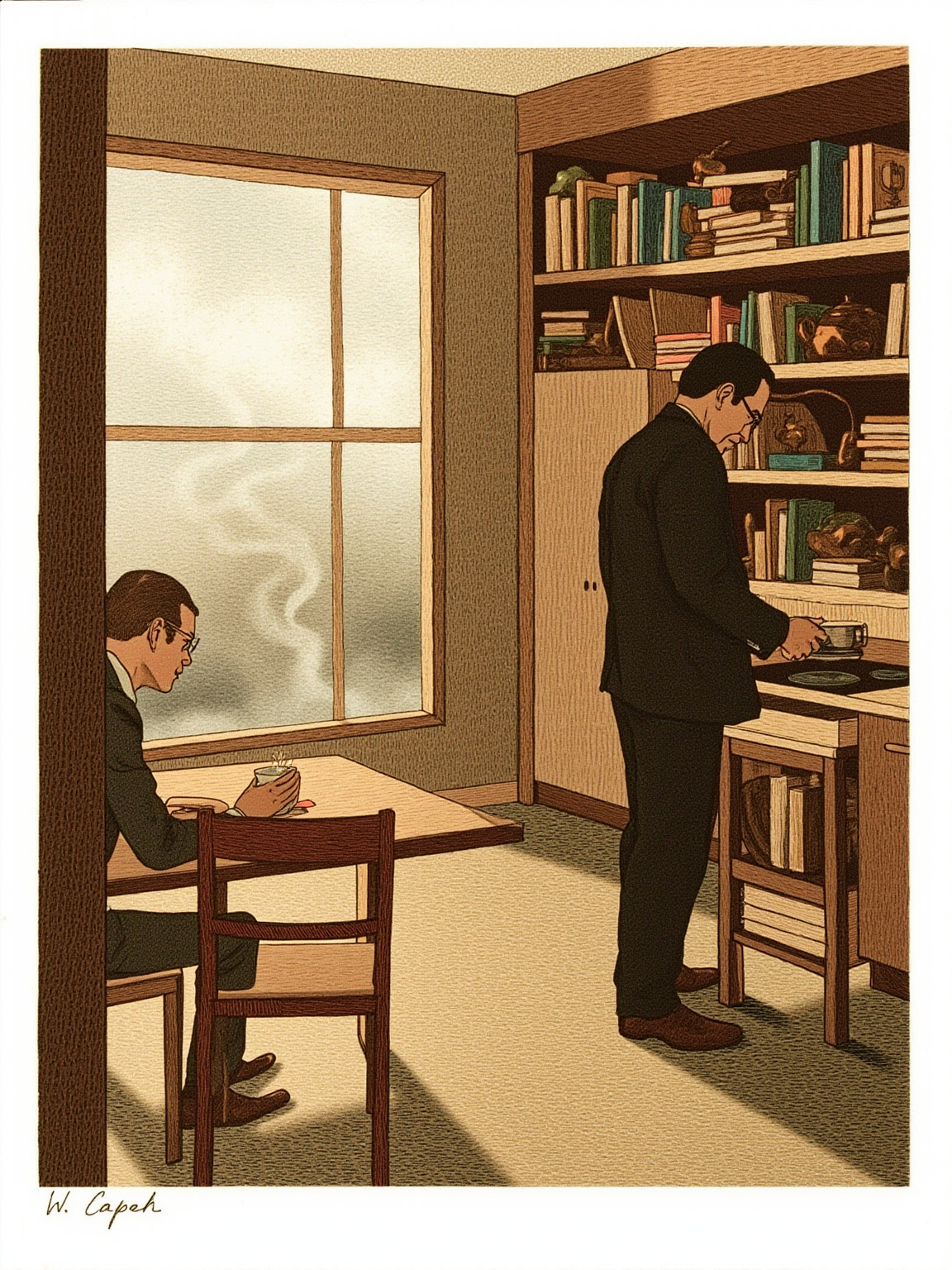
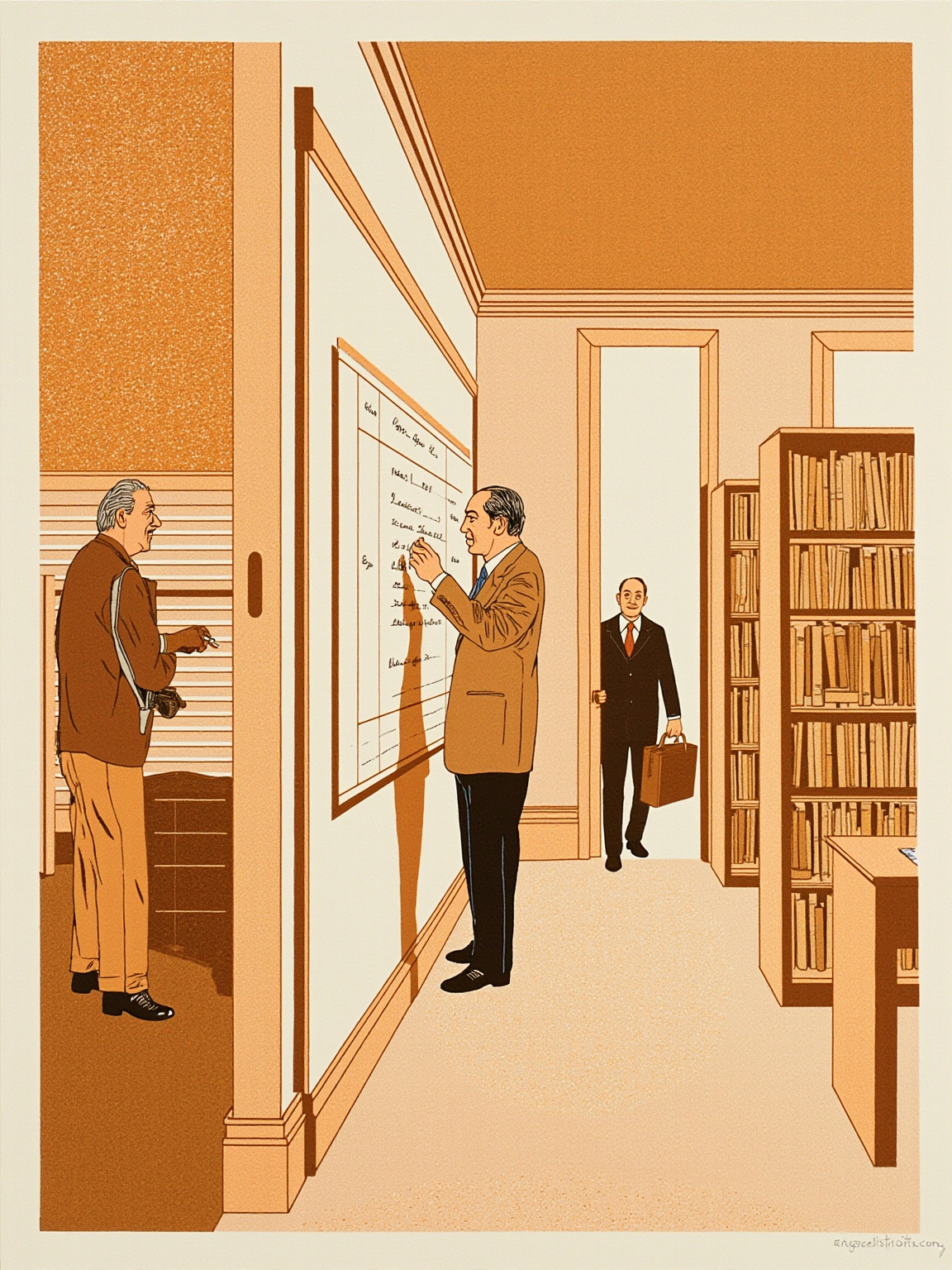
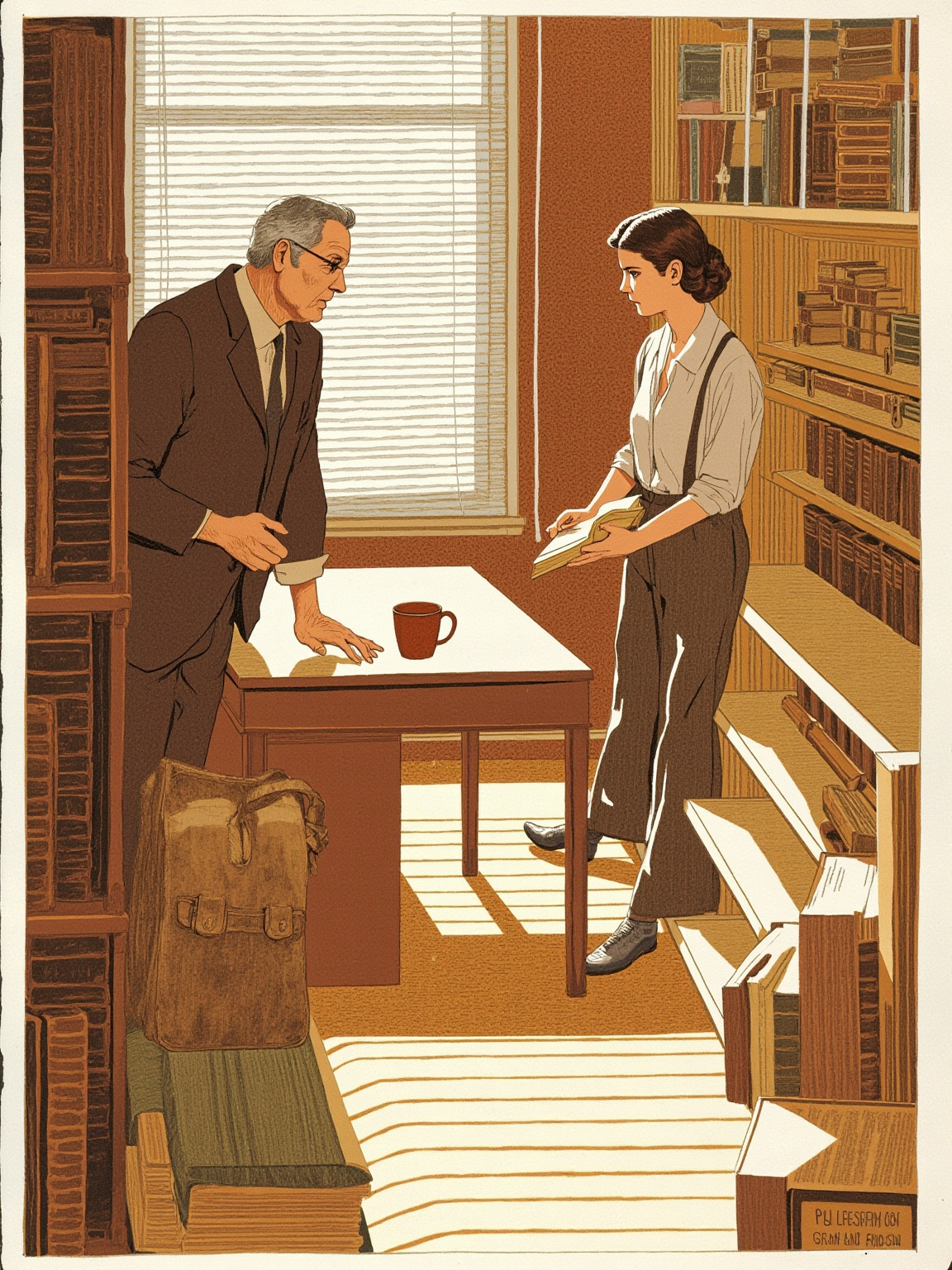
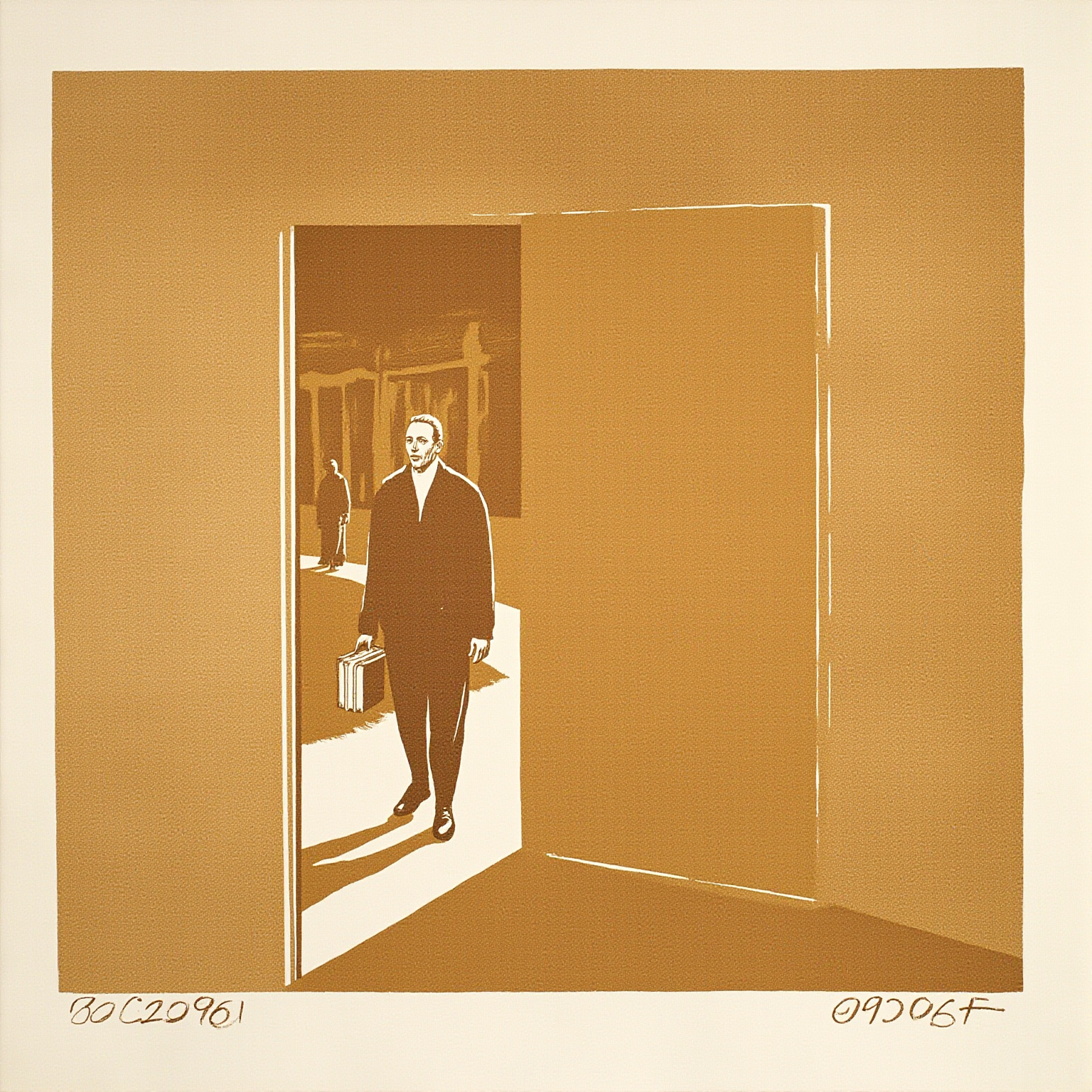
Before the guide was written, this book got a visual foundation — every illustration you just read grew out of it.

The story opens when he's nineteen. Professor Sloane reads a sonnet aloud in class and asks a question that sounds simple enough, and for the first time Stoner realizes a person could actually live on sentences like these. His parents are still waiting for him to finish his agriculture degree and come home to work the farm, but he quietly changes his mind. Williams keeps this opening light — one question, one class, one quiet jolt of current — and it sets the tone for the next forty years.
After graduating, Stoner doesn't go home to the farm, and he doesn't fight with his parents — he just quietly stays on in the department. He makes two close friends, the quick-witted Finch and the sharp-tongued Masters, and the three are inseparable on campus in the years before the war reaches Europe. When the First World War breaks out, Masters volunteers and goes to France, where he dies. Stoner chooses to stay behind and keep teaching, and from then on he carries a debt he can never quite say out loud: he lived, and his friend didn't. Williams doesn't dwell on it — he lets it pass in a line or two — and the less he says, the more it sits with you.
His proposal to Edith is the first scene that tightens your chest. They marry only weeks after meeting, and on their wedding night Edith's tears aren't happiness — they're regret. Williams condemns the whole marriage to come with a single stroke. What follows is decades of two bodies eating at the same table and turning over on opposite ends of the same bed without a word passing between them. Edith isn't a villain — she's high-strung, changeable, sorry after the fact — but the same routine plays out again and again until the house feels cold enough that no one lives there.
Grace's early childhood gives the book some of its only real warmth. Stoner comes home from work and crouches down to let his little daughter poke a finger at his chin, and there's a rare light in his eyes. But Edith notices, and she pries the child away from her father piece by piece — first she won't let him hold her at night, then she moves Grace into her own room, until Grace can no longer bring herself to call him Father. Grace grows up, marries in haste, and leaves home; by the time we see her again she is already a middle-aged woman who has done a great deal of drinking. Williams renders this father-daughter ledger with a coldness so exact that it leaves you choked up without being able to say exactly where it hurts.
A doctoral student named Charles Walker joins the department — glib, his written work a mess, but protected by department chairman Lomax. On the day of Walker's qualifying exam, Stoner fails him on principle, following his own academic conscience. What he doesn't know is that this single failing grade will be billed back to him for the rest of his career. Once Lomax holds power, he schedules Stoner into the dead afternoon slot no one wants, hands him the least desirable courses, and blocks him at every turn on the road to a promotion. The frightening part isn't any single act of revenge — it's decades of small, steady moves: no good classroom, no one reviewing his papers, students who don't sign up for his courses. Williams writes academic politics down to the bone — it doesn't run on shouting matches, it runs on attrition.
In middle age, Stoner meets Katherine Driscoll, a new instructor in the department. She's young but not shallow, and the two of them talk in his office until they become the rare kind of people who actually understand what the other is saying. Williams writes this relationship with a restraint that goes all the way down — no dizzy declarations, even the physical side of it is kept spare — and what moves you more is two clear-eyed adults sitting across a desk piled with books while the afternoon light slowly crosses the room. For Stoner, it's the first time in most of his life that he doesn't have to perform himself for anyone.
It doesn't stay secret for long. The rumor reaches Lomax, and Stoner is called into his office, where the department's "reputation" and both their "academic futures" get held up as threats — not shouted, but delivered in that needling, backhanded way. The two of them weigh it over for a night and make a decision that's heartbreaking without being melodramatic: they part quietly, Katherine leaves the university without fanfare, and no one is fired, no one dies. This is where Williams's sharpest cut lands — he doesn't hand you a grand tragedy, he shows you two decent people swallowing their tears.
The shadow of the Second World War passes overhead again, and Stoner is still standing in the same old classroom teaching the same small corner of literature — he never once changes lecterns. He holds on until the end, finishes a scholarly book almost no one reads, gets cancer, and ends up lying in that rented apartment. Williams writes his last several dozen pages like a fire slowly going out: he remembers the smell of his daughter as a baby, the afternoon light in Katherine's office, the moment Professor Sloane first stopped him cold. Before closing the book, the author doesn't give him tears turning to laughter, doesn't give him some sudden revelation — he just rests his hand on his own book and quietly stops breathing.
Stoner is really asking one question: can an ordinary life be the protagonist of a novel? Williams's answer is yes. Every stretch of Stoner's life is written as something less than impressive — he never gets promoted, can't hold onto his daughter, can't keep the person he loves — yet Williams renders every stroke of it with total precision. The novel's real nerve is that it refuses to give you an ending fit for sharing online. What sustains that nerve is Williams's restraint as a writer: he never speaks the emotion for his characters, he keeps the prose outside them, and lets action do the crying instead.
Seen from today, the book feels more relevant than ever. When everyone's résumé reads like an inspirational underdog drama, we're losing the ability to tell a story without a comeback in it. Stoner offers a different possibility: you don't have to win, but you can't afford to live carelessly. That has nothing to do with self-help success, and everything to do with whether you stay yourself.
What Stoner does is, in its own way, immense: it keeps a record, seen and taken seriously, for everyone who never won.
I've walked you through the characters and the shape of the plot, but that's exactly what this novel resists being told out loud — its power builds up, page by page. Only by turning through it yourself do you see how Williams repeats a single gesture twice to devastating effect, or buries half a lifetime in one unfinished line of dialogue. That afternoon light in Katherine's office only lands if you've actually walked through the pages where it appears. The spoiler tells you he loses. The book itself tells you how he loses — with dignity, and without ever quite making peace with it. That's exactly why knowing the plot makes this book worth reading more, not less.