Opening: Under a Beach Umbrella at Villa Diana, Dick Is Already on His Way Out
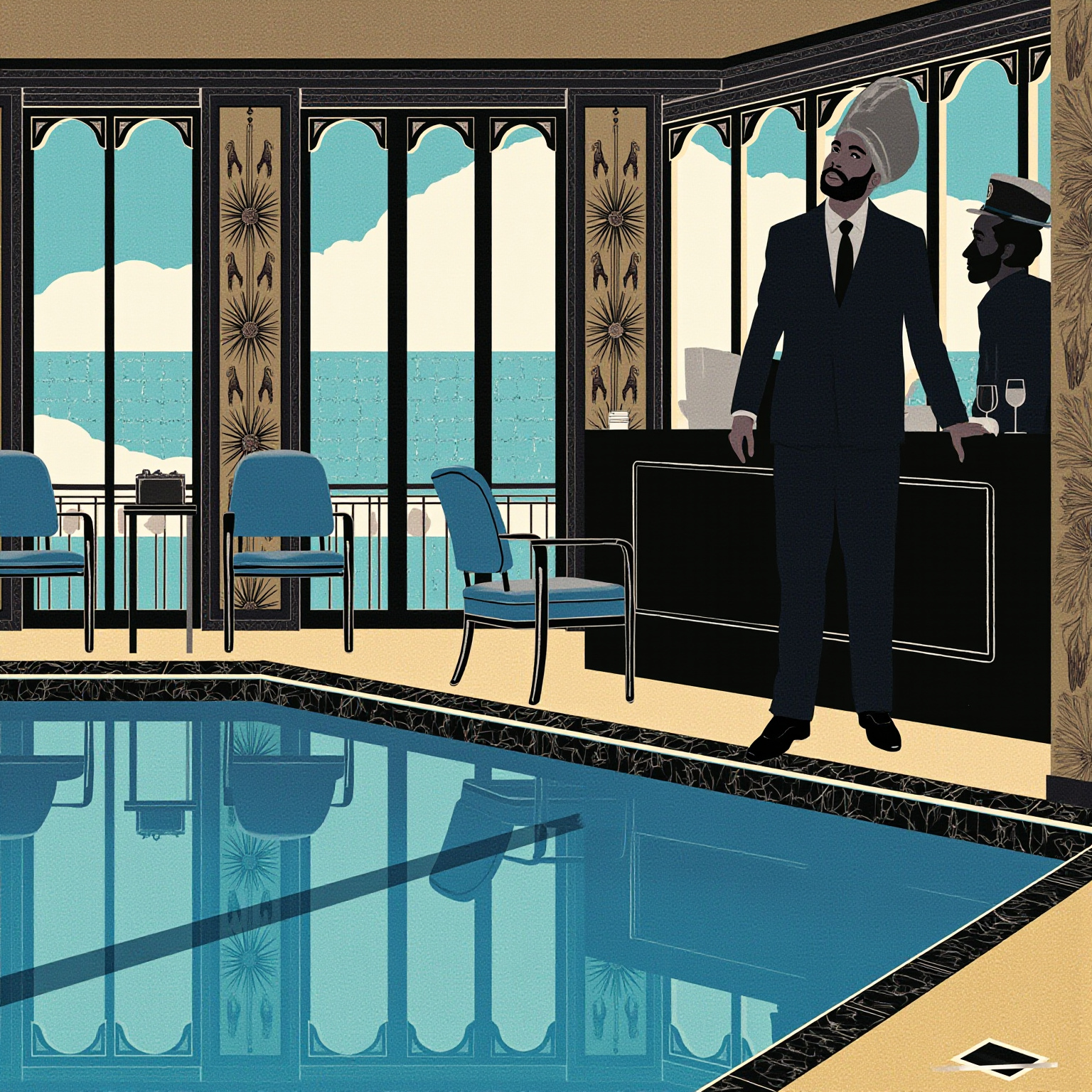
A red-and-white striped beach umbrella stands open on the south coast of France, and the man beneath it has just been laughing — laughing hard enough that the whole table raised their glasses with him. A few years later, that same Dick Diver will carry a battered suitcase alone into a hotel in some small town in upstate New York that nobody has heard of. The umbrella is still standing on that beach. The man is gone.
Tender Is the Night is about everything in between: how a man gets from under that umbrella to that small street.
What Kind of Book This Is
In 1934, F. Scott Fitzgerald delivered his longest novel, and the one that least sounds like him. The title comes from Keats — "tender is the night," a line of farewell from "Ode to a Nightingale." It ran as a serial in Scribner's Magazine before it came out as a book.
His previous novel, The Great Gatsby, is about a man clawing his way up. This one is about a man being pulled down, inch by inch, by his own hand. Put the two together and you get a matched pair of American silhouettes from the 1920s: the one who climbed, and the one who sank.
Characters and World: A Few Faces from the Golden Circle
Dick Diver, an American, was the young psychiatrist everyone expected great things from. At a lakeside clinic in Zurich, he took on a patient from America — Nicole Warren, heiress to the wealthy Warren family of Chicago. The roots of her breakdown were buried inside her own family, but he cured her, and he fell in love with her. The marriage began there, except the doctor-and-patient relationship never really ended.
After the wedding they settled at Villa Diana on the French Riviera, near Cap d'Antibes outside Cannes. On charm and sheer force of mind, Dick gathered the wealthy Americans around him into a nearly perfect summer circle: the beach, the cocktails, the talk that ran late into the night by the water. They gave it a name: the Golden Circle. Two regulars stood out in it: Abe North, a composer who drank too much, and Tommy Barban, a mercenary soldier who spent his years fighting other people's wars. One sinking, one rising, with Dick caught squarely between them.
Tender Is the Night is a novel about being hollowed out. Nobody knocks Dick down with a single blow — he's drained, slowly, by his own generosity, his own charm, his own instinct to heal. That structure was still new in 1934; looking back now, you can see how many later stories about the slow slide of the comfortable elite are, underneath it all, lifted from this one book.
There's a deeper layer underneath, and it's money. The Warren family's fortune is what cures Nicole, and it's also what quietly turns Dick into a kept man, watched over with a cold eye by Nicole's sister, Baby Warren. The true head of this marriage was never the doctor. It was capital, Fitzgerald's cold blade aimed straight at 1920s America.
There's also a structural move here that runs against expectation: Dick's story only fills the first half of the novel. In the second half, Fitzgerald hands the spotlight to Nicole — she grows stronger, the prose starts following her instead, and by the time the reader notices, the protagonist has already changed. Fitzgerald never announces the switch; he just moves the pen a little at a time. That quiet handover of the lead is itself the hardest thing about this book to pull off, and the thing most worth sitting with.
Art Direction4 plates
Before the guide was written, this book got a visual foundation — every illustration you just read grew out of it.
The Plot: How the Man Under the Umbrella Was Emptied Out, Step by Step
One: The Meeting by the Lake in Zurich
The story opens at a psychiatric clinic by the lake in Zurich. Young Dick Diver works there with his whole future ahead of him — colleagues say he could win a Nobel someday. There he meets a young American patient, Nicole Warren: pale, her eyes unable to hold still, sent by her family in Chicago to be treated. Dick takes her case.
He cures her. One thing leads to another, and they fall in love and marry. To everyone on the outside, it looks like the perfect match of a brilliant doctor and an heiress. Only Dick knows the truth: from the first day, he has been giving this woman a transfusion, handing over his own stability, his own will, his own psychological reserves, a little at a time. The marriage isn't built on romance. It's built on treatment.
Two: The Golden Summers at Villa Diana
A few years into the marriage, the couple moves to Villa Diana on the French Riviera. Dick no longer gives his transfusions to Nicole alone — he spends the same energy on everyone in the circle who needs it: rescuing an awkward guest at dinner, walking a drunk old friend back to his room, saying a few words to some young woman new to the beach that she'll remember for the rest of her life. He is the sun this crowd orbits.
Everyone around him thinks this is Dick at his best. The trouble is, even a sun can go cold.
Three: The Eighteen-Year-Old Who Walks In
In the summer of 1925, an eighteen-year-old Hollywood actress named Rosemary Hoyt arrives on this beach. She's just become famous for a film called Daddy's Girl, and she still carries that untouched, unworldly cleanliness of a girl fresh out of Los Angeles. She's captivated by the Divers' circle, Dick above all. The way she looks at him is close to worship.
I stopped short the first time I read this: an adult man, lit up by an eighteen-year-old's adoration, isn't that already dangerous on its own? Dick drifts into a murky, half-crossed line, telling himself at first that this is just some last flicker of youth. The real cost is quieter: his moral footing starts to shift without anyone noticing, and the glass in his hand grows harder and harder to hold steady.
Four: Abe's Dress Rehearsal
The first person in the circle to collapse isn't Dick — it's Abe North, the composer. Abe is enormously talented and drinks like it's his job; a drunken incident in Paris drags him into some kind of scandal. Fitzgerald never spells out the details, he just lets the reader feel that Abe's orbit has already come loose. Later, Abe is beaten to death in a New York speakeasy.
Abe's death works like a mirror set up in advance: he runs the whole course of the fall before Dick does.
Five: The Partner Walks Away
ImaRead3
Years after leaving Zurich, Dick partners with a former colleague, Franz Gregorovius, to open a private clinic in Switzerland. This is the other leg his career stands on — once the summer glow of the circle fades, the clinic is what actually holds up his identity.
But Dick's drinking keeps slipping further out of control. After one embarrassment too many, Franz finally has enough, and the partnership falls apart. The last professional support under Dick gives way.
Six: The Transfusion Finally Runs the Other Way
By this point in the story comes the twist that runs against everything you'd expect: Nicole gets better.
She owes her present self to the cure Dick gave her long ago; now she's strong, independent, and no longer needs him as her psychological crutch. And Dick, the man who has been giving the transfusions all along, becomes the one being drained instead. Somewhere in the quietest part of the marriage, the direction of giving and taking has reversed itself.
Seven: Tommy Barban Takes Nicole Away
Nicole falls for another familiar face from the circle — Tommy Barban, the mercenary soldier. Tommy has spent years leading men into battle, and he's blunt and hardened in a way that has nothing to do with Dick's polish. In the end, Nicole decides to leave Dick and go with Tommy.
The psychological cord holding the marriage together is cut in one stroke.
Eight: Drifting Back to America, a Name That Fades
Dick returns to America alone. There's no dramatic breakdown, no final explosion — he just picks up his bags and drifts from one small town in upstate New York to the next, each one smaller and more anonymous than the last, practicing medicine wherever he lands. From the brightest star on the Riviera to a name nobody remembers, there's no single frame you could freeze as the moment of goodbye.
This is where Fitzgerald shows his hand: he doesn't kill Dick off, and he doesn't drive him mad. He lets him fade. The umbrella is still standing on the beach. The chair under it is just empty now.
Theme and Craft: Being Hollowed Out Is Harder to Write Than Being Broken
ImaRead4
The Great Gatsby is about how a man climbs. Tender Is the Night is about how the same man, or the same generation, is slowly drained by himself. The umbrella is still standing on the beach. The man is long gone.
Go Read the Novel: A Map Is Not the Land
A companion piece like this one can give you a map: here's Zurich, here's the Riviera, here's how Dick gets emptied out, step by step. A map can do that much.
What a map can't give you is Fitzgerald's sentences. This book writes the sea, writes the drinking, writes that particular tired feeling of who goes up to bed first after a party breaks up at night, and all of it carries a temperature that's already starting to cool — what he does with a sentence, nobody else can do for you secondhand. The pages where Rosemary first sees the Divers from a distance on the beach, the morning Dick realizes he hasn't truly laughed in a long time, those are places you have to read for yourself.
It actually helps to already know how it ends. You'll catch some flicker crossing the face of the man under the umbrella before it happens, and then, a page later, suddenly understand what it was. That particular tragic feeling, I already knew this was coming, is something no summary can give you.