The Call of the Wild · Companion Guide
The Call of the Wild
A hundred-and-forty-pound estate dog is kidnapped into the Yukon's world of club and fang—civilization stripped off him like clothing, layer by layer, until a call at the edge of the snowbound forest leads him all the way back to the wolf pack.
The opening: the instant the club comes down
A hundred-and-forty-pound dog dozes on the estate lawn, fattened on good food, ridden by children, treated by the judge's family as a huge, breathing stuffed toy. Then one night a stranger's hand closes around its neck, and right behind it comes a club — falling out of nowhere, with no argument to make. It lunges, it bites, it gets beaten down, gets up, gets beaten down again, until it tastes its own blood and learns the first lesson: in this other world there is no sofa, no food bowl, only the law of club and fang. That is where the dog at the start of The Call of the Wild stands — its civilization stripped off it, one blow at a time, from that first club onward.
What kind of book this is: a small miracle of an atavistic epic
The Call of the Wild is a short novel Jack London wrote at the turn of the twentieth century. It is thin and taut, but it drives one big question all the way through: when an environment turns brutal enough, how fast does the shell called civilization come off a living creature? London had gone north himself to hunt for gold, and he packed everything he had lived through — the ice fields, the mail trails, the law of the dog pack — into this one dog's bones. So the book works both as an adventure story and as a naturalist's fable: the North keeps no morals, only a ledger of who can outlast whom. It went on to become one of the unavoidable books of American wilderness literature, standing at a distance across from Melville's Moby-Dick.
People and world: the whole longitude from the estate to the Yukon
The world of the story is built from two poles. One is California's Santa Clara Valley, with the judge's estate, sun-warmed wooden porches, and a pampered giant of a dog named Buck, part St. Bernard, part sheepdog. The other is the frozen wilderness where the Yukon meets Alaska, where the gold rush made a strong dog worth more than gold — dogs bought to haul sledges up the mail trails, where the only rule is that whoever cannot earn its food goes hungry, gets beaten, or gets killed by its own kind. The law of that world is the one London keeps naming: the law of club and fang — the strong eat, the weak go under, and there is no third option.
The people split into two poles too. On one side ride the various masters who pass over Buck's back — from the gardener who steals him and sells him into it, to the French-Canadian mail drivers François and Perrault who drop him into the North's hard labor, to the American gold-seekers Hal, Charles, and Mercedes, who nearly torture him to death. Most of these come and go — different ways of carving the same word, master. On the other side are the real characters: Spitz, the original lead dog of the sled team, a white husky who becomes Buck's mortal enemy, and John Thornton, who pulls a half-dead Buck out from under the club on the bank of the White River and becomes the last, and only, person who truly loves him — the last thread still tying Buck to the human world.
The plot line: seven beats that drive a house dog into a wolf
Beat one, that opening blow. A man in a red sweater pins Buck to the ground and teaches him, with a heavy club, a single fact: a man can kill you whenever he likes, and fighting back only makes it slower. This is not cruelty for its own sake — it is the North's first lesson: civilization's contract is void up here. In the writing, London deliberately stays inside what Buck understands in his own mind, without human speech or sentiment, letting him accept defeat blow by blow, the way a real animal would.
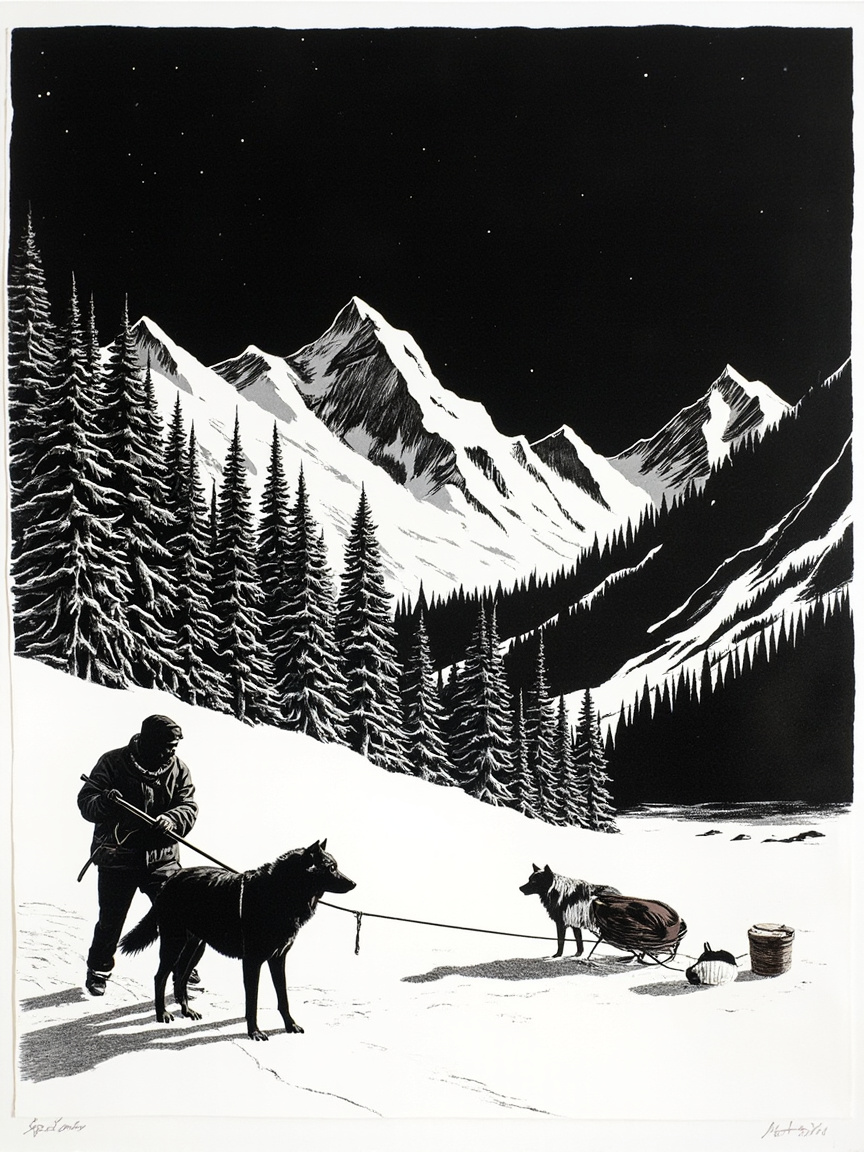
a man with a club was a lawgiver, a master to be obeyed
手持大棒的人,就是立法者,是必须服从的主人。
Original line · Chapter II · The man in the red sweater's club, the North's first lesson
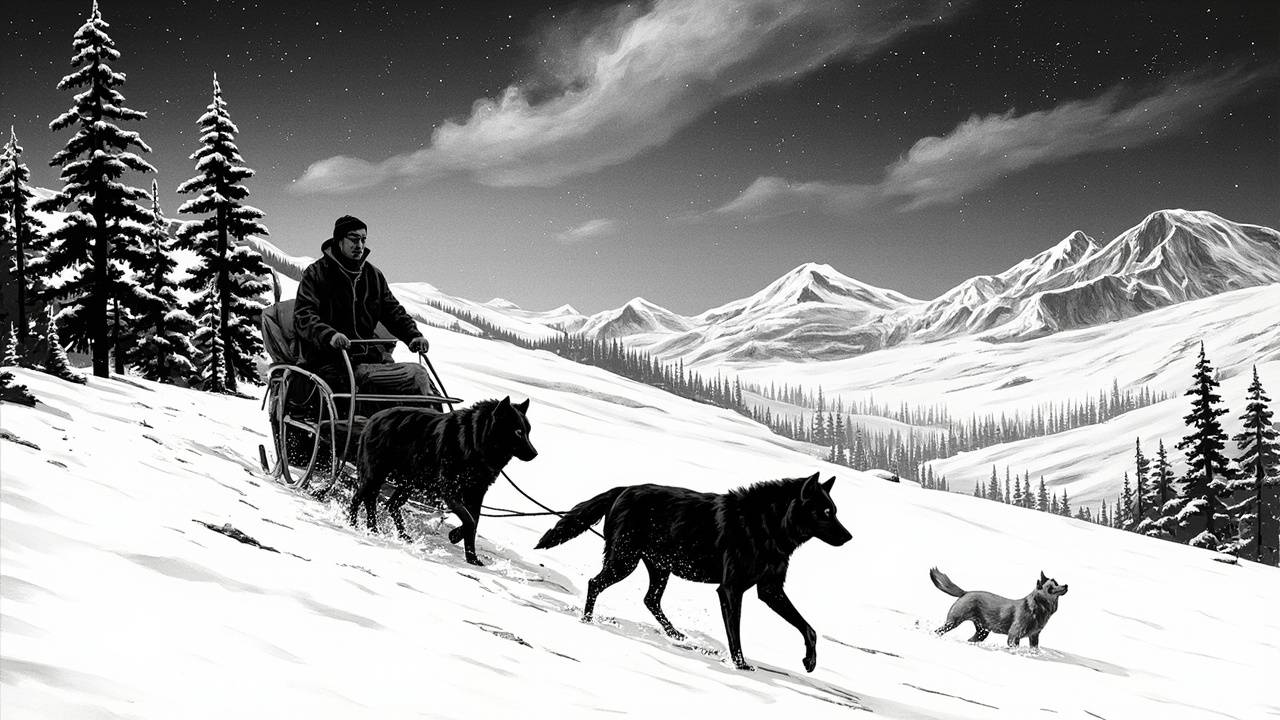
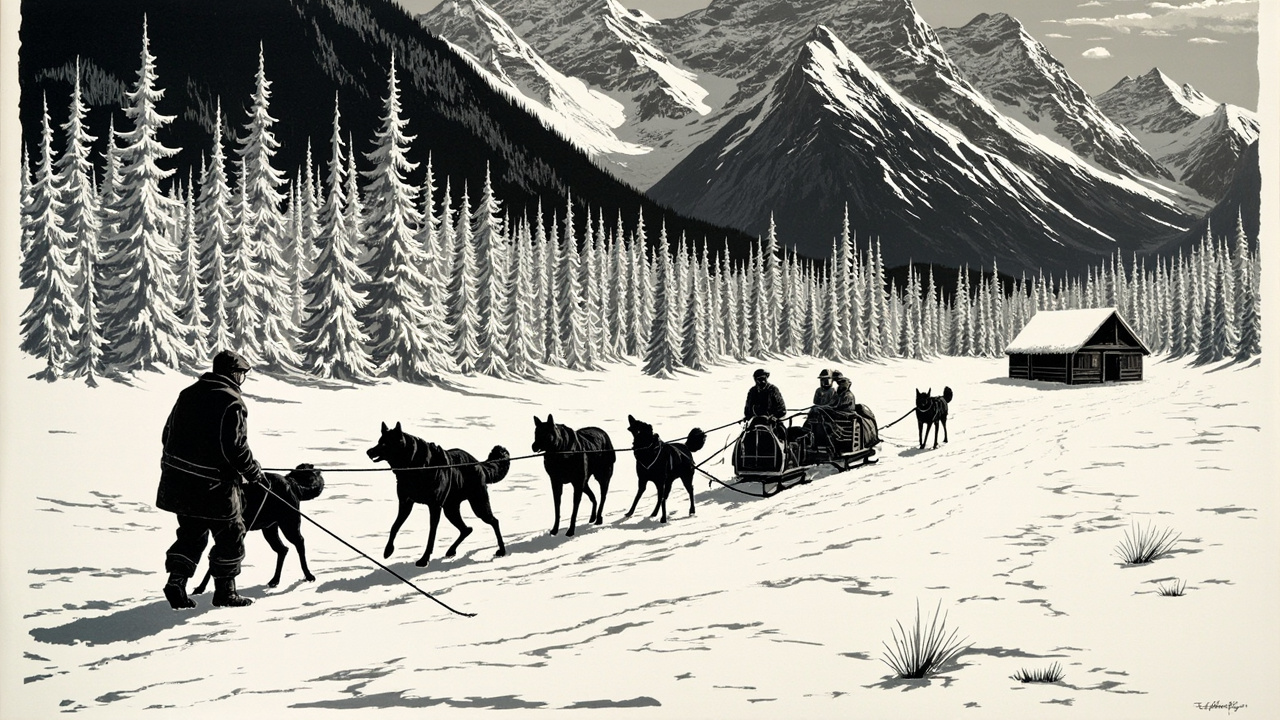
Beat two, hard labor on the northern mail trail. Buck is sold to the French-Canadian drivers François and Perrault, harnessed up, and set onto the snow road. Cold, hunger, ten and more hours of hauling a day, the unfamiliar law of the pack — the soft flesh and temper of an estate dog gets worn away layer by layer. What is worth watching here is craft: London replaces all interior monologue with details of the body. Buck's awakening never runs on sentiment; it runs on him quietly learning, from watching other dogs, how to dig food out of the ice, how to curl his toes in to keep warm, how to read an opponent's opening in a fight. The old, ancestral life comes back inch by inch, exactly like that.
Beat three, the duel between Buck and Spitz. There is room for only one lead dog on the team. Spitz, the vicious, cold-blooded white husky, has fought Buck for the position for a long time, and in one final battle on the snow, Buck wins on sheer bulk and instinct — and the rest of the pack falls on Spitz and finishes him. For the first time, Buck wins a round of the law of club and fang with his own teeth. The writing here moves fast and hard, with no human-style reflection at all — winning is winning, and that is the North.
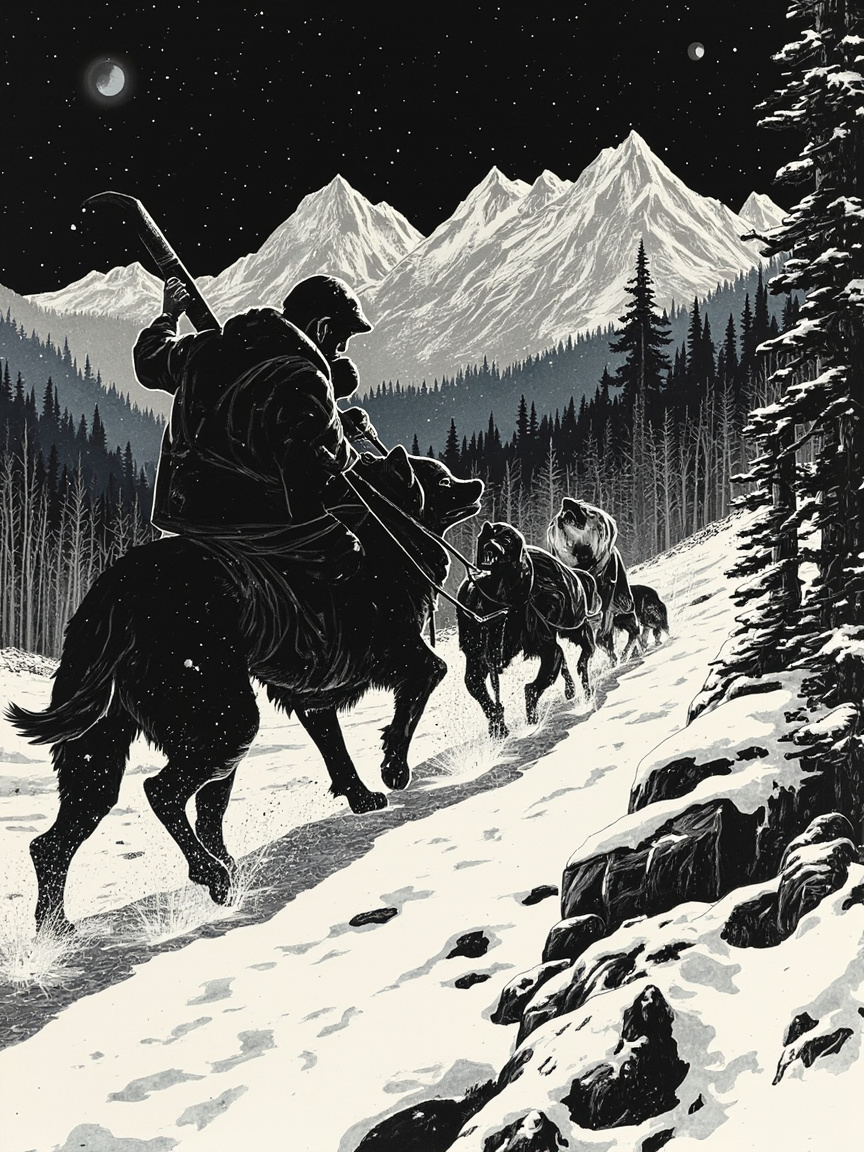
The dominant primordial beast was strong in Buck, and under the fierce conditions of trail life it grew and grew.
那头占据主宰的原始野兽在巴克体内日渐强健,在驿道生涯的严酷里不断生长、生长。
Original line · Chapter III · The snow-field duel with Spitz, the primordial beast awakens
Beat four, Hal's party drives him to death's door. The sled team changes hands several times and finally lands with a trio of American gold-seekers — Hal, Charles, and Mercedes. They do not understand dogs or the Arctic; they overload the sled, run out of food, and whip the dogs until most of them die of it. Buck is beaten nearly to death too. What is striking here is the contrast: every cruel master before this one was at least efficient. This crew is not even efficient — their violence is ignorant, childish, born of sheer stupidity, and that cuts deeper than plain evil ever could. On the bank of the White River, John Thornton wrestles the half-dead Buck out from under Hal's club; Hal's party, ignoring every warning, pushes on across the breaking spring ice and goes under with the sled, dogs and all — wiped out entirely. Thornton has saved Buck, and fate finally lets him draw one breath.
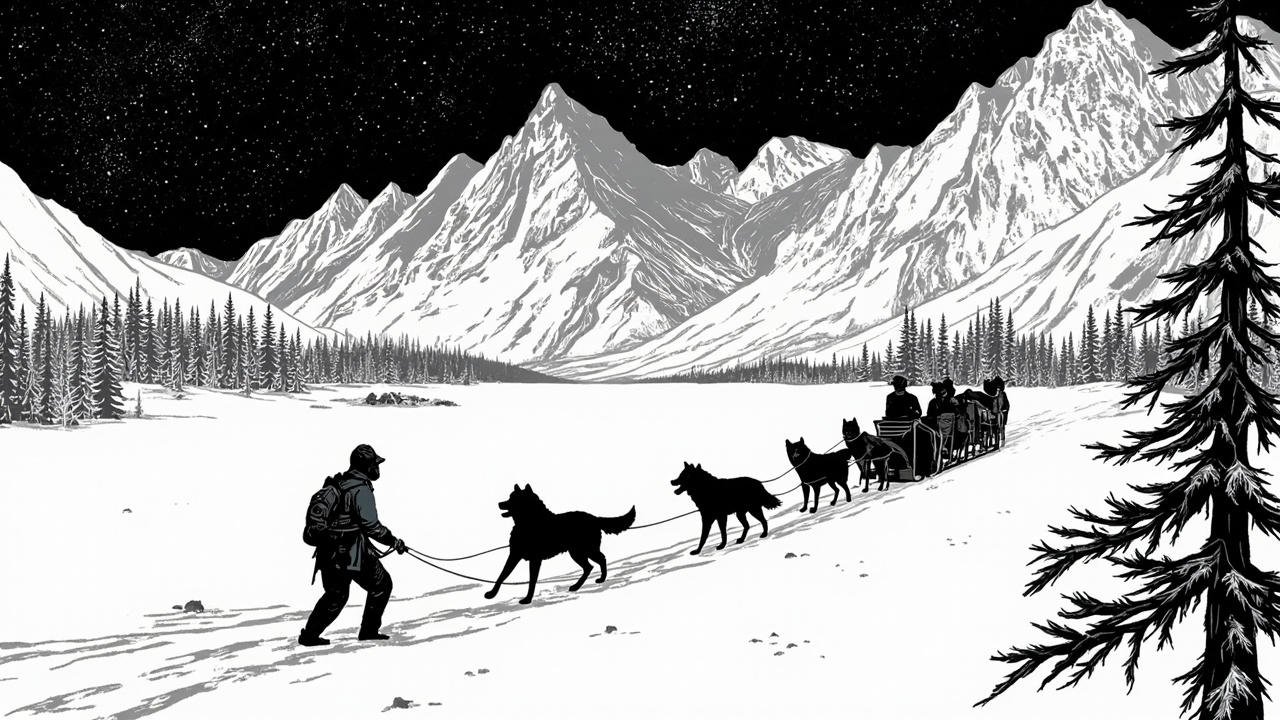
And as they continued to fall upon him, the spark of life within flickered and went down. It was nearly out.
棍子一下下落在它身上,它体内那点生命的火星摇曳着,暗了下去。几乎就要熄灭了。
Original line · Chapter V · Under Hal's club, Buck is beaten to within an inch of his life
Beat five, Thornton. This stretch is the warmest set of pages in the whole book, though the reader already senses the warmth will cost something. Thornton never beats Buck, never starves him, treats him as a partner. Buck hauls a thousand-pound sledge to win Thornton a bet and dives into the ice river more than once to save his life — the wild animal inside him obeys, without condition, only Thornton's word. London does not let this stretch turn into a fairy tale; he leaves it carrying a faint sense of the temporary — the warmer it gets, the more brittle the thread will feel when it finally snaps.
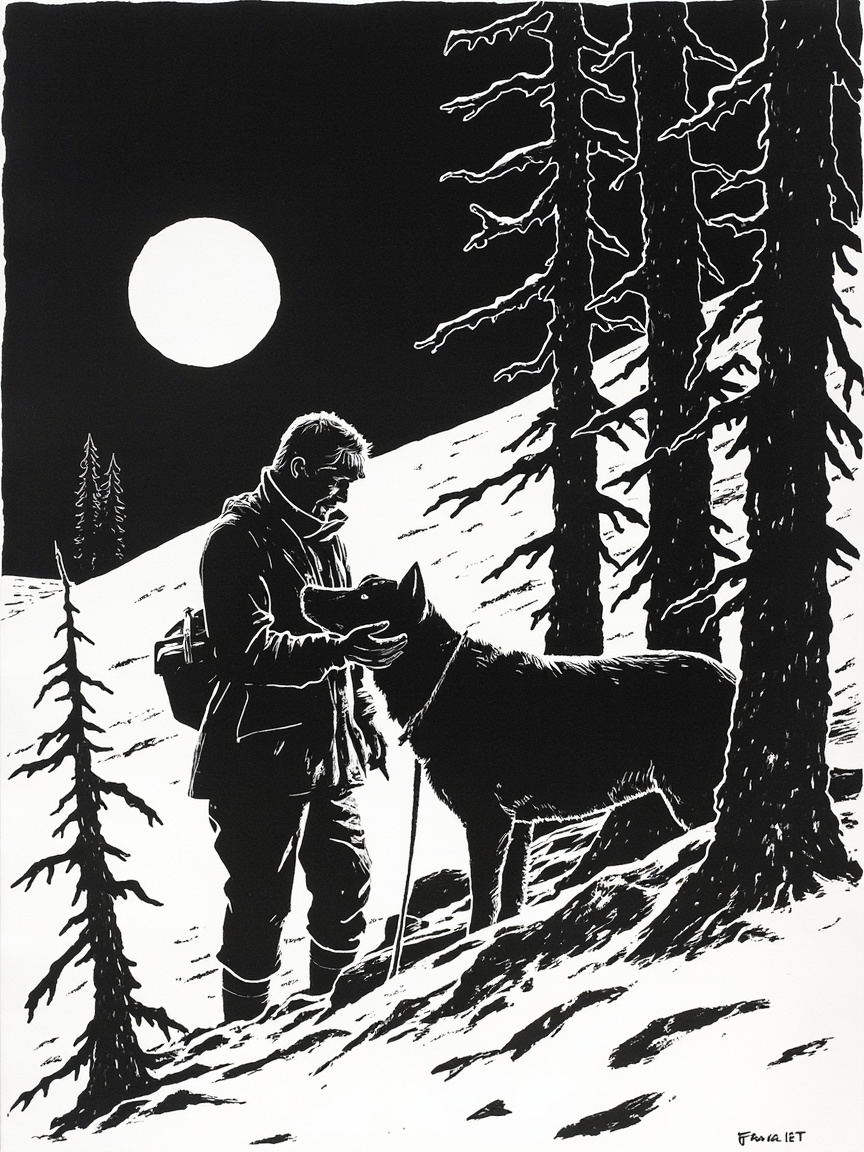
Love, genuine passionate love, was his for the first time.
爱,真正炽热的爱,第一次属于了它。
Original line · Chapter VI · Thornton saves him, and for the first time he learns love
Beat six, the call grows louder. At night, Buck slips alone into the spruce forest to run shoulder to shoulder with a wild wolf, scenting the wind, hunting deer, a light in his eyes that even Thornton no longer recognizes. He is still the dog who comes back when his master calls, but each time he returns a little later, with wilder snow clinging to his paws. In the writing, London renders the return to the wild as a slow, mounting absence — not a sudden morning when he turns into a wolf, but repeated walks farther out, each time still pretending to be a house dog.
Beat seven, the final blow. Buck comes back to camp one day to find it empty. A band of natives has wiped out Thornton's party while Buck was away. Buck tracks the scent into the woods and kills several of them. The writing's cruelty sits entirely in what comes after the killing — he does not grieve for long; he lowers his head, sniffs at what is left of Thornton, then turns and walks toward that call deep in the trees. This is not ingratitude. It is Buck cutting, with his own hand, the last tether: from this moment the wild is no longer just a temptation, it is home. He joins the wolf pack and becomes the Ghost Dog of northern legend.
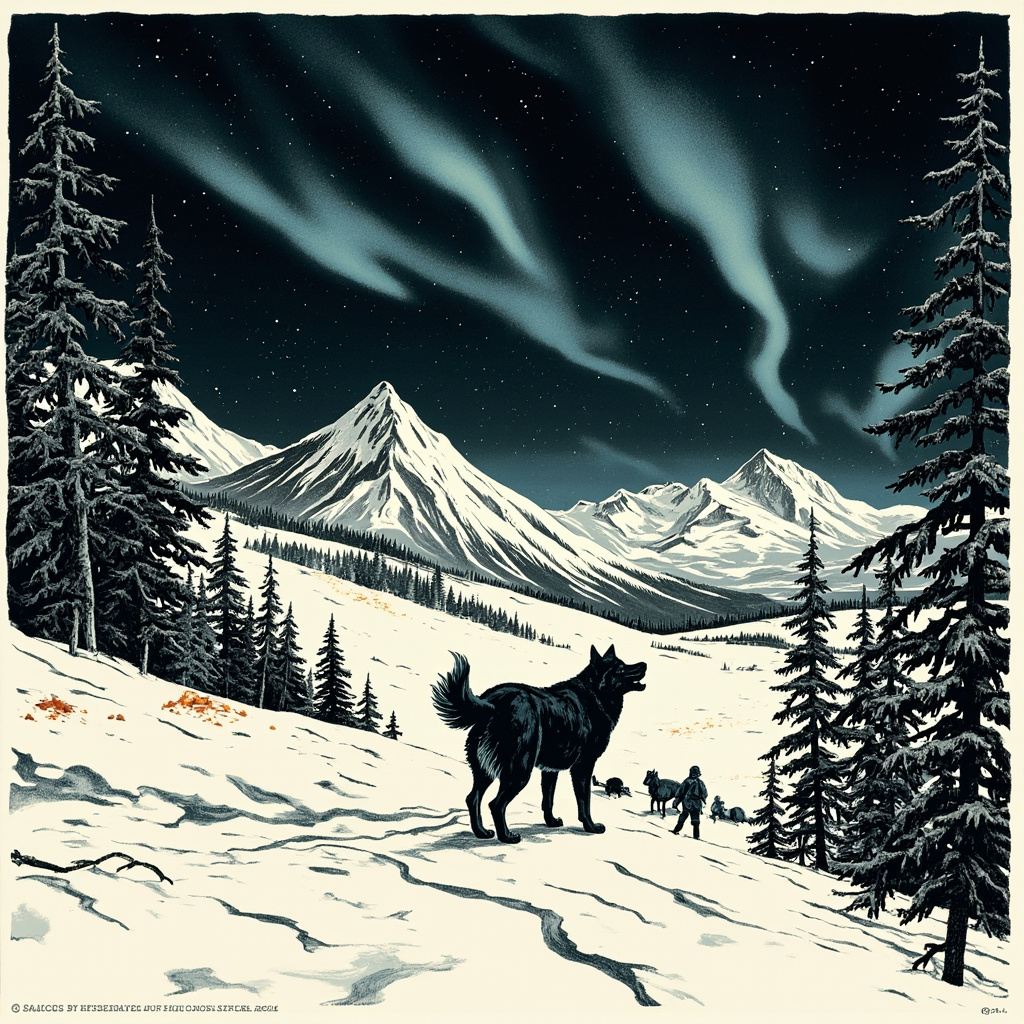
He had killed man, the noblest game of all, and he had killed in the face of the law of club and fang.
它杀了人——一切猎物中最尊贵的猎物;而且是在棍与牙的法则之下动的手。
Original line · Chapter VII · The Yeehats are slaughtered, and the last thread tying him to humankind snaps
What it is really saying: why the wild never stops sitting inside us
This book is not just a spectacle of a dog turning into a wolf; it is asking whether civilization actually grows on us, or is just a coat we are wearing. The naturalism of London's era gives a cold answer: once the environment strips that coat off, piece by piece, what is left is something older, sitting in the blood. Buck is not turning bad — he is going home. And the Thornton thread reminds the reader of something even more important: what keeps a wild beast on the city side of the line was never a cage, it was love; once love breaks, nothing holds. Translate that into today's terms — someone pushed to the edge by their own life, a mother who sends her child abroad and then lies awake night after night, someone in a cubicle who suddenly wants to shut the laptop and walk out into the rain — that thing called the call, London wrote it a hundred years ago, and it can still be heard today.
What makes it good: short as a book can be, and still carries a myth
It succeeds at three things. First, point of view: the whole book moves through Buck's senses, and yet he is never written as a talking cartoon dog — there is something going on inside him, but it is expressed not through lines of dialogue but through how his muscles tense, how his paws draw in, how he reads the wind, which is a far higher order of craft than a first-person fantasy adventure. Second, pacing: a slim book, seven beats from start to finish, from the estate to the wolf pack, without a single wasted subplot. Third, the durability of its theme: the idea that the wild is always coiled underneath civilization is still, more than a hundred years later, something everyone hears once in a while, late at night. It stands as a mirror to London's own later book White Fang — White Fang is a wild wolf tamed into a house dog, The Call of the Wild is a house dog returning to the wild — two flags planted on opposite sides of wilderness literature.
This is not a story about learning to be ruthless. It is a pampered animal slowly remembering who it always was.
Why you should still read it, even knowing how it ends
This companion has handed you the map of the plot, but a few things the map cannot show live only in the text itself. First, the rhythm of the body — the way your feet go cold reading about paws numb with pain on the fourth day of hauling through snow; London gets there purely through physical detail. Second, the power of slowness itself: the layer-by-layer stripping-away, across a hundred-odd pages, from the estate to the snow trail to the forest — no summary can hand you that sense of pace. Third, those few warm pages with Thornton — they move you precisely because everything before them was cold enough, and everything after is fated to break; once the spoiler is already in your head, those pages carry more weight, not less. Once you know Buck will become king of the wolves, you will actually want to follow him through being a good house dog one more time.
Art Direction4 plates
Before the guide was written, this book got a visual foundation — every illustration you just read grew out of it.