Salinger's bible of adolescence: the last cliff edge before innocence collapses
Text and illustrations produced by the pipeline
You probably know someone like this — mouth full of contempt for everything, heart more afraid than anyone's that someone might get hurt. He'll slam down his chopsticks and storm off in the middle of dinner, hear sarcasm in your most harmless joke, sneak home at two in the morning just to check whether his sister is asleep. He's sixteen, expelled from school for the fourth time, and he jumps on a night train to New York with a red hunting hat tucked under his arm. This is Holden Caulfield. He created a template for the rebellious teenager, and for more than half a century readers around the world have recognized themselves in him.
But this book is more than a rant. What Salinger wrote is a boy who has just run headlong into the discovery that the world is fake — he isn't ready for it, and he doesn't want to be. The whole novel follows him wandering for three days and two nights; you watch him grow lonelier the deeper he wades into the crowd, until at last, in front of the carousel in Central Park, he goes quiet for the first time.
The Catcher in the Rye was published in 1951. Salinger himself had fought in World War II, living through the Normandy landings and the bloodletting of the Hürtgen Forest. After he was discharged he went back to New York and spent years in seclusion writing this slim book — one critics first sneered at, and one generation after another of young readers has since read as scripture. The novel is short and the story simpler still: a sixteen-year-old gets expelled and drifts around New York for three days and two nights. But its real revolution was this: for the first time, a novel was honest enough to write down the way teenagers actually talked inside their own heads — rough, jumpy, foul-mouthed, and true in every line.
It became the most recognizable banned-yet-required book in twentieth-century Western literature — topping the American Library Association's most-challenged list year after year, while high school English teachers keep putting it on the required-reading list, also year after year. It grew from a novel into a cultural phenomenon: Holden's hunting hat and his word phony became a kind of shared code among teenagers everywhere.
Holden is sixteen, expelled from Pencey Prep for the fourth time. He grinds through a few nights in a cheap New York hotel and crosses paths with dance-hall girls, an old prostitute, cab drivers, and phony classmates and teachers. His mouth is full of contempt, but his heart holds two people: his ten-year-old sister Phoebe, the only person in the whole book he's willing to be completely honest with, and his dead brother Allie, who died of leukemia as a child. Allie's baseball mitt, covered in poems he'd written on it, is the one thing Holden carries with him everywhere — the source of all his wounds.
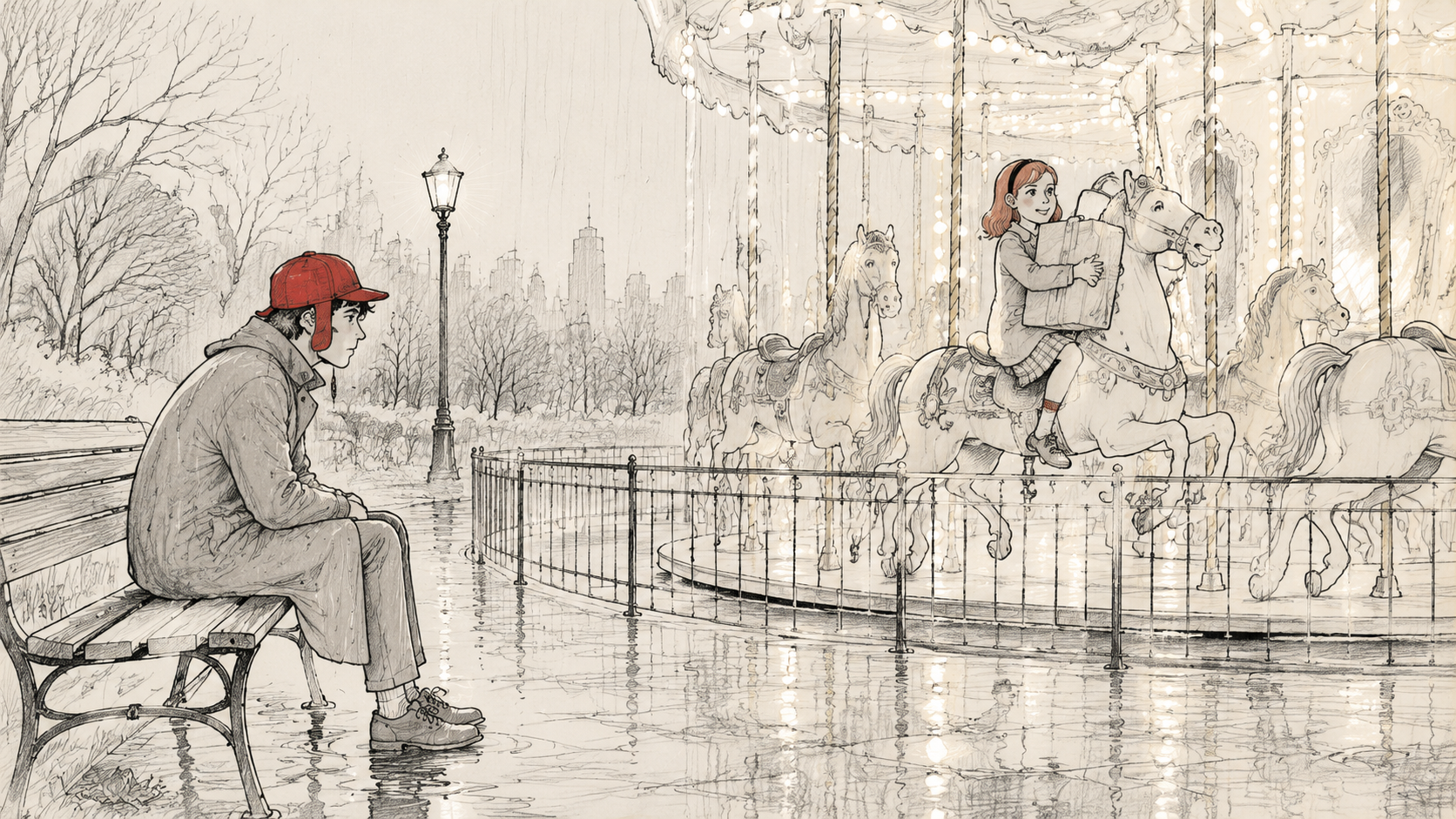
Giving Up on Running Away, in Front of the Carousel. The next day Holden decides to head west, to somewhere he'll never have to play grown-up again. Before he goes, he stops by the museum to say goodbye to Phoebe one last time — but she sees right through him. She insists on packing her own suitcase and coming with him, even if it means living on the street. That's the moment Holden breaks: he can't let his sister fall along with him. He takes her to the carousel in Central Park and lets her ride, while he sits on a bench in the rain watching her go around and around — and for the first time he thinks to himself, at least I won't let her fall.
Epilogue: Told from the Sanatorium. In the book's final pages, Holden tells you he's now at a facility in California, and that even as he writes all this down, plenty about his future remains blurry and out of place. He refuses to hand you a neat, tidy ending — and that admission of I haven't figured it out either is the truest thing Salinger ever said about being a teenager: you may spend your whole life still dealing with that sixteen-year-old Holden.
Before the guide was written, this book got a visual foundation — every illustration you just read grew out of it.
Another key figure is Mr. Antolini, Holden's former English teacher, one of the few people Holden turns to for help on this night in New York — until an ambiguous gesture of his, late at night, shatters what's left of Holden's trust in the adult world. It's worth noting that the whole book isn't a real-time diary. By the novel's own frame, it takes place about a year after the events themselves: an adult Holden, now in a facility in California receiving treatment, sits and tells the reader about those three days in retrospect. That looking-back-from-later voice gives the whole monologue its edge — and also a faint, unreliable haze.
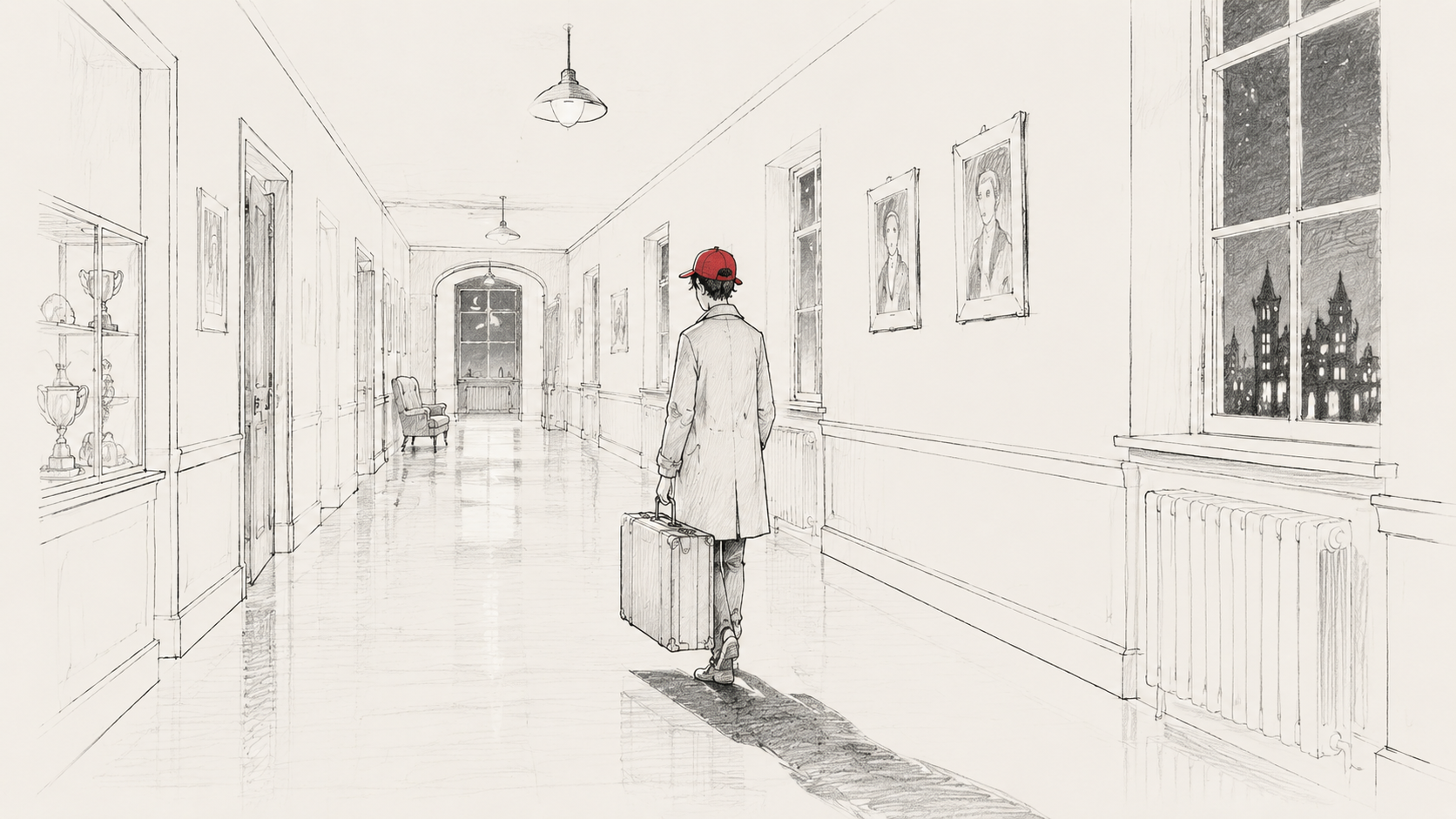
The Night He Leaves School. Holden is expelled from Pencey Prep for the fourth time after failing several classes. He doesn't tell his family right away — he decides to leave school that same night, and gets into a fistfight with his roommate before he goes. He takes the night train to New York alone, with nothing but a suitcase to his name. Salinger's style announces itself immediately — Holden opens his mouth and out comes a stream of complaints, jumping from thing to thing, and yet every word rings true. From the first page, the reader can feel that something is wound tight inside this kid.
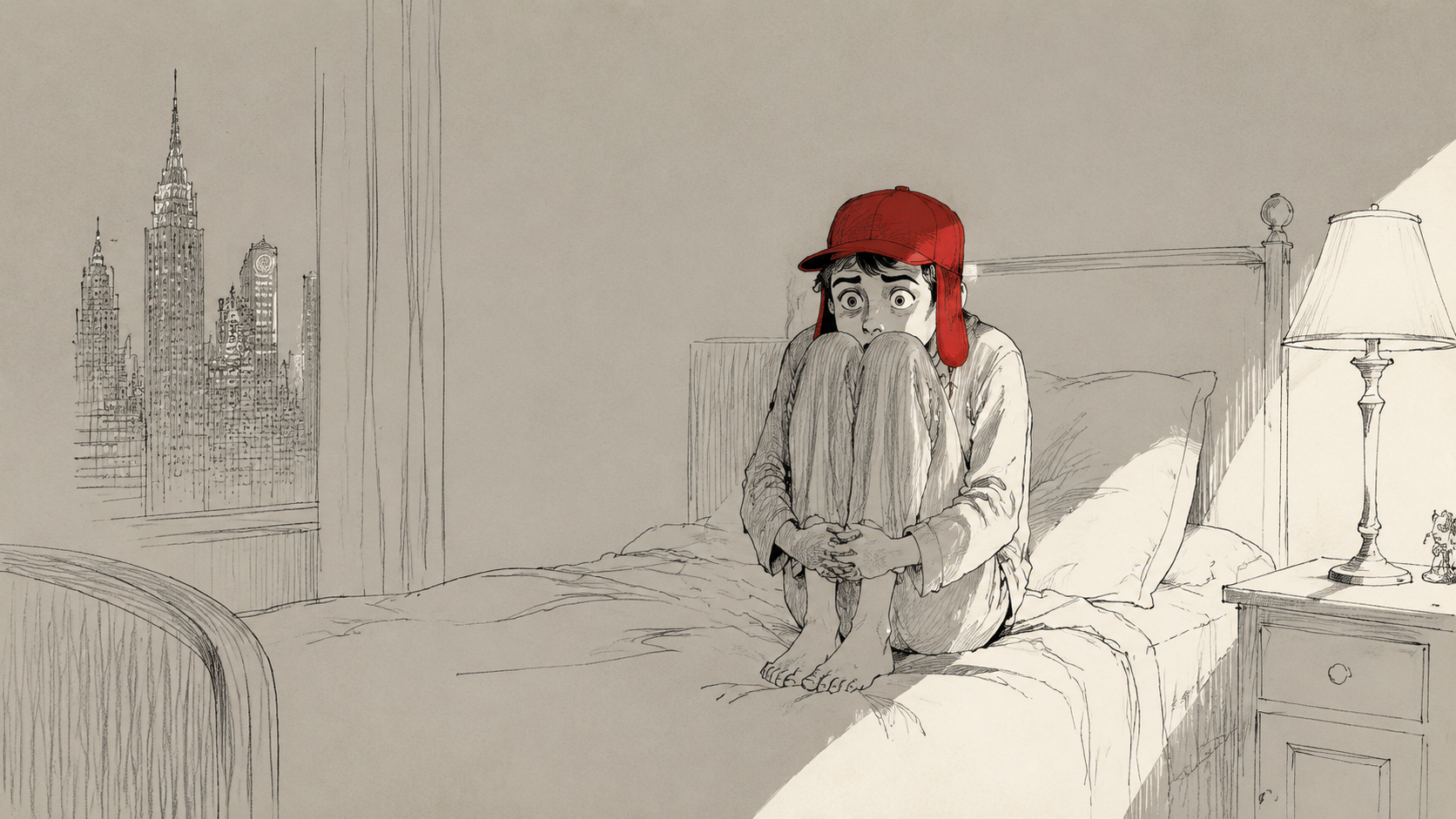
A Night in a Cheap Hotel, a City of Strangers. Holden holes up in a run-down Manhattan hotel and starts a long night of wandering — he goes to a bar and orders whiskey pretending to be an adult, watches a phony floor show at a nightclub, runs into old classmates at a dance hall and realizes everyone around him is playing grown-up. He calls up a prostitute, then gets so nervous all he wants to do is talk to her, and ends up getting beaten up by her pimp and robbed of his money. What Salinger does so well here is make sure Holden fails at everything he tries — he wants to belong but can't fit in, wants to rebel but only looks ridiculous, and the loneliness keeps piling up.
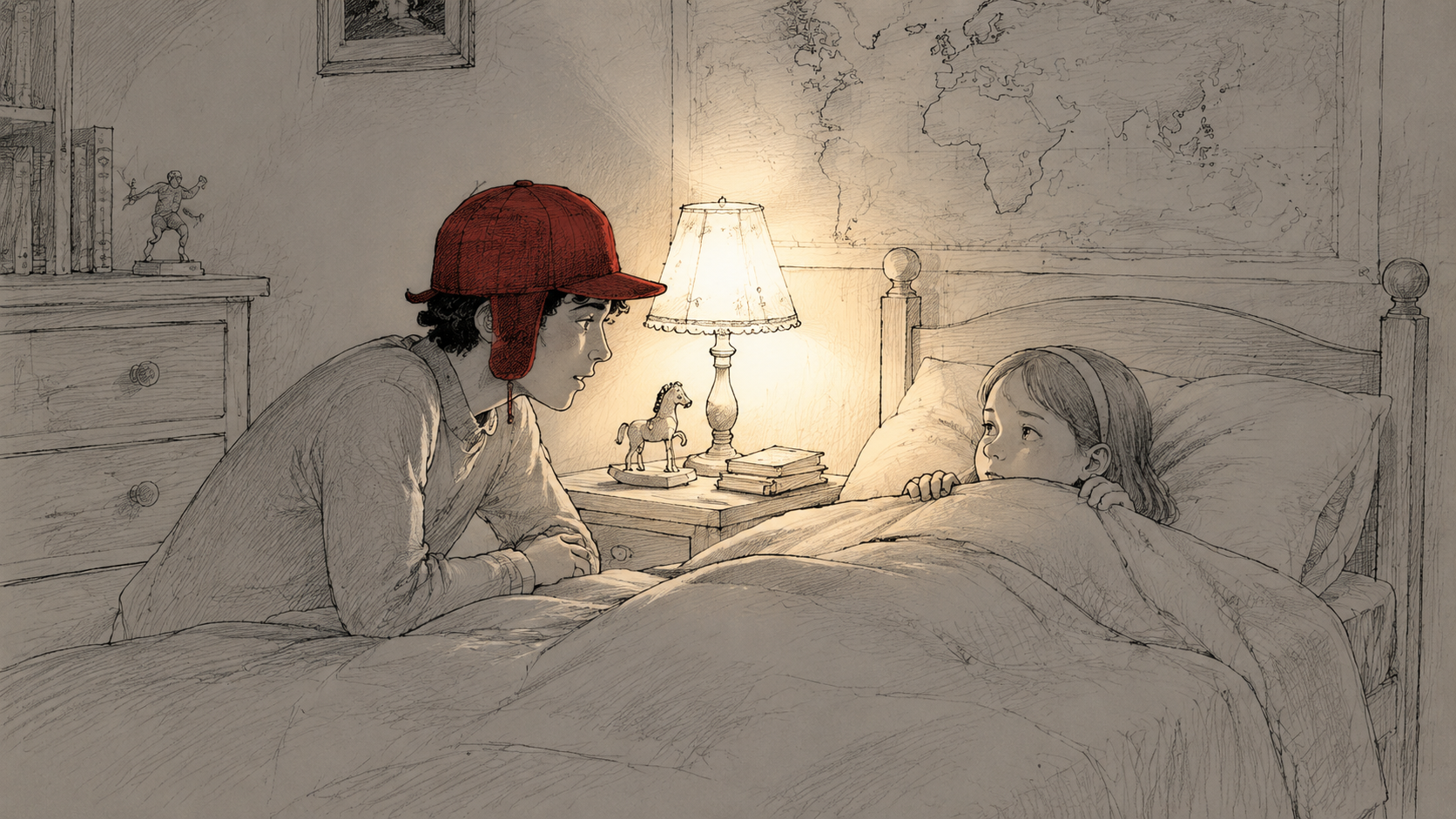
Sneaking Home at Night to See His Sister. That night Holden sneaks home. All he wants is to know whether Phoebe is sleeping well. He wakes her in the dark and shows her Allie's baseball mitt — their dead brother's mitt — and for the first time says out loud the image of the catcher in the rye: standing on the edge of a cliff above a field of rye, watching over a crowd of children playing below, ready to catch anyone about to fall off. It's the book's central metaphor, and Salinger delivers it in a tender bedside confession, surfacing a wish that grows almost impossible to say out loud once you're an adult.
The Night He Visits Mr. Antolini. With nowhere left to turn, Holden shows up at the home of Mr. Antolini, his former English teacher. Uncharacteristically gentle with him, the teacher lets him stay the night and delivers a speech about learning where to set a person down once you've been holding them up. But in the middle of the night Holden wakes with a start at something his teacher does, and flees the apartment in a panic — in that moment he can't even trust the one good teacher he ever had. The scene is written deliberately ambiguous; even Holden wonders whether he's overreacting, and it's exactly this refusal to spell things out that shows the book's real nerve for writing uncertainty.
On the surface, The Catcher in the Rye is about a teenager who hates everything phony. But what Salinger is really writing about is how innocence actually gets lost. A person doesn't lose their innocence by turning bad — they lose it when they can no longer believe that other people are real either. Behind Holden's conviction that everyone is a phony stands someone he refuses to talk about: his brother Allie, who died at an age Holden never got the chance to make sense of. Holden keeps pushing people away, one by one, because he's afraid they'll disappear the way Allie did.
Salinger changed postwar literature because he created a teenage voice that actually sounded like one. It's a rough voice, foul-mouthed, jumpy, prone to veering off into some tangent every couple of pages — and that colloquial first-person monologue blew the lid off the tone of serious postwar literature. Holden became shorthand for rebellion and sensitivity, and the youth literature and rock culture of the rest of the twentieth century all borrowed, one way or another, the language he first spoke.
This guide has given you a map, but a map is not the territory. What Salinger really pulls off is a rhythm that feels almost physical — a rough-edged kid talking to himself, circling back to the same line again and again, each repetition hurting a little more than the last. Even knowing how the story ends, you'll still get pulled in by that voice once you're sitting inside the book, and you'll start counting for yourself how many times Holden has run into something phony today. And that's before you get to the many translators who have tried to capture, in their own language, that same mix of jumpiness and foul mouth — which isn't something a summary can convey. You have to read it to feel it in your body.
What Holden wants was never to save the world — it was to keep the next person from falling the way he did. He couldn't save himself, but he caught his sister, and for that one instant, it was enough to get him through the winter of being sixteen.