Gikeiki / The Chronicle of Yoshitsune · Companion Guide
義經記
美少年五条桥上立名,旋即为亲兄长逼入北国雪原——一场尚未走完便已被判定的坠落。
Opening: The Crash on Gojō Bridge
On Gojō Bridge in Kyoto, a warrior monk carrying seven weapons stood with his blade drawn, challenging every samurai who tried to cross. He had won a hundred times. This time the one who came at him was a boy, delicate-featured and not yet grown into his height. When his halberd hit the planks, the whole bridge shook. The monk went down on his knees, took a new name, and followed that boy for the rest of his life. The boy had no name yet; people just called him Ushiwakamaru. Later, every Japanese would know him as Minamoto no Yoshitsune.
What This Book Records
The Chronicle of Yoshitsune is one of the less celebrated war chronicles of medieval Japan, author unknown, compiled sometime between the fourteenth and fifteenth centuries, in the years when the fires of China's Southern Song wars had not yet died down and Japan's Muromachi shogunate had only just opened its doors. Together with The Tale of the Heike, it forms one of the two pillars of medieval Japanese war literature: the Heike tells how the Taira fell, this book tells how a hero of the Minamoto fell. One is a story about battle, the other about a man. It is not a historical record; it is the stroke that fixed the legend in place. Nearly every Noh play about Yoshitsune, every tear-jerking Kabuki scene built around him, traces back upstream to this book.
What has kept it alive in memory is the phrase it gave to the Japanese psyche: hōgan-biiki, literally sympathy for the hōgan, the judicial title Yoshitsune once held, and by extension the reflex to side with anyone who loses, to weep for the one who was beaten. For a thousand years, whenever the Japanese have spoken of Yoshitsune, they have found his defeat more moving than any victory could have been. This book is where that ache begins.
The Boy, the Brother, the Loyal Retainer, the Lover
Yoshitsune is written as a boy too beautiful for a warrior. His father died in battle when he was small, and his mother raised him as a dependent at Kurama Temple, his real name kept hidden. That kind of childhood — a boy who should have inherited a great house, dropped instead to the bottom of the world and left to claw his way back up on nothing but skill — recurs across later legend. Yoshitsune's older brother is Minamoto no Yoritomo, the first shogun in Japanese history, who founded a century of shogunal rule. Yoritomo barely appears on the page, yet he hangs over the second half of the book like a cloud, growing suspicious of his brother, ordering him hunted, driving the victor step by step toward death. This is a quarrel between brothers, not a grudge between lord and retainer of different blood; don't mistake the two.
Two circles of people around Yoshitsune carry the book's most affecting theme. Musashibō Benkei, the warrior monk who yielded on Gojō Bridge, keeps his seven weapons and his halberd and never again leaves his lord's side. Shizuka Gozen, a shirabyōshi dancer and Yoshitsune's lover, follows him from Kyoto all the way to the northern provinces. The book states its own key point plainly: Yoshitsune's image is built on the sacrifice and devotion of the people around him. He is not a lone hero. He is a man held up by everyone who loved him, which is exactly why his fall lands so hard.
Boyhood Training on Mount Kurama
The story opens on Mount Kurama. Ushiwakamaru lives at the temple as a dependent, his standing held firmly down. The book does not dwell on what he suffered there; it dwells on how he trained. Later legend would claim a tengu, a mountain goblin, taught him swordsmanship, but this book leaves the question of his teacher blank. That silence is itself a technique: it never explains where Yoshitsune's skill came from, only shows a boy who, somewhere in the mountains, became formidable, and comes down already extraordinary. A master with no named teacher — that mold would be cast again and again in the hero legends that followed.
Gojō Bridge: The Sound of a Falling Halberd
On his way down from the mountain, Ushiwakamaru passed over Gojō Bridge in Kyoto. A warrior monk who claimed to be the strongest fighter alive was working the bridge, nominally soliciting alms through combat but really robbing every samurai who crossed, taking their weapons when they lost. That monk was Musashibō Benkei. Round after round, the boy beat him back, until the halberd hit the ground and the weapons came off his back one by one. Benkei was won over. He knelt on the bridge and swore himself to his new lord. This is the book's first climax, and every later Yoshitsune play opens with some version of it. The craft here is sharp: the author gives Yoshitsune no lineage to lean on, no battle strategy, no ally, only his own fists. A character's weight gets established in the plainest possible contest.
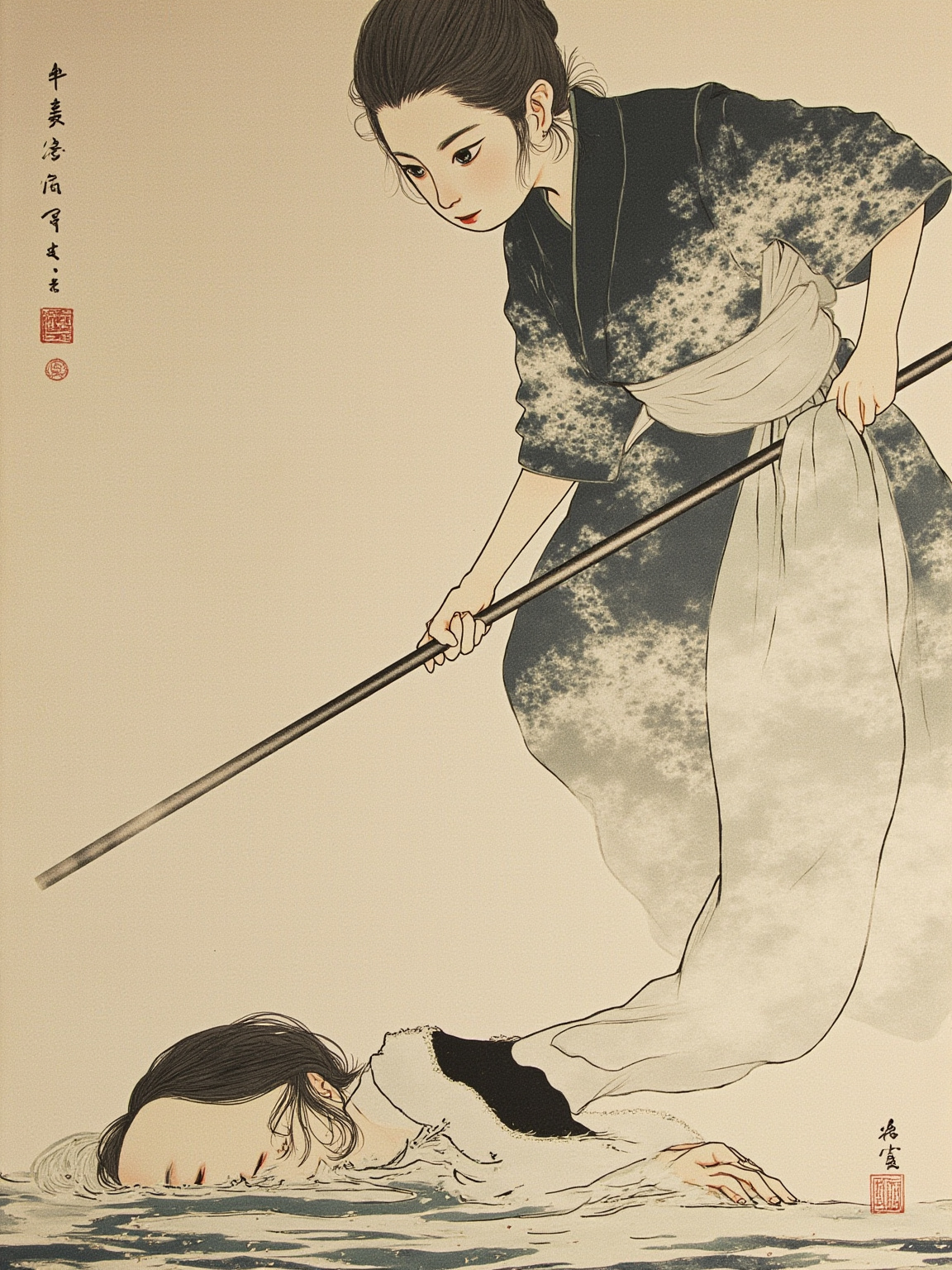
The naginata fell, and the whole bridge rang with the sound.
薙刀落地时,整座桥都在响。
金句 · 开篇 · 五条大桥
Three Battles, One Ruin: The Taira Fall in a Few Pages
Ushiwakamaru joined his brother Minamoto no Yoritomo, took the name Yoshitsune, and was sent to crush the Taira, who still held the western provinces. At Ichinotani he cut straight through their lines in a surprise charge. At the sea battle of Yashima he stood at the bow and shot down a fan mounted high above the enemy ranks. At Dannoura, when the tide turned, he closed his ships in against theirs. The Taira were destroyed, completely. By rights this should be the part the book lingers on longest — instead it covers all three battles in a few pages. That is not laziness; it is a choice. The author is not after a battle report. He is after a person. Each victory gets compressed into a handful of lines for a single purpose: stack them all to the top, so they can come down together.
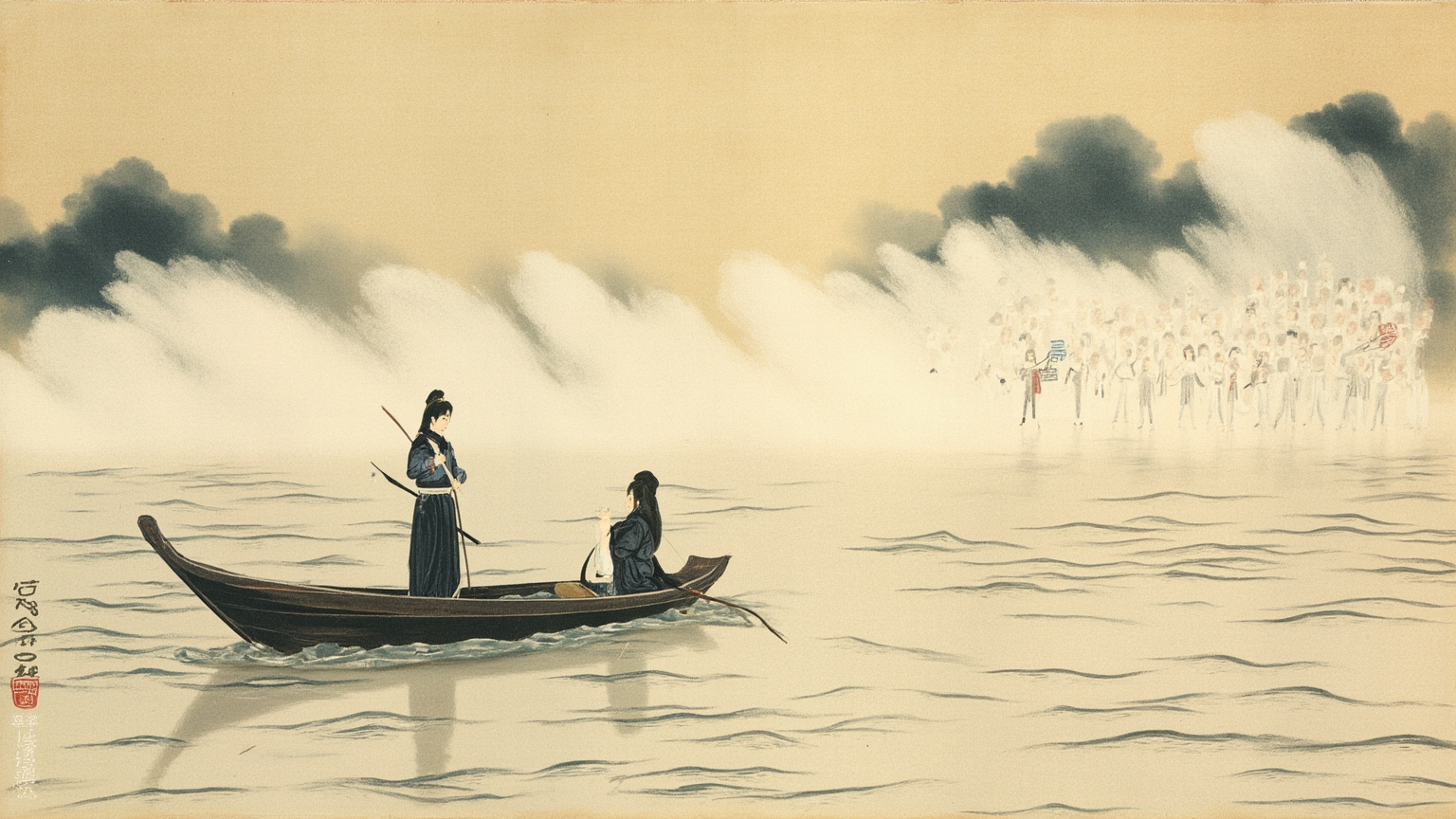
The battles are told in only a few pages — pressed thin as a pressed leaf, for the falling to come clean.
一场一场的胜仗,被压成寥寥数页;堆到顶点,是为了让崩塌来得干净。
金句 · 中卷 · 一之谷、屋岛、坛之浦
Too Great a Name: Suspicion from His Own Brother
The trouble starts here. Minamoto no Yoritomo, far off in Kamakura, hears the victories piling up at the front and grows darker by the report. His own brother has more credit than anyone, a louder name than anyone's, and a standing that rises by the day; for a man trying to build a shogunate, that is the worst news there is. Once suspicion takes root, it stops listening to reason. Yoritomo orders him hunted, and Yoshitsune is driven out of Kyoto. The book has him set out on a flight that makes no geographical sense at all: out of Kyoto, along the Tōsandō, up the Ōshū road, looping far north to seek shelter with Fujiwara no Hidehira of Ōshū. The route is pointless by any map, but politically it is the only route there is. He cannot go back to Kyoto, cannot go straight to Kamakura, and so he zigzags toward the far edge of the country instead. That zigzag is itself the oldest shape fugitive literature has.
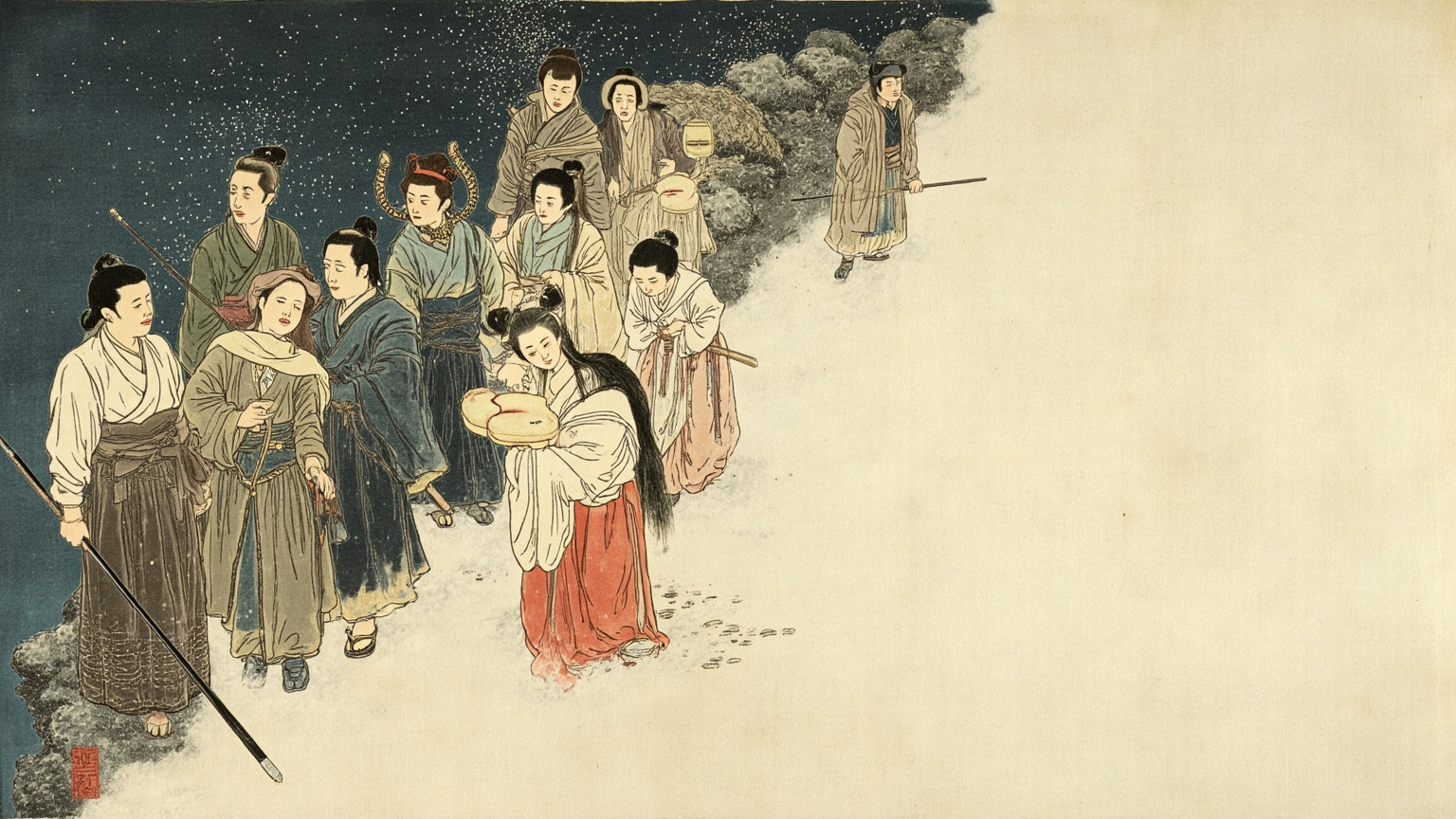
It is his own elder brother who turns his face away; it is his own lord who sends the hunters.
背过脸去的是亲兄长;派出追兵的,是曾效忠的主公。
金句 · 中下卷 · 赖朝追讨
Hiraizumi in Ōshū: Shelter and Terminus in One
Fujiwara no Hidehira, the real ruler of northeastern Japan at the time, took Yoshitsune in at Hiraizumi. The residence at Koromogawa became his last home. It is the book's rare breathing space, its last calm stretch. Hidehira is not written as a saint; he has his own reasons for offering protection. But the protection itself is real, and for a while Yoshitsune lives something close to a settled life in Hiraizumi. Then Hidehira dies, and what patience Yoritomo had left runs out. The hunters close in, and Koromogawa is surrounded.
Curtain in the North: The Bottom of the Long Fall
Yoshitsune falls from the height of victory all the way down to the snowfields of the north. Benkei and the other retainers stay with him to the end. Shizuka Gozen stays with him too. The book closes on this northern tragedy — exactly how, is best left to the text itself. What matters here is this: the real man behind the book, a warrior who actually lived from 1159 to 1189, has by this book's hand stopped being a historical figure and become the template for a folk hero. Ever since, whenever the Japanese think of a loser, they think of him, because no one has ever lost more completely, and because no one has ever had so many people love him all the way down.
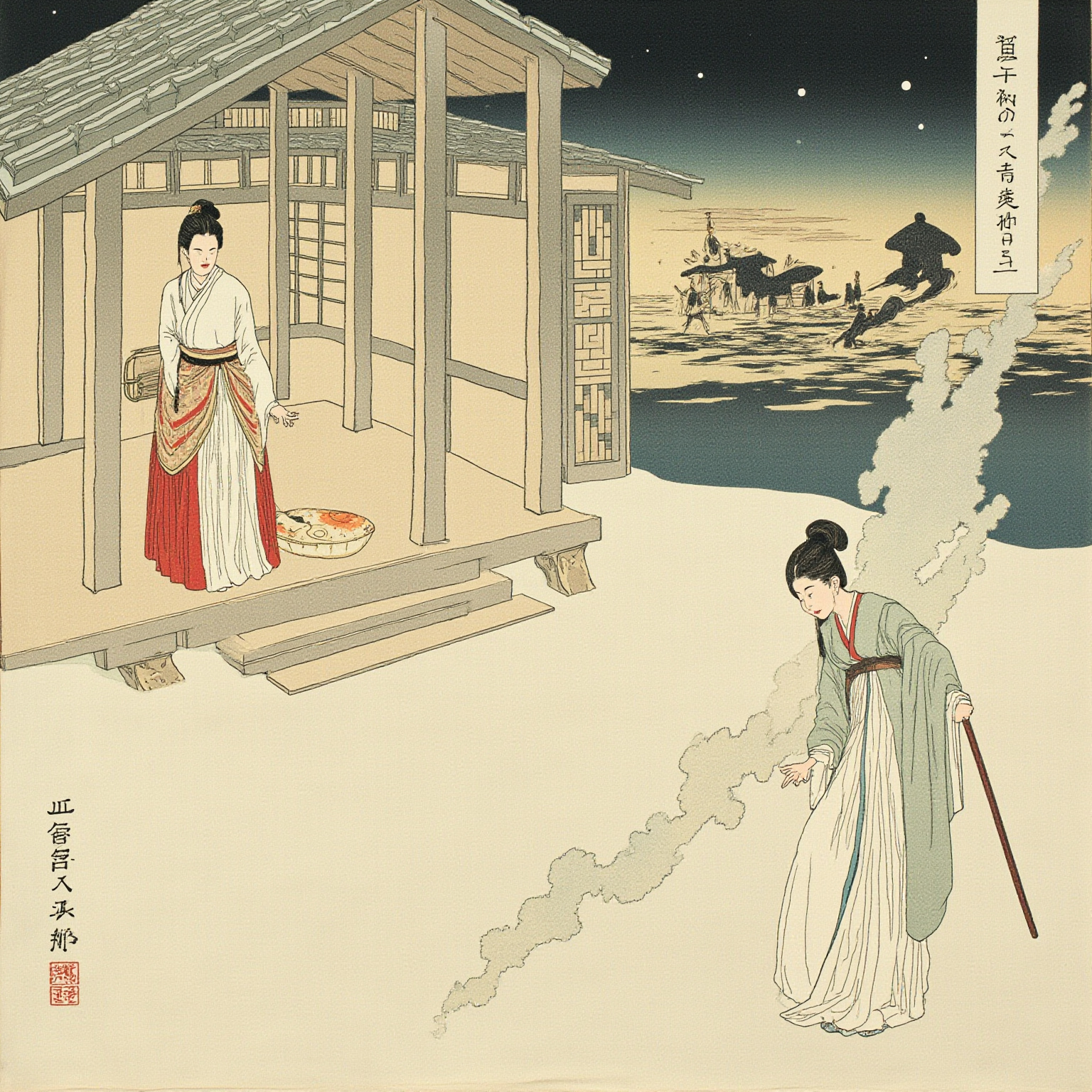
He who rose highest of all has fallen farthest, into the snow country where no roads lead back.
升得最高的人,跌得也最深——落入北国,再无归路。
金句 · 终卷 · 衣川馆北国落幕
What It Is Really About
On the surface this is the heroic legend of a boy. Underneath, it is about being driven to ruin by your own people. That is one of the most painful themes running through medieval Japanese war literature: the one who suspects you is not a stranger but your own brother; the one who hunts you down is not an enemy but the lord you once served. Yoshitsune's tragedy is not that he lost to an enemy on the battlefield. It is that he was pushed, step by step, off the peak of victory by the person closest to him by blood. Hōgan-biiki, the instinct to side with the loser, has dug itself so deep into Japan precisely because this book laid the pattern out so clearly.
The other reason this book has lasted is that it shows, in plain view, how a legend gets made. It does not treat Yoshitsune as a god, and it does not treat him as flawless, only as a boy held up by the people who loved him. That approach handed Noh, Kabuki, and Bunraku puppet theater a well of material that has never run dry. Nearly any Yoshitsune play staged in a Noh theater in Japan today carries this book's shadow somewhere inside it.
Victory after victory, compressed into a few pages — stacked to the top only so it could come down clean.
What It Means for Readers Today
You do not need to know Japanese history to read this book, and you do not need to trace the branches of the Taira and Minamoto clans. What you need to watch is a young man's rise snapped off at its brightest point, a pain readers everywhere, in any century, already recognize. What it means for us now is simple: it lets us see exactly how a whole aesthetic of the noble loser grew out of one book. When we feel for Yoshitsune, we are really feeling for anyone who won and still got cornered.
Why Read the Original Text at All
A guide gives you the map. The text is the land itself. What actually moves a reader here cannot be drawn on any map: the rhythm of the halberd hitting the boards on Gojō Bridge, the wind cutting through the wooden doors of Koromogawa across the snowfields of Ōshū, the exact tone in Benkei's voice at the moment he kneels. Only the original page gives you that. More important still, the book's habit of settling a whole battle in a few pages, its control of pace, its choices about what to show of war and what to show of the men fighting it, is something no retelling or summary can reproduce. It is worth reading even when you already know how it ends, because you will want to see how, with such plain lines, the author made a victory feel so light and a fall feel so heavy.
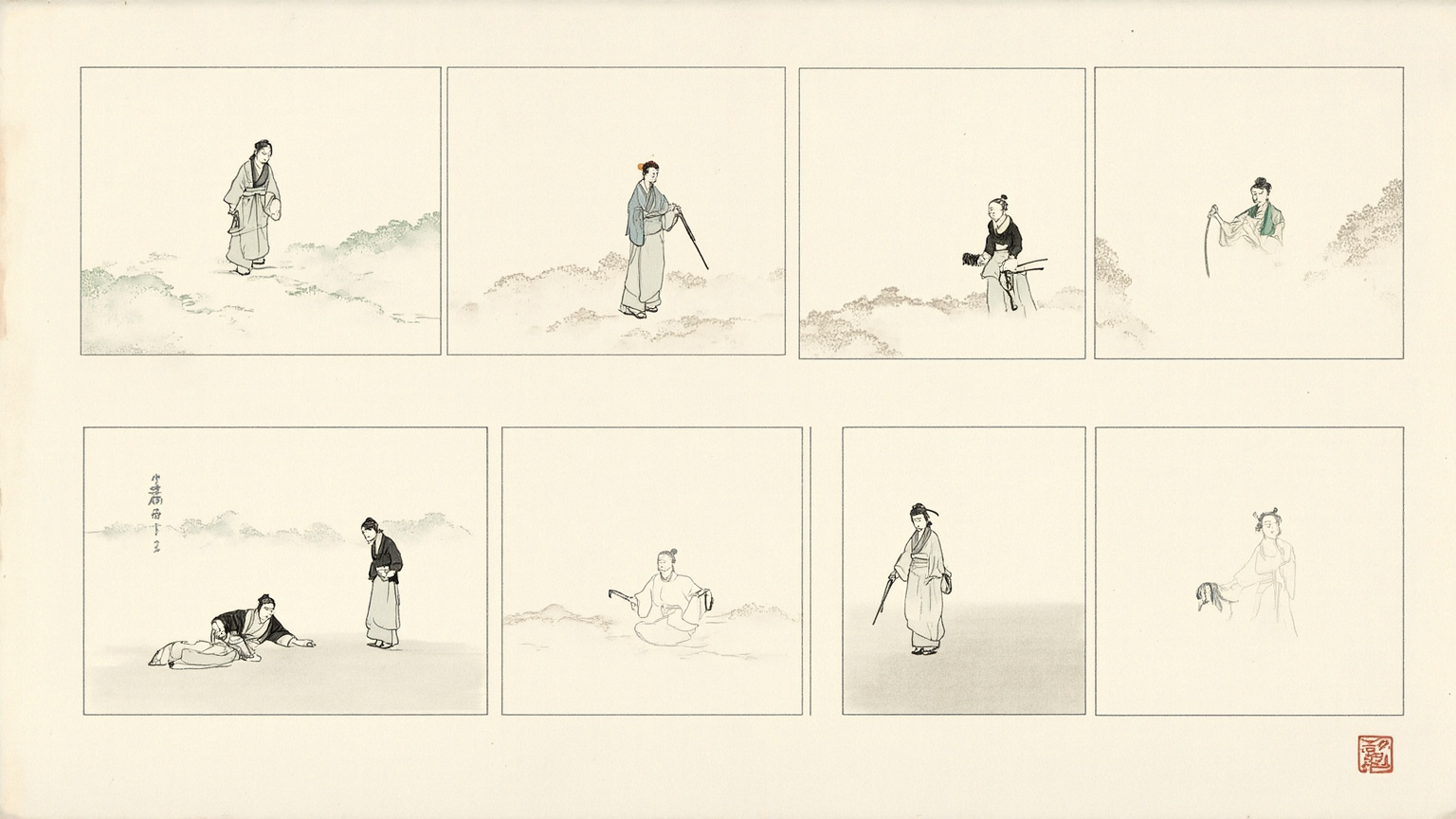
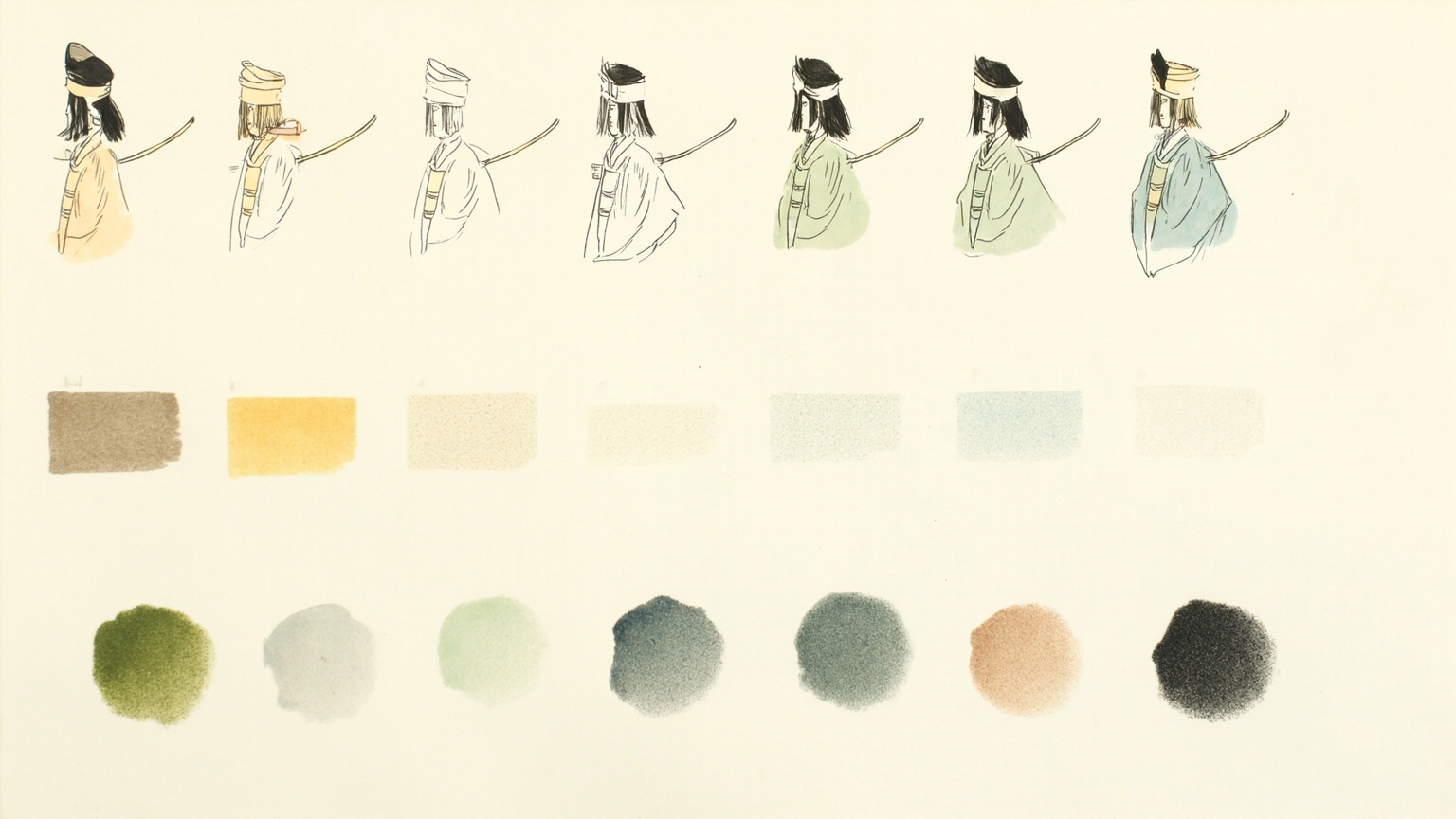
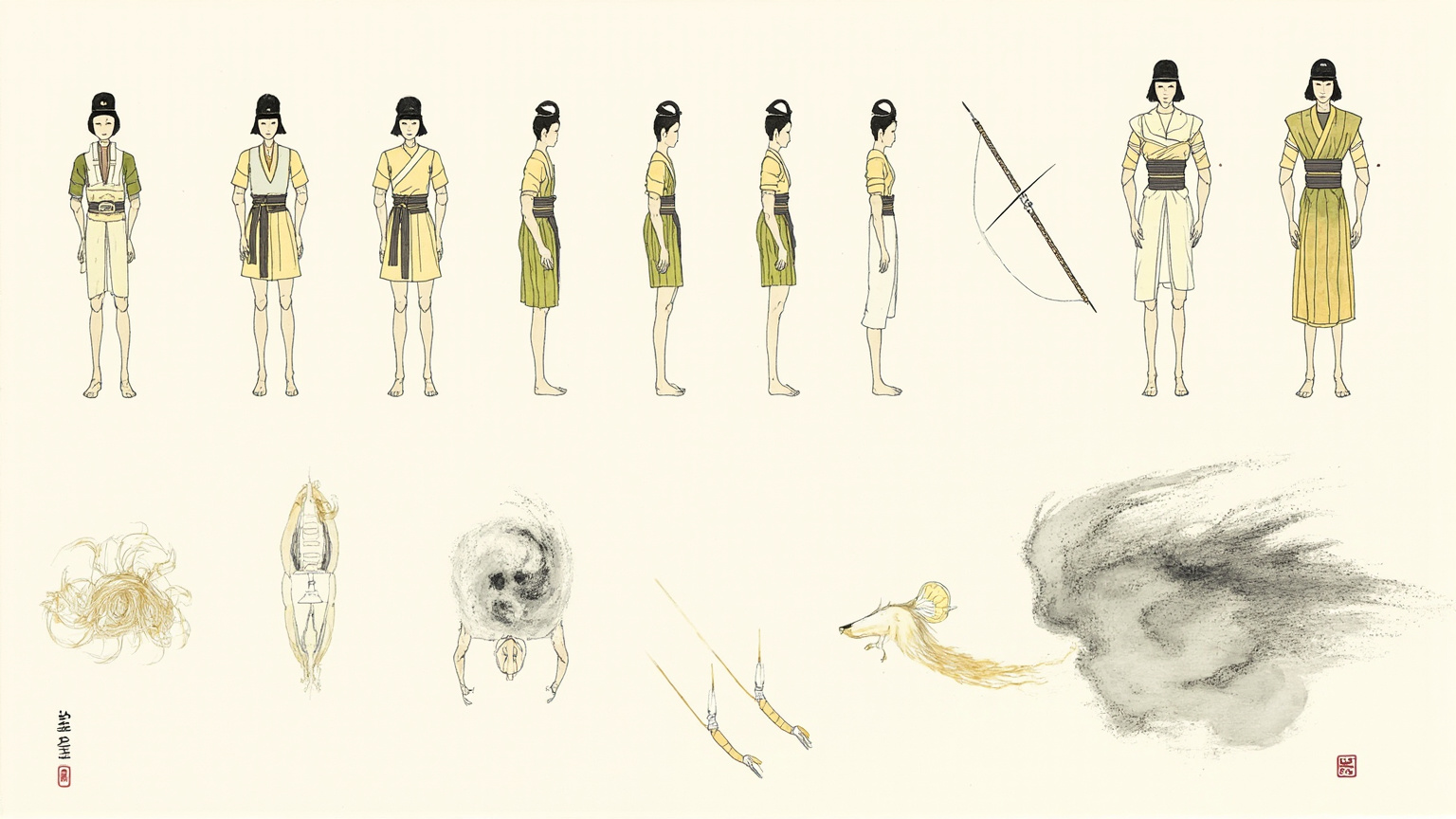
Art Direction4 plates
Before the guide was written, this book got a visual foundation — every illustration you just read grew out of it.