
The Conference of the Birds (Mantiq al-Tayr / منطقالطیر) · Companion Guide
群鸟会议
三十只鸟飞越七谷去找一位王,最后在镜中撞见自己——阿塔尔的苏菲史诗把朝圣路走成了一面照心的镜子。
Opening
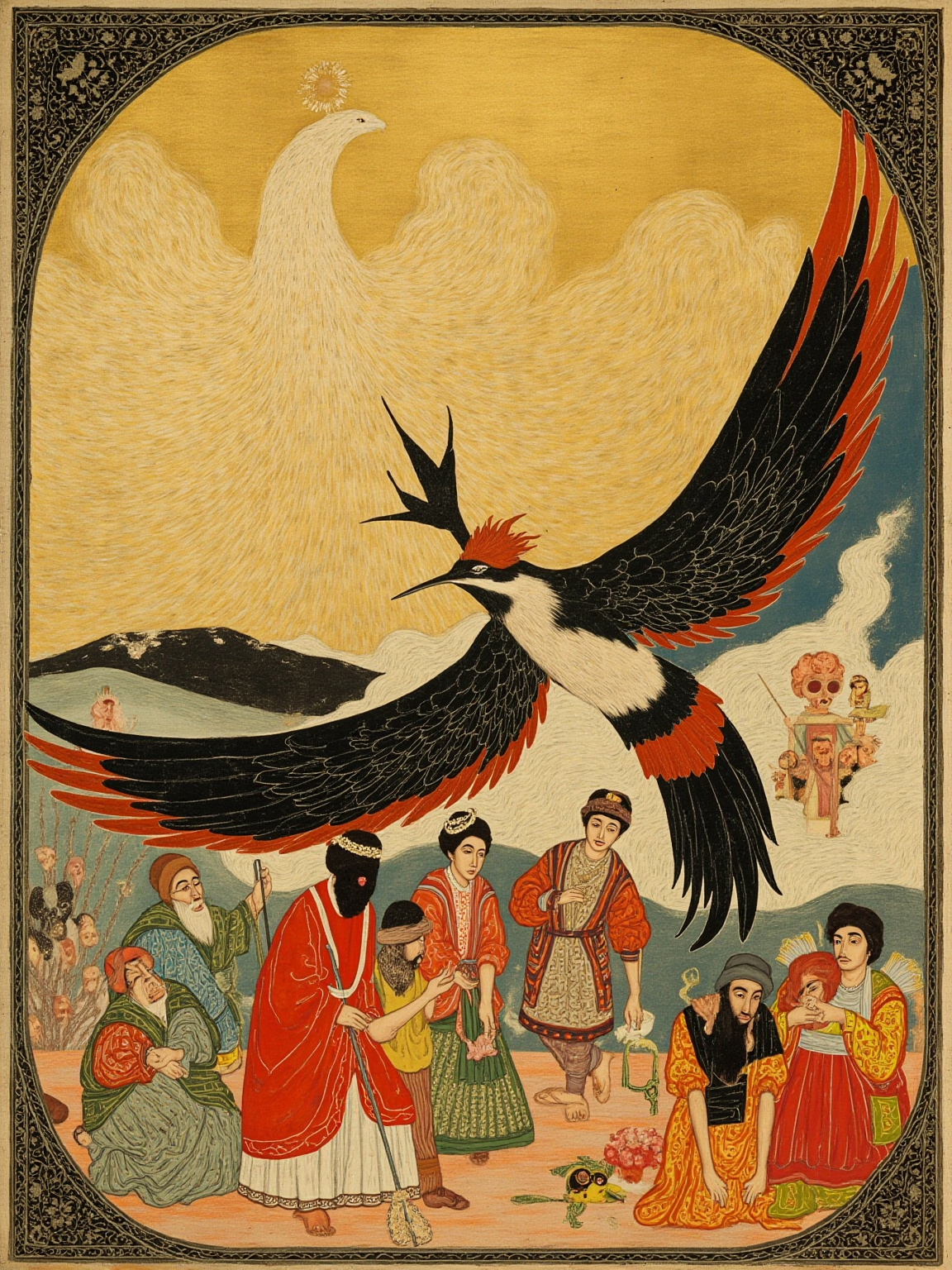
In the marketplace outside Nishapur, a hoopoe lands on a merchant's scale and calls every bird in the world to assembly. The world has no king, it says, and the birds are leaderless, so it names one: the Simorgh. Thirty birds rise to answer, ready to fly to Mount Qaf and find it. The journey will take seven valleys.
What this book is
This is The Conference of the Birds, the twelfth-century Persian poet Attar's masterwork and the summit of Sufi narrative verse. Attar himself sold spices and medicines in Nishapur for a living; poetry was something he did on the side, and that trade seems to have sharpened his sense of the sacred and the ordinary sharing one counter. Written in Persian, running to some ten thousand lines, the poem turns an abstract spiritual process into a pilgrimage you can watch: each bird carries one obsession on the road, each valley strips away a layer of self, and what finally comes into view is not a distant god but the flock itself. It fills a gap most world literature leaves empty — a collective quest, not a solitary hero, all chasing the same thing.
The birds who show up
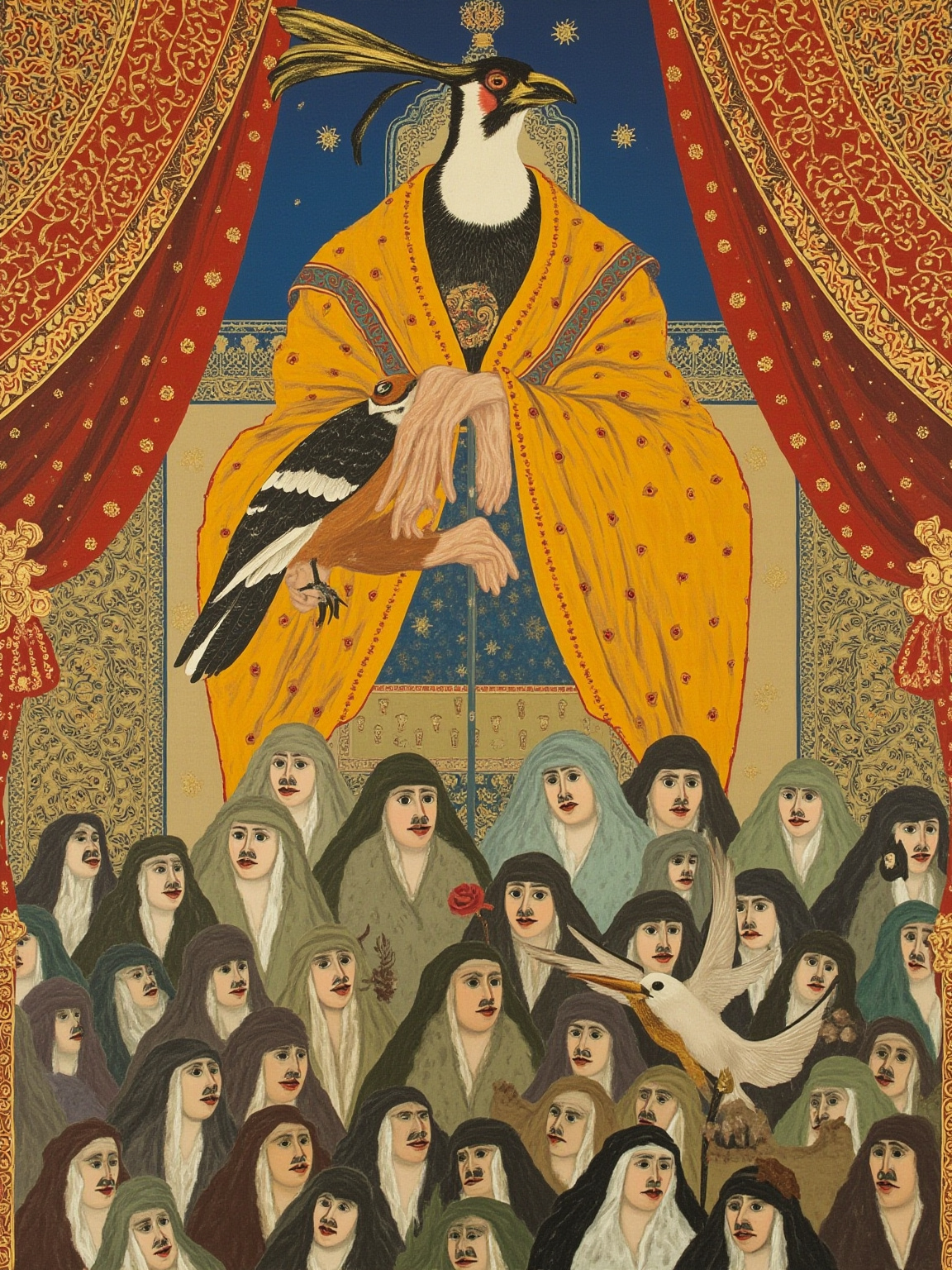
The hoopoe leads the flock and does most of the talking. It heard the Simorgh's name once at Solomon's throne, so it knows the route and it knows exactly what every excuse for turning back sounds like. The nightingale is the first to commit — it wants to find the Simorgh for the sake of the rose it loves. The pelican, oldest of the birds, is the only one whose whole practice is self-sacrifice; before the journey even starts it vows to feed the fledglings with its own blood. The peacock shakes out its bright feathers and will not move, held back by pride. The duck flaps and stays put in the marsh. The ostrich buries its head in the sand, muttering that believing in your heart is enough. Each bird carries a different sickness of faith: attachment to a lover, to beauty, to comfort, to words instead of deeds. They wear pilgrims' cloaks and speak like people, but Attar never lets you forget they are still birds.
The story is set in twelfth-century Khorasan, opening and closing in Attar's own city of Nishapur. Outside the walls, caravans converge on the marketplace; inside, a great mosque's dome is sheathed in gold leaf. The birds gather from every corner of the world and set out across the deserts, salt lakes, and wind-carved plateaus of Central Asia. These are not real coordinates so much as a map of the soul — each valley has exactly the weather it needs.
Seven valleys, each one strips away a layer
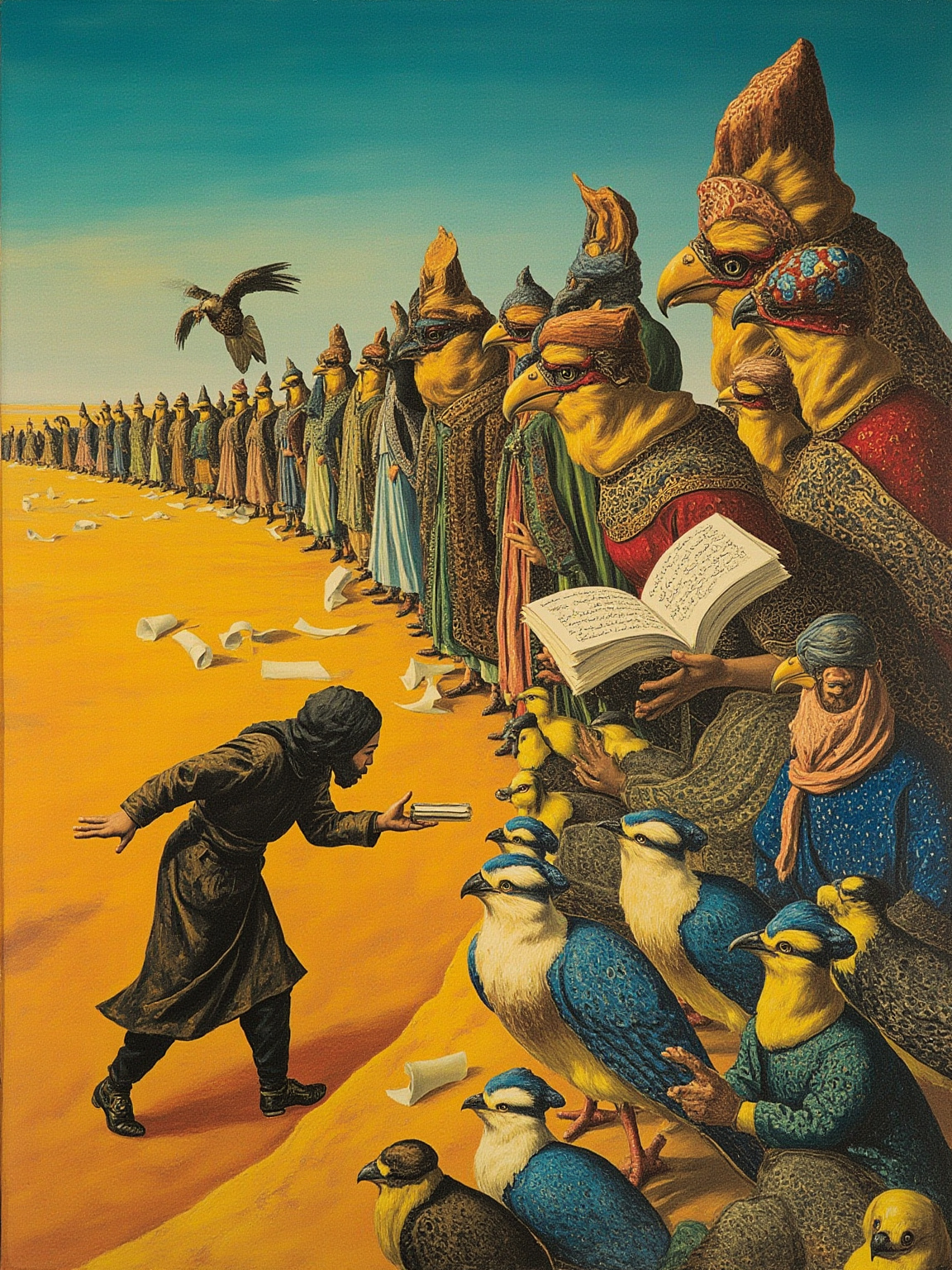
On the day they set out, the hoopoe does one thing first: it puts every hesitant bird on trial in front of the whole flock. The nightingale says it cannot leave its rose, and the hoopoe answers with a parable — you are infatuated with a shadow of the created world, not the creator, and if you stop here you have not taken a single step. The peacock says its beauty is too precious to risk on suffering, and the hoopoe cuts through that too: those bright feathers only exist because other eyes are watching; strip the audience away and there is nothing underneath. The duck pleads for the comfort of water, the ostrich insists that believing in your heart is enough, and the hoopoe turns down both. What I admire most here is how Attar stages every excuse for turning back before the flock even leaves the ground: the real threshold of a pilgrimage is not up in the sky, it is down here, and it opens the moment you set out.
The Way is long and the road is weary — yet how can the lover rest, when his very life is bound up in the quest?
道路漫长而疲惫——可情人如何能歇?他的性命本就系在这一场寻觅里。
金句 · 启程辩诘章 · 戴胜鸟演说
The flock finally lifts off and enters the first valley, the Valley of the Quest. Its lesson is desire — the same heat that drives you to search for God is also the disease. Attar does not write this valley as pure misery: the birds' throats burn, their feathers tangle, and still their wings keep pushing forward. The second valley is the Valley of Love, where the fire burns hotter and every bird has to drop something it once loved. The nightingale lets go of the rose, the peacock lets go of its own reflection, the dove lets go of a throne. Love at this depth scalds, because what burns is always something you truly did not want to lose.
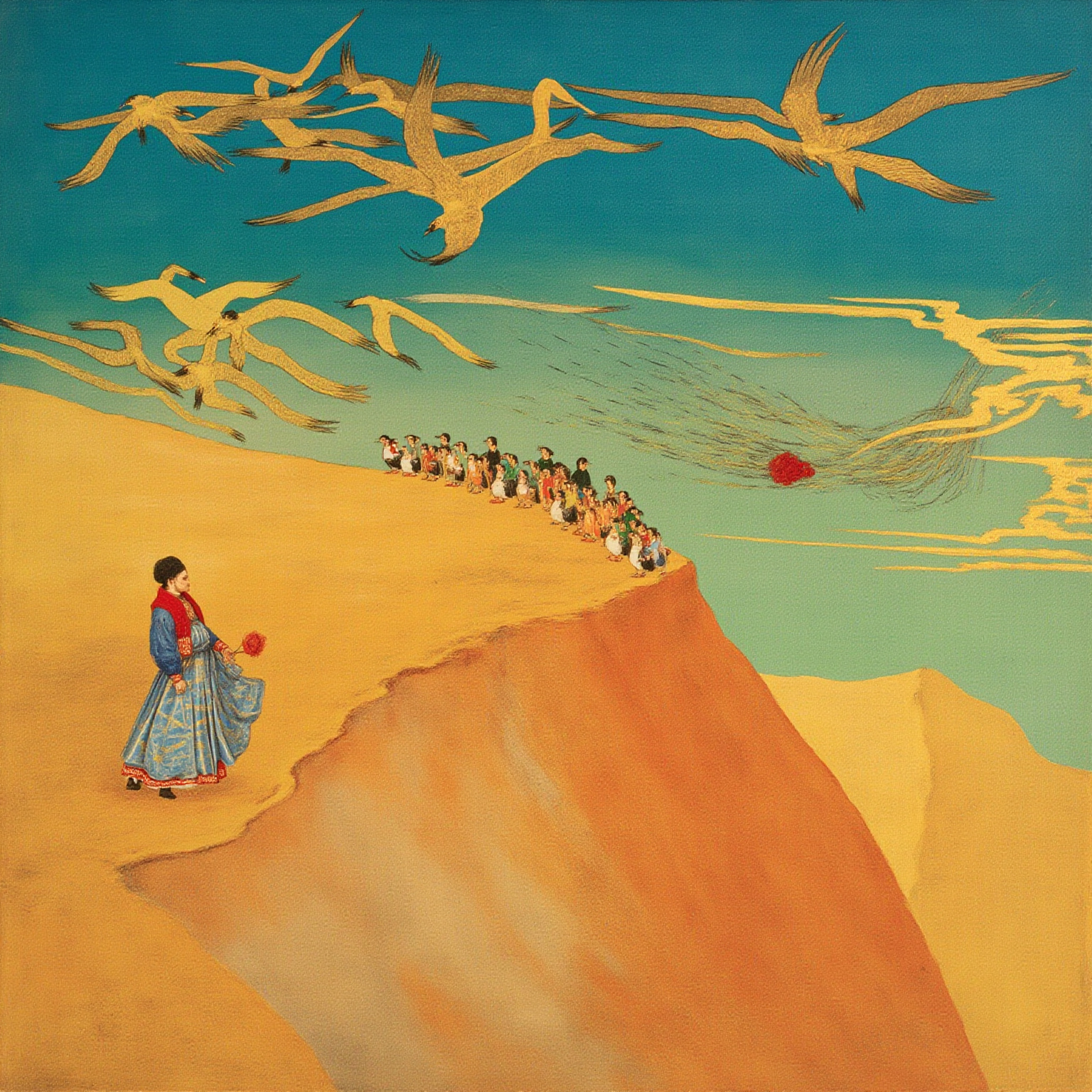
Journey on, for the Beloved is everywhere; let the heart become a mirror, polished bright with love.
继续走吧——所爱者无所不在;当让这颗心磨成明镜,被爱一遍遍擦亮。
金句 · 七谷启行章 · 寻求之谷
The third valley is the Valley of Knowledge. Here Attar turns the argument on itself: memorizing scripture and mastering argument until you believe you understand God is just another idol, dressed up as wisdom. The birds have to strangle the scholar living inside each of them. The fourth valley is the Valley of Detachment, where even the wish to see God has to go, because wanting to see is still wanting something back. By the far side of this valley, the flock has thinned to shadows.
Knowledge is a sea without shore; the more you drink of it, the deeper grows the thirst.
学识是一片无岸的海——你饮得越多,口渴就越深。
金句 · 七谷中行章 · 认知之谷
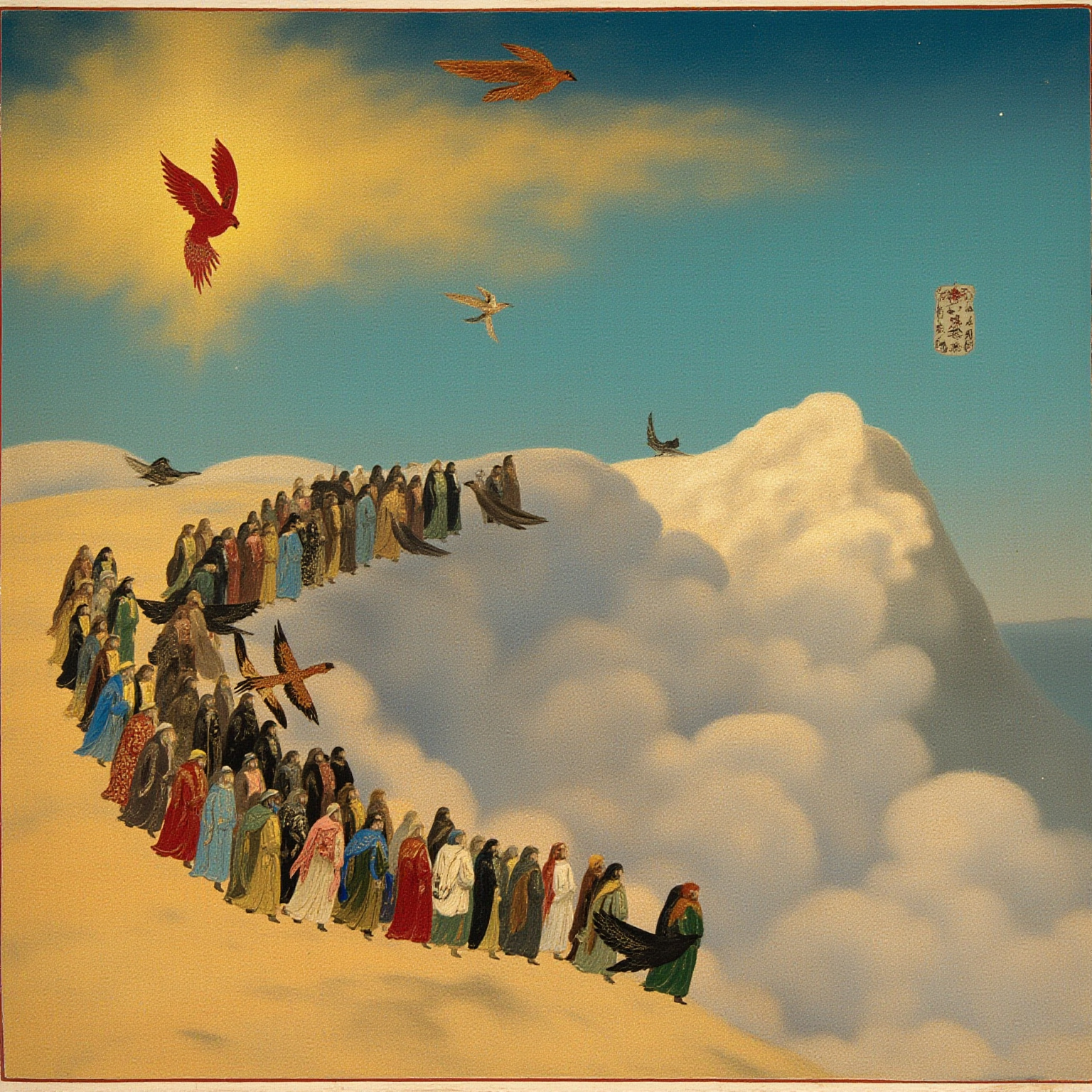
The fifth valley is the Valley of Unity, where everything dissolves into one light and the birds can no longer tell self from other, here from there. The sixth is the Valley of Bewilderment, which strips away even that unity — you realize you are nothing, not even someone who has let go of wanting. The seventh and last is the Valley of Poverty and Nothingness. Nothing is left to hold on to, not even the thought that you have become empty. By this point Attar's birds fly so far gone they can no longer make out each other's shapes; one opens its beak to ask if a companion is still there, and only a dry rasp of air comes out.
When you have lost even the self you thought was lost, then you shall see the face of the Simorgh at last.
当你连那个'已失落的自己'也彻底失去——那一刻,你终将得见西摩格之面。
金句 · 七谷深处章 · 贫无之谷
The second before the mirror is the cleanest stroke in the poem
Thirty birds stagger to the summit of Mount Qaf. There is no throne there, no great bird, nothing at all — only a mirror. The thirty crowd around it and look. What stares back is not a stranger's face but their own reflections. Si morgh, Persian for thirty birds, is the Simorgh. The god they had searched their whole lives for was the flock itself. The cut is clean because the wordplay and the philosophy click shut at the same instant, and neither one comes apart from the other. Attar never uses a word like enlightenment. He lets one image carry it, and at a moment like this a mirror does more work than any adjective could.
They came at last to the mirror of the Simorgh — and beheld themselves, the thirty birds, shining there.
群鸟终于抵达西摩格之镜——看见的,正是它们自己,三十只鸟,正在镜中发光。
金句 · 卡夫山镜前章 · 收束
The ending returns to the marketplace, under the mosque's dome
In the poem's final stretch, the birds return to Nishapur, and there is no glory of having reached the summit — they simply settle back into the marketplace, under the mosque's dome. Attar closes the circle beautifully: the destination was never the far mountain, it was the human world all along. The sacred was never waiting on top of Mount Qaf to be carried home; it had been living inside the flock's daily life from the start. This move saves the whole poem from reading like an otherworldly spiritual fable and returns it to the counter Attar actually knew — spice merchants calling out on the corner, worshippers washing before prayer, the birds settling back exactly where they started that morning.
What makes it work
Most spiritual poetry is good at feeling and bad at showing; Attar does the opposite. He takes something as abstract as the erosion of the self and forces it into a journey you can picture valley by valley. Each valley gets one bird's obsession, each obsession gets a parable that argues it down, and each parable stands on its own well enough to read as a short story — the structure is that tight. Then there is the pun that closes the whole thing: thirty birds is the Simorgh, which compresses the entire Sufi claim that knowing yourself is knowing God into a single line of Persian. That skill, turning abstract philosophy into images you can actually see, is why people are still reading this eight hundred years later.
What seven valleys were spent searching for had been flying alongside them the whole time — Attar built his entire poem toward this one second.
Worth reading even after you know how it ends
A guide like this can hand you a map; it cannot give you the feeling of walking the road. What makes The Conference of the Birds genuinely gripping is how physical it is: lips cracking with thirst in the third valley, eyes blinded by light in the fifth, birds no longer sure whether they are even still flying in the seventh. No summary can substitute for that — you have to read it bird by bird, line by line. And the dozens of side parables Attar weaves into the main story are each their own small universe; skip them and all you have left is the poem's skeleton. The map is in your hand. The road is still under your feet.
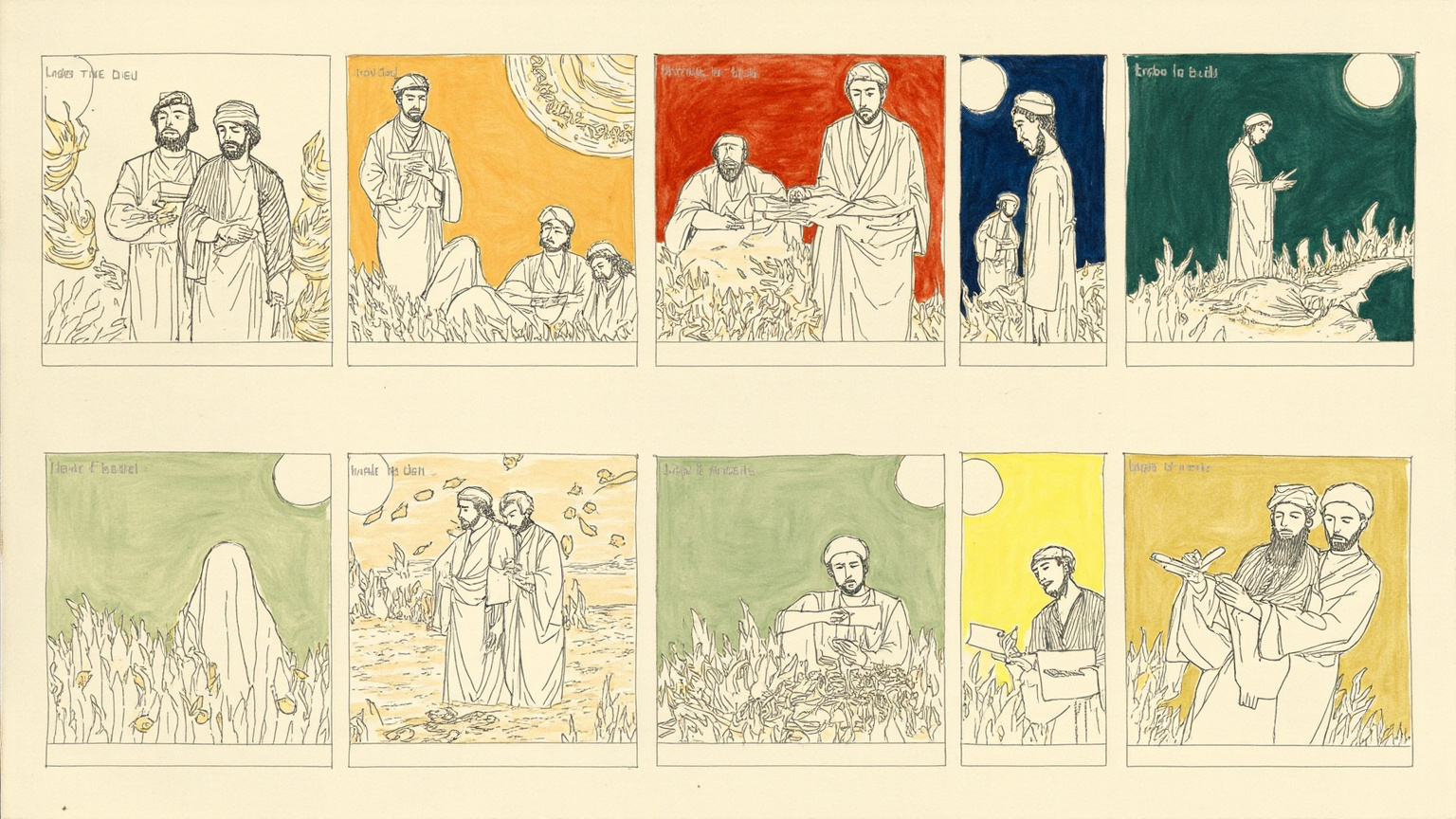
Art Direction4 plates
Before the guide was written, this book got a visual foundation — every illustration you just read grew out of it.


