Kerouac's 1958 book of Zen, written as an answer to On the Road
Text and illustrations produced by the pipeline
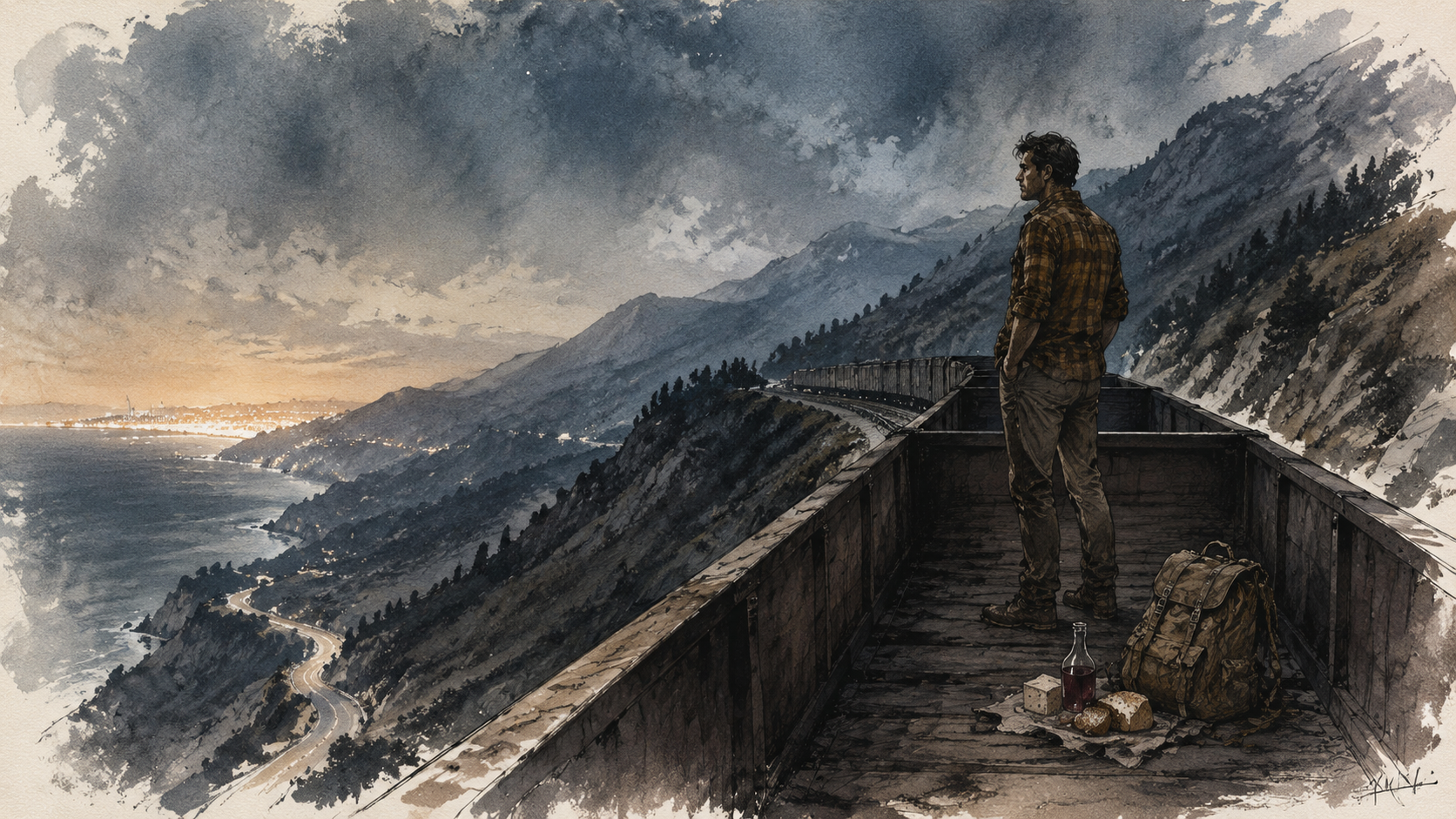
A dark boxcar. Half a loaf of bread, a hunk of cheese, a jug of cheap wine, the city dissolving behind you into a smear of dirty orange light. In climbs a bony old bum who pulls a crumpled copy of a prayer of St. Teresa out of his pocket and asks you to read it aloud. The wheels clatter on like some long litany, and you sit there listening to that absurdly plain old prayer and suddenly think: this is enough. This is closer to God than any church you were ever baptized in. That is what the first page of The Dharma Bums hands you. It is not a solemn book. It is a jolt that shakes you out of your seat.
Why would anyone still pick up a book from 1958? It follows a young American named Ray Smith drifting through the mid-to-late 1950s — riding a midnight freight north out of Southern California, meeting a young Zen madman come down from the mountains in Berkeley, climbing a lone peak in the Sierra Nevada with him, then parting ways. The book is full of sutras, Zen, mountaineering, camping, all-night talk, hunger, freedom. Call it the Beat Generation's mountain book — where On the Road runs on highways, whiskey, and jazz, The Dharma Bums lets off the gas, shoulders a canvas pack, and hands the body over to real rock, real frost, real thin air. It doesn't read like a novel so much as a friend leaning in close to tell you about the wildest months of his life.
Ray, the narrator, drifts between libraries and railyards, half obsessed with the Diamond Sutra, and tells anyone who'll listen that comparisons are odious — meaning stop pining for some other place, some other life, some other moment, because the piece of bread in your hand right now is the best bread there is. He's a little lazy, a little mystical, a little too much the poet, and his bones haven't yet been through the real grinding of mountain and snow.
The essay hands you the map; the text itself is the moment the cold air out on the snow actually stabs into your lungs.
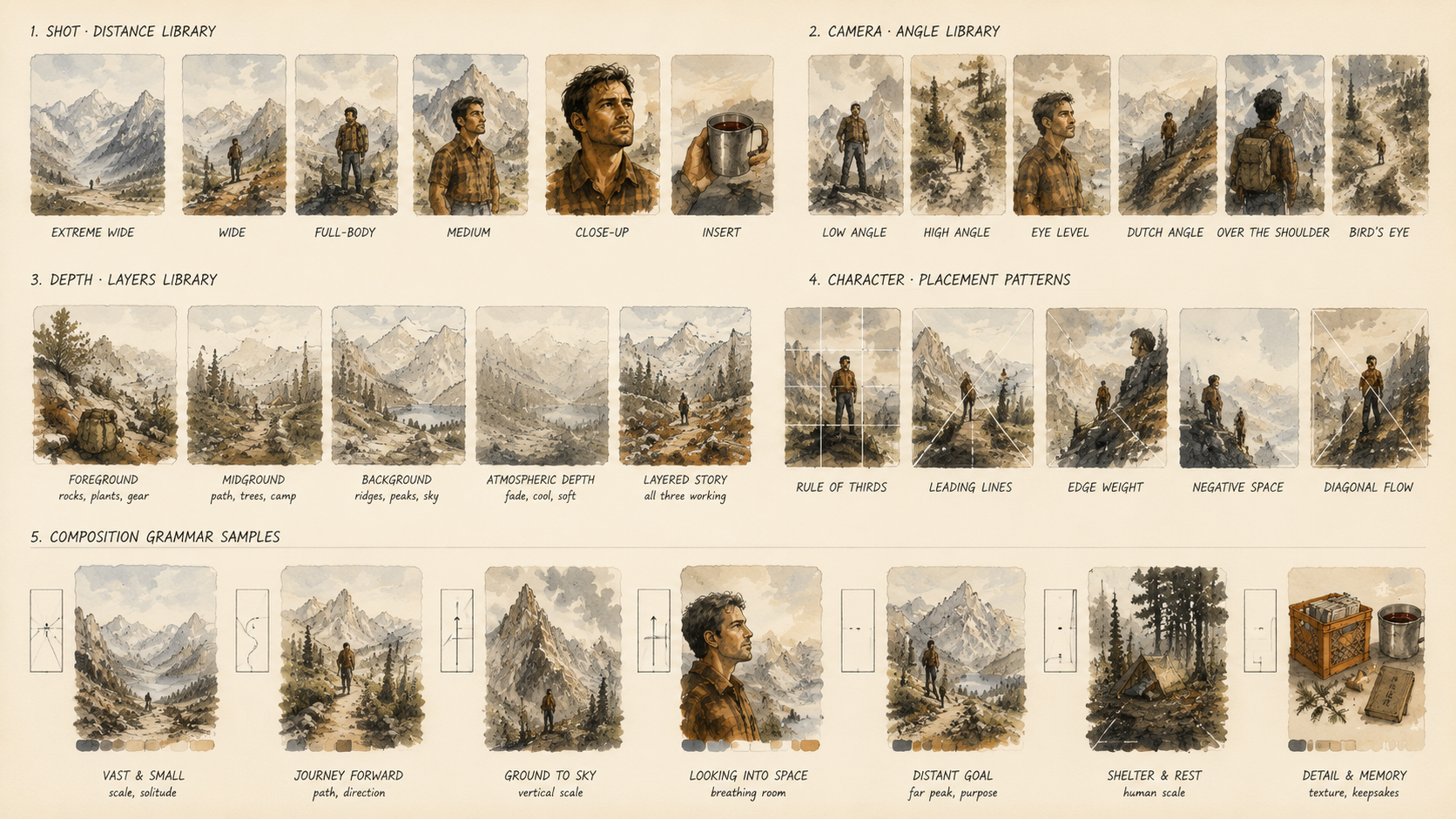
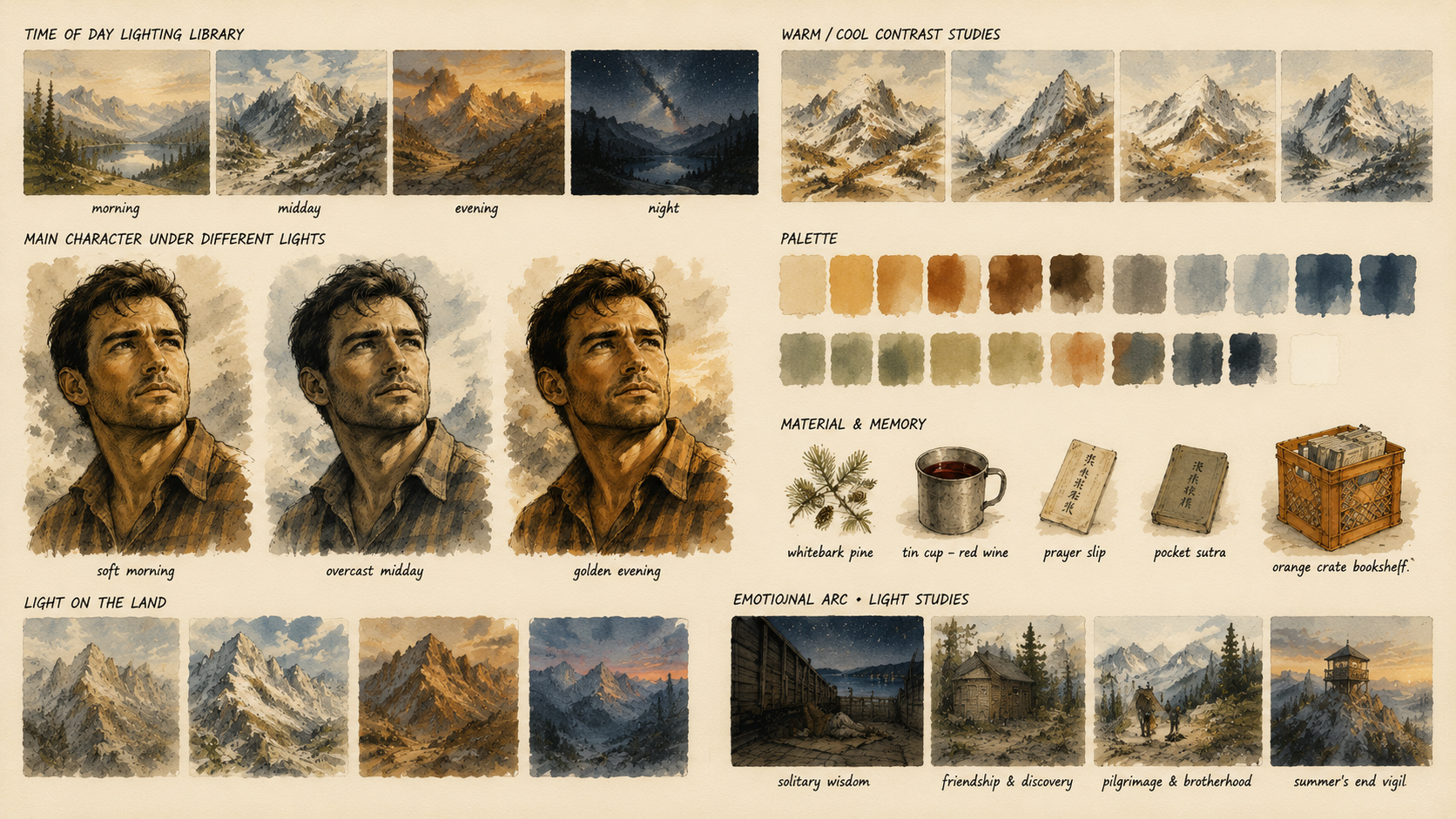
Before the guide was written, this book got a visual foundation — every illustration you just read grew out of it.
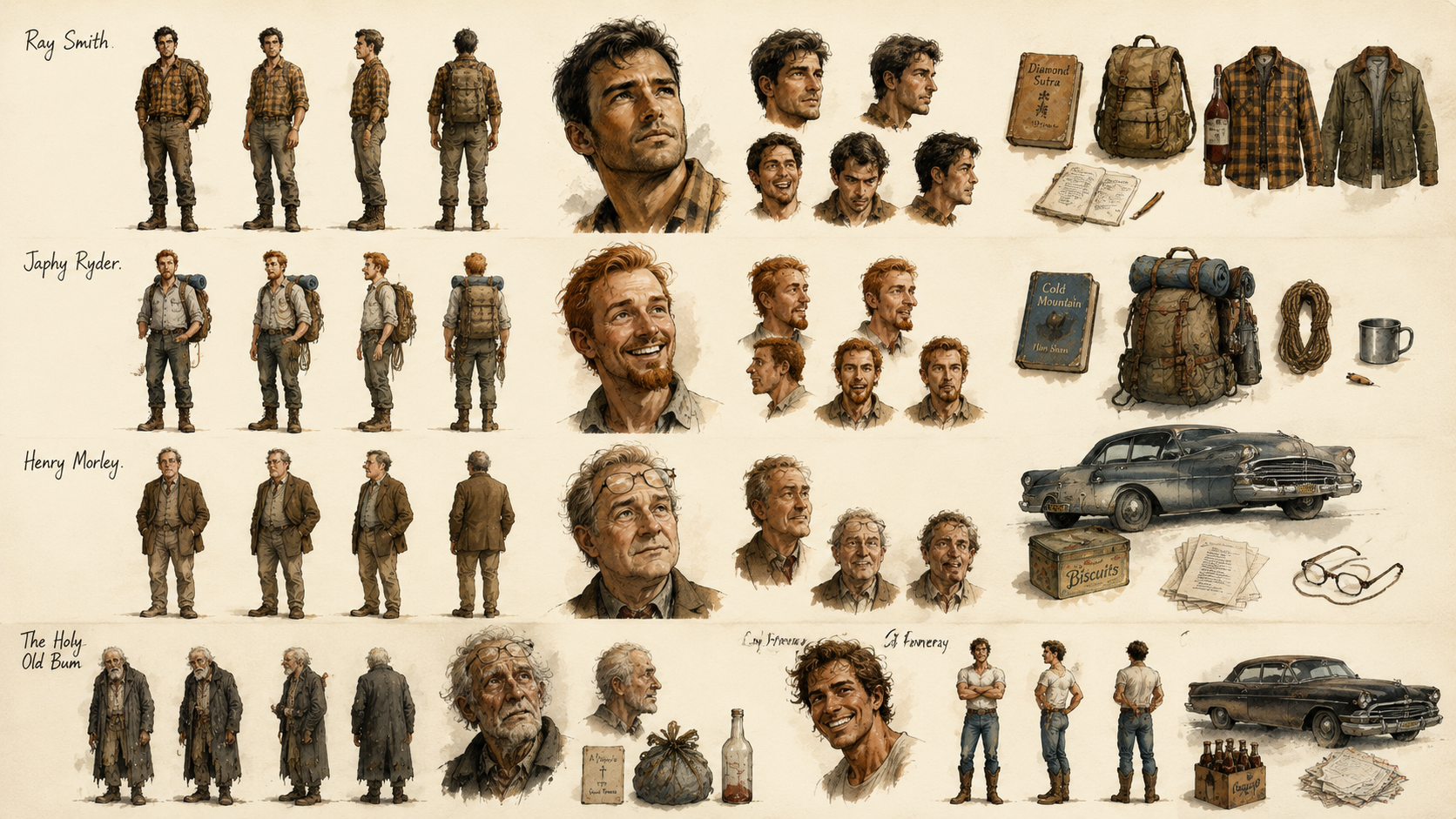
Japhy Ryder, a young logger and poet down from Oregon, lives barefoot on the wood floor of a backyard shack in Berkeley, translating the old poems of Han Shan while reciting the Diamond Sutra and mountaineering knots in the same breath. He's younger than Ray, tougher than Ray, and knows exactly what he wants out of life — to keep walking, keep climbing, keep pushing further into the mountains. Japhy is Ray's mirror image: Ray dreams of mountains from the city, while Japhy comes down from the mountains only to scrape together enough money to walk back into them.
The story unfolds on the late-1950s American West Coast: the San Francisco Bay Area with its Zen temples and poets' bars, the Sierra Nevada as true wilderness, and the Cascades up north as what Japhy calls the homeland of the mountains. The rules of this world are almost primitive in their simplicity — you own exactly as much as you can carry on your back, and you're free exactly as far as you can walk. Any apartment, any paycheck, any monthly payment is just another word for slow suffocation.
Ray first stumbles onto Japhy in that Berkeley shack, the two of them cross-legged on the floor, teapot after teapot going empty, talk running from Han Shan to Dharma, from the Diamond Sutra to climbing rope, from the difference between a bum and a wandering monk to whether a poet has to go hungry. Kerouac pulls off a move here you won't forget once you've seen it: he never writes they discussed philosophy. He writes the teapot empties, the candle burns down, crumpled paper piles up on the floor, and lets the scene speak for itself — the reader sits right there in that little shack, listening to the two of them burn cup after cup of tea straight through to dawn.
A few days later Japhy's eyes light up and he announces they're climbing Matterhorn Peak — not the tourist one in Europe, the one in the Sierra Nevada with real rock and real thin air. An old friend named Henry Morley, who knows Sanskrit and owns a car, gets roped in as the driver, and the three of them pack into his old car and head east. Japhy preaches the whole way: how to pick the right pack (not the army-surplus kind), how to saw the handle off your toothbrush, how everything you don't strictly need is a stone tied around your neck. The city is a slow, comfortable death; the mountains are the only real wealth.
That night at the foot of the mountain, Japhy spreads the gear out on a flat rock and delivers his last lesson: light, light, light. The stars press down cold, and the three of them sit on a fallen log saying almost nothing, because the mountain is already crouched black in front of them, and there's nothing left to say.
The next few days are real walking. Silver grass bends in the meadows, the smell of pine and granite sharpens with every foot of elevation, and past one ridge a lake of impossible blue lies among the broken rock. The two of them pitch camp on the sandy shore, build a fire, drink hot coffee out of enamel cups, and toss haiku back and forth at the moon. Kerouac pulls off something here that looks simple and is anything but: he lets the friendship between two men run not on plot but on shared silence. The moonlit path across the lake, the two pairs of eyes at the fire looking the same direction, needing no more words — the quiet itself becomes a third companion.
They're up at four to make the summit. The scree is so loose every step slides you back, Japhy bounding up it like a goat while Ray hunches over, gasping his way up. Over an hour in, they hit the hardest stretch — bare granite, nothing to hold, the peak just above. Ray flattens himself against the rock, frozen solid, the world at his feet looking ready to drop away entirely. Japhy is already up over the last slab, standing there, arms thrown open to the wind, grinning, and with a laugh the thin air at that height can't even suppress, he shouts down: a mountain never drops you — a cliff does. A mountain gives you a thousand places to hold on; the only thing that can drop you is the picture in your own head.
That's when Ray cries. Coming down, the two of them stop picking their way and just run — bounding down the loose scree in long strides like kids, silver waves of gravel kicking up around their feet, laughter and gasping and skinned knees and falls on their backsides all becoming the same thing: the fear hasn't vanished, it's been boiled down into something else, warm, giggling, the way a child turns a nightmare into a game of tag. This passage is the core of the whole book — Kerouac telling you that enlightenment doesn't happen in a temple, it happens in the muscles of your calves: you go up the mountain one person and come down another.
Back down in the city, still worked up, Japhy launches into his rucksack revolution: someday, he says, thousands of young Americans will kick jobs, apartments, mortgages, and televisions to the curb, buy secondhand packs, go bumming and hitchhiking, climb real mountains, watch fire, watch snow, watch the calluses grow on the backs of their own hands, read Zen, read yoga, read the old pagan religions — they'll turn into a kind of Chinese-style lunatic, not clowning around but people who've seen straight through the whole plastic middle-class dream and chosen, barefoot, to wake up. It reads like prophecy, but Kerouac lets a little self-doubt creep in too: listening, Ray is half persuaded and half aware that this is really just a man who badly wants the whole world to grow into the shape of his own mountain shack.
With Japhy's sermon on the saint's path finished, Ray wants to try his own path of solitude. He shoulders his pack, sticks out a thumb heading west, and tells no one goodbye. In the desert heat he hitches rides on strangers' trucks and unrolls a thin sleeping bag under low gray brush on the roadside. No bell, no teacher, no monastery — just wind moving through dry grass, a dog barking somewhere far off, stars slowly filling the whole sky. He sits cross-legged in the moonlight and lets his thoughts wander off one by one like cattle through a fence, no longer chasing them, no longer arguing with them, until all that's left to see is himself, and a cool, sufficient stretch of earth. That night he understands: the Dharma isn't in books, isn't in robes. The Dharma is this road.
Ray heads home partway through, back to North Carolina for Christmas. The train cuts through an iron-gray sky, and he watches the rolling pine forest out the window, that damp, red-clay, pine-needle smell he's known since childhood. His mother bakes a cake, his aunt mutters about when he's finally going to get a real job, and the whole little machine of middle-class American life keeps ticking along without him just fine. But one afternoon he slips into the pine woods behind the house, sits cross-legged on a fallen log as snow drifts down, and suddenly understands: Zen isn't up on some cold peak, isn't somewhere far away. Zen is in the backyard — that backyard has been a mountain all along.
After the holidays, Ray returns to San Francisco to news that drops like a stone into still water: Japhy has saved enough money and booked a one-way passage to Japan, to study under a real Zen master at a snow-country monastery in Hokkaido. The last night's party runs wild like jazz spinning out of control — liquor, guitars, girls dancing barefoot, someone crying in the bathroom, someone teaching sutras out on the back porch. Japhy sits in the corner, still wearing that same wide grin, ready to expound a koan to anyone who wants to hear one. Later the two of them climb Mount Tamalpais one last time, the fog breaking apart overhead, San Francisco glittering below the Golden Gate Bridge like a shattered mirror.
Standing at the threshold of Japhy's shack, Ray tries desperately to memorize every last gesture — the way he ties his bootlaces, the way he walks, the way his whole face shakes when he laughs. Once the gate opens, the bond between teacher and student comes apart. Japhy heads east to find his old Zen master; Ray heads west to find his own dharma — the one made of paper and pen and whiskey. Kerouac lets them part without a handshake, just a few plain words: good luck, old man, thanks. The restraint of the scene is exactly what makes it the tightest knot in the whole book.
At the end, Ray goes to a bare ridge in Washington State — Desolation Peak in the North Cascades — to work a summer as a fire lookout. Alone, in a cabin suspended above a sea of clouds, for the whole season. The first week the silence nearly drives him mad; by the second week the silence has become a room he can sit inside. He watches a weasel kill a mouse under the rocks and thinks: today's sermon is over. He can't make sense of D.T. Suzuki, and finds he doesn't need to. He writes a thousand lines of bad poetry, cries and laughs for no particular reason, sleeps like an infant. For the first time he truly understands the emptiness of the Heart Sutra — not as terror, but as the calm of every last drop of water gathering at the bottom of the bucket.
When summer ends he walks down the mountain into a small bar, drinks a beer, and knows he will never fully walk out of that mountain again. From now on it will live inside him, and everything else will be weighed against that silence. This is the quietest chapter in the whole book — Kerouac says the least here and opens the most space, no longer talking about Zen at all, letting the whole North Cascades speak for him instead.
On the surface, The Dharma Bums is a road-and-mountain novel about a bum, a backwoods poet, and a few peaks. What it's really about is less is more: want less, and you get lighter; get lighter, and you move closer to yourself; move closer to yourself, and you move closer to right here, right now — and everything Zen ever teaches ultimately just points back to right here, right now. Kerouac carries Zen out of the temple and drops it onto granite slopes, into kerosene flames, out the truck window onto the rolling highway — a full-bodied, physical rebuttal to the 1950s American middle-class dream.
For a reader today, it reads more like a sketch of an escape route drawn for everyone chased by work, screens, notifications, and rent. Kerouac isn't really telling you to go climb Matterhorn Peak — what he shows you is a posture: throw away the unnecessary things one at a time, and let the body arrive at a moment of clarity before the mind does.
The whole of Kerouac's slim 1958 book comes down to one line: a mountain gives you a thousand places to hold on; the only thing that can drop you is the picture in your own head.
Knowing the ending doesn't ruin this book, for the simple reason that it was never driven by what happens next. It runs on breath instead — how short the sentences are, how steady the pauses land, how the images stack up, layer by layer, into a rhythm you only find in the mountains. The loose, unclenched feeling of Ray sitting alone in the desert moonlight watching his thoughts drift off like cattle through a fence; the bright rush of gravel spraying like silver waves underfoot on the way down the mountain; that emptiness up in the lookout tower where he stares out at the whole North Cascades, can't write a decent line of poetry, and laughs out loud anyway — you can only get to these things by reading Kerouac's own sentences. A summary hands you a map; the actual text is the cold air stabbing into your lungs out on the snow.
What's more, the things Kerouac was saying back in the 1950s carry a strange, present-tense charge when you read them today — secondhand packs, ditching the apartment, ditching the monthly paycheck, digging the soul back out of the plastic. That sense of a prophecy coming true keeps The Dharma Bums from reading like a book from 1958 at all; it reads more like a sketch that later generations keep retracing. You don't read it to find out which mountain Ray climbed in 1958. You read it so that tonight, lying down, looking at whatever bread happens to be within reach, you can quietly say to yourself: this is enough.