The Divine Comedy / La Divina Commedia · Companion Guide
The Divine Comedy
Midway through life, he loses himself in a dark wood — and the ghost of an ancient Roman poet leads him down through the earth's core, across Hell, Purgatory, and Paradise, to let him see the stars again.
Opening: Have You Ever Lost Your Way at Midlife
Jolted awake in the middle of the night, a man in his mid-thirties finds himself standing in a dark wood, unable to find his way forward or back. Three beasts — a leopard, a lion, a wolf — close in on him from different directions, driving him back. He tries to climb the hillside ahead to find a way out, but the sun beating down on the mountain pass leaves him dazzled and blind. Just as he's about to be swallowed back into the dark, a figure steps out of the gloom — not a god come to save him, not a demon come to seize him, but an old Roman poet dead more than a thousand years, who says: come with me. I'll show you a different ending. This is not the opening of a nightmare. It's the opening a poem written at the start of the fourteenth century still gives to readers today.
What Kind of Book Is This
The Divine Comedy is a long poem Dante Alighieri wrote in exile, after being banished from Florence, in his native Tuscan dialect. He began it around 1308 and finished it around 1320, dying in Ravenna the following year. The poem runs to a hundred cantos, split into three parts — Inferno, Purgatorio, Paradiso — each with thirty-three cantos plus one introductory canto, adding up to exactly one hundred, a number that carried the weight of perfection in medieval theology. It's written in a scheme called terza rima: ABA, BCB, CDC, and so on — each tercet's rhymes reach into the next, one link locking into another, so the three-line stanza never breaks loose. The poem manages two things that almost never coexist in literary history. First, it takes the entire medieval Christian cosmology of the afterlife and lays it out as a journey told in the first person, one you can walk alongside. Second, it was written in the vernacular rather than Latin, and in doing so it single-handedly forged Italian out of a scatter of regional dialects into a language capable of carrying great literature. Botticelli, William Blake, and Gustave Dore all illustrated it in full — for seven hundred years, most of what the Western mind pictures when it imagines hell has come from this book.
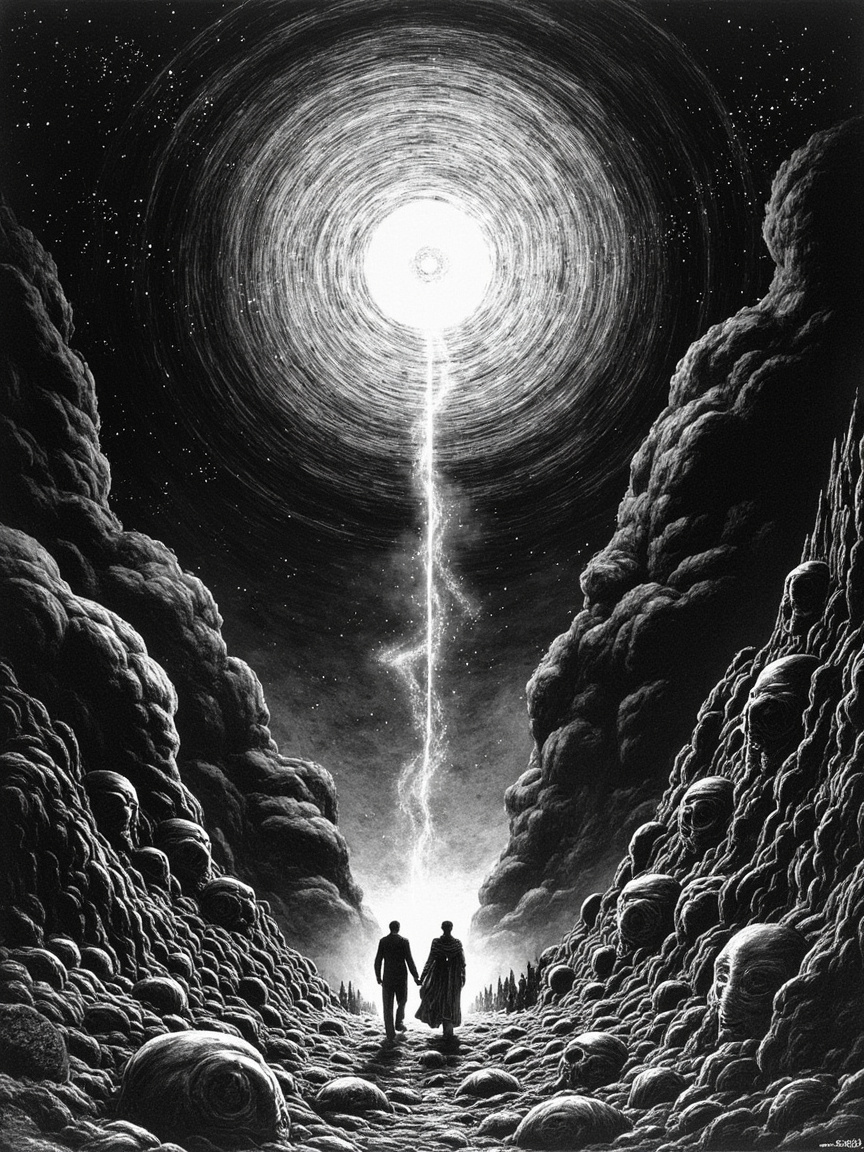
Midway upon the journey of our life I found myself within a forest dark, For the straightforward pathway had been lost.
在我们人生旅程的中途,我发现自己身处一片幽暗的森林,因为那条笔直的路已经迷失。
Original lines · Inferno, Canto I · The poem's opening, the dark wood
Three Living People, and a Rescue
Only three living people actually move through this poem: Dante himself, who is also the narrator, and his two guides — the Roman poet Virgil, and Beatrice, the woman he loved his whole life. Don't be fooled by the shape of a hero-saves-the-princess story — Dante didn't launch this journey himself. Beatrice, from heaven, sent Virgil down to rescue him. She isn't the one waiting to be saved. She's the rescuer. Virgil stands for human reason — he can lead you through the dark, tell you which way is which, explain the rules. But he's a virtuous pagan who died before Christ was born, and under the cosmology of the time that means he lives in Limbo, the shallowest circle of hell, and can never enter heaven. So his authority as a guide runs out at the top of the mountain of Purgatory. Beatrice stands for divine love, or revelation — only she can carry Dante upward, through the heavens, to look on God directly. The third and final guide, taking over at the very end, is Saint Bernard, who prays to the Virgin Mary in the highest heaven and wins Dante the right to gaze on the Celestial Rose, formed from the light of countless souls. Three people, passing the journey hand to hand; three forces: reason, love, grace.
The First Night: The Dark Wood and Three Guides
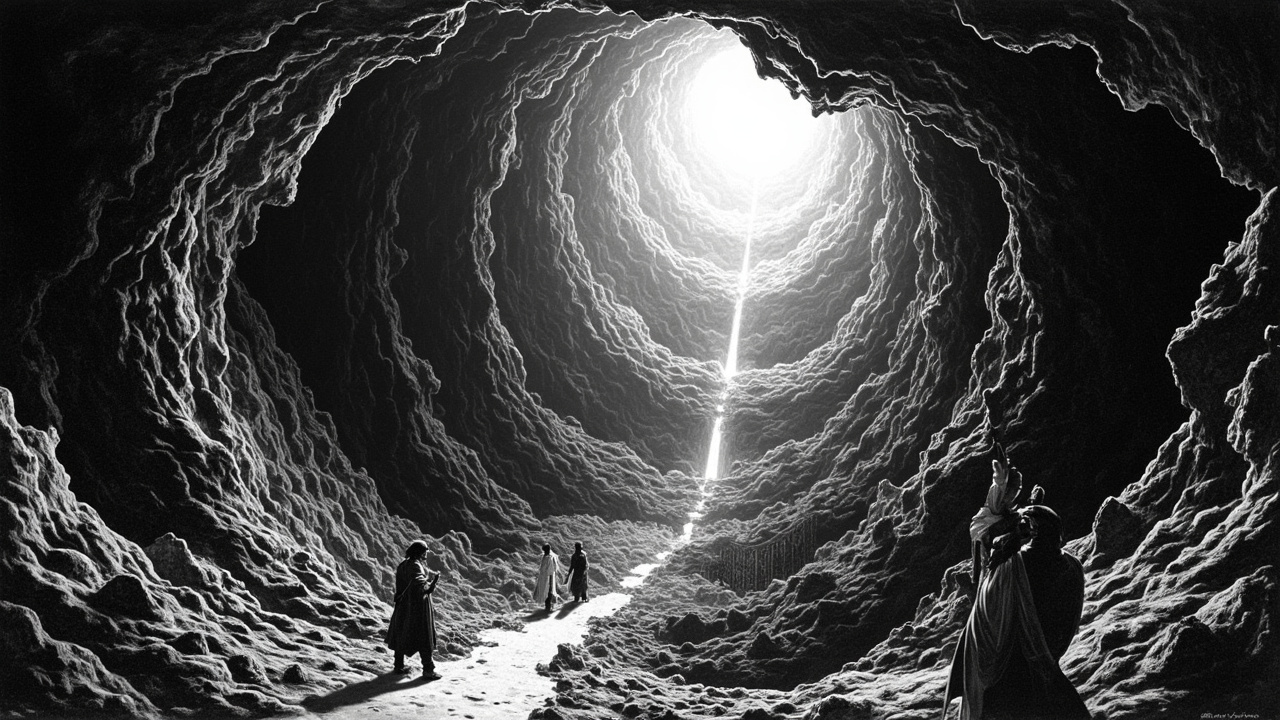
The story opens on the eve of Easter, 1300. Dante, lost in a dark wood at the midpoint of his life, is driven back by three beasts standing for three sins — a leopard for lust, a lion for pride, a wolf for greed — and he can't climb the mountain ahead on his own. The ghost of Virgil appears and tells him there's another way: not over the mountain, but through hell, purgatory, and heaven, to see a different ending with his own eyes. Then Virgil adds the line that sets the whole poem's foundation trembling: I didn't arrange this journey myself — Beatrice sent me down from heaven. You are remembered. What's worth noticing in the craft: Dante takes the private anxiety of a middle-aged man losing his way and sets it inside a cosmic coordinate system. You think you're reading about one man's wrong turn, but what he's really reading is his own life's sins, his city, his age. That's why this poem became something like an origin point for Western literature the moment it was written.
Hell: Moral Law Built as Architecture
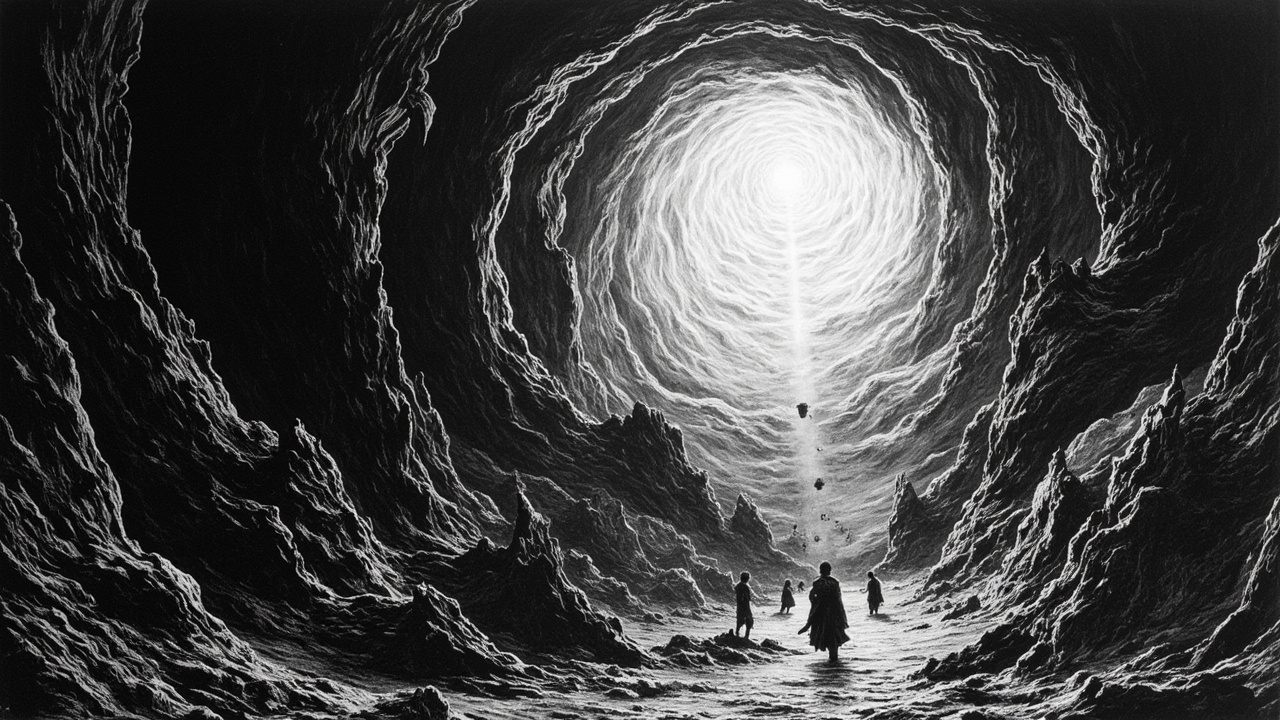
The two of them pass through the gate carved with an inscription of despair — abandon all hope, ye who enter here — and spiral down through nine concentric circles: the farther down, the heavier the sin, the smaller the circle. The shallowest is Limbo, home to virtuous pagans who died unbaptized. Below that are the lustful, driven forever by a violent wind. Further down are the gluttonous, the greedy, the wrathful, the heretics sealed in flaming tombs, the violent boiled in a river of blood, the deep trenches of the fraudulent, and at the very bottom, a frozen lake for the traitors, where Judas, Brutus, and Cassius, men who betrayed their benefactors, are locked in ice. Hell's governing rule is contrapasso, retributive symmetry: every punishment mirrors the sin itself — gluttons forced to swallow filth, diviners with their heads twisted backward so they can only ever look behind them, sowers of discord split down the middle by a sword, wound after wound, never allowed to heal. Sin here has been built into an architecture of punishment you can walk into and put your hand on.
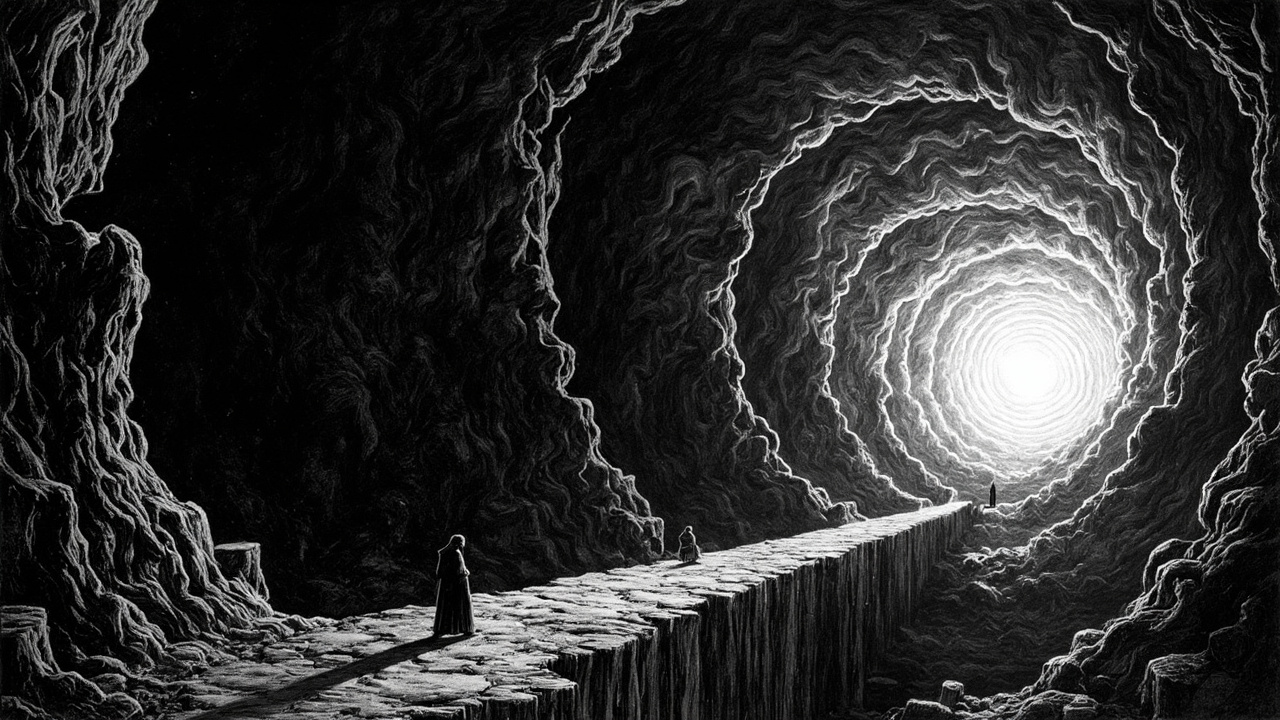
All hope abandon, ye who enter in!
入此门者,当弃绝一切希望!
Original lines · Inferno, Canto III · The inscription over the gate of Hell
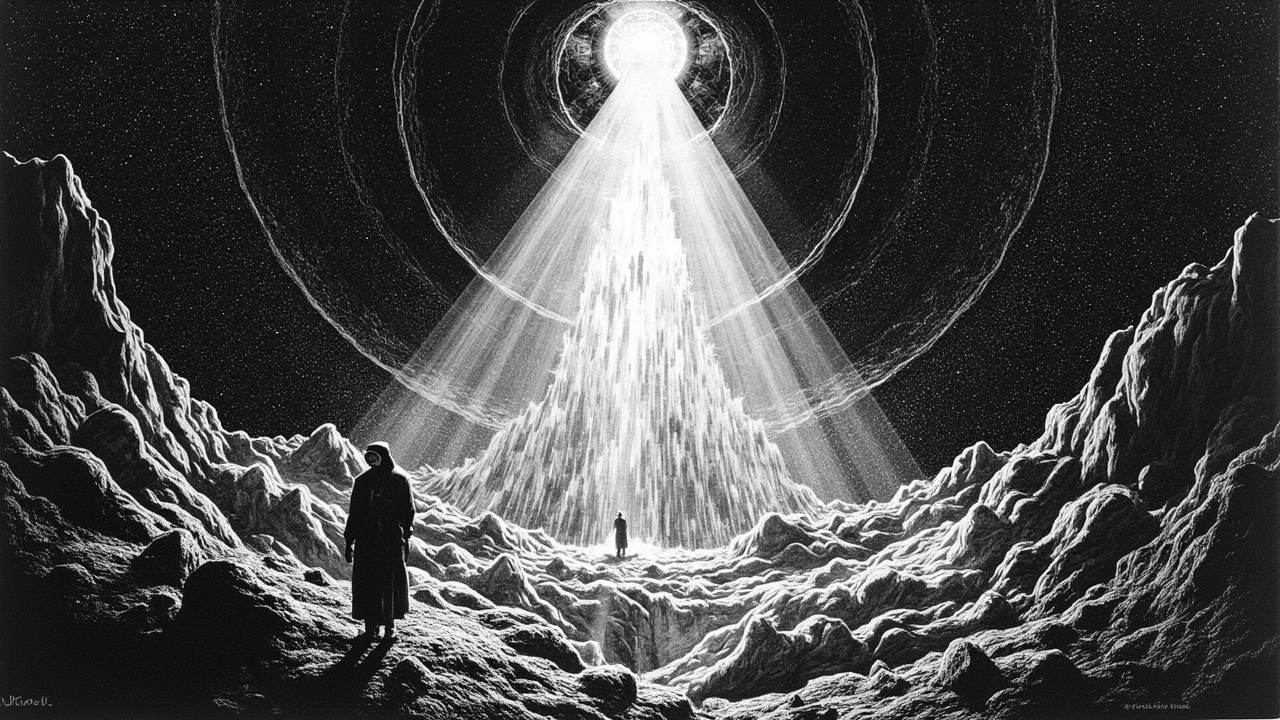
At the end of the nine circles is the center of the earth: the three-faced giant Lucifer, Satan himself, half frozen into the ice of Cocytus, his three mouths eternally chewing the three great traitors. It's a detail that runs against every instinct: the deepest point of hell isn't fire, it's ice. The heaviest sin isn't lust or violence, it's betrayal — betrayal of a benefactor, of trust, of love. What traitors get is eternal cold, not eternal heat. Here the poem does something that leaves you holding your breath: Dante and Virgil climb down Satan's own body through the center of the earth. The far side of the globe appears beneath their feet, they climb out past Satan's other side, and through an opening on the far face they see the stars overhead again.
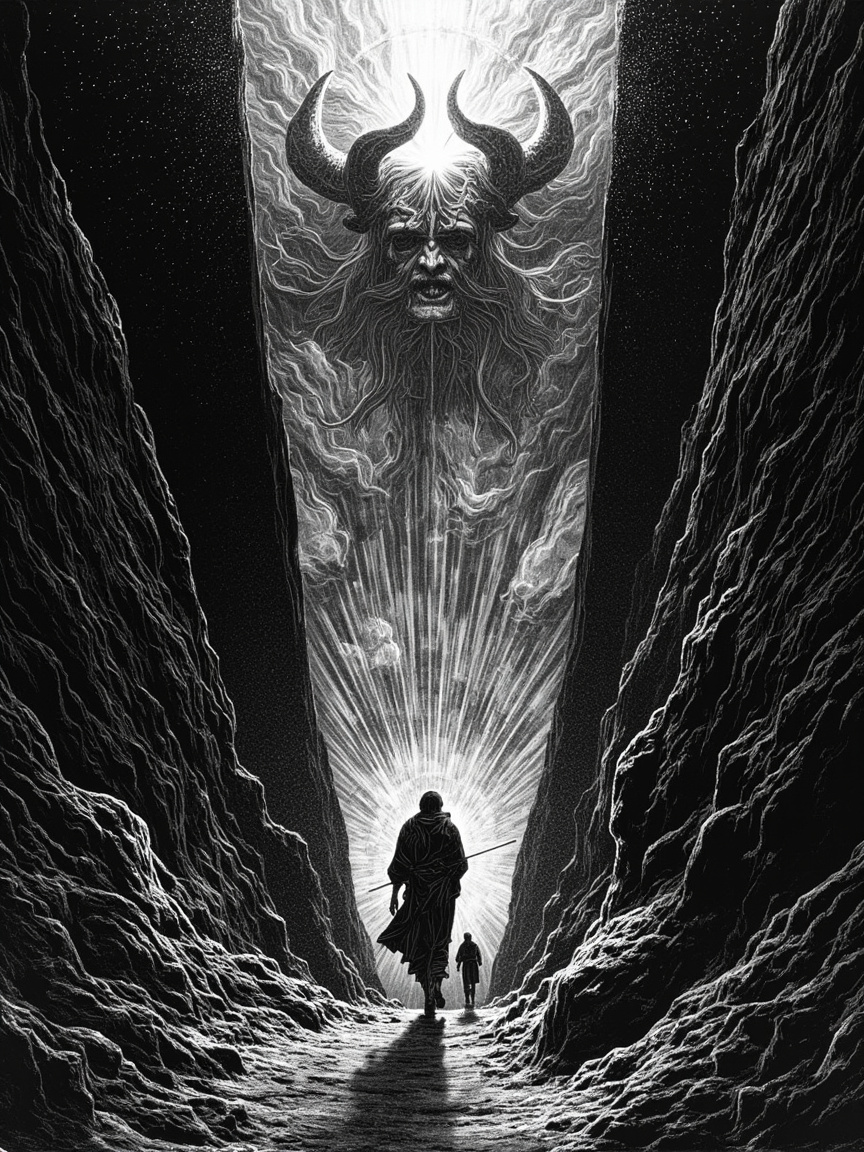
The Emperor of the kingdom dolorous From his mid-breast forth issued from the ice;
那痛苦王国的皇帝,自胸膛以上探出了冰面。
Original lines · Inferno, Canto XXXIV · Lucifer in the frozen lake of Cocytus — the deepest point is not fire, but ice
Purgatory: From Despair to the Hope of Labor
Past the center of the earth, they climb out onto the shore of the southern hemisphere, and ahead of them stands a mountain: the Mount of Purgatory. This was Dante's own invention, unique to his afterlife — hell is eternal punishment, but purgatory is temporary, a place of cleansing with an end date. At the mountain's foot, souls wait outside the gate to be admitted; above, seven terraces correspond to the seven deadly sins — pride, envy, wrath, sloth, avarice, gluttony, lust — and each terrace climbed sands down one more edge of sin. The key shift in atmosphere happens right here: everyone in hell lives inside an eternal present with no hope at all, while the souls on the mountain of Purgatory labor, remember, correct one another, and look forward to the day they will rise into heaven. Unlike hell's parade of horrors, glimpsed and passed by, Purgatory is a place with a sense of time — suffering here means something, because it will end. At the summit of the mountain is an earthly paradise, an Eden of forest and rivers. Virgil stops here. As a pagan, this is as far as he goes. Before he vanishes, he speaks some of the plainest and most heartbreaking lines in the whole poem, to the effect of: I have brought you this far; I can go with you no further; look at the light over there — that is your guide now.
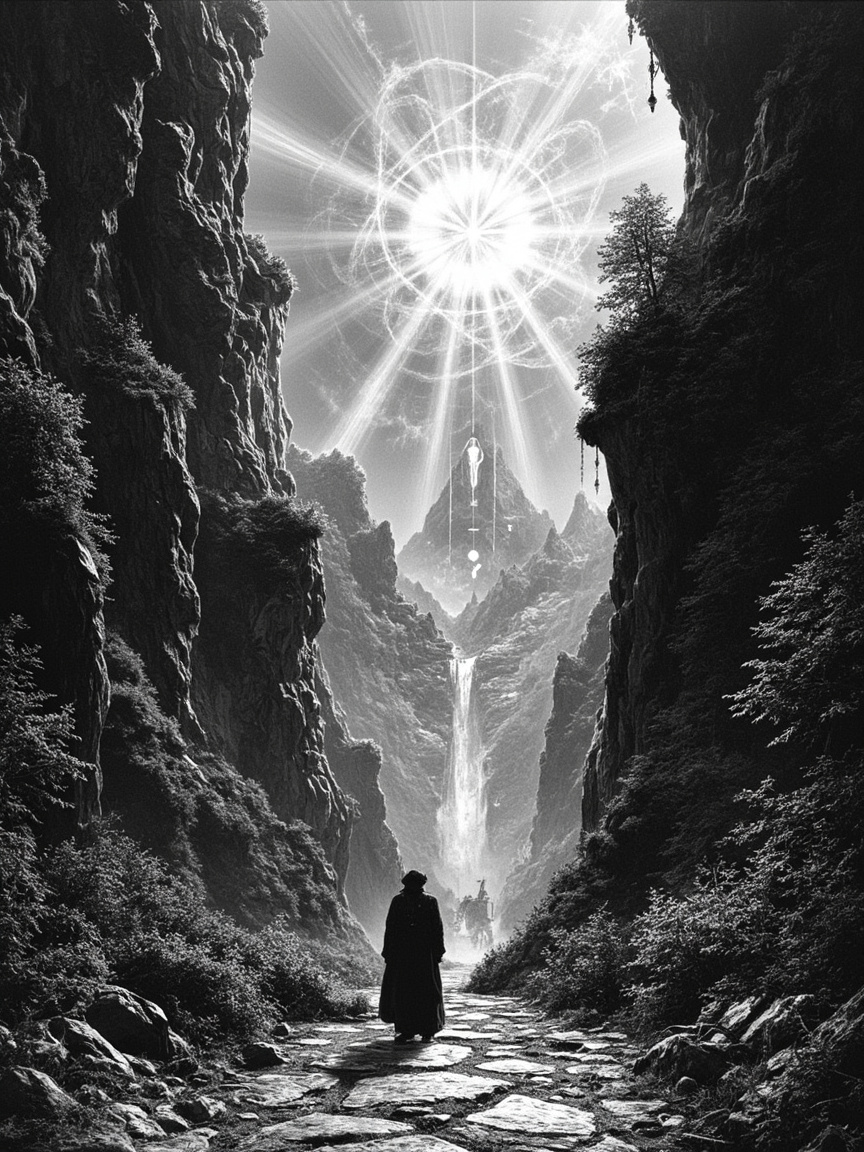
Thence we came forth to rebehold the stars.
我们从那里走出,重又望见了群星。
Original lines · Inferno, the final line · Climbing past the earth's core to see the stars again
Paradise: From the Sphere of the Moon to the Rose
Beatrice takes over as guide. Dante is told that from here on, the journey moves by seeing rather than walking — the strength of the eye replaces the movement of the body. She scolds him first, for having loved elsewhere after her death, and then they begin to rise. The nine heavens, moving outward, are the Moon, Mercury, Venus, the Sun, Mars, Jupiter, Saturn, the fixed stars, and the Primum Mobile — the standard model of the medieval cosmos. In each heaven Dante speaks with a different class of saved soul: the faithful, the hopeful, the loving; martyrs, saints, the wise, and kings. The farther out they go, the less material the beings become and the brighter the light, until language can no longer describe it. Past the Primum Mobile, the entire physical universe falls away behind them, and they enter the Empyrean — outside space, outside time, pure light, the dwelling place of God himself. The inhabitants here are no longer located anywhere. They exist at a certain intensity of love instead. In the Empyrean, Beatrice hands Dante over to Saint Bernard, the medieval abbot famous for his prayers to the Virgin. Bernard prays to Mary on Dante's behalf, and Dante is granted permission to look upon the Celestial Rose, formed from the light of countless souls — the Church, the redeemed, the whole of human history, gathered into a single flower of light.
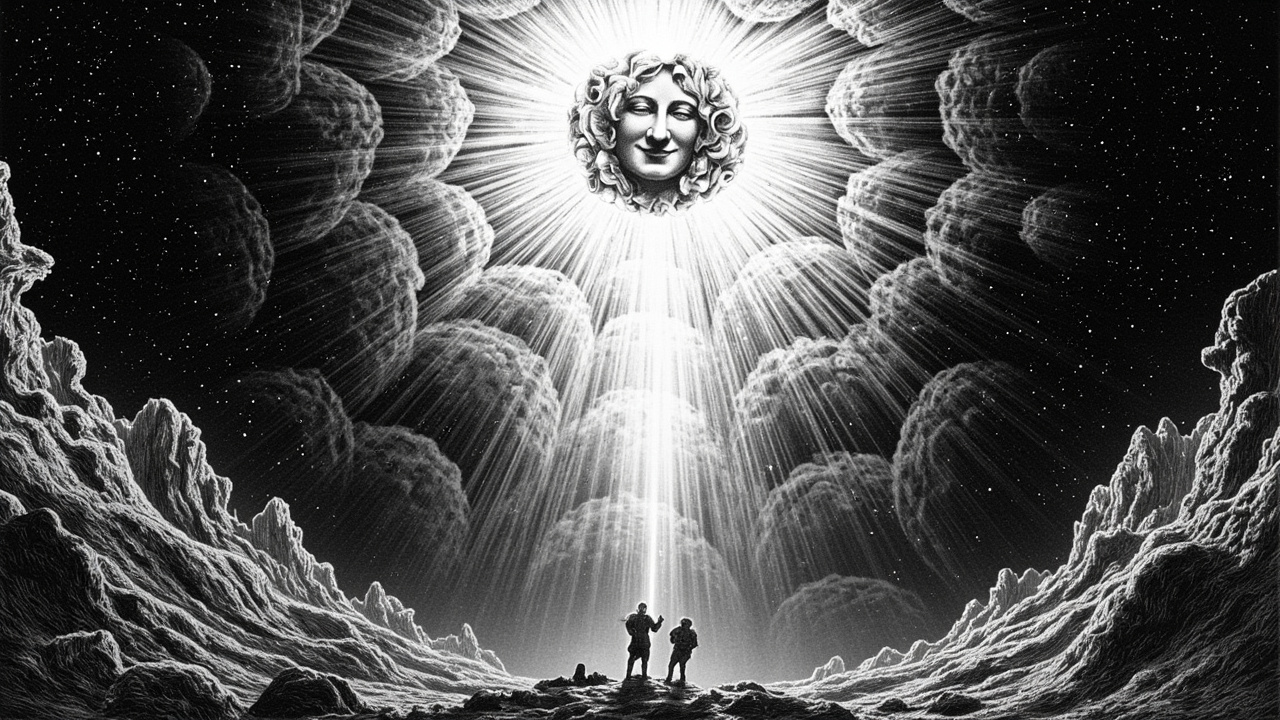
The glory of Him who moveth everything Doth penetrate the universe, and shine In one part more and in another less.
那推动万物者的荣光贯穿整个宇宙,在一处照得更亮,在另一处则黯淡些。
Original lines · Paradiso, Canto I · The opening, where light is the measure of grace
The Final Second: The Beatific Vision
In the poem's final lines, Dante's gaze pierces the rose, pierces the countless points of light, pierces Beatrice and everything that was ever made, and looks directly on God — and in that instant, the love that moves the sun and the other stars falls into his eyes. Love is no longer one person's feeling for another. It's the engine of the universe, the single first cause shared by physics and theology alike. Each of the three canticles ends on the same word: stelle, the stars. Inferno closes with once again I saw the stars. Purgatorio ends pure and ready to rise to the stars. And the final line of Paradiso is the love that moves the sun and the other stars. The same word, three different intensities of light, three different meanings — a road that began in darkness and ends, at last, in light itself.
The Love which moves the sun and the other stars.
是爱,推动着太阳和群星。
Original lines · The poem's final line · The beatific vision
What It Is Saying, and Why No One Has Put It Down for Seven Hundred Years
At its core, the Divine Comedy is about love and order: it turns abstract sin and punishment into a space you can perceive, turns theology into a chain of interlocking tercets, and lifts one man's exile into a pilgrimage across the whole universe. The number three governs the poem at every level — three canticles, three realms, thirty-three cantos apiece, three-line rhyme — the form itself is a theological statement. What makes it rarer still is that Dante built the most sweeping spiritual architecture of the medieval world in a regional dialect, letting private feeling and the largest possible questions drive each other forward. Seven hundred years on, we are still reading it, not because it hands down a pile of doctrine, but because it tells the story of one living man finding his way from being lost to standing in the light.
This is not a book that walks the road for you. It is a book that leaves you, once you have finished it, willing to walk your own again.
Why It Is Still Worth Reading the Poem Once You Know the Plot
A plot summary gives you the skeleton, but the skeleton is not the texture of this poem. Once you have read the explainer, you know who passed through which circle, who said goodbye where, who took over the guide's role last, but you have not heard the breathing rhythm of terza rima locking ABA into BCB, have not watched a single soul settle its whole life's account in twenty lines, have not felt the wind slap your face in hell's first circle or the scald of blood at your ankles in its seventh, have not heard Dante faint from sheer pity partway through the story of Francesca. That kind of dizziness, trembling, turning back, weeping is exactly what no plot summary can hold. More to the point, you have not met the private warmth of the exiled middle-aged Italian himself, the extra second he lingers on every politician he cannot stand, the extra sigh he lets out over every love story he can barely bring himself to hear. The poem looks like it is about the three realms of the afterlife, but buried in every layer of it is his judgment of, and his longing for, the living, his own city, this world. The reason to read it even knowing how it ends is that what actually shakes you in the text is not the destination. It is the living man muttering to himself the whole way through his pilgrimage.
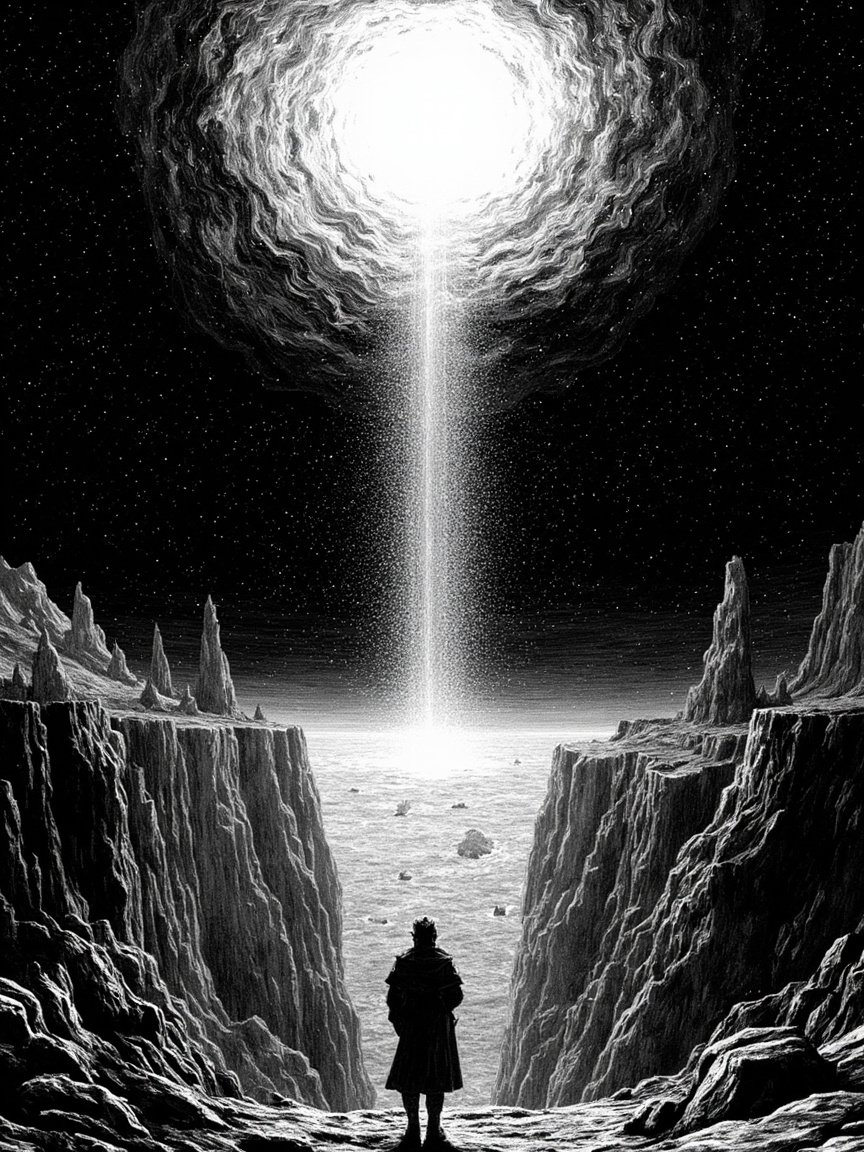
Art Direction3 plates
Before the guide was written, this book got a visual foundation — every illustration you just read grew out of it.