The Gateless Gate (Wumenguan) · Companion Guide
无门关
南宋禅僧把四十八个说不通的问题钉在纸上,每一个都设计成让你停下来——不是让你答,是让你不再问。
Opening: A Barrier With No Gate Number
A monk holds a knife to a cat's throat, looks around the hall full of monks, and says: speak and I'll spare it, stay silent and I'll kill it. No one speaks. He brings the knife down. That night another monk returns, hears what happened, takes off his own sandals, sets them on his head, and walks out the gate. This isn't a gangster film. It's Case 14 of The Gateless Gate, the collection the Southern Song monk Wumen Huikai put together — Nanquan Kills a Cat. It asks you: if not killing is mercy, is killing another kind of mercy? The book doesn't answer. It shoves the question in front of you and walks off.
The Gateless Gate runs forty-eight cases, with no continuous plot, no protagonist, no rising and falling action. It's a book that nails questions to the page — each one was built not to be answered but to stop the person asking it. The compiler calls these forty-eight questions barriers: a barrier is a gate, a gate is a barrier, and gateless means there's no door here you can push open — but you still have to get through.
What Kind of Book This Is
It was compiled in the 1220s at Jingshan Temple in Hangzhou, in the Southern Song, by the Linji-school monk Wumen Huikai, whose secular surname was Liang. Chan Buddhism had by then been transmitted for six or seven hundred years — from Bodhidharma's arrival from the west, through the Sixth Patriarch Huineng, to the branching of its various lineages — leaving behind a mass of exchanges between masters and students that no one could quite pin down. Later generations called these koans. Wumen did something no one before him had done systematically: he pulled forty-eight cases out of that enormous body of material, attached his own commentary to each, added a four-line verse, and put the whole thing together as a collection meant to be worked through by hand. It later drifted overseas along with the spread of Japanese Zen and became the koan collection most studied in Japanese Zen monasteries — but in China itself, it stayed for a long time inside a narrow circle of specialist readers.
It's remembered because it fixed a way of transmitting the teaching into a shape: Chan doesn't state the Dharma directly, doesn't write treatises, doesn't define its terms. It uses a question about whether a dog has Buddha-nature, a sudden shout, the fall of a blade, to cut straight through the conceptual thinking running in your head. This book is the specimen of that method.
Who Appears: None of Them Is the Protagonist
No one carries the whole book. The masters who appear — Zhaozhou Congshen, Nanquan Puyuan, Huangbo Xiyun, Baizhang Huaihai, Linji Yixuan, Yunmen Wenyan, Dongshan Liangjia, Deshan Xuanjian — are all real figures from Chan history in the Tang and Five Dynasties periods, the eighth through tenth centuries, gathered by the Southern Song compiler Wumen into their own separate cases. Each one appears only once or twice, and every appearance is a single action or a single line — like a walk-on part in a play: step onstage, deliver the line, step off, and the next one comes on.
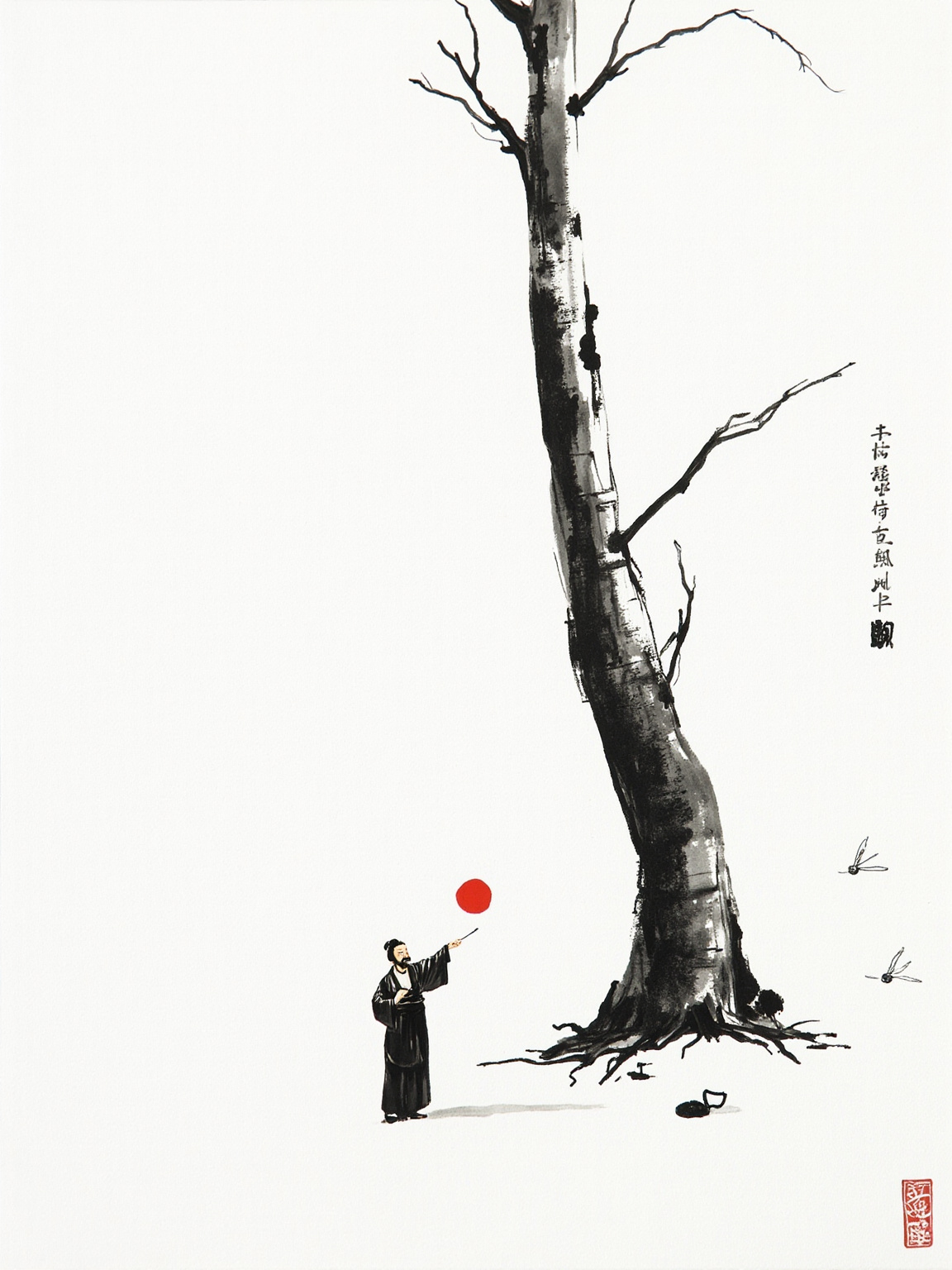
If you can say it, I will spare the cat. If you cannot, I will cut it in two.
道得即救,道不得即斩。
金句 · 第三则 · 南泉斩猫
Zhaozhou appears the most. A good share of the forty-eight cases are attributed to him — Does the dog have Buddha-nature?, Go drink your tea, The ten thousand things return to one, and where does the one return to? This old man was still traveling from temple to temple in his eighties, and whenever someone came to ask about the Dharma, he answered with some small piece of ordinary life. Notice that Zhaozhou never once gives a straight answer to anyone — and yet people leave him quieter than they arrived.
The real 'I' in this book is the compiler, Wumen himself. The commentary attached to each of the forty-eight cases is his voice — he takes a line from some other old master, or writes one of his own, and pushes the case a step further; the four-line verse at the end of each is his as well. Reading this book, you're really having a conversation with the mind of an old monk in the Southern Song.
Case One: The Dog's Buddha-Nature — the Book Opens on One Word, No
The first case in the book: someone asks Zhaozhou — does a dog have Buddha-nature or not? Zhaozhou answers: No. Just that one word. Wumen turns this No over and over in his commentary, and the last line of the verse he writes is a single word: Look! This No doesn't mean the dog lacks Buddha-nature — if it did, Zhaozhou would simply be denying it, and Chan doesn't work that way. The No is a cut. The moment you ask whether the dog has Buddha-nature or not, you've already framed the question inside the pair has and has-not, and Zhaozhou's No knocks the frame over. Once it's knocked over, you're left standing there, and the question you started with has collapsed under you.
What to notice in the writing: the book sets its rule on the opening page — this case tells you what the other forty-seven are doing. One word knocking down a whole question isn't a rhetorical trick. It's the basic move of Chan transmission: answer with something that makes no sense, and use it to stop the momentum of the asker's thinking.
Case Two: Baizhang Beats Huangbo — Three Days, Three Beatings
Huangbo Xiyun goes to Baizhang Huaihai and asks: what is the essential meaning of the Dharma? Baizhang doesn't answer — he picks up his staff and hits him. The next day Huangbo comes back with the same question and gets hit again. The third day, the same thing. Three days, three beatings, and Huangbo walks away dazed, wondering on the road home whether he asked the question wrong. Another monk sees him looking gray and asks what happened; when Huangbo tells him, the monk laughs. Next time, he says, ask him again — what is the essential meaning of the Dharma? — and when he raises the staff to hit you, grab it and turn the question back on him: master, who is it you're hitting? Huangbo goes back and tries it. Baizhang raises the staff to strike, and Huangbo lets out a great shout. Baizhang laughs. Well, Huangbo, he says. You've got it.
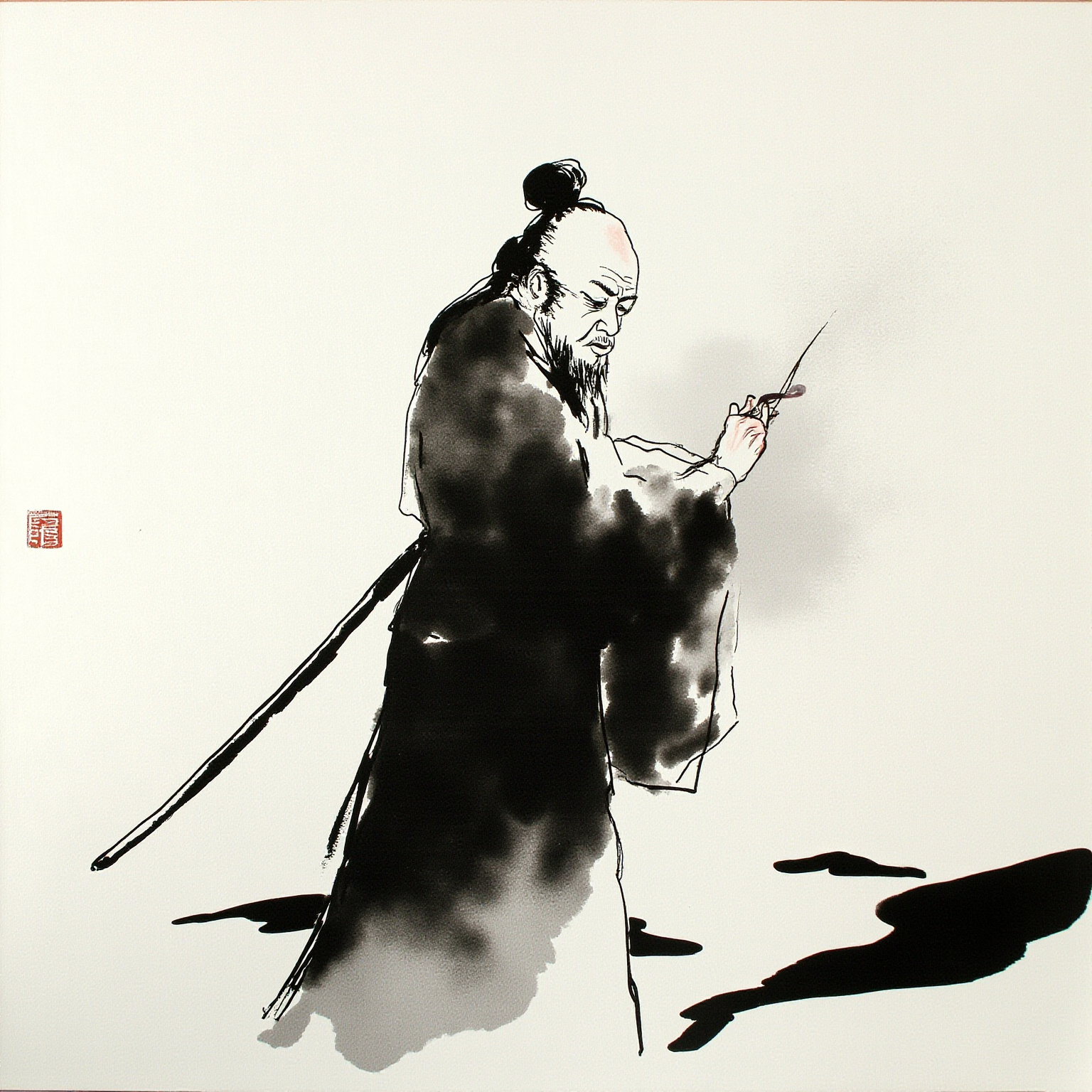
Not a single word was spoken. He struck the cat and cut it in two.
众僧皆无对,南泉斩猫。
金句 · 第三则 · 南泉斩猫
This is a specimen of the answer that refuses to answer. Baizhang hits him all three times instead of speaking, because the moment he speaks, the Dharma becomes a concept, and a concept is exactly what Huangbo would run off with and get lost in. It has to be an action — the staff — that knocks Huangbo out of the state of asking, so he runs straight into the moment of his own asking. What to notice in the writing: a koan doesn't describe what someone is thinking, it describes what they do. Three beatings, three questions, three answers — three nearly identical beats carried forward by the rhythm of the staff going up and coming down. In the commentary, Wumen adds a phrase — great capacity, great function — so the reader understands this was never a beating. It was the teaching itself.
Case Three: Nanquan Kills the Cat, Zhaozhou Puts a Sandal on His Head
At the mountain temple where Nanquan Puyuan was abbot, the monks of the east hall and the west hall were fighting over a cat, and neither side would give way. Nanquan saw it, picked up the cat, raised a knife, and said: speak and I'll spare it, stay silent and I'll cut it down. The whole hall went quiet. He brought the knife down. That night Zhaozhou Congshen came back to the temple, and Nanquan told him what had happened that day and asked what he would have said. Zhaozhou bent down, took off the sandal on his foot, set it on his head, and walked straight out the gate. Nanquan sighed. If you'd been there today, he said, the cat could have been saved.
The key to this case is the sandal on Zhaozhou's head — you can't read it as a plea for animal welfare. Taking off a sandal and putting it on your head is an impossible act, and doing it shows that Zhaozhou is no longer standing inside the divide between object and life, which is exactly why he can answer at all. When Nanquan says if you'd been there, the cat could have been saved, he isn't praising Zhaozhou's kindness — he means that when someone capable of answering is present, the question itself comes undone. What to notice in the writing: the act of killing the cat takes only a few words in the case, and in his commentary Wumen never writes killing or cruelty — he treats both the knife and the cat as figures, not facts. Nothing here should be drawn as a literal blade, blood, or a recognizable cat. How the text turns violence into a flash of insight is the hardest thing this case has to carry.
Midpoint: The Sixth Patriarch's Two Lines of Verse
In cases eleven and seventeen, at the book's midpoint, Wumen pulls the reader back to two founding moments of Chan. One is the night the Fifth Patriarch, Hongren, passed his robe to the Sixth Patriarch, Huineng, and Huineng answered Shenxiu's verse — the body is a bodhi tree, the mind a bright mirror's stand, wipe it clean at every hour, let no dust collect — with his own: fundamentally there is not one thing, so where would dust collect? The other is the case that sets Huineng's answer against Shenxiu's, where Huineng says: let the mind arise without settling anywhere — don't let it stick to anything, just let what happens pass.
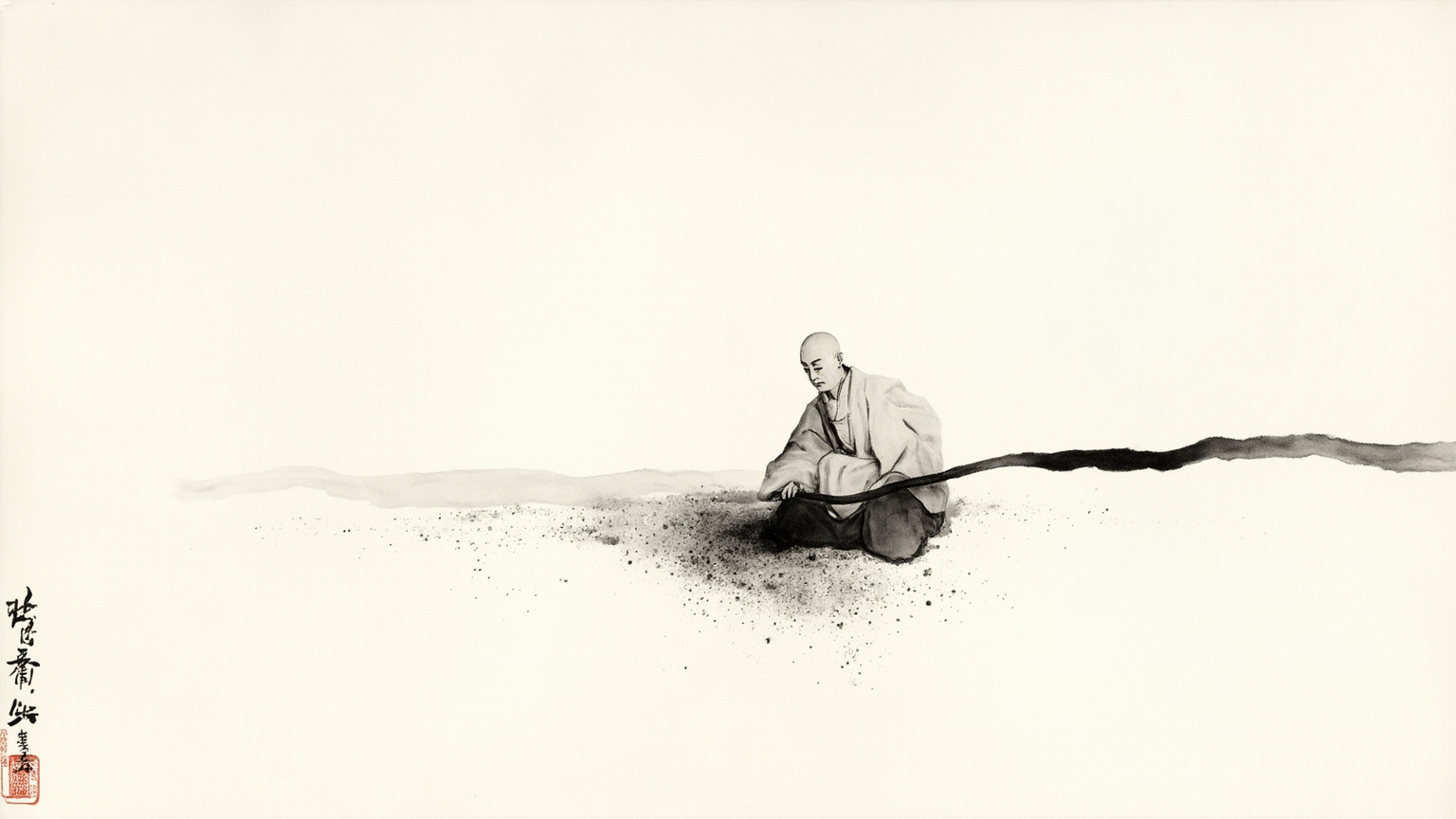
Originally there is not a single thing — where could dust alight?
本来无一物,何处惹尘埃。
金句 · 第十一则 · 六祖本来无一物
Wumen places these two lines at the book's midpoint to give the reader something to stand on. Everything before this point — the shouts, the staff, the knife — has been so physical that he seems worried the reader will mistake Chan for a string of stunts, so he returns to the cleanest possible source in language: fundamentally there is not one thing; let the mind arise without settling anywhere. What to notice in the writing: at the midpoint of the collection, the compiler reaches backward and welds the two lines of the book — action and language — into one. Only here does the reader realize that the dog, the knife, the staff, the tea from earlier all come back, in the end, to these two lines.
The Cluster of Instant Moves: A Shout, a Staff, a Blade, a Reflection
The second half of the book gathers Linji's four shouts, Yunmen's three phrases, Deshan's staff, and Dongshan crossing the stream. Linji Yixuan had four kinds of shout — sometimes a shout comes down like a diamond sword; sometimes it's a lion crouched and ready on the ground; sometimes it's a fishing pole pushed into the grass to see what's underneath; and sometimes a shout is nothing more than an ordinary grunt. All four are the same shout, aimed differently depending on who's standing in front of him. Yunmen Wenyan had three phrases: the first covers heaven and earth, the second cuts off every current, the third rides the waves wherever they go — three levels answering three different kinds of attachment. Deshan's staff works the same way as Baizhang's, but harder — he said, I've lived on this mountain thirty years and never once struck anyone carelessly, meaning: I hit, but I never hit at random. Dongshan Liangjia, crossing a stream, looked down and saw his own reflection in the water, and it brought him to a line: he is truly me now, but I am not him. The one in the river is me — and it isn't.
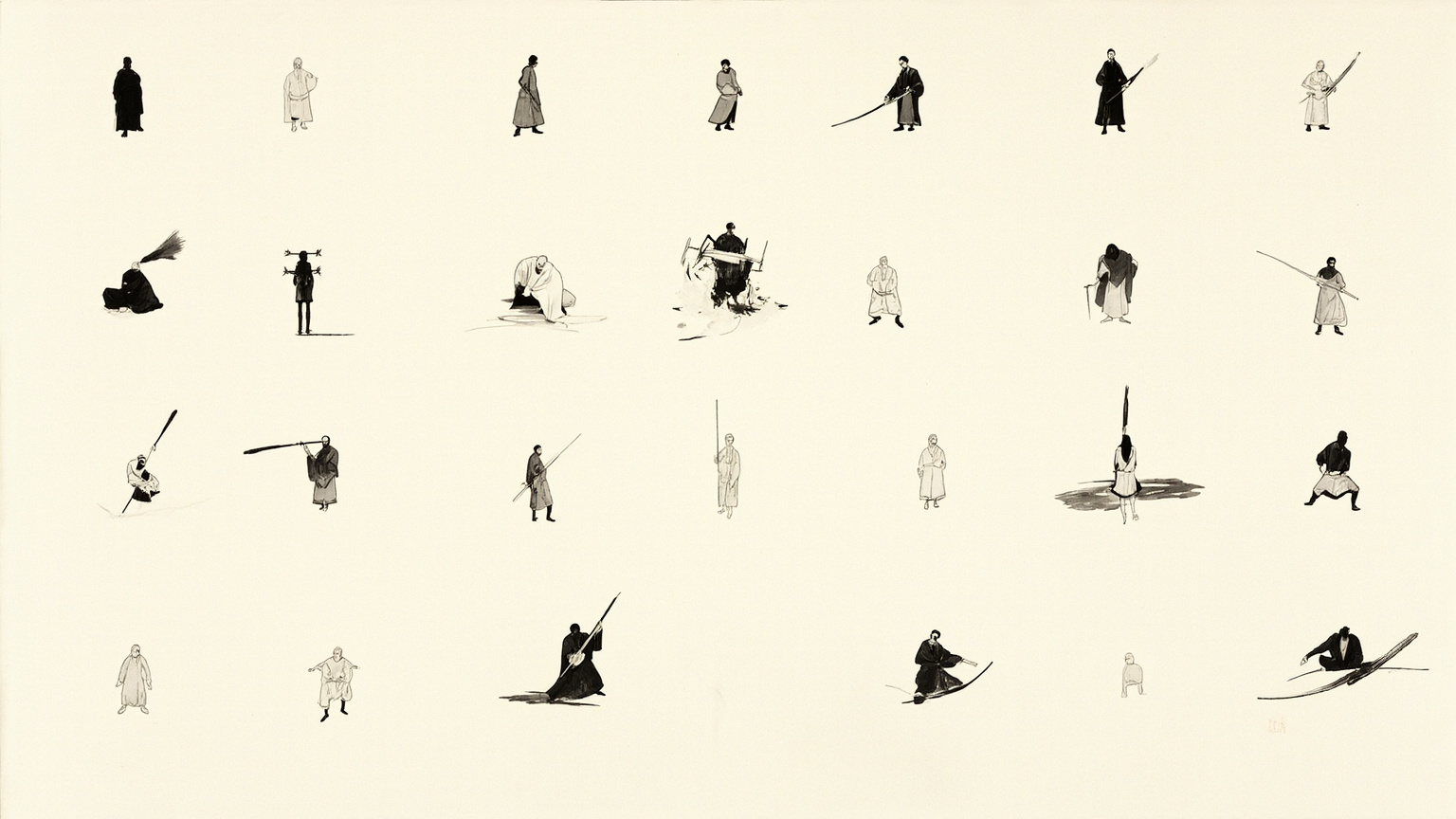
What to notice in the writing: none of these cases run past a few dozen words, but every one carries its own concrete object or motion — a sword, a lion, a fishing pole, a grunt, a staff, a reflection in water. Wumen demonstrates the same single act — cutting off habitual thought — through four completely different props. This is why a koan collection lends itself to spare illustration: the object is the whole subject, the emptier the background the better, and the less there is on the page, the more directly the reader runs into the act itself.
Closing: Zhaozhou Tests the Nuns, and the Book Closes on Yes
The final case: Zhaozhou meets a nun on the road, back from her travels, and asks — have you been here before? The nun says yes. Zhaozhou says: go drink your tea. He meets another nun and asks the same question. This one says no. Zhaozhou says: go drink your tea. The temple steward standing nearby is baffled and asks Zhaozhou: you tell the one who's been here to drink tea, and you tell the one who hasn't been here the same thing — what's the reasoning? Zhaozhou calls out: Steward! The steward answers. Zhaozhou says: go drink your tea.
The book opens on a No and closes on a Yes — but this Yes isn't a literal confirmation that Buddha-nature exists, either. When Zhaozhou calls out to the steward and answers his own summons with go drink your tea, he's pulling the whole case out of the logic of yes and no altogether: whether you've been here or not, tea is tea, and drinking it is drinking it. Whoever passes through this barrier isn't looking for an answer — they're looking to stop asking. What to notice in the writing: opening on No and closing on Yes is a circle Wumen built on purpose. But by the time you've read all forty-eight cases and look back, this Yes is no longer sitting across from that No. It's just the bowl of tea.
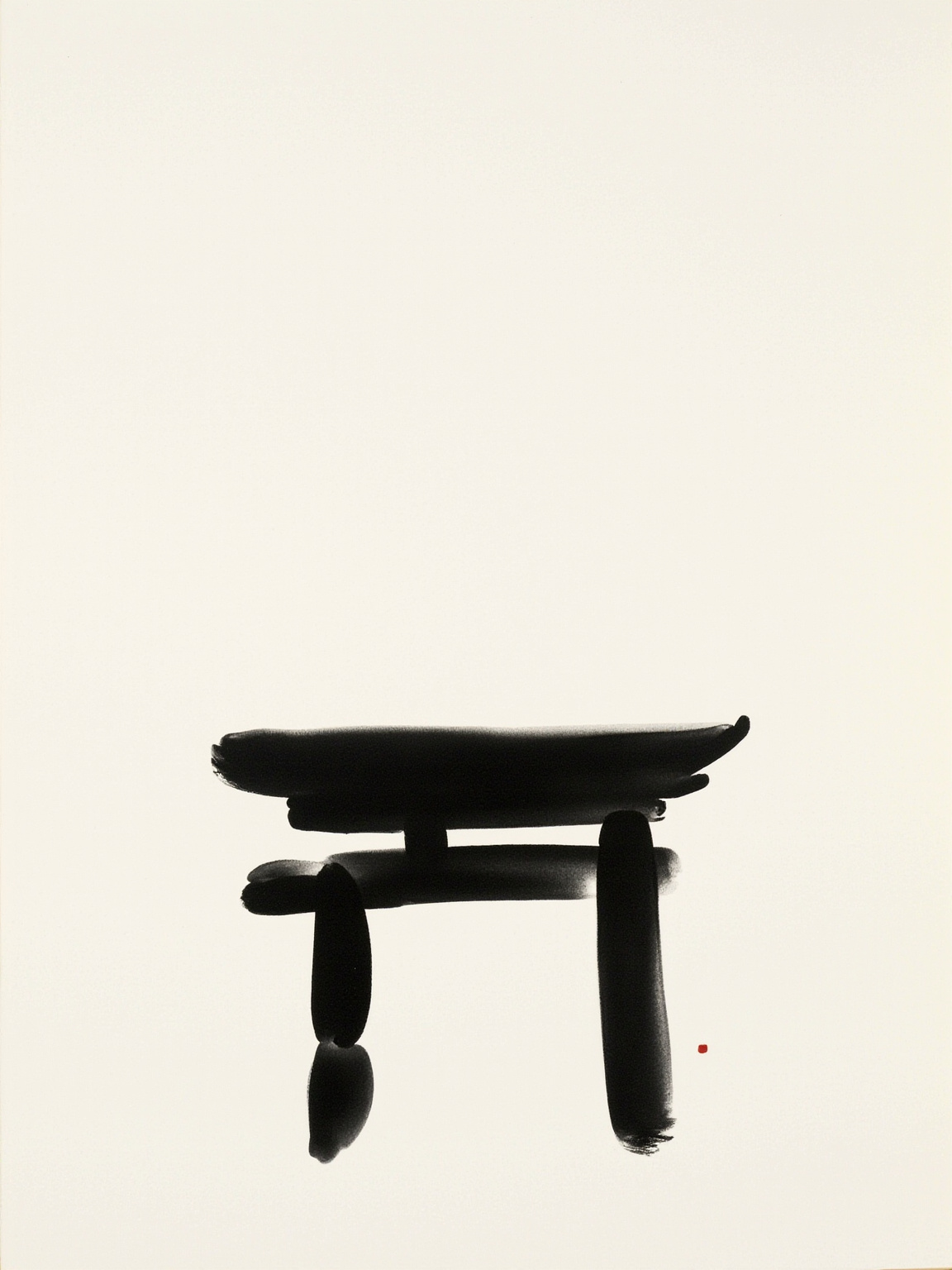
The monk came before, the nun said she had been here. Zhaozhou said: Go drink tea.
来过也,吃茶去;不曾来,也吃茶去。
金句 · 第四十八则 · 赵州勘婆
This isn't a book meant to be understood. It's a book meant to stop you.
What It's Really Saying: An Eastern Philosophy of the Absurd
Set The Gateless Gate on the shelf next to twentieth-century philosophy and it belongs with Camus's absurd and Wittgenstein's language games — all of them use questions that don't obey logic to break the momentum of reason directly. Does a dog have Buddha-nature? and What is the purpose of the universe? are the same kind of question at the level of structure: both are built so that no existing conceptual frame can catch them. The difference is in the medium. Camus wrote novels, philosophers write treatises, and Chan writes koans — an action, a line of dialogue, a silence. You don't need to understand Buddhism to read this book. You just need to have spent one evening stopped cold by four words about a dog and its Buddha-nature. That feeling of being stopped is the thing the book is trying to give you.
What it's really about isn't Buddha-nature and isn't enlightenment — it's this is it, right now. The cypress tree in the garden is just the cypress tree in the garden, not a metaphor. This bowl of tea is just this bowl of tea, not a lesson in doctrine. A koan collection at its best takes every abstract principle and folds it into a concrete object or action — a sandal, a reflection in water, a bowl of tea, a staff. You may finish this book without understanding it. But you might, some afternoon, pick up a teacup and pause for half a second — and that pause is exactly what these forty-eight cases are trying to do to you.
Why a Guide Can Never Be the Text Itself
This guide has already walked through the most famous cases in the book — by now you know the dog gets answered with No, that Nanquan killed the cat, that Linji had four kinds of shout. But none of that was ever meant to be traded for knowing. The first time I read the case about the dog's Buddha-nature, I kept thinking: why does Zhaozhou say No? That doesn't sound like Buddhism at all. Then I read Wumen's commentary and suddenly understood that the No wasn't meant literally — and a few days later, I wasn't sure I understood it after all. That back-and-forth, understanding and then not understanding, grinding away in your head, is the real work a koan collection asks of you. Making sense of a single case was never about information. It's about whether you're willing to let it stop you for a while — and that's the one thing a guide can never do in your place. Go read the book.
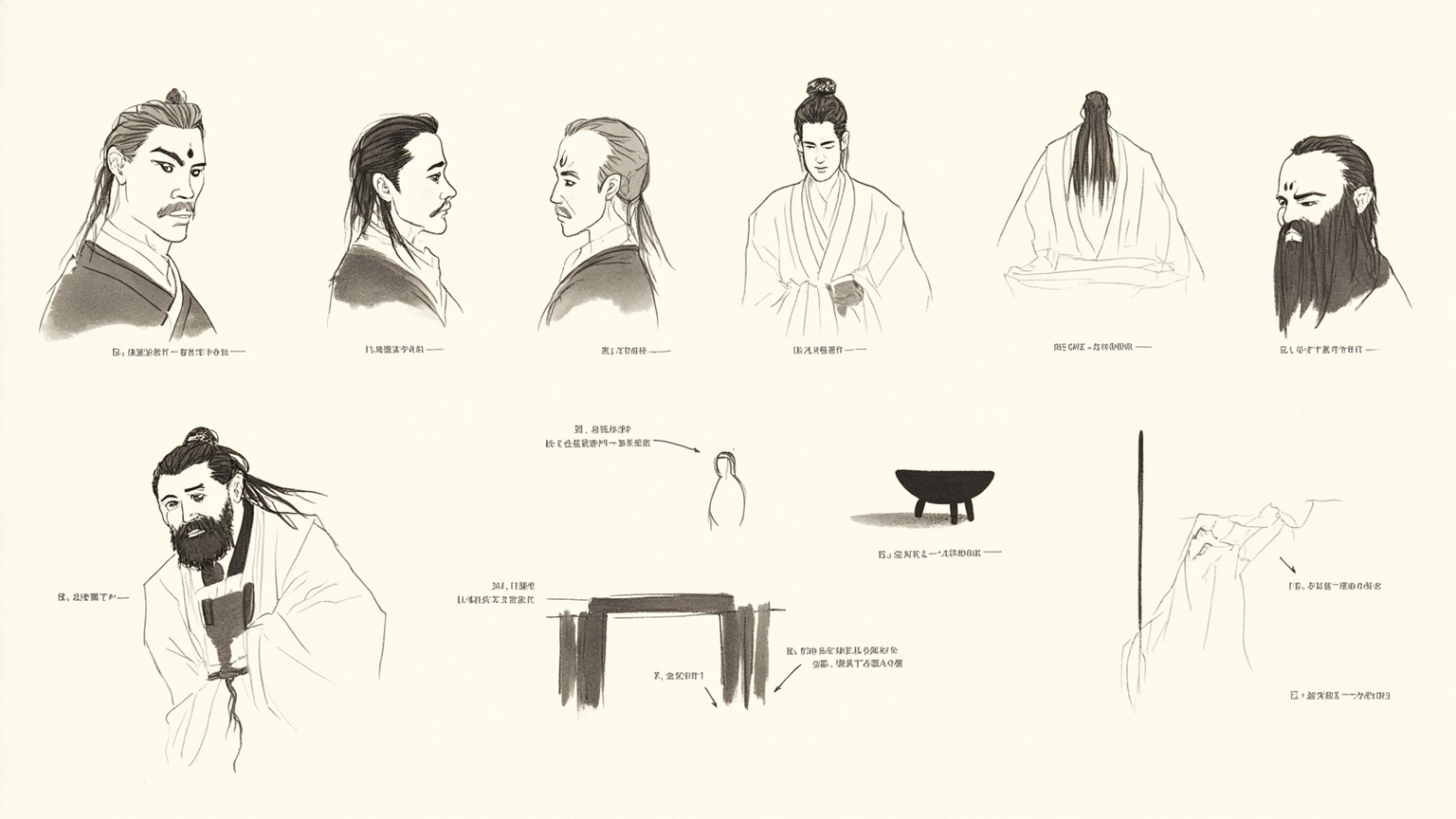
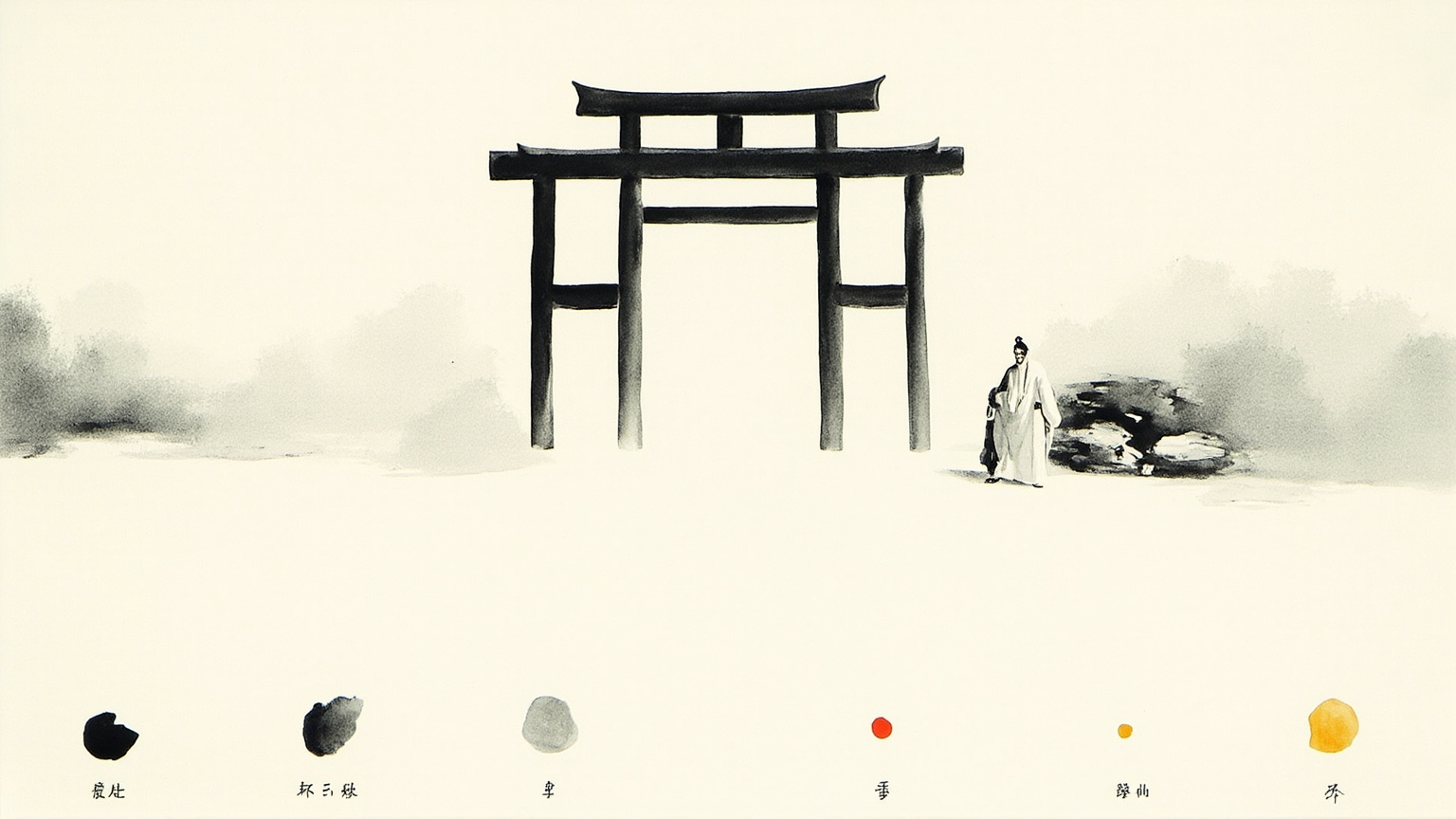
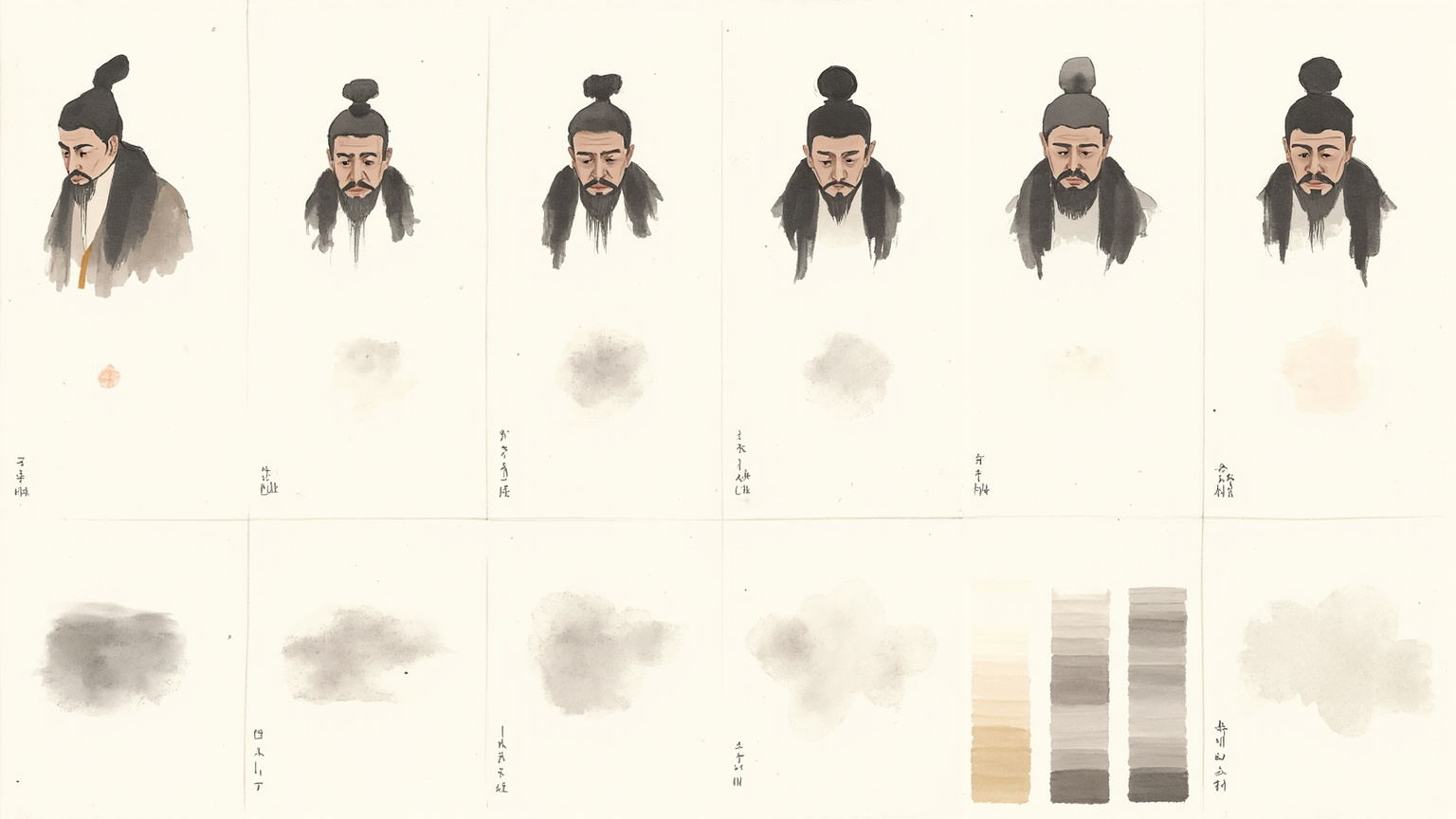
Art Direction4 plates
Before the guide was written, this book got a visual foundation — every illustration you just read grew out of it.