The Great Gatsby · Companion Guide
了不起的盖茨比
一个白手起家的男人,用五年时间堆砌起纸醉金迷的巴别塔,只为跨越海湾去够到那盏绿灯,却发现旧梦无法重来。
1. A Summer Night, the Bay, and a Green Light
At the end of the dock on the far shore hangs one small green light. It blinks on and off, as if someone were counting something out for you, on a stifling summer night when the water lies black and glossy across the bay. Somewhere in this book a man has waited his whole life for that light. Across the water lives the woman he loved as a young man and never managed to marry. On this side stands the loudest house on all of Long Island, the one he built after spending five years remaking himself from a poor nobody into a rich man. The parties, the music, the champagne, the parade of faces coming and going — all of it exists for one reason: so the woman across the water might look at him again. That is the whole of this slim book: a man builds a castle to chase a shadow, and dies in his own swimming pool with not one guest from that castle at his funeral.
2. What Kind of Book This Is, Who Wrote It, and Why It Matters
The Great Gatsby was published in 1925, and its author, F. Scott Fitzgerald, was the most faithful chronicler the Jazz Age ever had: he wrote novels, threw parties, and courted society girls, living the era so thoroughly that his own life became a kind of memoir of it. The first edition sold badly, and when Fitzgerald died in 1940 he never lived to see the enormous reputation the novel would go on to earn. Not until the 1950s and 60s was it rediscovered, and it has not dropped out of the front rank of essential English-language reading since. People today say it defined the Jazz Age — more precisely, it compresses an era that looked gilded and was in fact riddled with rot into a little over a hundred and eighty pages.
3. People and World: Money Splits the Bay in Two
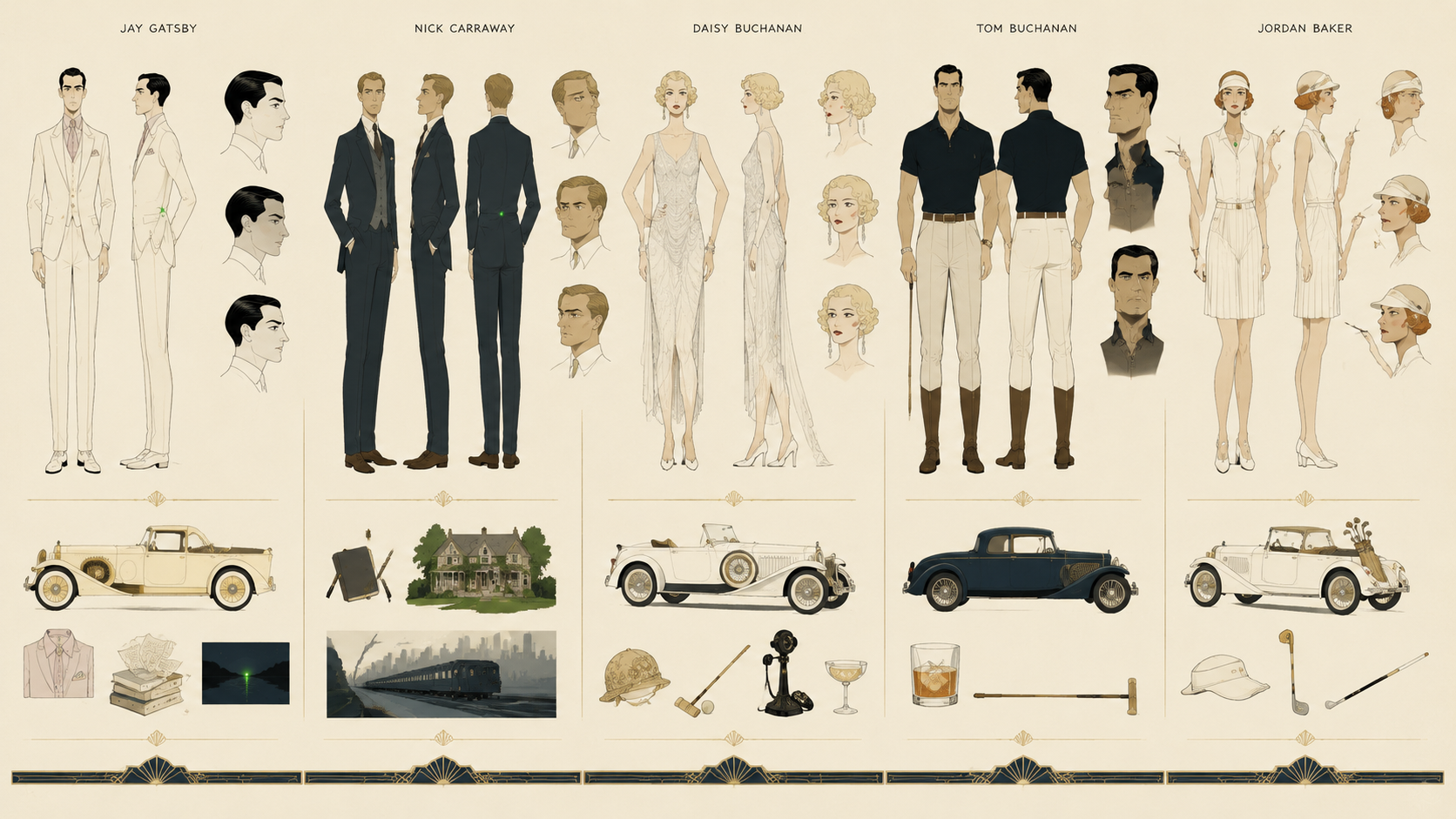
The story unfolds over the summer of 1922, on Long Island, New York. Two egg-shaped peninsulas face each other across a narrow bay. West Egg belongs to the new money, men who got rich overnight on nerve, luck, and business best left unexamined. East Egg belongs to the old families, inherited estates, forks of solid gold, dogs whose names sound like they came with a title. A little further south along the bay sits a gray industrial wasteland called the Valley of Ashes, all auto shops, exhaust, and rundown apartments, the tail end of all that glamour trailing behind it. On the West Egg side, a Midwestern transplant named Nick Carraway has come east to sell bonds. He rents a small house next door to Jay Gatsby, whose parties run every night of the week. Nobody in the neighborhood can say exactly how old Gatsby is, what he looks like up close, or where he came from, only the rumors: that he was poor once, that he loved once, that he disappeared, and that when he resurfaced his pockets were full of money. Nick has another connection to this world besides: across the water in East Egg, his cousin Daisy Buchanan is married to Tom Buchanan, a physically imposing man who talks like he's giving orders. The two of them appear to have everything, though it's an open secret that Tom keeps a mistress, Myrtle, out in the Valley of Ashes. Little by little Nick is drawn into the story of that green light, becoming both the go-between and the one person who never stops feeling for Gatsby, start to finish.
4. How the Plot Moves: How an American Dream Falls Apart
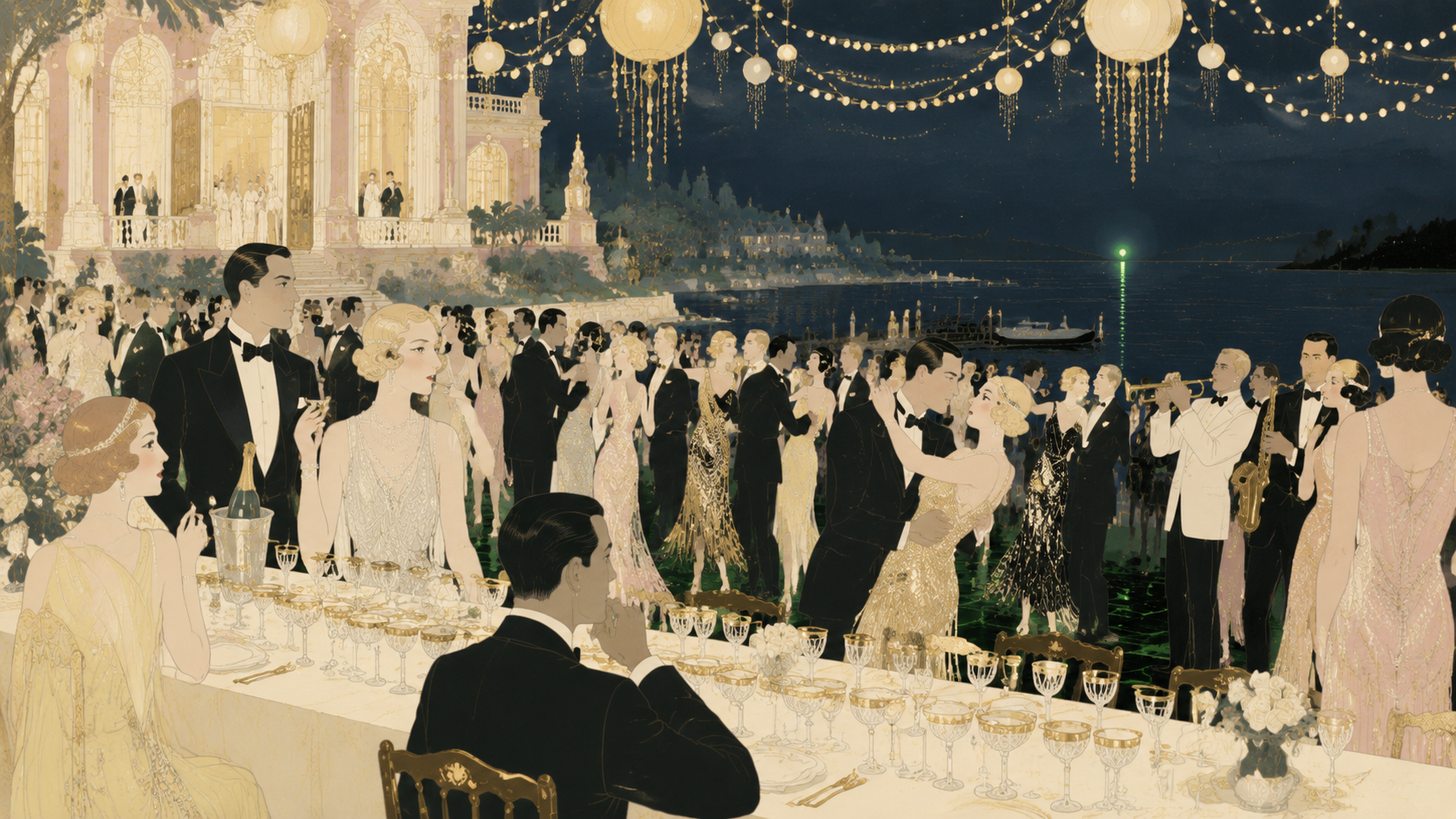
No sooner has Nick settled into West Egg than tents go up on the lawn next door every weekend, champagne glasses line up by the hundred, and crowds pour in from New York to dance, flirt, and fall into the pool, men and women who mostly don't know each other, with the host himself reduced to scenery for his own spectacle. Nick gets an invitation and goes along, and amid all that light and crowding, the air tinted pink-gold and warm yellow, he tries to play the cool observer and finds he can't manage even a coherent account of the evening. There's a nice bit of craft at work here: Fitzgerald refuses to let you actually see Gatsby at first. He trains you, through parties, rumor, and the cryptic answers of servants, to be just as full of questions as Nick is.
It faced-or seemed to face-the whole eternal world for an instant, and then concentrated on you with an irresistible prejudice in your favour.
它面向——或仿佛面向——整个永恒的世界,仅一瞬,然后汇聚于你,带着一种让你无从抗拒的偏爱。
原文金句 · 第3章 · 初见盖茨比微笑
At the party Nick finally gets Gatsby alone, and up close the man is younger and more awkward than expected, like a good student playing dress-up as a millionaire. This is when Gatsby first lets the secret slip: the green light across the bay belongs to Daisy, the woman he loved five years ago. He vanished for five years to make the kind of money she couldn't refuse, and now that he has everything, the one thing still missing is her. There's another narrative move worth noting here: Nick hears Gatsby's account of his own past on two separate occasions, and the two versions don't match, first a poor boy, then a son of old money, and only much later the real name: James Gatz, from North Dakota. Doling the truth out like pieces of a puzzle is Fitzgerald's way of warning you never to fully trust a man in the middle of rebuilding himself.
Nick arranges a reunion between Gatsby and Daisy, choosing his own house so the meeting doesn't feel too overwhelming from the start. The moment they see each other, the air seems to freeze — Daisy cries, and Gatsby leans his head back, as if finally exhaling five years' worth of held breath. Over the following weeks, Gatsby remakes his whole household to Daisy's taste: the servants' uniforms go Oxford gray, the lawn is clipped until it looks laid with green felt, and he dumps box after box of expensive shirts out for her to see, like a peacock fanning its tail. There's a cruel little detail buried in all this: Daisy's voice always sounds as if it has a string of gold coins jingling somewhere inside it. She carries the sound of money in her own throat, and it's that sound Gatsby has spent his whole life buying.
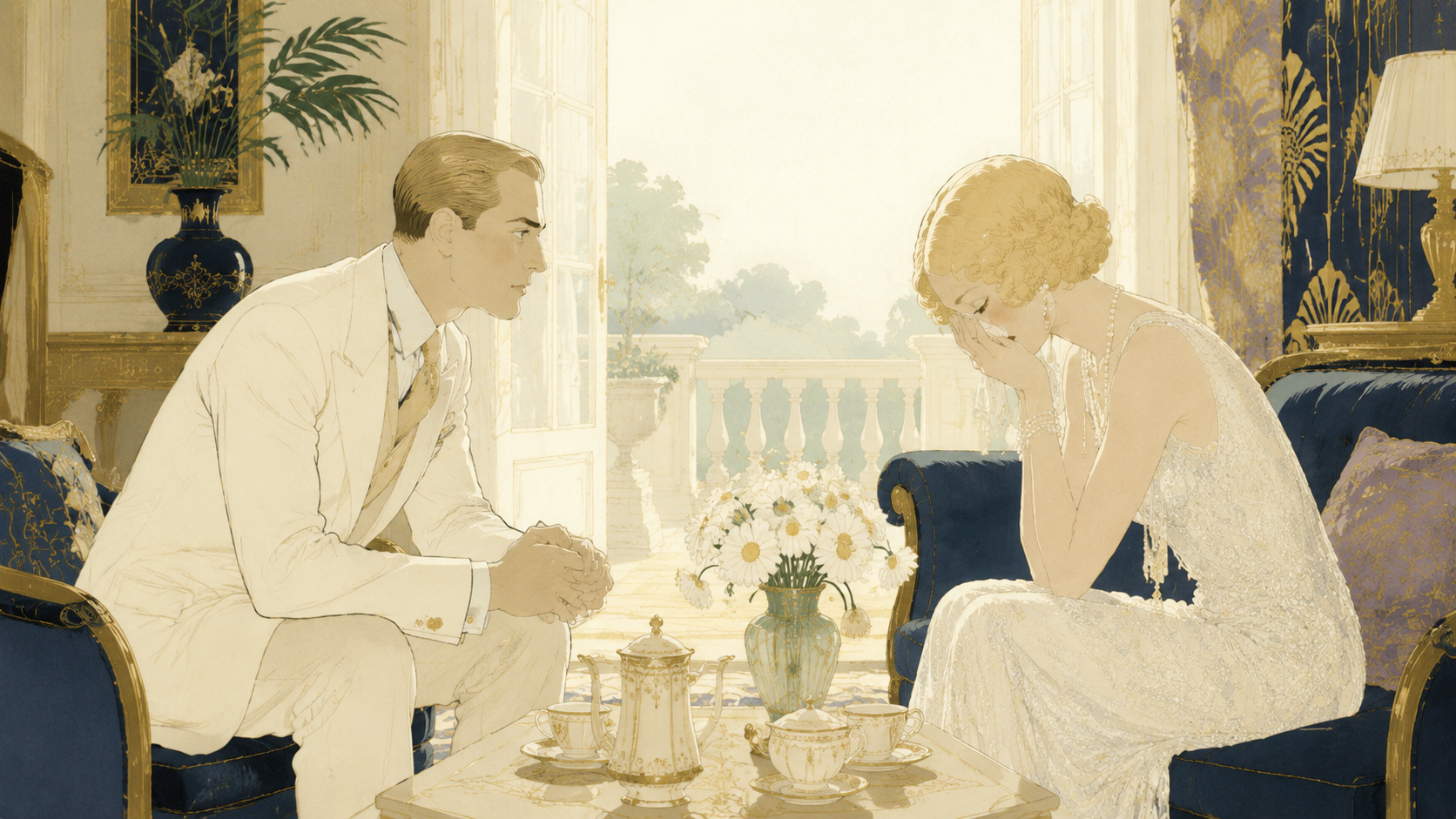
"It makes me sad because I've never seen such-such beautiful shirts before."
这让我伤心,因为我从未见过这么——这么漂亮的衬衫。
原文金句 · 第5章 · 黛西对衬衫哭泣
Some things can't stay hidden. Tom soon smells that something is off — his wife, his money, his polo set, none of it to be touched. On one suffocatingly hot afternoon, the five of them, Nick, Gatsby, Daisy, Tom, and Jordan, drive into Manhattan and crowd into a stifling hotel room for a confrontation. Gatsby announces, in front of everyone, that Daisy never loved Tom, and airs some of Tom's own dirty laundry besides. Tom staggers under it at first, then lands one question that ends the whole argument: where exactly did your money come from? A single question is enough to knock Gatsby straight back down to new money — the people of East Egg don't care what you say, only about bloodline, surname, and a father whose origins can be accounted for. Daisy flinches in that moment, and doesn't take Gatsby's side.
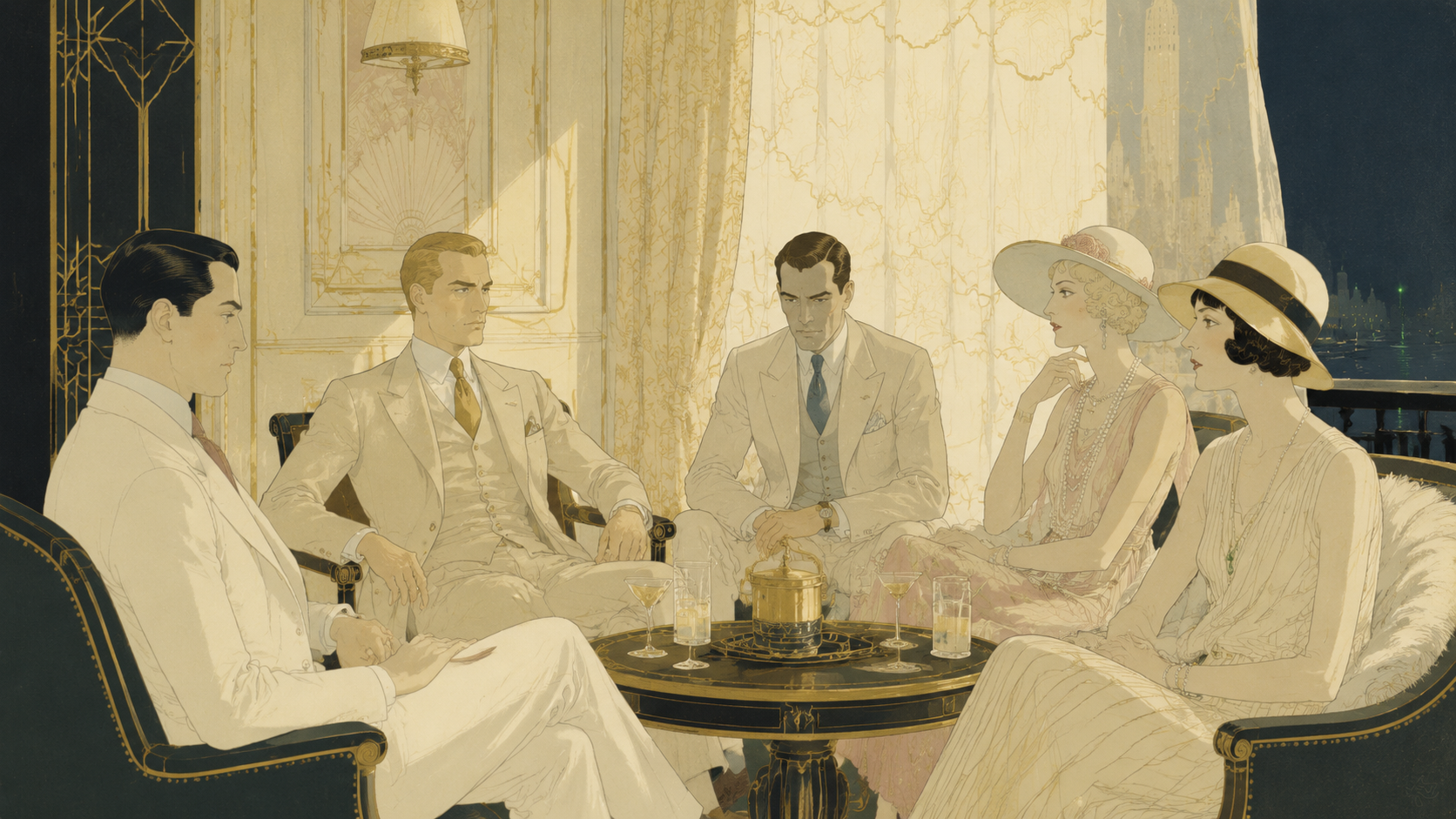
He wanted nothing less of Daisy than that she should go to Tom and say: "I never loved you."
他要的不过是,黛西去告诉汤姆:“我从未爱过你。”
原文金句 · 第6章 · 盖茨比要求黛西否定过去
On the drive back, everything collapses. Daisy, at the wheel of Gatsby's yellow roadster, strikes and kills Tom's mistress Myrtle in the Valley of Ashes and drives on without stopping. Nick only pieces the full picture together afterward: Daisy was driving, and Gatsby takes on all the blame for her. Fitzgerald's cruelest touch comes in the scene right after: Nick and Gatsby sit side by side on folding chairs outside the garage, waiting for a phone call from Daisy that never comes.
Myrtle's husband, George, comes apart at the seams in his garage, and Tom tells him only that the yellow car belongs to Gatsby. Early the next morning George walks over to the West Egg house that had been ablaze with light only the night before, finds Gatsby by the pool, pulls the trigger, and then turns the gun on himself. A man who made himself from a poor nobody into a millionaire dies in the pool he built with his own money — there isn't even room left for a struggle.
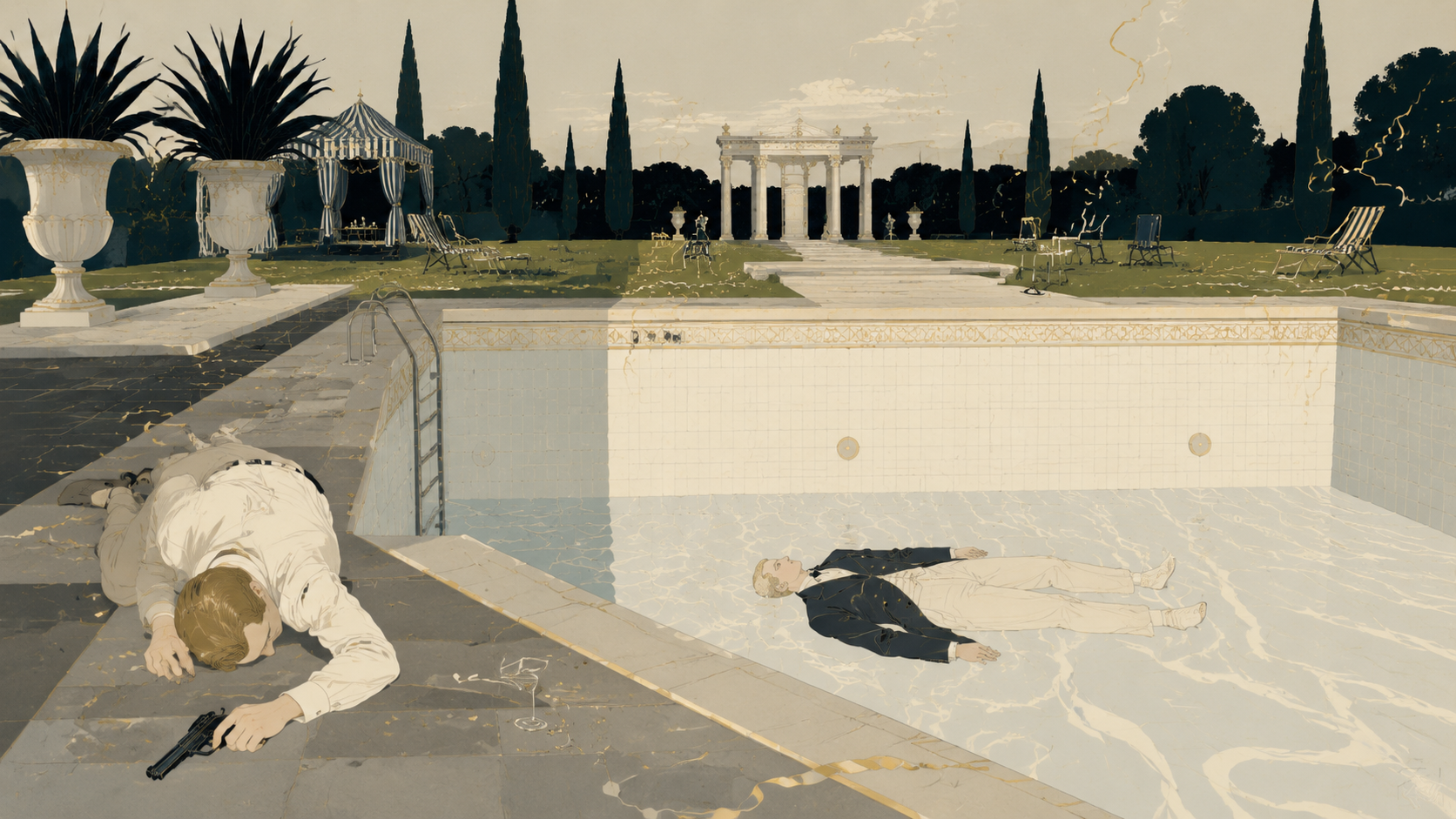
"I waited, and about four o'clock she came to the window and stood there for a minute and then turned out the light."
我等着,大约四点钟她走到窗前,站了一会儿,然后熄了灯。
原文金句 · 第8章 · 盖茨比守护黛西的灯
Then come some of the most ironic pages in all of American fiction: Gatsby's funeral. Nick calls, one by one, the people who once got drunk, laughed, and stole small things in Gatsby's house — not one of them comes. The two who do show up are strangers to the guest list: a heavyset man in owl-eyed glasses, and a young man who attended every party but whom nobody there ever knew. Daisy and Tom have already packed and slipped away, without so much as sending flowers. In the nearly empty room a few blossoms sit on the coffin, while outside, uncollected champagne glasses still litter the ground. Millions of dollars' worth of laughter couldn't buy him thirty minutes at a funeral.
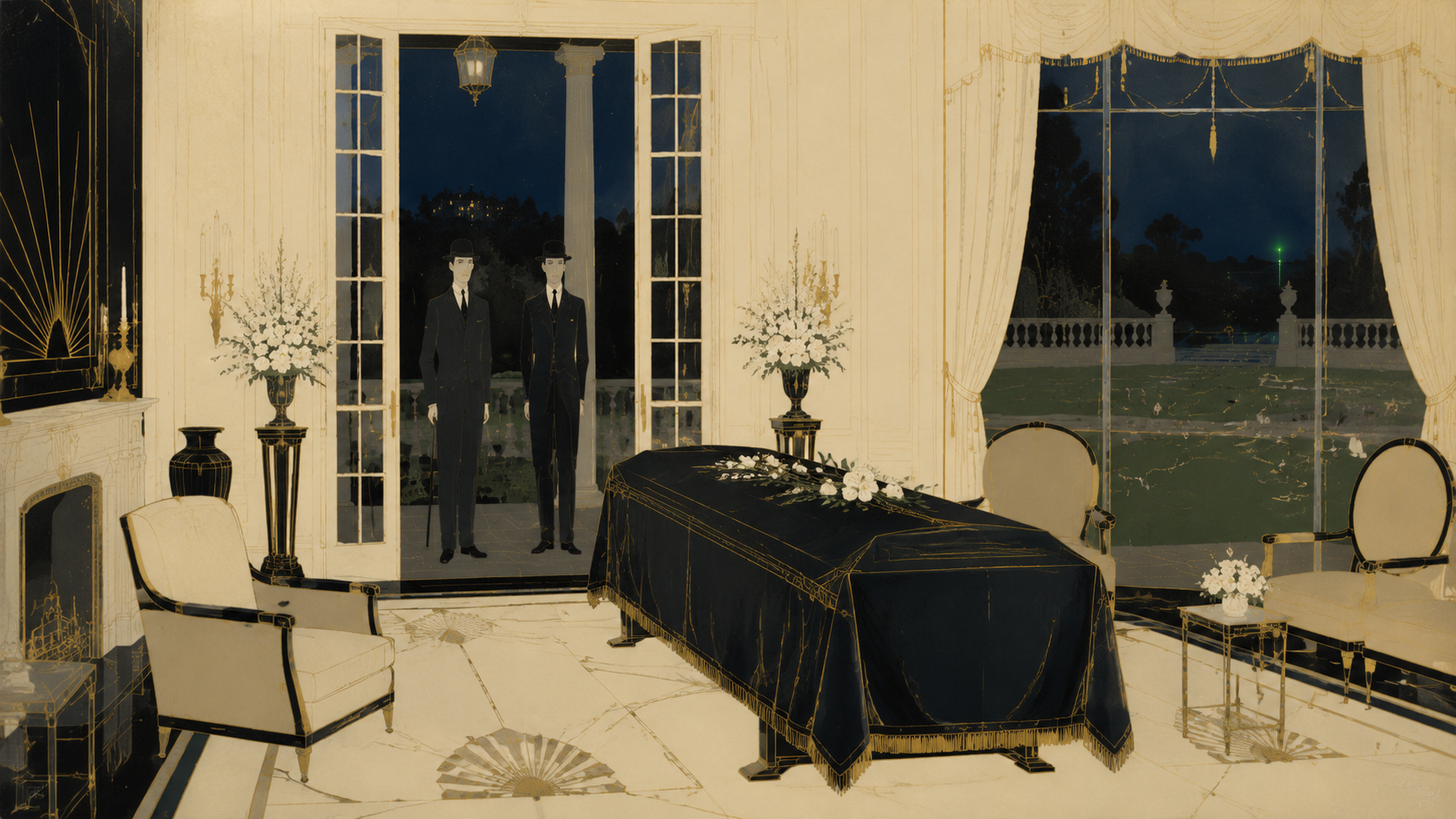
All night the saxophones wailed the hopeless comment of the "Beale Street Blues"
整夜,萨克斯风都在哀号着《比尔街布鲁斯》那绝望的评注。
原文金句 · 第8章 · 萨克斯风奏响绝望之夜
The book closes on one last morning of reflection from Nick. He has decided to leave the East that has sickened him, and before he goes he walks down to the bay one more time; the green light across the water is still burning. That is when he finally gives voice to the famous line, that we beat on, boats against the current, borne back ceaselessly into the past. Structurally, the whole novel is a perfect symmetry: it opens with Nick looking at the green light and closes with him looking at that same light again, and everything in between is the story of how he was swept into this world and then spat back out of it. The green light hasn't changed. The man watching it has.
5. What It's Saying, and Why It's Written So Well
The disillusionment of the American dream is the book's largest theme: a poor boy can earn money, but money can't buy a family name going back generations, a woman's genuine love, or the particular shine of old society that comes from ancestors who were once rich too. Gatsby has the money, the parties, hundreds of people circling around him, but he can never cross that half-mile of bay — one question from East Egg, who was your father, sends him right back to where he started. Fitzgerald lived a version of the same story himself: he married Zelda, his own golden girl, and what he put into the book was the very life he himself never quite managed to live well. The other theme is the irreversibility of time. Daisy isn't a villain; she's simply a woman with a voice like money, living entirely in the present. Gatsby's mistake is insisting on replaying a hand that has already been dealt and finished. Whenever Fitzgerald describes one of that era's gilded parties, he always leaves a thorn somewhere in the corner: a broken car window, spoiled milk, the coal smoke drifting over from the Valley of Ashes. What he's really writing about isn't the party itself, but what's left after it's over, the glasses nobody bothers to collect.
What makes it well written starts with its economy. At under fifty thousand words, it compresses an entire era, several families, and a whole state of mind. It's also well written in its point of view: Nick is both an insider and an outsider, unromantic, fallible, easily dazzled by beautiful things, and yet he remains the one person who never stops respecting Gatsby. Finally, it's well written in the density of its images. The green light, the Valley of Ashes, the enormous pair of eyes on the billboard, the coins in Daisy's voice — Fitzgerald uses barely a handful of props to fit an entire era inside the frame. When you finish the book and close it, what surfaces first in your mind isn't a plot point but one or two images. That's what a good novel can do.
6. What a Companion Guide Can't Give You
A companion guide can tell you what the green light symbolizes, who was actually driving the car, and why none of the party guests showed up to the funeral. What it can't give you is Fitzgerald's sentences themselves — that jazz-like rhythm, with its small, deliberate misalignments between words; the way a scene at the height of a party suddenly cuts off, leaving you to hear only a single muffled thud; the sheer density of a line like the one where Daisy's voice is full of money. Nor can it give you the way Nick's temperature as a narrator keeps shifting between hot and cold, judging and forgiving in the same breath, repulsed and moved at once. Only by following him through the actual prose, down that dirt road from West Egg to East Egg, can you feel that by the time he speaks that final line, he is no longer the Midwestern young man who first arrived. Reading this book, the text itself is both the cheapest and the most extravagant experience there is: an evening or two to finish, and enough to think about for a long time after.
Gatsby spent five years building himself a place where he could start over, only to find that the past leaves no way back to start from. The whole book is one man chasing a green light, and when he finally catches it, the light goes out.
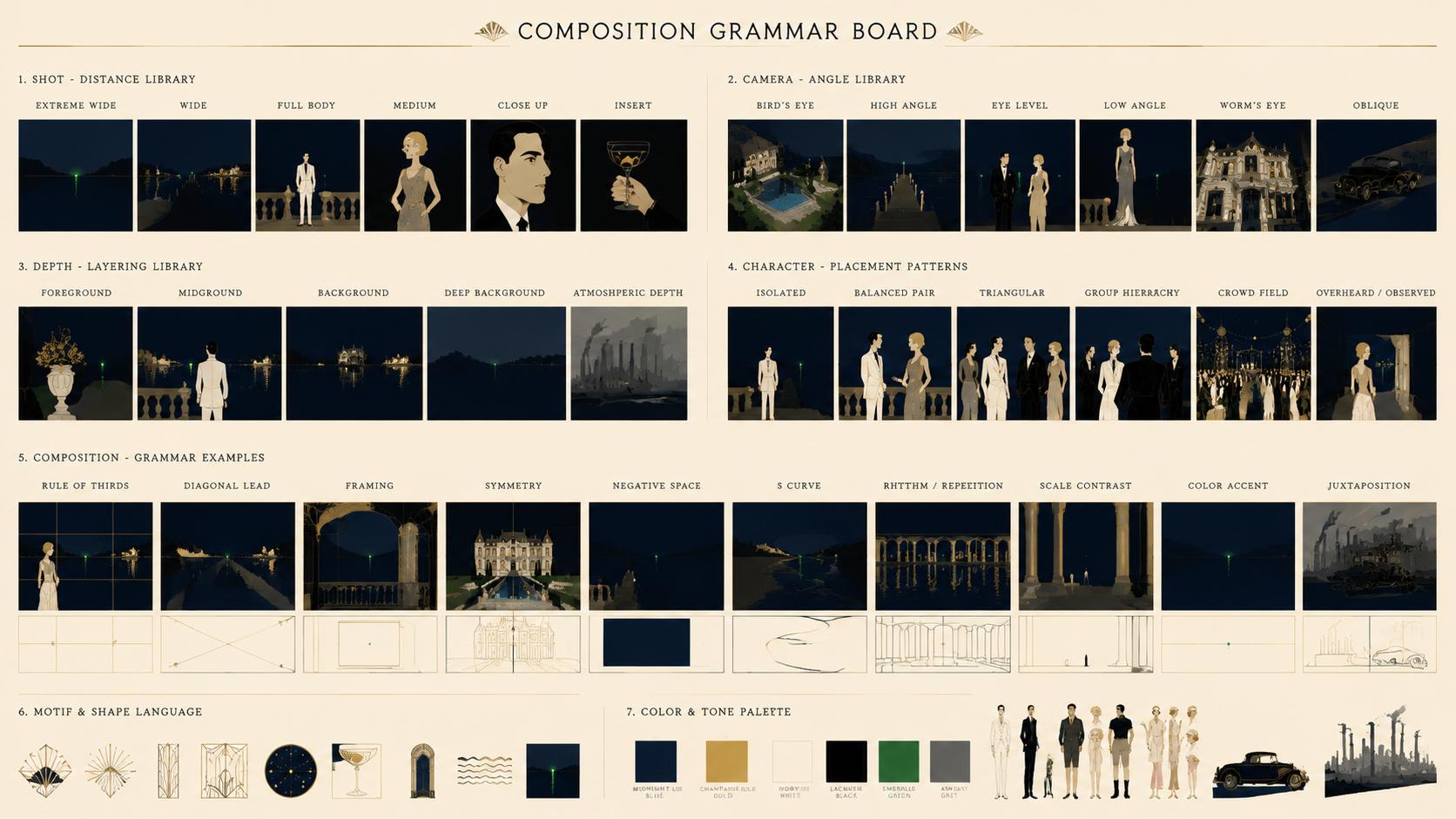
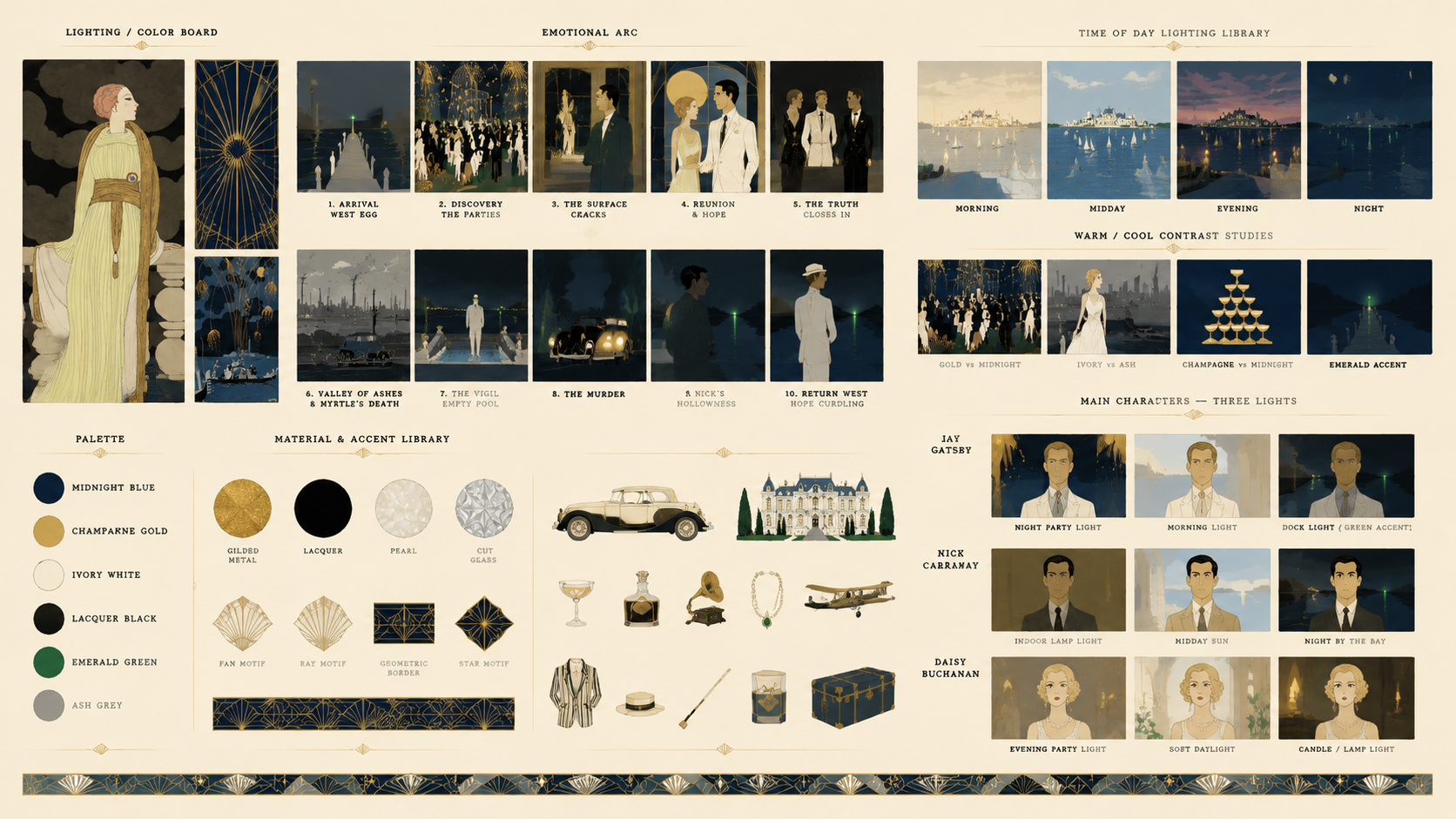
Art Direction4 plates
Before the guide was written, this book got a visual foundation — every illustration you just read grew out of it.