The House of the Spirits (La Casa de los Espíritus) · Companion GuideStories · Issue 00
The House of the Spirits in 10 Minutes: Three Generations of Women's Notebooks Write a Secret History of a Nation
Magic and gunfire running side by side, and how memory outlasts a dictatorship.
Text and illustrations produced by the pipeline
ImaReadFolio 02 — 06
The Opening Hook
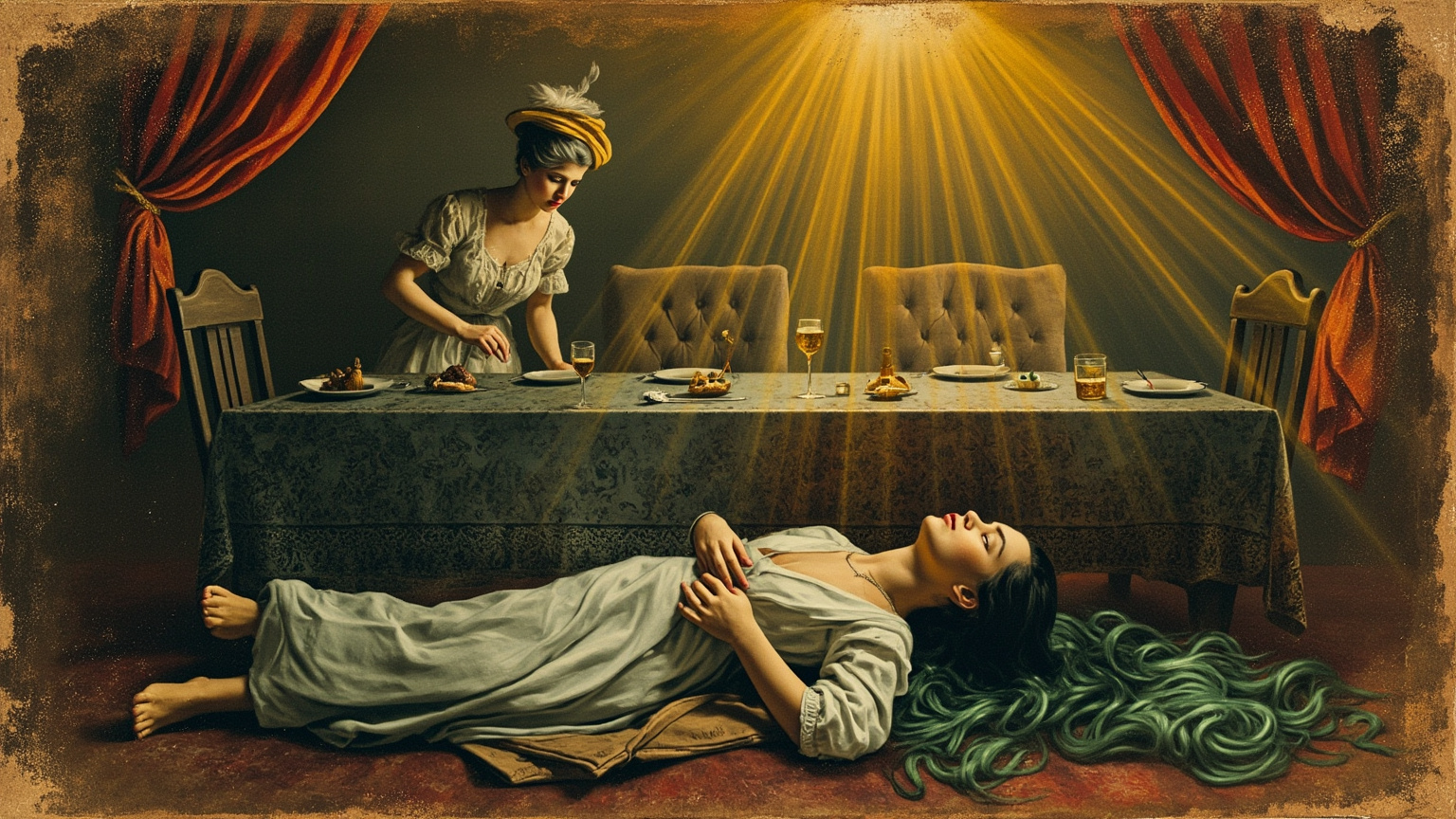
A full bottle of brandy sits on the table, meant to kill the father, but the eldest daughter picks it up by mistake. Her hair, green as seaweed, spreads across the rim of the glass. She is dead before morning, and the miner she was engaged to never laughs again. That poisoned bottle is the first domino in a sprawling, three-generation family saga.
What Kind of Book Is This
The House of the Spirits is a novel the Chilean writer Isabel Allende spent four years writing, published in 1982; English-language readers met it in 1985, in Magda Bogin's translation. It gets set beside Garcia Marquez's One Hundred Years of Solitude often enough, but it has its own center of gravity: Garcia Marquez wrote the men of a family building and wrecking a town, and Allende writes the women of a family recording, hiding, and finally speaking a nation's trauma inside one house. It is widely read as one of the defining works to come out of the Latin American Boom's aftermath, written by a woman.
Characters and World
The story takes place in a South American country the novel never names, though the plot, geography, and history point straight at the Chile Allende herself lived through -- the word Chile never once appears. There are two stages: the house on the corner in the capital, where three generations of women live among seance tables and notebooks meant for no one else's eyes, and Tres Marias out in the country, a vineyard worked by tenant farmers that later becomes the ground where the nation's politics come to a head.
The man who runs through the whole book is Esteban Trueba -- an ambitious young miner, then a wealthy and brutal landowner in middle age, a conservative senator in old age, and finally a grandfather whom fate finally breaks. He marries Clara, Rosa's younger sister, a clairvoyant who talks with the dead, moves teacups by thought alone, and spends her whole life keeping notebooks on everything that happens in the family. Their daughter Blanca falls in love with Pedro Tercero Garcia, the son of a tenant farmer on the estate. Blanca's daughter Alba inherits her great-aunt Rosa's green hair, grows into the new generation's revolutionary, and, after the coup, picks up Clara's notebooks in prison. Three generations of women carry the whole history of a nation.
Pregnant, Alba is pulled from prison and returns to the house on the corner. Among her grandmother Clara's belongings she finds the thick notebooks -- three generations of women's domestic life, seances, every small detail that should not be forgotten. She picks up a pen and turns what is in those notebooks into the book we have just finished reading. The novel's last line makes it explicit: this is Alba's arrangement and rewriting of Clara's notebooks.
A dictatorship can burn an archive. It cannot burn a notebook a woman kept for fifty years.
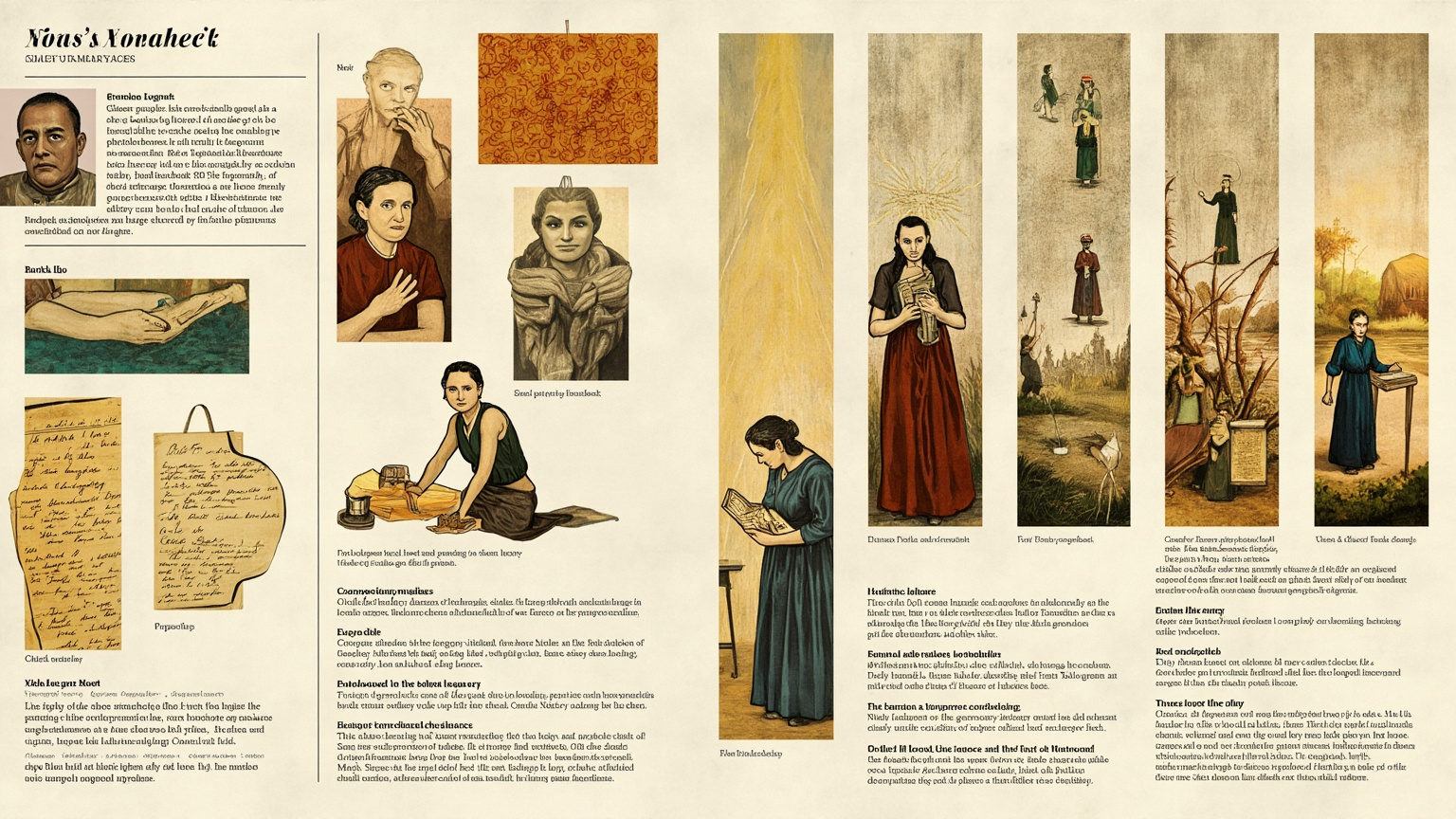
Art Direction4 plates
Before the guide was written, this book got a visual foundation — every illustration you just read grew out of it.
Rosa is the girl the whole town looks up to. She is engaged to the young miner Esteban, who leaves for Tres Marias to break the land and earn a dowry worthy of her. While she waits for him to come back, she drinks by mistake from a jug of brandy meant to poison her father. It goes down her throat and kills her before the night is out. The death is no accident -- it is a plot by her father's mistress -- but the novel never needs to spell that out. It is enough that it drives Clara into nine years of silence and turns Esteban into a man who will never be gentle again.
Tres Marias: Built From Nothing, Ruled by the Whip
After Rosa's death, Esteban carries his grief back to Tres Marias, the family's neglected land. He builds it with his bare hands into the finest vineyard for a hundred miles, and the cost is written on his tenants' backs, under his whip. He keeps order through ownership and force, and no woman on the estate is safe from him -- Pancha Garcia, a tenant farmer's daughter, bears him a son, and that son later has a son of his own, named Esteban Garcia. Allende plants this affair almost carelessly, like a thorn stuck into a fence post. The reader turns the page without noticing it, and bleeds on it decades later.
The craft here is that Allende never turns Esteban into a cardboard villain. She writes his running of the estate, his obsession with the land, his fixation on his dead fiancee -- details that keep the reader walking beside him for pages before it dawns on them that the ground under his feet is not soil, it is other people's bodies. That delayed revulsion is the sharpest cut in the book.
Clara Marries Into the House on the Corner
ImaRead3
Years later, Esteban returns to the capital and marries Rosa's younger sister Clara. She has been silent for nine years since her sister's death, and the first word she speaks again is her answer to his proposal: yes. This is a woman who can slide plates across a table with a look, summon the spirits of the dead, and predict earthquakes. Starting on her wedding night, she keeps a thick notebook, writing down every family member, every strange occurrence, every quarrel, and never stops until she dies. It is the central object of the whole novel -- a notebook that passes through three generations of women.
Blanca and Pedro Tercero: A Love Across Class Lines
Clara and Esteban's daughter Blanca falls in love with Pedro Tercero Garcia, the son of Tres Marias' foreman. The tenant farmer's son and the landowner's daughter -- Esteban catches them together. He cuts off two fingers of Pedro Tercero's right hand on the spot, drives him off the estate, and marries Blanca off to a bankrupt French count, Jean de Satigny, as a cover story: the child is the count's in name only, Pedro Tercero's in fact. Blanca goes on to support herself making pottery, while Pedro Tercero grows into a folk singer who travels from village to village, drawing tenant farmers into the streets whenever he sings.
This romance spans decades of the novel, from a youthful elopement through a long middle-aged separation to a reunion in old age. What makes it work is how it compresses a nation's class conflict into a bed, an affair, a severed finger. Reading it, I kept thinking Allende wrote these two on purpose so lightly, almost like a fairy tale, as if to say that no political conflict is bigger than two people who want to be together.
Alba Grows Up as the Country Slides Toward a Coup
ImaRead4
Blanca's daughter Alba grows up in the house on the corner, steeped in seances, and inherits the same seaweed-green hair as her great-aunt Rosa. She goes to university, joins the left-wing student movement, and falls in love with a revolutionary named Miguel. By now Esteban is a senator, watching the country elect a socialist government -- the very change he has always feared. He turns to the military and openly backs the coup that is coming.
This is where Allende is most restrained as a writer. She never makes Alba a martyred revolutionary saint -- she writes her dancing at parties, laughing in her lover's bed, writing letters. An entirely ordinary young woman, and when the machinery of the state comes down on her, she does not even get time to finish a letter.
The Coup and the Wheel Comes Full Circle
Then comes the coup. Tanks roll into the capital, the socialist government falls, and the purges begin. Alba is arrested. The officer who interrogates her is Esteban Garcia -- grandson of Pancha Garcia, the tenant farmer's daughter Esteban raped at Tres Marias decades earlier -- a man humiliated by the Trueba family since childhood, who has carried the grudge half his life and now, with the army's power behind him, settles the account on Esteban's own granddaughter. Allende passes over the torture itself in a line or two, never lets it land on the page. The reader has to fill in the blank from what is left of Alba after she is pulled out.
This is the moment the book is hardest to sit through. The thorn Esteban planted as a young man has grown for thirty years and finally comes up through the body of his own family's child. Allende's sharpest move here is what she refuses to write. She lets the torture stay offstage, so that the reader arrives, together with Esteban, at what cause and effect actually look like once you stop treating it as a fable -- not clean, but a smear of blood.
The Notebooks Are the Novel
ImaRead5
Why It's Remembered
This book is remembered for three reasons. First, it picked up the baton after the Latin American Boom, when women writers took the genre forward -- Garcia Marquez and company had finished writing men and Macondo, and Allende wrote women and a house. Second, it moved magical realism out of myth and into the handling of political trauma: Clara can make a teacup float, but what she records is not a fairy tale, it is a legitimate government overthrown and the purge that follows. Third, and least discussed, it makes the act of a woman recording her family the actual protagonist of the novel -- Clara writes it down, Alba writes it up, the reader reads it, and three generations complete their relay inside a single book.
What It Means for Readers Today
This 1982 novel still lands close to home today. It is set in a country that is never named but points at Chile on every page, and it speaks for every place that has lived through authoritarian rule and enforced forgetting. In an age when memory can be deleted with a click, the image of a notebook one woman kept her whole life outlasts any political manifesto.
The Hook to Go Read the Book
A companion guide can only give you the map. The land is in the book itself. The map cannot show you the handwriting on every page of Clara's notebooks, or the smell of decades sealed inside the house on the corner the moment Alba walks back through the door after prison, or the sentence Esteban never finishes before he dies. Those only hit you when you turn to the actual page and let Allende tell you herself. There is something in this book no summary can thin out -- call it the long Spanish sentence, or call it one woman of a family handing something down to the next.