The book that let Western readers hear an Afghan voice for the first time, and take it seriously
Text and illustrations produced by the pipeline
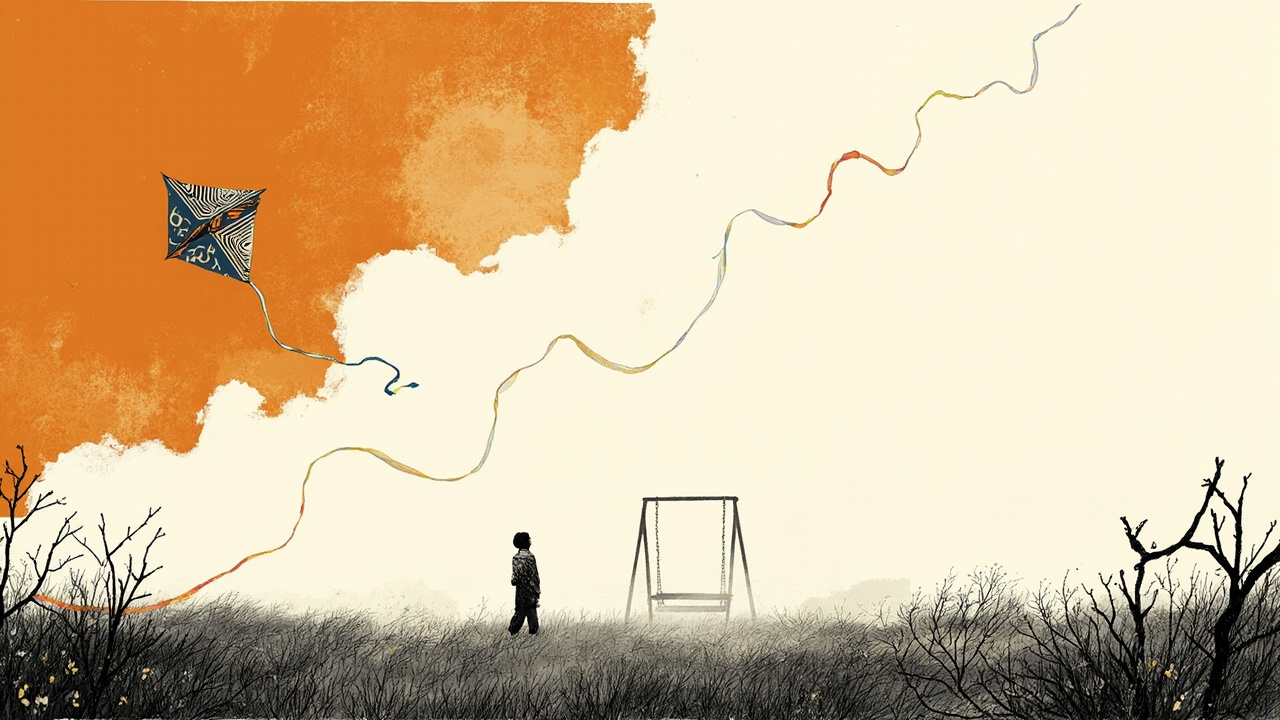
When you were a kid, did someone ever chase something down for you — bring it back grinning, hand it over, and you just pocketed it like it was owed to you? And to get it, he paid a price you can't imagine paying, not in your whole life? This book opens with a boy like that: he grows up in a house that seems to lack for nothing, and at the one moment that matters most, he turns away.
If you still remember that turning away, this book is the process of turning your head back.
The Kite Runner was written by Khaled Hosseini, an Afghan-American, and published as his first novel in 2003. It exploded in the English-speaking world the moment it came out, went on to sell across dozens of countries, and became known as the novel that made the West listen to Afghanistan for the first time. It doesn't write Afghanistan as a place-name in a war briefing — it writes two boys in a courtyard, a kite, and an apology half a lifetime in the making. One line from it sticks after a single read — the lightest sentence in the whole book, and also the heaviest: 'For you, a thousand times over.'
At the story's core are two households. Amir is the son of a wealthy Pashtun merchant in Kabul, raised in comfort, but with a hole in him — his father is too busy, too severe, and almost never praises him. Hassan is the son of Ali, the family's servant, a Hazara boy who always has a grin on his face, handles a slingshot better than anyone, and gives Amir a loyalty with no conditions attached. On Kabul's relatively calm streets in the 1970s, the two of them really do grow up together. Hassan's family lives in the small house at the edge of the courtyard, worlds apart from Amir in social standing, but inside that courtyard they are still just two boys. Then the kites arrive, and those two worlds are about to collide.
'For you, a thousand times over' — light as a sigh, heavy as a stone. Only the rhythm of the actual prose can give you those words; a plot summary never will.
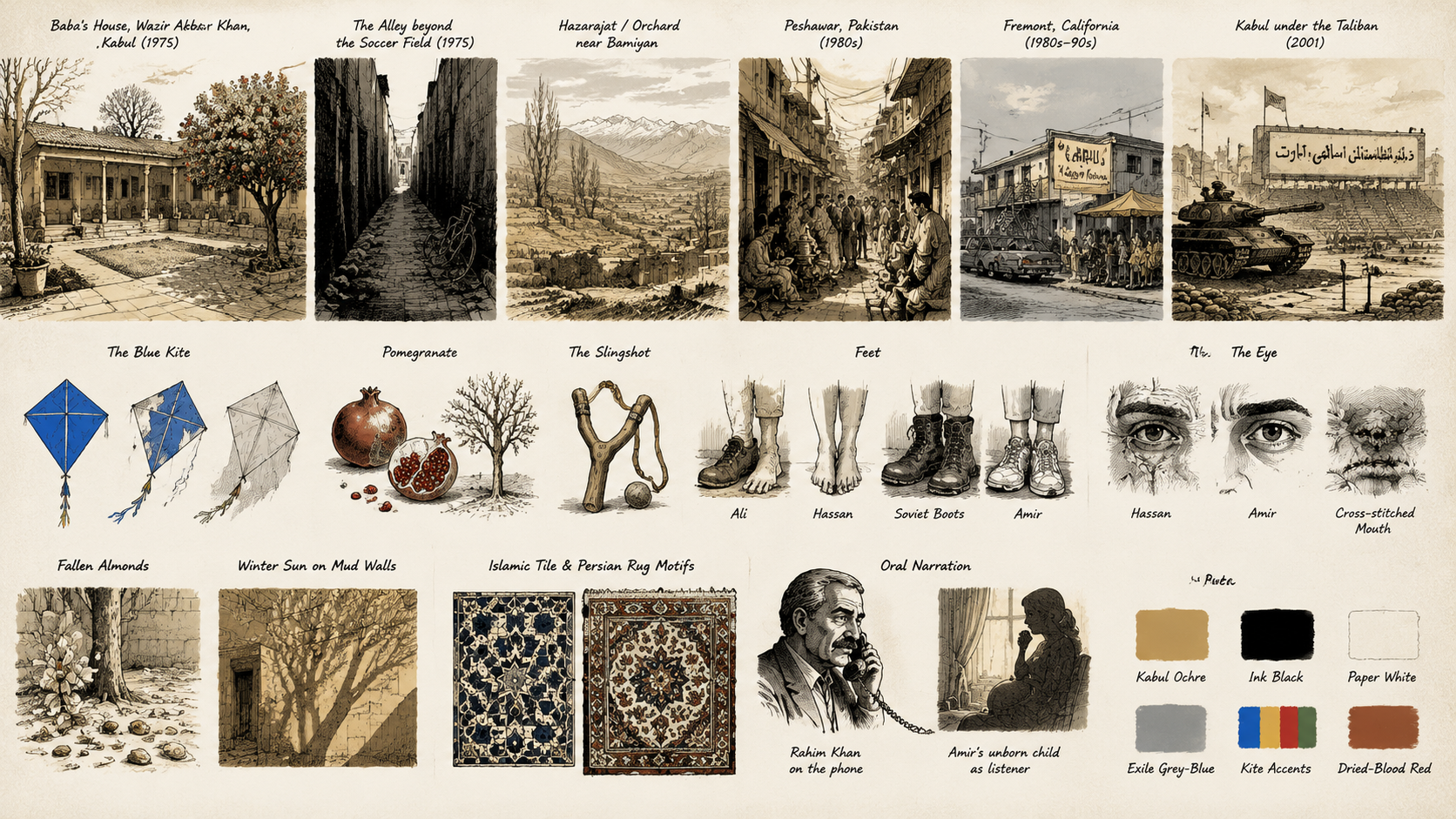
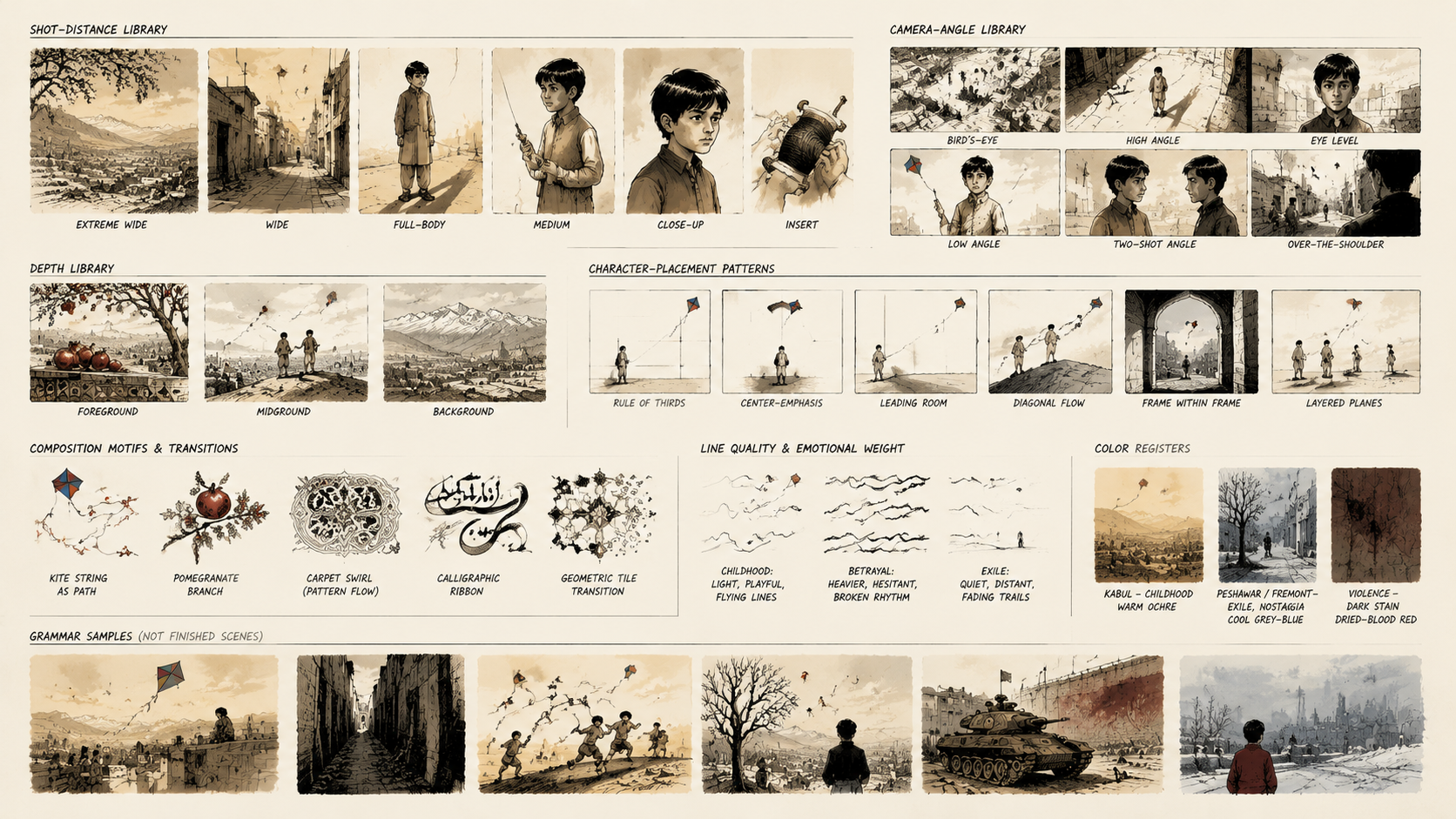
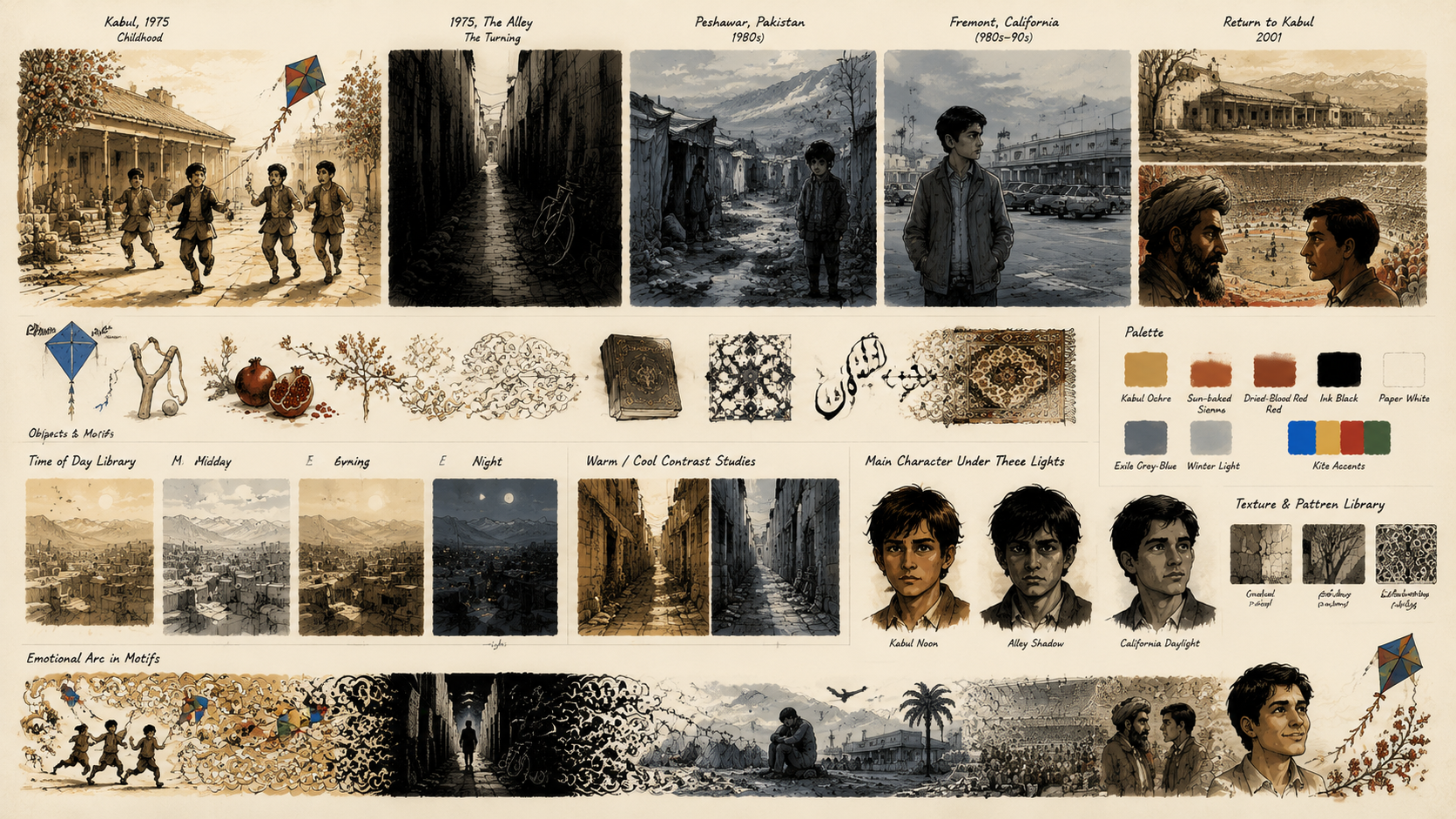
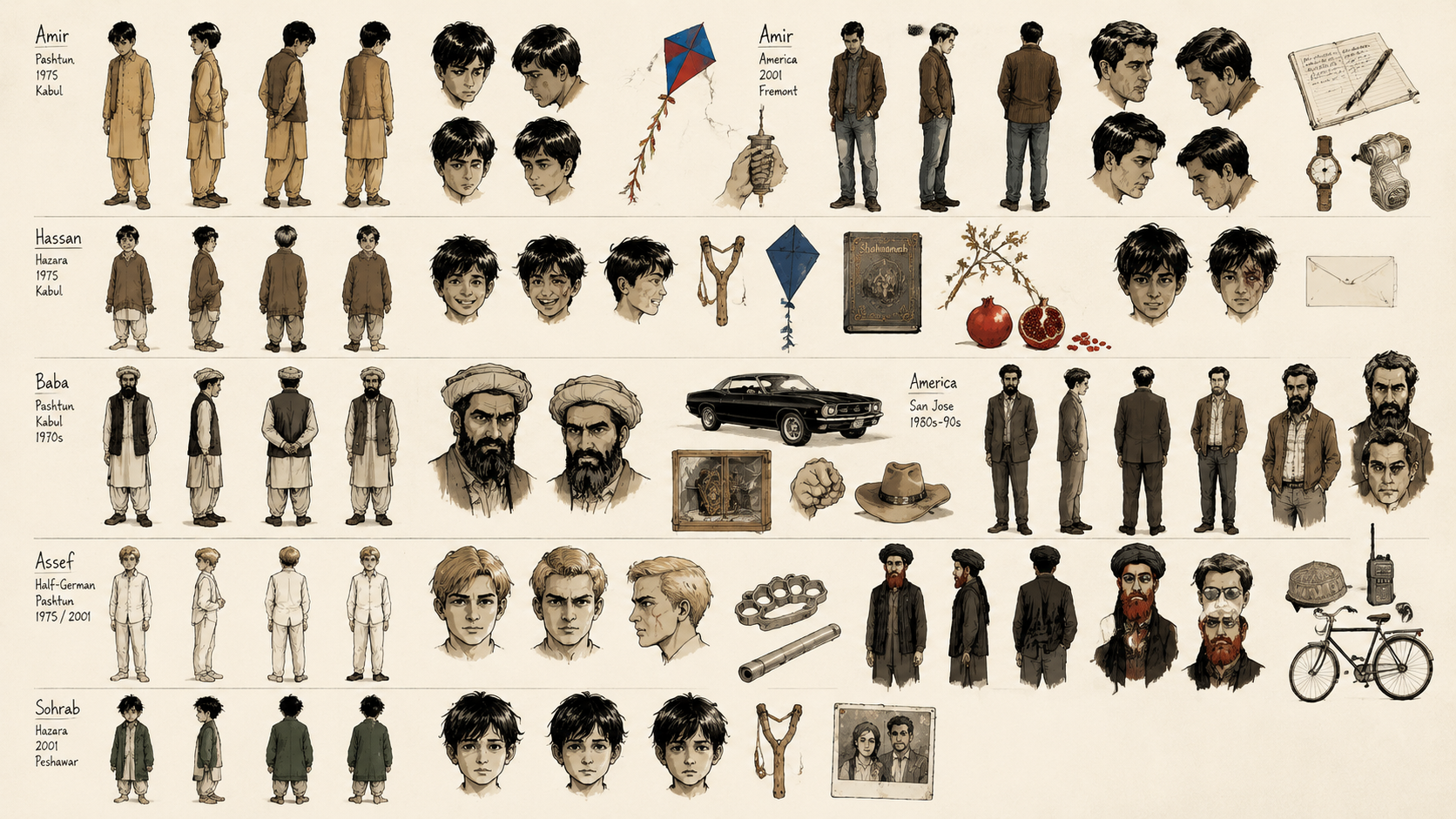
Before the guide was written, this book got a visual foundation — every illustration you just read grew out of it.
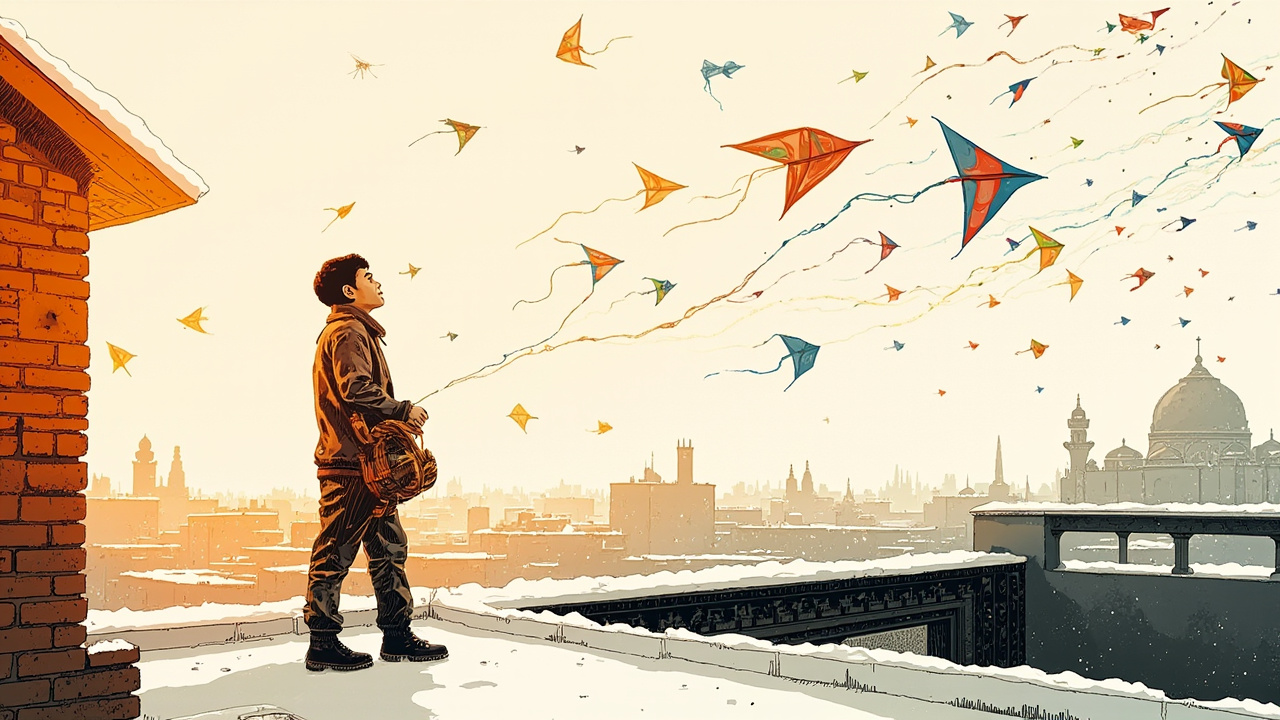
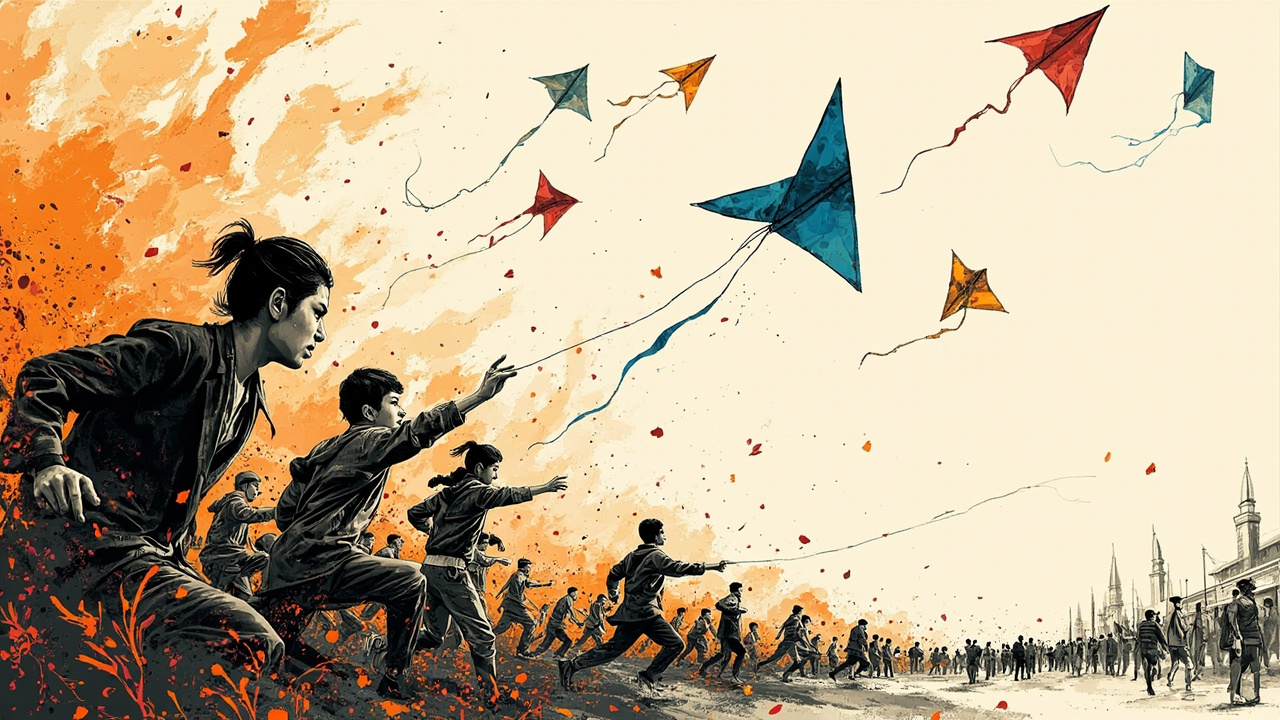
Winter, 1975: Kabul's annual kite-fighting tournament. Desperate for the rare word of praise from his father, Amir fights his kite all the way to the end and finally cuts down his opponent's blue kite. The rule is that the last kite to fall belongs to the winner — but claiming it means a boy has to run ahead and catch it. That boy is the kite runner. Hassan takes off running, grinning, and says the line that would become famous: 'For you, a thousand times over.' Amir waits at home. What comes back is Hassan, caked in mud and blood, his pants torn, the blue kite clutched in his hands. He says nothing. From this moment on, the book's engine is running.
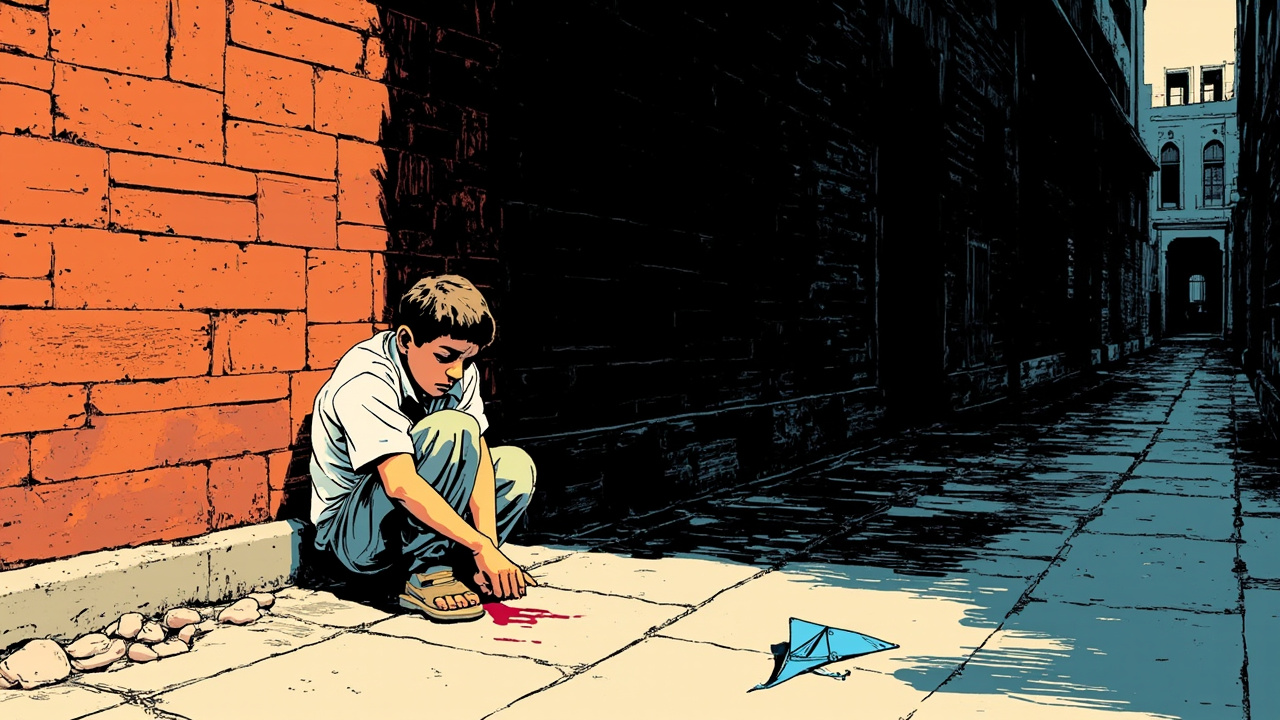
The scene Hassan never speaks of is one the author deliberately leaves unspoken too. He puts young Amir behind a wall at the mouth of an alley, watching, his legs refusing to move. It's one of the book's strongest strokes — it doesn't render the assault itself, only a boy slowly emptying himself out in that alley. From then on, a room takes up permanent residence in Amir's mind, and the sign on its door reads: I could have.
Guilt can hurt worse than hatred. Amir's way of handling that fire isn't to confess — it's to strike first. He plants money and a watch under Hassan's pillow and accuses him of theft. Baba, furious, throws Hassan and Ali out of the courtyard they've lived in their whole lives. As Hassan leaves, Amir hides by his bedroom window, and can't even get out the word sorry.
Four years later, in 1979, the Soviets invade Kabul. Amir and his father are crammed into a truck fleeing the city — the pampered young master of the courtyard ends up in a refugee camp in Peshawar, Pakistan, struggling even for clean water. Later, father and son make their way to Fremont, California. Baba's refugee dignity — the refusal to bow to anyone — means he still walks with his head up even working a gas station. Amir grows up, goes to college, writes novels, and marries Soraya, an Afghan girl he meets at a gathering of expatriates. The household slowly starts to feel like a home, but there's an emptiness in it that no amount of new life can fill.
A late-night phone call shatters all of it. It's Rahim Khan, Baba's old friend, calling from his deathbed in Pakistan, and he tells Amir something he's never known: Hassan was actually Baba's own son, born out of an affair with Ali's wife. Which means the most loyal boy in that courtyard was Amir's half-brother — another family Baba kept hidden inside his shame. What makes this so devastating is that it explains everything: the faint, causeless dislike Amir felt toward Hassan as a boy wasn't dislike at all — it was some instinctive alarm carried in the blood. Rahim Khan's last words are: 'Come. Bring him back from Kabul.' The 'him' is Hassan's son, Sohrab.
2001, Kabul around the time of 9/11, under Taliban rule. Amir crosses the border illegally, and the whole city feels unplugged. Women's faces have vanished from street advertisements, and public executions play out one after another in the old stadium. A boy who once had a garden of his own learns for the first time what it means to know a country that no longer knows you back.
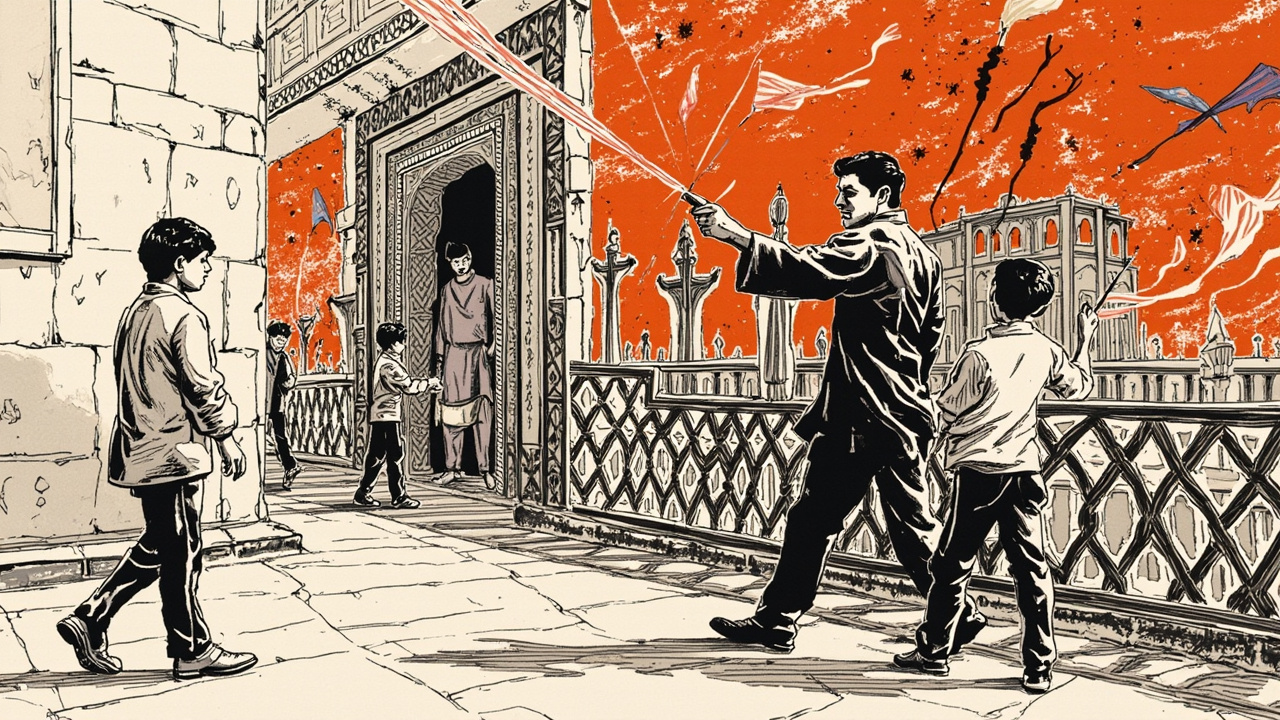
In a Taliban office, Amir finds his childhood nemesis again: Assef, the half-German boy who assaulted Hassan at the mouth of that alley all those years ago. Assef has shed his old skin and become a minor Taliban official, bearded now, with a nickel-plated brass knuckle in hand. Getting Sohrab out costs Amir a beating that nearly kills him — he's saved only when Hassan's son pulls a slingshot from his pocket, the same one Hassan's father once gave him, and aims it at Assef's eye, forcing him back on instinct. Only then can Amir carry the boy out. It's the single most concentrated moment of feeling in the whole book: the abuser, a loyalty long forgotten, and the father who never came back, all crammed into a few square feet.
Getting Sohrab back to America is nowhere near as simple as 'and they lived happily ever after.' There are visas, adoption paperwork, and the hardest part of all: this boy, who watched his parents killed, has forgotten how to smile. There's food on the table and a roof overhead, but night after night he shuts himself in the closet, like a cat that's been badly frightened.
One weekend in the park, father and son — legally just made so — go fly a kite. It lifts into the air, and this time Amir runs for it himself. Not Hassan running for him — he does the running. When the kite comes down, he turns to Sohrab and calls out the old line, 'for you, a thousand times over' — only now it isn't being handed back to Hassan, it's aimed at his son, at the future, at the boy he was twenty years ago when he turned his head away. He can't give Hassan any more than he already has. All he can do is carry that line forward, and spend what's left of his life showing up for the next child.
On the surface it's about kites, about a boy's jealousy and betrayal. Underneath, it's about three things. First, class and ethnicity — the wall between Hazaras and Pashtuns has stood since birth, and neither the children nor the adults are allowed to cross it. Second, fathers: a son fights with everything he has for one word of approval from his father, never knowing that his father once hid his own son in the servants' quarters to protect his name — two generations of the same cowardice. Third, politics: the king, the Soviets, the Taliban roll through one after another, and what they crush isn't a headline, it's a neighbor's dinner. The single best thing this book does is restraint. It doesn't sermonize, it doesn't wring your emotions, and the assault itself is handled almost entirely as blank space. That restraint is what let Western readers, for the first time, read Afghanistan as a country people actually lived in, rather than a patch of color on a map.
What an explainer gives you is the map, not the land. By the end of this you probably know the main line of the story, but you still haven't tasted the stew simmering in a Kabul kitchen in winter, haven't heard the wind moving through the mulberry branches in that courtyard, haven't felt the weight of 'for you, a thousand times over' the first time it comes out of Hassan's mouth — light as a sigh, heavy as a stone. Only the book's own sentences, line by line, can give you that. And there's something the author does especially well: he lets you watch the little room inside Amir close over and over, then slowly get pushed open again. Only prose can do that. A plot summary can only tell you where the door is. If you finish the whole book and only keep one line, keep this one — it isn't from the original, but it's what this piece wants to tell you, after having read the whole book through: Some roads only need you to turn around.