The Knight in the Panther's Skin (Vepkhistkaosani / Vepkhviatkosani) · Companion Guide
骑虎皮的勇士
一个身披豹皮的异国王子闯入御花园,借月光诉说心碎;守夜的阿拉伯王子放下一切,随他跨雪山、闯要塞,只为兄弟与爱情。
Opening: a panther-skin cloak binds two princes together
An Arabian prince keeps watch in the royal garden and, by moonlight, comes upon a stranger wrapped in panther skin, the fur so worn its color has gone, the eyes burning red. The stranger does not draw a blade. He simply stands there and begins to speak a name, then a love story he barely believes he can finish. It is the most dramatic meeting in medieval literature set beneath the snows of the Caucasus, and it is only the doorway into a Georgian epic six thousand lines long. The poem is called The Knight in the Panther's Skin.
What this book is about
The full title translates literally as The Knight Wearing a Panther's Skin. It was written in Georgia at the close of the twelfth century by Shota Rustaveli, though no record fixes his exact age; the earliest documentary trace of him falls somewhere around the 1170s. The poem is composed in Georgian's own sixteen-syllable rhymed couplet, shairi, rhyming every two lines in a rhythm that sounds at once like church chant and battle song. Across more than six thousand lines, not a single word names a real fortress in the Caucasus, Persia, or India. The poem folds the whole East into one imagined geography, where India's Kajeti fortress, Arabia's Shiraz gardens, the markets of Baghdad, and mountain roads through snow-choked passes all sit on a single poetic map. Later generations set it beside Dante's Divine Comedy: a national language came of age through this poem. Georgians still call this twelfth-century poet the father of their literature.
Two knights, and a woman locked away
The poem's true protagonists are two men and one woman. Tariel is a prince of a kingdom in India, raised in silk and comfort. He falls in love with Nestan-Darejan, princess of Kajeti, another Indian kingdom, and a family feud tears the two apart. The grief unmakes him. He finally takes up a panther skin and wears it, hence the name Knight in the Panther's Skin, and wanders from country to country as a beggar, appearing and vanishing without warning. Avtandil is the Arabian king's nephew, sent by the king to find out who has been slipping into the royal garden every night. The two men meet there by moonlight. Tariel tells his story across three days and three nights, and Avtandil weeps at the telling. On the spot the two swear themselves sworn brothers, and Avtandil vows to go with Tariel to India and win the woman back. That vow of brotherhood, crossing blood and border alike, is the spine of the whole poem. The woman herself is locked in a tower in the Kajeti fortress. India's king, poisoned against her by a scheme from Tariel's three uncles, has imprisoned her there and ordered her married off to a foreign warrior named Mukhrani, with the wedding day closing in.
He who knows not love, let him weep, that he may come to know.
不识爱者,且为他落泪——他终将学会去爱。
金句 · 开篇·豹皮人的独白
A night meeting, a vow, the road
The plot turns on that night in the royal garden. The Arabian king has set Avtandil to keep watch, to catch the unknown man in the panther skin. When the two meet, Tariel means no harm to anyone; he only wants a corner of the garden to shelter in. The prince has no ambition left in him, and no violence either. Longing for the woman he loves has hollowed him out until there is nothing left for him to lose.
This figure of the knight gone mad for love arrives well ahead of anything in Western European romance. Avtandil is rational, loyal, a man of action, and after three days and nights of listening he makes a reckless choice: he sets aside his standing at the Arabian court to travel with a foreign prince who looks half out of his mind. In the garden the two princes exchange tokens, swear oaths to each other, and seal a knightly vow. It is the sworn-brotherhood motif of European literature reaching a mature form in Eastern verse.
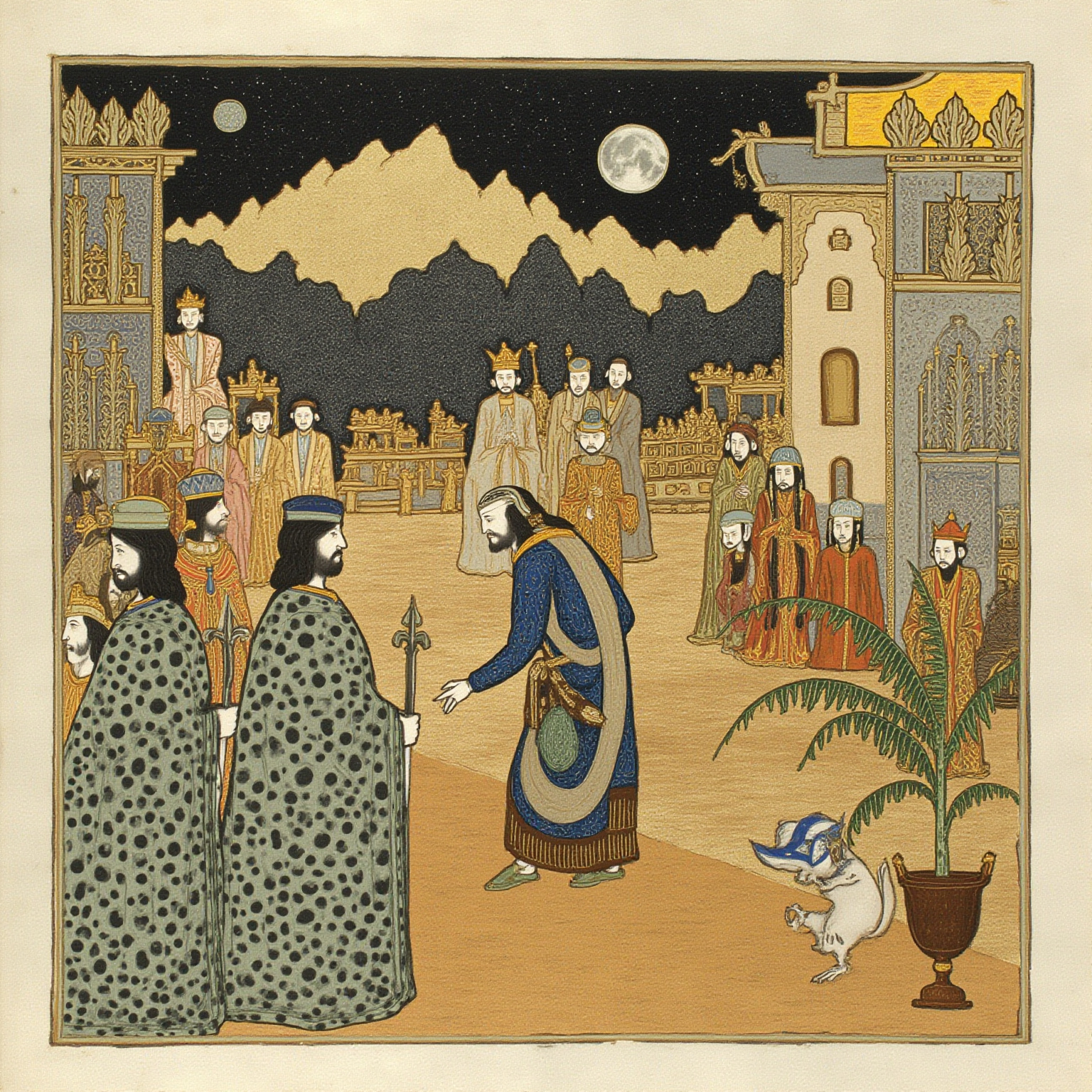
I am your friend, though we are parted by land and lineage.
纵然国土相隔、血统有别,我此生是你的朋友。
金句 · 御花园盟誓·义兄弟缔结
A tower, a signal, a wedding closing in
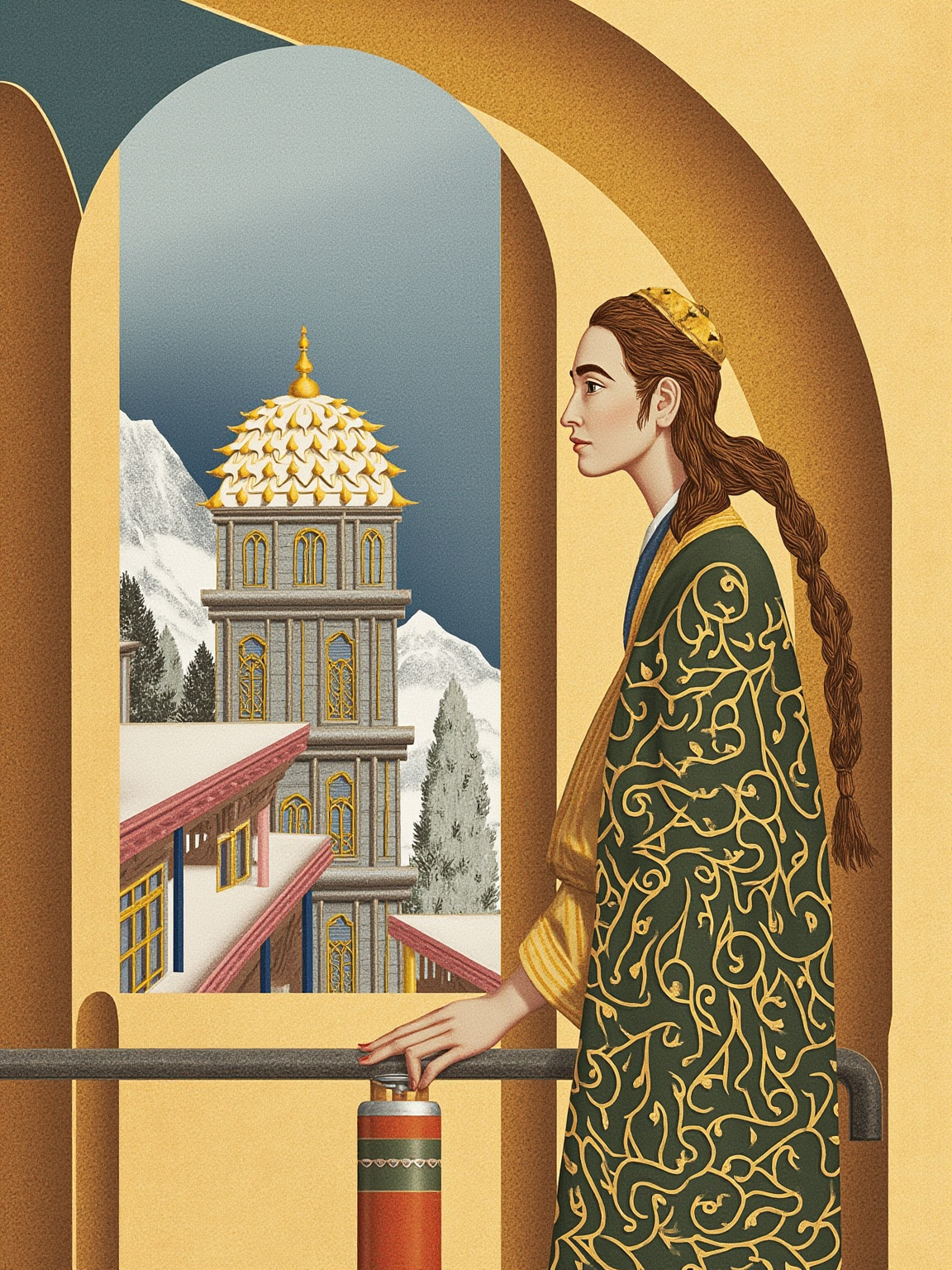
When the point of view shifts to Nestan, she is confined to the tower of the Kajeti fortress, her whole world narrowed to a slit of a window. Rustaveli's touch here is precise: he does not have the princess weeping alone. Instead he shows her watching, through that narrow window, the people passing below. Then she spots Tariel's banner, in the marketplace, in the hills, arriving from far away. How does she get word out? This is the moment painters have gone back to again and again: the girl in the tower signaling by whatever means she has, dropping an object, lighting a fire, tracing an agreed-upon pattern, so the men below know where she is, and that she is still alive.
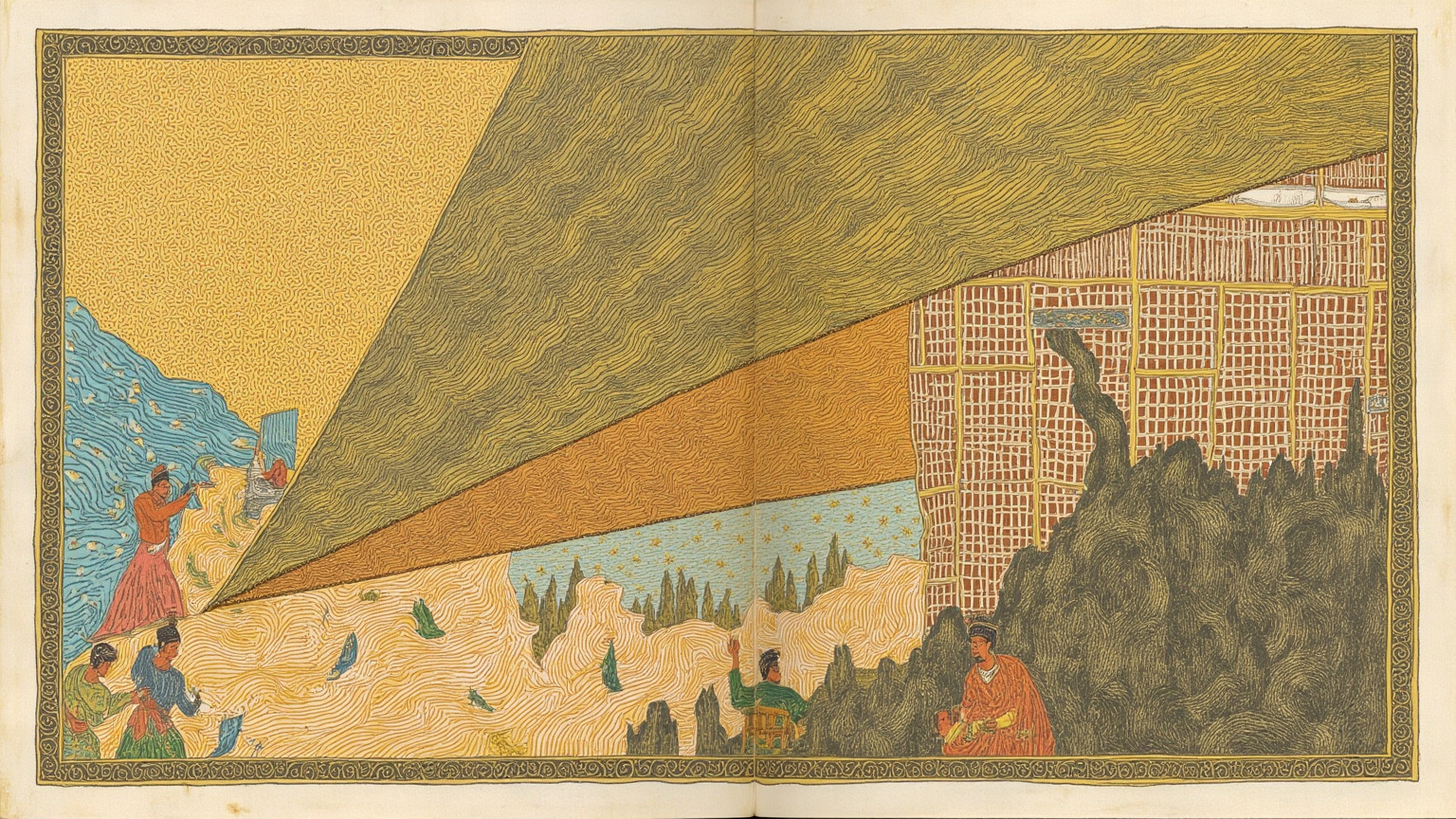
The tower held her, but her gaze reached far beyond its walls.
高塔困住了她,她的目光却越过了每一堵墙。
金句 · 高塔囚禁·窗前凝望
Slipping into Kajeti
To get into Kajeti, the two princes go through disguise after disguise: merchants, wandering ascetics begging their way along, traveling entertainers. They talk their way past checkpoint after checkpoint, wearing their tongues out on the effort. The writing here has the street-smart energy of a swordsman's tale; the men bicker with local elders and stall interrogations even as they push forward, and the reader smuggles along with them, laughing the whole way. This is Rustaveli at his best: he can make a cross-border expedition feel both romantically grand and thick with everyday life.
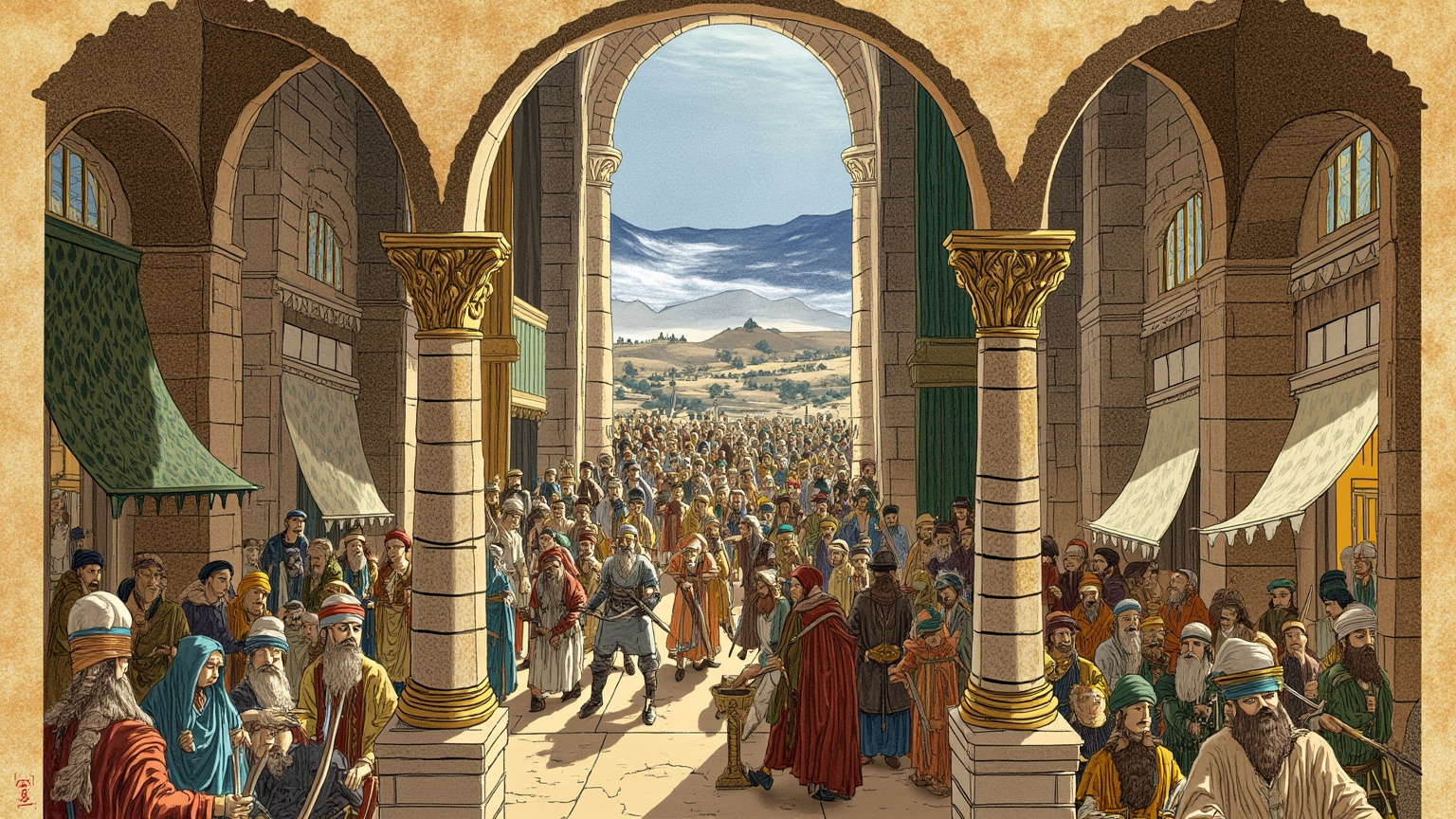
Many roads lead astray; few carry the faithful home.
歧路万千,能引忠信者归家的,不过寥寥。
金句 · 雪山跋涉·伪装入市
One blow on the dueling ground
Getting in is not enough. To pull her out of the tower, someone has to win a public match on Kajeti's dueling ground. The setup: Mukhrani is the foreign warrior the king of Kajeti has forced on Nestan-Darejan as a husband, and only a public defeat, in front of everyone, can call off the marriage. Avtandil is the one who fights that duel, and this is the single stroke of design in the whole poem that makes me want to cheer out loud. Tariel is the hero of the story, yet it is his sworn brother's hand that swings the blade that breaks the deadlock. Rustaveli gives each knight his own kind of courage: one man mad with love, the other steady under pressure; one always out ahead of his own feeling, the other always behind him, clearing the road.
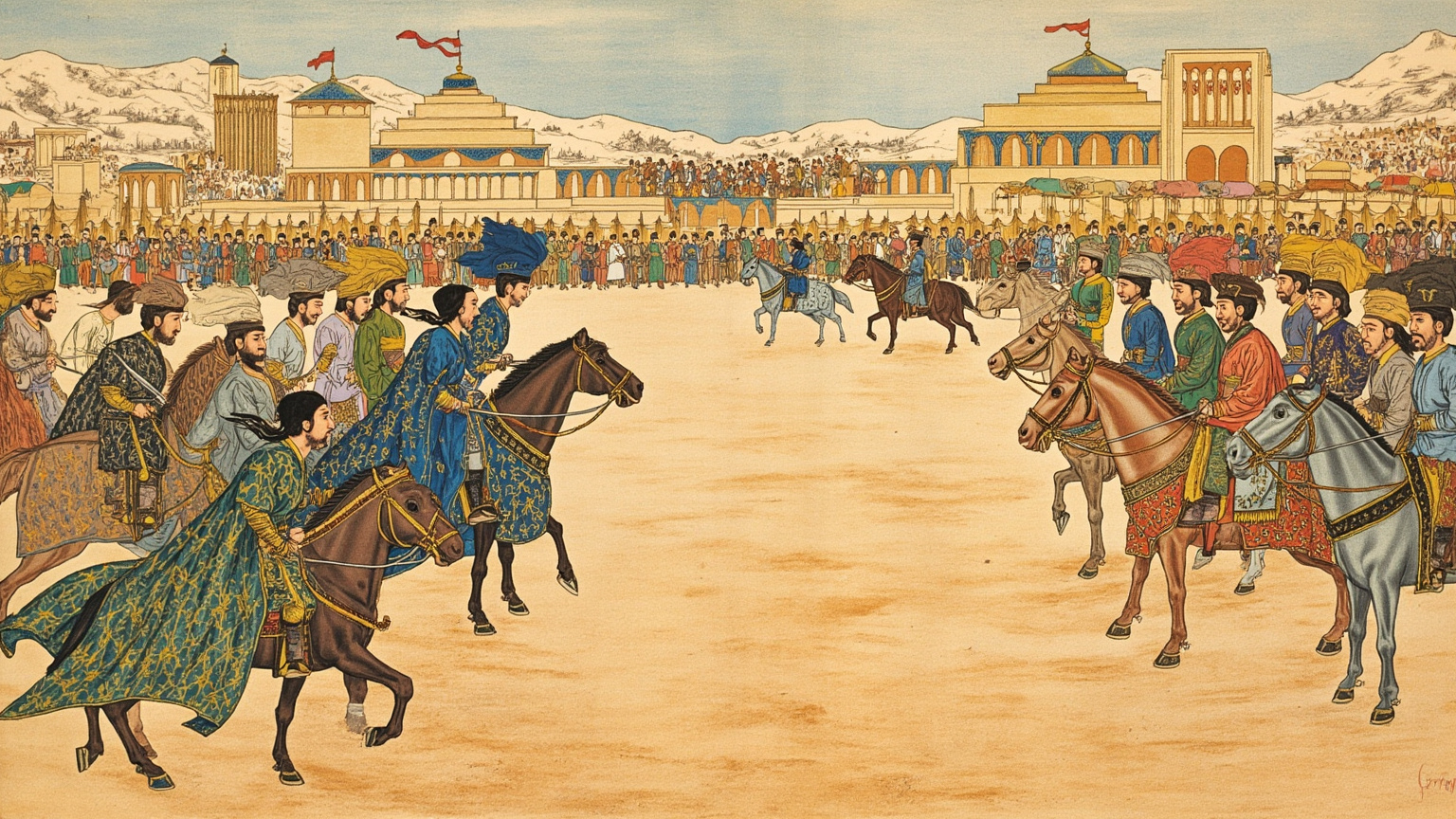
He who strikes for another strikes for his own soul.
为兄弟挥剑,便是为自己灵魂挥剑。
金句 · 决斗场·穆赫拉尼之战
Reunion in the tower, then flight
The moment the duel is won, Tariel races into the tower, and there, at the top, he and Nestan-Darejan meet again. Rustaveli holds back here; there is no lingering over the embrace. The two exchange one look on the tower roof, the knight pulls her up onto his horse, and they ride out of Kajeti that same night. What is striking is that the poem's greatest dramatic tension has always been how the two were torn apart, yet the climax is a coming-together rather than another separation. This is a common move in medieval romance: let the parting fill the pages and keep the reunion spare. The reader has already followed a thousand lines of longing, and it is the lightness of the reunion that shows how much the longing weighed.
A triple wedding to close
The two princes return to Tariel's kingdom, where Tariel takes the throne and holds a great feast for the assembled lords; that is the first joy. Avtandil, the nephew who left Arabia to fight alongside him, meets an Indian princess on the way home, and the two settle on each other at once; that is the poem's second joy. At the close, Rustaveli binds Nestan-Darejan's wedding, Avtandil's wedding, and the kingdom's coronation feast into one triple celebration and ends the poem there. The ending catches a reader off guard; by the story's own logic this should end badly. Instead Rustaveli tunes the whole poem to its most triumphant note. There is a kinship here with Dante's Divine Comedy: the poem is not written to release us from the world, it is written to set the world in order and bring it to a proper close.
What makes it good, and why read it now
Literary historians tend to shelve it beside Dante's Divine Comedy and Chaucer's Canterbury Tales, as a founding work of national literature. But its sharpest difference from its Western European contemporaries is a decision made at the outset: to write a world-class poem in Georgian, a language with no established literary pedigree behind it. Partway through the poem, Rustaveli steps out of the narrative to praise the Georgian language itself. That gesture is romantic in the fullest sense; the language becomes a nation's poetic declaration of its own existence. It gives literature outside Western Europe a traceable point of origin for that same romantic impulse. For a reader today, The Knight in the Panther's Skin is a rare full score of the medieval East as it was imagined: the courts and markets, the snow peaks and fortresses of the Caucasus, Persia, and India, all mixed together. The imagery alone could feed any illustrator for years: the panther-skin cloak, the fortress tower, the expedition across snow and desert, the dueling ground, the noise of the marketplace. As a set of visual motifs, it is more cinematic than a great deal of Western European romance.
Why knowing the plot is not enough
Finishing this only means I have read a map, for two reasons. First, it is a poem: more than six thousand lines of sixteen-syllable rhymed Georgian couplets, a rhythm that runs like chant and pounds like a war drum. Knowing what happens gives you the skeleton; the body is the sound itself. Only by running into those rhymed couplets yourself do you understand why Rustaveli's own people have held him up for a thousand years. Second, there is an ease to Rustaveli's handling of this medieval Eastern imagination. He lets his knights go out of their minds for love, then reins them in until they waste no word. He lets his heroes get roughed up in the streets with no trace of a halo, then makes them stand on the dueling ground as bright as dawn. A man can be shattered by love and still throw a fist for his brother in the next breath. A plot summary cannot hold all of that. Only the poem can.
A twelfth-century Georgian epic that already knew how to let one man go mad for love, and another swing a blade for his brother.
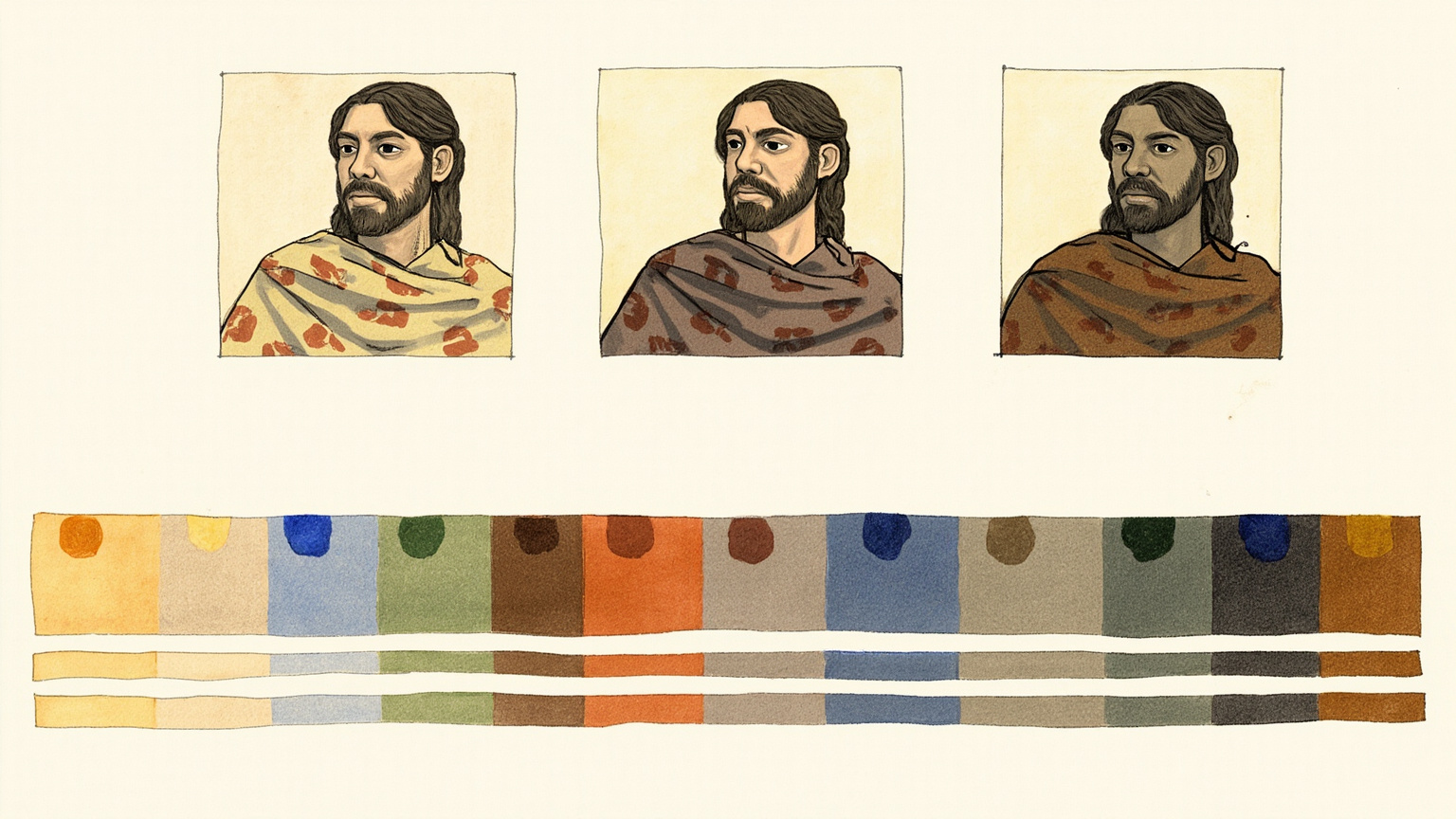
Art Direction4 plates
Before the guide was written, this book got a visual foundation — every illustration you just read grew out of it.