A fairy tale written for grown-ups, about taming, goodbyes, and what the eye cannot see
Text and illustrations produced by the pipeline
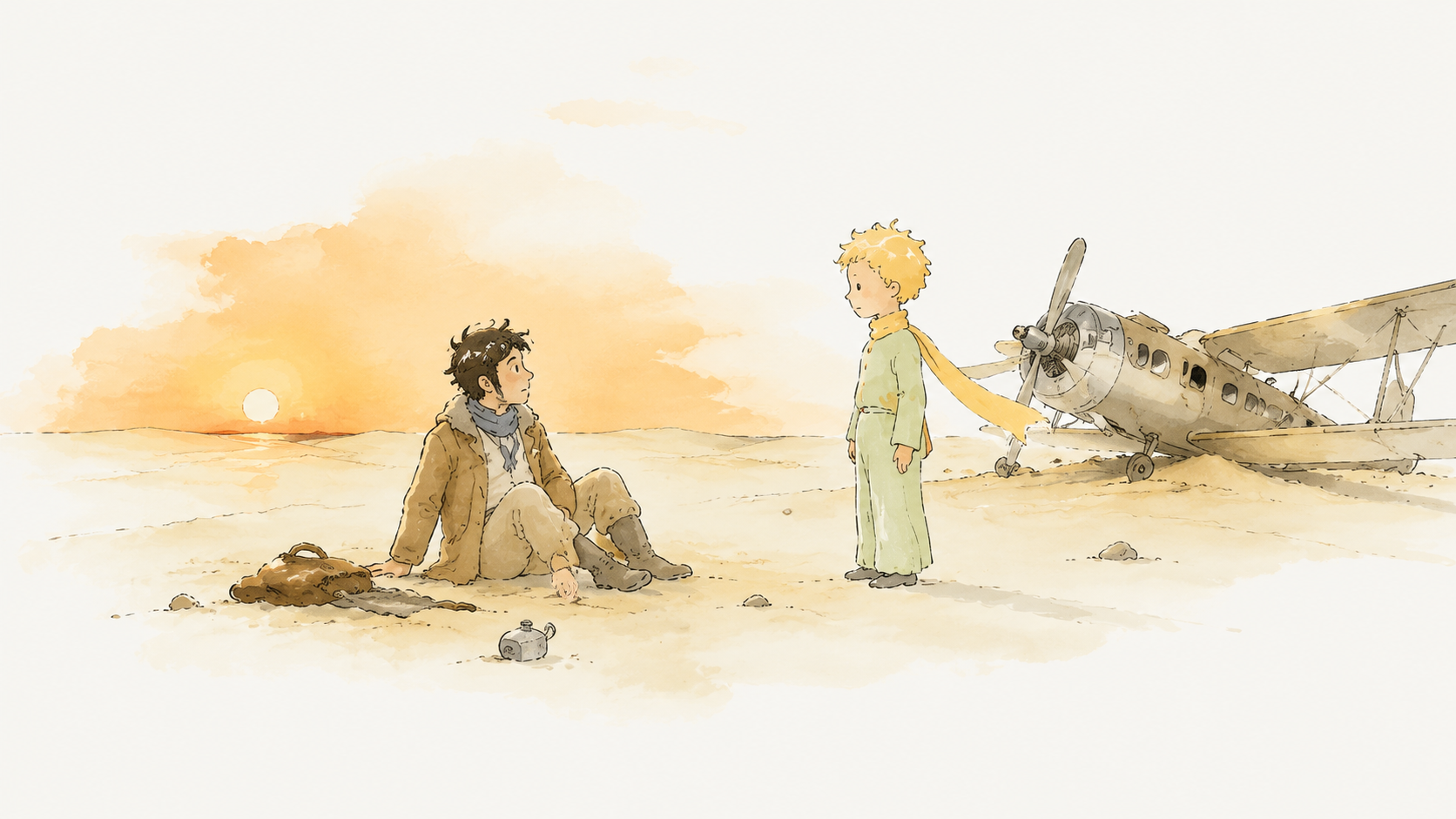
Your plane is down in the middle of the desert, water enough for a few days. A small boy with golden hair turns up, and his first words are not "help me" but "draw me a sheep." You say you can't draw, he says never mind, try again. You scribble a box and say the sheep is inside it, and he actually laughs. This is not how fairy tales usually open — it feels more like two lost people, in the middle of nothing, stumbling into a conversation that was never supposed to happen.
The Little Prince is a philosophical fairy tale written by the French aviator and writer Antoine de Saint-Exupéry while he was in exile in America during the Second World War. It was published in New York in 1943, simultaneously in French and English — not in France, because that year France itself was still under Nazi occupation. It looks like a slim little book, and the same person wrote the words and drew the pictures. It has since been translated into hundreds of languages and read by hundreds of millions of people, becoming something close to a shared spiritual code passed down across generations. In one line: it's a small book written in a child's voice for adults, and the more you read it, the more precisely it seems to total up the cost of growing up.
The whole book runs on a handful of characters, and yet they hold up an entire sky. The aviator, "I" — an adult forced down in the Sahara, who carries the whole book's point of view and translates between the reader and the little prince. The little prince — a golden-haired boy from the asteroid B612, living on a planet not much bigger than a house. The rose — the one flower he ever tended, proud, vain, covered in thorns, and yet the one attachment he can never set down. The fox — the sage the little prince meets on Earth, who spells out the price of love in a single word: taming. The snake — that golden creature in the desert who talks in riddles, and who sees the story out at the end. It wears a child's costume, but what it carries inside is a miniature of the absurdity of the adult world, and every grown reader finds a piece of themselves in it.
Generation after generation has kept this book close, and not only because of the sheep shut in a box, the rose who coughs, the fox who sighs. It endures because it refuses to let the word "reality" push innocence out of the way. The question it keeps asking, from the first page to the last, never changes: are you willing to spend your time on something?
This isn't a farewell written for children — it's written for every adult who has ever been alone in a desert, so you don't forget the boy who once asked you to draw him a sheep still lives inside you.
The plot can be summed up, but there are things a summary can never deliver: Saint-Exupéry's short French sentences, restrained to the point of near transparency, light as wind; the fox's tone, sighing its way slowly through what it has to say — reading it aloud and reading it silently are two entirely different experiences; the well in the desert, the water, sweet only because the body has walked six days to reach it; the night the little prince falls at the end, when the aviator feels him go down as gently as a tree — you won't understand what losing someone feels like in the body until you've read it yourself. And then there are the watercolors — the sheep in its box, the rose in her veil, the boa constrictor digesting its elephant — every line drawn like a child's drawing, and only seeing them with your own eyes lets you feel the force of saying the deepest things with the simplest lines. Go read it — the little prince is still out there in the desert, waiting for you.
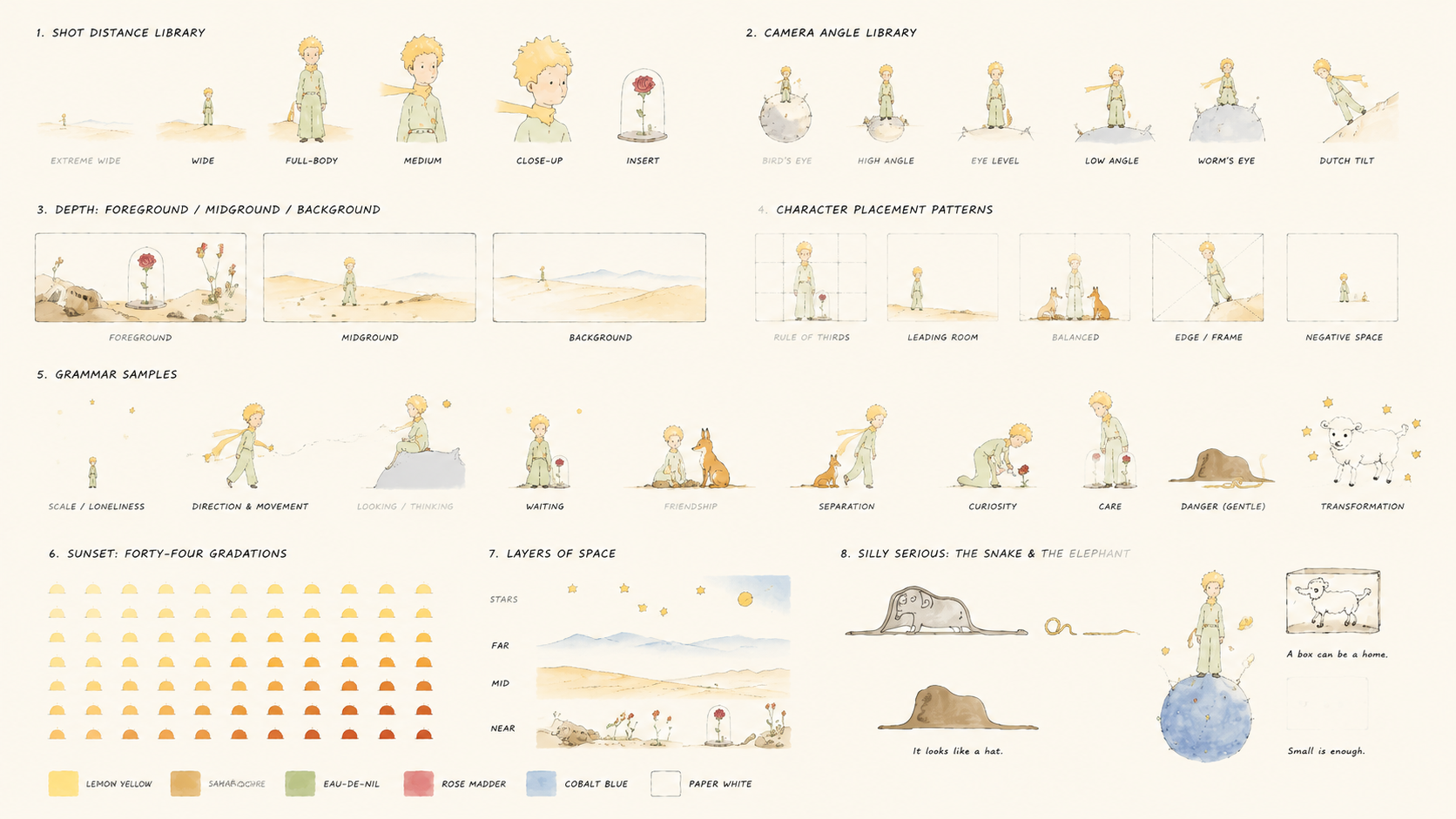
Before the guide was written, this book got a visual foundation — every illustration you just read grew out of it.
Over the six days it takes to fix his plane, the aviator meets this mysterious boy. The little prince doesn't answer questions — instead he keeps asking for drawings: a sheep, a boa constrictor swallowing an elephant, a sheep inside a box. Only the last one satisfies him. That detail is the key to the whole book: an adult sees only the surface, while a child can picture the life hidden inside a box. What makes the writing work is that the narrator starts out as a card-carrying practical adult, and the little prince drags him back, bit by bit, to the side of imagination — the contrast between the two of them is what keeps you reading.
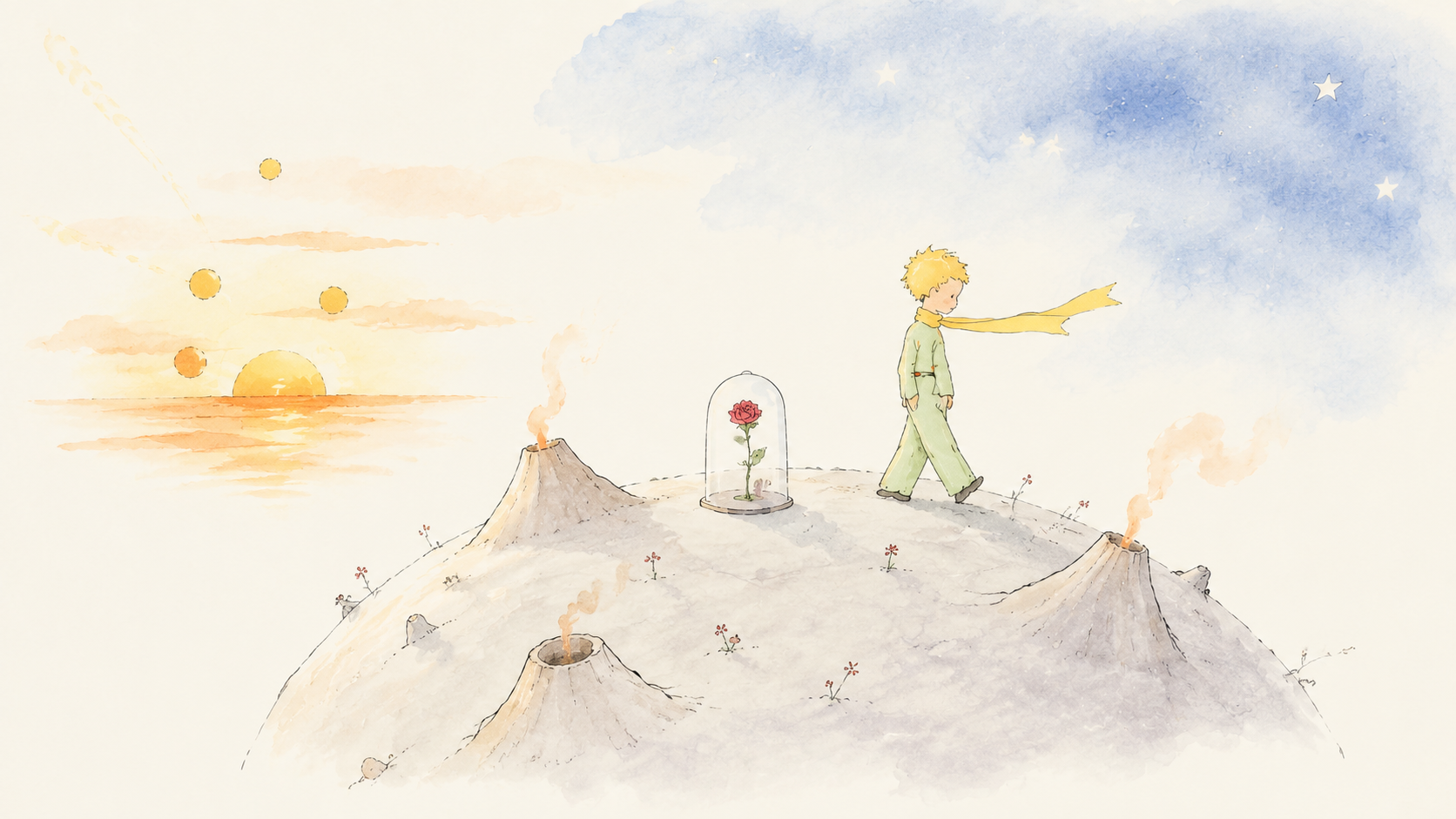
The little prince gradually opens up: he comes from a planet no bigger than a house, with three volcanoes knee-high — two active, one dead — and a single rose. This rose is a peculiar creature: she pouts, she coughs, she plays at being fragile, and she carries four thorns on her. The little prince waters her, shields her from the wind, gives her whatever she asks, and still she isn't satisfied — until finally he can't stand her vanity anymore and storms off. This passage is quietly brutal in what it's doing: a child leaves the person he cares about most, not because he stopped loving her, but because he hasn't yet learned how to bear all of someone while loving them.
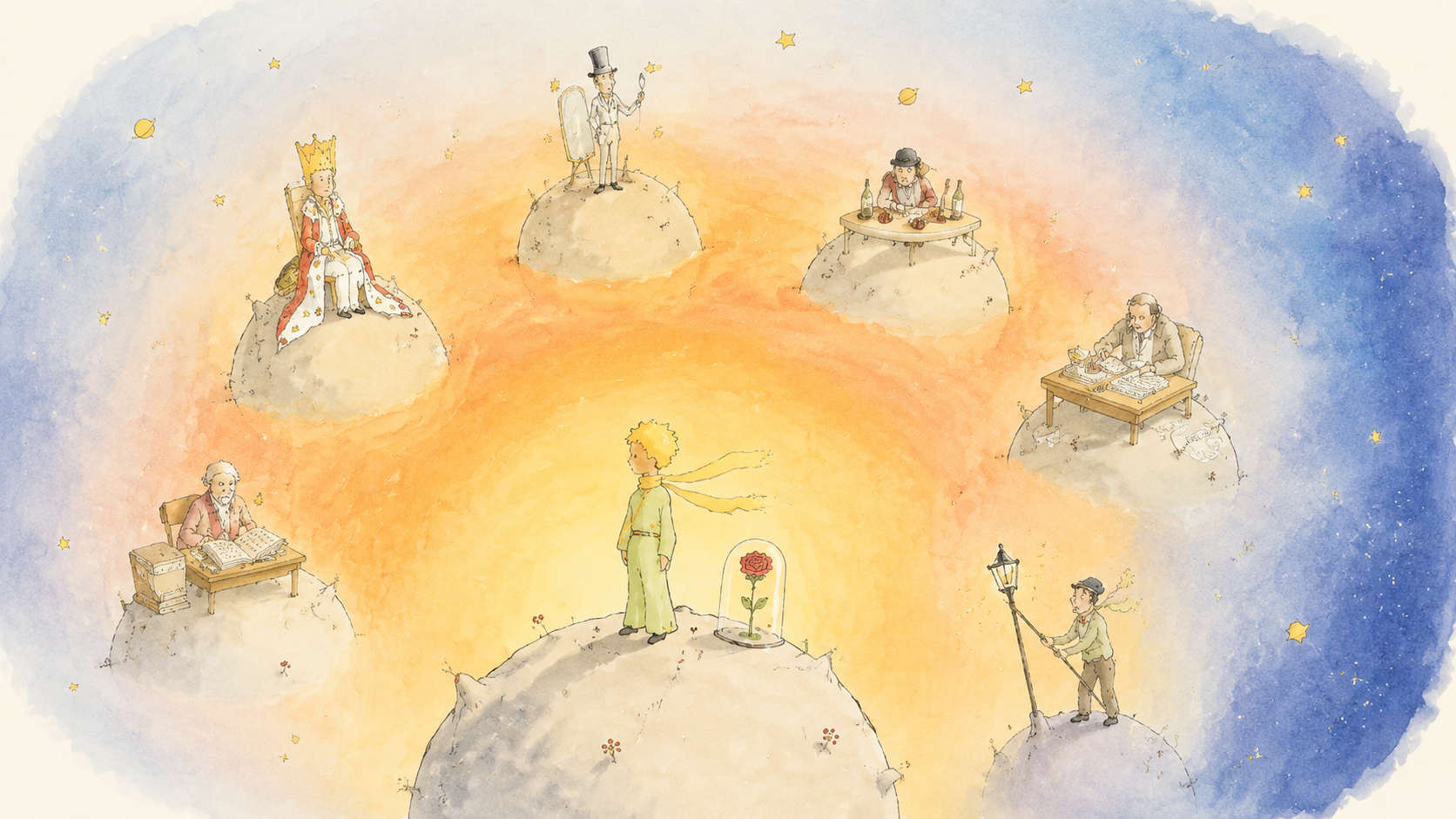
After leaving B612, the little prince visits six asteroids in a row, each home to exactly one man — a king, a conceited man, a drunkard drowning his sorrows, a businessman fixated on a tally, a lamplighter obeying orders to light and douse his lamp, and a geographer who only records the world and never steps out of his study. These six are less characters than six adult afflictions held up under a magnifying glass: power, vanity, addiction, greed, blind obedience, and detachment from reality. What makes the writing work is how light the satire stays — it never presses the point. Nearly all of it rides on the little prince's why, and the more earnestly, innocently he asks it, the less anywhere the absurdity of the adult world has left to hide.
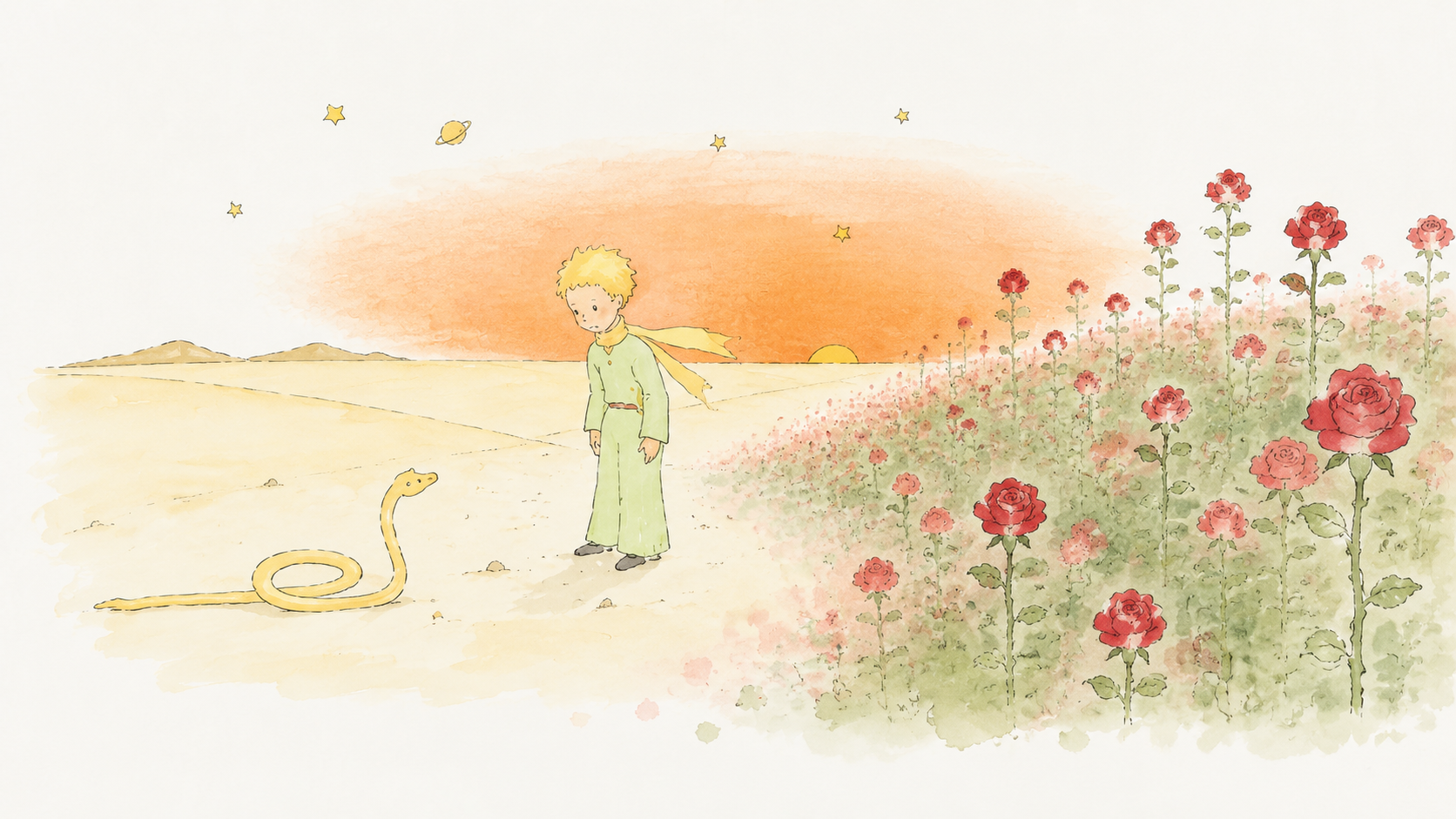
On reaching Earth, the little prince first meets a snake in the desert, then walks alone through a garden of roses — full of flowers exactly like his own. This is the single most devastating turn in the book. He had believed his rose was the only one in the world, beyond price, and now discovers, all at once, that he is just the owner of an ordinary rose. He stands in a sea of flowers, and the color drains from his face. Nothing this book preaches lands as hard as this moment does: losing the sense of being one of a kind is a growing pain almost every adult eventually runs into.
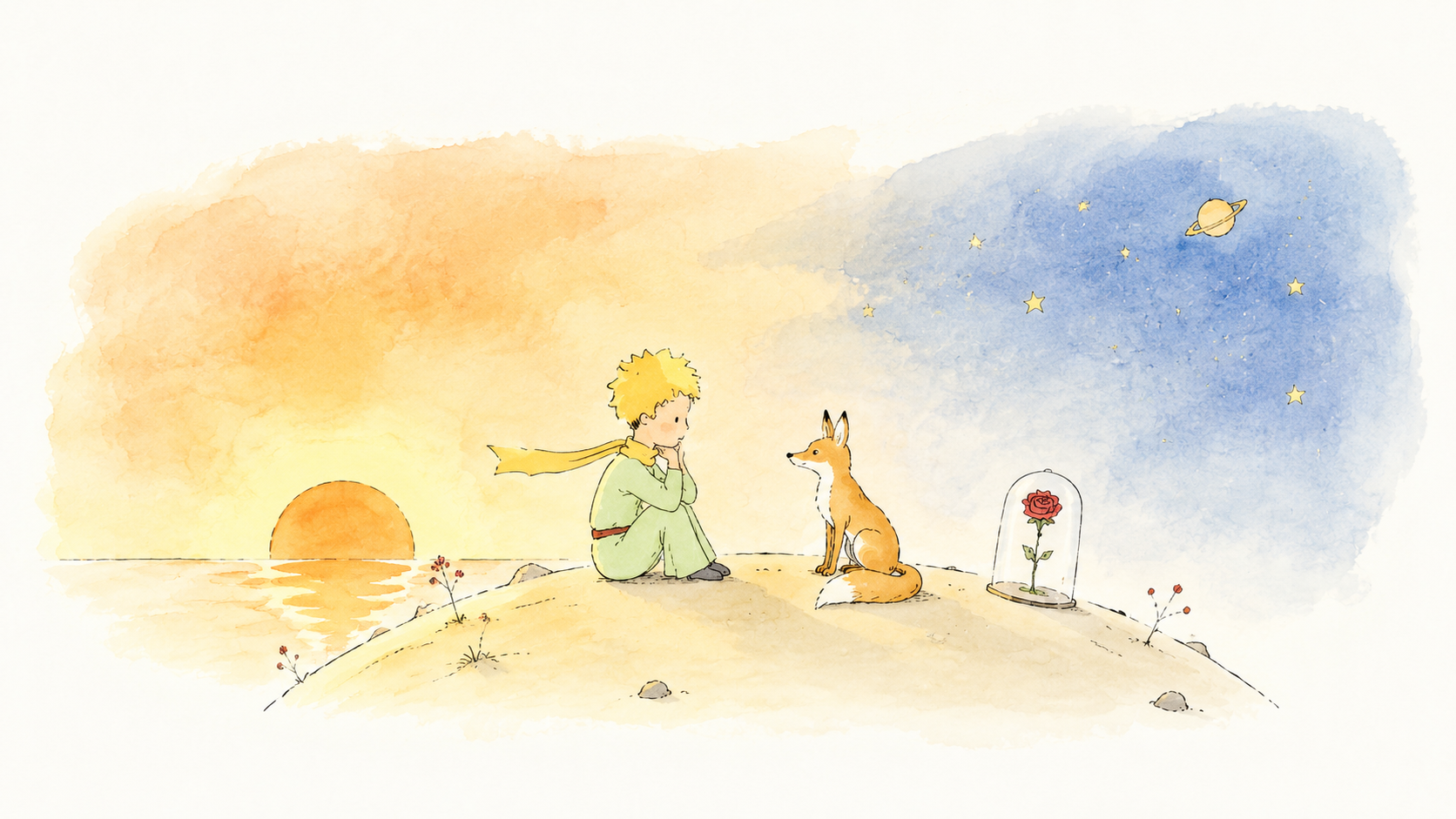
Just as the little prince is on the verge of tears over what he's lost, he meets a fox. The fox doesn't ask him to draw a sheep — instead he lays down a condition, unhurried: "If you want me to play with you, you have to tame me first." The little prince doesn't understand at first — isn't taming just another word for making a connection? The fox patiently explains what taming really means: spend time on something, and it becomes unique to you; spend time on your rose, and she matters more to you than every rose in every garden put together. Before they part, the fox leaves him with the single most famous line in the whole book — that what is essential is invisible to the eye, and only the heart sees clearly. This passage is the heart of the book, in every sense, but Saint-Exupéry never lets the fox lecture. He has him sigh as he speaks, so that the idea arrives as a friend's goodbye, reluctant to see you go.
The section where the aviator and the little prince go looking for water in the desert is the plainest and most moving chapter in the book. The water has run out, the desert stretches on without end, and the two of them walk and talk, until they pass an old well, little more than a ruin. They wind up the rope, the bucket comes up full of clear water, and they drink together like brothers. There's no moral being pushed here, but the physical sensation is overwhelming: thirst, exhaustion, legs that won't move, one more push, one more step. The weight of holding each other up inside an extreme hardship like this is taming made physical — they have already spent time on each other, and neither one is a stranger anymore.
On the last night, the little prince tells the aviator that a full year has passed since he came to Earth, and it's time to go back. He has to return to his planet and look after his rose. But he doesn't say how he'll get there — only that his body is too heavy to carry along. Under the stars he walks up to the yellow snake and asks it to send him on his way. The snake bites him, and the little prince falls, softly. When the aviator goes looking for him the next morning, all that's left in the sand is a yellow husk — the body itself is gone. Notice that Saint-Exupéry never states outright that the little prince has died; what he writes is that the boy has set his body down and gone home to his planet, leaving the whole thing deliberately blurred. That is the one place this fairy tale refuses to grow up — it lets a child's departure be gentle, a homecoming, rather than the cold plain fact of death.
It's worth noting that every illustration in the book is a watercolor Saint-Exupéry painted himself — the artless little figures, the sheep shut in its box, the rose in her veil — a fusion of word and image rarely seen in literary history. A little over a year after the book was published, he vanished during a reconnaissance flight over the Mediterranean, and the wreckage of his plane wasn't found for decades. So he never lived to see the book make its way around the world. The fact itself reads like something out of the little prince's own story — the things that matter most, you never quite live long enough to watch pay you back.
On the surface this book is about a boy and a rose, a fox and a snake. What it's actually doing is speaking, in a child's voice, to a room full of adults who have already "grown up" — telling them what they've lost. Growing up, much of the time, just means being slowly tamed by power, vanity, calculation, and blind obedience; taming, in the opposite direction, means being willing to spend time, over and over, on a flower, a friend, a relationship — treating someone as irreplaceable, and being able to bear the weight of missing them and losing them. The things that actually matter — love, responsibility, memory, longing — none of them live in the visible world; they only come into focus where the heart looks. That's why it never wears out with rereading: every generation of adults that comes back to it stops cold on some page or other.