The Lute / Pipa Ji (Kao Ming, c. 1350) · Companion Guide
琵琶記
新婚第二天被父催上京赴考,京里他被相府强留下做女婿,乡下她咽糟糠葬公婆,千里琵琶寻夫——两端的苦,谁也没错。
Opening
A lute walked a thousand miles on a woman's back. Strapped beside it was a scroll painting of her dead parents-in-law. Those two things were everything she owned. She had set out from a village house with no fire in the stove and no warmth in the bed, walking toward the capital to find the husband who had been sent off to sit the imperial examinations the day after their wedding and never come home. Her name was Zhao Wuniang.
What the book is
The Lute was written in the late Yuan dynasty by Gao Ming (c. 1305-1359). It is the first mature nanxi, or southern drama, composed by a single literatus rather than pieced together by traveling troupes, and later generations called it the father of southern drama. It opened four centuries of Ming and Qing chuanqi that followed it, from Tang Xianzu to Hong Sheng to Kong Shangren, none of them able to write around it. It has never left the stage. For hundreds of years every troupe has learned its craft on this play first; it is the primer of the trade.
The reason is simple. Earlier southern dramas were mostly rowdy crowd-pleasers stitched together by folk performers; The Lute was the first to give the form a complete script, written by one hand, able to carry the weight of tragedy. The story comes from an older southern play, Zhao the Faithful Wife, in which Cai Bojie is a faithless husband struck dead by lightning for his betrayal. Gao Ming turned the whole thing around. He does not blame the man. He asks a harder question: who, or what system, drove him to this? That reversal is what made it a classic.
People and worlds
The whole play holds two worlds and five people trapped between them. The countryside of Chenliu: poor. Cai Bojie is newly married when his father, Old Cai, pushes him to sit for the examinations, and Zhao Wuniang pawns her own clothes to fund his trip and sees him off with her own hands. The chancellor's residence in the capital: rich. The moment Cai Bojie places first in the examinations, Chancellor Niu takes notice of him and insists he marry into the family. Cai asks three times to decline the post, refused each time; asks three times to decline the marriage, refused each time. He is left hanging in that house, wanting to go home and unable to.
Zhao Wuniang stays behind, waiting for word from her husband, and what comes instead is years of drought and locusts, rice priced like pearls and firewood like cinnamon. She swallows chaff herself and cooks what little white rice is left for her parents-in-law, and it still is not enough: they starve to death, one after the other. Miss Niu, on her side, is the chancellor's only daughter, raised in comfort, well read and properly brought up. Her father arranges her marriage to Cai Bojie. She has not stolen anyone's husband; like him, she has simply been pinned down by the same order.
None of these five people deserves blame. Cai Bojie is no Chen Shimei, the faithless husband of later opera legend. Chancellor Niu is no scheming villain. Zhao Wuniang is no saint. Miss Niu is furthest of all from being a villain. Everyone here is trapped, and everyone has reason on their side, which is exactly what makes this play so hard to stage simply and so rewarding to watch closely.
The newlywed farewell: the lute's first gift
The story opens on a marriage that barely lasts a week. Cai Bojie and Zhao Wuniang have just married when Old Cai orders his son onto the road, arguing that a poor family needs him to make something of himself, since the examinations are the only way up and out. Zhao Wuniang does not want him to go, but she knows this is her father-in-law's command. She pawns her own clothes and jewelry to fund his travel and walks him to the edge of the village herself. The lute enters the story here: before he leaves, Cai Bojie leaves it with her, the instrument's first appearance on stage. What makes the farewell scene work is that no one weeps or wails. All the reluctance sits in the gestures: handing over the clothes, packing the bag, one last look back. The family believes there will be time enough later.
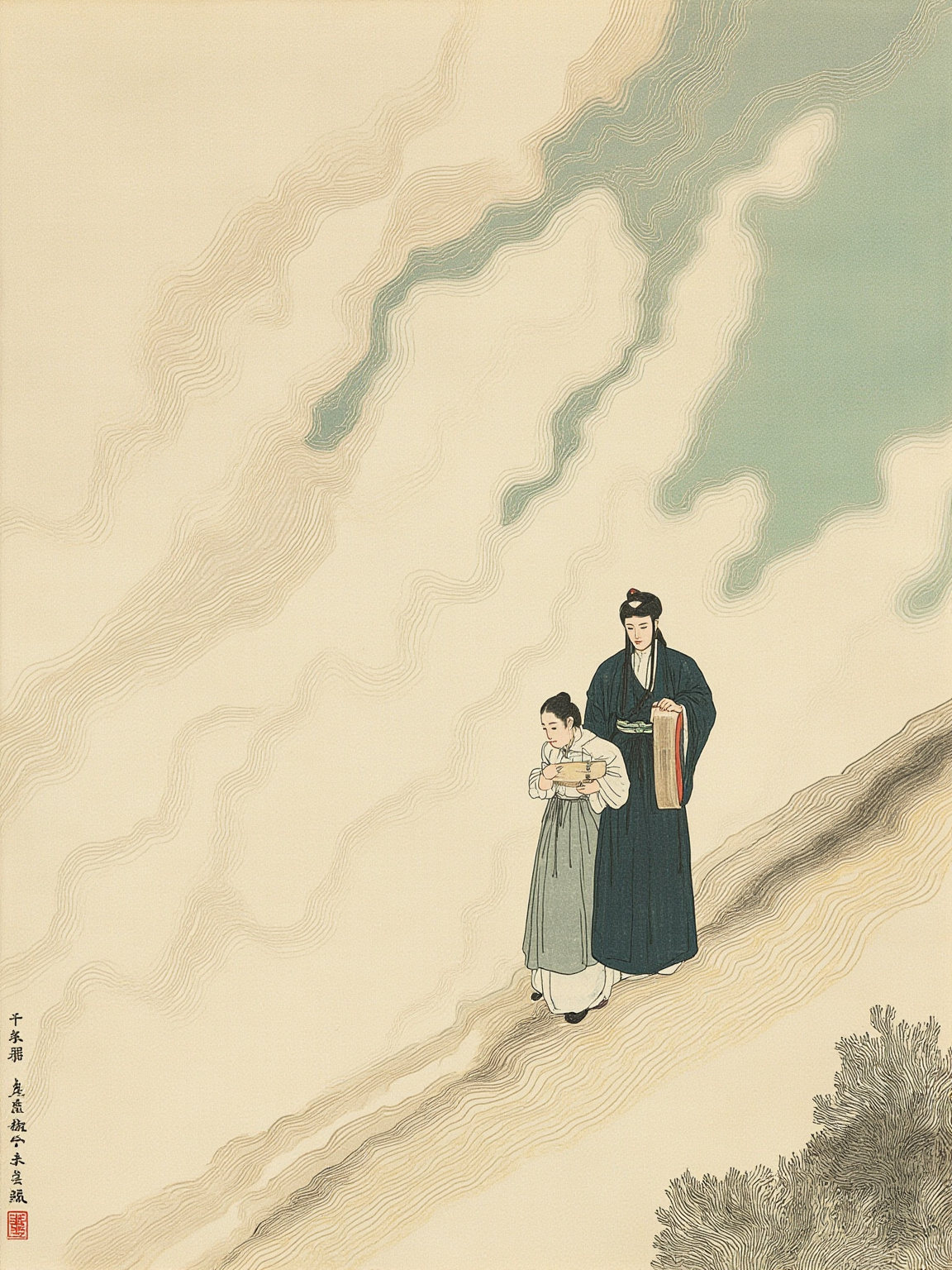
The day after the wedding, his father stood at the gate and would not let him turn back.
新婚才两日,公公便立在门前,催他上路,不许回头。
金句 · 第二齣 · 祝髮買梨
The Qionglin Banquet: a top graduate trapped in the chancellor's house
The scene shifts. Cai Bojie has placed first in the examinations. At the Qionglin Banquet held for the new graduates, Chancellor Niu takes a liking to him and wants him for a son-in-law. Cai asks three times to decline the official post; the court refuses each time. He asks three times to decline the marriage; the chancellor refuses each time. On one side sit his name at the top of the list, the imperial banquet, the fine embroidered house. On the other sits the house with no fire in the stove that he wants to go back to. The red lacquer and gold leaf of the chancellor's residence, he cannot push any of it away. What makes this passage work is that he is never allowed to complain or weep. The more mild-mannered he stays, the more plainly the system shows how completely it has pinned him down.
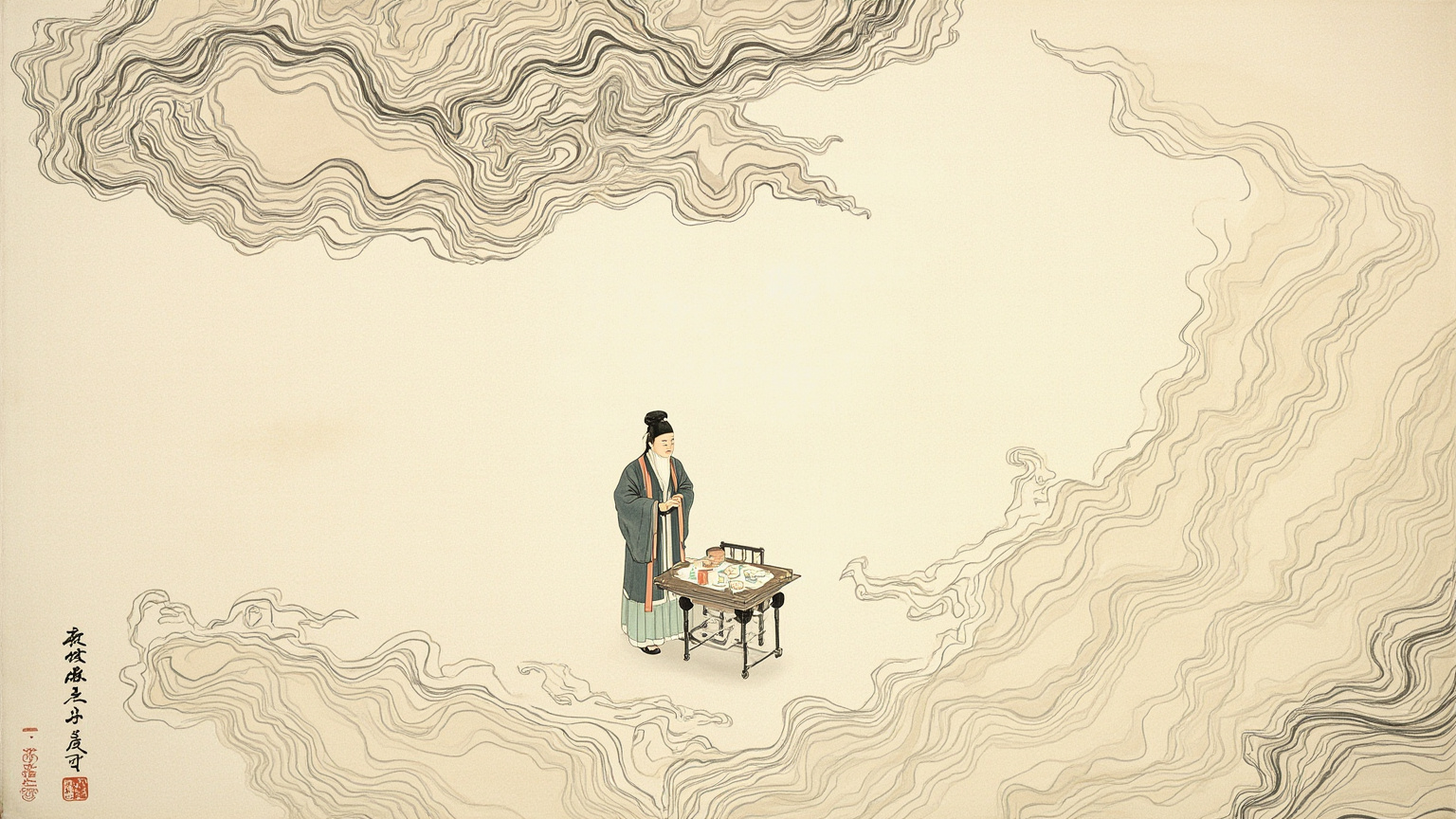
He bowed three times to refuse the marriage; three times the door of refusal was closed against him.
三辭婚,三不從——相府的金門,他進得出不得。
金句 · 第十一齣 · 蔡母嗟兒
Famine in Chenliu: chaff and rice
Back in Chenliu, years of drought and locusts have left the fields bare and the wells nearly dry. Zhao Wuniang's rice jar is empty. She cooks what little white rice remains for her parents-in-law and swallows the chaff herself. Chaff scratches the throat going down; it is the last resort of the poor. Her parents-in-law still starve to death in front of her, one after the other. The scene handles eating with real restraint: two bowls on the table, one of white rice and one of chaff, and no line of dialogue is needed to say who is holding which. Gao Ming's sharpest move is refusing to let the actors cry at the exact moment the audience expects it.
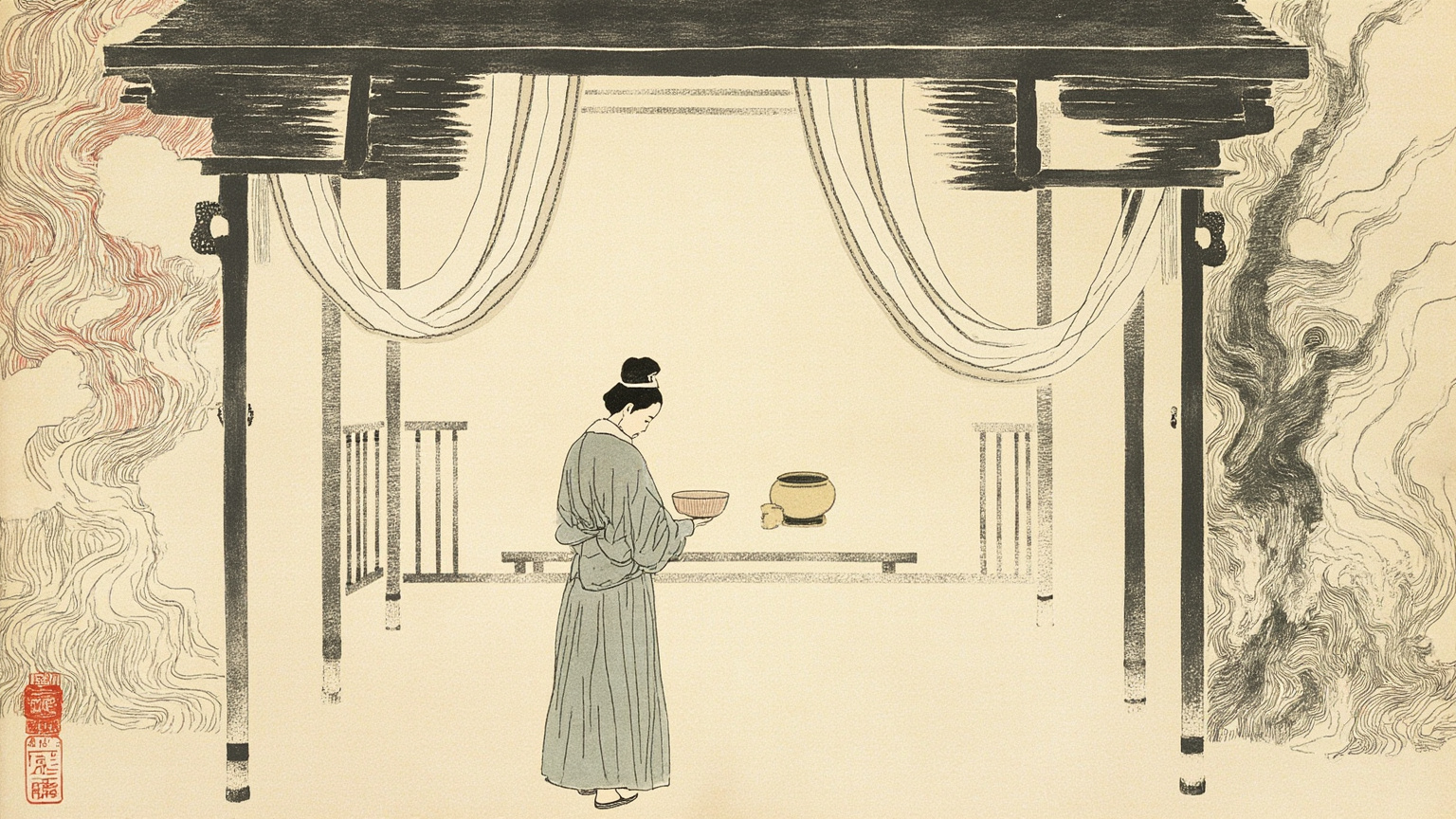
I swallow the chaff myself and let the white rice stay for the old.
糟糠自嚥,秔米留與公婆。
金句 · 第二十一齣 · 糟糠自厭
Mourning in sackcloth: the portrait and the cut hair
Both parents-in-law are dead. There is nothing left in the house to pawn, and she wears sackcloth. Zhao Wuniang does a few things, each one detailed enough to make the reader squirm: she paints their portraits from memory herself, afraid there will be nothing left to honor them by later; she pawns the last clothes and ornaments she owns to cover the funeral; she carries earth in the folds of her own skirt and builds their grave with her hands. Squire Zhang, the neighbor who is the one steady source of decency in the whole play, helps with the funeral costs and gives her money for the road. This passage is not about grief. It is about what still has to get done. She has no time to cry.
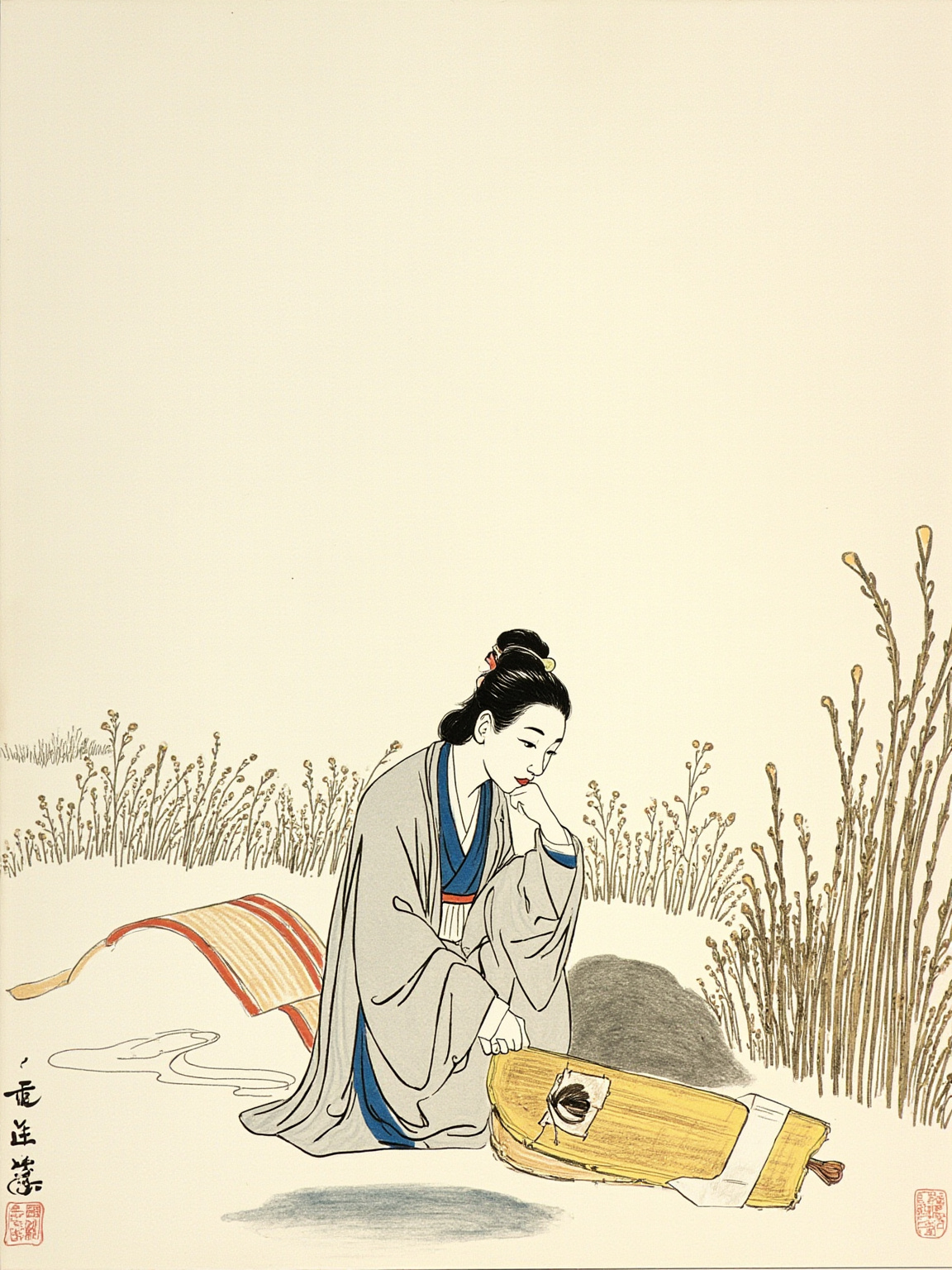
I had no portrait to bow before — so I took up the brush and drew the faces of the dead myself.
無處拜公婆真容,只得自描遺像,羅裙包土,親手築墳。
金句 · 第二十七齣 · 感格墳成
A thousand miles of begging with a lute: two things she carries
From this point on, only two things travel with her: the lute and the portraits of her parents-in-law. One is how she makes a living. The other is what she is holding onto. Across a thousand miles of mountains and passes, through wind and snow, she carries the lute on her back and sings for coins the whole way to the capital. The lute has to stay in view throughout: it earns her food, it is not a literary flourish planted there for effect. The image of her playing through the snow is one of the most enduring pictures in Chinese theater, heavier than any line of grief could be.
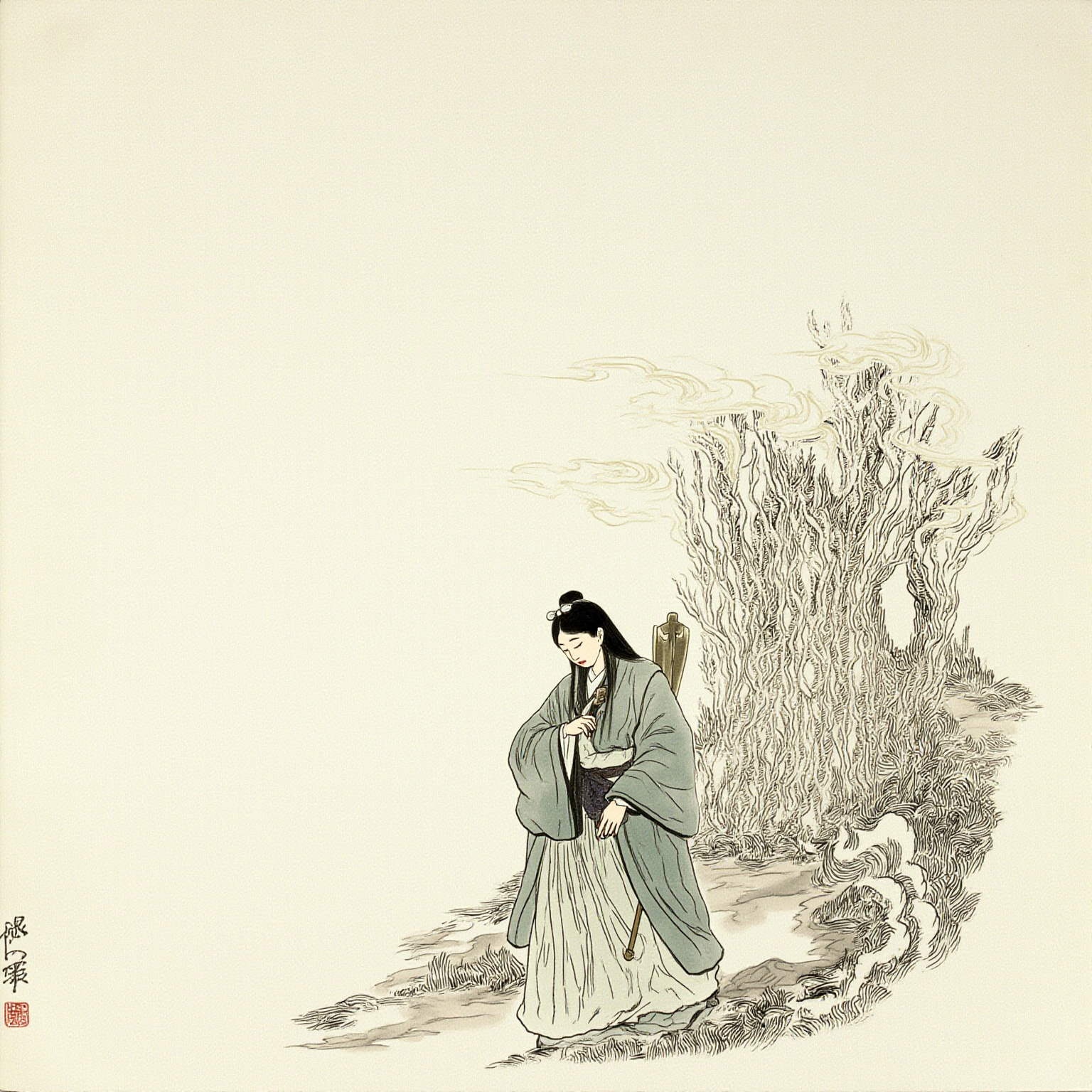
The lute on her back, the scroll of the dead across her shoulders — a thousand li of road, and these two things were all she owned.
背上一把琵琶,肩頭一卷真容,千里關山,此身之外更無長物。
金句 · 第二十九齣 · 途窮乞食
Husband and wife meet at the chancellor's house: Miss Niu steps aside
She reaches the capital, and the gate of the chancellor's residence. Zhao Wuniang does not make a scene or trade insults. She moves Miss Niu with the sound of the lute and the sight of the portraits, and only then does Miss Niu learn how much her husband has been carrying in silence. This well-read, properly raised daughter of the house makes a decision her father never anticipated: she asks, on her own, to give up her place as principal wife, so that her husband's obligation can be honored in full. She is not defeated. She is the third person in this triangle to see the shape of the trap clearly. The two wives stay together, and the conflict resolves, not because the man wakes up, but because two women choose to make room for each other.
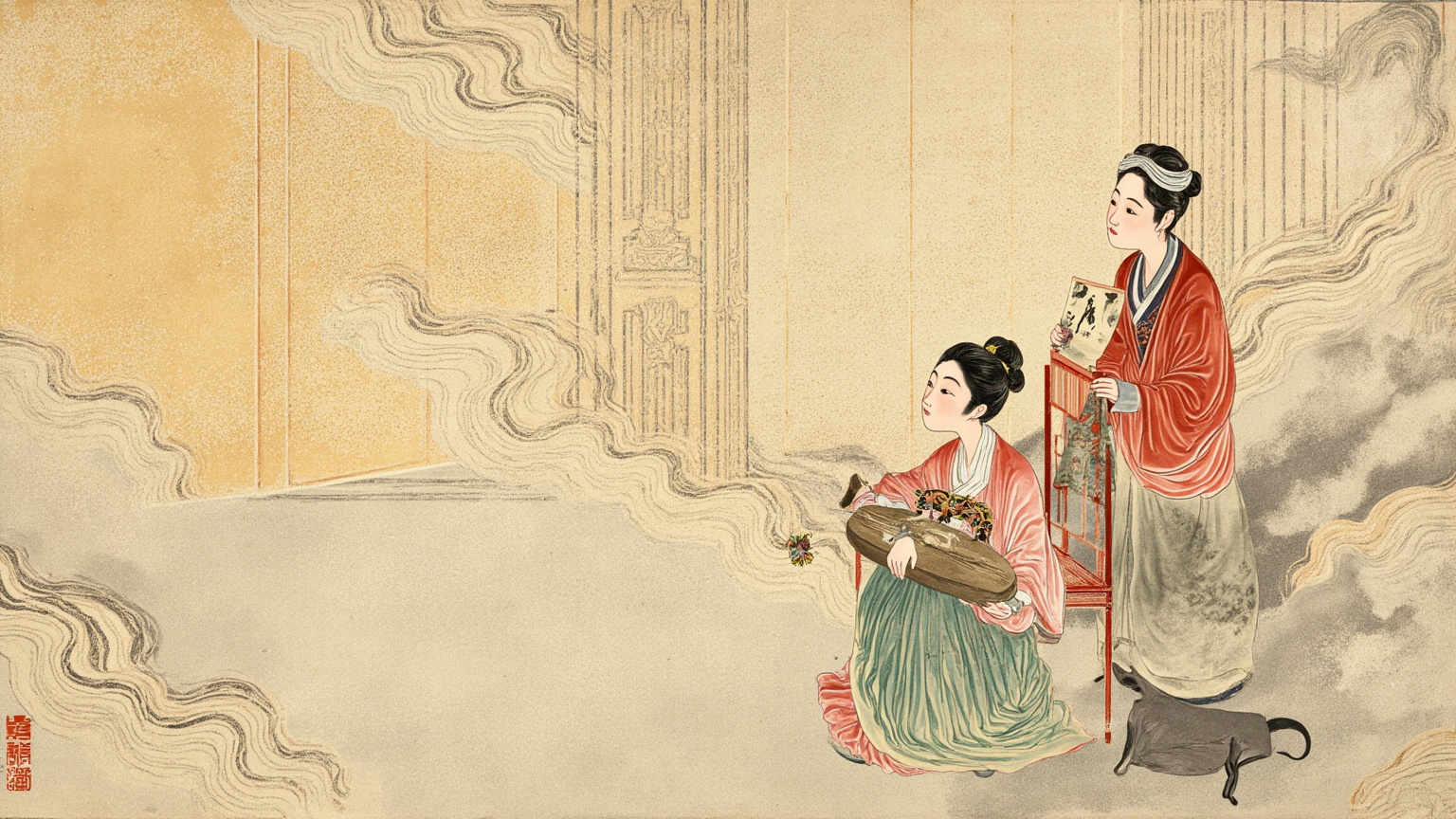
The lady of the prime seat bowed and stepped down — that the broken threads of an old house might be tied again.
正位之婦自請讓座——只願這殘破的人家,重新團圓。
金句 · 第三十七齣 · 書館悲逢
Ending: home to guard the grave, and an imperial commendation
Cai Bojie returns to Chenliu with both Zhao Wuniang and Miss Niu, not to a happy household but to the grave of his parents. The family is reunited, and the court grants its commendation: loyalty and filial devotion both fulfilled, in four characters. But Gao Ming keeps this part light on purpose. The lines granting titles and honors pass by quickly, because the real weight of the play was already spent in the scenes of Zhao Wuniang swallowing chaff, pawning her last belongings, playing the lute for a thousand miles. The commendation comes from the court. The respectability comes from other people. No one can give back the hours she spent suffering.
No one in this play is a villain, and every good person in it suffers. That is what sets it above anything else written in its time.
What it is actually about
On the surface it is about a lute. Underneath, it is about owing two debts at once and being able to pay neither in full. Ambition and filial duty, the wife who ate chaff and the wife newly married: tradition pulls a person in half from both ends, and what it splits is not Cai Bojie's conscience but the order of the whole age. Chenliu's end of the story is chaff, wells, sackcloth. The capital's end is red lacquer, gold, banquets. The objects and colors on each side pull apart from each other, and that contrast is the strongest visual structure the play has. Anyone who paints only one half of it loses the counterpoint the whole thing depends on.
Underneath that, it asks a question few classical Chinese plays dared ask outright: does the promise that goodness is rewarded actually hold up in the world? Zhao Wuniang is the most thoroughly suffering wife in the history of Chinese theater. There is no snow falling in midsummer to vindicate her, the way there is in The Injustice to Dou E. There is no elopement that works out, the way it does in The Story of the Western Wing. She survives on chaff, on selling her own hair, on a lute carried a thousand miles, all of it done with an ordinary body, nothing supernatural to carry her through. Making filial devotion something the body actually feels is what Gao Ming really accomplished when he rewrote the old play into this one.
Why it is remembered
Three reasons. First, it turned southern drama from a rowdy folk form into a mature genre capable of carrying real tragic weight: how the arias link together, how spoken dialogue is set into them, how the male and female leads carry equal weight, all of it had a model to follow after this. Second, Zhao Wuniang herself: the first fully convincing suffering wife in the history of Chinese theater, not a statue of a moral exemplar but a woman who gets hungry, gets tired, and gags on chaff going down. Third, it has no villain. That moral untidiness is exactly why it still stings, centuries later.
Why read the original
This guide gives you the skeleton. The original gives you the heat. Reading the actual arias, you can hear the roughness catching in Zhao Wuniang's throat as she swallows chaff; the way the aria form builds that bodily sensation layer by layer is something no modern prose summary can carry over. When Cai Bojie is trapped in the chancellor's house, unable to write, unable to speak, unable to move for those few seconds, the suffering packed into the verse runs denser than any line of dialogue could, and you only sit with it properly in the original. And the lute itself, from the farewell at the wedding to the thousand miles of begging to the reunion at the chancellor's house, carries a different weight every time it appears. None of that is told to you. It is sung, verse by verse.
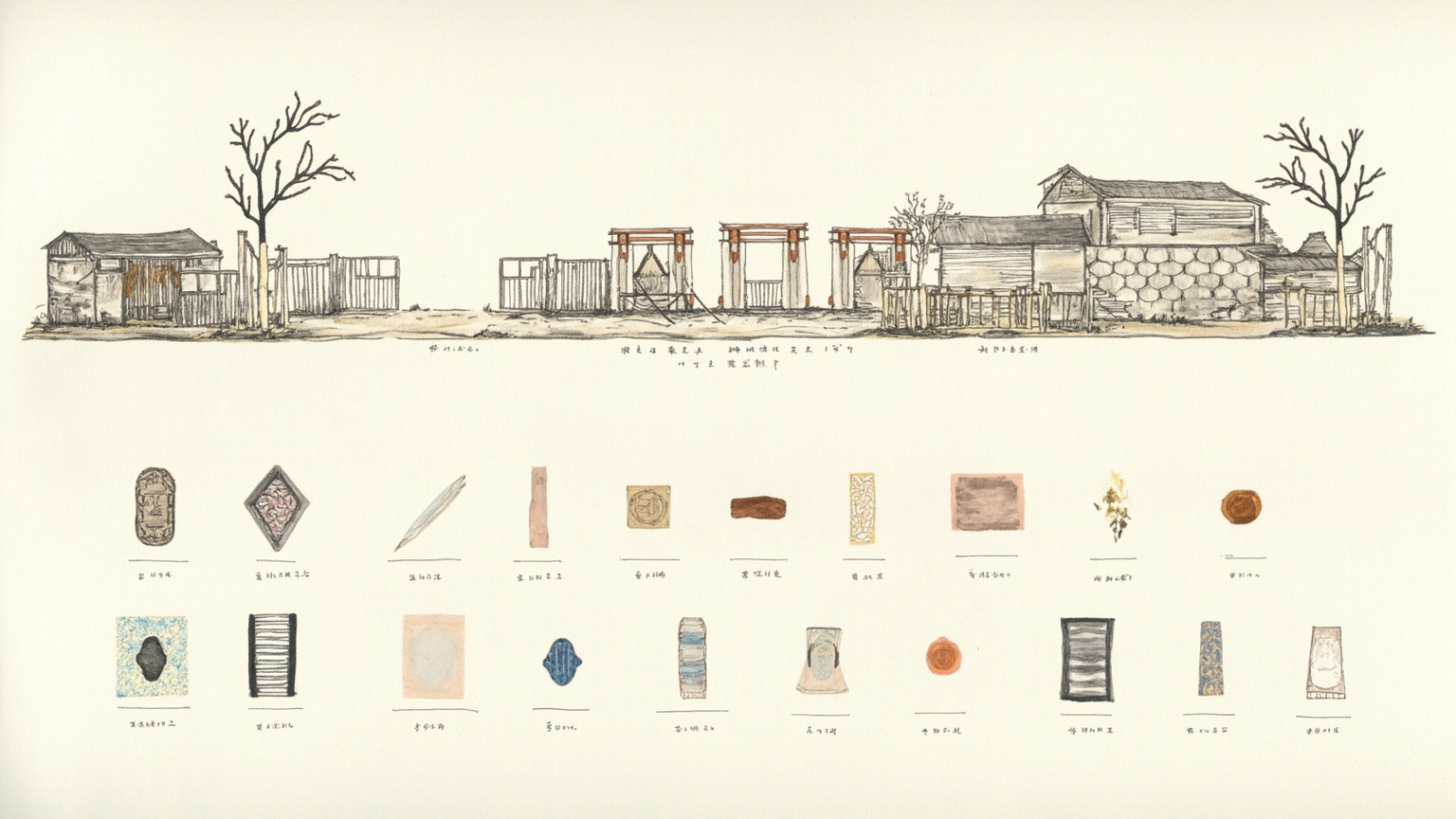
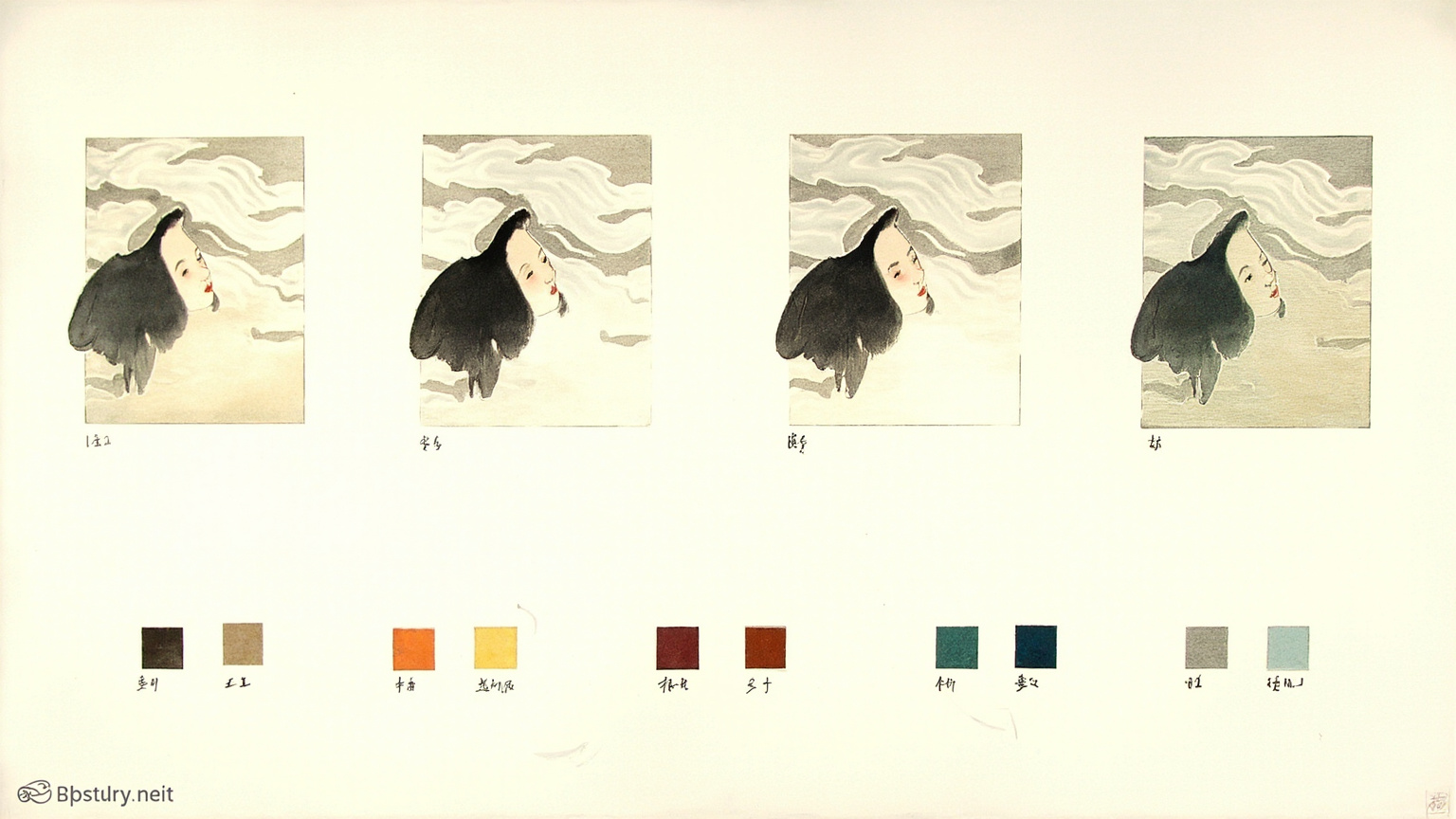
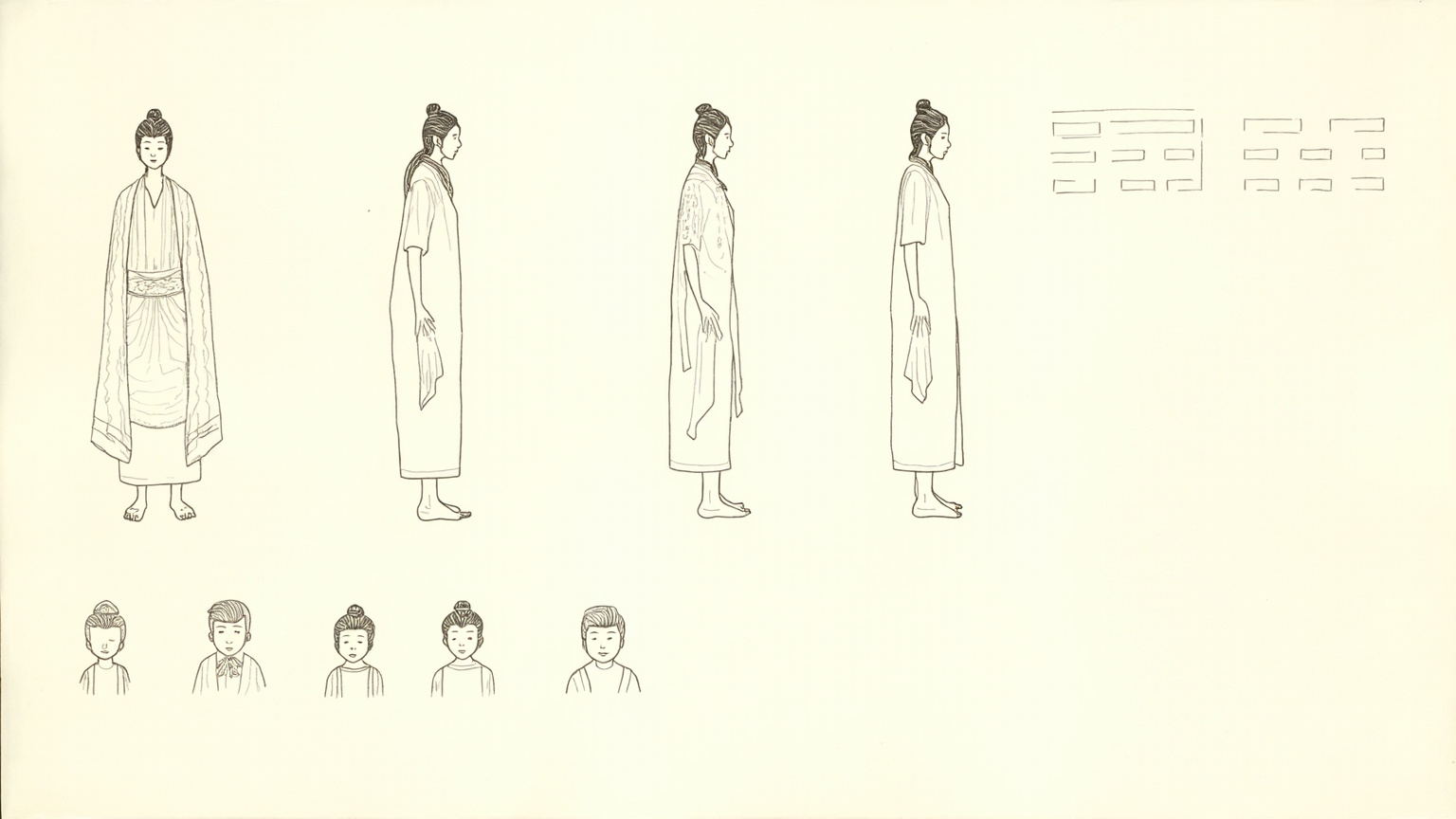
Art Direction4 plates
Before the guide was written, this book got a visual foundation — every illustration you just read grew out of it.