There is no good and evil in this Indian epic, only the difficulty of every direction
Text and illustrations produced by the pipeline
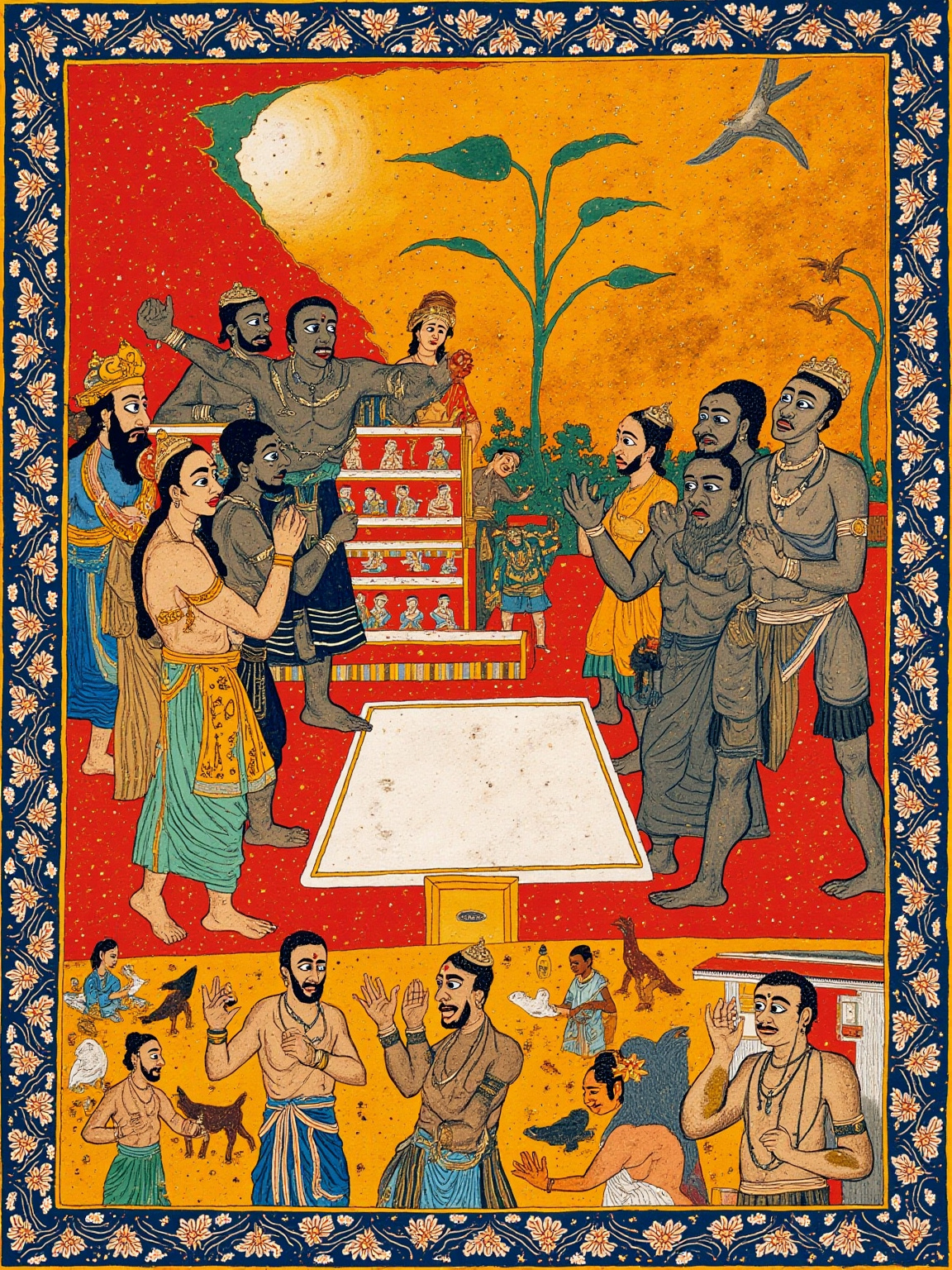
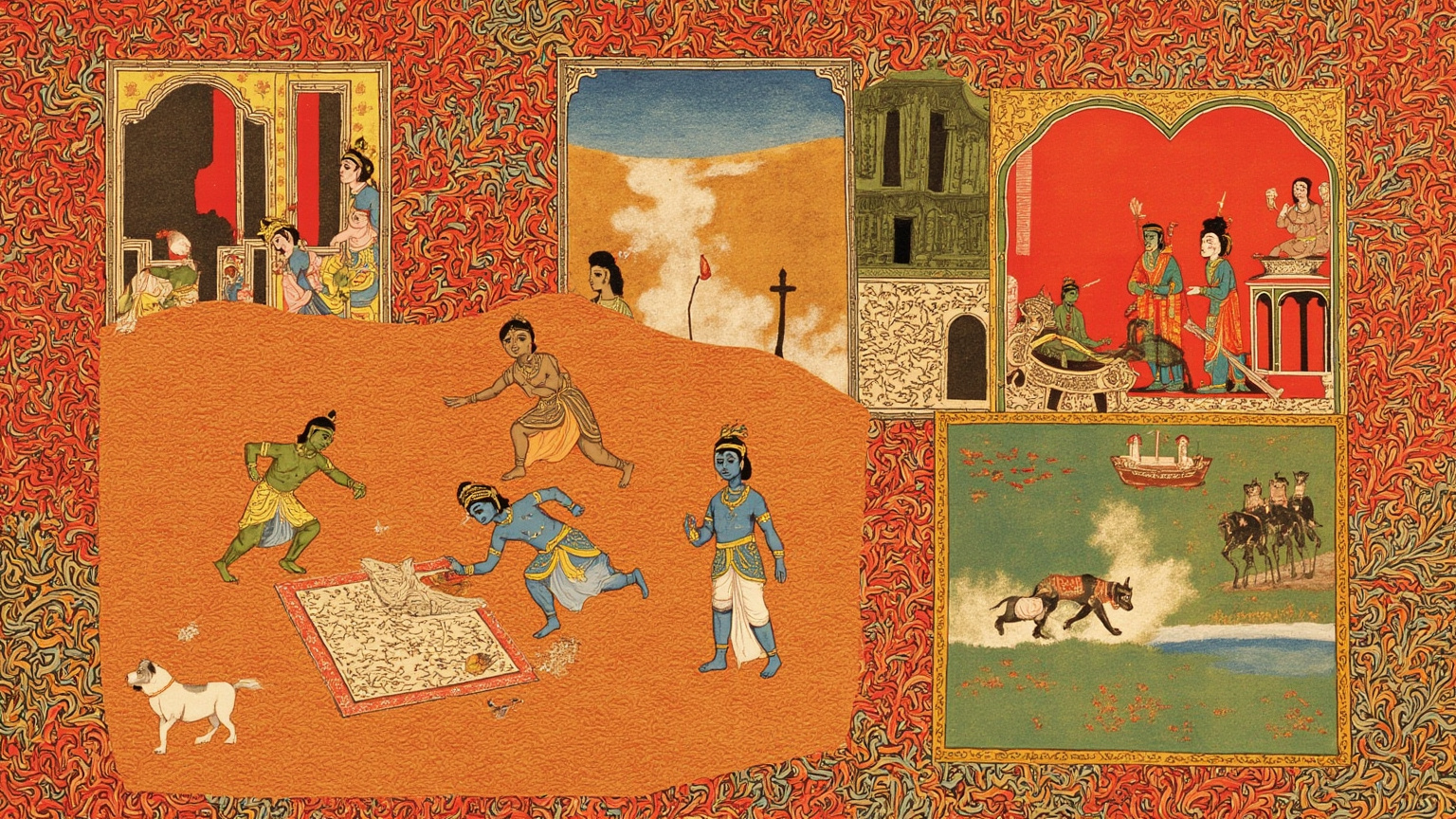
The dice hit the floor, and the court at Hastinapura draws one collective, stunned breath — then the sound of cloth tearing, a woman's voice, a brother's hand closing on a brother's arm. A king named Yudhishthira sits down to the game knowing he will lose everything, and sits down anyway. He will not be called a coward who backed out for fear of losing. That single choice wagers away a kingdom, four brothers, and the wife who will be publicly shamed in the same hall.
This is how the Mahabharata opens — not a battlefield, not an omen, a game of dice. Generation after generation of readers stall on this same scene: the trap is obvious, so why does a clever man sit down anyway? The epic gives no answer. It hands the question back to the reader and leaves it lodged like a splinter, one that never works its way out across the eighteen books that follow.
The Mahabharata was not written by one person at one desk. It grew over several centuries, layered up generation after generation by bards and Brahmin compilers, and only settled into something like its present form around the fourth century CE. Tradition credits the compiler who gathered it as Vyasa — the name means arranger, or teller — and he functions less like a single pen than like a bridge across all those hands.
Centuries in the making sounds like a recipe for sprawl, but that sprawl is the whole point: the Mahabharata folds ancient India's three great traditions of thought, dharma, karma, bhakti, into a hundred thousand verses, ten times the length of the Iliad and the Odyssey combined. There is an old Indian saying: what is here is found elsewhere; what is not here is nowhere. That is not boasting, it is capacity. The book asks far more than it settles.
The story unfolds across two cities and a plain in ancient India. Hastinapura is the old capital of the Kauravas — palace, council hall, throne, the women's quarters, all of it here. Dhritarashtra is the blind king, father to a hundred sons led by Duryodhana. His younger brother Pandu died long before the story starts, leaving five sons led by Yudhishthira; these five are the Pandavas. Two branches of cousins share one city, and the question of who inherits the throne is a fuse laid from the first page.


One more piece of restraint is worth noting. The dice game skips the details, the clothing, the bodies. The eighteen days at Kurukshetra get flattened into the single phrase a war that lasted eighteen days. The night raid on the sleeping camp gives only the fact that Draupadi lost every one of her sons in a single night, no scene, no wounds, no blood on anyone's face. This restraint is not there to spare you. It is there to spend your attention on the hard questions of dharma instead of on counting bodies.
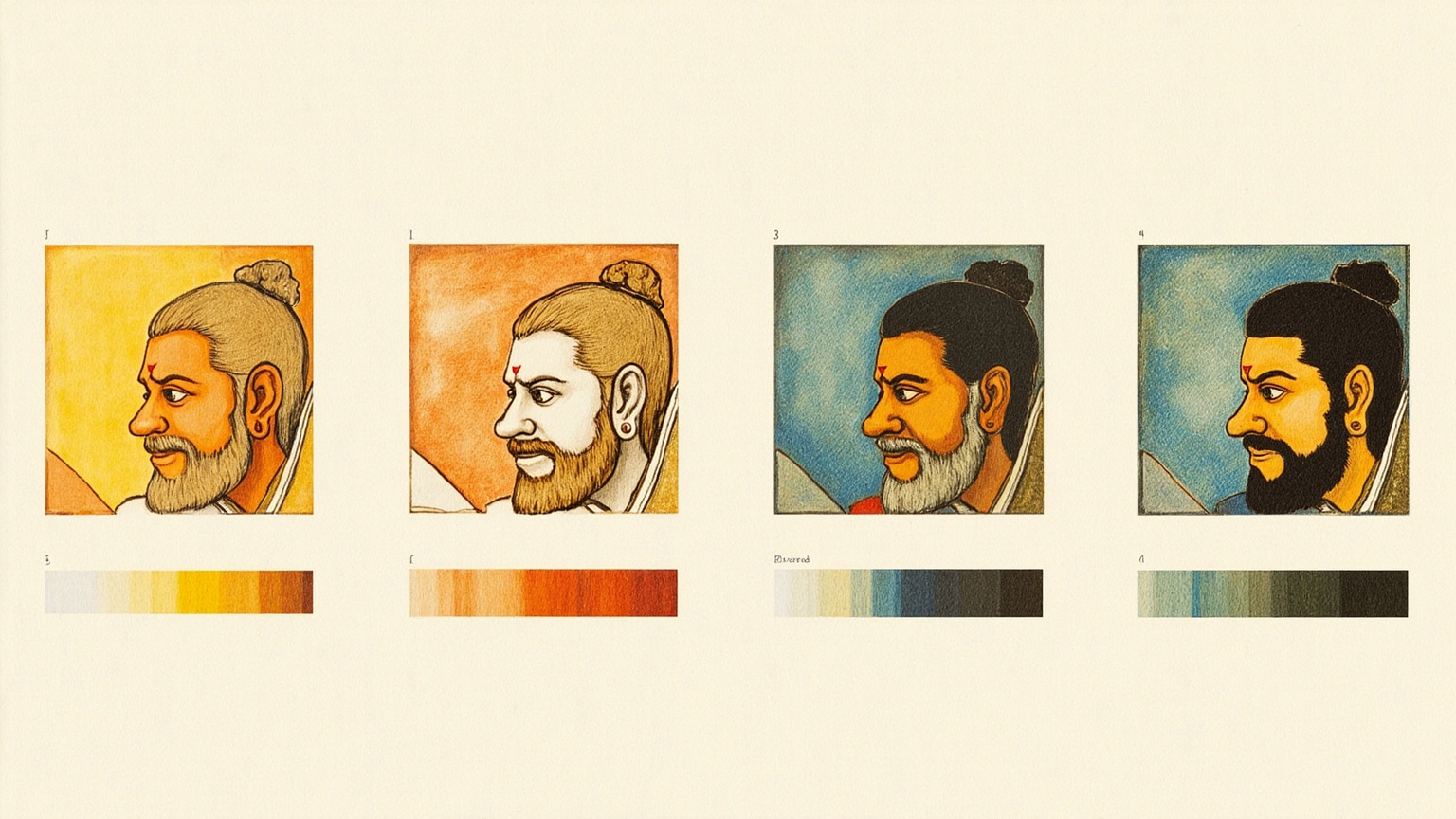
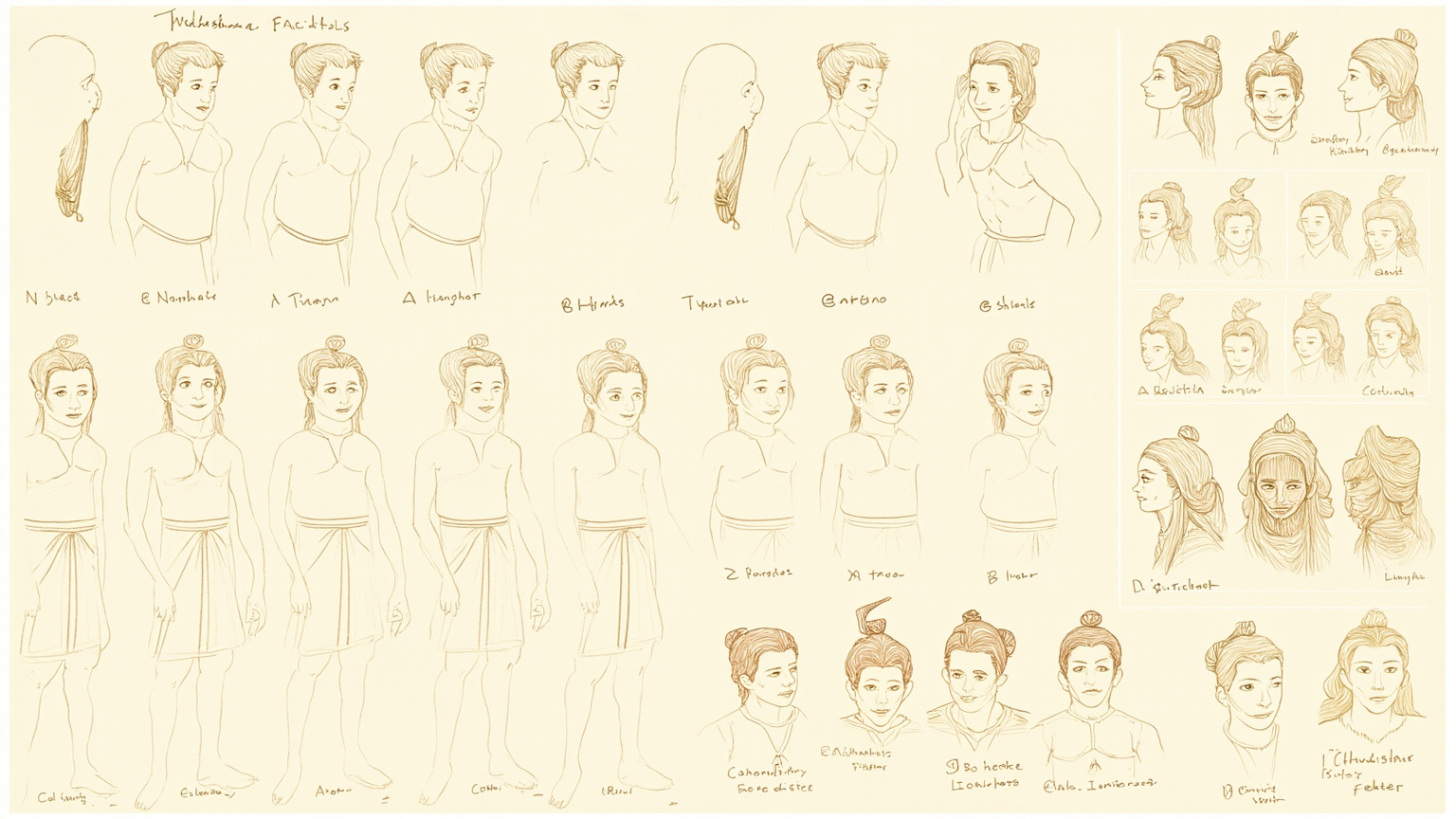
Before the guide was written, this book got a visual foundation — every illustration you just read grew out of it.
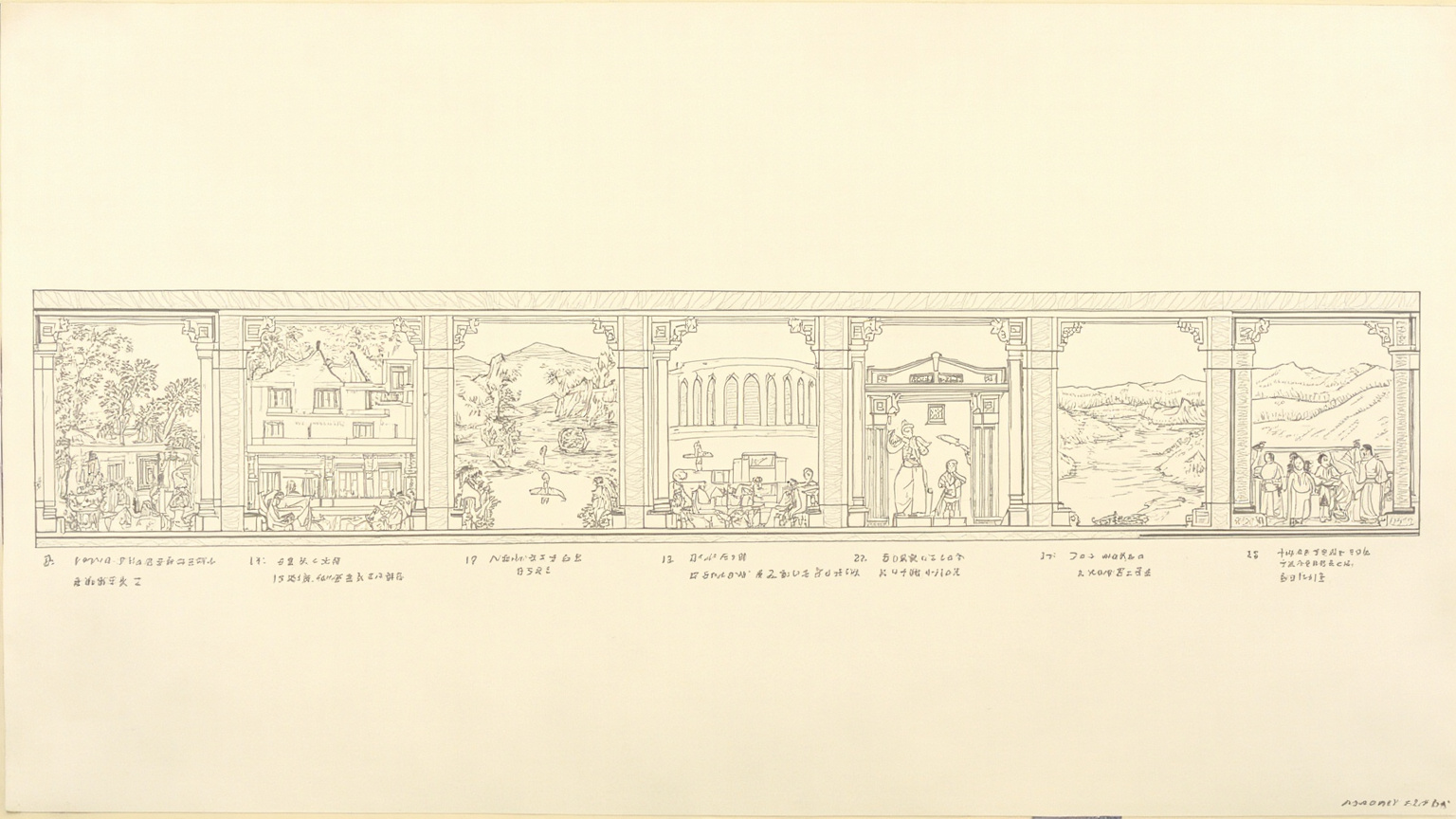
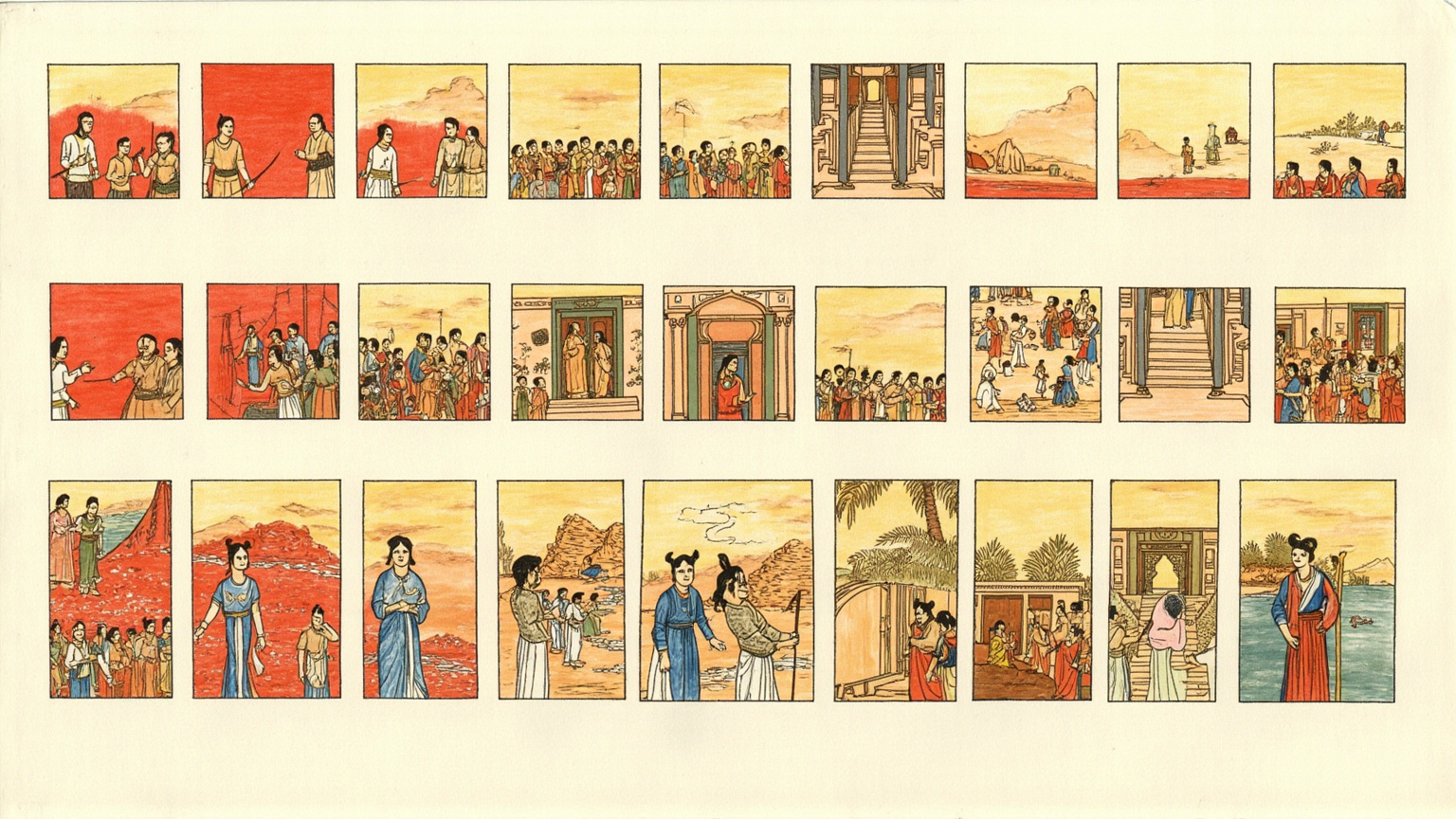
Indraprastha is the new capital handed to the five Pandavas — they burn back the forest and raise the palace themselves. Carpets on the floor, a dice board waiting in a corner. Farther north lies Kurukshetra, a plain so flat it holds nothing but chariot lines, banners, war horns, and rising dust, the field where the war will be fought. The forest years of exile mean hermit huts, rivers, deer, the quiet routines of ascetics. Farthest of all is the foot of the Himalayas, the last stretch of road before the final ascent.
The main characters fall into roughly three groups. Among the Pandavas: Yudhishthira is the king of dharma, torn by the problem of righteousness through the whole epic; Arjuna is the greatest archer of his line, and the conversation that happens on his chariot before the battle later stands alone as the Bhagavad Gita; Krishna is Arjuna's charioteer and counselor — charioteer is the single most important word of humility in the whole epic, because he is an avatar of Vishnu who never lifts a weapon himself, only shapes the battle through counsel. Among the Kauravas: Duryodhana is not simply a villain: he is the mirror image of Yudhishthira's own attachment to the throne, equally unwilling to yield; Bhishma is the grand-uncle shared by both houses, bound by an old vow to the throne and forced by it to carry a banner for the unjust side; Karna is the son of a charioteer, abandoned at birth, a warrior whose skill matches Arjuna's own and who becomes his great rival.
Then there are the ones nobody listens to. Dhritarashtra shelters Duryodhana even knowing he is in the wrong, a tragedy of a father's love outweighing what is right. Gandhari blindfolds herself for life to share her husband's darkness, and only removes the blindfold after the war, to grieve with eyes that once saw her sons. Vidura, the minister of Hastinapura, warns Dhritarashtra and Duryodhana again and again in words heavy with foreboding, and no one ever listens. Dharma keeps speaking in that court, and no one ever catches it.
Everything begins with obsession. Duryodhana is obsessed with the throne: he will not give his cousins so much as a needle's point of land. Yudhishthira is obsessed with never being called a coward who quit for fear of losing: he will not be seen backing down in open court. The two obsessions collide, and neither man will let go first. One line from the epic gets quoted more than almost any other: the greatest dharma in this world is to let go. The man who says it is Bhishma, and he never manages to let go himself.
The dice game is the second detonation. Yudhishthira sits down knowing the danger, unwilling to be called a coward. The dice fall, and he loses the kingdom, his brothers, himself, and finally the right to keep Draupadi from being publicly humiliated in court. The epic handles this scene with striking restraint: no clothing described, no bodies, no blow-by-blow. It gives only the fact of a public humiliation and the vow of vengeance it sets off. It will not let you watch. It only lets you hear the single sentence that comes out of Draupadi's mouth. After that, nothing can be reconciled.
The thirteen years of exile form the longest stretch of the book, running through most of the third, fourth, and fifth parvas. Austerities in the forest, debates with hermits, taunts sent by Duryodhana's messengers, the temptation of Mahadevi, each trial presses down on the five Pandavas in turn. In the thirteenth year they slip into the court of King Virata in disguise, working as servants, hiding in plain sight for a full year. The moment the peace talks fail on their return, the wheels toward Kurukshetra are already turning.
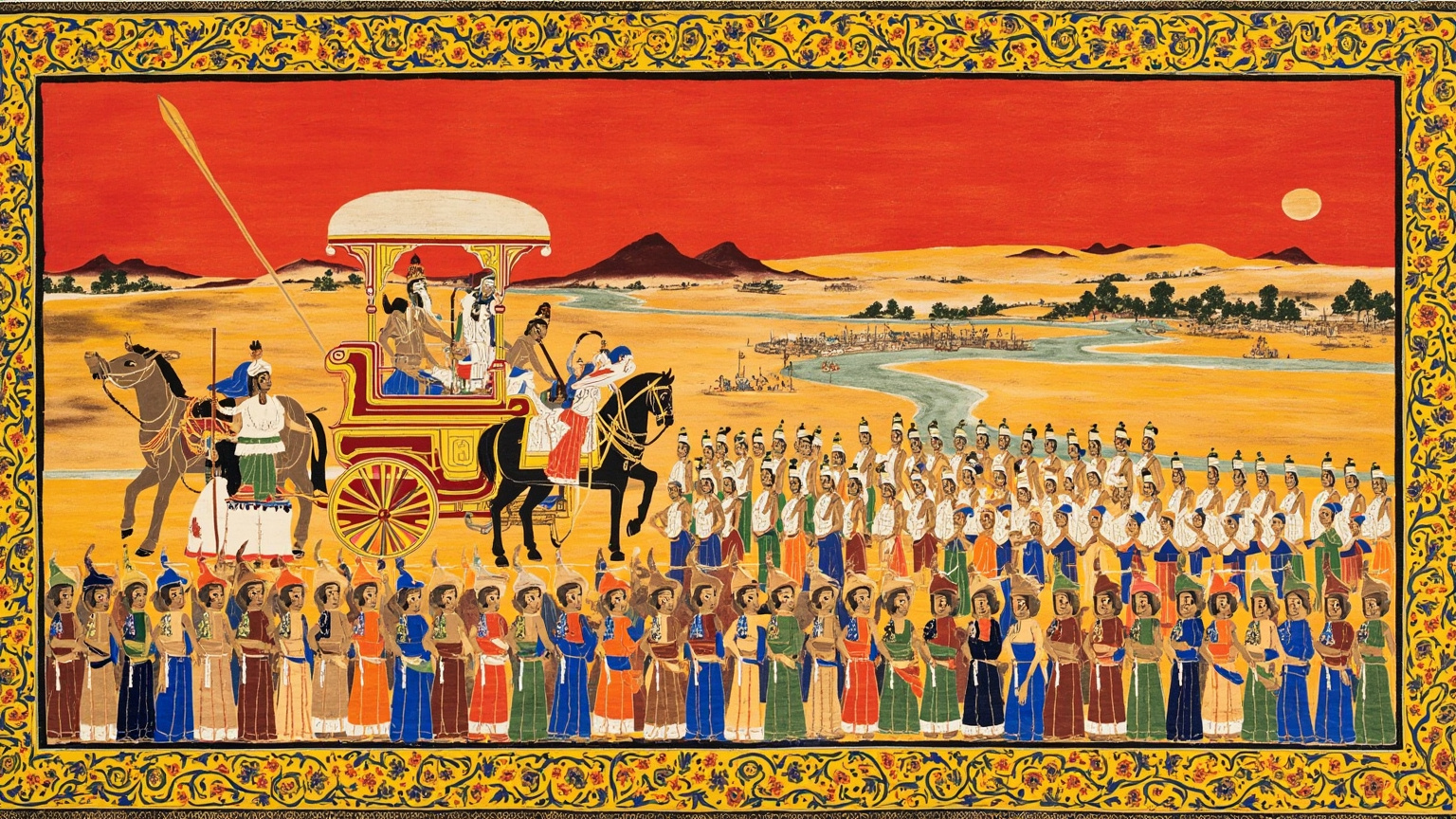
On the day the armies finish forming their lines, Krishna drives Arjuna's chariot out between them. The wind lifts the banners, and across the field stand the teacher who taught Arjuna to shoot, the grand-uncle who watched him grow up, and cousins he was raised alongside. Arjuna's grip loosens, and the bow Gandiva sinks in his hands. He cannot bring himself to kill his own elders. He is not being a coward. He is caught where the problem of dharma collides with human feeling: what is he supposed to do? Krishna argues him out of it on the grounds of dharma, and he raises the bow again. This exchange becomes the Bhagavad Gita, but within the epic it is only one section of the sixth book, twenty-five chapters and seven hundred verses, never a standalone work in its own right.
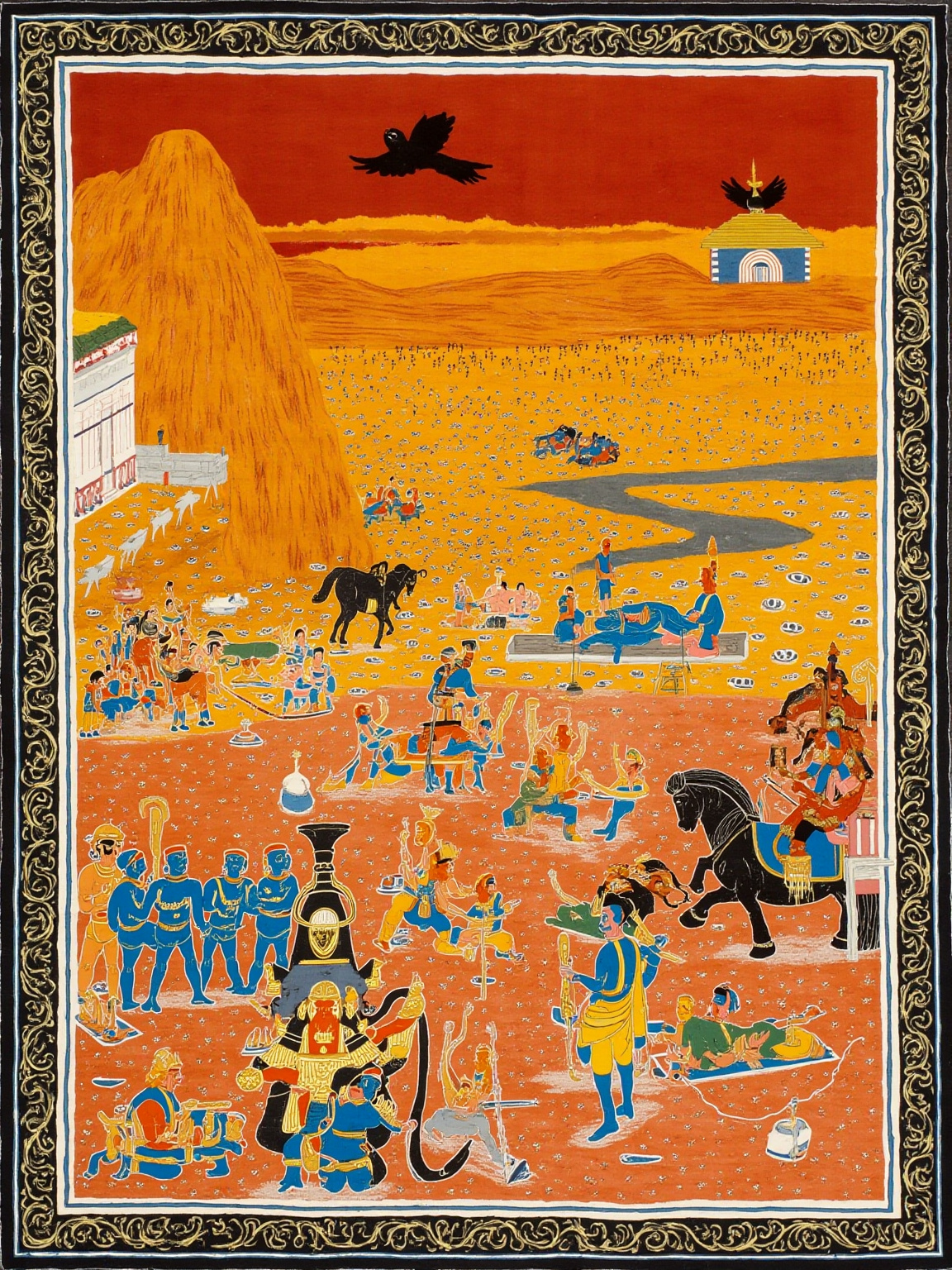
The eighteen days of war get an unexpectedly restrained treatment: no extended carnage, only the fall of the most honorable men one after another. Bhishma, the grand-uncle both houses revere, the most respected elder in the whole epic, stands on the wrong side and holds off death on the battlefield for ten days. Drona falls. Karna is shot down from his chariot by Arjuna. One idea keeps circling back through the book: the most honorable elder stands on the wrong side, the greatest warrior is the enemy, and even the righteous side carries its own guilt. Before the war, Yudhishthira admits to Bhishma's face that he too bears responsibility for what is coming, he is not the innocent party.
The last night gets the most abstracted treatment of all: Draupadi loses every one of her sons in a single night. The night raid on the sleeping camp is handled entirely in the abstract, no bodies, no blood, only the emptiness left in a mother. The dust the war raised settles back into dust.
In the end, Dhritarashtra, Gandhari, Vidura, Duryodhana's widow, and the five Pandavas all come to the battlefield to weep over the dead. After the coronation, the Pandavas pass the throne to the next generation and ascend toward heaven with Draupadi at their side; a dog follows Yudhishthira the entire way. The winner discovers he has won nothing. Every hard question dharma raises is left without a clean answer.
The axis the Mahabharata turns on is the emptiness of winning. This is not a myth of good against evil with a clean side to root for; no one comes out unstained. Yudhishthira wins the kingdom and loses his brothers and his sons forever. Draupadi loses every child she has. Dhritarashtra and Gandhari lose all hundred sons. Duryodhana knows he is walking toward ruin before the war even starts, and does not turn back. Every hard edge of dharma is laid bare: a king's duty tears against a brother's loyalty inside the same man, obsession drags both sides toward destruction, and right and wrong never come labeled.
What makes the writing work is not the plot but the structure. A hundred thousand verses divide into eighteen books, packed with digressions, genealogies, myths, and treatises on dharma, and the whole thing looks as loose as a forest, but the frame never lets go. Duryodhana's obsession runs from the first book to the eleventh. Arjuna's hesitation carries straight through from before the war to the chariot itself. The epic gathers up the three great traditions, dharma, karma, bhakti, without ever handing down a standard answer. In this book, dharma, karma, and bhakti are questions, not doctrine.
This guide has told the story, but the Mahabharata is not a book you finish once you know the plot. Its prose has a texture rare anywhere else: long sentences piling up clause on clause, short lines of dialogue driven in like nails; digressions nest inside digressions, and a single discourse on dharma can leap from the battlefield to the deep past and back again. The passage where Arjuna's bow sinks in his hands stopped me the first time I read it, and I went back and reread the page before it. That kind of pause is not something a guide can hand you. And the dog that follows Yudhishthira the whole way — the book gives it only a few lines, but it will follow you long after you close the book.