A masterpiece of magical realism that didn't appear whole until nearly thirty years after its author's death
Text and illustrations produced by the pipeline
The manuscript is about a judge, and a philosopher he wrongly condemned. Soon, they tear your pages apart in front of you — not because it is badly written, but because it says what must not be said. You are thrown into a psychiatric hospital, your name erased from literary history, and the woman who loves you cannot find you. More than twenty years later, someone else copies the manuscript out of the ashes, and only then does the world get to read it. This is not the biographical sketch of some writer — it is the original of a novel its author paid for with his life. And what destroyed him was not Satan. It was the upstanding, respectable people of his own age.
The Master and Margarita is a strange, singular book that the Russian writer Mikhail Bulgakov began conceiving in the late 1920s and never finished before his death in 1940. He never lived to see it published — it sat unpublished for nearly thirty years after his death before his widow assembled it from his manuscripts and brought it into print. Even then, the first published version had roughly twelve percent of its text cut, nearly fifteen thousand words carved out, leaving more than a hundred and fifty wounds in the text. The complete, uncensored Russian edition did not reach readers until more than thirty years after the author's death. The book is remembered not only because it is absurd, enchanting, and reads like a roller coaster, but because it is a work of literature bought with a body: the devil circles above Moscow while its author has already turned to ash.
An explainer can hand you a map, but the novel is the land itself. What no map can capture is Bulgakov's particular sense of language: the kind that makes you laugh until the laugh catches in your throat, Behemoth the cat's shameless yet oddly loyal wisecracks, and the handful of lines, quiet almost to a whisper, where Pilate is finally allowed, after two thousand years, a moment of peace. You only run into these things by turning the pages yourself, late at night. The most an explainer can tell you is this: there is a tone in that book, something between wine and medicine, that says do not wait for a clear day to start reading.
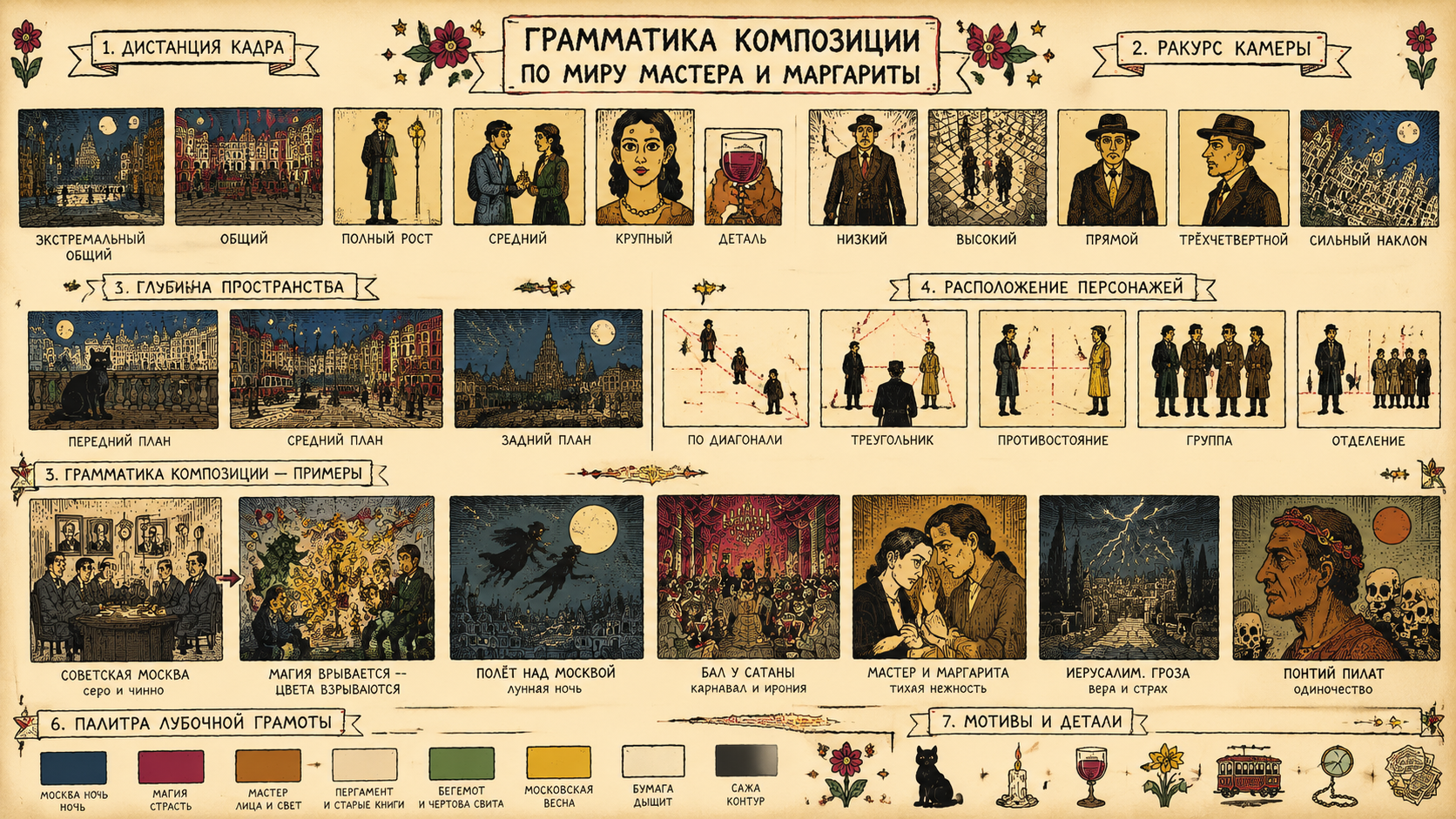
Before the guide was written, this book got a visual foundation — every illustration you just read grew out of it.
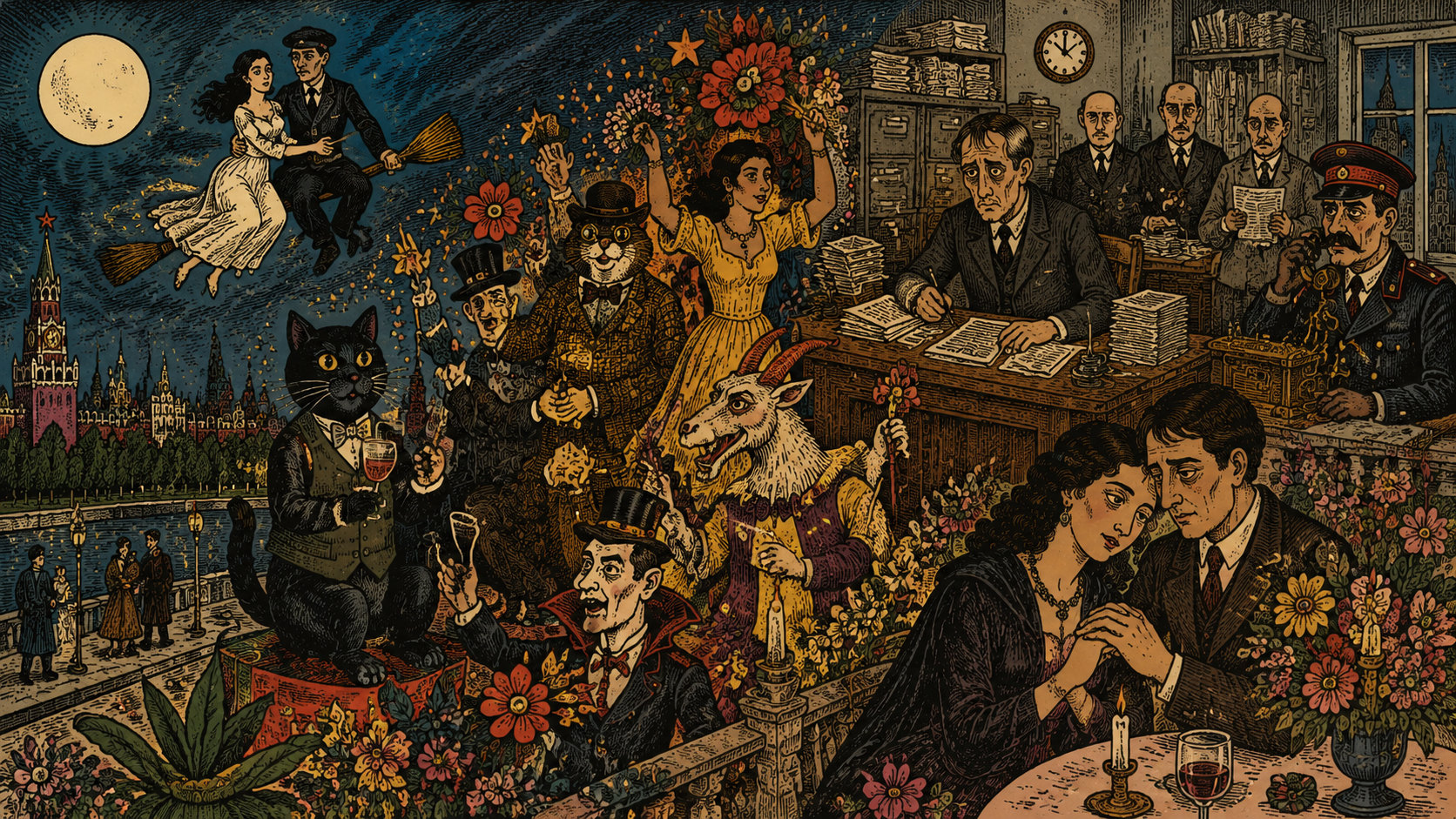
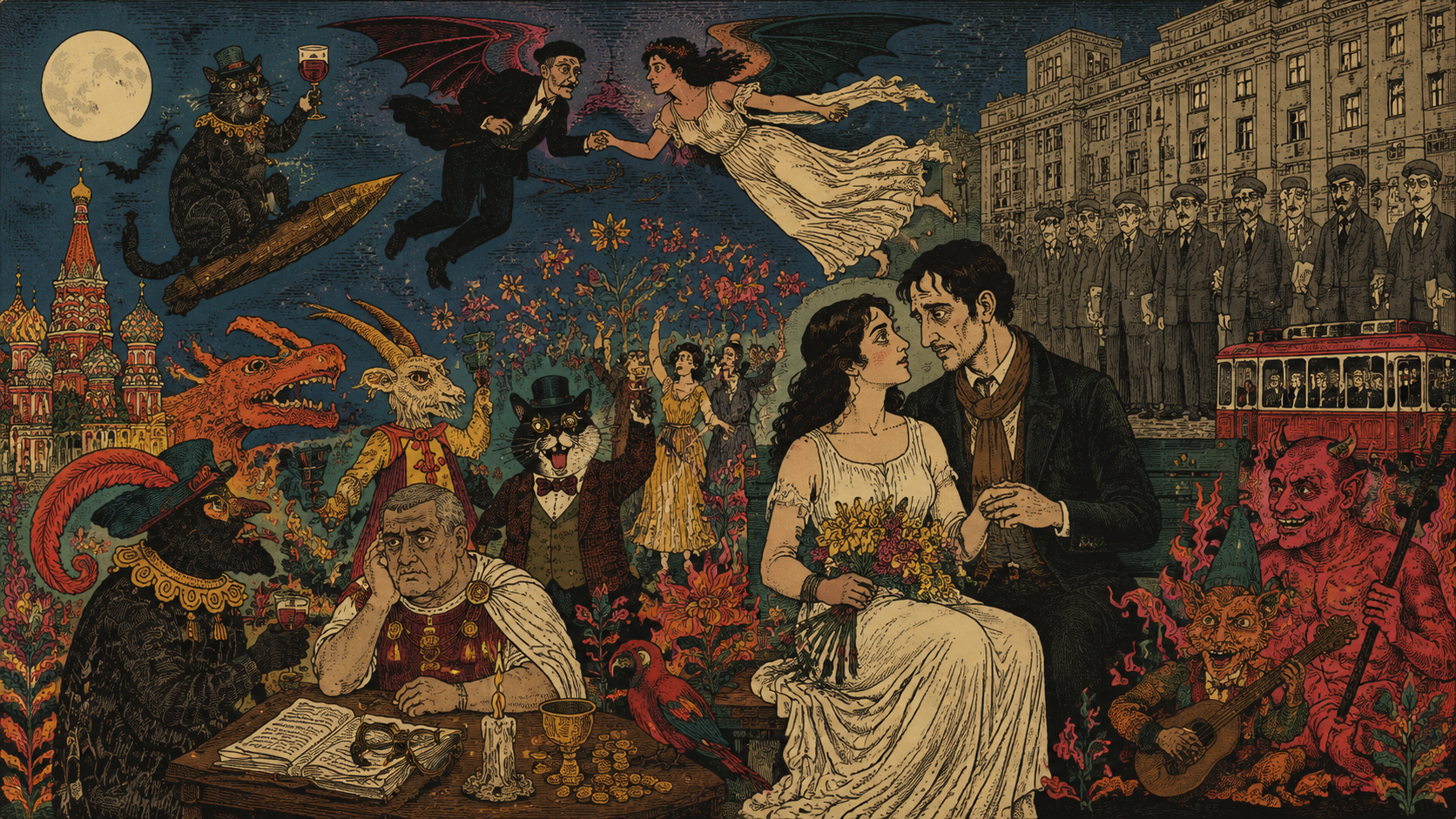
The novel runs on two timelines, following two casts of characters. Start with the modern one — 1930s Moscow, where a visitor calling himself a foreign professor of literature, Woland, descends on the capital with his retinue. He is, in fact, the devil himself. His entourage includes a talking black cat named Behemoth — gluttonous, shameless, a dead shot with a pistol, a thug dressed up in a man's clothes — along with a tall, lanky flunky and a one-eyed giant. He has not come to destroy Moscow; he has come to hold it to account. Among those he judges are Berlioz, the head of the writers' union and a committed atheist; a young poet swept up in the affair, Ivan Bezdomny; and every grasping face in the city reaching for money, housing, or a byline.
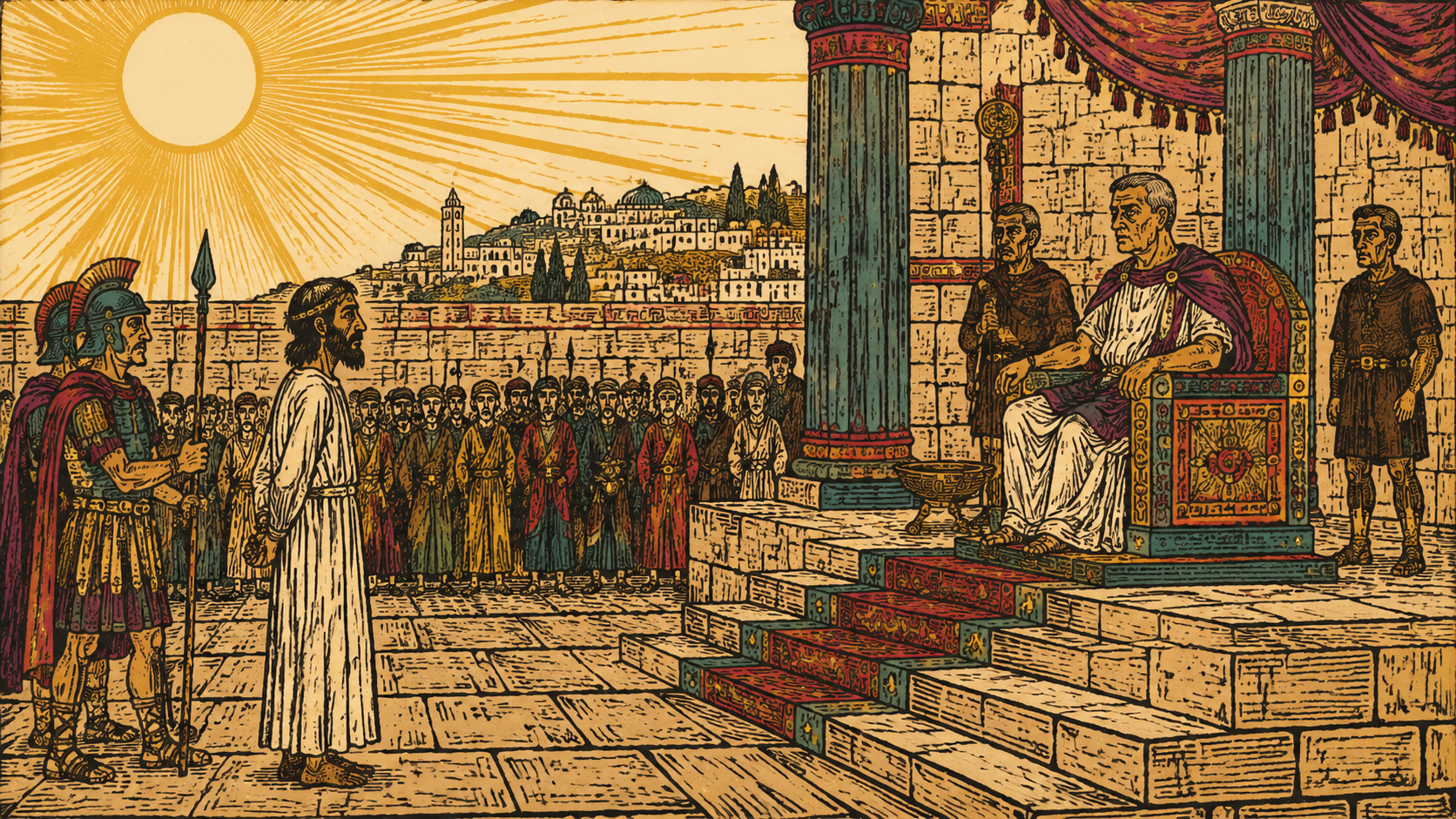
The other timeline runs two thousand years earlier, in a Judean province under Roman rule, where the procurator Pontius Pilate sits under the blazing sun interrogating a wandering philosopher, Yeshua. This is the story written inside the Master's destroyed novel: the Master is its hero, a writer who produced this masterpiece only to have the literary establishment crush him for it; Margarita is its heroine, a woman who loves the Master enough to stake her own soul with the devil to get him back. On one side, the devil's mischief among the living; on the other, a genius ground down by power — the two lines answer each other throughout the book, like a single soul split in half.
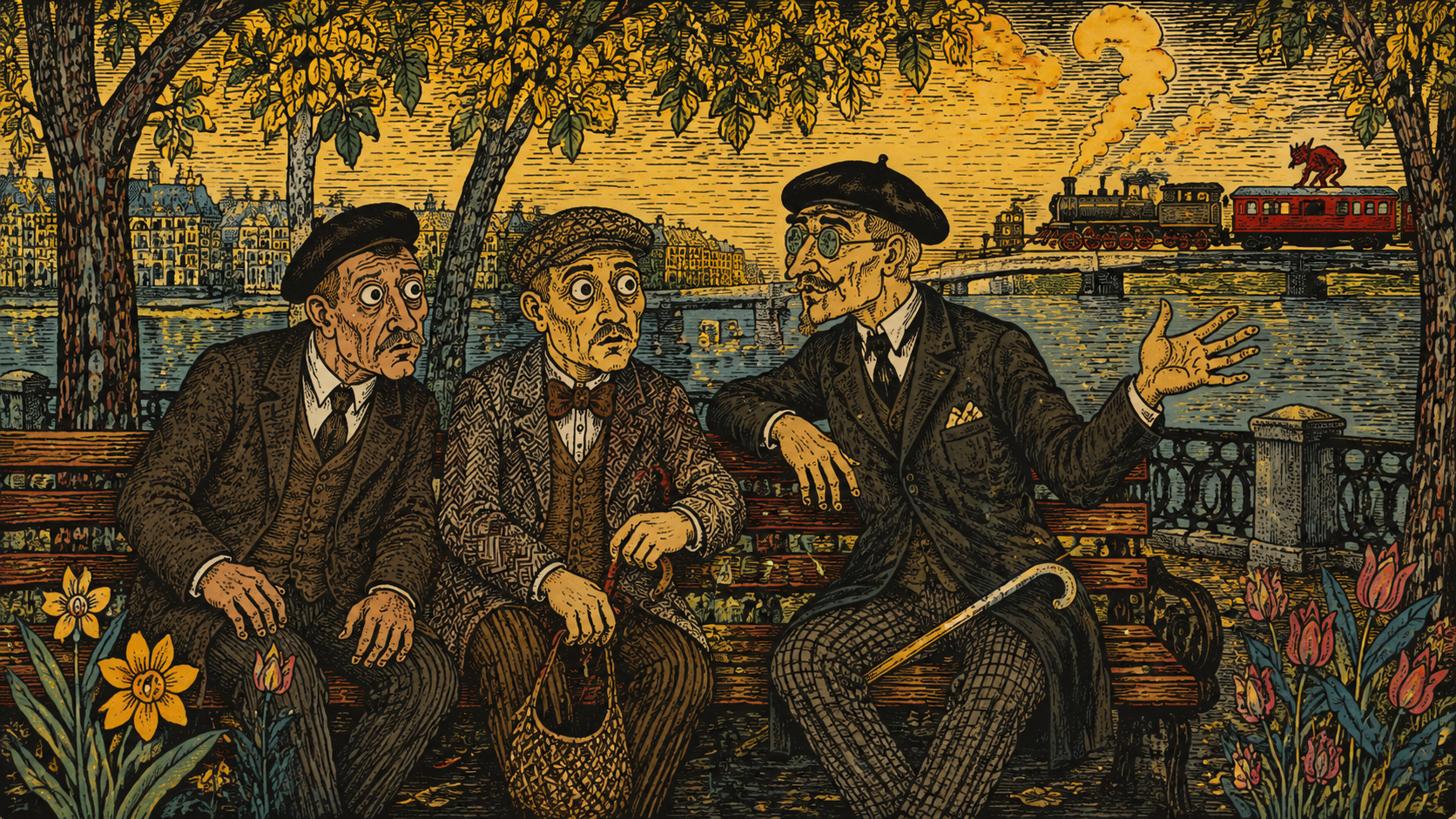
The story opens on a summer evening. On a bench by Patriarch's Ponds in Moscow, Berlioz, head of the writers' union, is walking with the young poet Ivan Bezdomny, holding forth on how God does not exist and death is nothing but eternal emptiness. Sitting nearby, the foreign professor Woland overhears him and says mildly: everything you just said is not wrong, except you will not live to finish writing that article tomorrow, because you are going to die. Then Woland predicts exactly how: run over by a streetcar, his head severed. The two men are still arguing when a scream carries over from the tracks nearby, and word comes back that it happened exactly as he said. The craft here is that Bulgakov never has the devil leap up and cast a spell; he simply states an almost impossibly improbable death as casually as a daily schedule. This scheduled horror is the book's signature move — the miraculous never arrives looking like a miracle. It always lands on you like an unpaid bill, the moment you stop paying attention.
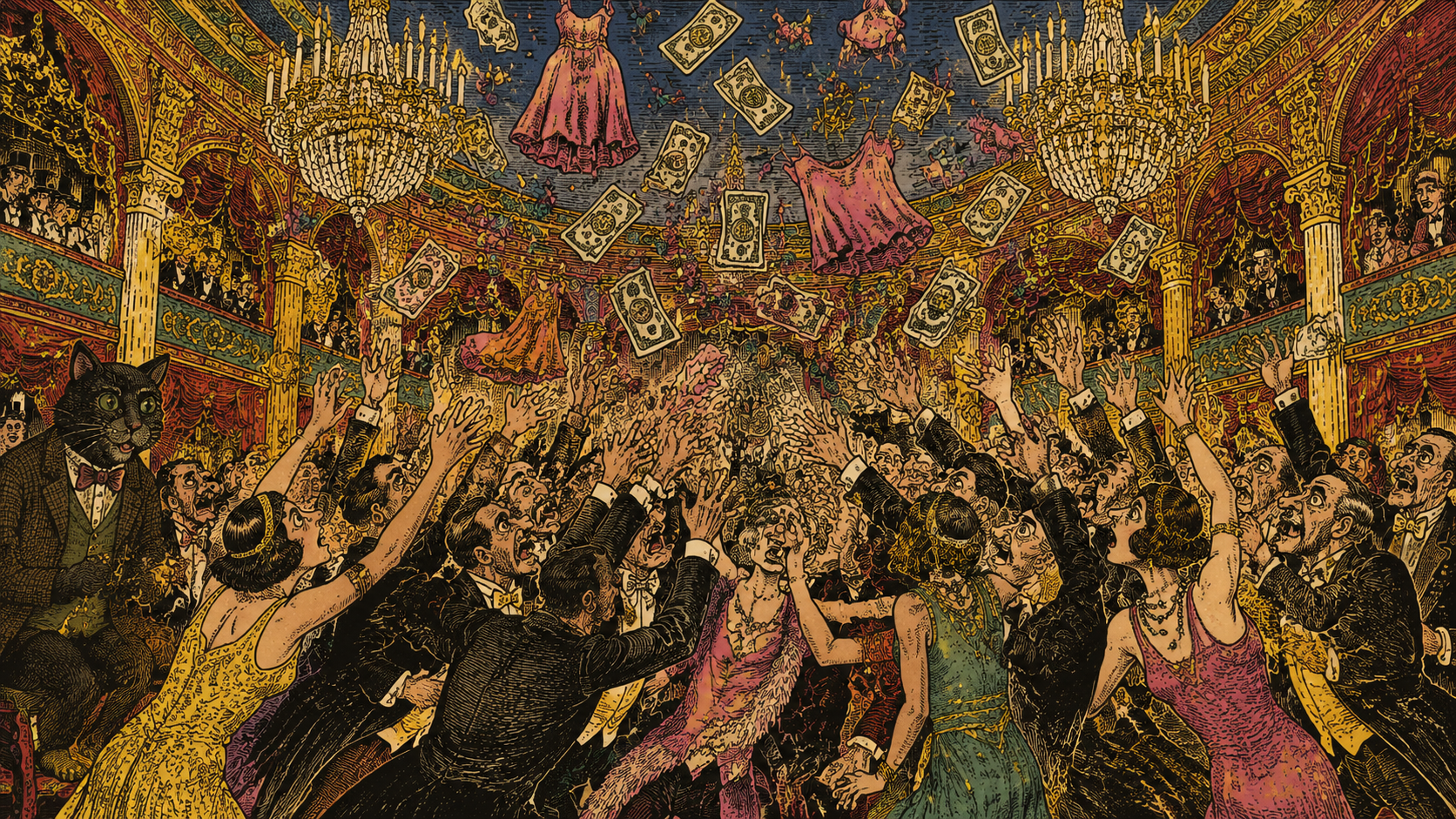
Berlioz's death is only the opening act. Woland and his retinue — especially the black cat Behemoth — start staging what look like pranks all over Moscow: banknotes rain down over a theater out of nowhere, and a hall full of well-dressed people pounce on them like starving wolves; minutes later the bills turn back into scraps of waste paper, and the Parisian fashions everyone grabbed vanish, leaving people standing in their underwear, while whole apartments get turned upside down. What is genuinely vicious about Bulgakov's writing is not the spectacle itself — it is that every scene maps onto some disease already living in these people: greed, vanity, the reflex to skim off the state. The magical farce just throws what was already inside people's hearts onto the floor and lets it stink. Call it trial by comedy: once you are done laughing, you notice that the line you laughed hardest at landed squarely on yourself.
While Woland's trial unfolds, the novel's other thread is embedded inside a manuscript being passed hand to hand — the very novel written by the destroyed genius. Pontius Pilate, the Roman procurator of the Judean province, is a real historical figure. Yeshua is a wandering philosopher, brought before Pilate by the local priesthood on a charge of inciting the people. After only a few exchanges with him, Pilate already understands he is an innocent, decent man — but Pilate is a coward. He is afraid of an uprising in Jerusalem, afraid of losing his position, afraid of being blamed by his superiors, and so he sends a man he knows to be innocent to the cross. This is the deepest cut in the whole book: Bulgakov makes the reader see clearly that the greatest sin is rarely malice — it is cowardice. That cut has not dulled in two thousand years. By the end of this section, it is hard not to think back on some moment of your own when cowardice made you swallow a word you should have spoken.
In the modern-day thread, Ivan, the young poet driven half-mad by witnessing Berlioz's death, is committed to a psychiatric hospital. There he meets a strange man, calm, humble, with eyes like a burnt-out lamp: the Master. The Master tells him: I wrote a novel about Pilate and Yeshua, about how cowardice is the true sin. When I finished it, I gave the manuscript to my friends in the literary world. They praised it first, then condemned it, then tore it out of my hands and destroyed it. I never wrote it again. I have lived here ever since. Bulgakov does not have Ivan denounce anyone; he simply lets one destroyed man give one final telling on behalf of another man who has already stopped fighting back. This is the quietest, and most painful, section in the book — you realize that literature's real catastrophe is not the absence of good work. It is good work being buried alive by a circle of acquaintances wearing cultural credentials.
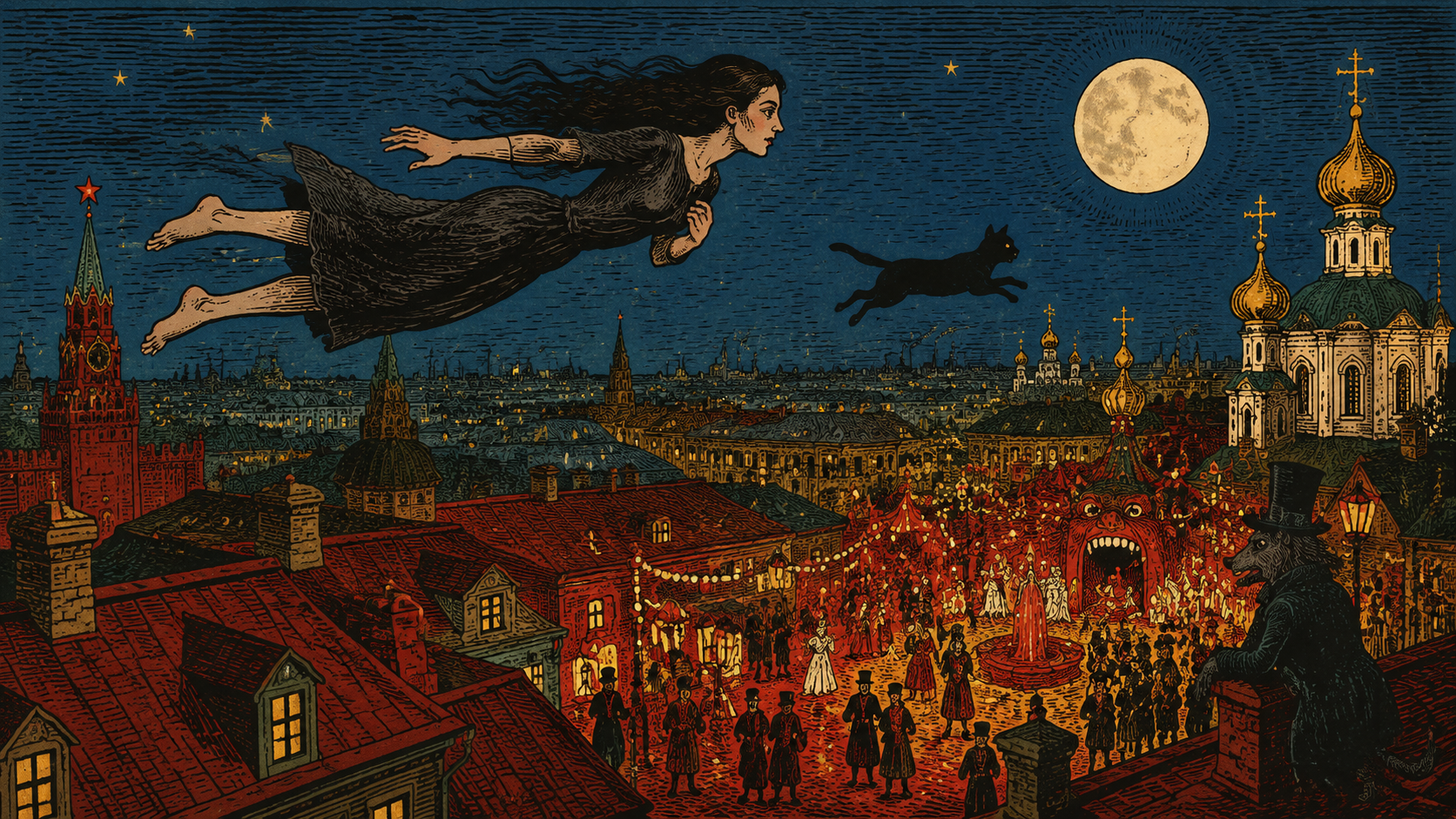
Margarita is the only person who read the Master's manuscript in full before he vanished, and the only one still looking for him. When Woland's retinue finds her and offers her a magic ointment — rub it on and you become a witch, with no way back — she does not even ask what it costs. She takes the deal, because it is the only road back to the Master. She flies over Moscow by night to attend Satan's grand midnight ball for the damned souls of history, and that night is not about pleasure. It is a trial of loyalty in love: is she willing to give up the entire ordinary world for a man with no property, no name, a man who has even given up on himself? Bulgakov deliberately writes this section as lavish, even absurd, because he wants ordinary, seemingly unremarkable love tested on the most outlandish stage imaginable — hauling everyday courage into the spotlight is exactly what reveals its true weight.
Woland grants Margarita her wish. His men steal the Master out of the psychiatric hospital and return the complete manuscript to him, delivering the novel's most famous line: manuscripts don't burn. This is not a religious slogan — it is Bulgakov's verdict on every machine of censorship: you can burn paper, you can burn people, but you cannot burn a truth that has already taken shape. This is the true climax of the novel — not magic, not judgment, but a simple affirmation. A creator who was denied, a love that was denied, both preserved by a force older than denial itself.
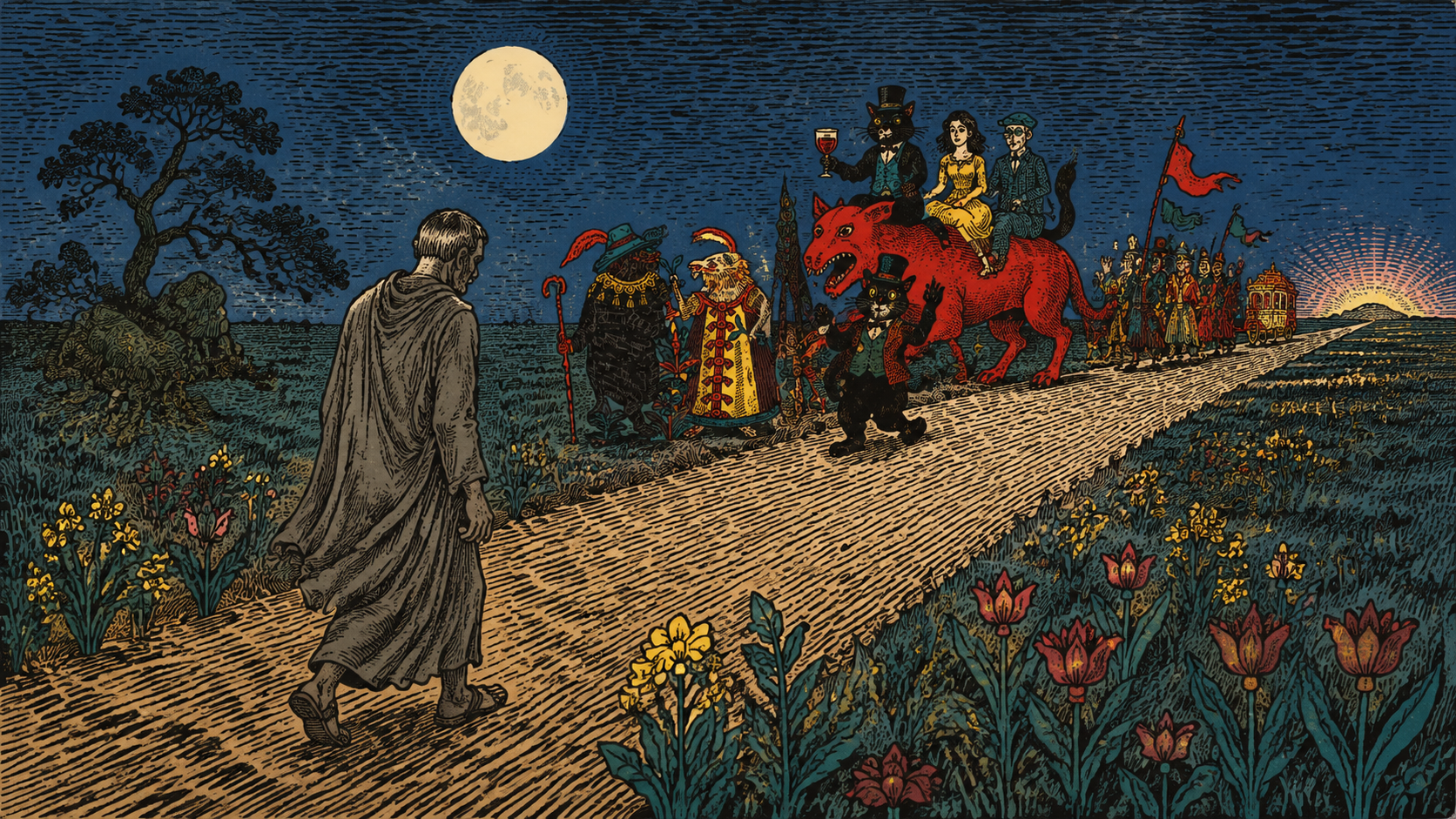
The ending carries a rare tenderness. What Woland gives the Master and Margarita is not victory, is not revenge, is not recognition restored by the world — he gives them a small house under the moonlight, together forever, never to be parted. That same night, Pilate finally receives his pardon, allowed to walk off the moonlit road he has walked for two thousand years, so that the unfinished conversation with Yeshua can continue at last. Bulgakov's choice of peace over light as the final destination is the book's most contrarian move: he never says truth, goodness, and beauty will win over the world. He only says they will find peace. In an age when people dared to be angry but not to speak, that line is already the greatest optimism available — not that the world will get better, but that the part worth protecting was, in the end, protected.
What the book is really saying comes down to only a few things, and none of them are light. Good and evil are not two opposing colors; they generate each other, and neither can exist without the other — the devil does not come to earth to do evil, he comes to strip away the varnish; Pilate kills no one, but he deserves judgment more than a murderer would, because he let go of what he knew was right. Art is never a tool that power can fully control — a manuscript that tells the truth can be torn up, but its destruction cannot be torn out of existence. It is precisely because all three of these are present at once that the book stands as a rare specimen in twentieth-century totalitarian-era literature: bold enough to satirize reality, bold enough to play with the sacred, and able to turn myth into a courtroom — doing all three at once, in one novel, with nothing else quite like it.
For today's readers, it means two things. First, literature remains stubbornly alive even in an age of censorship — every era has its own Woland and its own Berlioz. Second, more personally: you probably have your own torn-up manuscript somewhere inside you, your own swallowed conversation, your own choice you sidestepped out of cowardice. This book will not solve it for you, but it will sit with you through the part you have been afraid to hear.